Soft Skills
Training & Development
Presented By
Sadaf Hublikar
Quality Analyst
Objectives of the Session
To understand the need for communication
To know the different styles of communication
How to become an assertive communicator
The importance of listening and questioning skills
The need for good e-mail etiquette
How to hold effective conversations over the telephone
Common mistakes and blunder we create in English due to
Indianism
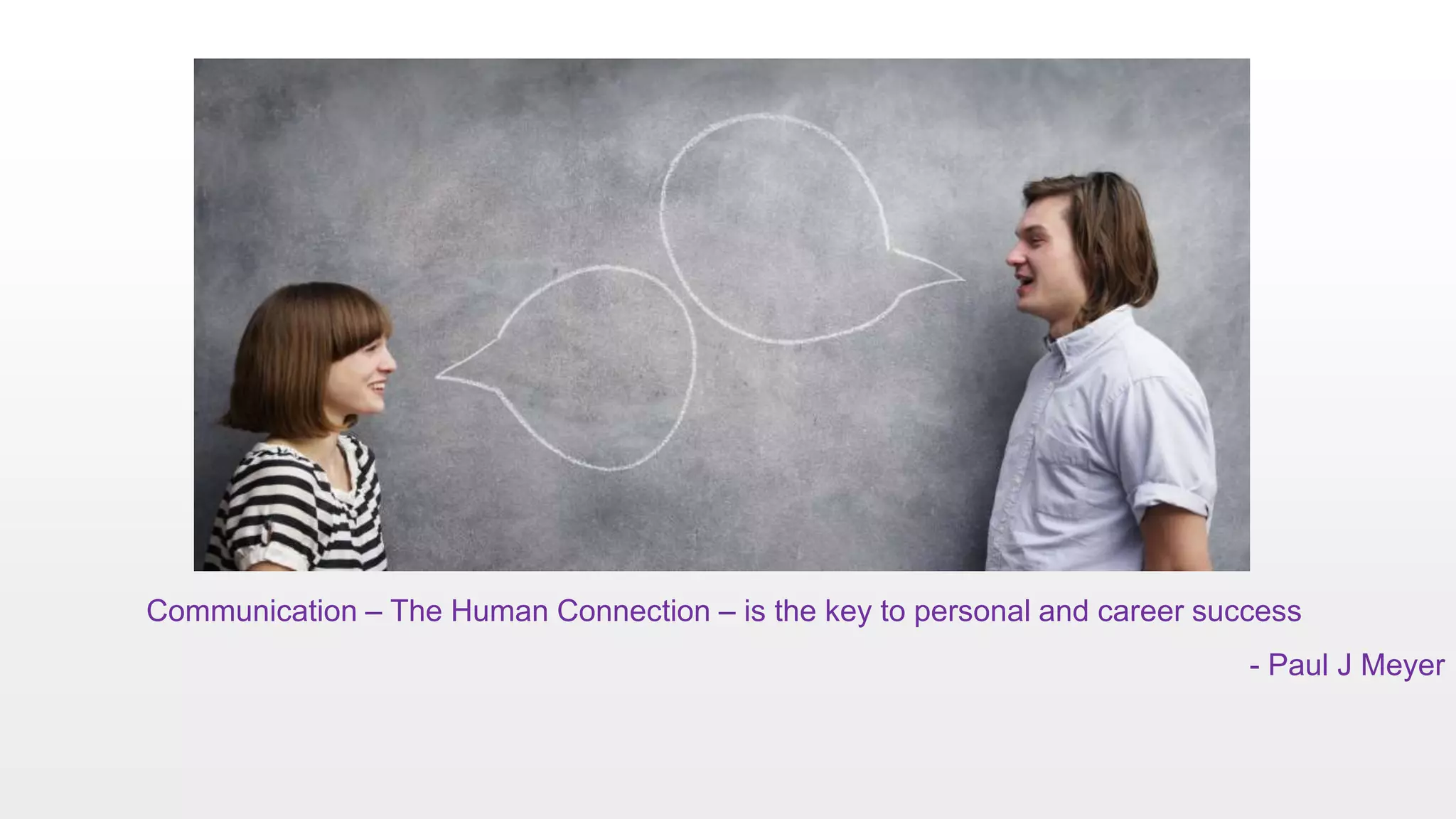
Communication – The Human Connection – is the key to personal and career success
- Paul J Meyer
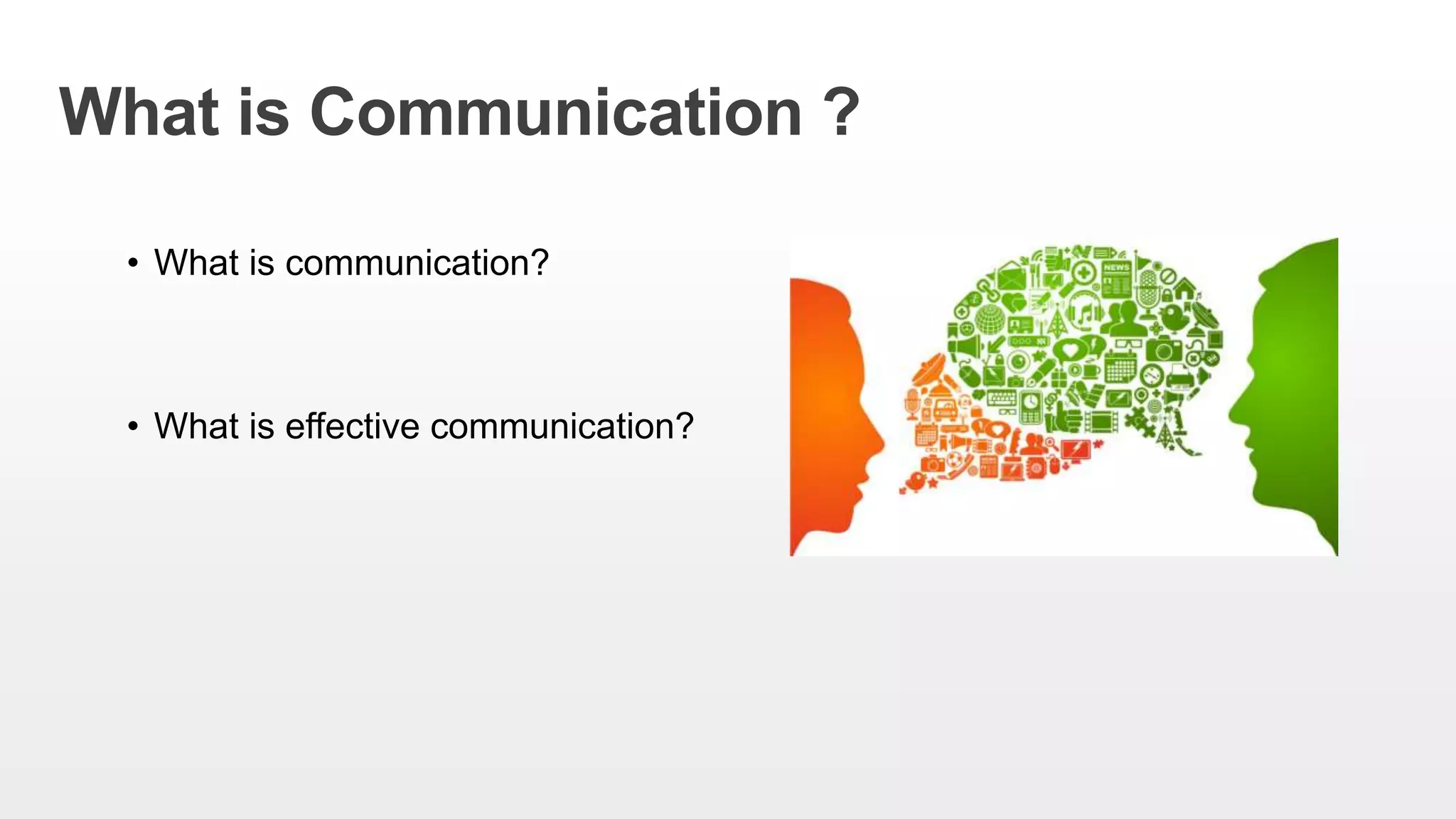
What is Communication ?
• What is communication?
• What is effective communication?
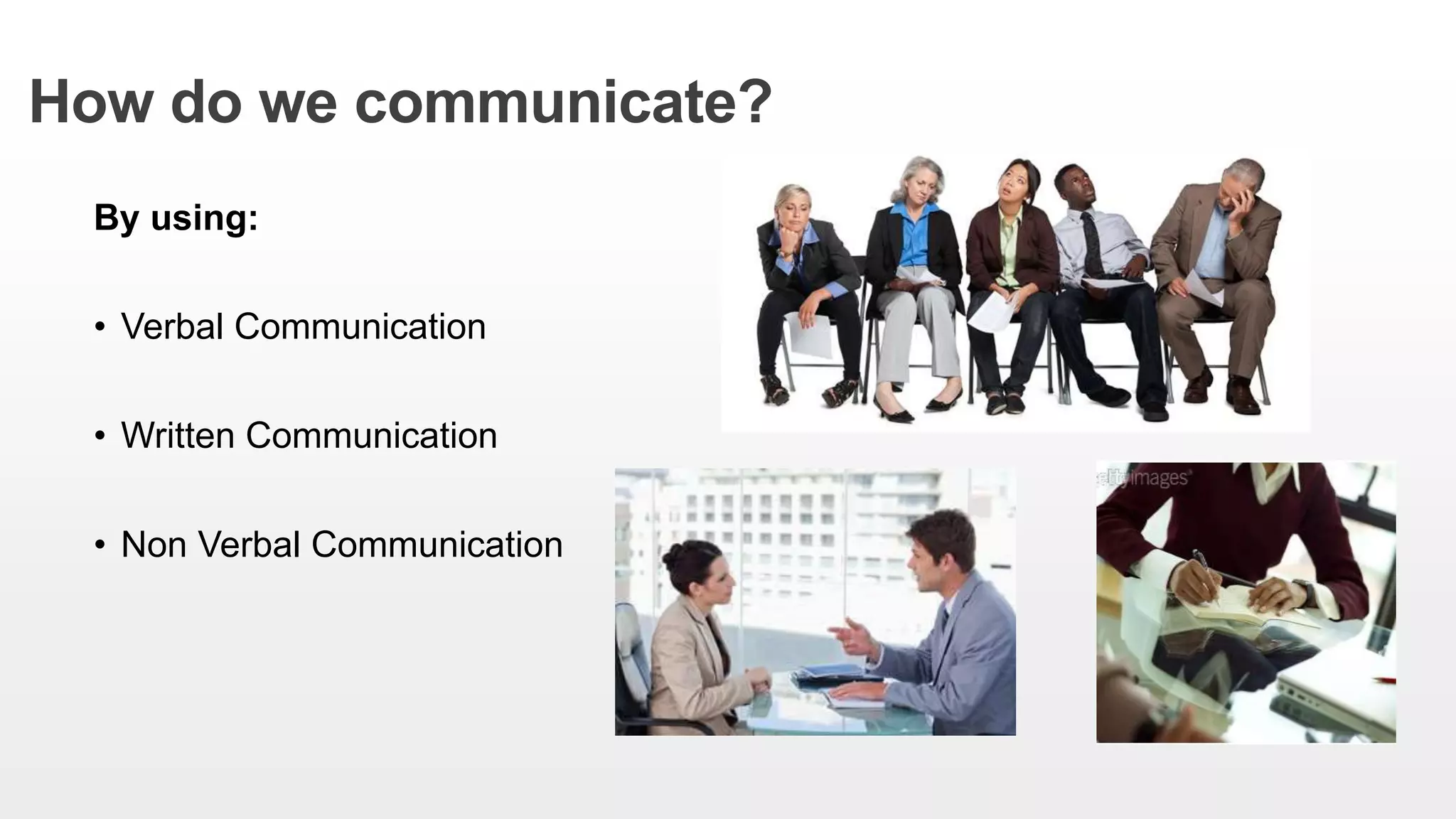
How do we communicate?
By using:
• Verbal Communication
• Written Communication
• Non Verbal Communication
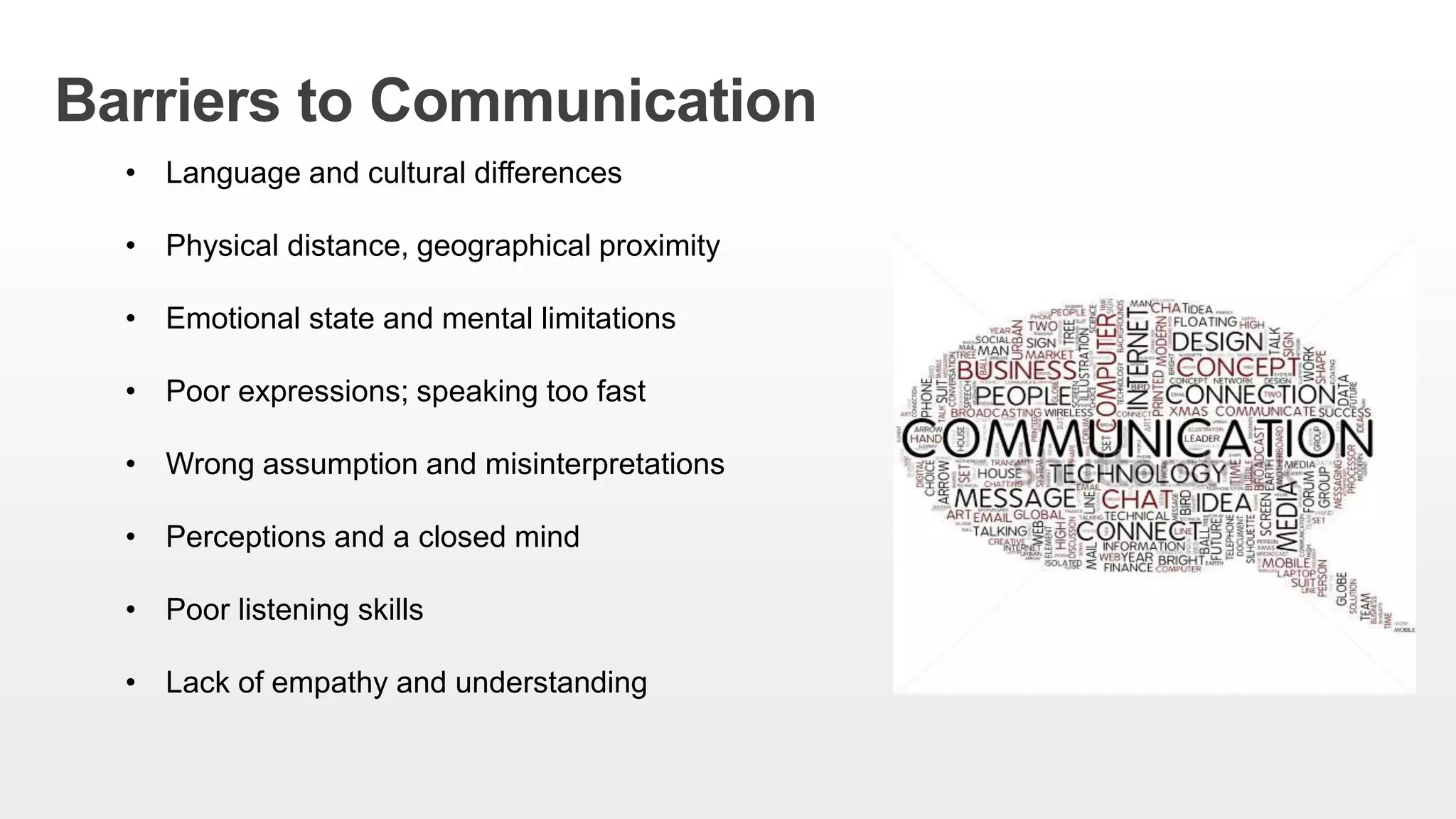
Barriers to Communication
• Language and cultural differences
• Physical distance, geographical proximity
• Emotional state and mental limitations
• Poor expressions; speaking too fast
• Wrong assumption and misinterpretations
• Perceptions and a closed mind
• Poor listening skills
• Lack of empathy and understanding
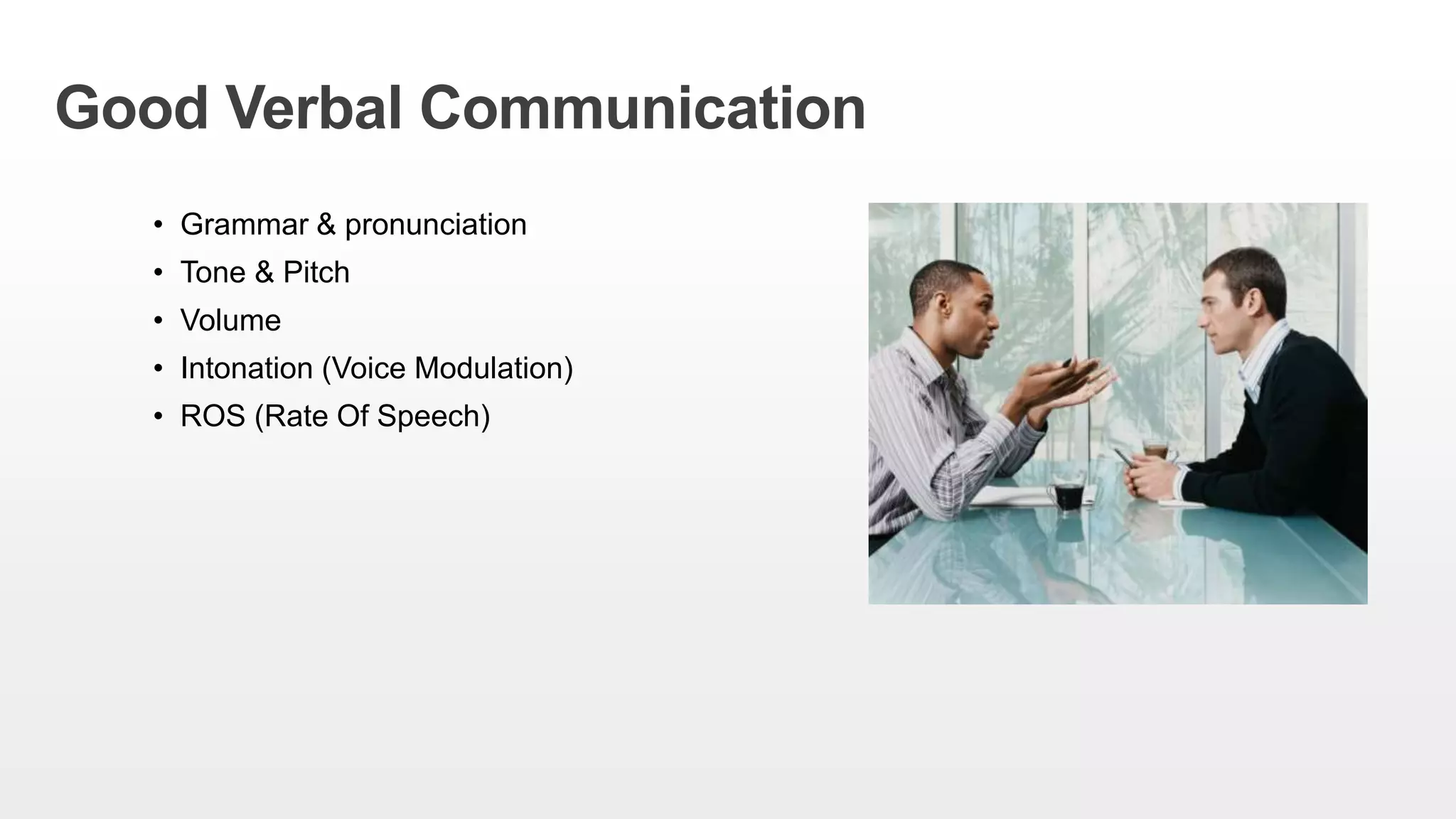
Good Verbal Communication
• Grammar & pronunciation
• Tone & Pitch
• Volume
• Intonation (Voice Modulation)
• ROS (Rate Of Speech)
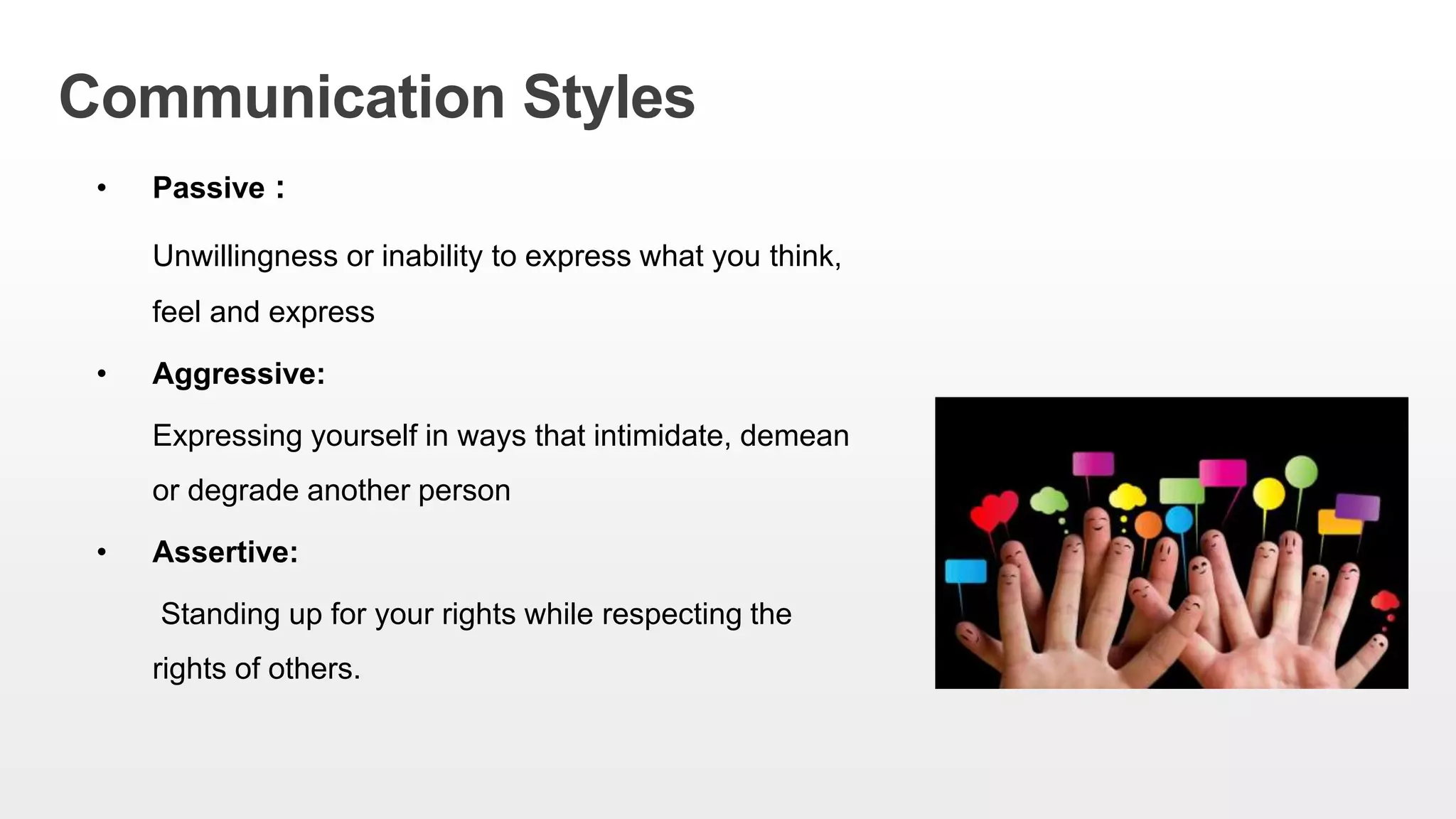
Communication Styles
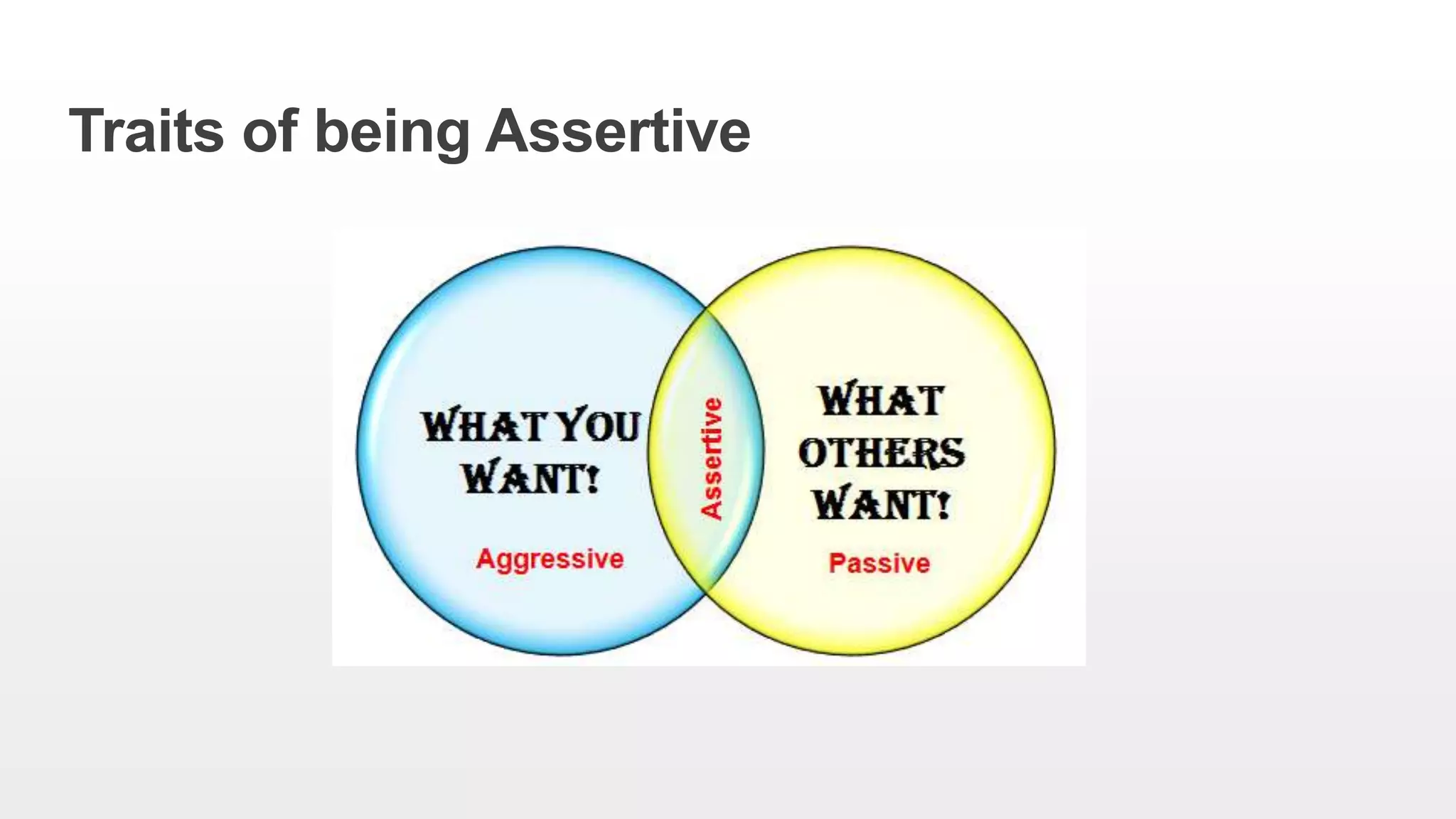
• Passive :
Unwillingness or inability to express what you think,
feel and express
• Aggressive:
Expressing yourself in ways that intimidate, demean
or degrade another person
• Assertive:
Standing up for your rights while respecting the
rights of others.
Traits of being Assertive
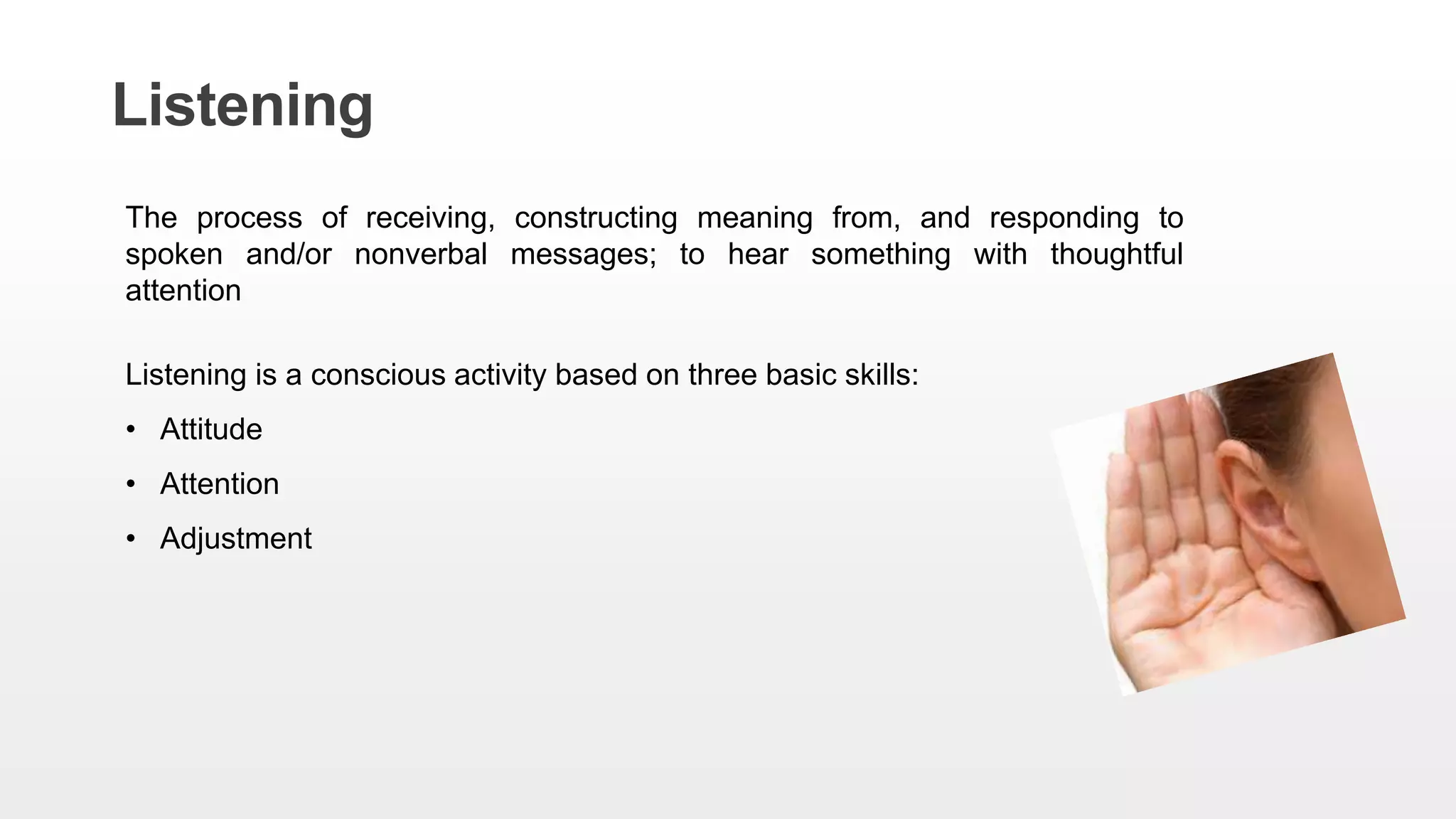
Listening
The process of receiving, constructing meaning from, and responding to
spoken and/or nonverbal messages; to hear something with thoughtful
attention
Listening is a conscious activity based on three basic skills:
• Attitude
• Attention
• Adjustment
How do you show that you are
listening?
L = Look interested
I = Involve yourself by responding
S = Stay Focussed
T = Test your understanding
E = Evaluate the message
N = Neutralise your opinions and feelings
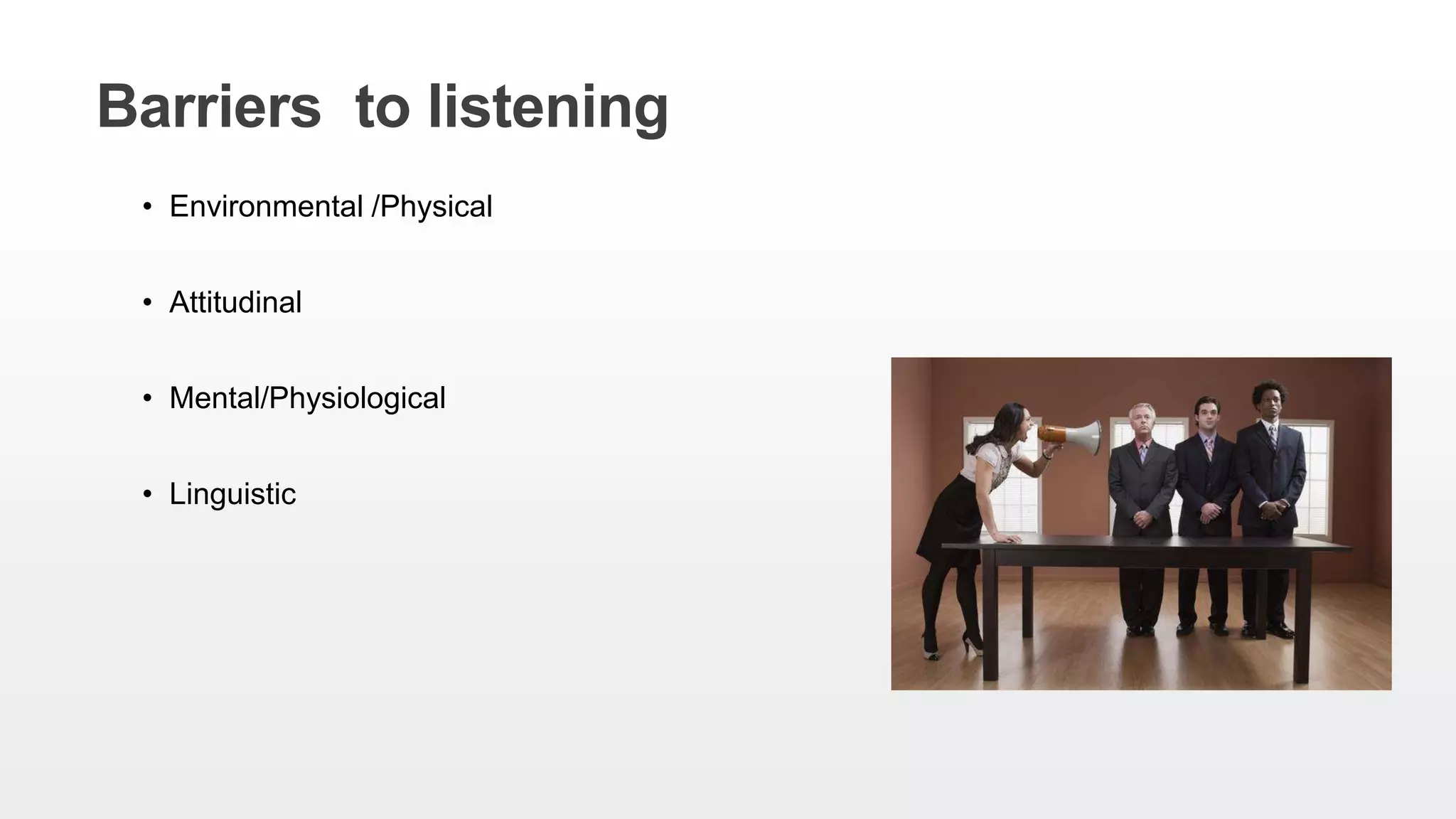
• Environmental /Physical
• Attitudinal
• Mental/Physiological
• Linguistic
Barriers to listening
Probing and Question Technique
Probing means collecting information by asking relevant
questions
Why Probing
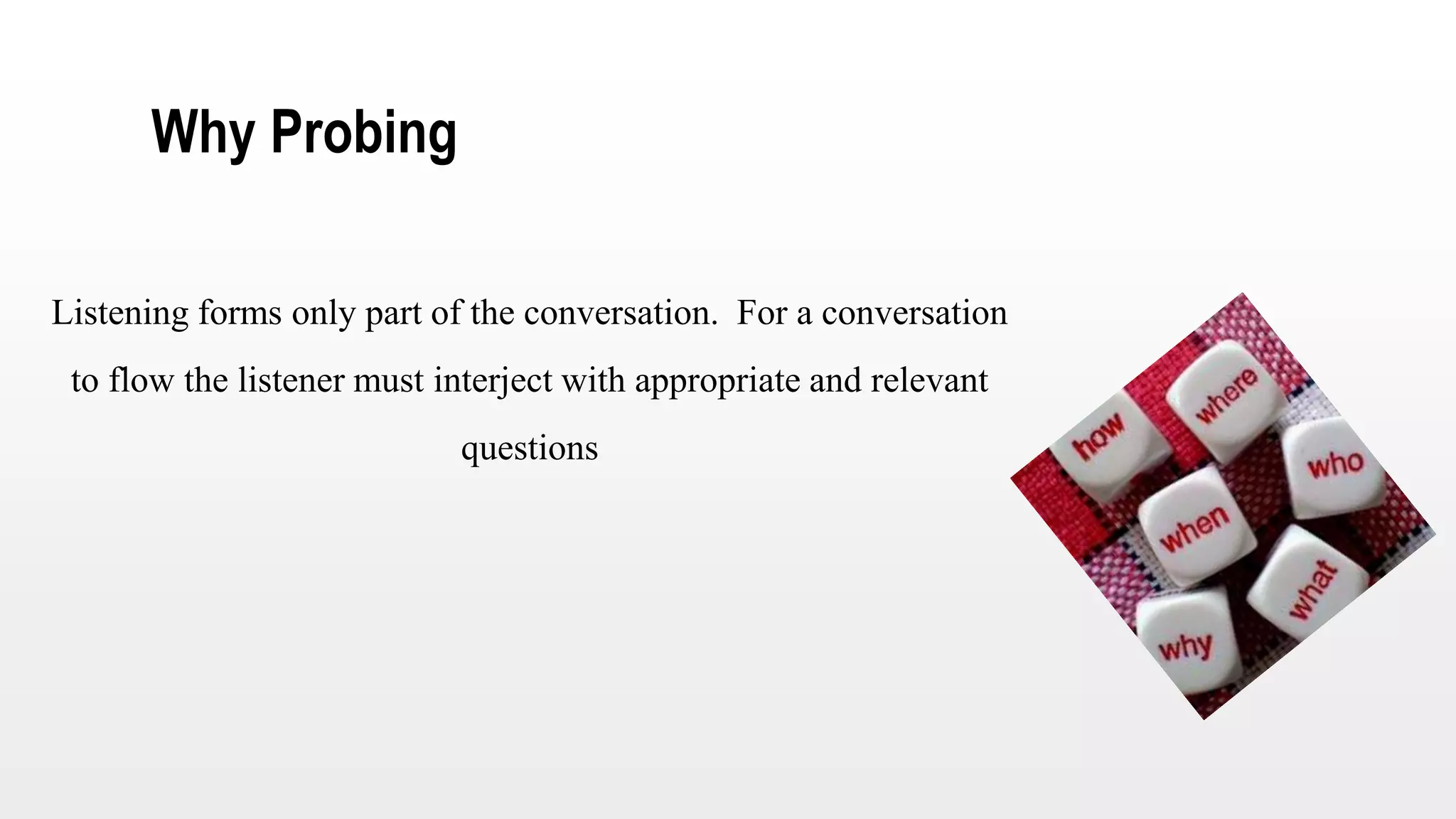
Listening forms only part of the conversation. For a conversation
to flow the listener must interject with appropriate and relevant
questions
Why to do probing
Check customer’s understanding of key
points
 Understand the root cause of concern or
query
Check for mastery of basic concepts
Encourage critical thinking
Stimulate interaction with customer
Open & Closed Ended Questions
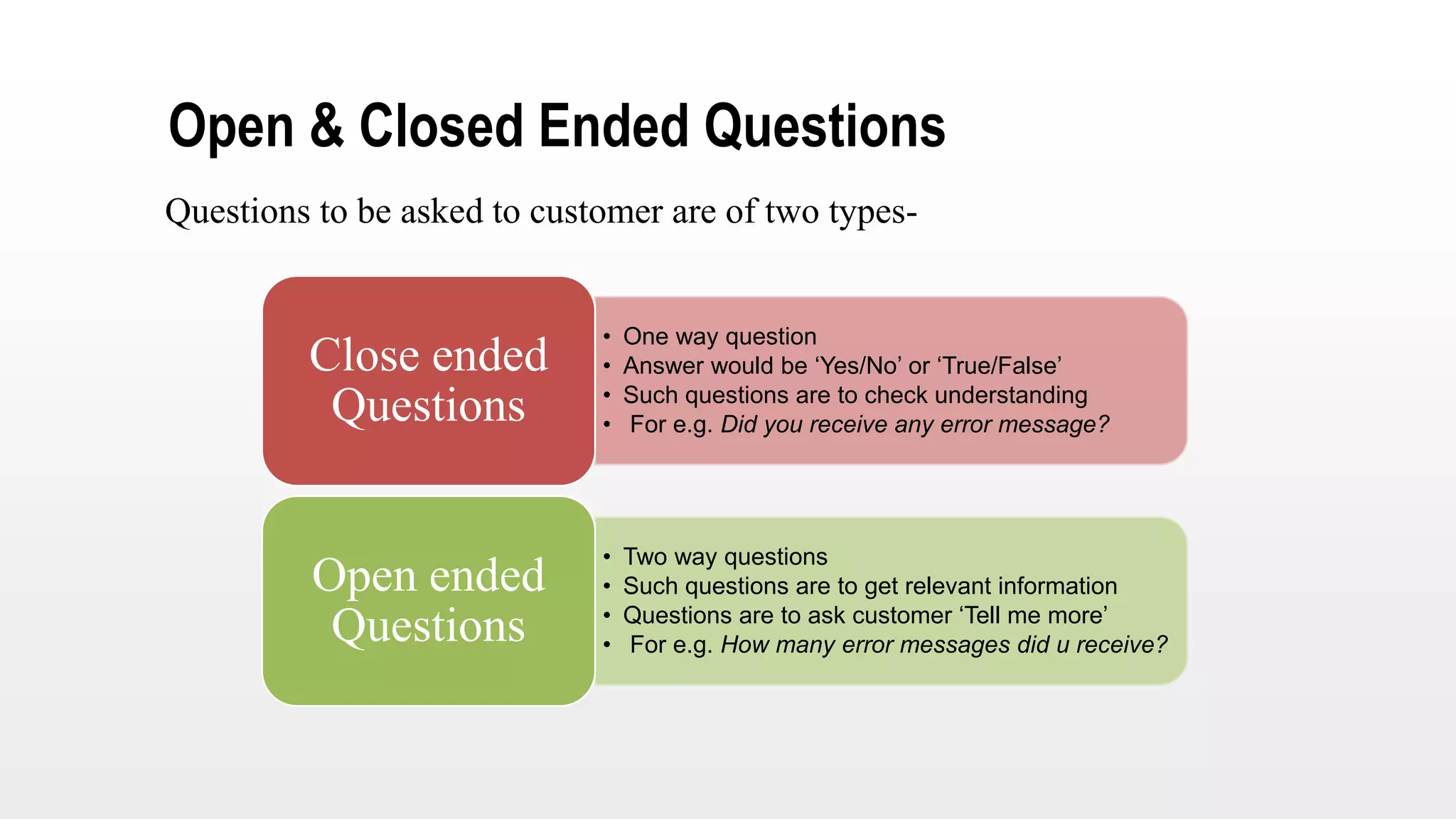
• One way question
• Answer would be ‘Yes/No’ or ‘True/False’
• Such questions are to check understanding
• For e.g. Did you receive any error message?
Close ended
Questions
• Two way questions
• Such questions are to get relevant information
• Questions are to ask customer ‘Tell me more’
• For e.g. How many error messages did u receive?
Open ended
Questions
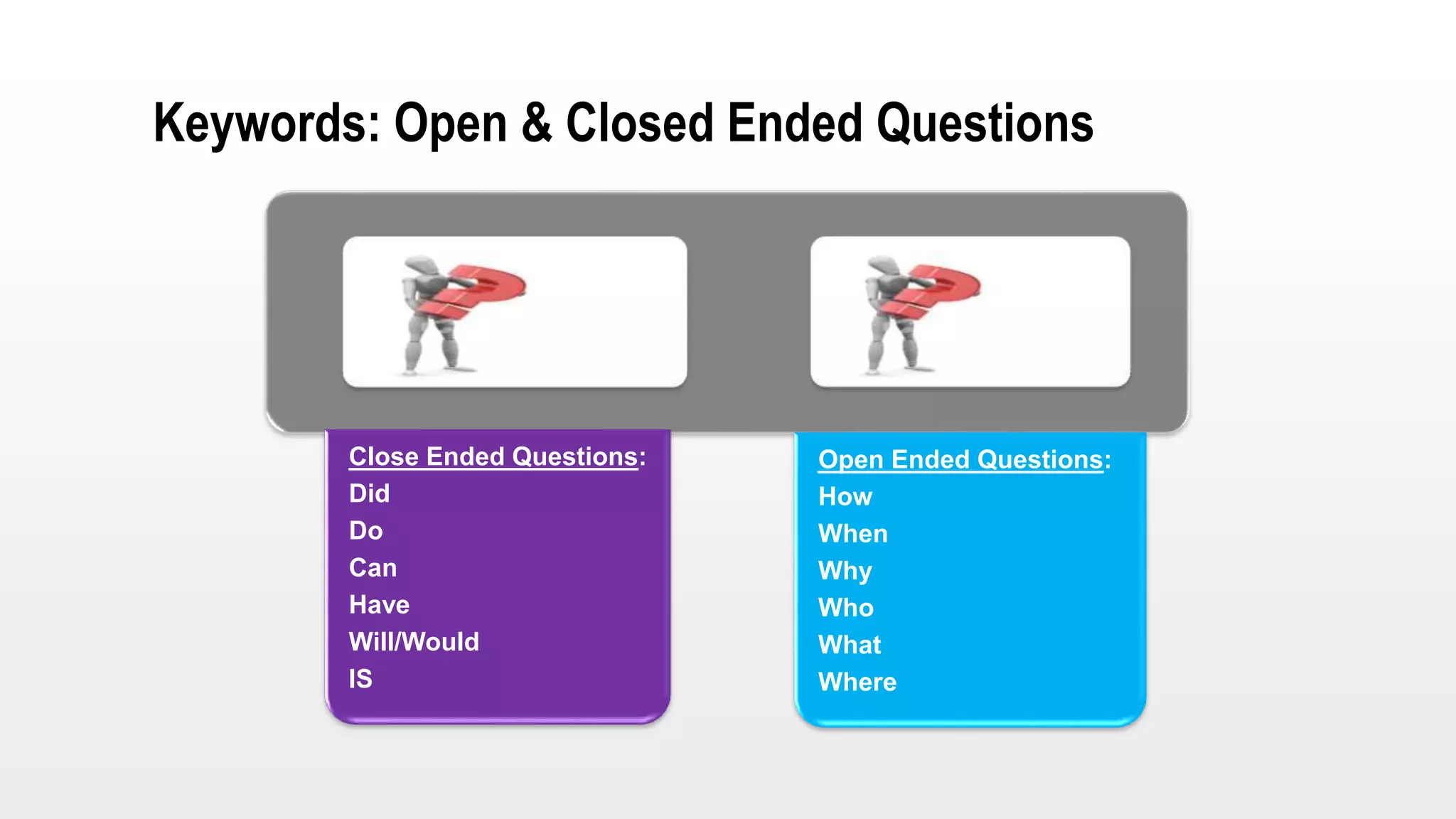
Questions to be asked to customer are of two types-
Close Ended Questions:
Did
Do
Can
Have
Will/Would
IS
Open Ended Questions:
How
When
Why
Who
What
Where
Keywords: Open & Closed Ended Questions
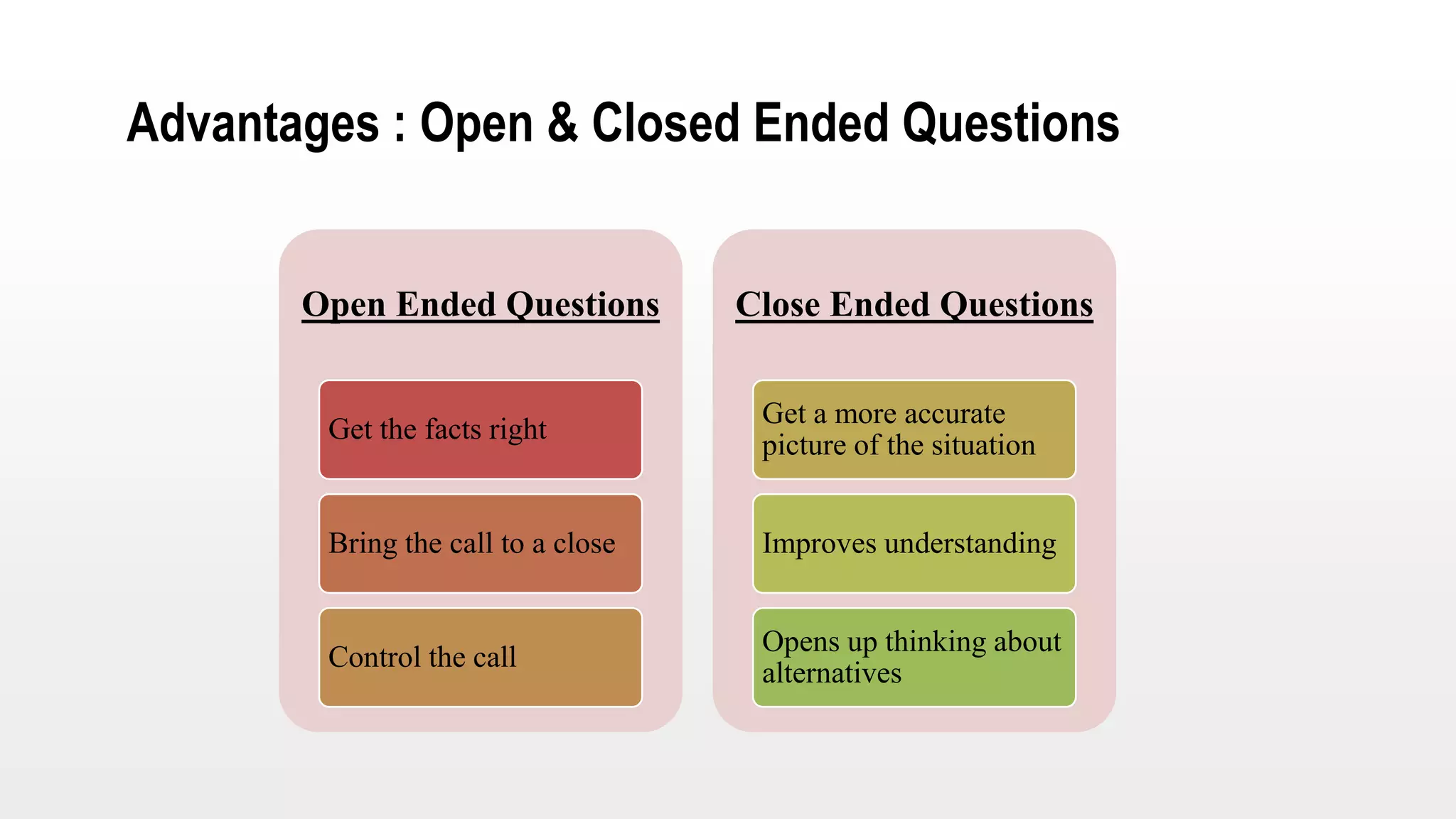
Advantages : Open & Closed Ended Questions
Open Ended Questions
Get the facts right
Bring the call to a close
Control the call
Close Ended Questions
Get a more accurate
picture of the situation
Improves understanding
Opens up thinking about
alternatives
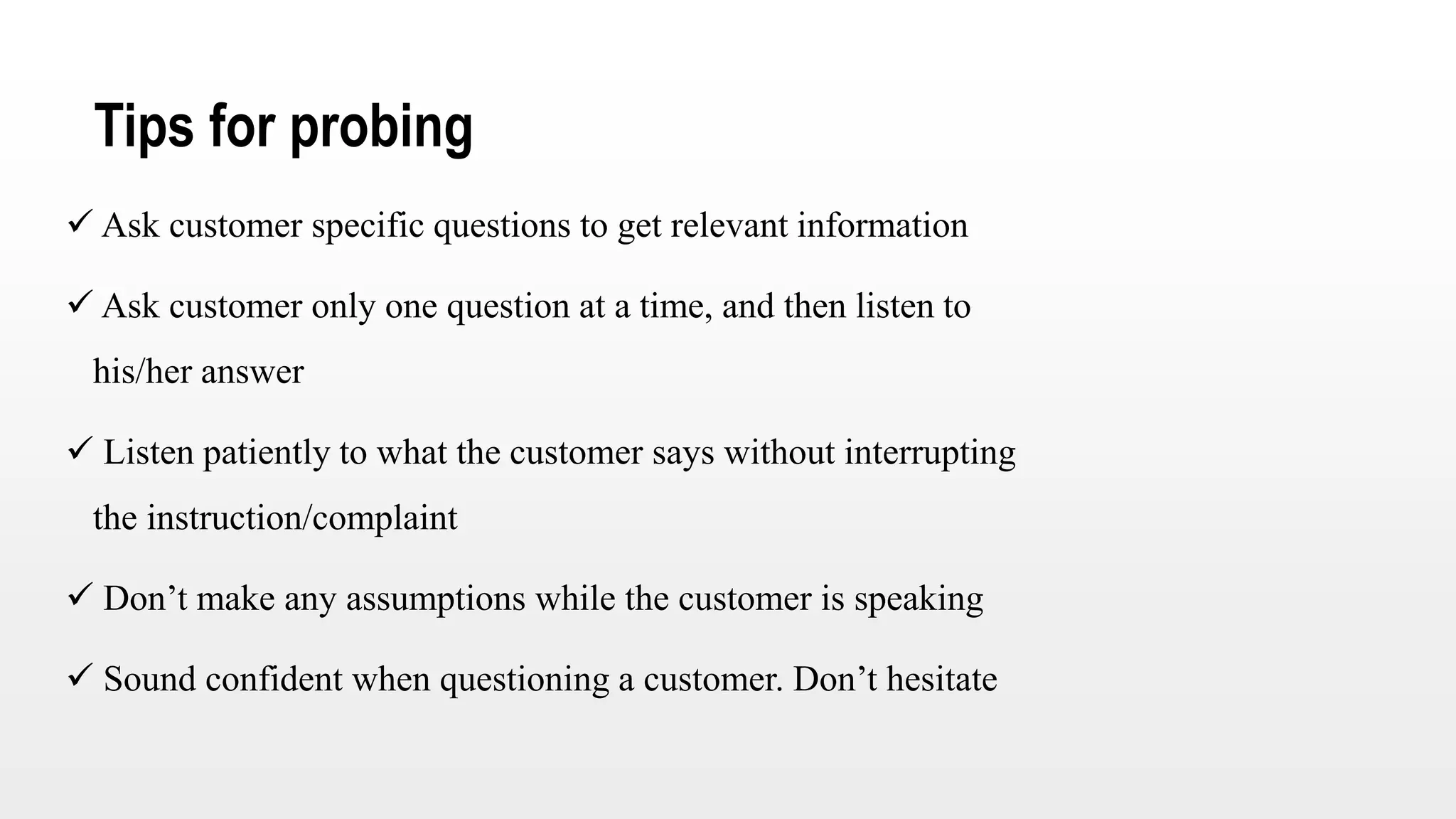
Tips for probing
 Ask customer specific questions to get relevant information
 Ask customer only one question at a time, and then listen to
his/her answer
 Listen patiently to what the customer says without interrupting
the instruction/complaint
 Don’t make any assumptions while the customer is speaking
 Sound confident when questioning a customer. Don’t hesitate
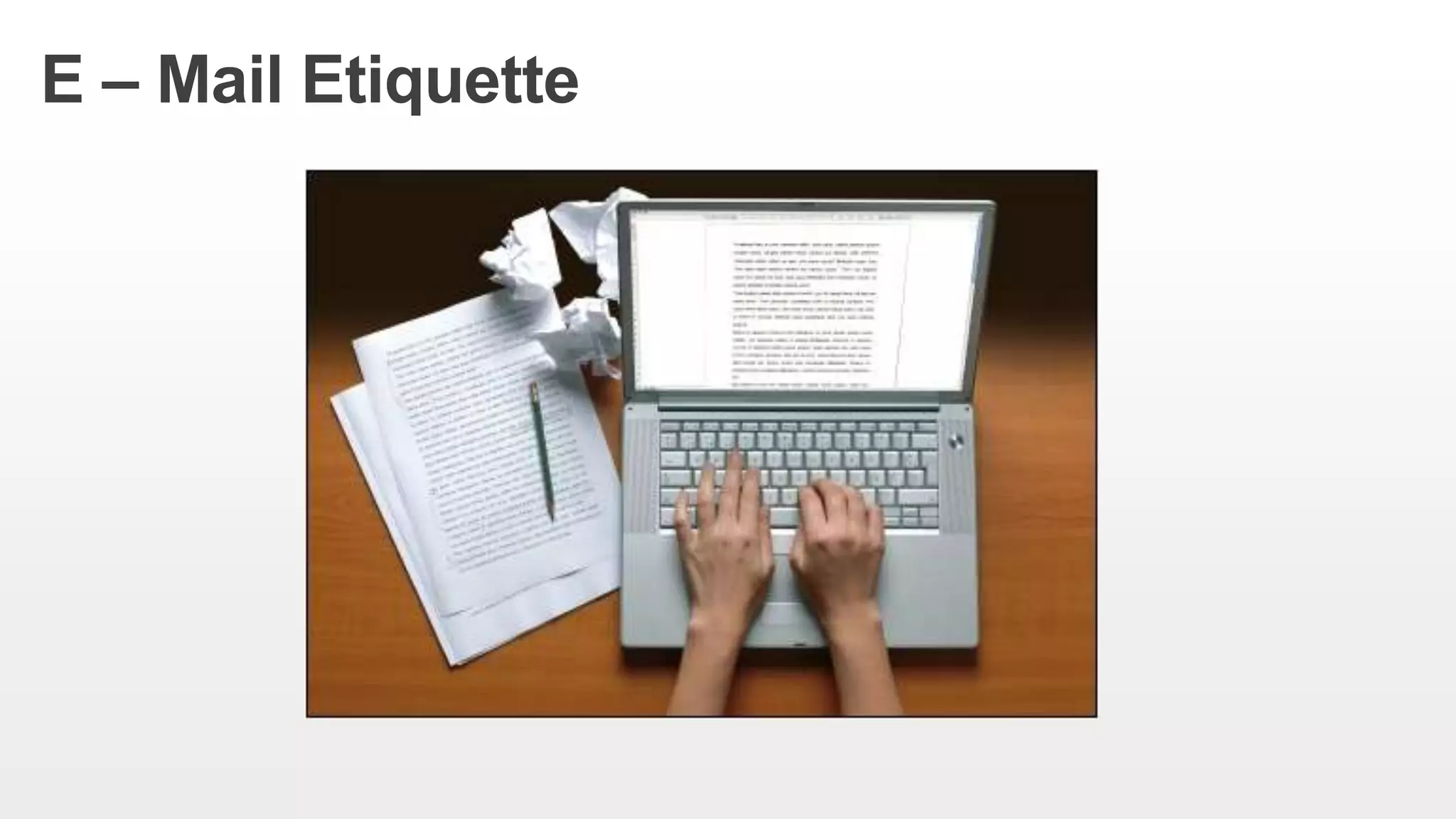
E – Mail Etiquette
Need & Importance of Written
Communication
• A widely used method in the office
• A permanent record of messages
• It is used as a reference or a proof
• It can be precise and detailed depending on how
you use it
• It gives the reader time to “think”
Know your audience
Once the recipient list is decided, take care to:
• Know more about the recipients
• How much do they already know about the content
• Level of detail which needs to be shared with them
• People don’t understand what you think they
understand
Edit
• Unnecessary Points
• Unnecessary Punctuation
• Offensive Language
• Harsh Vocabulary
• Long Sentences
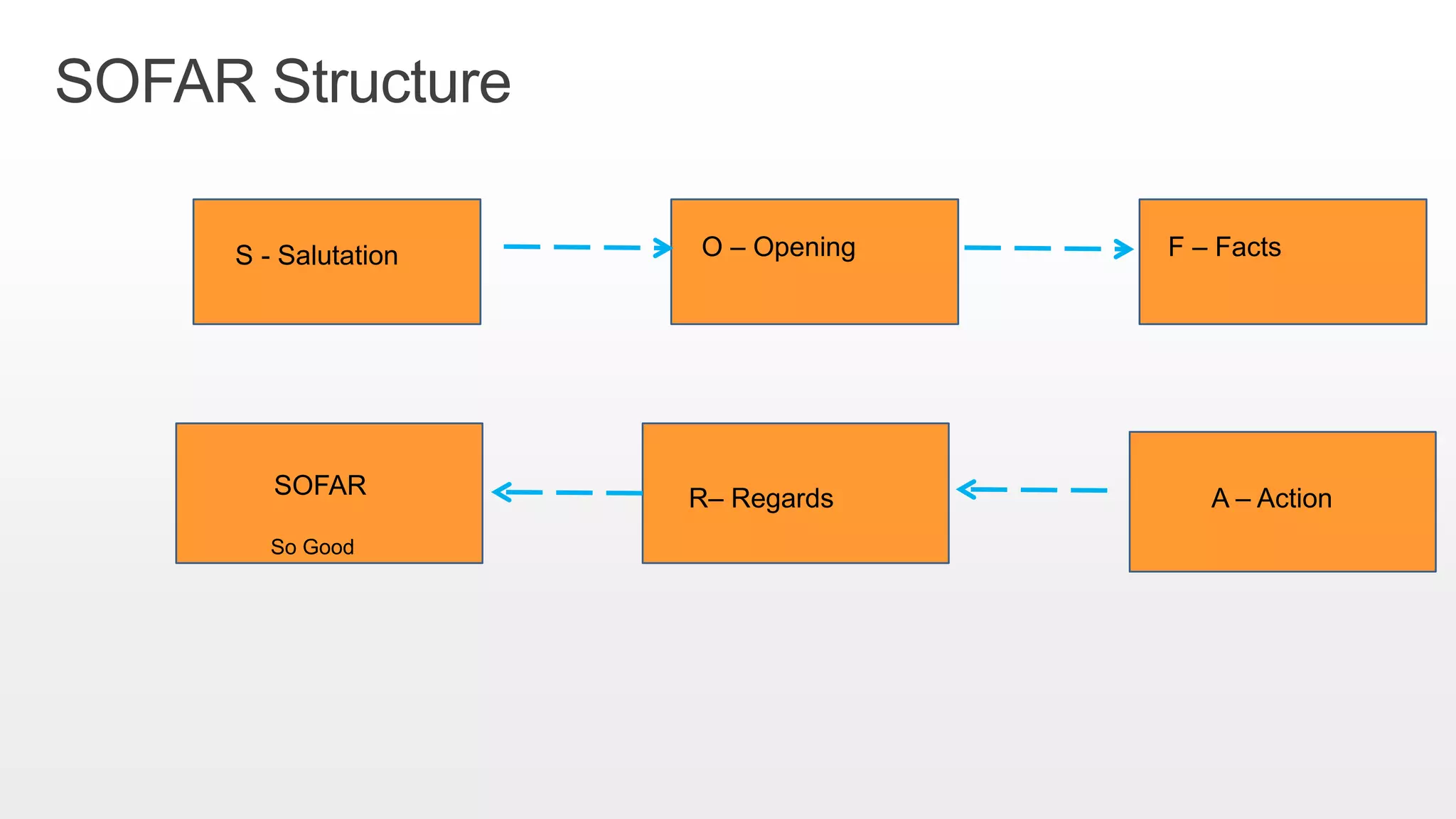
F – Facts
A – Action
SOFAR Structure
S - Salutation O – Opening
R– RegardsSOFAR
So Good
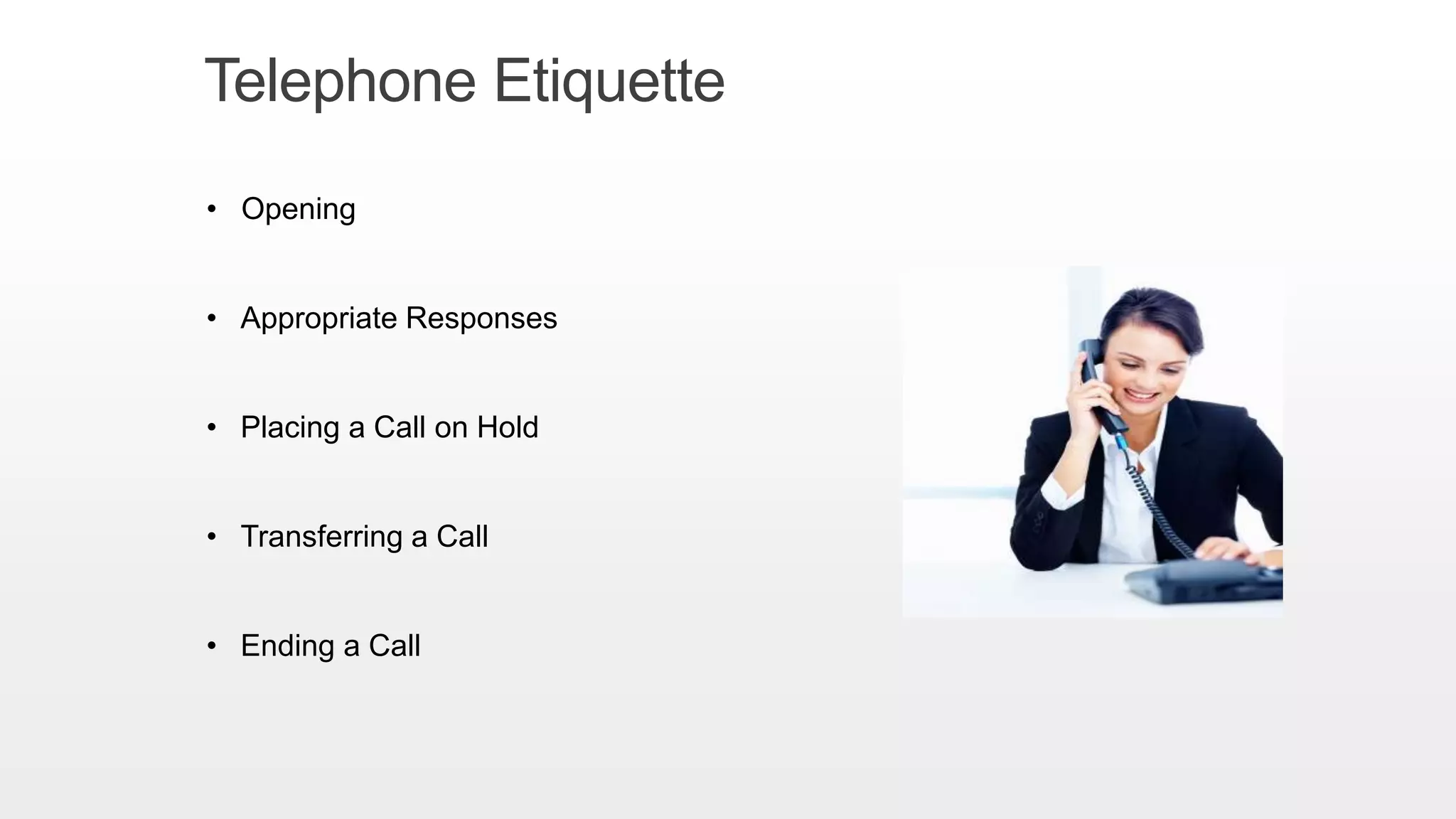
Telephone Etiquette
• Opening
• Appropriate Responses
• Placing a Call on Hold
• Transferring a Call
• Ending a Call
• Answer calls within three rings.
• Greet the caller.
– Identify yourself.
– Identify your company.
– Ask how you can help (In-Bound Calls).
– Ask for time to talk and proceed with the product
information (Out-Bound Calls)
Call Opening
• Placing callers on “hold”:
– Ask if the caller minds being placed on hold.
– Check back with callers so they don’t think you’ve
forgotten them.
– It’s okay if you don’t know the answer immediately.
– If you need to research, provide an estimate of when you
will follow up.
Hold Procedure
Generic Rules for Telephone Etiquette
• Speak clearly and directly into the mouthpiece.
• Do not eat or chew gum while talking on the telephone .
• Focus your attention on the caller.
• Use the caller’s name during the conversation (3-4 times during the call).
• Build rapport with the caller.
• Always be polite.
• Avoid jargon and acronyms.
• Follow the “golden rule.” “Do unto others as you would have them do unto you.”
Questions?
Thank you!

Soft skills

  • 1.
    Soft Skills Training &Development Presented By Sadaf Hublikar Quality Analyst
  • 2.
    Objectives of theSession To understand the need for communication To know the different styles of communication How to become an assertive communicator The importance of listening and questioning skills The need for good e-mail etiquette How to hold effective conversations over the telephone Common mistakes and blunder we create in English due to Indianism
  • 3.
    Communication – TheHuman Connection – is the key to personal and career success - Paul J Meyer
  • 4.
    What is Communication? • What is communication? • What is effective communication?
  • 5.
    How do wecommunicate? By using: • Verbal Communication • Written Communication • Non Verbal Communication
  • 6.
    Barriers to Communication •Language and cultural differences • Physical distance, geographical proximity • Emotional state and mental limitations • Poor expressions; speaking too fast • Wrong assumption and misinterpretations • Perceptions and a closed mind • Poor listening skills • Lack of empathy and understanding
  • 7.
    Good Verbal Communication •Grammar & pronunciation • Tone & Pitch • Volume • Intonation (Voice Modulation) • ROS (Rate Of Speech)
  • 8.
    Communication Styles • Passive: Unwillingness or inability to express what you think, feel and express • Aggressive: Expressing yourself in ways that intimidate, demean or degrade another person • Assertive: Standing up for your rights while respecting the rights of others.
  • 9.
    Traits of beingAssertive
  • 10.
    Listening The process ofreceiving, constructing meaning from, and responding to spoken and/or nonverbal messages; to hear something with thoughtful attention Listening is a conscious activity based on three basic skills: • Attitude • Attention • Adjustment
  • 11.
    How do youshow that you are listening? L = Look interested I = Involve yourself by responding S = Stay Focussed T = Test your understanding E = Evaluate the message N = Neutralise your opinions and feelings
  • 12.
    • Environmental /Physical •Attitudinal • Mental/Physiological • Linguistic Barriers to listening
  • 13.
    Probing and QuestionTechnique Probing means collecting information by asking relevant questions
  • 14.
    Why Probing Listening formsonly part of the conversation. For a conversation to flow the listener must interject with appropriate and relevant questions
  • 15.
    Why to doprobing Check customer’s understanding of key points  Understand the root cause of concern or query Check for mastery of basic concepts Encourage critical thinking Stimulate interaction with customer
  • 16.
    Open & ClosedEnded Questions • One way question • Answer would be ‘Yes/No’ or ‘True/False’ • Such questions are to check understanding • For e.g. Did you receive any error message? Close ended Questions • Two way questions • Such questions are to get relevant information • Questions are to ask customer ‘Tell me more’ • For e.g. How many error messages did u receive? Open ended Questions Questions to be asked to customer are of two types-
  • 17.
    Close Ended Questions: Did Do Can Have Will/Would IS OpenEnded Questions: How When Why Who What Where Keywords: Open & Closed Ended Questions
  • 18.
    Advantages : Open& Closed Ended Questions Open Ended Questions Get the facts right Bring the call to a close Control the call Close Ended Questions Get a more accurate picture of the situation Improves understanding Opens up thinking about alternatives
  • 19.
    Tips for probing Ask customer specific questions to get relevant information  Ask customer only one question at a time, and then listen to his/her answer  Listen patiently to what the customer says without interrupting the instruction/complaint  Don’t make any assumptions while the customer is speaking  Sound confident when questioning a customer. Don’t hesitate
  • 20.
    E – MailEtiquette
  • 21.
    Need & Importanceof Written Communication • A widely used method in the office • A permanent record of messages • It is used as a reference or a proof • It can be precise and detailed depending on how you use it • It gives the reader time to “think”
  • 22.
    Know your audience Oncethe recipient list is decided, take care to: • Know more about the recipients • How much do they already know about the content • Level of detail which needs to be shared with them • People don’t understand what you think they understand
  • 23.
    Edit • Unnecessary Points •Unnecessary Punctuation • Offensive Language • Harsh Vocabulary • Long Sentences
  • 24.
    F – Facts A– Action SOFAR Structure S - Salutation O – Opening R– RegardsSOFAR So Good
  • 25.
    Telephone Etiquette • Opening •Appropriate Responses • Placing a Call on Hold • Transferring a Call • Ending a Call
  • 26.
    • Answer callswithin three rings. • Greet the caller. – Identify yourself. – Identify your company. – Ask how you can help (In-Bound Calls). – Ask for time to talk and proceed with the product information (Out-Bound Calls) Call Opening
  • 27.
    • Placing callerson “hold”: – Ask if the caller minds being placed on hold. – Check back with callers so they don’t think you’ve forgotten them. – It’s okay if you don’t know the answer immediately. – If you need to research, provide an estimate of when you will follow up. Hold Procedure
  • 28.
    Generic Rules forTelephone Etiquette • Speak clearly and directly into the mouthpiece. • Do not eat or chew gum while talking on the telephone . • Focus your attention on the caller. • Use the caller’s name during the conversation (3-4 times during the call). • Build rapport with the caller. • Always be polite. • Avoid jargon and acronyms. • Follow the “golden rule.” “Do unto others as you would have them do unto you.”
  • 29.
  • 30.