WORD EMBEDDING
• Word embedding is a way of representing words as vectors. The main goal of word
embedding is to convert the high dimensional feature space of words into low dimensional
feature vectors by preserving the contextual similarity in the corpus.
• These models are widely used for all NLP problems. It first generates a vocabulary with
the help of a training corpus and then learns the word embedding representations. In
simple words, these models take a text corpus as input and produce the word vectors as
output.
• They can be used as feature vectors for the Machine Learning model, used to measure
text similarity using cosine similarity techniques, words clustering, and text
classification techniques, which we will be discussed in the subsequent part of this
series.
PREDICTION-BASED WORD EMBEDDING
• The popular pre-trained models to create word embedding of a
text are as follows:
• Word2Vec — From Google
• Fast text — From Facebook
• Glove — From Stanford
WHY THESE MODELS ARE CALLED PREDICTION-BASED?
1. These methods were prediction-based as they give the probabilities
to the words.
2. They proved to be state of the art for tasks like word
analogies and word similarities.
3. They were also able to achieve algebraic operations tasks such
as King -man +woman = Queen, which was considered a result
almost magical.
DIFFERENT MODEL ARCHITECTURES FOR WORD
REPRESENTATION
• The following model architectures are used for word representations
with an objective to maximize the accuracy and minimize the
computation complexity:
• FeedForward Neural Net Language Model (NNLM)
• Recurrent Neural Net Language Model (RNNLM)
• For training of the above-mentioned models, we use Stochastic
gradient descent as an optimizer and backpropagation.
FEEDFORWARD NEURAL NET LANGUAGE
MODEL (NNLM)
• This model consists of the following layers:
• Input layer,
• Projection layer,
• Hidden layer, and
• Output layer.
• This architecture becomes complex for computation between the projection and the
hidden layer, as values in the projection layer are dense.
RECURRENT NEURAL NET LANGUAGE
MODEL (RNNLM)
• This model can efficiently represent more complex patterns than the shallow neural
network. This model consists of the following layers:
• Input layer,
• Hidden layer, and
• Output layer.
• To train these models for huge datasets, we will be using a large-scale distributed
framework known as DistBelief, which would give better results.
PROBLEM WITH THESE MODELS
• These models outperform for the huge dataset of words but the main problem in these
models is the computation complexity. So, to overcome the computation complexity, the
Word2Vec uses CBOW and Skip-gram architecture in order to maximize the accuracy
and minimize the computation complexity.
WHAT IS WORD2VEC MODEL?
• Word2Vec model is used for Word representations in Vector Space which is founded by Tomas
Mikolov and a group of the research teams from Google in 2013. It is a neural network model that
attempts to explain the word embeddings based on a text corpus.
• These models work using context. This implies that to learn the embedding, it looks at nearby words;
if a group of words is always found close to the same words, they will end up having similar
embeddings.
• To label how words are similar or close to each other, we first fix the window size, which determines
which nearby words we want to pick.
• For Example, For a window size of 2, implies that for every word, we’ll pick the 2 words behind and
the 2 words after it. Let’s see the following example:
WHAT IS WORD2VEC MODEL?
• Sentence:
• The pink horse is eating
THE GENERAL FLOW OF THE ALGORITHM
• Step-1: Initially, we will assign a vector of random numbers to each word in the corpus.
• Step-2: Then, we will iterate through each word of the document and grab the vectors of the
nearest n-words on either side of our target word, and concatenate all these vectors, and then
forward propagate these concatenated vectors through a linear layer + softmax function, and try
to predict what our target word was.
• Step-3: In this step, we will compute the error between our estimate and the actual target word
and then backpropagated the error and then modifies not only the weights of the linear layer but
also the vectors or embeddings of our neighbor’s words.
• Step-4: Finally, we will extract the weights from the hidden layer and by using these weights
encode the meaning of words in the vocabulary.
WORD2VEC MODEL
• Word2Vec model is not a single algorithm but is composed of the following two
preprocessing modules or techniques:
• Continuous Bag of Words (CBOW)
• Skip-Gram.
• Both of the mentioned models are basically shallow neural networks that map word(s) to
the target variable which is also a word(s). These techniques learn the weights that act
as word vector representations. Both these techniques can be used to implementing
word embedding using word2vec.
WHY WORD2VEC TECHNIQUE IS CREATED?
• As we know that most of the NLP systems treat words as atomic units. In existing systems with the
same purpose as that of word2vec, there is a disadvantage that there is no notion of similarity
between words. Also, those system works for small, simpler data and outperforms on because of
only a few billions of data or less.
• So, In order to train the system with a larger dataset with complex models, these techniques use a
neural network architecture to train complex data models and outperform huge datasets with billions
of words and with vocabulary having millions of words.
• It helps to measure the quality of the resulting vector representations and works with similar words
that tend to close with words that can have multiple degrees of similarity.
• Syntactic Regularities: These regularities refer to grammatical sentence correction.
• Semantic Regularities: These regularities refer to the meaning of the vocabulary symbols arranged in
that structure.
• The proposed technique was found that the similarity of word representations goes beyond syntactic
regularities and works surprisingly well for algebraic operations of word vectors.
Vector(“King”) — Vector(“Man”)+Vector(“Woman”) = Word(“Queen”)
CONTINUOUS BAG OF WORDS (CBOW)
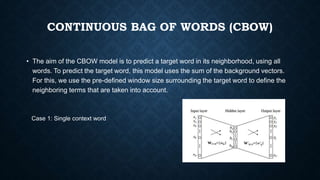
• The aim of the CBOW model is to predict a target word in its neighborhood, using all
words. To predict the target word, this model uses the sum of the background vectors.
For this, we use the pre-defined window size surrounding the target word to define the
neighboring terms that are taken into account.
Case 1: Single context word
CONTINUOUS BAG OF WORDS
(CBOW)
• Firstly, the input layer and the target, both are one-hot encoded of size [1 X V].
• In this model, we have two sets of weights- one is between the input and the hidden layer and the second between the
hidden and output layer.
• Input-Hidden layer matrix size =[V X N], hidden-Output layer matrix size = [N X V]: Where N is an arbitrary size that defines
the size of our embedding space or the number of dimensions that we choose to represent our word in. It is a hyper-
parameter for a Neural Network. Also, N is the number of neurons present in the hidden layer.
• There is no activation function present between any of the layers in the model or More specifically, we can refer to this as a
linear activation.
• The input is multiplied by the weights present between the input and hidden layer and it is known as hidden activation. It
becomes the corresponding row in the input-hidden matrix copied.
• The hidden input gets multiplied by weights present between hidden and output layers and output is computed.
• Then, compute the error between output and target and using that error propagated back to re-adjust the weights upto we
achieve the minimum error.
• So, the weight between the hidden layer and the output layer is taken as the word vector representation of the word.
Case 1: Single context word
CONTINUOUS BAG OF WORDS
(CBOW)
Case-2: Multiple context words
it takes 3 context words and
predicts the probability of a target
word.
CONTINUOUS BAG OF WORDS
(CBOW)
Case-2: Multiple context words
INPUT: The input can be assumed as taking three one-hot encoded vectors in
the input layer as shown above in red, blue, and green.
So, the input layer will have 3 [1 X V] Vectors and we have 1 [1 X V] vector in the
output layer. The rest of the architecture is the same as for a 1-context CBOW.
The above-mentioned steps remain the same but the only thing that changes is
the calculation of hidden activation. Here, instead of just sending the
corresponding rows of the input-hidden weight matrix to the hidden layer, an
average is taken over all the corresponding rows of the matrix. We can
understand this with the above figure. Therefore, the average vector calculated
becomes the hidden activation.
So, if for a single target word we have three context words, then we will have
three initial hidden activations which we are averaged element-wise to obtain the
final activation.
OBJECTIVE FUNCTION OF CBOW MODEL
The objective function in CBOW is the negative log-likelihood of a word given a set of context i.e -
log( p( wo/wi )), where p( wo/wi ) is given as:
CBOW
• Advantages of CBOW:
• 1. Generally, it is supposed to perform superior to deterministic methods due to its
probabilistic nature.
• 2. It does not need to have huge RAM requirements. So, it is low on memory.
• Disadvantages of CBOW:
• 1. CBOW takes the average of the context of a word. For Example, consider the word apple
that can be both a fruit and a company but CBOW takes an average of both the contexts and
places it in between a cluster for fruits and companies.
• 2. If we want to train a CBOW model from scratch, then it can take forever if we not properly
optimized it.
SKIP-GRAM
• 1. Given a word, the Skip-gram model predicts the context.
• 2. Skip–gram follows the same topology as CBOW. It just flips CBOW’s architecture on
its head. Therefore, the skip-gram model is the exact opposite of the CBOW model.
• 3. In this case, the target word is given as the input, the hidden layer remains the same,
and the output layer of the neural network is replicated multiple times to accommodate
the chosen number of context words.
GENERAL STEPS INVOLVED IN THE ALGORITHM
• Let’s the input vector give to a skip-gram is going to be similar to a 1-context CBOW model.
Note that the calculations up to hidden layer activations are going to be the same.
• The difference will be in the target variable. Since we have defined a context window of 1 on
both sides of our target word, we will be getting “two” one-hot encoded target
variables and “two” corresponding outputs which are represented by the blue section in
the below image.
• Then, we compute the two separate errors with respect to the two target variables, and then
we add the two error vectors element-wise to obtain a final error vector which is propagated
back to update the weights until our objective is met.
• Finally, the weights present between the input and the hidden layer are considered as the
word vector representation after training. The loss function or the objective is of the same
type as the CBOW model.
SKIP GRAM MODEL
SKIP GRAM MODEL
•Size of Input layer ——— [1 X V],
•Size of Input hidden weight matrix ———– [V X N],
•Number of neurons present in the hidden layer —— N,
•Size of Hidden-Output weight matrix ——- [N X V],
•Size of Output layer —- C [1 X V]
• C is the number of context words=2, and V= 10, N=4.
SKIP GRAM MODEL
• The red row represents the hidden activation corresponding to the input one-hot encoded vector. It basically represents the corresponding row of
the input-hidden matrix.
• The yellow matrix is the weights present between the hidden layer and the output layer.
• To obtain the blue matrix, we do the matrix multiplication of hidden activation and the hidden output weights, and there will be two rows calculated
for two targets (context) words.
• Then, we convert each row of the blue matrix into its softmax probabilities individually which is shown in the green box.
• Here, the grey matrix describes the one-hot encoded vectors of the two context words i.e, target.
• Error is calculated by subtracting the first row of the grey matrix(target) from the first row of the green matrix(output) element-wise. This is
repeated for the next row. Therefore, if we have n target context words, then we will have n error vectors.
• The element-wise sum is taken over all the error vectors to obtain a final error vector.
• Finally, the calculated error vector is backpropagated to adjust the weights.
ADVANTAGES OF SKIP-GRAM MODEL
• 1. The Skip-gram model can capture two semantics for a single word. i.e two vector
representations for the word Apple. One for the company and the other for the fruit.
• 2. Generally, Skip-gram with negative sub-sampling performs well then every other
method.
• To visualize CBOW and skip-gram in action, the given below is a very excellent
interactive tool. I would suggest you really go through this link for a better understanding.
• Visualize CBOW and Skip-Gram
•

Word_Embedding.pptx

  • 1.
    WORD EMBEDDING • Wordembedding is a way of representing words as vectors. The main goal of word embedding is to convert the high dimensional feature space of words into low dimensional feature vectors by preserving the contextual similarity in the corpus. • These models are widely used for all NLP problems. It first generates a vocabulary with the help of a training corpus and then learns the word embedding representations. In simple words, these models take a text corpus as input and produce the word vectors as output. • They can be used as feature vectors for the Machine Learning model, used to measure text similarity using cosine similarity techniques, words clustering, and text classification techniques, which we will be discussed in the subsequent part of this series.
  • 2.
    PREDICTION-BASED WORD EMBEDDING •The popular pre-trained models to create word embedding of a text are as follows: • Word2Vec — From Google • Fast text — From Facebook • Glove — From Stanford
  • 3.
    WHY THESE MODELSARE CALLED PREDICTION-BASED? 1. These methods were prediction-based as they give the probabilities to the words. 2. They proved to be state of the art for tasks like word analogies and word similarities. 3. They were also able to achieve algebraic operations tasks such as King -man +woman = Queen, which was considered a result almost magical.
  • 4.
    DIFFERENT MODEL ARCHITECTURESFOR WORD REPRESENTATION • The following model architectures are used for word representations with an objective to maximize the accuracy and minimize the computation complexity: • FeedForward Neural Net Language Model (NNLM) • Recurrent Neural Net Language Model (RNNLM) • For training of the above-mentioned models, we use Stochastic gradient descent as an optimizer and backpropagation.
  • 5.
    FEEDFORWARD NEURAL NETLANGUAGE MODEL (NNLM) • This model consists of the following layers: • Input layer, • Projection layer, • Hidden layer, and • Output layer. • This architecture becomes complex for computation between the projection and the hidden layer, as values in the projection layer are dense.
  • 6.
    RECURRENT NEURAL NETLANGUAGE MODEL (RNNLM) • This model can efficiently represent more complex patterns than the shallow neural network. This model consists of the following layers: • Input layer, • Hidden layer, and • Output layer. • To train these models for huge datasets, we will be using a large-scale distributed framework known as DistBelief, which would give better results.
  • 7.
    PROBLEM WITH THESEMODELS • These models outperform for the huge dataset of words but the main problem in these models is the computation complexity. So, to overcome the computation complexity, the Word2Vec uses CBOW and Skip-gram architecture in order to maximize the accuracy and minimize the computation complexity.
  • 8.
    WHAT IS WORD2VECMODEL? • Word2Vec model is used for Word representations in Vector Space which is founded by Tomas Mikolov and a group of the research teams from Google in 2013. It is a neural network model that attempts to explain the word embeddings based on a text corpus. • These models work using context. This implies that to learn the embedding, it looks at nearby words; if a group of words is always found close to the same words, they will end up having similar embeddings. • To label how words are similar or close to each other, we first fix the window size, which determines which nearby words we want to pick. • For Example, For a window size of 2, implies that for every word, we’ll pick the 2 words behind and the 2 words after it. Let’s see the following example:
  • 9.
    WHAT IS WORD2VECMODEL? • Sentence: • The pink horse is eating
  • 10.
    THE GENERAL FLOWOF THE ALGORITHM • Step-1: Initially, we will assign a vector of random numbers to each word in the corpus. • Step-2: Then, we will iterate through each word of the document and grab the vectors of the nearest n-words on either side of our target word, and concatenate all these vectors, and then forward propagate these concatenated vectors through a linear layer + softmax function, and try to predict what our target word was. • Step-3: In this step, we will compute the error between our estimate and the actual target word and then backpropagated the error and then modifies not only the weights of the linear layer but also the vectors or embeddings of our neighbor’s words. • Step-4: Finally, we will extract the weights from the hidden layer and by using these weights encode the meaning of words in the vocabulary.
  • 11.
    WORD2VEC MODEL • Word2Vecmodel is not a single algorithm but is composed of the following two preprocessing modules or techniques: • Continuous Bag of Words (CBOW) • Skip-Gram. • Both of the mentioned models are basically shallow neural networks that map word(s) to the target variable which is also a word(s). These techniques learn the weights that act as word vector representations. Both these techniques can be used to implementing word embedding using word2vec.
  • 12.
    WHY WORD2VEC TECHNIQUEIS CREATED? • As we know that most of the NLP systems treat words as atomic units. In existing systems with the same purpose as that of word2vec, there is a disadvantage that there is no notion of similarity between words. Also, those system works for small, simpler data and outperforms on because of only a few billions of data or less. • So, In order to train the system with a larger dataset with complex models, these techniques use a neural network architecture to train complex data models and outperform huge datasets with billions of words and with vocabulary having millions of words. • It helps to measure the quality of the resulting vector representations and works with similar words that tend to close with words that can have multiple degrees of similarity. • Syntactic Regularities: These regularities refer to grammatical sentence correction. • Semantic Regularities: These regularities refer to the meaning of the vocabulary symbols arranged in that structure. • The proposed technique was found that the similarity of word representations goes beyond syntactic regularities and works surprisingly well for algebraic operations of word vectors. Vector(“King”) — Vector(“Man”)+Vector(“Woman”) = Word(“Queen”)
  • 13.
    CONTINUOUS BAG OFWORDS (CBOW) • The aim of the CBOW model is to predict a target word in its neighborhood, using all words. To predict the target word, this model uses the sum of the background vectors. For this, we use the pre-defined window size surrounding the target word to define the neighboring terms that are taken into account. Case 1: Single context word
  • 14.
    CONTINUOUS BAG OFWORDS (CBOW) • Firstly, the input layer and the target, both are one-hot encoded of size [1 X V]. • In this model, we have two sets of weights- one is between the input and the hidden layer and the second between the hidden and output layer. • Input-Hidden layer matrix size =[V X N], hidden-Output layer matrix size = [N X V]: Where N is an arbitrary size that defines the size of our embedding space or the number of dimensions that we choose to represent our word in. It is a hyper- parameter for a Neural Network. Also, N is the number of neurons present in the hidden layer. • There is no activation function present between any of the layers in the model or More specifically, we can refer to this as a linear activation. • The input is multiplied by the weights present between the input and hidden layer and it is known as hidden activation. It becomes the corresponding row in the input-hidden matrix copied. • The hidden input gets multiplied by weights present between hidden and output layers and output is computed. • Then, compute the error between output and target and using that error propagated back to re-adjust the weights upto we achieve the minimum error. • So, the weight between the hidden layer and the output layer is taken as the word vector representation of the word. Case 1: Single context word
  • 15.
    CONTINUOUS BAG OFWORDS (CBOW) Case-2: Multiple context words it takes 3 context words and predicts the probability of a target word.
  • 16.
    CONTINUOUS BAG OFWORDS (CBOW) Case-2: Multiple context words INPUT: The input can be assumed as taking three one-hot encoded vectors in the input layer as shown above in red, blue, and green. So, the input layer will have 3 [1 X V] Vectors and we have 1 [1 X V] vector in the output layer. The rest of the architecture is the same as for a 1-context CBOW. The above-mentioned steps remain the same but the only thing that changes is the calculation of hidden activation. Here, instead of just sending the corresponding rows of the input-hidden weight matrix to the hidden layer, an average is taken over all the corresponding rows of the matrix. We can understand this with the above figure. Therefore, the average vector calculated becomes the hidden activation. So, if for a single target word we have three context words, then we will have three initial hidden activations which we are averaged element-wise to obtain the final activation.
  • 17.
    OBJECTIVE FUNCTION OFCBOW MODEL The objective function in CBOW is the negative log-likelihood of a word given a set of context i.e - log( p( wo/wi )), where p( wo/wi ) is given as:
  • 18.
    CBOW • Advantages ofCBOW: • 1. Generally, it is supposed to perform superior to deterministic methods due to its probabilistic nature. • 2. It does not need to have huge RAM requirements. So, it is low on memory. • Disadvantages of CBOW: • 1. CBOW takes the average of the context of a word. For Example, consider the word apple that can be both a fruit and a company but CBOW takes an average of both the contexts and places it in between a cluster for fruits and companies. • 2. If we want to train a CBOW model from scratch, then it can take forever if we not properly optimized it.
  • 19.
    SKIP-GRAM • 1. Givena word, the Skip-gram model predicts the context. • 2. Skip–gram follows the same topology as CBOW. It just flips CBOW’s architecture on its head. Therefore, the skip-gram model is the exact opposite of the CBOW model. • 3. In this case, the target word is given as the input, the hidden layer remains the same, and the output layer of the neural network is replicated multiple times to accommodate the chosen number of context words.
  • 20.
    GENERAL STEPS INVOLVEDIN THE ALGORITHM • Let’s the input vector give to a skip-gram is going to be similar to a 1-context CBOW model. Note that the calculations up to hidden layer activations are going to be the same. • The difference will be in the target variable. Since we have defined a context window of 1 on both sides of our target word, we will be getting “two” one-hot encoded target variables and “two” corresponding outputs which are represented by the blue section in the below image. • Then, we compute the two separate errors with respect to the two target variables, and then we add the two error vectors element-wise to obtain a final error vector which is propagated back to update the weights until our objective is met. • Finally, the weights present between the input and the hidden layer are considered as the word vector representation after training. The loss function or the objective is of the same type as the CBOW model.
  • 21.
  • 22.
    SKIP GRAM MODEL •Sizeof Input layer ——— [1 X V], •Size of Input hidden weight matrix ———– [V X N], •Number of neurons present in the hidden layer —— N, •Size of Hidden-Output weight matrix ——- [N X V], •Size of Output layer —- C [1 X V] • C is the number of context words=2, and V= 10, N=4.
  • 23.
    SKIP GRAM MODEL •The red row represents the hidden activation corresponding to the input one-hot encoded vector. It basically represents the corresponding row of the input-hidden matrix. • The yellow matrix is the weights present between the hidden layer and the output layer. • To obtain the blue matrix, we do the matrix multiplication of hidden activation and the hidden output weights, and there will be two rows calculated for two targets (context) words. • Then, we convert each row of the blue matrix into its softmax probabilities individually which is shown in the green box. • Here, the grey matrix describes the one-hot encoded vectors of the two context words i.e, target. • Error is calculated by subtracting the first row of the grey matrix(target) from the first row of the green matrix(output) element-wise. This is repeated for the next row. Therefore, if we have n target context words, then we will have n error vectors. • The element-wise sum is taken over all the error vectors to obtain a final error vector. • Finally, the calculated error vector is backpropagated to adjust the weights.
  • 24.
    ADVANTAGES OF SKIP-GRAMMODEL • 1. The Skip-gram model can capture two semantics for a single word. i.e two vector representations for the word Apple. One for the company and the other for the fruit. • 2. Generally, Skip-gram with negative sub-sampling performs well then every other method. • To visualize CBOW and skip-gram in action, the given below is a very excellent interactive tool. I would suggest you really go through this link for a better understanding. • Visualize CBOW and Skip-Gram •