Language Model (N-Gram)
Suriandi Jayakrista S.T.,M.T.
Kalbis Institute
N-gram
• Model probabilistik N-gram, merupakan model yang digunakan untuk
memprediksi kata berikutnya yang mungkin dari kata N-1 sebelumnya. Model
statistika dari urutan kata ini seringkali disebut juga sebagai model bahasa
(language models / LMs).
• Model estimasi seperti N-gram memberikan probabilitas kemungkinan pada
kata berikutnya yang mungkin dapat digunakan untuk melakukan
kemungkinan penggabungan pada keseluruhan kalimat. Model N-
gram merupakan model yang paling penting dalam pemrosesan suara
ataupun bahasa baik untuk memperkirakan probabilitas kata berikutnya
maupun keseluruhan sequence.
• N-Grams ini akan mengambil sejumlah kata yang kita butuhkan
dari sebuah kalimat. Seperti contohnya kalimat “Fahmi adalah
anak yang rajin”, maka bentuk N-Grams dari kalimat tersebut
adalah :
1.Unigram : Fahmi, adalah, anak, yang, rajin
2.Bigram : Fahmi adalah, adalah anak, anak yang, yang rajin
3.Trigram : Fahmi adalah anak, anak yang rajin
4.dst.
What is an N-gram?
• An n-gram is a subsequence of n items from a given sequence.
• Unigram: n-gram of size 1
• Bigram: n-gram of size 2
• Trigram: n-gram of size 3
• Item:
• Phonemes
• Syllables
• Letters
• Words
• Anything else depending on the application.
Example
the dog smelled like a skunk
• Bigram:
• "# the”, “the dog”, “dog smelled”, “ smelled like”, “like a”, “a skunk”, “skunk#”
• Trigram:
• "# the dog", "the dog smelled", "dog smelled like", "smelled like a", "like a
skunk" and "a skunk #".
How to predict the next word?
• Assume a language has T word types in its lexicon, how likely is word
x to follow word y?
• Solutions:
• Estimate likelihood of x occurring in new text, based on its general frequency
of occurrence estimated from a corpus
• popcorn is more likely to occur than unicorn
• Condition the likelihood of x occurring in the context of previous words
(bigrams, trigrams,…)
• mythical unicorn is more likely than mythical popcorn
Statistical View
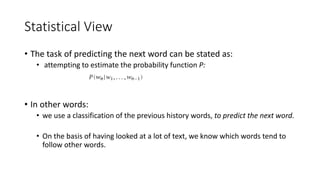
• The task of predicting the next word can be stated as:
• attempting to estimate the probability function P:
• In other words:
• we use a classification of the previous history words, to predict the next word.
• On the basis of having looked at a lot of text, we know which words tend to
follow other words.
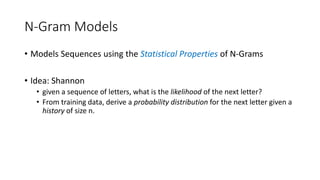
N-Gram Models
• Models Sequences using the Statistical Properties of N-Grams
• Idea: Shannon
• given a sequence of letters, what is the likelihood of the next letter?
• From training data, derive a probability distribution for the next letter given a
history of size n.
• Markov assumption: the probability of the next word depends only
on the previous k words.
• Common N-grams:
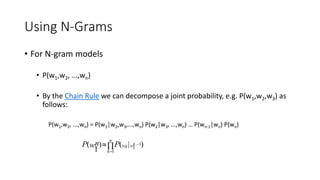
Using N-Grams
• For N-gram models
• P(w1,w2, ...,wn)
• By the Chain Rule we can decompose a joint probability, e.g. P(w1,w2,w3) as
follows:
P(w1,w2, ...,wn) = P(w1|w2,w3,...,wn) P(w2|w3, ...,wn) … P(wn-1|wn) P(wn)




n
k
wk
wk
P
wn
P
1
1
1
)
|
(
)
1
(
Example
• Compute the product of component conditional probabilities?
• P(the mythical unicorn) = P(the) * P(mythical | the) * P(unicorn|the mythical)
• How to calculate these probability?
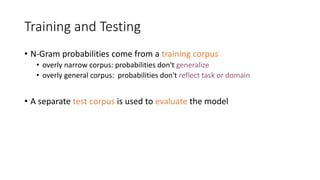
Training and Testing
• N-Gram probabilities come from a training corpus
• overly narrow corpus: probabilities don't generalize
• overly general corpus: probabilities don't reflect task or domain
• A separate test corpus is used to evaluate the model
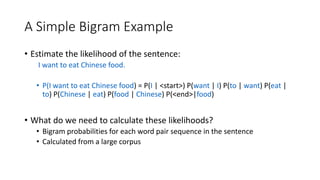
A Simple Bigram Example
• Estimate the likelihood of the sentence:
I want to eat Chinese food.
• P(I want to eat Chinese food) = P(I | <start>) P(want | I) P(to | want) P(eat |
to) P(Chinese | eat) P(food | Chinese) P(<end>|food)
• What do we need to calculate these likelihoods?
• Bigram probabilities for each word pair sequence in the sentence
• Calculated from a large corpus
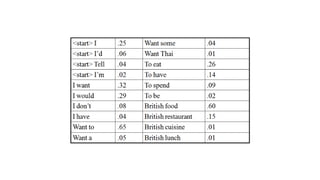
Early Bigram Probabilities from BERP
The Berkeley Restaurant Project (BeRP) is a testbed for a speech recognition system is being developed
by the International Computer Science Institute in Berkeley, CA
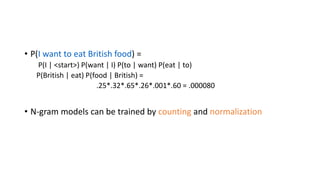
• P(I want to eat British food) =
P(I | <start>) P(want | I) P(to | want) P(eat | to)
P(British | eat) P(food | British) =
.25*.32*.65*.26*.001*.60 = .000080
• N-gram models can be trained by counting and normalization
References
• https://web.cs.hacettepe.edu.tr/~ilyas/Courses/CMP711/lec03-
LanguageModels.pdf

Language Model (N-Gram).pptx

  • 1.
    Language Model (N-Gram) SuriandiJayakrista S.T.,M.T. Kalbis Institute
  • 2.
    N-gram • Model probabilistikN-gram, merupakan model yang digunakan untuk memprediksi kata berikutnya yang mungkin dari kata N-1 sebelumnya. Model statistika dari urutan kata ini seringkali disebut juga sebagai model bahasa (language models / LMs). • Model estimasi seperti N-gram memberikan probabilitas kemungkinan pada kata berikutnya yang mungkin dapat digunakan untuk melakukan kemungkinan penggabungan pada keseluruhan kalimat. Model N- gram merupakan model yang paling penting dalam pemrosesan suara ataupun bahasa baik untuk memperkirakan probabilitas kata berikutnya maupun keseluruhan sequence.
  • 3.
    • N-Grams iniakan mengambil sejumlah kata yang kita butuhkan dari sebuah kalimat. Seperti contohnya kalimat “Fahmi adalah anak yang rajin”, maka bentuk N-Grams dari kalimat tersebut adalah : 1.Unigram : Fahmi, adalah, anak, yang, rajin 2.Bigram : Fahmi adalah, adalah anak, anak yang, yang rajin 3.Trigram : Fahmi adalah anak, anak yang rajin 4.dst.
  • 4.
    What is anN-gram? • An n-gram is a subsequence of n items from a given sequence. • Unigram: n-gram of size 1 • Bigram: n-gram of size 2 • Trigram: n-gram of size 3 • Item: • Phonemes • Syllables • Letters • Words • Anything else depending on the application.
  • 5.
    Example the dog smelledlike a skunk • Bigram: • "# the”, “the dog”, “dog smelled”, “ smelled like”, “like a”, “a skunk”, “skunk#” • Trigram: • "# the dog", "the dog smelled", "dog smelled like", "smelled like a", "like a skunk" and "a skunk #".
  • 6.
    How to predictthe next word? • Assume a language has T word types in its lexicon, how likely is word x to follow word y? • Solutions: • Estimate likelihood of x occurring in new text, based on its general frequency of occurrence estimated from a corpus • popcorn is more likely to occur than unicorn • Condition the likelihood of x occurring in the context of previous words (bigrams, trigrams,…) • mythical unicorn is more likely than mythical popcorn
  • 7.
    Statistical View • Thetask of predicting the next word can be stated as: • attempting to estimate the probability function P: • In other words: • we use a classification of the previous history words, to predict the next word. • On the basis of having looked at a lot of text, we know which words tend to follow other words.
  • 8.
    N-Gram Models • ModelsSequences using the Statistical Properties of N-Grams • Idea: Shannon • given a sequence of letters, what is the likelihood of the next letter? • From training data, derive a probability distribution for the next letter given a history of size n.
  • 9.
    • Markov assumption:the probability of the next word depends only on the previous k words. • Common N-grams:
  • 10.
    Using N-Grams • ForN-gram models • P(w1,w2, ...,wn) • By the Chain Rule we can decompose a joint probability, e.g. P(w1,w2,w3) as follows: P(w1,w2, ...,wn) = P(w1|w2,w3,...,wn) P(w2|w3, ...,wn) … P(wn-1|wn) P(wn)     n k wk wk P wn P 1 1 1 ) | ( ) 1 (
  • 11.
    Example • Compute theproduct of component conditional probabilities? • P(the mythical unicorn) = P(the) * P(mythical | the) * P(unicorn|the mythical) • How to calculate these probability?
  • 12.
    Training and Testing •N-Gram probabilities come from a training corpus • overly narrow corpus: probabilities don't generalize • overly general corpus: probabilities don't reflect task or domain • A separate test corpus is used to evaluate the model
  • 13.
    A Simple BigramExample • Estimate the likelihood of the sentence: I want to eat Chinese food. • P(I want to eat Chinese food) = P(I | <start>) P(want | I) P(to | want) P(eat | to) P(Chinese | eat) P(food | Chinese) P(<end>|food) • What do we need to calculate these likelihoods? • Bigram probabilities for each word pair sequence in the sentence • Calculated from a large corpus
  • 14.
    Early Bigram Probabilitiesfrom BERP The Berkeley Restaurant Project (BeRP) is a testbed for a speech recognition system is being developed by the International Computer Science Institute in Berkeley, CA
  • 16.
    • P(I wantto eat British food) = P(I | <start>) P(want | I) P(to | want) P(eat | to) P(British | eat) P(food | British) = .25*.32*.65*.26*.001*.60 = .000080 • N-gram models can be trained by counting and normalization
  • 17.

Editor's Notes

  • #15 The Berkeley Restaurant Project (BeRP) is a testbed for a speech recognition system s being developed by the International Computer Science Institute in Berkeley, CA http://www.icsi.berkeley.edu/real/berp.html