Chapter 5
Week 12 -Frequency Response Analysis
Topics:
Control System Engineering
PE-3032
Prof. CHARLTON S. INAO
Defence Engineering College,
Debre Zeit , Ethiopia
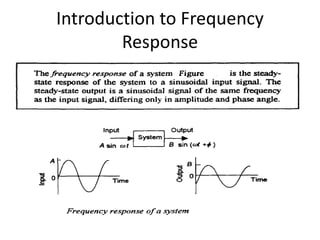
Introduction to Frequency
Response
Terminologies- Frequency , Amplitude ,
Phase
• Frequency, or its inverse, the period- is the
number of occurrences of a repeating event
per unit time. The number of cycles per unit
of time is called the frequency.
The hertz (symbol Hz) is the SI unit of frequency defined as the
number of cycles per second of a periodic phenomenon. One
of its most common uses is the description of the sine wave,
particularly those used in radio and audio applications, such
as the frequency of musical tones. The word "hertz" is named
for Heinrich Rudolf Hertz, who was the first to conclusively
prove the existence of electromagnetic wave.
• Period is the inverse of frequency
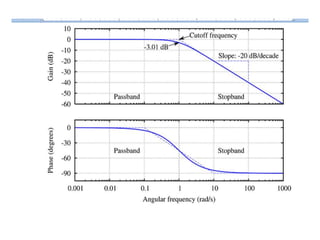
Bode Plot :Introduction
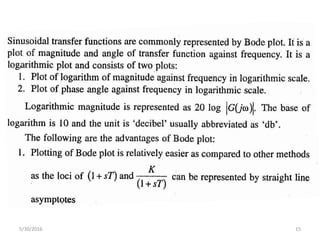
• The plot of magnitude as well as phase angle
versus frequency may represent a sinusoidal
transfer function.
• Hendrik Wade Bode used the logarithmic
scale extensively for the study of the
magnitude of the transfer function and the
frequency variable. The logarithmic plot is
called Bode Plot.
• A Bode plot, named after Hendrik Wade Bode,
is usually a combination of a Bode magnitude
plot and Bode phase plot:
• A Bode magnitude plot is a graph of log
magnitude against log frequency often used in
signal processing to show the transfer
function or frequency response of a linear,
time-invariant system.
Phase and Gain Cross Over
Frequency
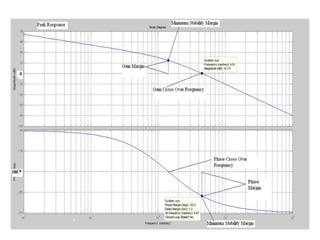
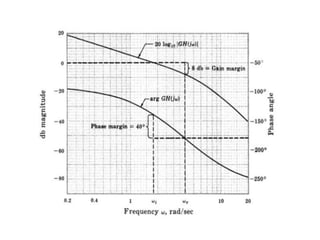
The gain cross over frequency is the frequency
at which the magnitude of the open loop
transfer function is UNITY.
The phase cross over frequency is the
frequency at which the phase of the open loop
transfer function is 180o.
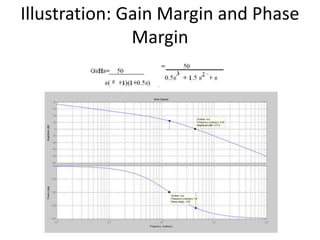
Illustration: Gain Margin and Phase
Margin
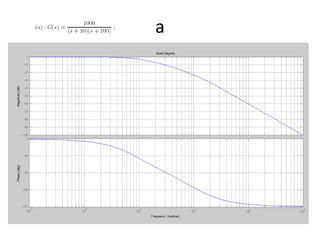
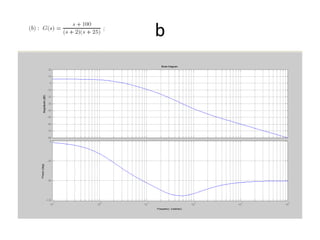
a
b
Bode Plot Construction
5/30/2016 15
5/30/2016 16
5/30/2016 17
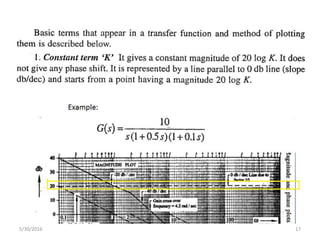
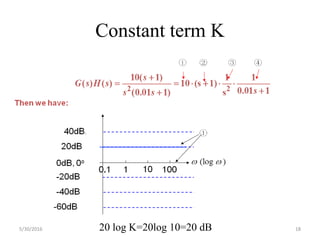
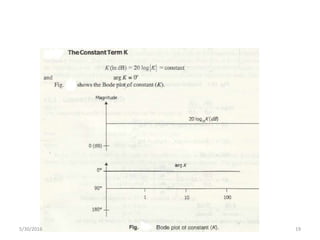
Constant term K
20 log K=20log 10=20 dB5/30/2016 18
5/30/2016 19
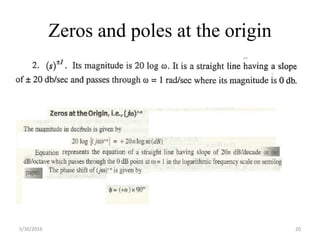
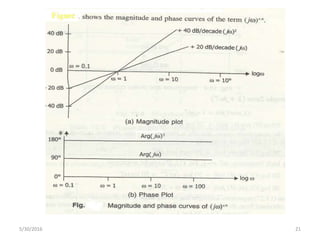
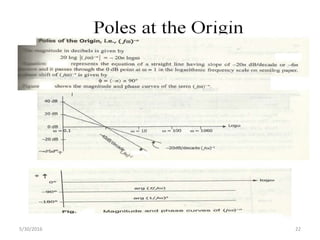
Zeros and poles at the origin
5/30/2016 20
5/30/2016 21
5/30/2016 22
5/30/2016 23
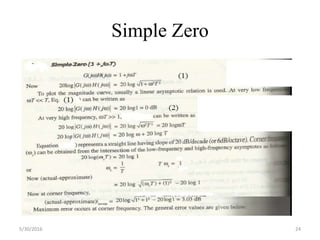
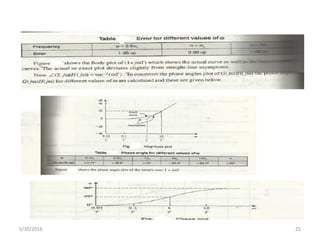
Simple Zero
5/30/2016 24
5/30/2016 25
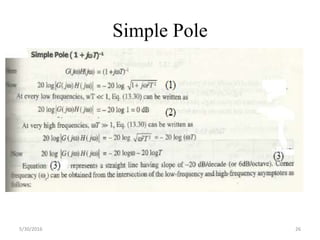
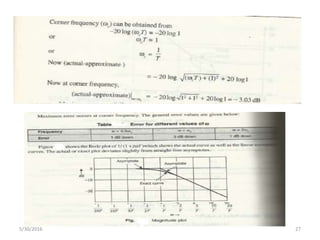
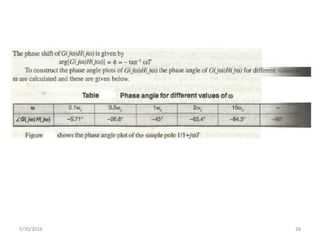
Simple Pole
5/30/2016 26
5/30/2016 27
5/30/2016 28
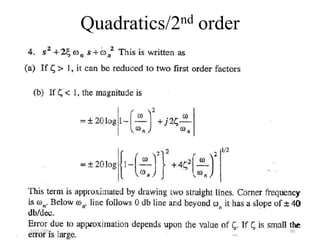
Quadratics/2nd order
5/30/2016 29
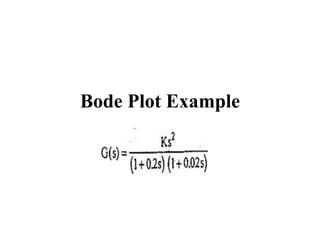
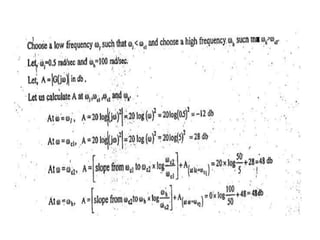
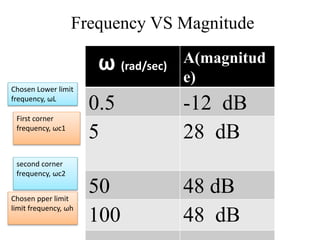
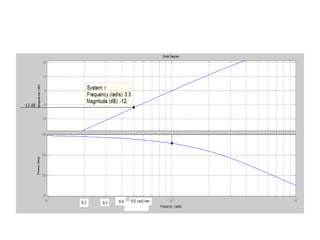
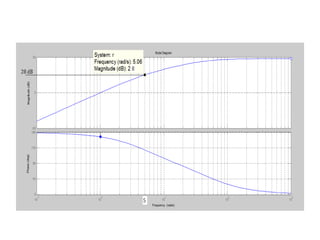
Bode Plot Example
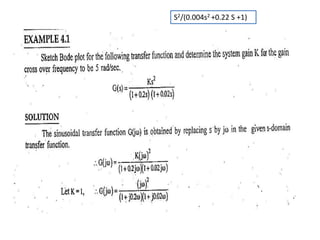
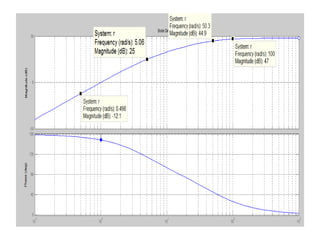
S2/(0.004s2 +0.22 S +1)
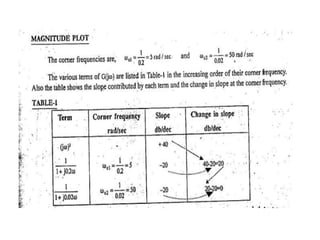
Frequency VS Magnitude
ω (rad/sec)
A(magnitud
e)
0.5 -12 dB
5 28 dB
50 48 dB
100 48 dB
First corner
frequency, ωc1
second corner
frequency, ωc2
Chosen Lower limit
frequency, ωL
Chosen pper limit
limit frequency, ωh
Semilog paper
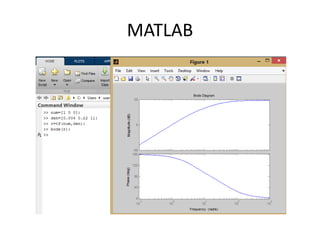
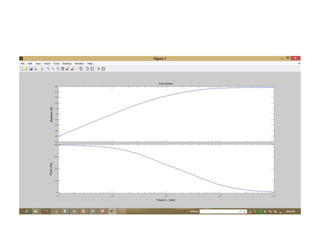
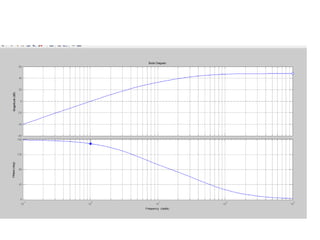
MATLAB
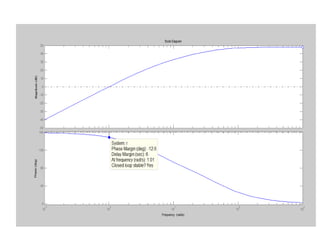
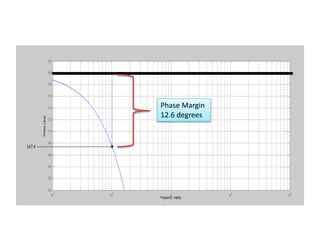
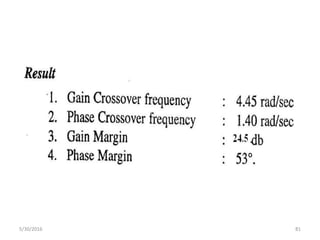
Phase Margin
12.6 degrees
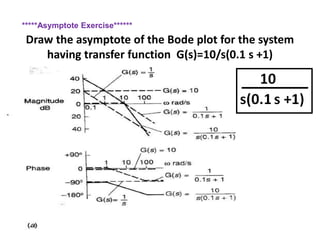
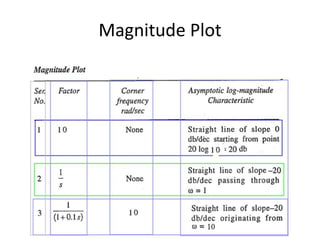
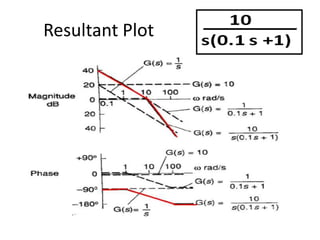
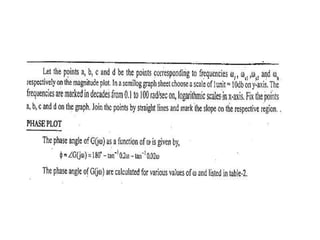
Draw the asymptote of the Bode plot for the system
having transfer function G(s)=10/s(0.1 s +1)
*****Asymptote Exercise******
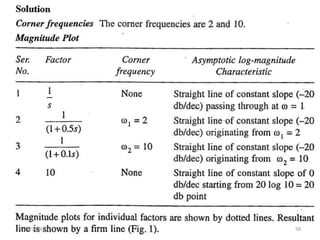
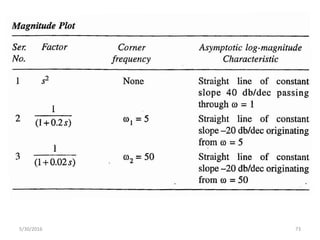
Magnitude Plot
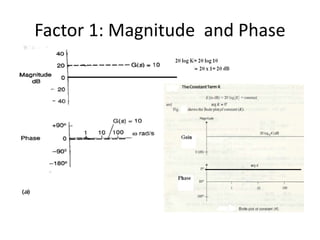
Factor 1: Magnitude and Phase
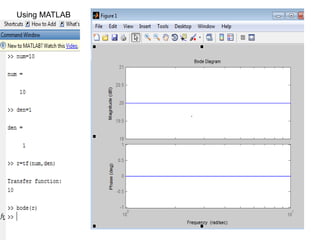
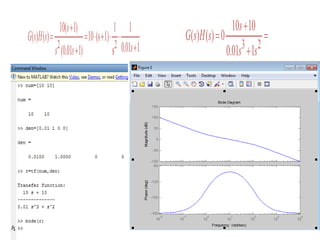
Using MATLAB
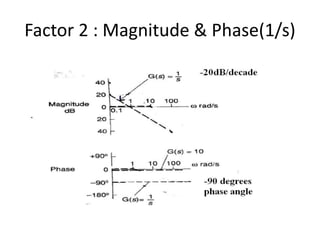
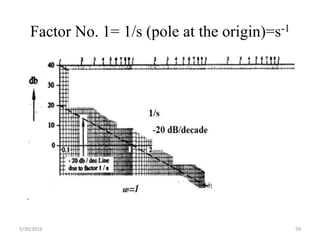
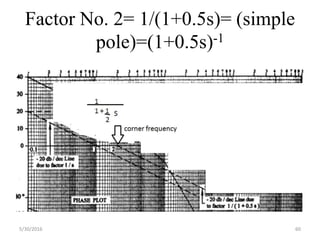
Factor 2 : Magnitude & Phase(1/s)
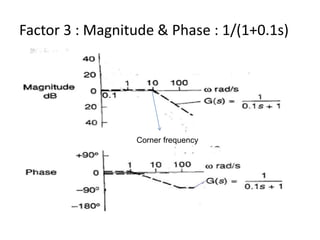
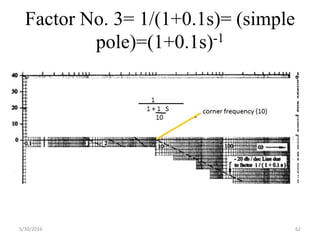
Factor 3 : Magnitude & Phase : 1/(1+0.1s)
Corner frequency
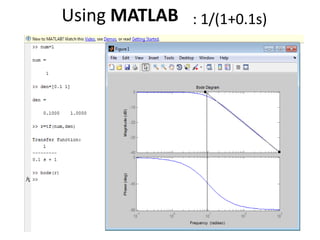
Using MATLAB : 1/(1+0.1s)
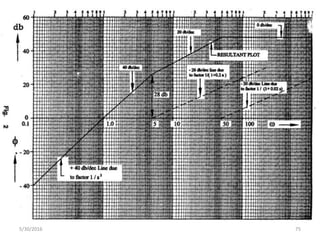
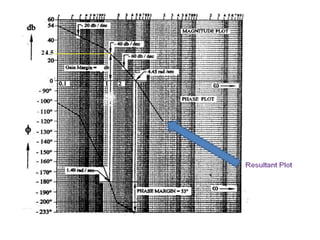
Resultant Plot
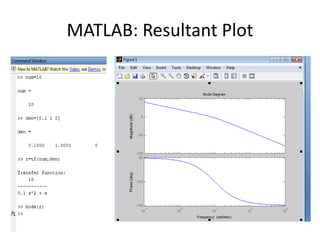
MATLAB: Resultant Plot
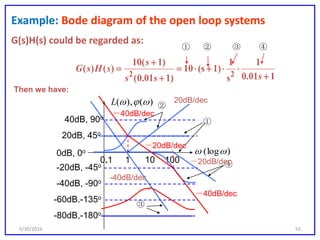
Example: Bode diagram of the open loop systems
G(s)H(s) could be regarded as:
Then we have:
101.0
1
s
1
1)(s10
)101.0(
)1(10
)()(
22 




sss
s
sHsG
① ② ③ ④
0dB, 0o
1001010.1
)(log
)(),( L
③
④
②
①
20dB, 45o
-20dB, -45o
-40dB, -90o
40dB, 90o
-80dB,-180o
-60dB.-135o
-40dB/dec
-20dB/dec
20dB/dec
-40dB/dec
-20dB/dec
-40dB/dec
5/30/2016 55
101.0
1
s
1
1)(s10
)101.0(
)1(10
)()(
22 




sss
s
sHsG 



23
101.0
1010
0)()(
ss
s
sHsG
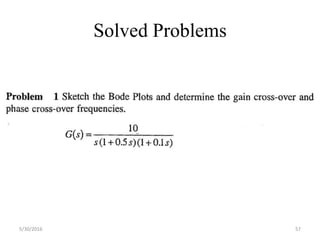
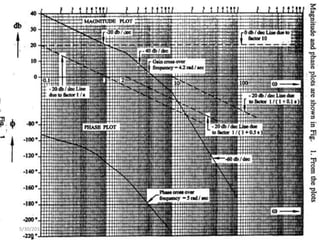
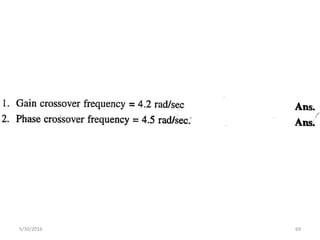
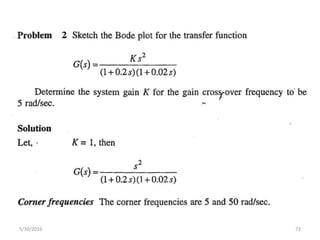
Solved Problems
5/30/2016 57
5/30/2016 58
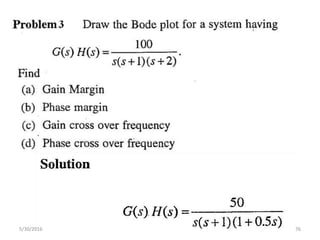
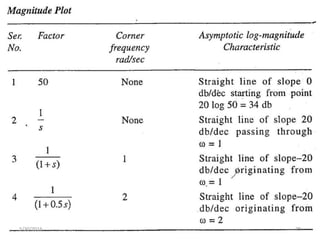
Factor No. 1= 1/s (pole at the origin)=s-1
5/30/2016 59
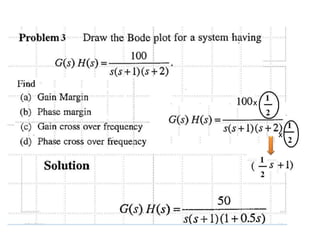
Factor No. 2= 1/(1+0.5s)= (simple
pole)=(1+0.5s)-1
5/30/2016 60
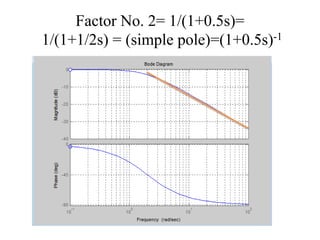
Factor No. 2= 1/(1+0.5s)=
1/(1+1/2s) = (simple pole)=(1+0.5s)-1
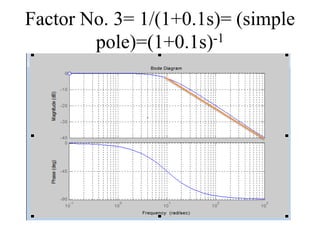
Factor No. 3= 1/(1+0.1s)= (simple
pole)=(1+0.1s)-1
5/30/2016 62
Factor No. 3= 1/(1+0.1s)= (simple
pole)=(1+0.1s)-1
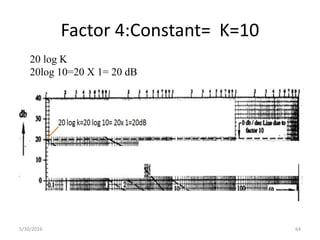
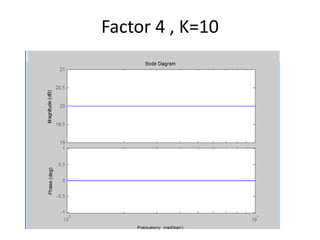
Factor 4:Constant= K=10
5/30/2016 64
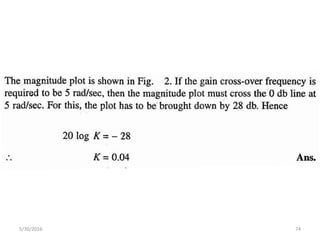
20 log K
20log 10=20 X 1= 20 dB
Factor 4 , K=10
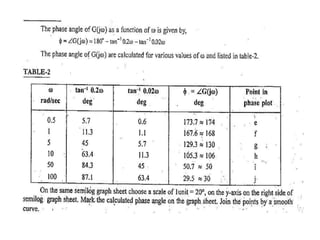
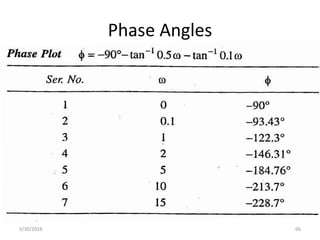
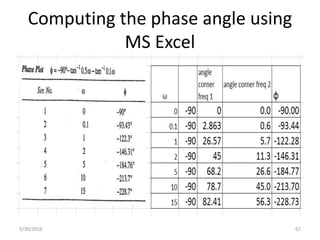
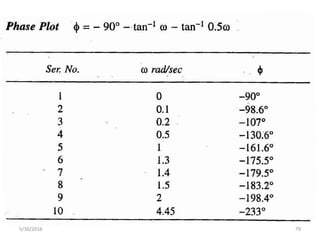
Phase Angles
5/30/2016 66
Computing the phase angle using
MS Excel
5/30/2016 67
5/30/2016 68
5/30/2016 69
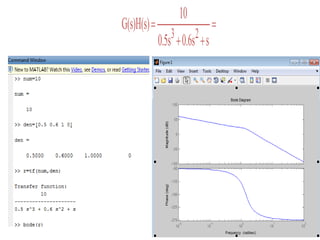
Using Matlab



s0.6s0.5s
10
G(s)H(s)
23
Num=10
Den=[0.5 0.6 1 0 ]
r=tf(num,den)
Bode(r)
commands



s0.6s0.5s
10
G(s)H(s)
23
5/30/2016 72
5/30/2016 73
5/30/2016 74
5/30/2016 75
5/30/2016 76
x
x
5/30/2016 78
5/30/2016 79
5/30/2016 81
 (rad/sec)
dB Mag
Phase
(deg)
1 1 1 1 1 1
wlg
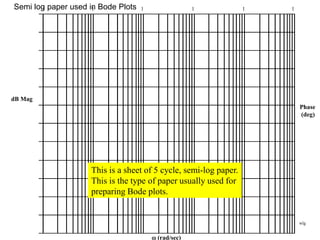
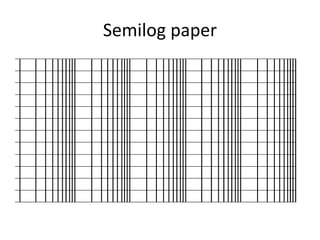
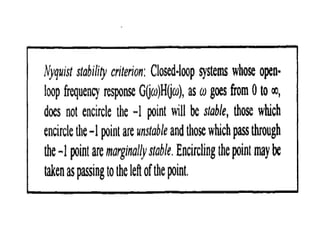
This is a sheet of 5 cycle, semi-log paper.
This is the type of paper usually used for
preparing Bode plots.
Semi log paper used in Bode Plots
Nyquist Stability
Criterion
Week 12 Frequency Response Analysis
Topics:
Control System Engineering
PE-3032
Prof. CHARLTON S. INAO
Defence Engineering College,
Debre Zeit , Ethiopia
Instructional Objectives
At the end of this lecture, the students shall be able to:
1. Conduct review of Frequency Response
fundamentals
2. Discuss the parameters in Nyquist Plot construction
3. Understand Nyquist Stability Criterion
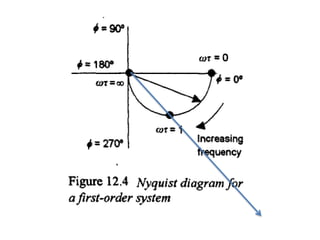
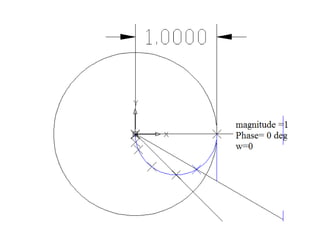
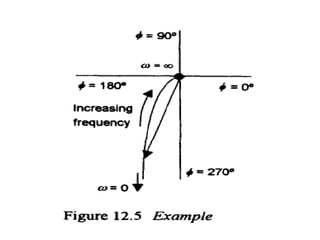
Nyquist Plot
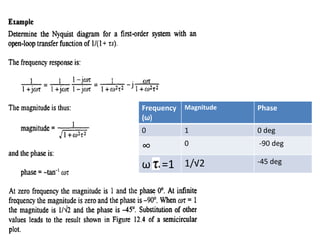
Frequency
(ω)
Magnitude Phase
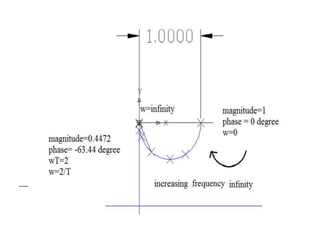
0 1 0 deg
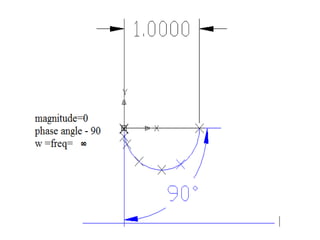
∞ 0 -90 deg
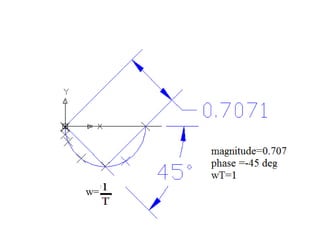
ω =1 1/√2 -45 deg
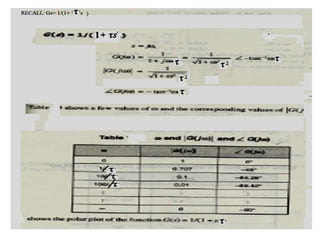
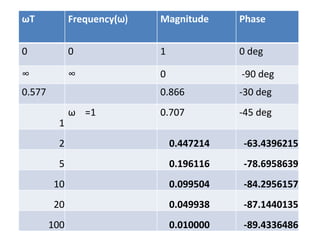
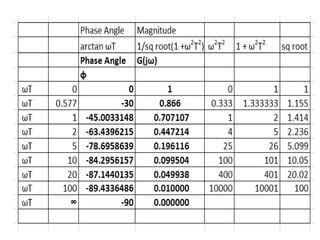
ωT Frequency(ω) Magnitude Phase
0 0 1 0 deg
∞ ∞ 0 -90 deg
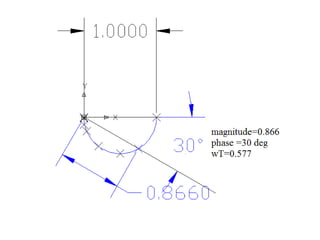
0.577 0.866 -30 deg
1
ω =1 0.707 -45 deg
2 0.447214 -63.4396215
5 0.196116 -78.6958639
10 0.099504 -84.2956157
20 0.049938 -87.1440135
100 0.010000 -89.4336486
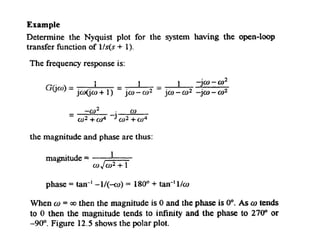
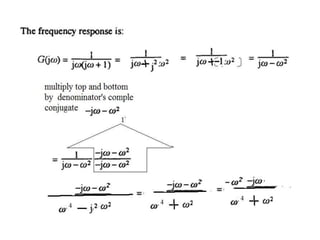
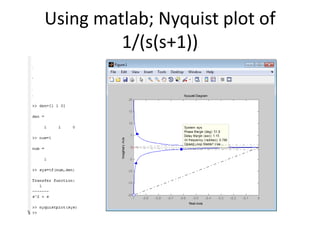
Using matlab; Nyquist plot of
1/(s(s+1))
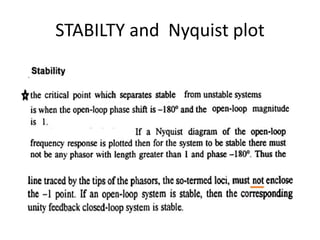
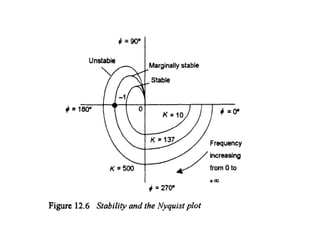
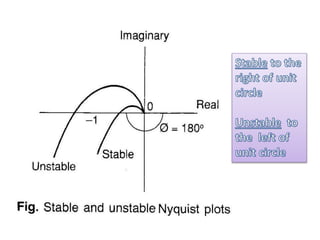
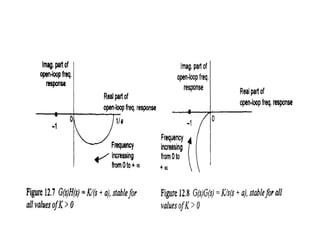
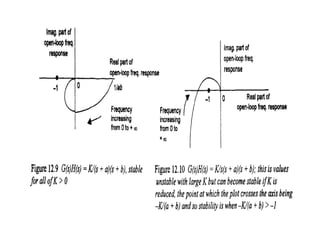
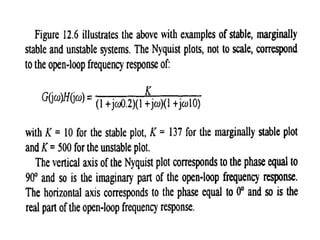
STABILTY and Nyquist plot
Summary
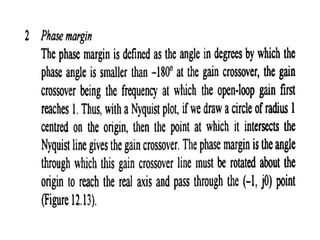
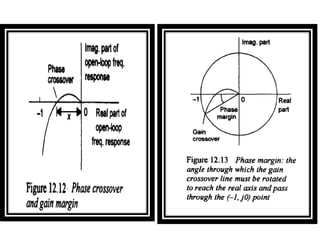
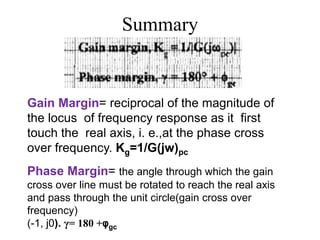
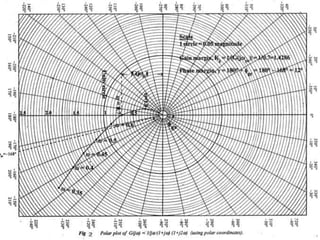
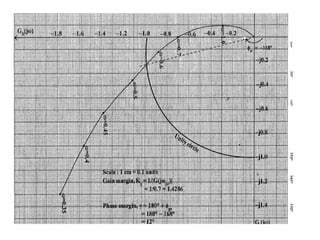
Gain Margin= reciprocal of the magnitude of
the locus of frequency response as it first
touch the real axis, i. e.,at the phase cross
over frequency. Kg=1/G(jw)pc
Phase Margin= the angle through which the gain
cross over line must be rotated to reach the real axis
and pass through the unit circle(gain cross over
frequency)
(-1, j0). γ= 180 +φgc
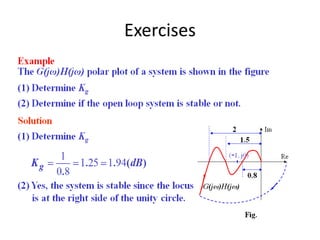
Exercises
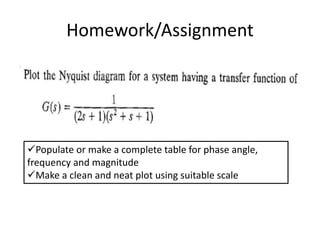
Homework/Assignment
Populate or make a complete table for phase angle,
frequency and magnitude
Make a clean and neat plot using suitable scale

Wk 12 fr bode plot nyquist may 9 2016