PRITESH VASOYA (130420105057)
VISHVARAJ CHAUHAN(130420105058)
VIVEK MISTRY (130420105059)
MILAN HIRAPARA (140423105004)
FREQUENCY RESPONSE
ANALYSIS
Active Learning Assignment, Instrumentation & Process Control
BE SEM V
Chemical Engineering
INTRODUCTION
Frequency responses are generally derived by using
the standard Laplace transform of sinusodial forcing
functions.
We shall look at a convenient graphical technique for
obtaining frequency response of linear systems.
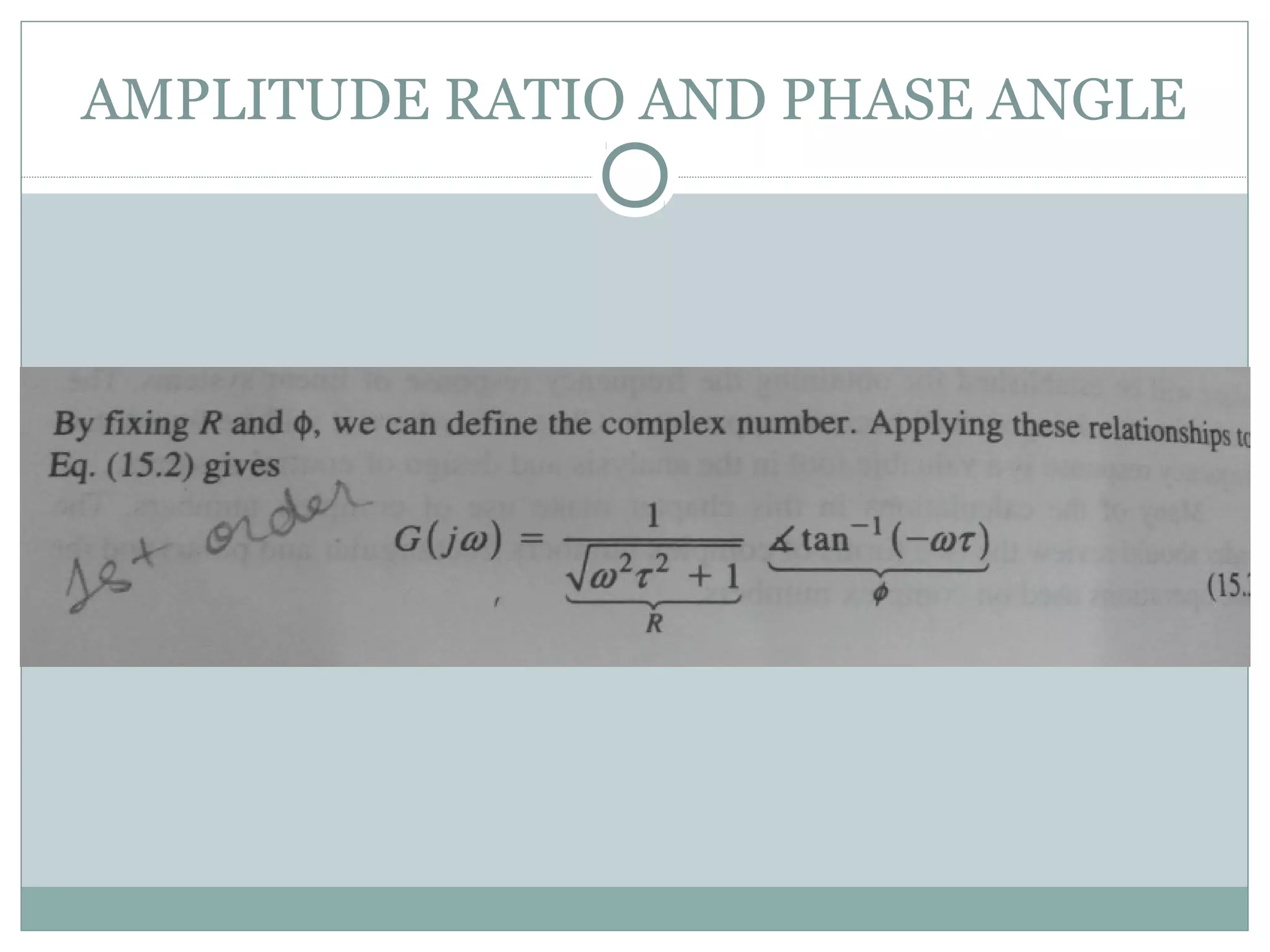
AMPLITUDE RATIO AND PHASE ANGLE
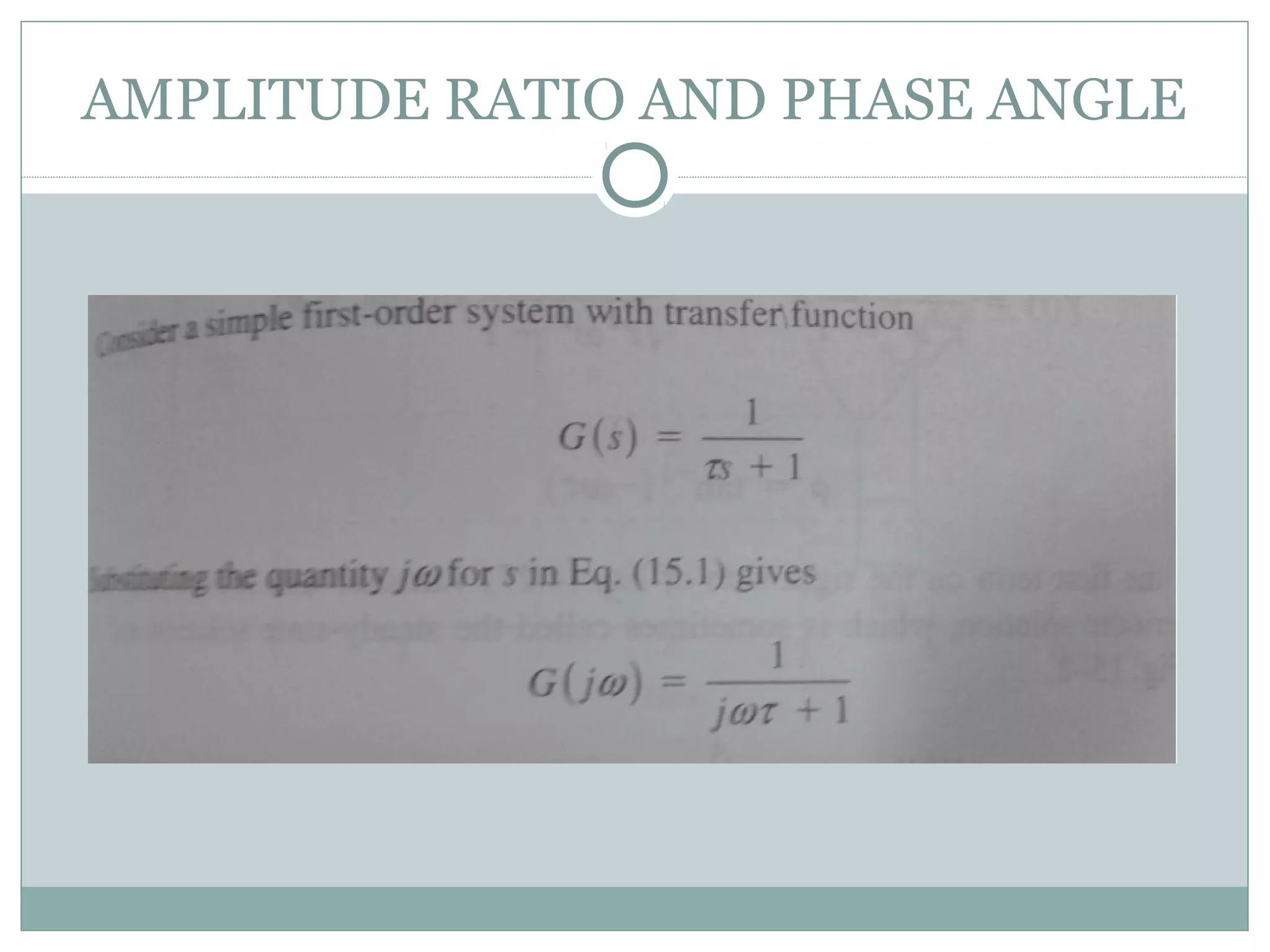
After sufficient time elapses, the response of a first
order system to a sinusodial input of frequency ω
also a sinusoid of frequency ω.
Amplitude Ratio is defined as output amplitude
upon input amplitude, and is denoted by |G (jω)|.
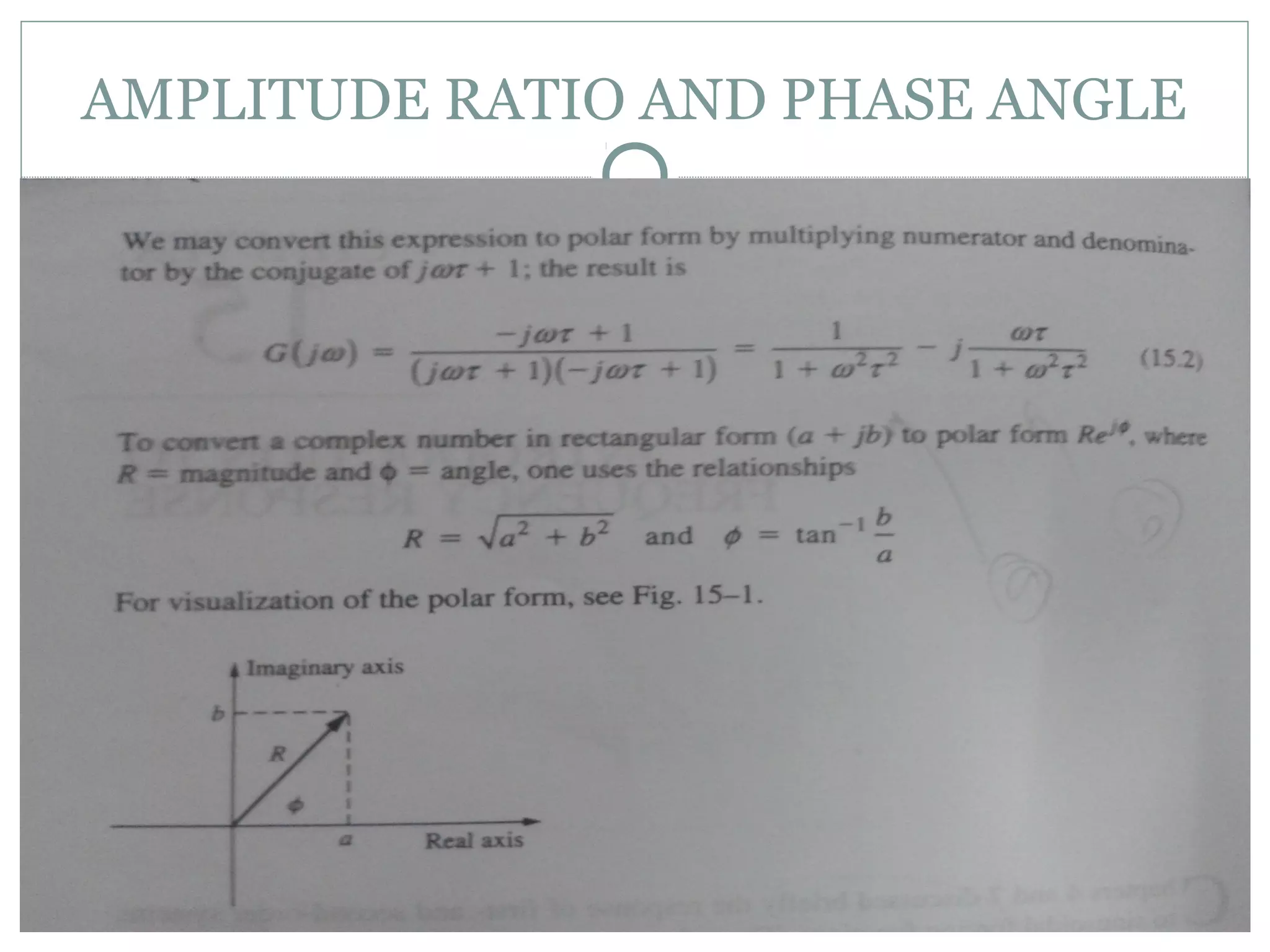
To obtain AR and phase angle, one merely
substitutes jω instead of s in the transfer function
and then finds the magnitude and angle of the
resulting complex number.
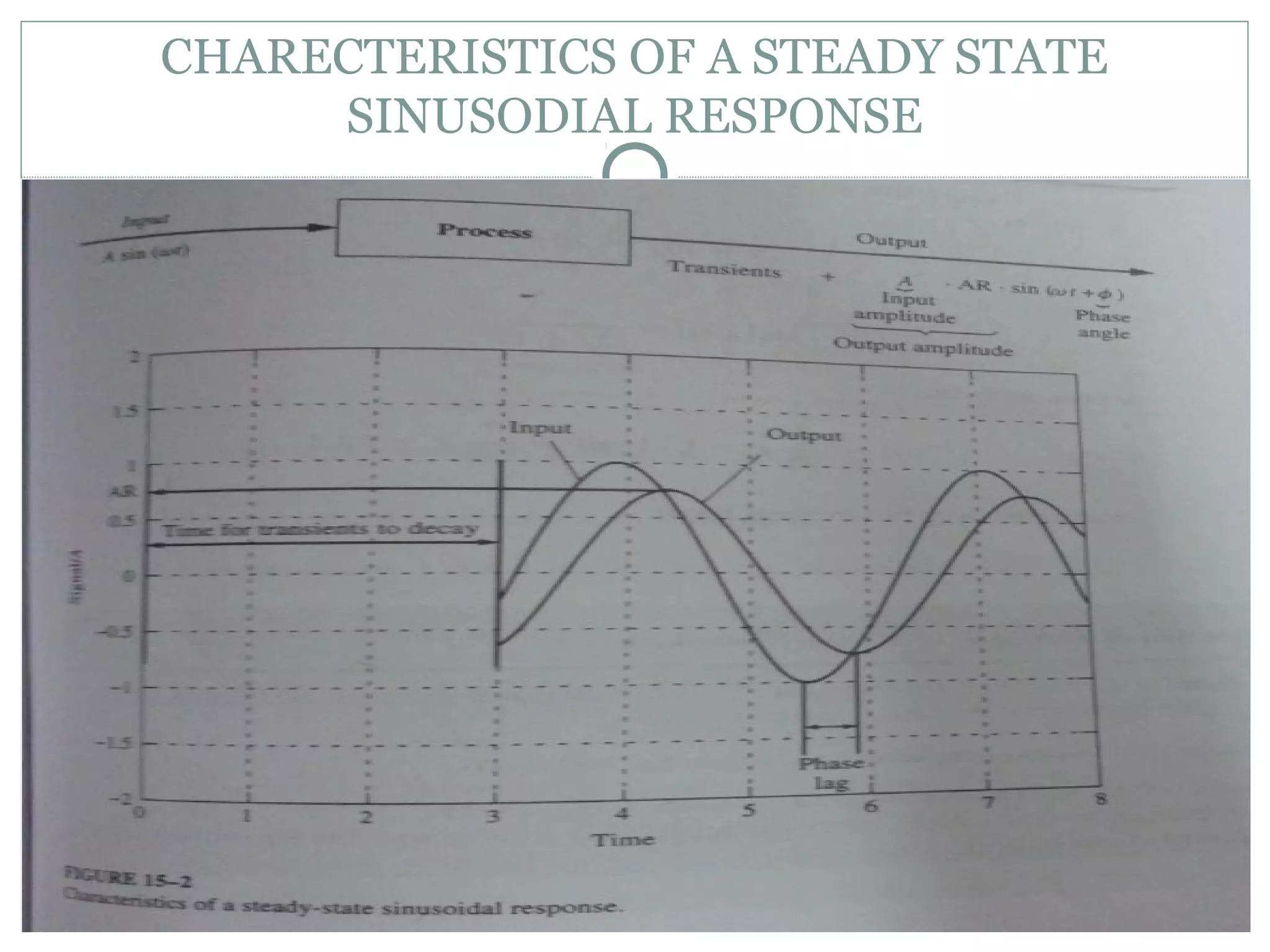
CHARECTERISTICS OF A STEADY STATE
SINUSODIAL RESPONSE
CHARECTERISTICS OF A STEADY STATE
SINUSODIAL RESPONSE
The output is also a sine wave.
Input frequency=output frequency=ω.
In general, AR < 1, which means output amplitude is
greater than input amplitude.
The output is shifted in time, that is it lags the input
by a phase angle of φ.
Amplitude ratio (AR) and phase angle are both
functions of frequency.
BODE DIAGRAMS
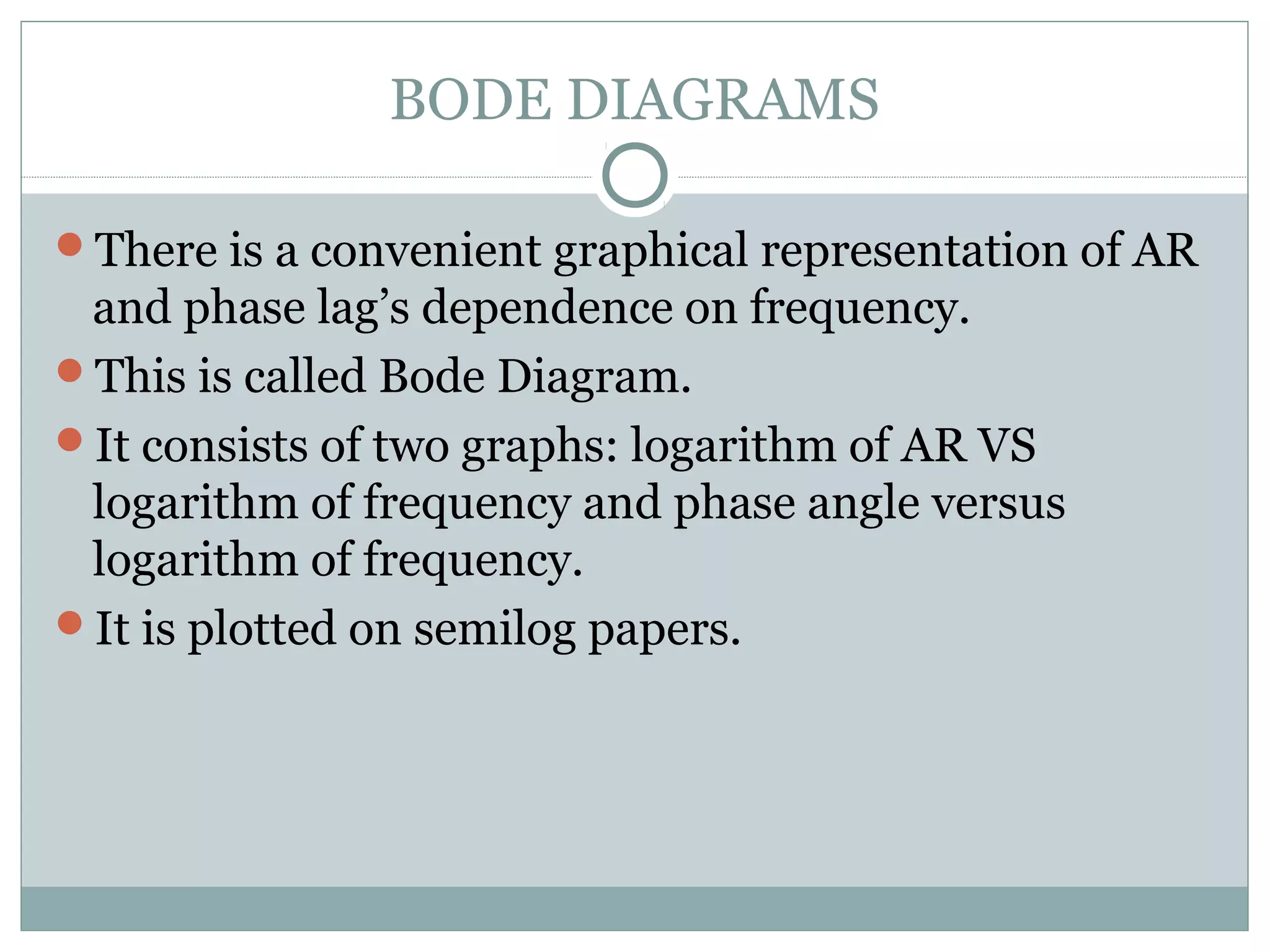
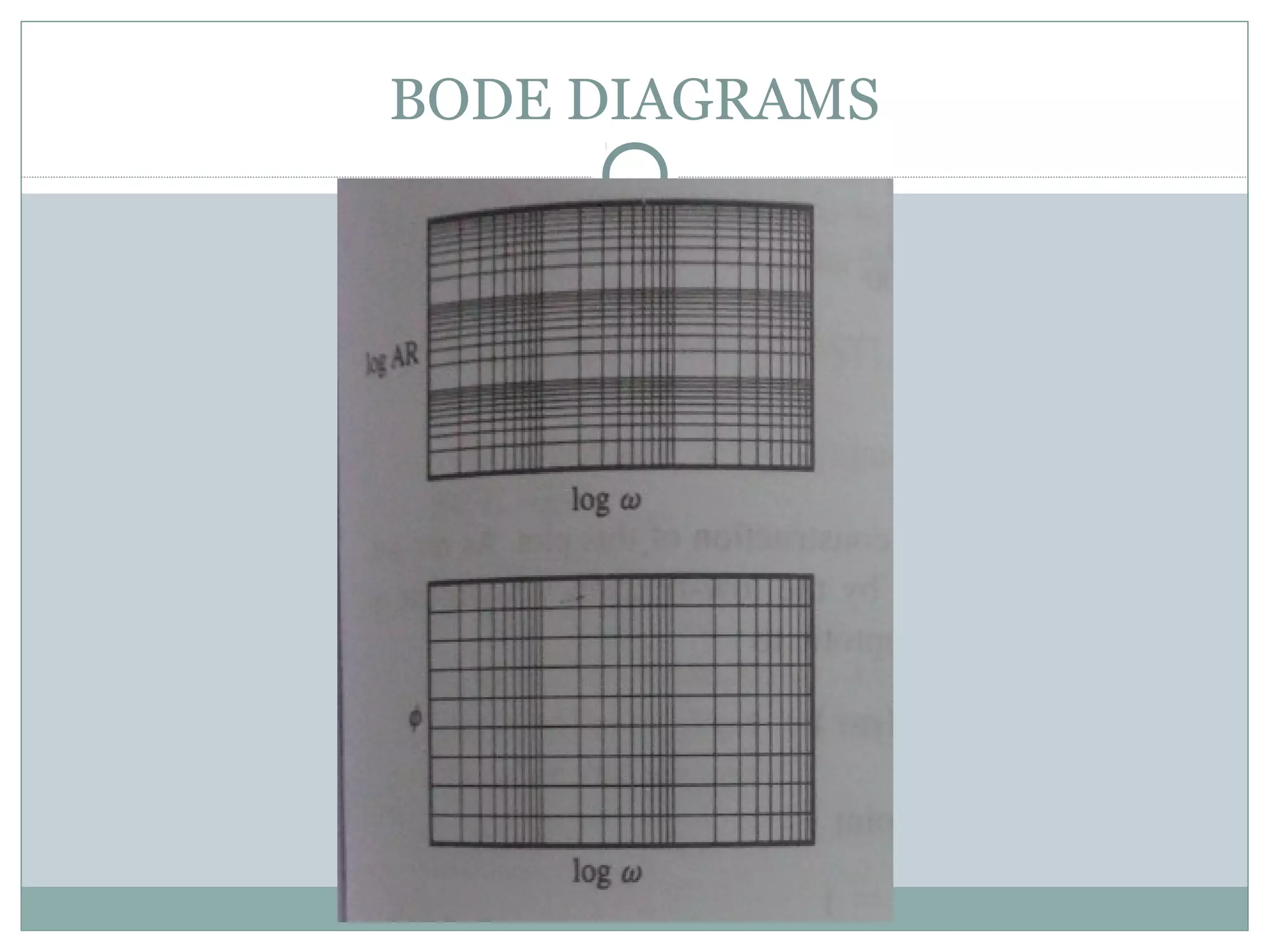
There is a convenient graphical representation of AR
and phase lag’s dependence on frequency.
This is called Bode Diagram.
It consists of two graphs: logarithm of AR VS
logarithm of frequency and phase angle versus
logarithm of frequency.
It is plotted on semilog papers.
BODE DIAGRAMS
BODE DIAGRAMS (FOR FIRST ORDER SYSTEMS)
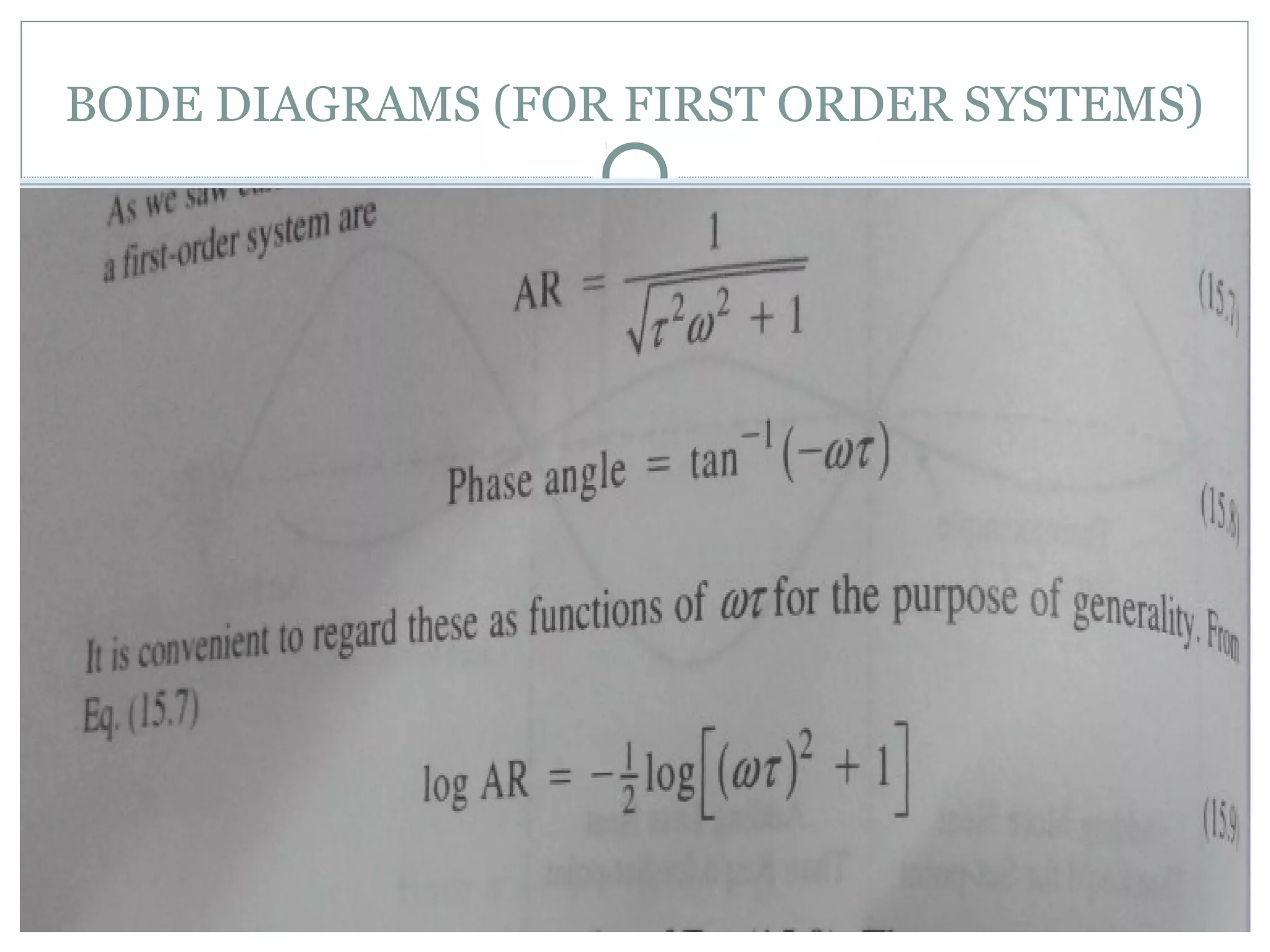
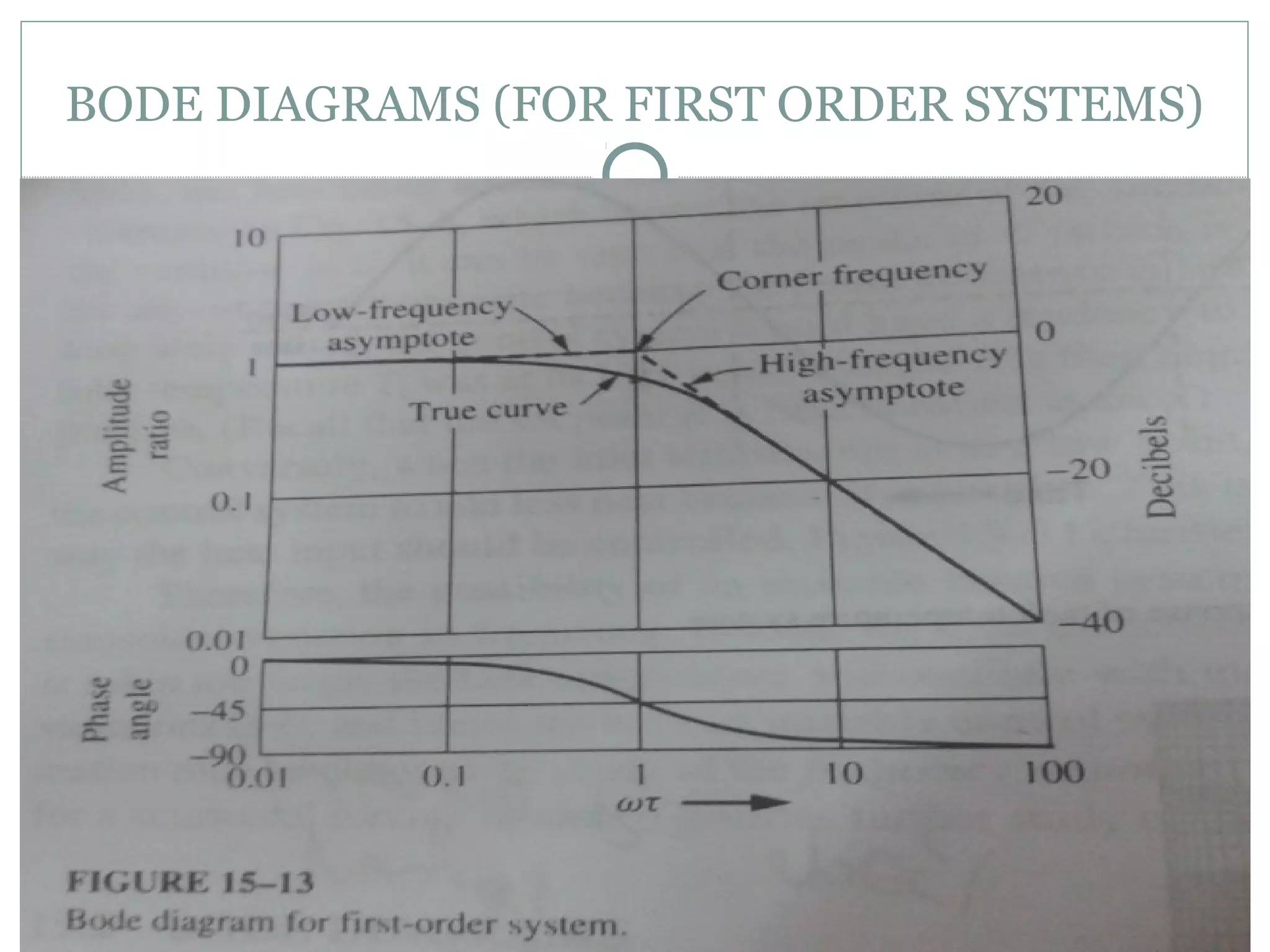
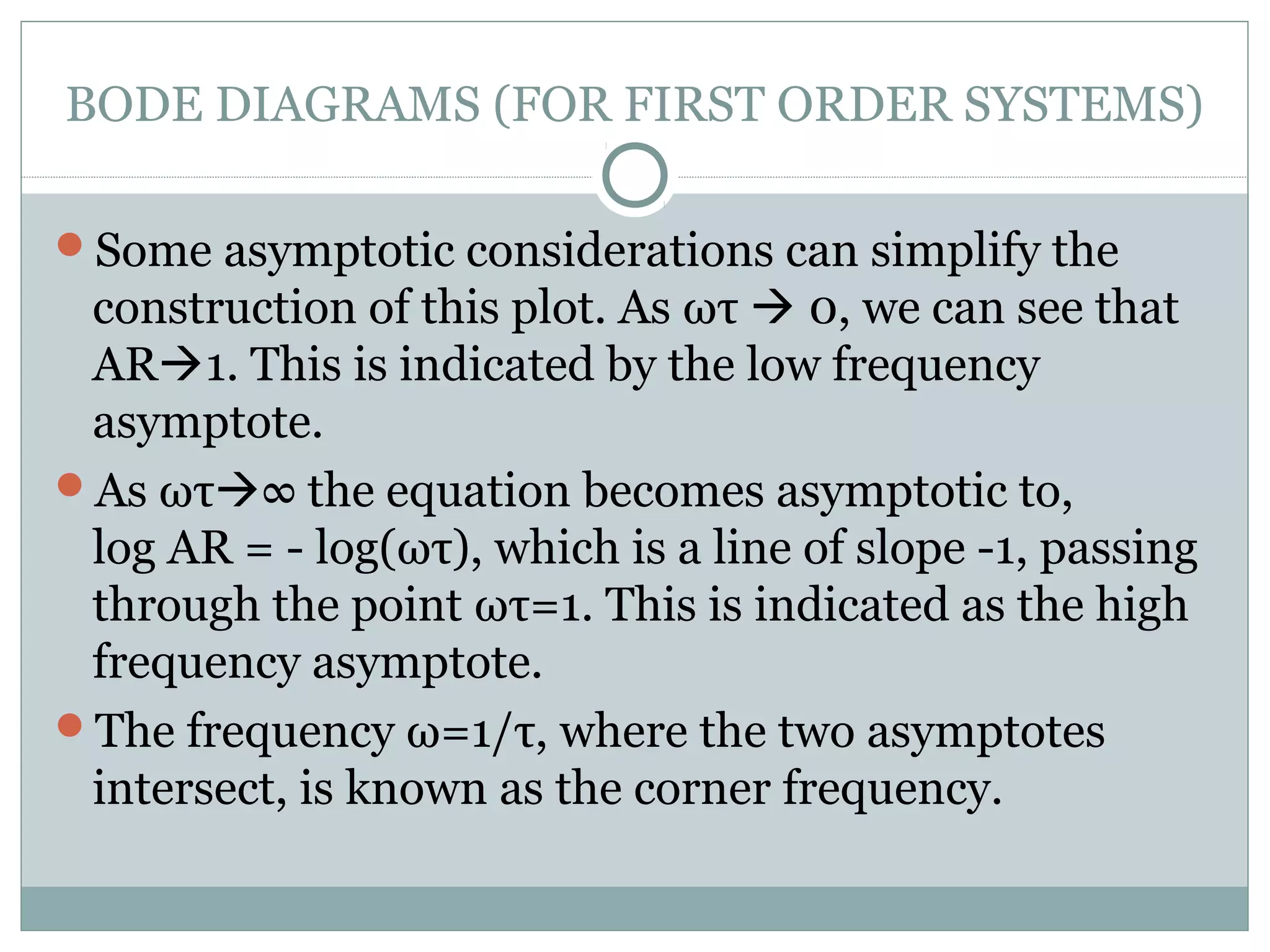
Some asymptotic considerations can simplify the
construction of this plot. As ωτ  0, we can see that
AR1. This is indicated by the low frequency
asymptote.
As ωτ∞ the equation becomes asymptotic to,
log AR = - log(ωτ), which is a line of slope -1, passing
through the point ωτ=1. This is indicated as the high
frequency asymptote.
The frequency ω=1/τ, where the two asymptotes
intersect, is known as the corner frequency.
BODE DIAGRAMS (FOR FIRST ORDER SYSTEMS)
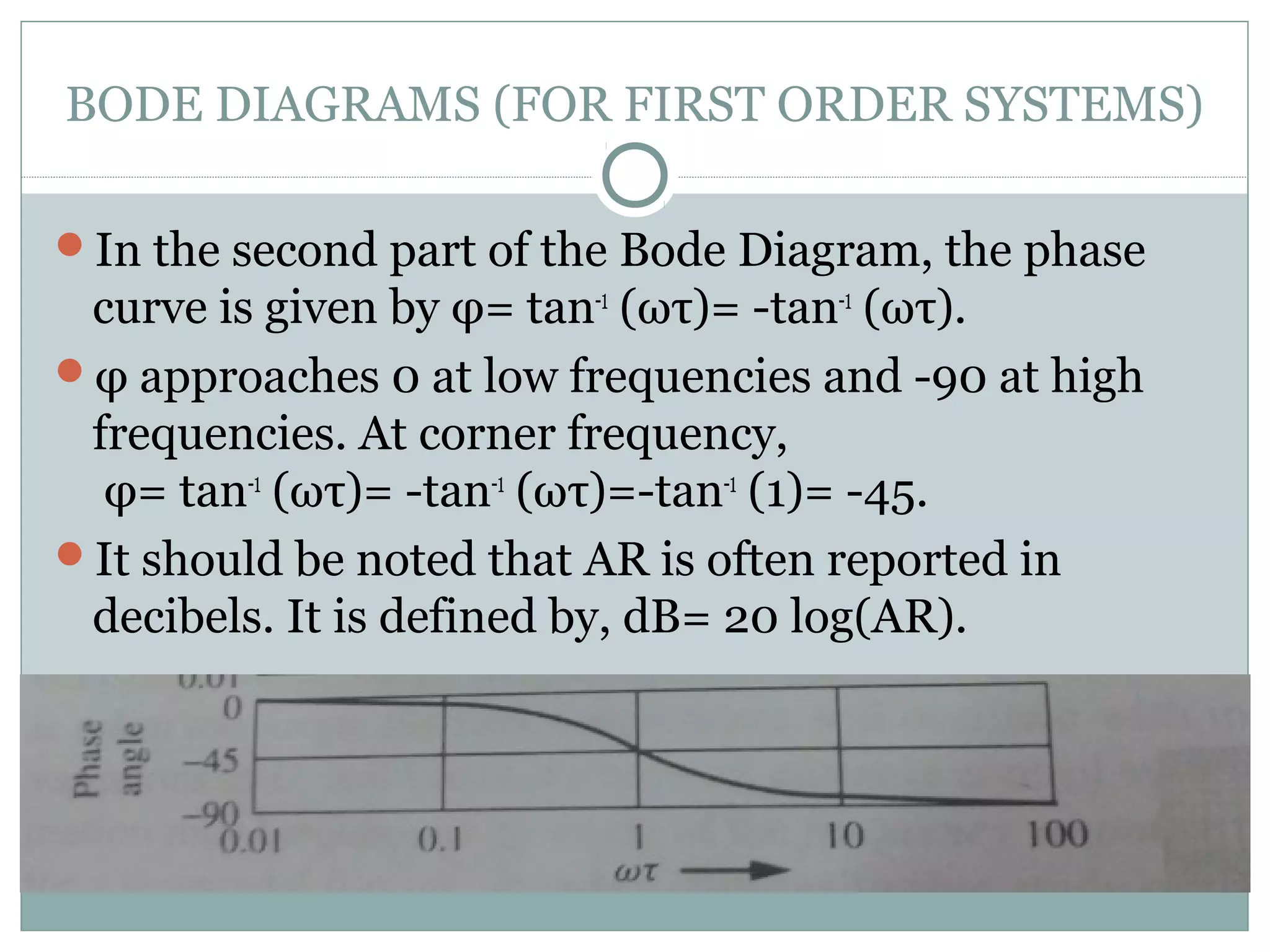
In the second part of the Bode Diagram, the phase
curve is given by φ= tan-1
(ωτ)= -tan-1
(ωτ).
φ approaches 0 at low frequencies and -90 at high
frequencies. At corner frequency,
φ= tan-1
(ωτ)= -tan-1
(ωτ)=-tan-1
(1)= -45.
It should be noted that AR is often reported in
decibels. It is defined by, dB= 20 log(AR).
THANK YOU.

Frequency Response Analysis and Bode Diagrams for First Order Systems

  • 1.
    PRITESH VASOYA (130420105057) VISHVARAJCHAUHAN(130420105058) VIVEK MISTRY (130420105059) MILAN HIRAPARA (140423105004) FREQUENCY RESPONSE ANALYSIS Active Learning Assignment, Instrumentation & Process Control BE SEM V Chemical Engineering
  • 2.
    INTRODUCTION Frequency responses aregenerally derived by using the standard Laplace transform of sinusodial forcing functions. We shall look at a convenient graphical technique for obtaining frequency response of linear systems.
  • 3.
  • 4.
  • 5.
  • 6.
    AMPLITUDE RATIO ANDPHASE ANGLE After sufficient time elapses, the response of a first order system to a sinusodial input of frequency ω also a sinusoid of frequency ω. Amplitude Ratio is defined as output amplitude upon input amplitude, and is denoted by |G (jω)|. To obtain AR and phase angle, one merely substitutes jω instead of s in the transfer function and then finds the magnitude and angle of the resulting complex number.
  • 7.
    CHARECTERISTICS OF ASTEADY STATE SINUSODIAL RESPONSE
  • 8.
    CHARECTERISTICS OF ASTEADY STATE SINUSODIAL RESPONSE The output is also a sine wave. Input frequency=output frequency=ω. In general, AR < 1, which means output amplitude is greater than input amplitude. The output is shifted in time, that is it lags the input by a phase angle of φ. Amplitude ratio (AR) and phase angle are both functions of frequency.
  • 9.
    BODE DIAGRAMS There isa convenient graphical representation of AR and phase lag’s dependence on frequency. This is called Bode Diagram. It consists of two graphs: logarithm of AR VS logarithm of frequency and phase angle versus logarithm of frequency. It is plotted on semilog papers.
  • 10.
  • 11.
    BODE DIAGRAMS (FORFIRST ORDER SYSTEMS)
  • 12.
    BODE DIAGRAMS (FORFIRST ORDER SYSTEMS)
  • 13.
    BODE DIAGRAMS (FORFIRST ORDER SYSTEMS) Some asymptotic considerations can simplify the construction of this plot. As ωτ  0, we can see that AR1. This is indicated by the low frequency asymptote. As ωτ∞ the equation becomes asymptotic to, log AR = - log(ωτ), which is a line of slope -1, passing through the point ωτ=1. This is indicated as the high frequency asymptote. The frequency ω=1/τ, where the two asymptotes intersect, is known as the corner frequency.
  • 14.
    BODE DIAGRAMS (FORFIRST ORDER SYSTEMS) In the second part of the Bode Diagram, the phase curve is given by φ= tan-1 (ωτ)= -tan-1 (ωτ). φ approaches 0 at low frequencies and -90 at high frequencies. At corner frequency, φ= tan-1 (ωτ)= -tan-1 (ωτ)=-tan-1 (1)= -45. It should be noted that AR is often reported in decibels. It is defined by, dB= 20 log(AR).
  • 15.