Massive MIMO and 
Channel Modeling for Millimeter Wave 
Gustavo Fraidenraich 
Engenharia Elétrica 
Departamento de Comunicações 
Unicamp 
1
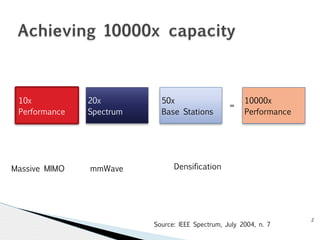
Achieving 10000x capacity 
Source: IEEE Spectrum, July 2004, n. 7 2 
10x 
Performance 
20x 
Spectrum 
50x 
Base Stations = 10000x 
Performance 
Massive MIMO mmWave Densification
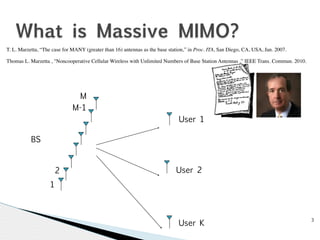
What is Massive MIMO? 
T. L. Marzetta, “The case for MANY (greater than 16) antennas as the base station,” in Proc. ITA, San Diego, CA, USA, Jan. 2007. 
Thomas L. Marzetta , "Noncooperative Cellular Wireless with Unlimited Numbers of Base Station Antennas ,” IEEE Trans. Commun. 2010. 
BS 
User 1 
User 2 
User K 3 
M 
M-1 
1 
2
4 
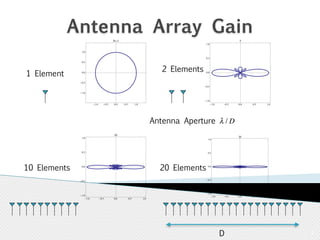
Antenna Array Gain 
1 Element 
1.0 
0.5 
0.0 
-0.5 
1.0 
0.5 
10 
1.0 
0.5 
0.0 
-0.5 
10 Elements 20 Elements 
-1.0 -0.5 0.0 0.5 1.0 
20 Elements 
-1.0 -0.5 0.0 0.5 1.0 
-1.0 
N=1 
0.0 
-0.5 
-1.0 
-1.0 -0.5 0.0 0.5 1.0 
1.0 
0.5 
0.0 
-0.5 
-1.0 
20 
-1.0 -0.5 0.0 0.5 1.0 
-1.0 
5 
2 Elements 
Antenna Aperture λ / D 
D
5 
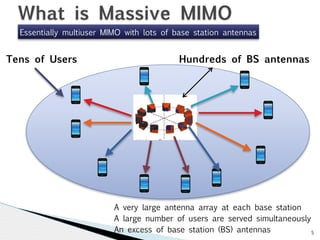
What is Massive MIMO 
Essentially multiuser MIMO with lots of base station antennas 
Hundreds Tens of Users of BS antennas 
A very large antenna array at each base station 
A large number of users are served simultaneously 
An excess of base station (BS) antennas
6 
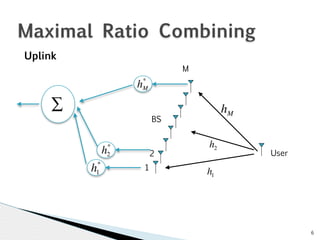
Maximal Ratio Combining 
Uplink 
BS 
User 
M 
* 
1 
2 
* 
h1 
* 
h2 
hM 
Σ 
h2 
h1 
hM
7 
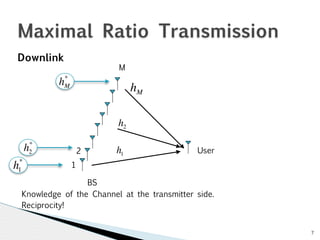
Maximal Ratio Transmission 
Downlink 
BS 
User 
M 
1 
2 
h2 
h1 
hM 
* 
* 
* 
Knowledge of the Channel at the transmitter side. 
Reciprocity! 
h1 
h2 
hM
8 
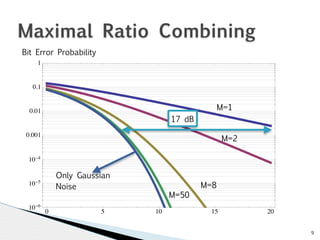
Bit Error Probability 
Maximal Ratio Combining 
y = x + z 
Pb = Q 
2Eb 
N0 
⎛ 
⎝ ⎜ 
⎞ 
⎠ ⎟ 
y = [hhh!h]x + z 
1 2 3M y = hx + z 
h†y 
MRC 
M 
Pb = 1 
2 
1− γ b 
γ b + M 
⎛ 
⎞ 
⎟ 
⎠ ⎜⎝ M −1+ k 
M−1 Σ 1 
k 
⎛ 
⎝ ⎜ 
⎞ 
⎠ ⎟ 
k=0 
2 
+ 1 
2 
γ b 
γ b + M 
⎛ 
⎝ ⎜ 
⎞ 
⎠ ⎟ 
k 
AWGN Channel 
AWGN Channel 
+Fading with 
γ Diversity b = Eb 
N0
9 
Maximal Ratio Combining 
Bit Error Probability 
0 5 10 15 20 
1 
0.1 
0.01 
0.001 
10-4 
10-5 
10-6 
M=1 
M=2 
M=8 
M=50 
Only Gaussian 
Noise 
17 dB
10 
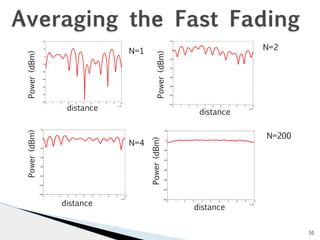
Averaging the Fast Fading 
20 
N=1 N=2 
N=4 
N=200 
4 
0 
−20 
−40 
−60 
−80 
−100 
0 1 2 3 4 5 6 7 8 9 10 
4 
x 10 
20 
0 
−20 
−40 
−60 
−80 
−100 
−120 
0 1 2 3 4 5 6 7 8 9 10 
4 
x 10 
20 
10 
0 
−10 
−20 
−30 
−40 
−50 
−60 
0 1 2 3 4 5 6 7 8 9 10 
x 10 
−120 
0 1 2 3 4 5 6 7 8 9 10 
4 
x 10 
20 
0 
−20 
−40 
−60 
−80 
−100 
−120 
Power (dBm) 
distance distance 
Power (dBm) 
Power (dBm) Power (dBm) 
distance distance
11 
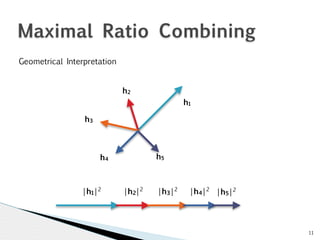
Maximal Ratio Combining 
h1 
h2 
Geometrical Interpretation 
h3 
h4 h5 
|h1|2 |h2|2 |h3|2 |h4|2 |h5|2
12 
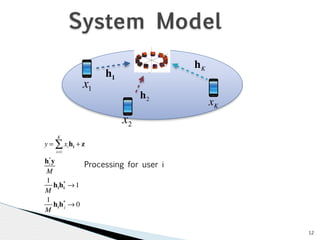
System Model 
h1 
h2 
hK 
x1 
x2 
xK 
Processing for user i 
KΣ 
y = xihi 
i=1 
+ z 
*y 
M 
1 
M 
hi 
* →1 
hihi 
1 
M 
* →0 
hihj
13 
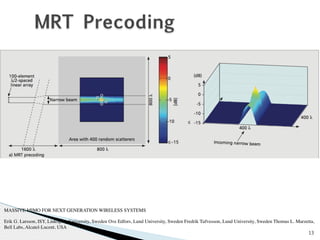
MRT Precoding 
MASSIVE MIMO FOR NEXT GENERATION WIRELESS SYSTEMS 
Erik G. Larsson, ISY, Linköping University, Sweden Ove Edfors, Lund University, Sweden Fredrik Tufvesson, Lund University, Sweden Thomas L. Marzetta, 
Bell Labs, Alcatel-Lucent, USA
14 
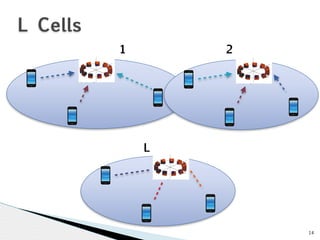
L Cells 
1 2 
L
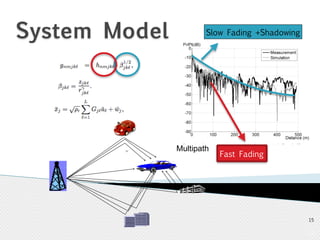
System Model 
15 
x 
S3 Multipath 
h n 
15 
Slow Fading +Shadowing 
Fast Fading
16 
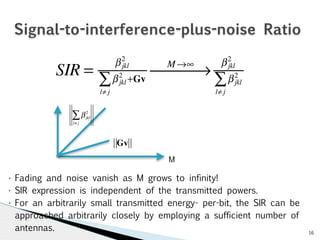
Signal-to-interference-plus-noise Ratio 
SIR = β jkl 
2 
β jkl 
2 +Gv 
l≠j Σ 
⎯M⎯→⎯∞→ β jkl 
2 
β 2 
jkl 
l≠j Σ 
M 
β 2 
jkl 
l≠j Σ 
Gv 
• Fading and noise vanish as M grows to infinity! 
• SIR expression is independent of the transmitted powers. 
• For an arbitrarily small transmitted energy- per-bit, the SIR can be 
approached arbitrarily closely by employing a sufficient number of 
antennas.
17 
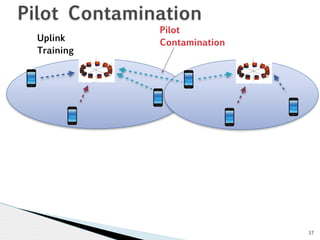
Pilot Contamination 
Uplink 
Training 
Pilot 
Contamination
18 
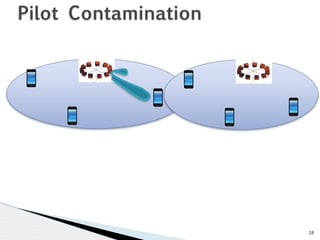
Pilot Contamination
19 
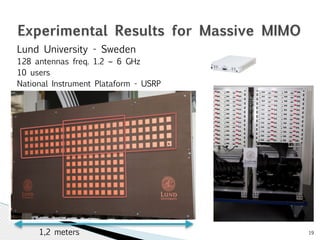
Experimental Results for Massive MIMO 
Lund University - Sweden 
128 antennas freq. 1.2 ~ 6 GHz 
10 users 
National Instrument Plataform - USRP 
1,2 meters
20 
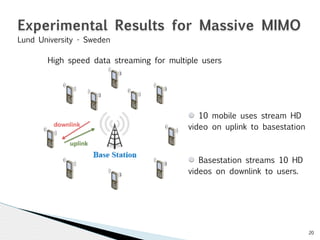
Experimental Results for Massive MIMO 
Lund University - Sweden 
High speed data streaming for multiple users 
10 mobile uses stream HD 
video on uplink to basestation 
Basestation streams 10 HD 
videos on downlink to users.
21 
Experimental Results for Massive MIMO 
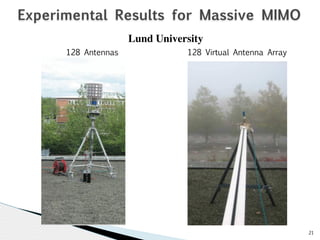
Lund University 
128 Antennas 128 Virtual Antenna Array
22 
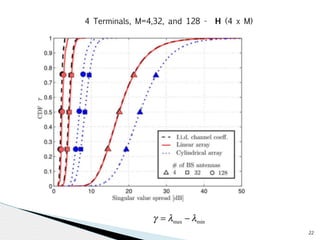
γ = λmax −λmin 
γ 
4 Terminals, M=4,32, and 128 - H (4 x M)
23 
Experimental Results for Massive MIMO 
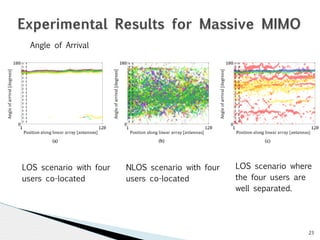
LOS scenario with four 
users co-located 
NLOS scenario with four 
users co-located 
LOS scenario where 
the four users are 
well separated. 
Angle of Arrival
24 
Experimental Results for Massive MIMO 
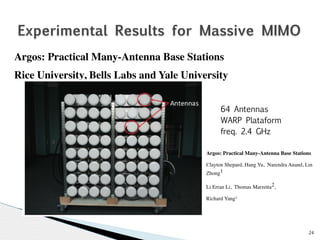
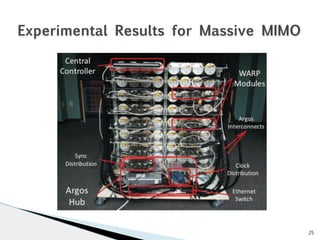
Argos: Practical Many-Antenna Base Stations 
Rice University, Bells Labs and Yale University 
64 Antennas 
WARP Plataform 
freq. 2.4 GHz 
Argos: Practical Many-Antenna Base Stations 
Clayton Shepard, Hang Yu, Narendra Anand, Lin 
Zhong1 
Li Erran Li, Thomas Marzetta2, 
Richard Yang3
25 
Experimental Results for Massive MIMO
26 
# 
! !" 
& 
= 
$ $% 
h h 
11 12 
h h 
21 22 
H 
11 h 
22 h 
21 h 
12 h 
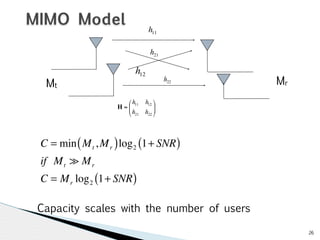
MIMO Model 
Mt Mr 
C = min Mt ,Mr ( )log2 (1+ SNR) 
if Mt ≫ Mr 
C = Mr log2 (1+ SNR) 
Capacity scales with the number of users
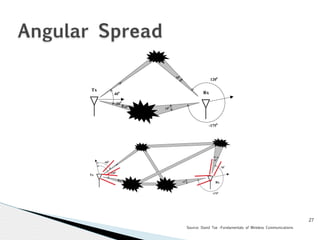
Angular Spread 
Source: David Tse –Fundamentals of Wireless Communications 
27
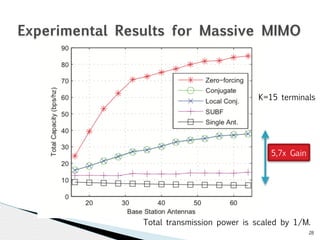
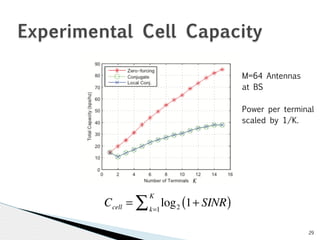
K=15 terminals 
28 
Experimental Results for Massive MIMO 
5,7x Gain 
Total transmission power is scaled by 1/M.
M=64 Antennas 
at BS 
Power per terminal 
scaled by 1/K. 
29 
Experimental Cell Capacity 
K Σ 
K 
Ccell = log2 (1+ SINR) k=1
30 
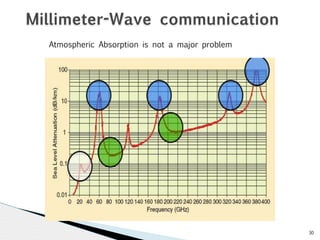
Millimeter-Wave communication 
Atmospheric Absorption is not a major problem
Channel Modeling for millimeter Wave 
• Parameters 
– Free Space Attenuation 
– Path Loss Exponent 
– AOA (Angle of Arrival) and AOD (Angle of 
Departure) 
– Penetration loss
32 
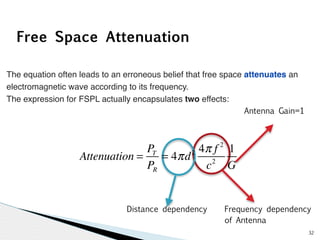
Free Space Attenuation 
The equation often leads to an erroneous belief that free space attenuates an 
electromagnetic wave according to its frequency. 
The expression for FSPL actually encapsulates two effects: 
Distance dependency Frequency dependency 
of Antenna 
Attenuation = PT 
PR 
= 4π d2 4π f 2 
c2 
1 
G 
Antenna Gain=1
33 
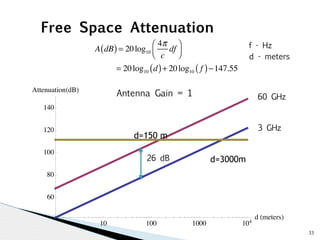
Free Space Attenuation 
d=150 m 
10 100 1000 104 
60 GHz 
d HmetersL 
AttenuationHdBL 
140 
120 
100 
80 
60 
3 GHz 
26 dB 
d=3000m 
A(dB) = 20log10 
4π 
c 
df ⎛⎝ ⎜ 
⎞⎠ ⎟ 
= 20log10 (d)+ 20log10 ( f )−147.55 
f - Hz 
d - meters 
Antenna Gain = 1
34 
λ −2 
Free Space Attenuation 
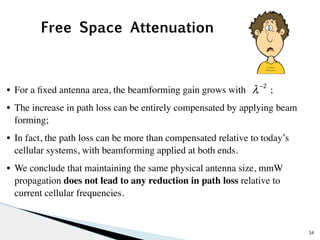
• For a fixed antenna area, the beamforming gain grows with ; 
• The increase in path loss can be entirely compensated by applying beam 
forming; 
• In fact, the path loss can be more than compensated relative to today’s 
cellular systems, with beamforming applied at both ends. 
• We conclude that maintaining the same physical antenna size, mmW 
propagation does not lead to any reduction in path loss relative to 
current cellular frequencies.
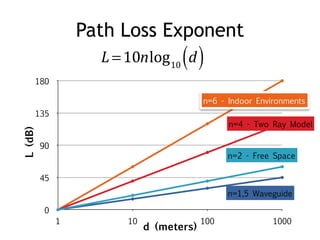
Path Loss Exponent 
L =10nlog10 (d) 
180 
135 
90 
45 
0 
n=6 - Indoor Environments 
n=4 - Two Ray Model 
n=2 - Free Space 
n=1,5 Waveguide 
1 10 100 1000 
d (meters) 
L (dB)
36 
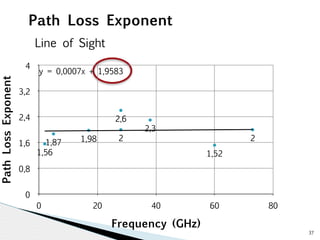
Path Loss Exponent 
Frequency LOS NLOS Distance Reference 
900 MHz 5.3 30-400 [7] 
1800 MHz 5.5 30-400 [7] 
2 GHz 1,56 1-20 [4] 
2,3 GHz 6 30-400 [7] 
5 GHz 1,87 1-20 [4] 
17 GHz 1,98 1-20 [4] 
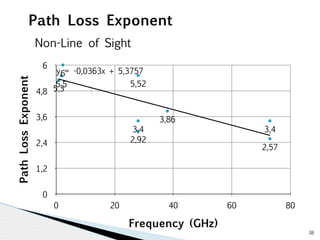
28 GHz 2 2,92 30 — 200 [1] 
28 GHZ 2,6 3,4 1—100 [2] 
28 GHz 5,52 1-100 [9] 
38 GHz 2.3 3.86 [10] 
60 GHz 1,52 0,5 — 3 [5] 
73 GHz 2 2,57 30 — 200 [1] 
73 GHz 2 3,4 1—100 [2]
4 
y = 0,0007x + 1,9583 
Exponent 
3,2 
2,4 
2,6 
2,3 
Loss 1,6 
1,87 1,98 2 
2 
1,56 
1,52 
Path 0,8 
0 
0 20 40 60 80 
Frequency (GHz) 
37 Path Loss Exponent 
Line of Sight
38 
Path Loss Exponent 
6 
4,8 
3,6 
2,4 
1,2 
0 
y = -0,0363x + 5,3757 
55,3,5 
5,52 
3,4 
3,4 
0 20 40 60 80 
Frequency (GHz) 
6 
2,92 
3,86 
2,57 
Path Loss Exponent 
Non-Line of Sight
39 
Penetration Loss 
Frequency Loss (dB) Material Reference 
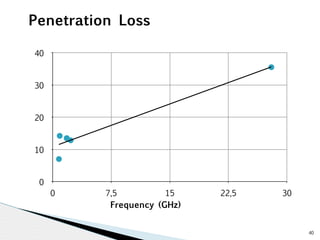
800 MHz 7 Wall [6] 
900 MHz 14,2 Wall [7] 
1.8 GHz 13,5 Wall [3] 
1,8 GHz 13,4 Wall [7] 
2,3 GHz 12,8 Wall [7] 
28 GHz 35,5 Wall [8]
40 
Penetration Loss 
40 
30 
20 
10 
0 
0 7,5 15 22,5 30 
Frequency (GHz)
41 
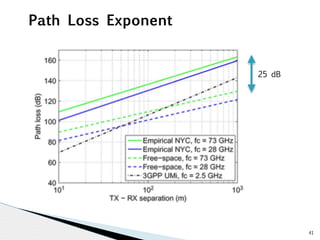
Path Loss Exponent 
25 dB
42 
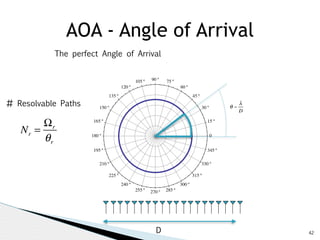
AOA - Angle of Arrival 
15 ° 
0 
30 ° 
45 ° 
60 ° 
105 ° 90 ° 75 ° 
120 ° 
135 ° 
150 ° 
165 ° 
180 ° 
195 ° 
210 ° 
225 ° 
240 ° 
255 ° 270 ° 285 ° 
300 ° 
330 ° 
315 ° 
345 ° 
The perfect Angle of Arrival 
D 
θ ~ 
λ 
D 
# Resolvable Paths 
Nr = Ωr 
θ r
AOA - Angle of Arrival 
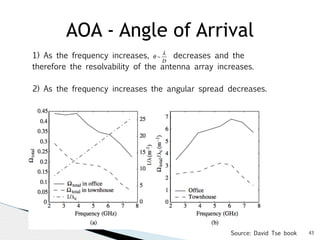
1) As the frequency increases, decreases and the 
therefore the resolvability of the antenna array increases. 
2) As the frequency increases the angular spread decreases. 
43 
θ ~ 
λ 
D 
Source: David Tse book
44 
AOA - Angle of Arrival 
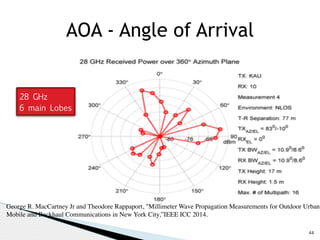
28 GHz 
6 main Lobes 
George R. MacCartney Jr and Theodore Rappaport, "Millimeter Wave Propagation Measurements for Outdoor Urban 
Mobile and Backhaul Communications in New York City,”IEEE ICC 2014.
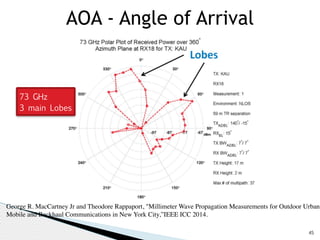
George R. MacCartney Jr and Theodore Rappaport, "Millimeter Wave Propagation Measurements for Outdoor Urban 
Mobile and Backhaul Communications in New York City,”IEEE ICC 2014. 
45 
AOA - Angle of Arrival 
73 GHz 
3 main Lobes
46 
AOA - Angle of Arrival 
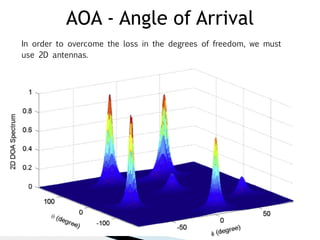
In order to overcome the loss in the degrees of freedom, we must 
use 2D antennas.
47 
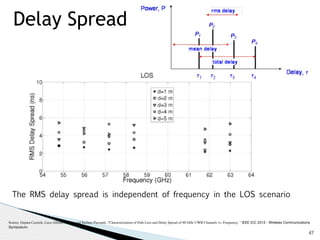
Delay Spread 
The RMS delay spread is independent of frequency in the LOS scenario 
Source: Dajana Cassioli, Luca Alfredo Annoni and Stefano Piersanti, “Characterization of Path Loss and Delay Spread of 60-GHz UWB Channels vs. Frequency, “ IEEE ICC 2013 - Wireless Communications 
Symposium.
48 
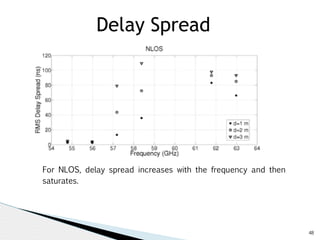
Delay Spread 
For NLOS, delay spread increases with the frequency and then 
saturates.
49 
Set of measurements at 10 GHz 
- Penetration loss 
- AOA 
- Knife edge diffraction 
- Delay Spread 
Prof. Matti Latva-Aho 
PhD. Student Claudio F. Dias
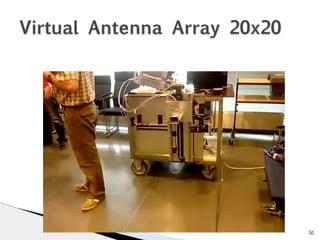
50 
Virtual Antenna Array 20x20
51 
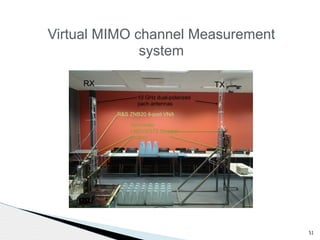
Virtual MIMO channel Measurement 
system 
RX TX 
10 GHz dual-polarized 
pach antennas 
R&S ZNB20 4-port VNA 
Schneider 
LMDCE572 Stepper 
motors
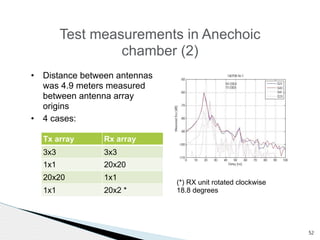
52 
Test measurements in Anechoic 
• Distance between antennas 
was 4.9 meters measured 
between antenna array 
origins 
• 4 cases: 
chamber (2) 
Tx array Rx array 
3x3 3x3 
1x1 20x20 
20x20 1x1 
1x1 20x2 * 
(*) RX unit rotated clockwise 
18.8 degrees
53 
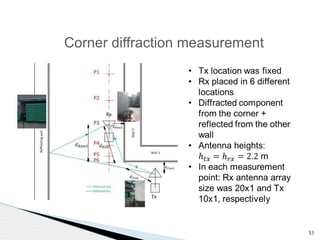
Corner diffraction measurement
54 
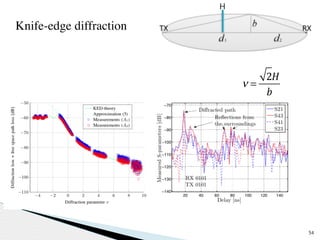
Knife-edge diffraction 
ν = 
2H 
b 
H
55 
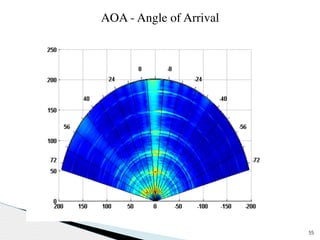
AOA - Angle of Arrival
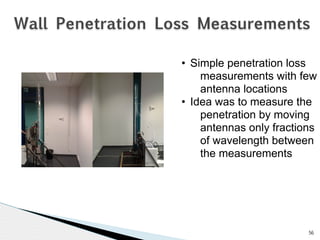
Wall Penetration Loss Measurements 
56 
• Simple penetration loss 
measurements with few 
antenna locations 
• Idea was to measure the 
penetration by moving 
antennas only fractions 
of wavelength between 
the measurements
57 
Conclusions 
Benefits from the (many) excess antennas 
Simplified multiuser processing (MRC and MRT) 
Reduced transmit power 
Thermal noise and fast fading vanish 
mmW Communication 
Narrow-beam communication is new to cellular 
communications and poses difficulties. 
Free space does not increase as frequency increases 
(keeping the same effective antenna area). 
Penetration loss is the new problem (on-off behavior of 
the channel). 
The loss of degrees of freedom, as frequency increases, 
may be compensated using 2D antennas. 
We need 3D channel modeling to better understand all the 
physical phenomena.
58 
References 
[1] - Mustafa Riza Akdeniz, Yuanpeng Liu, Mathew K. Samimi, Shu Sun, Student Member, IEEE, Sundeep Rangan, 
Theodore S. Rappaport, and Elza Erkip, "Millimeter Wave Channel Modeling and Cellular Capacity Evaluation,”, IEEE 
JOURNAL ON SELECTED AREAS IN COMMUNICATIONS, VOL. 32, NO. 6, JUNE 2014. 
[2] - Millimeter Wave Cellular Ultra-Wideband Statistical Channel Model for NonLine of Sight Millimeter-Wave Urban 
Channels Communications: Channel Models, Capacity Limits, Challenges and Opportunities 
Prof. Ted Rappaport NYU WIRELESS, NYU Polytechnic School of Engineering, Joint work with Sundeep Rangan and Elza 
Erkip. 
[3] - A. F. Toledo, D. GJ Lewis, and A.M.D. Turkmani, "Radio Propagation into Buildings at 1.8 GHz” 
[4] P. Nobles, and F. Halsall, "Delay Spread and Received Power Measurements within a Building at 2GHz, 5 GHz and 17 
Ghz,” 
[5] - Maria-Teresa Martinez-Ingles, Davy P. Gaillot, Juan Pascual-Garcia, Jose-Maria Molina-Garcia-Pardo, Martine Lienard, 
and José-Víctor Rodríguez, “Deterministic and Experimental Indoor mmW Channel Modeling, “IEEE ANTENNAS AND 
WIRELESS PROPAGATION LETTERS, VOL. 13, 2014 1047. 
[6] -D. Cox, "Measurements of 800 MHz Radio Transmission 
Into Buildings with Metallic Walls”, The Bell System Technical Journal 1983 
[7] - A. F. Toledo, , Adel Turlmani, and David Parsons, "Estimating Coverage of Radio Transmission into and within 
Buildings at 900, 1800, and 2300 MHz,” IEEE Personal Communications April 1998. 
[8] - Hao Xu, Member, IEEE, Vikas Kukshya, Member, IEEE, and Theodore S. Rappaport, Fellow, IEEE , “Spatial and 
Temporal Characteristics of 60-GHz Indoor Channels, “IEEE JOURNAL ON SELECTED AREAS IN COMMUNICATIONS, VOL. 
20, NO. 3, APRIL 2002. 
[9] - Mathew Samimi, Kevin Wang, Yaniv Azar, George N. Wong, Rimma Mayzus, Hang Zhao, Jocelyn K. Schulz, Shu Sun, 
Felix Gutierrez, Jr., and Theodore S. Rappaport , 28 GHz Angle of Arrival and Angle of Departure Analysis for Outdoor 
Cellular Communications using Steerable Beam Antennas in New York City, VTC 2013. 
[10] - Theodore S. Rappaport, Yijun Qiao, Jonathan I. Tamir, James N. Murdock, Eshar Ben-Dor , “Cellular Broadband 
Millimeter Wave Propagation and Angle of Arrival for Adaptive Beam Steering Systems (Invited Paper),”RWS 2012. 
[11] - Dajana Cassioli, Luca Alfredo Annoni and Stefano Piersanti, “Characterization of Path Loss and Delay Spread of 60- 
GHz UWB Channels vs. Frequency, “ IEEE ICC 2013 - Wireless Communications Symposium.
59

Channel Models for Massive MIMO

  • 1.
    Massive MIMO and Channel Modeling for Millimeter Wave Gustavo Fraidenraich Engenharia Elétrica Departamento de Comunicações Unicamp 1
  • 2.
    Achieving 10000x capacity Source: IEEE Spectrum, July 2004, n. 7 2 10x Performance 20x Spectrum 50x Base Stations = 10000x Performance Massive MIMO mmWave Densification
  • 3.
    What is MassiveMIMO? T. L. Marzetta, “The case for MANY (greater than 16) antennas as the base station,” in Proc. ITA, San Diego, CA, USA, Jan. 2007. Thomas L. Marzetta , "Noncooperative Cellular Wireless with Unlimited Numbers of Base Station Antennas ,” IEEE Trans. Commun. 2010. BS User 1 User 2 User K 3 M M-1 1 2
  • 4.
    4 Antenna ArrayGain 1 Element 1.0 0.5 0.0 -0.5 1.0 0.5 10 1.0 0.5 0.0 -0.5 10 Elements 20 Elements -1.0 -0.5 0.0 0.5 1.0 20 Elements -1.0 -0.5 0.0 0.5 1.0 -1.0 N=1 0.0 -0.5 -1.0 -1.0 -0.5 0.0 0.5 1.0 1.0 0.5 0.0 -0.5 -1.0 20 -1.0 -0.5 0.0 0.5 1.0 -1.0 5 2 Elements Antenna Aperture λ / D D
  • 5.
    5 What isMassive MIMO Essentially multiuser MIMO with lots of base station antennas Hundreds Tens of Users of BS antennas A very large antenna array at each base station A large number of users are served simultaneously An excess of base station (BS) antennas
  • 6.
    6 Maximal RatioCombining Uplink BS User M * 1 2 * h1 * h2 hM Σ h2 h1 hM
  • 7.
    7 Maximal RatioTransmission Downlink BS User M 1 2 h2 h1 hM * * * Knowledge of the Channel at the transmitter side. Reciprocity! h1 h2 hM
  • 8.
    8 Bit ErrorProbability Maximal Ratio Combining y = x + z Pb = Q 2Eb N0 ⎛ ⎝ ⎜ ⎞ ⎠ ⎟ y = [hhh!h]x + z 1 2 3M y = hx + z h†y MRC M Pb = 1 2 1− γ b γ b + M ⎛ ⎞ ⎟ ⎠ ⎜⎝ M −1+ k M−1 Σ 1 k ⎛ ⎝ ⎜ ⎞ ⎠ ⎟ k=0 2 + 1 2 γ b γ b + M ⎛ ⎝ ⎜ ⎞ ⎠ ⎟ k AWGN Channel AWGN Channel +Fading with γ Diversity b = Eb N0
  • 9.
    9 Maximal RatioCombining Bit Error Probability 0 5 10 15 20 1 0.1 0.01 0.001 10-4 10-5 10-6 M=1 M=2 M=8 M=50 Only Gaussian Noise 17 dB
  • 10.
    10 Averaging theFast Fading 20 N=1 N=2 N=4 N=200 4 0 −20 −40 −60 −80 −100 0 1 2 3 4 5 6 7 8 9 10 4 x 10 20 0 −20 −40 −60 −80 −100 −120 0 1 2 3 4 5 6 7 8 9 10 4 x 10 20 10 0 −10 −20 −30 −40 −50 −60 0 1 2 3 4 5 6 7 8 9 10 x 10 −120 0 1 2 3 4 5 6 7 8 9 10 4 x 10 20 0 −20 −40 −60 −80 −100 −120 Power (dBm) distance distance Power (dBm) Power (dBm) Power (dBm) distance distance
  • 11.
    11 Maximal RatioCombining h1 h2 Geometrical Interpretation h3 h4 h5 |h1|2 |h2|2 |h3|2 |h4|2 |h5|2
  • 12.
    12 System Model h1 h2 hK x1 x2 xK Processing for user i KΣ y = xihi i=1 + z *y M 1 M hi * →1 hihi 1 M * →0 hihj
  • 13.
    13 MRT Precoding MASSIVE MIMO FOR NEXT GENERATION WIRELESS SYSTEMS Erik G. Larsson, ISY, Linköping University, Sweden Ove Edfors, Lund University, Sweden Fredrik Tufvesson, Lund University, Sweden Thomas L. Marzetta, Bell Labs, Alcatel-Lucent, USA
  • 14.
    14 L Cells 1 2 L
  • 15.
    System Model 15 x S3 Multipath h n 15 Slow Fading +Shadowing Fast Fading
  • 16.
    16 Signal-to-interference-plus-noise Ratio SIR = β jkl 2 β jkl 2 +Gv l≠j Σ ⎯M⎯→⎯∞→ β jkl 2 β 2 jkl l≠j Σ M β 2 jkl l≠j Σ Gv • Fading and noise vanish as M grows to infinity! • SIR expression is independent of the transmitted powers. • For an arbitrarily small transmitted energy- per-bit, the SIR can be approached arbitrarily closely by employing a sufficient number of antennas.
  • 17.
    17 Pilot Contamination Uplink Training Pilot Contamination
  • 18.
  • 19.
    19 Experimental Resultsfor Massive MIMO Lund University - Sweden 128 antennas freq. 1.2 ~ 6 GHz 10 users National Instrument Plataform - USRP 1,2 meters
  • 20.
    20 Experimental Resultsfor Massive MIMO Lund University - Sweden High speed data streaming for multiple users 10 mobile uses stream HD video on uplink to basestation Basestation streams 10 HD videos on downlink to users.
  • 21.
    21 Experimental Resultsfor Massive MIMO Lund University 128 Antennas 128 Virtual Antenna Array
  • 22.
    22 γ =λmax −λmin γ 4 Terminals, M=4,32, and 128 - H (4 x M)
  • 23.
    23 Experimental Resultsfor Massive MIMO LOS scenario with four users co-located NLOS scenario with four users co-located LOS scenario where the four users are well separated. Angle of Arrival
  • 24.
    24 Experimental Resultsfor Massive MIMO Argos: Practical Many-Antenna Base Stations Rice University, Bells Labs and Yale University 64 Antennas WARP Plataform freq. 2.4 GHz Argos: Practical Many-Antenna Base Stations Clayton Shepard, Hang Yu, Narendra Anand, Lin Zhong1 Li Erran Li, Thomas Marzetta2, Richard Yang3
  • 25.
    25 Experimental Resultsfor Massive MIMO
  • 26.
    26 # !!" & = $ $% h h 11 12 h h 21 22 H 11 h 22 h 21 h 12 h MIMO Model Mt Mr C = min Mt ,Mr ( )log2 (1+ SNR) if Mt ≫ Mr C = Mr log2 (1+ SNR) Capacity scales with the number of users
  • 27.
    Angular Spread Source:David Tse –Fundamentals of Wireless Communications 27
  • 28.
    K=15 terminals 28 Experimental Results for Massive MIMO 5,7x Gain Total transmission power is scaled by 1/M.
  • 29.
    M=64 Antennas atBS Power per terminal scaled by 1/K. 29 Experimental Cell Capacity K Σ K Ccell = log2 (1+ SINR) k=1
  • 30.
    30 Millimeter-Wave communication Atmospheric Absorption is not a major problem
  • 31.
    Channel Modeling formillimeter Wave • Parameters – Free Space Attenuation – Path Loss Exponent – AOA (Angle of Arrival) and AOD (Angle of Departure) – Penetration loss
  • 32.
    32 Free SpaceAttenuation The equation often leads to an erroneous belief that free space attenuates an electromagnetic wave according to its frequency. The expression for FSPL actually encapsulates two effects: Distance dependency Frequency dependency of Antenna Attenuation = PT PR = 4π d2 4π f 2 c2 1 G Antenna Gain=1
  • 33.
    33 Free SpaceAttenuation d=150 m 10 100 1000 104 60 GHz d HmetersL AttenuationHdBL 140 120 100 80 60 3 GHz 26 dB d=3000m A(dB) = 20log10 4π c df ⎛⎝ ⎜ ⎞⎠ ⎟ = 20log10 (d)+ 20log10 ( f )−147.55 f - Hz d - meters Antenna Gain = 1
  • 34.
    34 λ −2 Free Space Attenuation • For a fixed antenna area, the beamforming gain grows with ; • The increase in path loss can be entirely compensated by applying beam forming; • In fact, the path loss can be more than compensated relative to today’s cellular systems, with beamforming applied at both ends. • We conclude that maintaining the same physical antenna size, mmW propagation does not lead to any reduction in path loss relative to current cellular frequencies.
  • 35.
    Path Loss Exponent L =10nlog10 (d) 180 135 90 45 0 n=6 - Indoor Environments n=4 - Two Ray Model n=2 - Free Space n=1,5 Waveguide 1 10 100 1000 d (meters) L (dB)
  • 36.
    36 Path LossExponent Frequency LOS NLOS Distance Reference 900 MHz 5.3 30-400 [7] 1800 MHz 5.5 30-400 [7] 2 GHz 1,56 1-20 [4] 2,3 GHz 6 30-400 [7] 5 GHz 1,87 1-20 [4] 17 GHz 1,98 1-20 [4] 28 GHz 2 2,92 30 — 200 [1] 28 GHZ 2,6 3,4 1—100 [2] 28 GHz 5,52 1-100 [9] 38 GHz 2.3 3.86 [10] 60 GHz 1,52 0,5 — 3 [5] 73 GHz 2 2,57 30 — 200 [1] 73 GHz 2 3,4 1—100 [2]
  • 37.
    4 y =0,0007x + 1,9583 Exponent 3,2 2,4 2,6 2,3 Loss 1,6 1,87 1,98 2 2 1,56 1,52 Path 0,8 0 0 20 40 60 80 Frequency (GHz) 37 Path Loss Exponent Line of Sight
  • 38.
    38 Path LossExponent 6 4,8 3,6 2,4 1,2 0 y = -0,0363x + 5,3757 55,3,5 5,52 3,4 3,4 0 20 40 60 80 Frequency (GHz) 6 2,92 3,86 2,57 Path Loss Exponent Non-Line of Sight
  • 39.
    39 Penetration Loss Frequency Loss (dB) Material Reference 800 MHz 7 Wall [6] 900 MHz 14,2 Wall [7] 1.8 GHz 13,5 Wall [3] 1,8 GHz 13,4 Wall [7] 2,3 GHz 12,8 Wall [7] 28 GHz 35,5 Wall [8]
  • 40.
    40 Penetration Loss 40 30 20 10 0 0 7,5 15 22,5 30 Frequency (GHz)
  • 41.
    41 Path LossExponent 25 dB
  • 42.
    42 AOA -Angle of Arrival 15 ° 0 30 ° 45 ° 60 ° 105 ° 90 ° 75 ° 120 ° 135 ° 150 ° 165 ° 180 ° 195 ° 210 ° 225 ° 240 ° 255 ° 270 ° 285 ° 300 ° 330 ° 315 ° 345 ° The perfect Angle of Arrival D θ ~ λ D # Resolvable Paths Nr = Ωr θ r
  • 43.
    AOA - Angleof Arrival 1) As the frequency increases, decreases and the therefore the resolvability of the antenna array increases. 2) As the frequency increases the angular spread decreases. 43 θ ~ λ D Source: David Tse book
  • 44.
    44 AOA -Angle of Arrival 28 GHz 6 main Lobes George R. MacCartney Jr and Theodore Rappaport, "Millimeter Wave Propagation Measurements for Outdoor Urban Mobile and Backhaul Communications in New York City,”IEEE ICC 2014.
  • 45.
    George R. MacCartneyJr and Theodore Rappaport, "Millimeter Wave Propagation Measurements for Outdoor Urban Mobile and Backhaul Communications in New York City,”IEEE ICC 2014. 45 AOA - Angle of Arrival 73 GHz 3 main Lobes
  • 46.
    46 AOA -Angle of Arrival In order to overcome the loss in the degrees of freedom, we must use 2D antennas.
  • 47.
    47 Delay Spread The RMS delay spread is independent of frequency in the LOS scenario Source: Dajana Cassioli, Luca Alfredo Annoni and Stefano Piersanti, “Characterization of Path Loss and Delay Spread of 60-GHz UWB Channels vs. Frequency, “ IEEE ICC 2013 - Wireless Communications Symposium.
  • 48.
    48 Delay Spread For NLOS, delay spread increases with the frequency and then saturates.
  • 49.
    49 Set ofmeasurements at 10 GHz - Penetration loss - AOA - Knife edge diffraction - Delay Spread Prof. Matti Latva-Aho PhD. Student Claudio F. Dias
  • 50.
    50 Virtual AntennaArray 20x20
  • 51.
    51 Virtual MIMOchannel Measurement system RX TX 10 GHz dual-polarized pach antennas R&S ZNB20 4-port VNA Schneider LMDCE572 Stepper motors
  • 52.
    52 Test measurementsin Anechoic • Distance between antennas was 4.9 meters measured between antenna array origins • 4 cases: chamber (2) Tx array Rx array 3x3 3x3 1x1 20x20 20x20 1x1 1x1 20x2 * (*) RX unit rotated clockwise 18.8 degrees
  • 53.
  • 54.
  • 55.
    55 AOA -Angle of Arrival
  • 56.
    Wall Penetration LossMeasurements 56 • Simple penetration loss measurements with few antenna locations • Idea was to measure the penetration by moving antennas only fractions of wavelength between the measurements
  • 57.
    57 Conclusions Benefitsfrom the (many) excess antennas Simplified multiuser processing (MRC and MRT) Reduced transmit power Thermal noise and fast fading vanish mmW Communication Narrow-beam communication is new to cellular communications and poses difficulties. Free space does not increase as frequency increases (keeping the same effective antenna area). Penetration loss is the new problem (on-off behavior of the channel). The loss of degrees of freedom, as frequency increases, may be compensated using 2D antennas. We need 3D channel modeling to better understand all the physical phenomena.
  • 58.
    58 References [1]- Mustafa Riza Akdeniz, Yuanpeng Liu, Mathew K. Samimi, Shu Sun, Student Member, IEEE, Sundeep Rangan, Theodore S. Rappaport, and Elza Erkip, "Millimeter Wave Channel Modeling and Cellular Capacity Evaluation,”, IEEE JOURNAL ON SELECTED AREAS IN COMMUNICATIONS, VOL. 32, NO. 6, JUNE 2014. [2] - Millimeter Wave Cellular Ultra-Wideband Statistical Channel Model for NonLine of Sight Millimeter-Wave Urban Channels Communications: Channel Models, Capacity Limits, Challenges and Opportunities Prof. Ted Rappaport NYU WIRELESS, NYU Polytechnic School of Engineering, Joint work with Sundeep Rangan and Elza Erkip. [3] - A. F. Toledo, D. GJ Lewis, and A.M.D. Turkmani, "Radio Propagation into Buildings at 1.8 GHz” [4] P. Nobles, and F. Halsall, "Delay Spread and Received Power Measurements within a Building at 2GHz, 5 GHz and 17 Ghz,” [5] - Maria-Teresa Martinez-Ingles, Davy P. Gaillot, Juan Pascual-Garcia, Jose-Maria Molina-Garcia-Pardo, Martine Lienard, and José-Víctor Rodríguez, “Deterministic and Experimental Indoor mmW Channel Modeling, “IEEE ANTENNAS AND WIRELESS PROPAGATION LETTERS, VOL. 13, 2014 1047. [6] -D. Cox, "Measurements of 800 MHz Radio Transmission Into Buildings with Metallic Walls”, The Bell System Technical Journal 1983 [7] - A. F. Toledo, , Adel Turlmani, and David Parsons, "Estimating Coverage of Radio Transmission into and within Buildings at 900, 1800, and 2300 MHz,” IEEE Personal Communications April 1998. [8] - Hao Xu, Member, IEEE, Vikas Kukshya, Member, IEEE, and Theodore S. Rappaport, Fellow, IEEE , “Spatial and Temporal Characteristics of 60-GHz Indoor Channels, “IEEE JOURNAL ON SELECTED AREAS IN COMMUNICATIONS, VOL. 20, NO. 3, APRIL 2002. [9] - Mathew Samimi, Kevin Wang, Yaniv Azar, George N. Wong, Rimma Mayzus, Hang Zhao, Jocelyn K. Schulz, Shu Sun, Felix Gutierrez, Jr., and Theodore S. Rappaport , 28 GHz Angle of Arrival and Angle of Departure Analysis for Outdoor Cellular Communications using Steerable Beam Antennas in New York City, VTC 2013. [10] - Theodore S. Rappaport, Yijun Qiao, Jonathan I. Tamir, James N. Murdock, Eshar Ben-Dor , “Cellular Broadband Millimeter Wave Propagation and Angle of Arrival for Adaptive Beam Steering Systems (Invited Paper),”RWS 2012. [11] - Dajana Cassioli, Luca Alfredo Annoni and Stefano Piersanti, “Characterization of Path Loss and Delay Spread of 60- GHz UWB Channels vs. Frequency, “ IEEE ICC 2013 - Wireless Communications Symposium.
  • 59.