Unit 5
Frequency domain Analysis
Prajakta J Pardeshi
MITCOE
Pune
Introduction
 Time-Domain analysis:
Impulse, unit step, ramp, etc. are used as
input to the system
 Frequency-Domain Analysis:
Frequency Response of a system is the
response of the system for sinusoidal input
signal of various frequencies
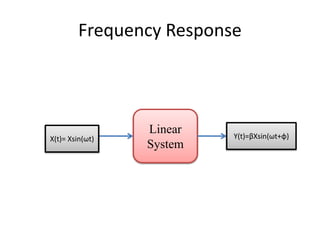
Frequency Response
Linear
System
X(t)= Xsin(ωt) Y(t)=βXsin(ωt+φ)
Need
• Extraction of Transfer function from Time domain is
difficult using differential equations
• Using Frequency Response, Transfer Function can be
easily obtained from the experimental data
• A system may be designed, so that effects of noise are
negligible
• Analysis & Design are extended to certain non-linear
control systems
• The design of controller can be easily done in the
frequency domain method, as compared to time-
domain method
Specifications
1. Resonant Frequency (ωr):
The frequency at which the system has
maximum magnitude is known as the
resonant frequency. At this, the slope of
magnitude curve is zero
2. Resonant Peak (Mr):
Maximum value of magnitude.
Mr= 1- 1.5
3. Cut-off Frequency:
The frequency at which the magnitude G(jω) is
0.707 times less than its, maximum value is
known as cut-off frequency.
4. Bandwidth: For feedback control systems, the
range of frequencies over which M is equal to or
greater than 0.707Mr is defined as bandwidth ωb
When Mr=1, Bandwidth = Cut-off frequency
The bandwidth of a control system indicates the
noise-filtering characteristics of the system.
5. Cut off Rate:
Rate of change of slope of magnitude at cut-off frequency
6. Gain Margin:
Amount of gain in decibels that can be added to the loop
before the closed loop system becomes unstable
Gain Crossover: The Point at which the magnitude plot
crossover 0dB
7. Phase Margin:
Amount of phase shift in degrees that can be added to the
loop before the closed loop system becomes unstable
Phase Crossover: The Point at which the phase plot
crosses is 180°
BODE PLOT
• Purpose:
1. To draw the frequency response of OLTF
2. To find the closed loop system stability
3. To find the relative stability by using GM &
PM
• The Bode Plot consists of two parts:
1. Magnitude Plot
2. Phase Plot
BODE PLOT
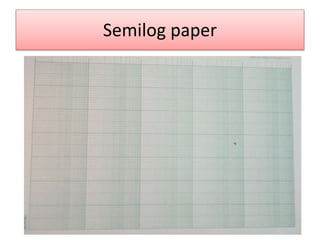
Semilog paper
Basic Procedure
1. Replace s jω, to convert it into frequency
domain
2. Write the magnitude & Convert it into dB
Magnitude = 20log G(j ω)
3. Find the φ angle
4. Vary ‘ω’ from min to max value & draw the
approximate magnitude & Phase plot
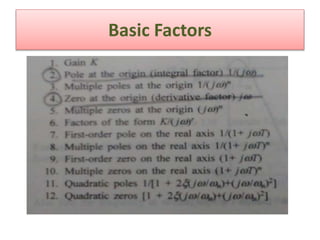
Basic Factors
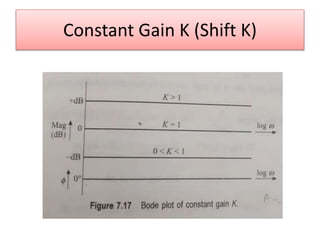
Constant Gain K (Shift K)
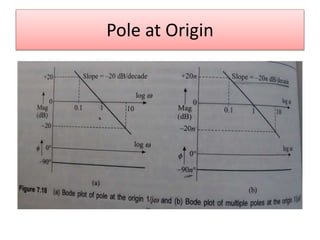
Pole at Origin
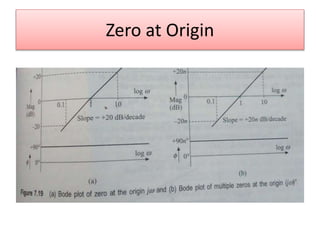
Zero at Origin
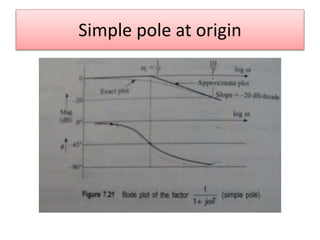
Simple pole at origin
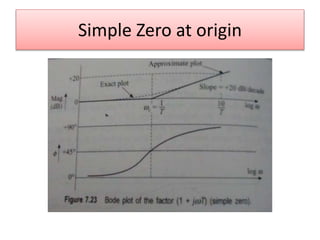
Simple Zero at origin
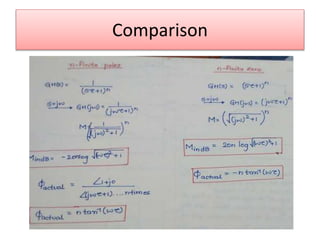
Comparison
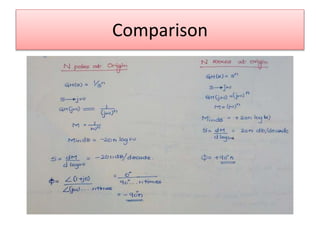
Comparison
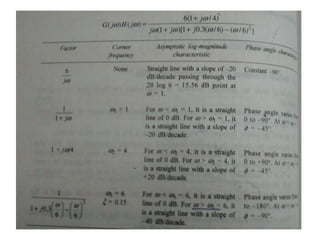
1. Express given G(s)H(s) in time constant form
2. Draw a line of 20LogK dB
3. Draw a line of appropriate slope representing poles or zeros at the
origin, passing through intersection point of ω=1 and 0 dB
4. Shift this intersection point on 20LogK line and draw parallel line
to the line drawn in step 3
5. Change the slope of this line at various corner frequencies by
appropriate value. For a pole, slope must be changed by -
20dB/Decade, For a simple zero slope changed by
+20dB/Decade .
• Continue this slope line, till it intersects last
corner frequency
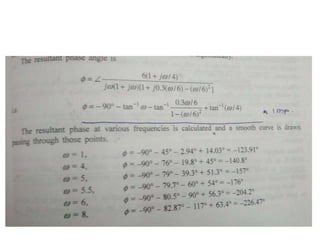
6. Prepare the phase angle plot and table & obtain the table of ω and
resultant phase angle φR by actual calculation.
7. Plot these points , & Draw a smooth curve obtaining necessary
phase angle plot
Steps to sketch Bode Plot
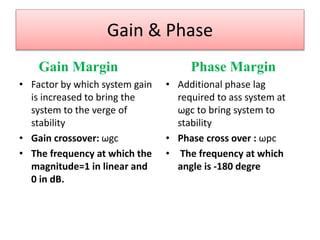
Gain & Phase
Gain Margin
• Factor by which system gain
is increased to bring the
system to the verge of
stability
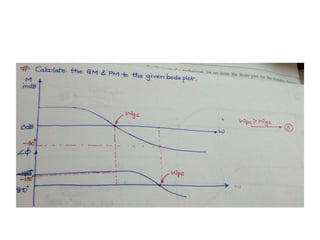
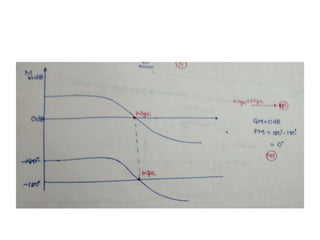
• Gain crossover: ωgc
• The frequency at which the
magnitude=1 in linear and
0 in dB.
Phase Margin
• Additional phase lag
required to ass system at
ωgc to bring system to
stability
• Phase cross over : ωpc
• The frequency at which
angle is -180 degre
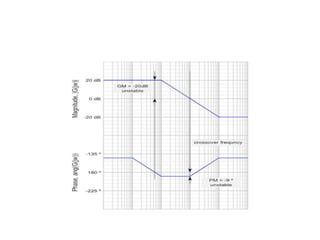
• Gain Margin
• The gain margin (GM) is the factor by which the gain is less than the
neutral stability value. We can usually read the gain margin directly from
the bode plot. This is done by calculating the vertical distance between
the curve and the at the frequency.
• Phase Margin
• Another quantity related to determining stability margin is the phase
margin (PM). This is a different way to measure how well stability
conditions are met in a given system. Phase margin is determined by how
much the phase of exceeds.
• The above figure shows that, for a system to be stable, a positive PM is
required. From the figures, we can also see that the GM indicates the
amount that the gain can increase before a system becomes unstable.
The PM is calculated by measuring the difference between the and when
crosses the circle . The stable case receives the phase margin’s positive
value.
Crossover Frequency
• A gain of factor 1 (equivalent to 0 dB) where both input
and output are at the same voltage level and
impedance is known as unity gain. When the gain is at
this frequency, it is often referred to as crossover
frequency.
• Frequency-response design is practical because we can
easily evaluate how gain changes affect certain aspects
of systems. With frequency-response design, we can
determine the phase margin for any value of without
needing to redraw the magnitude or phase
information. All we have to do is indicate where for
certain trial values of
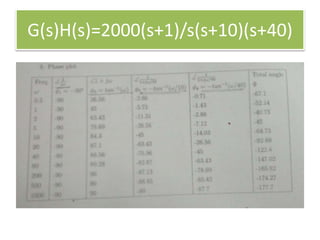
G(s)H(s)=2000(s+1)/s(s+10)(s+40)
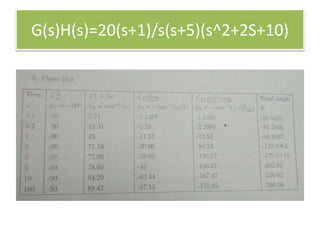
G(s)H(s)=20(s+1)/s(s+5)(s^2+2S+10)

Unit 4 frequency response-Bode plot

  • 1.
    Unit 5 Frequency domainAnalysis Prajakta J Pardeshi MITCOE Pune
  • 2.
    Introduction  Time-Domain analysis: Impulse,unit step, ramp, etc. are used as input to the system  Frequency-Domain Analysis: Frequency Response of a system is the response of the system for sinusoidal input signal of various frequencies
  • 3.
  • 4.
    Need • Extraction ofTransfer function from Time domain is difficult using differential equations • Using Frequency Response, Transfer Function can be easily obtained from the experimental data • A system may be designed, so that effects of noise are negligible • Analysis & Design are extended to certain non-linear control systems • The design of controller can be easily done in the frequency domain method, as compared to time- domain method
  • 5.
    Specifications 1. Resonant Frequency(ωr): The frequency at which the system has maximum magnitude is known as the resonant frequency. At this, the slope of magnitude curve is zero 2. Resonant Peak (Mr): Maximum value of magnitude. Mr= 1- 1.5
  • 6.
    3. Cut-off Frequency: Thefrequency at which the magnitude G(jω) is 0.707 times less than its, maximum value is known as cut-off frequency. 4. Bandwidth: For feedback control systems, the range of frequencies over which M is equal to or greater than 0.707Mr is defined as bandwidth ωb When Mr=1, Bandwidth = Cut-off frequency The bandwidth of a control system indicates the noise-filtering characteristics of the system.
  • 7.
    5. Cut offRate: Rate of change of slope of magnitude at cut-off frequency 6. Gain Margin: Amount of gain in decibels that can be added to the loop before the closed loop system becomes unstable Gain Crossover: The Point at which the magnitude plot crossover 0dB 7. Phase Margin: Amount of phase shift in degrees that can be added to the loop before the closed loop system becomes unstable Phase Crossover: The Point at which the phase plot crosses is 180°
  • 8.
    BODE PLOT • Purpose: 1.To draw the frequency response of OLTF 2. To find the closed loop system stability 3. To find the relative stability by using GM & PM
  • 9.
    • The BodePlot consists of two parts: 1. Magnitude Plot 2. Phase Plot BODE PLOT
  • 10.
  • 11.
    Basic Procedure 1. Replaces jω, to convert it into frequency domain 2. Write the magnitude & Convert it into dB Magnitude = 20log G(j ω) 3. Find the φ angle 4. Vary ‘ω’ from min to max value & draw the approximate magnitude & Phase plot
  • 12.
  • 13.
    Constant Gain K(Shift K)
  • 14.
  • 15.
  • 16.
  • 17.
  • 18.
  • 19.
  • 20.
    1. Express givenG(s)H(s) in time constant form 2. Draw a line of 20LogK dB 3. Draw a line of appropriate slope representing poles or zeros at the origin, passing through intersection point of ω=1 and 0 dB 4. Shift this intersection point on 20LogK line and draw parallel line to the line drawn in step 3 5. Change the slope of this line at various corner frequencies by appropriate value. For a pole, slope must be changed by - 20dB/Decade, For a simple zero slope changed by +20dB/Decade . • Continue this slope line, till it intersects last corner frequency 6. Prepare the phase angle plot and table & obtain the table of ω and resultant phase angle φR by actual calculation. 7. Plot these points , & Draw a smooth curve obtaining necessary phase angle plot Steps to sketch Bode Plot
  • 21.
    Gain & Phase GainMargin • Factor by which system gain is increased to bring the system to the verge of stability • Gain crossover: ωgc • The frequency at which the magnitude=1 in linear and 0 in dB. Phase Margin • Additional phase lag required to ass system at ωgc to bring system to stability • Phase cross over : ωpc • The frequency at which angle is -180 degre
  • 23.
    • Gain Margin •The gain margin (GM) is the factor by which the gain is less than the neutral stability value. We can usually read the gain margin directly from the bode plot. This is done by calculating the vertical distance between the curve and the at the frequency. • Phase Margin • Another quantity related to determining stability margin is the phase margin (PM). This is a different way to measure how well stability conditions are met in a given system. Phase margin is determined by how much the phase of exceeds. • The above figure shows that, for a system to be stable, a positive PM is required. From the figures, we can also see that the GM indicates the amount that the gain can increase before a system becomes unstable. The PM is calculated by measuring the difference between the and when crosses the circle . The stable case receives the phase margin’s positive value.
  • 24.
    Crossover Frequency • Again of factor 1 (equivalent to 0 dB) where both input and output are at the same voltage level and impedance is known as unity gain. When the gain is at this frequency, it is often referred to as crossover frequency. • Frequency-response design is practical because we can easily evaluate how gain changes affect certain aspects of systems. With frequency-response design, we can determine the phase margin for any value of without needing to redraw the magnitude or phase information. All we have to do is indicate where for certain trial values of
  • 27.
  • 30.