ME 176
Control Systems Engineering
    Steady-State Errors


                               Department of
                   Mechanical Engineering
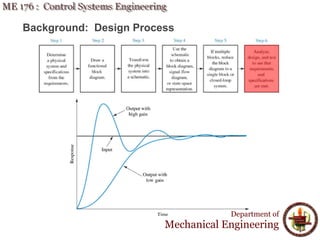
Background: Design Process


                                    Department of
                        Mechanical Engineering
Background: Analysis & Design Objectives
    "Analysis is the process by which a system's performance is determined."

 "Design is the process by which a systems performance is created or changed."

   Transient Response                  Steady State Error
   Steady State Response               Stability


                                                            Department of
                                        Mechanical Engineering
Background: Steady-State Error
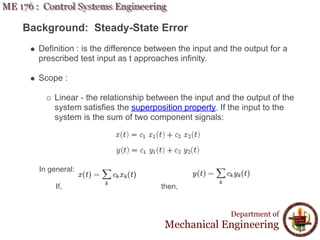
  Definition : is the difference between the input and the output for a
  prescribed test input as t approaches infinity.

  Scope :

       Linear - the relationship between the input and the output of the
       system satisfies the superposition property. If the input to the
       system is the sum of two component signals:


   In general:

        If,                        then,


                                                       Department of
                                    Mechanical Engineering
Background: Steady-State Error
  Scope :

      Time invariant systems - are systems that can be modeled with a
      transfer function that is not a function of time except expressed
      by the input and output.

  "Meaning, that whether we apply an input to the system now or T
  seconds from now, the output will be identical, except for a time delay
  of the T seconds. If the output due to input x (t ) is y (t ), then the output
  due to input x (t − T ) is y (t − T ). More specifically, an input affected by
  a time delay should effect a corresponding time delay in the output,
  hence time-invariant."


      STABLE


                                                         Department of
                                      Mechanical Engineering
Background: Steady-State Error

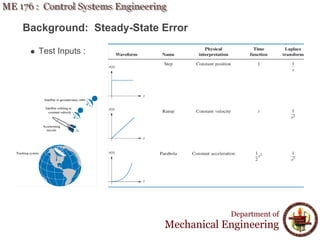
  Test Inputs :


                                     Department of
                         Mechanical Engineering
Evaluating: Steady-State Error
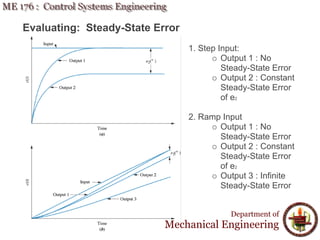
                                 1. Step Input:
                                          Output 1 : No
                                          Steady-State Error
                                          Output 2 : Constant
                                          Steady-State Error
                                          of e2

                                 2. Ramp Input
                                        Output 1 : No
                                        Steady-State Error
                                        Output 2 : Constant
                                        Steady-State Error
                                        of e2
                                        Output 3 : Infinite
                                        Steady-State Error


                                            Department of
                           Mechanical Engineering
Representation: Steady-State Error


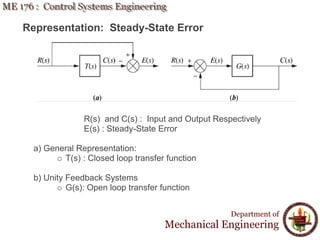
               R(s) and C(s) : Input and Output Respectively
               E(s) : Steady-State Error

  a) General Representation:
         T(s) : Closed loop transfer function

  b) Unity Feedback Systems
           G(s): Open loop transfer function


                                                    Department of
                                     Mechanical Engineering
Sources: Steady-State Error


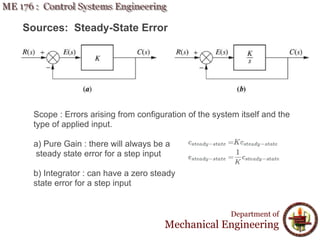
  Scope : Errors arising from configuration of the system itself and the
  type of applied input.

  a) Pure Gain : there will always be a
  steady state error for a step input

  b) Integrator : can have a zero steady
  state error for a step input


                                                       Department of
                                     Mechanical Engineering
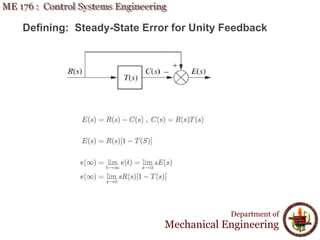
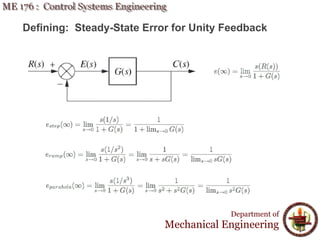
Defining: Steady-State Error for Unity Feedback


                                       Department of
                           Mechanical Engineering
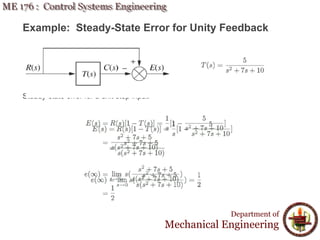
Example: Steady-State Error for Unity Feedback


Steady-state error for a unit step input:


                                                        Department of
                                            Mechanical Engineering
Defining: Steady-State Error for Unity Feedback


                                       Department of
                           Mechanical Engineering
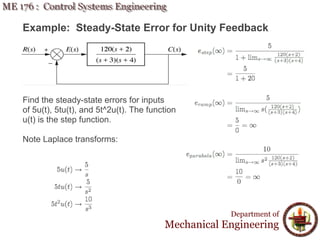
Example: Steady-State Error for Unity Feedback


Find the steady-state errors for inputs
of 5u(t), 5tu(t), and 5t^2u(t). The function
u(t) is the step function.

Note Laplace transforms:


                                                    Department of
                                        Mechanical Engineering
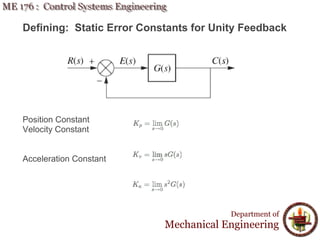
Defining: Static Error Constants for Unity Feedback


Position Constant
Velocity Constant


Acceleration Constant


                                        Department of
                           Mechanical Engineering
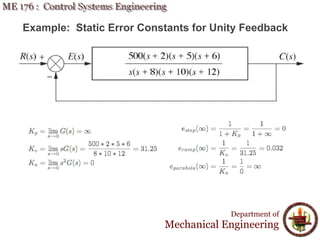
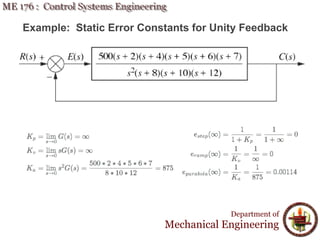
Example: Static Error Constants for Unity Feedback


                                       Department of
                          Mechanical Engineering
Example: Static Error Constants for Unity Feedback


                                       Department of
                          Mechanical Engineering
Example: Static Error Constants for Unity Feedback


                                       Department of
                          Mechanical Engineering
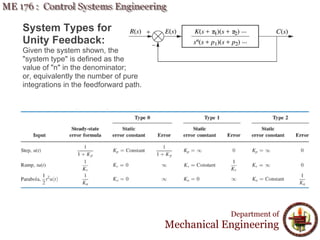
System Types for
Unity Feedback:
Given the system shown, the
"system type" is defined as the
value of "n" in the denominator;
or, equivalently the number of pure
integrations in the feedforward path.


                                                    Department of
                                        Mechanical Engineering
Specifications: Steady-State Error

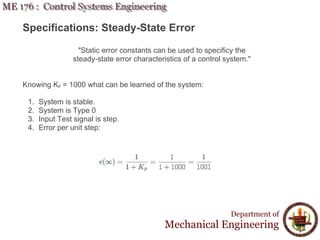
                   "Static error constants can be used to specificy the
                 steady-state error characteristics of a control system."


Knowing Kp = 1000 what can be learned of the system:

 1.   System is stable.
 2.   System is Type 0
 3.   Input Test signal is step.
 4.   Error per unit step:


                                                                  Department of
                                             Mechanical Engineering
Example: Steady-State Error Specification


Find K so that there is a 10% error in steady state.
     Since system is Type 1, error stated must apply to ramp function.


                                                               Department of
                                           Mechanical Engineering
Analysis: Steady-State Error for Disturbances


                                 "Steady-state error produced by a step
                                 function can be reduced by increasing
                                 the gain of G1(s) or decreasing the
                                 gain of G2(s)."


                                             Department of
                           Mechanical Engineering
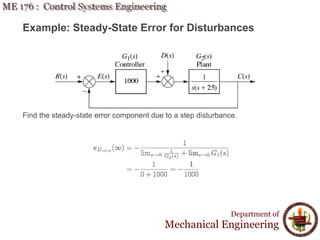
Example: Steady-State Error for Disturbances


Find the steady-state error component due to a step disturbance.


                                                              Department of
                                          Mechanical Engineering
Definition: Steady-State Error for Nonunity Feedback

                                     Move R(s) to right
                                     of summing
                                     junction.

                                     Compute resulting
                                     G(s) and H(s).

                                     Add and subtract
                                     unity feedback
                                     paths.

                                     Combine negative
                                     feedback path to H
                                     (s).

                                     Combine feedback
                                     system consisting
                                     of G(s) and [H(s)
                                     -1].
                                          Department of
                           Mechanical Engineering
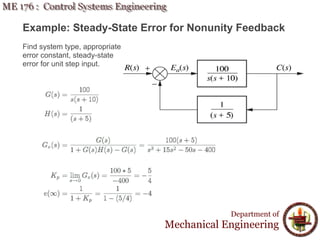
Example: Steady-State Error for Nonunity Feedback
Find system type, appropriate
error constant, steady-state
error for unit step input.


                                            Department of
                                Mechanical Engineering
Definition: Steady-State Error for Nonunity Feedback
          w/ Disturbances


General form:               For step input and step distrubances:


                                              Department of
                           Mechanical Engineering
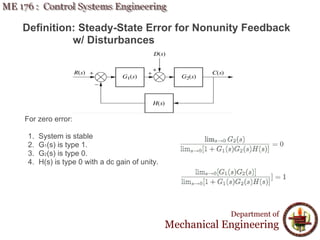
Definition: Steady-State Error for Nonunity Feedback
          w/ Disturbances


For zero error:

 1.   System is stable
 2.   G1(s) is type 1.
 3.   G2(s) is type 0.
 4.   H(s) is type 0 with a dc gain of unity.


                                                            Department of
                                                Mechanical Engineering
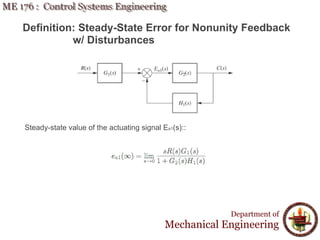
Definition: Steady-State Error for Nonunity Feedback
          w/ Disturbances


Steady-state value of the actuating signal Ea1(s)::


                                                        Department of
                                            Mechanical Engineering
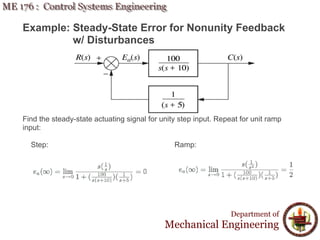
Example: Steady-State Error for Nonunity Feedback
         w/ Disturbances


Find the steady-state actuating signal for unity step input. Repeat for unit ramp
input:

  Step:                                        Ramp:


                                                                 Department of
                                            Mechanical Engineering
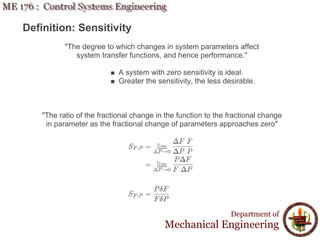
Definition: Sensitivity
           "The degree to which changes in system parameters affect
              system transfer functions, and hence performance."

                            A system with zero sensitivity is ideal.
                            Greater the sensitivity, the less desirable.


    "The ratio of the fractional change in the function to the fractional change
     in parameter as the fractional change of parameters approaches zero"


                                                                Department of
                                          Mechanical Engineering
Example: Sensitivity


Calculate sensitivity of the closed-loop transfer function to changes in parameter a:

  Closed-loop transfer function:


                                                                Department of
                                            Mechanical Engineering
Example: Sensitivity


Calculate sensitivity of the closed-loop transfer function to changes in parameter K
and a, with ramp inputs:


                                                                Department of
                                           Mechanical Engineering

Lecture 12 ME 176 6 Steady State Error

  • 1.
    ME 176 Control SystemsEngineering Steady-State Errors Department of Mechanical Engineering
  • 2.
    Background: Design Process Department of Mechanical Engineering
  • 3.
    Background: Analysis &Design Objectives "Analysis is the process by which a system's performance is determined." "Design is the process by which a systems performance is created or changed." Transient Response Steady State Error Steady State Response Stability Department of Mechanical Engineering
  • 4.
    Background: Steady-State Error Definition : is the difference between the input and the output for a prescribed test input as t approaches infinity. Scope : Linear - the relationship between the input and the output of the system satisfies the superposition property. If the input to the system is the sum of two component signals: In general: If, then, Department of Mechanical Engineering
  • 5.
    Background: Steady-State Error Scope : Time invariant systems - are systems that can be modeled with a transfer function that is not a function of time except expressed by the input and output. "Meaning, that whether we apply an input to the system now or T seconds from now, the output will be identical, except for a time delay of the T seconds. If the output due to input x (t ) is y (t ), then the output due to input x (t − T ) is y (t − T ). More specifically, an input affected by a time delay should effect a corresponding time delay in the output, hence time-invariant." STABLE Department of Mechanical Engineering
  • 6.
    Background: Steady-State Error Test Inputs : Department of Mechanical Engineering
  • 7.
    Evaluating: Steady-State Error 1. Step Input: Output 1 : No Steady-State Error Output 2 : Constant Steady-State Error of e2 2. Ramp Input Output 1 : No Steady-State Error Output 2 : Constant Steady-State Error of e2 Output 3 : Infinite Steady-State Error Department of Mechanical Engineering
  • 8.
    Representation: Steady-State Error R(s) and C(s) : Input and Output Respectively E(s) : Steady-State Error a) General Representation: T(s) : Closed loop transfer function b) Unity Feedback Systems G(s): Open loop transfer function Department of Mechanical Engineering
  • 9.
    Sources: Steady-State Error Scope : Errors arising from configuration of the system itself and the type of applied input. a) Pure Gain : there will always be a steady state error for a step input b) Integrator : can have a zero steady state error for a step input Department of Mechanical Engineering
  • 10.
    Defining: Steady-State Errorfor Unity Feedback Department of Mechanical Engineering
  • 11.
    Example: Steady-State Errorfor Unity Feedback Steady-state error for a unit step input: Department of Mechanical Engineering
  • 12.
    Defining: Steady-State Errorfor Unity Feedback Department of Mechanical Engineering
  • 13.
    Example: Steady-State Errorfor Unity Feedback Find the steady-state errors for inputs of 5u(t), 5tu(t), and 5t^2u(t). The function u(t) is the step function. Note Laplace transforms: Department of Mechanical Engineering
  • 14.
    Defining: Static ErrorConstants for Unity Feedback Position Constant Velocity Constant Acceleration Constant Department of Mechanical Engineering
  • 15.
    Example: Static ErrorConstants for Unity Feedback Department of Mechanical Engineering
  • 16.
    Example: Static ErrorConstants for Unity Feedback Department of Mechanical Engineering
  • 17.
    Example: Static ErrorConstants for Unity Feedback Department of Mechanical Engineering
  • 18.
    System Types for UnityFeedback: Given the system shown, the "system type" is defined as the value of "n" in the denominator; or, equivalently the number of pure integrations in the feedforward path. Department of Mechanical Engineering
  • 19.
    Specifications: Steady-State Error "Static error constants can be used to specificy the steady-state error characteristics of a control system." Knowing Kp = 1000 what can be learned of the system: 1. System is stable. 2. System is Type 0 3. Input Test signal is step. 4. Error per unit step: Department of Mechanical Engineering
  • 20.
    Example: Steady-State ErrorSpecification Find K so that there is a 10% error in steady state. Since system is Type 1, error stated must apply to ramp function. Department of Mechanical Engineering
  • 21.
    Analysis: Steady-State Errorfor Disturbances "Steady-state error produced by a step function can be reduced by increasing the gain of G1(s) or decreasing the gain of G2(s)." Department of Mechanical Engineering
  • 22.
    Example: Steady-State Errorfor Disturbances Find the steady-state error component due to a step disturbance. Department of Mechanical Engineering
  • 23.
    Definition: Steady-State Errorfor Nonunity Feedback Move R(s) to right of summing junction. Compute resulting G(s) and H(s). Add and subtract unity feedback paths. Combine negative feedback path to H (s). Combine feedback system consisting of G(s) and [H(s) -1]. Department of Mechanical Engineering
  • 24.
    Example: Steady-State Errorfor Nonunity Feedback Find system type, appropriate error constant, steady-state error for unit step input. Department of Mechanical Engineering
  • 25.
    Definition: Steady-State Errorfor Nonunity Feedback w/ Disturbances General form: For step input and step distrubances: Department of Mechanical Engineering
  • 26.
    Definition: Steady-State Errorfor Nonunity Feedback w/ Disturbances For zero error: 1. System is stable 2. G1(s) is type 1. 3. G2(s) is type 0. 4. H(s) is type 0 with a dc gain of unity. Department of Mechanical Engineering
  • 27.
    Definition: Steady-State Errorfor Nonunity Feedback w/ Disturbances Steady-state value of the actuating signal Ea1(s):: Department of Mechanical Engineering
  • 28.
    Example: Steady-State Errorfor Nonunity Feedback w/ Disturbances Find the steady-state actuating signal for unity step input. Repeat for unit ramp input: Step: Ramp: Department of Mechanical Engineering
  • 29.
    Definition: Sensitivity "The degree to which changes in system parameters affect system transfer functions, and hence performance." A system with zero sensitivity is ideal. Greater the sensitivity, the less desirable. "The ratio of the fractional change in the function to the fractional change in parameter as the fractional change of parameters approaches zero" Department of Mechanical Engineering
  • 30.
    Example: Sensitivity Calculate sensitivityof the closed-loop transfer function to changes in parameter a: Closed-loop transfer function: Department of Mechanical Engineering
  • 31.
    Example: Sensitivity Calculate sensitivityof the closed-loop transfer function to changes in parameter K and a, with ramp inputs: Department of Mechanical Engineering