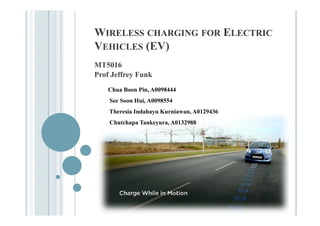
WWIRELESSSS CCHARGGINNGG FOOR ELECCTRICC 
VEHICLES (EV) 
MT5016 
Prof Jeffrey Funk 
Chua Boon Pin, A0098444 
See Soon Hui, A0098554 
TThheerreessiiaa IInnddaahhaayyuu KKuurrnniiaawwaann,, AA00112299443366 
Chutchapa Tankeyura, A0132988
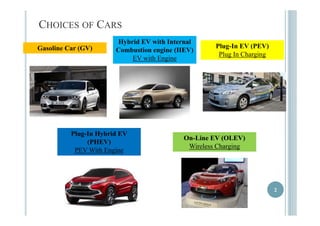
CHOICES OF CARS 
Hybrid EV with Internal 
Combustion engine (HEV) 
Gasoline Car (GV) Plug-In EV (PEV) 
g Plug In Charging 
EV with Engine 
Plug-In Hybrid EV OOnn--LLiinnee EEVV ((OOLLEEVV)) 
(PHEV) Wireless Charging 
PEV With Engine 
2
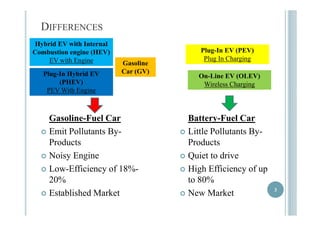
DIFFERENCES 
G li 
Hybrid EV with Internal 
Combustion engine (HEV) 
EV with Plug-In EV (PEV) 
Plug In Charging Gasoline 
Car (GV) 
Engine 
Plug-In Hybrid EV 
(PHEV) 
g g g 
On-Line EV (OLEV) 
Wireless Charging 
PEV With Engine 
g g 
Gasoline-Fuel Car 
 Emit Pollutants By- 
Battery-Fuel Car 
 Little Pollutants By- 
Products 
 Noisy Engine 
Products 
 Quiet to drive 
 Low-Efficiency of 18%- 
 High Efficiency of up 
20% 
to 80% 
 E bli h Established dM k Market  N New M k Market 
3
FRAME WORK 
 Market Selection 
 Technology 
 Cost Comparison 
 Value Proposition & Business Model 
 Strategic Control 
4
MMAARRKKEETT SSEELLEECCTTIIOONN 
5
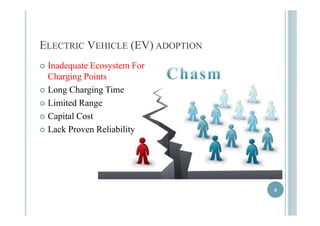
ELECTRIC VEHICLE (EV) ADOPTION 
 Inadequate Ecosystem For 
Charging Points 
 LLong CChhargiing TTiime 
 Limited Range 
 CCapiitall CCost 
 Lack Proven Reliability 
6
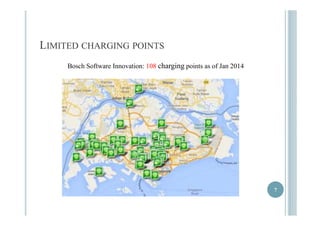
LIMITED CHARGING POINTS 
Bosch Software Innovation: 108 charging points as of Jan 2014 
7
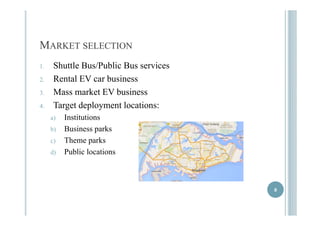
MARKET SELECTION 
1. Shuttle Bus/Public Bus services 
2. Rental EV car business 
3. Mass market EV business 
4. Target deployment locations: 
a) Institutions 
b) Business parks 
c)) TThheme parkks 
d) Public locations 
8
TTEECCHHNNOOLLOOGGYY 
9
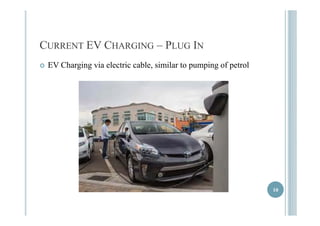
CURRENT EV CHARGING – PLUG IN 
 EV Charging via electric cable, similar to pumping of petrol 
10
WIRELESS CHARGING 
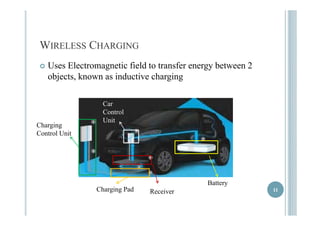
 Uses Electromagnetic field to transfer energy between 2 
objects, known as inductive charging 
Car 
Control 
Charging 
Control Unit 
Unit 
Charging R i 
Battery 
Pad Receiver 1111
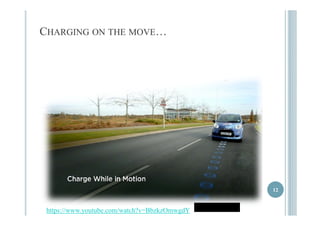
CHARGING ON THE MOVE… 
12 
https://www.youtube.com/watch?v=BbzkzOmwgdY
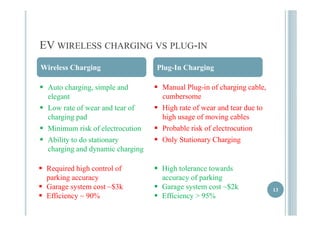
EV WIRELESS CHARGING VS PLUG-IN 
Wireless Charging Plug-In Charging 
 Auto charging charging, simple and 
 Manual Plug cable 
elegant 
 Low rate of wear and tear of 
Plug-in of charging cable, 
cumbersome 
 High rate of wear and tear due to 
charging pad 
 Minimum risk of electrocution 
 Abilit t d t ti 
high usage of moving cables 
 Probable risk of electrocution 
Ability to do stationary  Onl Only Stationar Stationary Charging 
charging and dynamic charging 
13 
 Required high control of 
parking accuracy 
 Garage system cost ~$3k g y  High tolerance towards 
accuracy of parking 
 Garage system cost ~$2k 
 Efficiency > 95% 
g y 
 Efficiency ~ 90%
AADDVVAANNTTAAGGEESS FFOORR OOLLEEVVSS 
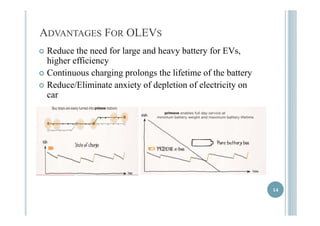
 Reduce the need for large and heavy battery for EVs, 
hhiigghheerr eeffffiicciieennccyy 
 Continuous charging prolongs the lifetime of the battery 
 RReedduuccee//EElliimmiinnaattee aannxxiieettyy ooff ddeepplleettiioonn ooff eelleeccttrriicciittyy oonn 
car 
14
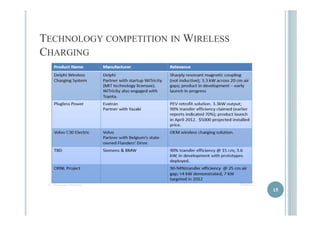
TTEECCHHNNOOLLOOGGYY CCOOMMPPEETTIITTIIOONN IINNWWIIRREELLEESSSS 
CHARGING 
15
CCOOSSTT CCOOMMPPAARRIISSOONN 
16
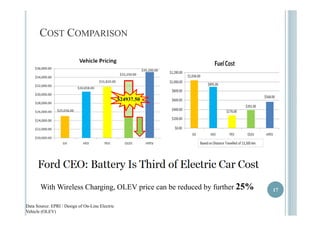
CCOOSSTT CCOOMMPPAARRIISSOONN 
$24937.50 
Huge Potential 
for Price 
Reduction 
With Wireless Charggingg,, OLEV pprice can be reduced byy further 25% 1177 
Data Source: EPRI / Design of On-Line Electric 
Vehicle (OLEV)
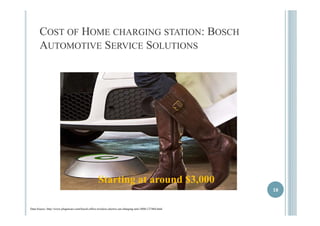
COST OF HOME CHARGING STATION: BOSCH 
AUTOMOTIVE SERVICE SOLUTIONS 
18 
Starting at around $3,000 
Data Source: http://www.plugincars.com/bosch-offers-wireless-electric-car-charging-unit-3000-127468.html
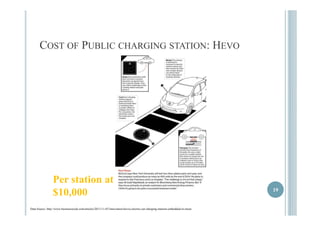
COST OF PUBLIC CHARGING STATION: HEVO 
19 
Per station at 
$$1100,000000 Data Source: http://www.businessweek.com/articles/2013-11-07/innovation-hevos-electric-car-charging-stations-embedded-in-street
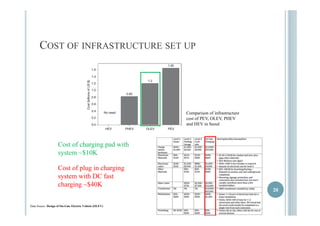
COST OF INFRASTRUCTURE SET UP 
CCoommppaarriissoonn ooff iinnffrraassttrruuccttuurree 
cost of PEV, OLEV, PHEV 
and HEV in Seoul 
Cost of charging pad with 
system ~$10K 
20 
Cost of plug in charging 
system with DC fast 
charging ~$40K 
Data Source: Design of On-Line Electric Vehicle (OLEV)
VVAALLUUEE PPRROOPPOOSSIITTIIOONN 
21
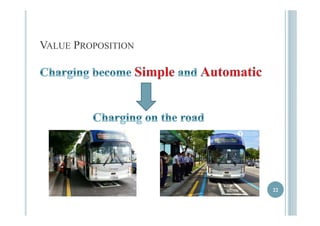
VALUE PROPOSITION 
22
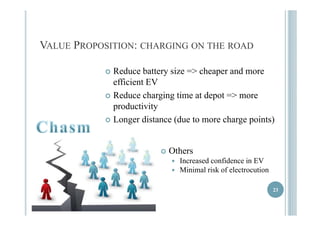
VALUE PROPOSITION: CHARGING ON THE ROAD 
 Reduce battery size => cheaper and more 
efficient EV 
 Reduce charging time at depot => more 
productivity 
 Longer distance (due to more charge points) 
 Others 
 Increased confidence in EV 
 Minimal risk of electrocution 
23
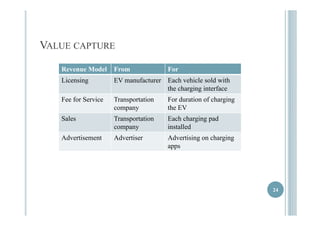
VALUE CAPTURE 
Revenue Model From For 
Licensing EV manufacturer Each vehicle sold with 
tthhe chhargiing iintterfface 
Fee for Service Transportation 
company 
For duration of charging 
the EV 
Sales Transportation 
company 
Each charging pad 
installed 
AAddvveerrttiisseemmeenntt AAddvveerrttiisseerr AAddvveerrttiissiinngg oonn cchhaarrggiinngg 
apps 
24
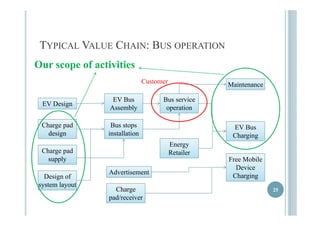
TYPICAL VALUE CHAIN: BUS OPERATION 
O f ti iti 
Customer Maintenance 
Our scope of activities 
EV Design EV Bus 
Bus service 
Assembly operation 
Charge pad 
Bus stops 
design installation 
g g 
EV Bus 
Charging 
Energy 
Charge pad Retailer 
supply Free Mobile 
Device 
Charging 
Advertisement 
Charge 
25 
Design of 
system layout 
pad/receiver
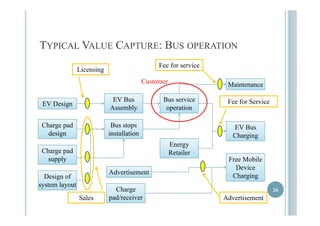
TYPICAL VALUE CAPTURE: BUS OPERATION 
Maintenance 
Licensing Fee for service 
Customer 
EV Design EV Bus 
Bus service 
Assembly operation 
Fee for Service 
Charge pad 
Bus stops 
design installation 
g g 
EV Bus 
Charging 
Energy 
Charge pad Retailer 
supply Free Mobile 
Device 
Charging 
Advertisement 
Charge 
26 
Design of 
system layout 
Sales 
pad/receiver Advertisement
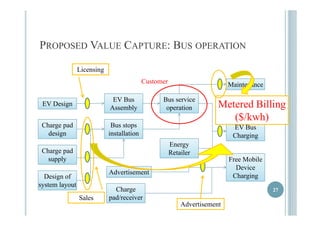
PROPOSED VALUE CAPTURE: BUS OPERATION 
Maintenance 
Licensing 
Customer 
EV Design EV Bus 
Bus service 
Assembly operation Metered Billing 
($/k h) 
Bus stops 
installation 
EV Bus 
Charging 
Charge pad 
design 
kwh) 
g g 
Energy 
Charge pad Retailer 
supply Free Mobile 
Device 
Charging 
Advertisement 
Charge 
27 
Design of 
system layout 
pad/receiver 
Advertisement 
Sales
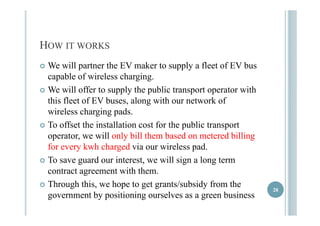
HOW IT WORKS 
 We will partner the EV maker to supply a fleet of EV bus 
capable of wireless charging. 
 WWe wiillll offffer tto supplly tthhe pubblliic ttransportt operattor wiitthh 
this fleet of EV buses, along with our network of 
wwiirreelleessss cchhaarrggiinngg ppaaddss. 
 To offset the installation cost for the public transport 
ooppeerraattoorr,, wwee wwiillll oonnllyy bbiillll tthheemm bbaasseedd oonn mmeetteerreedd bbiilllliinngg 
for every kwh charged via our wireless pad. 
 To save gguard our interest,, we will siggn a longg term 
contract agreement with them. 
 Through this, we hope to get grants/subsidy from the 28 
government by positioning ourselves as a green business
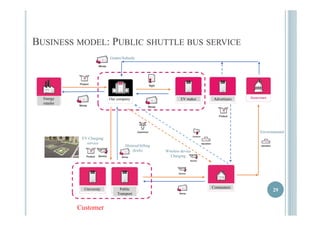
BUSINESS MODEL: PUBLIC SHUTTLE BUS SERVICE 
Grants/Subsidy 
Energy Our company EV maker 
retailer 
Advertisers 
EV Environmental 
Charging 
service 
Wireless device 
Charging 
Metered billing 
(kwh) 
UUnniivveerrssiittyy PPuubblliicc Commuters 29 
Transport 
Customer
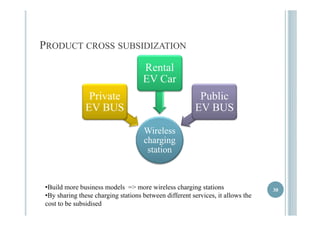
PRODUCT CROSS SUBSIDIZATION 
Rental 
EV Car 
Private 
EV BUS 
Public 
EV BUS 
Wireless 
chhargiing 
station 
•Build more business models => more wireless charggingg stations 3300 
•By sharing these charging stations between different services, it allows the 
cost to be subsidised
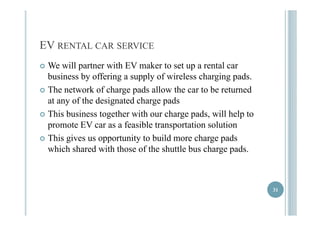
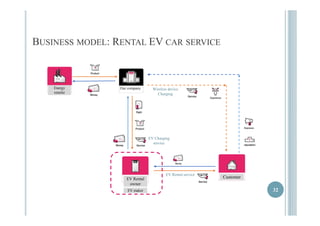
EV RENTAL CAR SERVICE 
 We will partner with EV maker to set up a rental car 
business by offering a supply of wireless charging pads. 
 TThhe nettworkk off chharge padds allllow tthhe car tto bbe retturnedd 
at any of the designated charge pads 
 TThhiiss bbuussiinneessss ttooggeetthheerr wwiitthh oouurr cchhaarrggee ppaaddss, wwiillll hheellpp ttoo 
promote EV car as a feasible transportation solution 
 TThhiiss ggiivveess uuss ooppppoorrttuunniittyy ttoo bbuuiilldd mmoorree cchhaarrggee ppaaddss 
which shared with those of the shuttle bus charge pads. 
31
BUSINESS MODEL: RENTAL EV CAR SERVICE 
EEnergy OOur company 
retailer 
Wireless device 
Charging 
EEVV CChhaarrggiinngg 
service 
EV Rental 
owner 
Customer 
EV k 
EV Rental service 
maker 3322
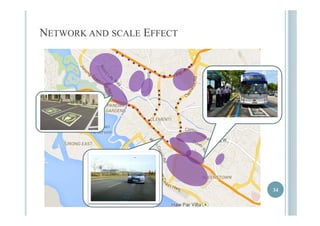
NETWORK AND SCALE EFFECT 
 WWiithh more chharger avaiillabblle on roadd, more EEVV bbuses can bbe 
charged as the stations can be shared 
 This will ppromote shuttle bus circuits to increases and overlapp 
in greater degree 
 It becomes more feasible to connect the different clusters of 
cciirrccuuiittss ttooggeetthheerr. 
 As first mover in the Singapore market, will be able to set up 
a critical mass base of users before other competitors 
 We will subsidise the cost of adoption of our wireless 
charging with the help of government funding 
 WWhhen chhargiing on tthhe move bbecomes possiibblle, we can exttendd 
the charging service to other EV cars 
 Eventually, we provide the ecosystem for EV cars to penetrate 33 
y, p y p 
the local market.
NNEETTWWOORRKK AANNDD SSCCAALLEE EEFFFFEECCTT 
34
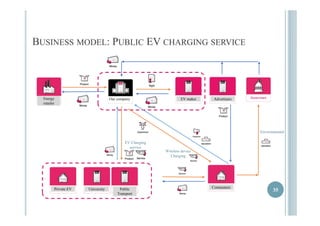
BUSINESS MODEL: PUBLIC EV CHARGING SERVICE 
Energy Our company EV maker 
retailer 
Advertisers 
Environmental 
EV Charging 
service 
Wireless device 
Charging 
Private EV UUnniivveerrssiittyy PPuubblliicc Commuters 35 
Transport
SSTTRRAATTEEGGIICC CCOONNTTRROOLL 
36
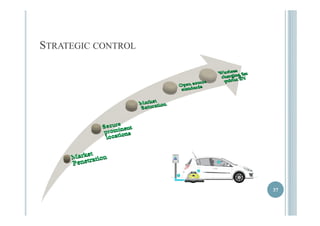
STRATEGIC CONTROL 
37
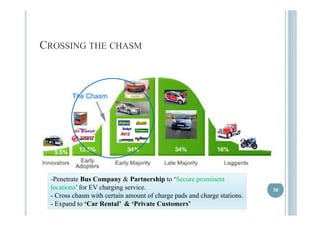
CROSSING THE CHASM 
38 
-Penetrate Bus Company & Partnership to ‘Secure prominent 
locations’ for EV charggingg service. - Cross chasm with certain amount of charge pads and charge stations. 
- Expand to ‘Car Rental’ & ‘Private Customers’
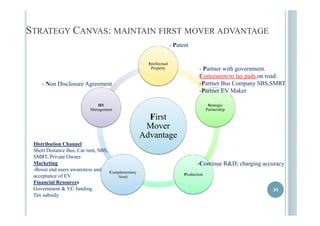
STRATEGY CANVAS: MAINTAIN FIRST MOVER ADVANTAGE 
- Patent 
Intellectual 
Property - Partner with government. 
Concession to lay pads on road. 
- Non Disclosure Agreement -Partner Bus Company SBS,SMRT 
Strategic 
Partnership 
HR 
Management 
-Partner EV Maker 
First 
Mover 
Advantagge 
-Continue R&D; charging accuracy 
Distribution Channel 
Short Distance Bus, Car rent, SBS, 
SMRT, Private Owner. 
Marketing 
39 
Complementary Production 
Asset 
-Boost end users awareness and 
acceptance of EV. 
Financial Resources 
GGoovveerrnnmmeenntt && VVCC ffuunnddiinngg.. Tax subsidy.
STRATEGY CANVAS: HOW TO SUSTAIN 
PROFITABILITY 
 WWe possess thhe requiiredd techhnollogy. 
 We focus on ‘continuous development’ R&D. 
 FFaasstteerr cchhaarrggiinngg ((ffoorr ddyynnaammiicc cchhaarrggiinngg)) 
 Increase accuracy range for efficient charging on the charging pad. 
 Ensure Charging Pad standard.* 
 PPllus, we ffocus on ddoiing markkettiing tto iinttrodduce prodductt tto 
the markets quickly. 
 We tryy to network and build strateggic ppartnershipps. 
 We target to become profitable after market acceptance and 
achieving our critical size of charging station network 
 Fiinalllly, we aiim to posiitiion oursellves as a wiirelless chhargiing 
service provider (metered charging) for all EVs 
40
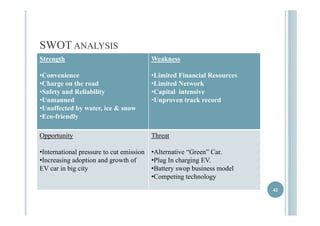
SWOT ANALYSIS 
Strenggth Weakness 
•Convenience 
•Charge on the road 
•Limited Financial Resources 
•Limited Network 
•Safety and Reliability 
•Unmanned 
•Unaffected by water, ice & snow 
•Capital intensive 
•Unproven track record 
•Eco-friendly 
Opppportunityy Threat 
•International pressure to cut emission 
•Increasing adoption and growth of 
•Alternative “Green” Car. 
•Plug In charging EV. 
EV car in big city •Battery swop business model 
•Competing technology 
41
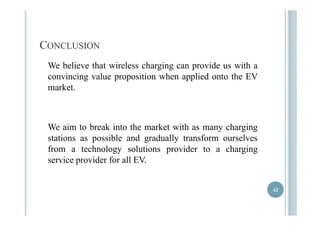
CONCLUSION 
We believe that wireless charging can provide us with a 
convincing value proposition when applied onto the EV 
market. 
We aim to break into the market with as many charging 
ssttaattiioonnss aass ppoossssiibbllee aanndd ggrraadduuaallllyy ttrraannssffoorrmm oouurrsseellvveess 
from a technology solutions provider to a charging 
service pprovider for all EV. 
42
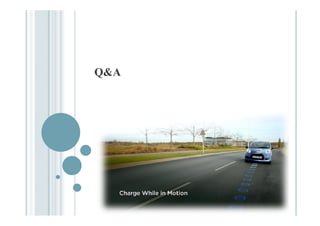
Q&A

Wireless charging for electric vehicles

  • 1.
    WWIRELESSSS CCHARGGINNGG FOORELECCTRICC VEHICLES (EV) MT5016 Prof Jeffrey Funk Chua Boon Pin, A0098444 See Soon Hui, A0098554 TThheerreessiiaa IInnddaahhaayyuu KKuurrnniiaawwaann,, AA00112299443366 Chutchapa Tankeyura, A0132988
  • 2.
    CHOICES OF CARS Hybrid EV with Internal Combustion engine (HEV) Gasoline Car (GV) Plug-In EV (PEV) g Plug In Charging EV with Engine Plug-In Hybrid EV OOnn--LLiinnee EEVV ((OOLLEEVV)) (PHEV) Wireless Charging PEV With Engine 2
  • 3.
    DIFFERENCES G li Hybrid EV with Internal Combustion engine (HEV) EV with Plug-In EV (PEV) Plug In Charging Gasoline Car (GV) Engine Plug-In Hybrid EV (PHEV) g g g On-Line EV (OLEV) Wireless Charging PEV With Engine g g Gasoline-Fuel Car  Emit Pollutants By- Battery-Fuel Car  Little Pollutants By- Products  Noisy Engine Products  Quiet to drive  Low-Efficiency of 18%-  High Efficiency of up 20% to 80%  E bli h Established dM k Market  N New M k Market 3
  • 4.
    FRAME WORK Market Selection  Technology  Cost Comparison  Value Proposition & Business Model  Strategic Control 4
  • 5.
  • 6.
    ELECTRIC VEHICLE (EV)ADOPTION  Inadequate Ecosystem For Charging Points  LLong CChhargiing TTiime  Limited Range  CCapiitall CCost  Lack Proven Reliability 6
  • 7.
    LIMITED CHARGING POINTS Bosch Software Innovation: 108 charging points as of Jan 2014 7
  • 8.
    MARKET SELECTION 1.Shuttle Bus/Public Bus services 2. Rental EV car business 3. Mass market EV business 4. Target deployment locations: a) Institutions b) Business parks c)) TThheme parkks d) Public locations 8
  • 9.
  • 10.
    CURRENT EV CHARGING– PLUG IN  EV Charging via electric cable, similar to pumping of petrol 10
  • 11.
    WIRELESS CHARGING Uses Electromagnetic field to transfer energy between 2 objects, known as inductive charging Car Control Charging Control Unit Unit Charging R i Battery Pad Receiver 1111
  • 12.
    CHARGING ON THEMOVE… 12 https://www.youtube.com/watch?v=BbzkzOmwgdY
  • 13.
    EV WIRELESS CHARGINGVS PLUG-IN Wireless Charging Plug-In Charging  Auto charging charging, simple and  Manual Plug cable elegant  Low rate of wear and tear of Plug-in of charging cable, cumbersome  High rate of wear and tear due to charging pad  Minimum risk of electrocution  Abilit t d t ti high usage of moving cables  Probable risk of electrocution Ability to do stationary  Onl Only Stationar Stationary Charging charging and dynamic charging 13  Required high control of parking accuracy  Garage system cost ~$3k g y  High tolerance towards accuracy of parking  Garage system cost ~$2k  Efficiency > 95% g y  Efficiency ~ 90%
  • 14.
    AADDVVAANNTTAAGGEESS FFOORR OOLLEEVVSS  Reduce the need for large and heavy battery for EVs, hhiigghheerr eeffffiicciieennccyy  Continuous charging prolongs the lifetime of the battery  RReedduuccee//EElliimmiinnaattee aannxxiieettyy ooff ddeepplleettiioonn ooff eelleeccttrriicciittyy oonn car 14
  • 15.
  • 16.
  • 17.
    CCOOSSTT CCOOMMPPAARRIISSOONN $24937.50 Huge Potential for Price Reduction With Wireless Charggingg,, OLEV pprice can be reduced byy further 25% 1177 Data Source: EPRI / Design of On-Line Electric Vehicle (OLEV)
  • 18.
    COST OF HOMECHARGING STATION: BOSCH AUTOMOTIVE SERVICE SOLUTIONS 18 Starting at around $3,000 Data Source: http://www.plugincars.com/bosch-offers-wireless-electric-car-charging-unit-3000-127468.html
  • 19.
    COST OF PUBLICCHARGING STATION: HEVO 19 Per station at $$1100,000000 Data Source: http://www.businessweek.com/articles/2013-11-07/innovation-hevos-electric-car-charging-stations-embedded-in-street
  • 20.
    COST OF INFRASTRUCTURESET UP CCoommppaarriissoonn ooff iinnffrraassttrruuccttuurree cost of PEV, OLEV, PHEV and HEV in Seoul Cost of charging pad with system ~$10K 20 Cost of plug in charging system with DC fast charging ~$40K Data Source: Design of On-Line Electric Vehicle (OLEV)
  • 21.
  • 22.
  • 23.
    VALUE PROPOSITION: CHARGINGON THE ROAD  Reduce battery size => cheaper and more efficient EV  Reduce charging time at depot => more productivity  Longer distance (due to more charge points)  Others  Increased confidence in EV  Minimal risk of electrocution 23
  • 24.
    VALUE CAPTURE RevenueModel From For Licensing EV manufacturer Each vehicle sold with tthhe chhargiing iintterfface Fee for Service Transportation company For duration of charging the EV Sales Transportation company Each charging pad installed AAddvveerrttiisseemmeenntt AAddvveerrttiisseerr AAddvveerrttiissiinngg oonn cchhaarrggiinngg apps 24
  • 25.
    TYPICAL VALUE CHAIN:BUS OPERATION O f ti iti Customer Maintenance Our scope of activities EV Design EV Bus Bus service Assembly operation Charge pad Bus stops design installation g g EV Bus Charging Energy Charge pad Retailer supply Free Mobile Device Charging Advertisement Charge 25 Design of system layout pad/receiver
  • 26.
    TYPICAL VALUE CAPTURE:BUS OPERATION Maintenance Licensing Fee for service Customer EV Design EV Bus Bus service Assembly operation Fee for Service Charge pad Bus stops design installation g g EV Bus Charging Energy Charge pad Retailer supply Free Mobile Device Charging Advertisement Charge 26 Design of system layout Sales pad/receiver Advertisement
  • 27.
    PROPOSED VALUE CAPTURE:BUS OPERATION Maintenance Licensing Customer EV Design EV Bus Bus service Assembly operation Metered Billing ($/k h) Bus stops installation EV Bus Charging Charge pad design kwh) g g Energy Charge pad Retailer supply Free Mobile Device Charging Advertisement Charge 27 Design of system layout pad/receiver Advertisement Sales
  • 28.
    HOW IT WORKS  We will partner the EV maker to supply a fleet of EV bus capable of wireless charging.  WWe wiillll offffer tto supplly tthhe pubblliic ttransportt operattor wiitthh this fleet of EV buses, along with our network of wwiirreelleessss cchhaarrggiinngg ppaaddss.  To offset the installation cost for the public transport ooppeerraattoorr,, wwee wwiillll oonnllyy bbiillll tthheemm bbaasseedd oonn mmeetteerreedd bbiilllliinngg for every kwh charged via our wireless pad.  To save gguard our interest,, we will siggn a longg term contract agreement with them.  Through this, we hope to get grants/subsidy from the 28 government by positioning ourselves as a green business
  • 29.
    BUSINESS MODEL: PUBLICSHUTTLE BUS SERVICE Grants/Subsidy Energy Our company EV maker retailer Advertisers EV Environmental Charging service Wireless device Charging Metered billing (kwh) UUnniivveerrssiittyy PPuubblliicc Commuters 29 Transport Customer
  • 30.
    PRODUCT CROSS SUBSIDIZATION Rental EV Car Private EV BUS Public EV BUS Wireless chhargiing station •Build more business models => more wireless charggingg stations 3300 •By sharing these charging stations between different services, it allows the cost to be subsidised
  • 31.
    EV RENTAL CARSERVICE  We will partner with EV maker to set up a rental car business by offering a supply of wireless charging pads.  TThhe nettworkk off chharge padds allllow tthhe car tto bbe retturnedd at any of the designated charge pads  TThhiiss bbuussiinneessss ttooggeetthheerr wwiitthh oouurr cchhaarrggee ppaaddss, wwiillll hheellpp ttoo promote EV car as a feasible transportation solution  TThhiiss ggiivveess uuss ooppppoorrttuunniittyy ttoo bbuuiilldd mmoorree cchhaarrggee ppaaddss which shared with those of the shuttle bus charge pads. 31
  • 32.
    BUSINESS MODEL: RENTALEV CAR SERVICE EEnergy OOur company retailer Wireless device Charging EEVV CChhaarrggiinngg service EV Rental owner Customer EV k EV Rental service maker 3322
  • 33.
    NETWORK AND SCALEEFFECT  WWiithh more chharger avaiillabblle on roadd, more EEVV bbuses can bbe charged as the stations can be shared  This will ppromote shuttle bus circuits to increases and overlapp in greater degree  It becomes more feasible to connect the different clusters of cciirrccuuiittss ttooggeetthheerr.  As first mover in the Singapore market, will be able to set up a critical mass base of users before other competitors  We will subsidise the cost of adoption of our wireless charging with the help of government funding  WWhhen chhargiing on tthhe move bbecomes possiibblle, we can exttendd the charging service to other EV cars  Eventually, we provide the ecosystem for EV cars to penetrate 33 y, p y p the local market.
  • 34.
  • 35.
    BUSINESS MODEL: PUBLICEV CHARGING SERVICE Energy Our company EV maker retailer Advertisers Environmental EV Charging service Wireless device Charging Private EV UUnniivveerrssiittyy PPuubblliicc Commuters 35 Transport
  • 36.
  • 37.
  • 38.
    CROSSING THE CHASM 38 -Penetrate Bus Company & Partnership to ‘Secure prominent locations’ for EV charggingg service. - Cross chasm with certain amount of charge pads and charge stations. - Expand to ‘Car Rental’ & ‘Private Customers’
  • 39.
    STRATEGY CANVAS: MAINTAINFIRST MOVER ADVANTAGE - Patent Intellectual Property - Partner with government. Concession to lay pads on road. - Non Disclosure Agreement -Partner Bus Company SBS,SMRT Strategic Partnership HR Management -Partner EV Maker First Mover Advantagge -Continue R&D; charging accuracy Distribution Channel Short Distance Bus, Car rent, SBS, SMRT, Private Owner. Marketing 39 Complementary Production Asset -Boost end users awareness and acceptance of EV. Financial Resources GGoovveerrnnmmeenntt && VVCC ffuunnddiinngg.. Tax subsidy.
  • 40.
    STRATEGY CANVAS: HOWTO SUSTAIN PROFITABILITY  WWe possess thhe requiiredd techhnollogy.  We focus on ‘continuous development’ R&D.  FFaasstteerr cchhaarrggiinngg ((ffoorr ddyynnaammiicc cchhaarrggiinngg))  Increase accuracy range for efficient charging on the charging pad.  Ensure Charging Pad standard.*  PPllus, we ffocus on ddoiing markkettiing tto iinttrodduce prodductt tto the markets quickly.  We tryy to network and build strateggic ppartnershipps.  We target to become profitable after market acceptance and achieving our critical size of charging station network  Fiinalllly, we aiim to posiitiion oursellves as a wiirelless chhargiing service provider (metered charging) for all EVs 40
  • 41.
    SWOT ANALYSIS StrenggthWeakness •Convenience •Charge on the road •Limited Financial Resources •Limited Network •Safety and Reliability •Unmanned •Unaffected by water, ice & snow •Capital intensive •Unproven track record •Eco-friendly Opppportunityy Threat •International pressure to cut emission •Increasing adoption and growth of •Alternative “Green” Car. •Plug In charging EV. EV car in big city •Battery swop business model •Competing technology 41
  • 42.
    CONCLUSION We believethat wireless charging can provide us with a convincing value proposition when applied onto the EV market. We aim to break into the market with as many charging ssttaattiioonnss aass ppoossssiibbllee aanndd ggrraadduuaallllyy ttrraannssffoorrmm oouurrsseellvveess from a technology solutions provider to a charging service pprovider for all EV. 42
  • 43.