Laxmi Devi Institute Of Engineering &
Technology,Chikani(Alwar)
A Project presentation on ELECTRIC
VEHICLE
Session
2017-18
Submitted By “Group 19 ”Submited To “Mr . Rajnish Mitter”
Group Members
 Surendra kumar(14ELDEE053)
 Vasudev dadhich(14ELDEE054)
 Shubham kumar rao(14ELDEE711)
 Rajesh kumar(14ELDEE046)
 Santosh saini(14ELDEE050)
 Manish Gadwal(14ELDEE031)
 Subhash kumar(14ELDEE052)
 Rishipal(14ELDEE213)
 Sandeep Panwar(14ELDEE047)
 Ambesh(14ELDEE701)
 Anil Kumar(14ELDEE702)
 Krishan Prajapat(14ELDEE027)
 Abhishek Yadav(15ELDEE200)
 Priya Sharma(15ELDEE209)
 Richa Sharma(15ELDEE212)
 Niraj kumar(15ELDEE207)
 Ankit Kumar
 Aijaj
 Asif
Table Of Contents
Name Of Topics Slide Number
Introduction 6
History of Electric vehicles 7
Need of electric vehicle 8
Components /Parts 9
BLDC motor 11
Controller 12
Differential 13
Power From motor 14
Advantage 17
Disadvantage 18
Working 19
Name Of Topic Slide Number
Types of Electric vehicles 20
Battery electric vehicles 22
Comparison with combustion vehicles 23
Cost effectiveness 24
Positive outcome on environment 25
Conclusion 26
References 27
Cont..
INTRODUCTION
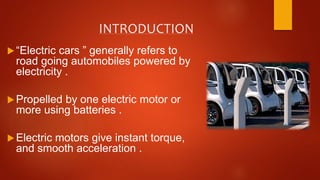
“Electric cars ” generally refers to
road going automobiles powered by
electricity .
Propelled by one electric motor or
more using batteries .
Electric motors give instant torque,
and smooth acceleration .
History of electric vehicle
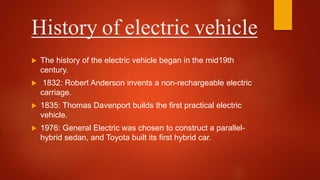
 The history of the electric vehicle began in the mid19th
century.
 1832: Robert Anderson invents a non-rechargeable electric
carriage.
 1835: Thomas Davenport builds the first practical electric
vehicle.
 1976: General Electric was chosen to construct a parallel-
hybrid sedan, and Toyota built its first hybrid car.
Need of electric vehicles
Contributes to cleaner air.
To preserve the fossil fuels.
 Less maintenance
 More efficient
 Cost Effective
Components /Parts
Main parts are:
1. Battery
2. Controller
3. BLDC motor
4.Differential
5.Tyres/Rim
6.Chassis
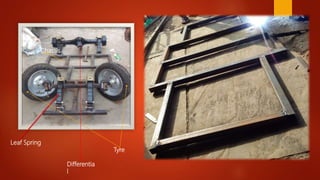
Leaf Spring
Differentia
l
Tyre
Chassis
BLDC motor
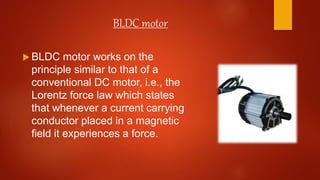
 BLDC motor works on the
principle similar to that of a
conventional DC motor, i.e., the
Lorentz force law which states
that whenever a current carrying
conductor placed in a magnetic
field it experiences a force.
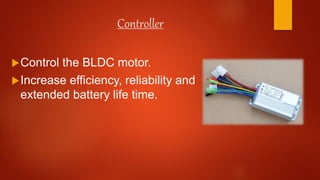
Controller
Control the BLDC motor.
Increase efficiency, reliability and
extended battery life time.
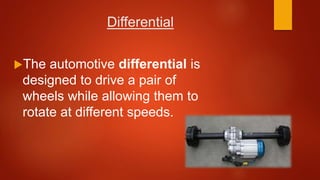
Differential
The automotive differential is
designed to drive a pair of
wheels while allowing them to
rotate at different speeds.
Power from motor
An electric motor has power
and in turn puts out a force
that is measured in torque.
Cont..
 The basic equation for power is:
P = Tw …………………………………….(1)
 For a basic motor there are two parameters that can
help show how the motor works.
 Velocity function:
P (w) = - (Ts / wn ) w2 + Ts w ……………(2)
 Torque function :
P (w) = - (wn / Ts ) T2 + wnT……………. (3)
Cont..
The electric motor controller
takes the power from the
batteries and delivers it to the
motor.
Advantages
Reduce dependences on oil and gasoline.
Pollutants and noise free.
Recyclable batteries.
No fire hazards.
Low maintenance and operation cost.
Disadvantage
High price
High recharge time.
Range lies between 25-30 miles only.
Time required to recharge the batteries
is more.
The batteries provided are quite heavy
increasing the net weight of the car.
Working
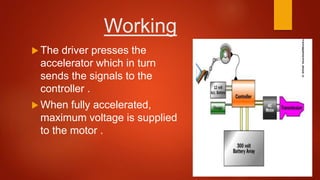
 The driver presses the
accelerator which in turn
sends the signals to the
controller .
 When fully accelerated,
maximum voltage is supplied
to the motor .
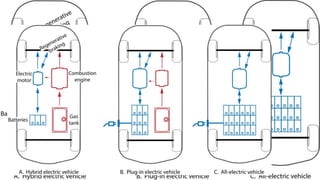
Types Of Electric Vehicle
Hybrid ElectricVehicle
Plug-in Electric Vehicle
All Electric Vehicle
Cont…
Battery Electric Vehicle
Battery electric vehicles are all electric.
 No internal combustion engine
Needs large recharge time (7-8 hours)
 Car halts when the battery dies.
In order to run 80 plus miles, it requires a
large battery i.e, 18kWH to 36 kWH.
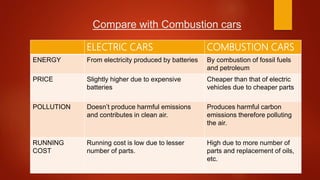
Compare with Combustion cars
ELECTRIC CARS COMBUSTION CARS
ENERGY From electricity produced by batteries By combustion of fossil fuels
and petroleum
PRICE Slightly higher due to expensive
batteries
Cheaper than that of electric
vehicles due to cheaper parts
POLLUTION Doesn’t produce harmful emissions
and contributes in clean air.
Produces harmful carbon
emissions therefore polluting
the air.
RUNNING
COST
Running cost is low due to lesser
number of parts.
High due to more number of
parts and replacement of oils,
etc.
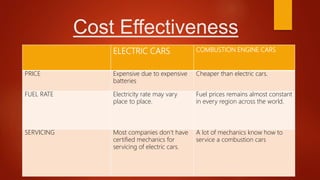
Cost Effectiveness
ELECTRIC CARS COMBUSTION ENGINE CARS
PRICE Expensive due to expensive
batteries
Cheaper than electric cars.
FUEL RATE Electricity rate may vary
place to place.
Fuel prices remains almost constant
in every region across the world.
SERVICING Most companies don’t have
certified mechanics for
servicing of electric cars.
A lot of mechanics know how to
service a combustion cars
Positive outcomes on environment
Electric cars contribute to cleaner air.
Reduced carbon emissions hence less air
pollution.
 Produce 27% less carbon(monoxide and
dioxide) than combustion engines.
Conclusion
 EV has reduced carbon emissions significantly
in the area where it is used.
 Increase the overall energy efficiency of cars.
 With this, we come to following facts that
number of expected vehicles doubling on the
roads in the near future the need for this
alternative energy is very evident and has
promising returns.
Refrences
[1] Senger, R., M. Markel, and J.Nelson,“Validation of
advisor in a series of Electric Vehicle,” SAE paper
981133, 1998.
[2] Wipke Anderson, Samuel Johnson, "Future
perspective of EV,” IJOART paper,2008.
[3] Donald MacArthur,Brooker pegotty,”Electrical
vehicle A sustainable view,” IJSER paper 2011
[4] Stevensonparker,”EV–A green vision for coming
generation,”IEEE Xplore, 2010
Thank You

electric vehicle ppt

  • 1.
    Laxmi Devi InstituteOf Engineering & Technology,Chikani(Alwar) A Project presentation on ELECTRIC VEHICLE Session 2017-18 Submitted By “Group 19 ”Submited To “Mr . Rajnish Mitter”
  • 3.
    Group Members  Surendrakumar(14ELDEE053)  Vasudev dadhich(14ELDEE054)  Shubham kumar rao(14ELDEE711)  Rajesh kumar(14ELDEE046)  Santosh saini(14ELDEE050)  Manish Gadwal(14ELDEE031)  Subhash kumar(14ELDEE052)  Rishipal(14ELDEE213)  Sandeep Panwar(14ELDEE047)  Ambesh(14ELDEE701)  Anil Kumar(14ELDEE702)  Krishan Prajapat(14ELDEE027)  Abhishek Yadav(15ELDEE200)  Priya Sharma(15ELDEE209)  Richa Sharma(15ELDEE212)  Niraj kumar(15ELDEE207)  Ankit Kumar  Aijaj  Asif
  • 4.
    Table Of Contents NameOf Topics Slide Number Introduction 6 History of Electric vehicles 7 Need of electric vehicle 8 Components /Parts 9 BLDC motor 11 Controller 12 Differential 13 Power From motor 14 Advantage 17 Disadvantage 18 Working 19
  • 5.
    Name Of TopicSlide Number Types of Electric vehicles 20 Battery electric vehicles 22 Comparison with combustion vehicles 23 Cost effectiveness 24 Positive outcome on environment 25 Conclusion 26 References 27 Cont..
  • 6.
    INTRODUCTION “Electric cars ”generally refers to road going automobiles powered by electricity . Propelled by one electric motor or more using batteries . Electric motors give instant torque, and smooth acceleration .
  • 7.
    History of electricvehicle  The history of the electric vehicle began in the mid19th century.  1832: Robert Anderson invents a non-rechargeable electric carriage.  1835: Thomas Davenport builds the first practical electric vehicle.  1976: General Electric was chosen to construct a parallel- hybrid sedan, and Toyota built its first hybrid car.
  • 8.
    Need of electricvehicles Contributes to cleaner air. To preserve the fossil fuels.  Less maintenance  More efficient  Cost Effective
  • 9.
    Components /Parts Main partsare: 1. Battery 2. Controller 3. BLDC motor 4.Differential 5.Tyres/Rim 6.Chassis
  • 10.
  • 11.
    BLDC motor  BLDCmotor works on the principle similar to that of a conventional DC motor, i.e., the Lorentz force law which states that whenever a current carrying conductor placed in a magnetic field it experiences a force.
  • 12.
    Controller Control the BLDCmotor. Increase efficiency, reliability and extended battery life time.
  • 13.
    Differential The automotive differentialis designed to drive a pair of wheels while allowing them to rotate at different speeds.
  • 14.
    Power from motor Anelectric motor has power and in turn puts out a force that is measured in torque.
  • 15.
    Cont..  The basicequation for power is: P = Tw …………………………………….(1)  For a basic motor there are two parameters that can help show how the motor works.  Velocity function: P (w) = - (Ts / wn ) w2 + Ts w ……………(2)  Torque function : P (w) = - (wn / Ts ) T2 + wnT……………. (3)
  • 16.
    Cont.. The electric motorcontroller takes the power from the batteries and delivers it to the motor.
  • 17.
    Advantages Reduce dependences onoil and gasoline. Pollutants and noise free. Recyclable batteries. No fire hazards. Low maintenance and operation cost.
  • 18.
    Disadvantage High price High rechargetime. Range lies between 25-30 miles only. Time required to recharge the batteries is more. The batteries provided are quite heavy increasing the net weight of the car.
  • 19.
    Working  The driverpresses the accelerator which in turn sends the signals to the controller .  When fully accelerated, maximum voltage is supplied to the motor .
  • 20.
    Types Of ElectricVehicle Hybrid ElectricVehicle Plug-in Electric Vehicle All Electric Vehicle
  • 21.
  • 22.
    Battery Electric Vehicle Batteryelectric vehicles are all electric.  No internal combustion engine Needs large recharge time (7-8 hours)  Car halts when the battery dies. In order to run 80 plus miles, it requires a large battery i.e, 18kWH to 36 kWH.
  • 23.
    Compare with Combustioncars ELECTRIC CARS COMBUSTION CARS ENERGY From electricity produced by batteries By combustion of fossil fuels and petroleum PRICE Slightly higher due to expensive batteries Cheaper than that of electric vehicles due to cheaper parts POLLUTION Doesn’t produce harmful emissions and contributes in clean air. Produces harmful carbon emissions therefore polluting the air. RUNNING COST Running cost is low due to lesser number of parts. High due to more number of parts and replacement of oils, etc.
  • 24.
    Cost Effectiveness ELECTRIC CARSCOMBUSTION ENGINE CARS PRICE Expensive due to expensive batteries Cheaper than electric cars. FUEL RATE Electricity rate may vary place to place. Fuel prices remains almost constant in every region across the world. SERVICING Most companies don’t have certified mechanics for servicing of electric cars. A lot of mechanics know how to service a combustion cars
  • 25.
    Positive outcomes onenvironment Electric cars contribute to cleaner air. Reduced carbon emissions hence less air pollution.  Produce 27% less carbon(monoxide and dioxide) than combustion engines.
  • 26.
    Conclusion  EV hasreduced carbon emissions significantly in the area where it is used.  Increase the overall energy efficiency of cars.  With this, we come to following facts that number of expected vehicles doubling on the roads in the near future the need for this alternative energy is very evident and has promising returns.
  • 27.
    Refrences [1] Senger, R.,M. Markel, and J.Nelson,“Validation of advisor in a series of Electric Vehicle,” SAE paper 981133, 1998. [2] Wipke Anderson, Samuel Johnson, "Future perspective of EV,” IJOART paper,2008. [3] Donald MacArthur,Brooker pegotty,”Electrical vehicle A sustainable view,” IJSER paper 2011 [4] Stevensonparker,”EV–A green vision for coming generation,”IEEE Xplore, 2010
  • 28.