

BUSINESS MODELS FOR HI-
TECH PRODUCTS (MT 5016):
WHAT IS A BUSINESS MODEL?
A/Prof Jeffrey Funk
Division of Engineering and Technology
Management
National University of Singapore
New Products Continually Emerge
Lots of Questions
 Which ones will succeed?
 Which ones will fail?
 How can we increase the chances of
success?
 How can we increase the chances of OUR
success?
 How can OUR firm succeed to the extent that
OUR firm is in the top 100 market
capitalization
 Google, Facebook, Tencent were founded in the
last 15 years
New Product Success is not about
Following Rules
 It is about SETTING the rules in the new industry!
 Setting the rules means BREAKING the existing
rules
 What should the new rules be for the new
industry?
 How should new rules be different from old rules?
 This is completely different from science and
engineering modules!
 Science and engineering modules tell you about the
rules of science
The Concept of a Business
Model
 Can Help Us
 Position Our Products Against
 other products and other firms
 other technologies including the old one
 for which customers?
 Find and obtain revenues
 Position our product in overall value chains
 Think about future entrants and long-term
profitability
Module Objectives
 To understand
 business models
 their impact on competition between firms
 how different business models are needed for
different situations
 what drives need for change in business models
 Similarities/differences between business models and
strategies
 To develop a business model for a firm and
technology in a group project
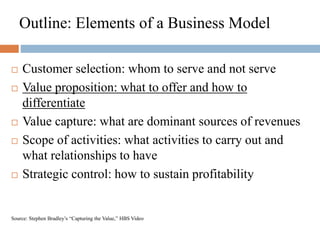
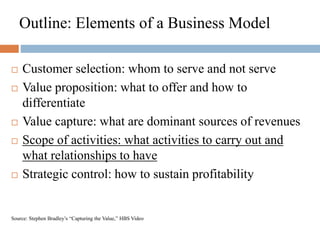
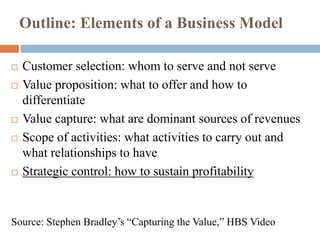
Outline: Elements of a Business Model
 Customer selection: whom to serve and not serve
 Value proposition: what to offer and how to
differentiate
 Value capture: what are dominant sources of revenues
 Scope of activities: what activities to carry out and
what relationships to have
 Strategic control: how to sustain profitability, create
barrier to entry
Source: Stephen Bradley’s “Capturing the Value,” HBS Video
Breaking the Rules
 Customer selection: find new customers who are
unsatisfied or find new needs that are unfilled
 Value proposition: offer new forms of value
 Value capture: find new sources of revenues that
are different from ones in the past
 Scope of activities: participate in a different set
of activities than firms have done in the past
 Strategic control: create a new barrier to entry
that is different from the ones in the past
Outline: Elements of a Business Model
 Customer selection: whom to serve and not serve
 Value proposition: what to offer and how to
differentiate
 Value capture: what are dominant sources of revenues
 Scope of activities: what activities to carry out and
what relationships to have
 Strategic control: how to sustain profitability, create
barrier to entry
Customer Selection
 Who are the potential customers?
 What are the customer needs and wants?
 Do different customers want different things?
 How can we use this information to segment the
market (see following slides)?
 Are there collaborators who can also be thought of
as customers (see following slides)?
 Which customers will probably be the first
adopters of a new technology?
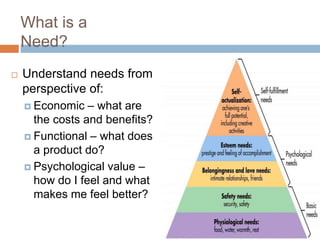
What is a
Need?
 Understand needs from
perspective of:
 Economic – what are
the costs and benefits?
 Functional – what does
a product do?
 Psychological value –
how do I feel and what
makes me feel better?
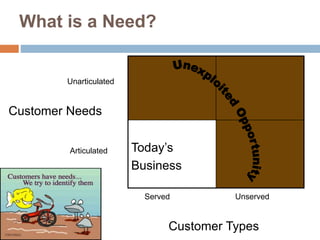
What is a Need?
Today’s
Business
Customer Needs
Unarticulated
Articulated
Customer Types
Served Unserved
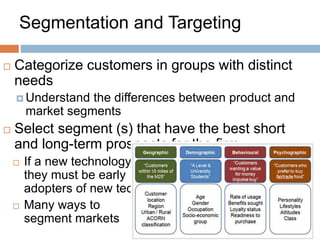
Segmentation and Targeting
 Categorize customers in groups with distinct
needs
 Understand the differences between product and
market segments
 Select segment (s) that have the best short
and long-term prospects for the firm
 If a new technology,
they must be early
adopters of new technology
 Many ways to
segment markets
What About Collaborators?
 Many products have multiple customers or
collaborators who might be considered
customers
 Who are they?
 They might be
 retail outlets
 providers of complementary
products or complementary
services
 How does the business model fit with these
collaborators?
Outline: Elements of a Business Model
 Customer selection: whom to serve and not serve
 Value proposition: what to offer and how to
differentiate
 Value capture: what are dominant sources of revenues
 Scope of activities: what activities to carry out and
what relationships to have
 Strategic control: how to sustain profitability
Source: Stephen Bradley’s “Capturing the Value,” HBS Video
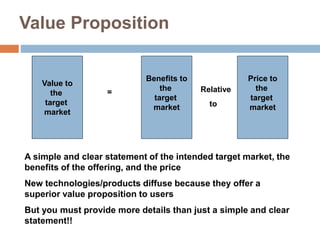
Value Proposition
Value to
the
target
market
Benefits to
the
target
market
Price to
the
target
market
= Relative
to
A simple and clear statement of the intended target market, the
benefits of the offering, and the price
New technologies/products diffuse because they offer a
superior value proposition to users
But you must provide more details than just a simple and clear
statement!!
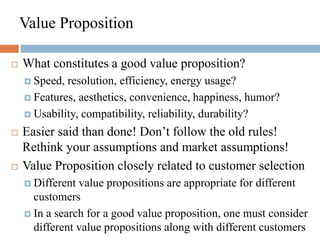
Value Proposition
 What constitutes a good value proposition?
 Speed, resolution, efficiency, energy usage?
 Features, aesthetics, convenience, happiness, humor?
 Usability, compatibility, reliability, durability?
 Easier said than done! Don’t follow the old rules!
Rethink your assumptions and market assumptions!
 Value Proposition closely related to customer selection
 Different value propositions are appropriate for different
customers
 In a search for a good value proposition, one must consider
different value propositions along with different customers
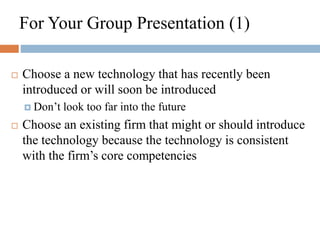
For Your Group Presentation (1)
 Choose a new technology that has recently been
introduced or will soon be introduced
 Don’t look too far into the future
 Choose an existing firm that might or should introduce
the technology because the technology is consistent
with the firm’s core competencies
For Your Group Presentation (2)
 Defining a value proposition should help you segment
and target markets
 Some segments will adopt a new technology faster
than will other segments
 You must identify and target those segments
 Ideally you will know the order in which segments/users
adopt the new technology
 Then you must contrast your firm’s product or service
with the competitors’ product or service for the target
segment(s)
Justification and Quantitative Data
 You must justify and/or quantify your data
 The justification is more important than the data
 Make sure you consider all the important dimensions
 Finding a new dimension is often a major source of
advantage in the market
 All dimensions aren’t created equally
 Quantifying each dimension of performance is useful,
albeit sometimes difficult
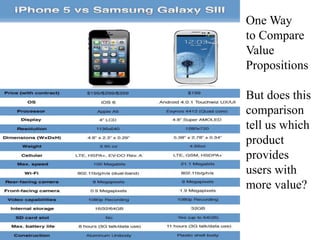
One Way
to Compare
Value
Propositions
But does this
comparison
tell us which
product
provides
users with
more value?
Outline: Elements of a Business Model
 Customer selection: whom to serve and not serve
 Value proposition: what to offer and how to
differentiate
 Value capture: what are dominant sources of revenues
 Scope of activities: what activities to carry out and
what relationships to have
 Strategic control: how to sustain profitability
Source: Stephen Bradley’s “Capturing the Value,” HBS Video
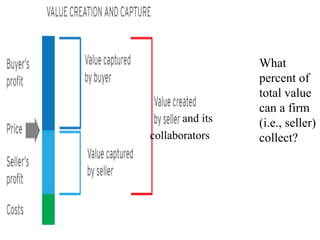
What
percent of
total value
can a firm
(i.e., seller)
collect?
and its
collaborators
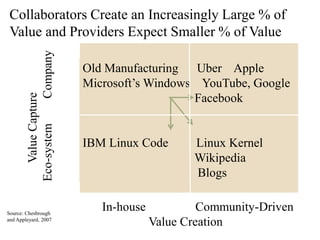
Old Manufacturing Uber Apple
Microsoft’s Windows YouTube, Google
Facebook
IBM Linux Code Linux Kernel
Wikipedia
Blogs
In-house Community-Driven
Value Creation
ValueCapture
Eco-systemCompany
Collaborators Create an Increasingly Large % of
Value and Providers Expect Smaller % of Value
Source: Chesbrough
and Appleyard, 2007
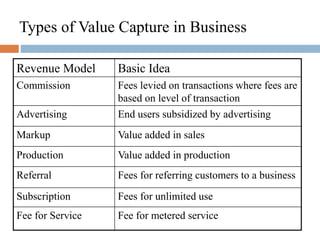
Types of Value Capture in Business Models
Revenue Model Basic Idea
Commission Fees levied on transactions where fees are
based on level of transaction
Advertising End users subsidized by advertising
Markup Value added in sales
Production Value added in production
Referral Fees for referring customers to a business
Subscription Fees for unlimited use
Fee for Service Fee for metered service
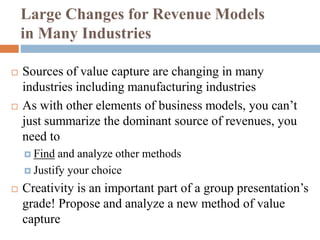
Large Changes for Revenue Models
in Many Industries
 Sources of value capture are changing in many
industries including manufacturing industries
 As with other elements of business models, you can’t
just summarize the dominant source of revenues, you
need to
 Find and analyze other methods
 Justify your choice
 Creativity is an important part of a group presentation’s
grade! Propose and analyze a new method of value
capture
Outline: Elements of a Business Model
 Customer selection: whom to serve and not serve
 Value proposition: what to offer and how to
differentiate
 Value capture: what are dominant sources of revenues
 Scope of activities: what activities to carry out and
what relationships to have
 Strategic control: how to sustain profitability
Source: Stephen Bradley’s “Capturing the Value,” HBS Video
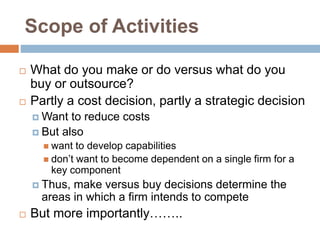
Scope of Activities
 What do you make or do versus what do you
buy or outsource?
 Partly a cost decision, partly a strategic decision
 Want to reduce costs
 But also
 want to develop capabilities
 don’t want to become dependent on a single firm for a
key component
 Thus, make versus buy decisions determine the
areas in which a firm intends to compete
 But more importantly……..
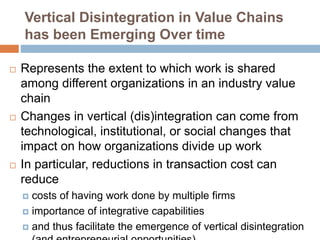
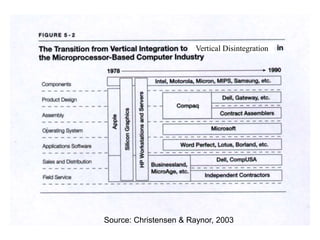
Vertical Disintegration in Value Chains
has been Emerging Over time
 Represents the extent to which work is shared
among different organizations in an industry value
chain
 Changes in vertical (dis)integration can come from
technological, institutional, or social changes that
impact on how organizations divide up work
 In particular, reductions in transaction cost can
reduce
 costs of having work done by multiple firms
 importance of integrative capabilities
 and thus facilitate the emergence of vertical disintegration
Source: Christensen & Raynor, 2003
Vertical Disintegration
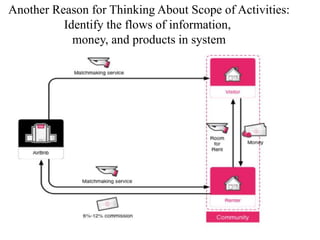
Another Reason for Thinking About Scope of Activities:
Identify the flows of information,
money, and products in system
Outline: Elements of a Business Model
 Customer selection: whom to serve and not serve
 Value proposition: what to offer and how to
differentiate
 Value capture: what are dominant sources of revenues
 Scope of activities: what activities to carry out and
what relationships to have
 Strategic control: how to sustain profitability
Source: Stephen Bradley’s “Capturing the Value,” HBS Video
Strategic Control
 What enables a firm to be profitable with a new technology?
 First mover advantages? Good design? Good performance?
These are only important in the short run, In the long-run,
most things can be copied
 Why are Google, Facebook, Tencent, Microsoft and Apple so
profitable and for many years? This is what drives venture
capitalists!
 This is the most difficult part of a business model
 For your group presentations, you should think about this last,
after you have determined the other elements of the business
model
Barriers to Entry Determine Profitability
 As firms enter, prices typically fall to a level at which
“marginal prices equal marginal revenues” where
 Profits barely support business
 So creating barriers to entry is critical for achieving
having above average profits. How can this be done?
 Control key resource, Intellectual Property (IP), etc.
 Might control key resource or asset through economies of scale
 Control the way work is divided up among different
organizations (e.g., through control of interface standards)
 Network effects
 Venture capitalists look for potential barriers to entry,
not just good value propositions!
In Summary: For your group presentations
 Tell me about the business model
 Customer selection: whom to serve and not serve
 Value proposition: what to offer and how to differentiate
 Value capture: dominant source of revenues
 Scope of activities: what activities to carry out
 Strategic control: how to sustain profitability
 You must justify your choices!
 Start forming your groups (3 to 4 members) at the break (in
about 45 minutes)
 Consistency
 among elements is critical
 between business model and company capabilities

Biz Models for High-Tech Products

  • 1.
    BUSINESS MODELS FORHI- TECH PRODUCTS (MT 5016): WHAT IS A BUSINESS MODEL? A/Prof Jeffrey Funk Division of Engineering and Technology Management National University of Singapore
  • 2.
  • 3.
    Lots of Questions Which ones will succeed?  Which ones will fail?  How can we increase the chances of success?  How can we increase the chances of OUR success?  How can OUR firm succeed to the extent that OUR firm is in the top 100 market capitalization  Google, Facebook, Tencent were founded in the last 15 years
  • 4.
    New Product Successis not about Following Rules  It is about SETTING the rules in the new industry!  Setting the rules means BREAKING the existing rules  What should the new rules be for the new industry?  How should new rules be different from old rules?  This is completely different from science and engineering modules!  Science and engineering modules tell you about the rules of science
  • 5.
    The Concept ofa Business Model  Can Help Us  Position Our Products Against  other products and other firms  other technologies including the old one  for which customers?  Find and obtain revenues  Position our product in overall value chains  Think about future entrants and long-term profitability
  • 6.
    Module Objectives  Tounderstand  business models  their impact on competition between firms  how different business models are needed for different situations  what drives need for change in business models  Similarities/differences between business models and strategies  To develop a business model for a firm and technology in a group project
  • 7.
    Outline: Elements ofa Business Model  Customer selection: whom to serve and not serve  Value proposition: what to offer and how to differentiate  Value capture: what are dominant sources of revenues  Scope of activities: what activities to carry out and what relationships to have  Strategic control: how to sustain profitability, create barrier to entry Source: Stephen Bradley’s “Capturing the Value,” HBS Video
  • 8.
    Breaking the Rules Customer selection: find new customers who are unsatisfied or find new needs that are unfilled  Value proposition: offer new forms of value  Value capture: find new sources of revenues that are different from ones in the past  Scope of activities: participate in a different set of activities than firms have done in the past  Strategic control: create a new barrier to entry that is different from the ones in the past
  • 9.
    Outline: Elements ofa Business Model  Customer selection: whom to serve and not serve  Value proposition: what to offer and how to differentiate  Value capture: what are dominant sources of revenues  Scope of activities: what activities to carry out and what relationships to have  Strategic control: how to sustain profitability, create barrier to entry
  • 10.
    Customer Selection  Whoare the potential customers?  What are the customer needs and wants?  Do different customers want different things?  How can we use this information to segment the market (see following slides)?  Are there collaborators who can also be thought of as customers (see following slides)?  Which customers will probably be the first adopters of a new technology?
  • 11.
    What is a Need? Understand needs from perspective of:  Economic – what are the costs and benefits?  Functional – what does a product do?  Psychological value – how do I feel and what makes me feel better?
  • 12.
    What is aNeed? Today’s Business Customer Needs Unarticulated Articulated Customer Types Served Unserved
  • 13.
    Segmentation and Targeting Categorize customers in groups with distinct needs  Understand the differences between product and market segments  Select segment (s) that have the best short and long-term prospects for the firm  If a new technology, they must be early adopters of new technology  Many ways to segment markets
  • 14.
    What About Collaborators? Many products have multiple customers or collaborators who might be considered customers  Who are they?  They might be  retail outlets  providers of complementary products or complementary services  How does the business model fit with these collaborators?
  • 15.
    Outline: Elements ofa Business Model  Customer selection: whom to serve and not serve  Value proposition: what to offer and how to differentiate  Value capture: what are dominant sources of revenues  Scope of activities: what activities to carry out and what relationships to have  Strategic control: how to sustain profitability Source: Stephen Bradley’s “Capturing the Value,” HBS Video
  • 16.
    Value Proposition Value to the target market Benefitsto the target market Price to the target market = Relative to A simple and clear statement of the intended target market, the benefits of the offering, and the price New technologies/products diffuse because they offer a superior value proposition to users But you must provide more details than just a simple and clear statement!!
  • 17.
    Value Proposition  Whatconstitutes a good value proposition?  Speed, resolution, efficiency, energy usage?  Features, aesthetics, convenience, happiness, humor?  Usability, compatibility, reliability, durability?  Easier said than done! Don’t follow the old rules! Rethink your assumptions and market assumptions!  Value Proposition closely related to customer selection  Different value propositions are appropriate for different customers  In a search for a good value proposition, one must consider different value propositions along with different customers
  • 18.
    For Your GroupPresentation (1)  Choose a new technology that has recently been introduced or will soon be introduced  Don’t look too far into the future  Choose an existing firm that might or should introduce the technology because the technology is consistent with the firm’s core competencies
  • 19.
    For Your GroupPresentation (2)  Defining a value proposition should help you segment and target markets  Some segments will adopt a new technology faster than will other segments  You must identify and target those segments  Ideally you will know the order in which segments/users adopt the new technology  Then you must contrast your firm’s product or service with the competitors’ product or service for the target segment(s)
  • 20.
    Justification and QuantitativeData  You must justify and/or quantify your data  The justification is more important than the data  Make sure you consider all the important dimensions  Finding a new dimension is often a major source of advantage in the market  All dimensions aren’t created equally  Quantifying each dimension of performance is useful, albeit sometimes difficult
  • 21.
    One Way to Compare Value Propositions Butdoes this comparison tell us which product provides users with more value?
  • 22.
    Outline: Elements ofa Business Model  Customer selection: whom to serve and not serve  Value proposition: what to offer and how to differentiate  Value capture: what are dominant sources of revenues  Scope of activities: what activities to carry out and what relationships to have  Strategic control: how to sustain profitability Source: Stephen Bradley’s “Capturing the Value,” HBS Video
  • 23.
    What percent of total value cana firm (i.e., seller) collect? and its collaborators
  • 24.
    Old Manufacturing UberApple Microsoft’s Windows YouTube, Google Facebook IBM Linux Code Linux Kernel Wikipedia Blogs In-house Community-Driven Value Creation ValueCapture Eco-systemCompany Collaborators Create an Increasingly Large % of Value and Providers Expect Smaller % of Value Source: Chesbrough and Appleyard, 2007
  • 25.
    Types of ValueCapture in Business Models Revenue Model Basic Idea Commission Fees levied on transactions where fees are based on level of transaction Advertising End users subsidized by advertising Markup Value added in sales Production Value added in production Referral Fees for referring customers to a business Subscription Fees for unlimited use Fee for Service Fee for metered service
  • 26.
    Large Changes forRevenue Models in Many Industries  Sources of value capture are changing in many industries including manufacturing industries  As with other elements of business models, you can’t just summarize the dominant source of revenues, you need to  Find and analyze other methods  Justify your choice  Creativity is an important part of a group presentation’s grade! Propose and analyze a new method of value capture
  • 27.
    Outline: Elements ofa Business Model  Customer selection: whom to serve and not serve  Value proposition: what to offer and how to differentiate  Value capture: what are dominant sources of revenues  Scope of activities: what activities to carry out and what relationships to have  Strategic control: how to sustain profitability Source: Stephen Bradley’s “Capturing the Value,” HBS Video
  • 28.
    Scope of Activities What do you make or do versus what do you buy or outsource?  Partly a cost decision, partly a strategic decision  Want to reduce costs  But also  want to develop capabilities  don’t want to become dependent on a single firm for a key component  Thus, make versus buy decisions determine the areas in which a firm intends to compete  But more importantly……..
  • 29.
    Vertical Disintegration inValue Chains has been Emerging Over time  Represents the extent to which work is shared among different organizations in an industry value chain  Changes in vertical (dis)integration can come from technological, institutional, or social changes that impact on how organizations divide up work  In particular, reductions in transaction cost can reduce  costs of having work done by multiple firms  importance of integrative capabilities  and thus facilitate the emergence of vertical disintegration
  • 30.
    Source: Christensen &Raynor, 2003 Vertical Disintegration
  • 31.
    Another Reason forThinking About Scope of Activities: Identify the flows of information, money, and products in system
  • 32.
    Outline: Elements ofa Business Model  Customer selection: whom to serve and not serve  Value proposition: what to offer and how to differentiate  Value capture: what are dominant sources of revenues  Scope of activities: what activities to carry out and what relationships to have  Strategic control: how to sustain profitability Source: Stephen Bradley’s “Capturing the Value,” HBS Video
  • 33.
    Strategic Control  Whatenables a firm to be profitable with a new technology?  First mover advantages? Good design? Good performance? These are only important in the short run, In the long-run, most things can be copied  Why are Google, Facebook, Tencent, Microsoft and Apple so profitable and for many years? This is what drives venture capitalists!  This is the most difficult part of a business model  For your group presentations, you should think about this last, after you have determined the other elements of the business model
  • 34.
    Barriers to EntryDetermine Profitability  As firms enter, prices typically fall to a level at which “marginal prices equal marginal revenues” where  Profits barely support business  So creating barriers to entry is critical for achieving having above average profits. How can this be done?  Control key resource, Intellectual Property (IP), etc.  Might control key resource or asset through economies of scale  Control the way work is divided up among different organizations (e.g., through control of interface standards)  Network effects  Venture capitalists look for potential barriers to entry, not just good value propositions!
  • 35.
    In Summary: Foryour group presentations  Tell me about the business model  Customer selection: whom to serve and not serve  Value proposition: what to offer and how to differentiate  Value capture: dominant source of revenues  Scope of activities: what activities to carry out  Strategic control: how to sustain profitability  You must justify your choices!  Start forming your groups (3 to 4 members) at the break (in about 45 minutes)  Consistency  among elements is critical  between business model and company capabilities

Editor's Notes

  • #8 A Biz Model is like poker or mah jong. Easy to describe, hard to do?
  • #12 What does he mean by physiological?
  • #13 Economic, functional, psychological. Everybody is different and things are always changing. The rules change. Don’t force your values on others.
  • #14 It used to be that military first, companies second, consumers third, but not anymore
  • #22 What do people want?
  • #25 What about demand-based economy? Why do I say old manufacturing? Apple? What about big data?
  • #26 Ask for examples
  • #33 How to determine profitability of business and thus the choice to enter a market?