Electric Vehicle: A Power
Engineer’s Perspective
Krishnakumar R V
Research Associate
Universiti Tenaga Nasional
Malaysia
23-11-2018 1
EV: A Jargon?
23-11-2018 2
• Traction of wheels by Electric Motors
• Portable Energy source
EV: The First Inception
23-11-2018 3
Robert Anderson
1850s
(Britain)
William
Morrison
1890
(Iowa, U.S)
1900
1/3rd of Vehicle
population
In USA
EV: The Saga
23-11-2018 4
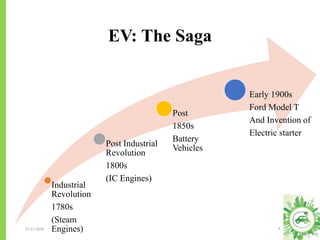
Industrial
Revolution
1780s
(Steam
Engines)
Post Industrial
Revolution
1800s
(IC Engines)
Post
1850s
Battery
Vehicles
Early 1900s
Ford Model T
And Invention of
Electric starter
Why EV?
23-11-2018 5
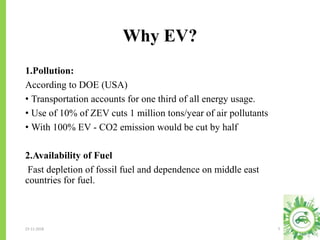
1.Pollution:
According to DOE (USA)
• Transportation accounts for one third of all energy usage.
• Use of 10% of ZEV cuts 1 million tons/year of air pollutants
• With 100% EV - CO2 emission would be cut by half
2.Availability of Fuel
Fast depletion of fossil fuel and dependence on middle east
countries for fuel.
Why EV?
23-11-2018 6
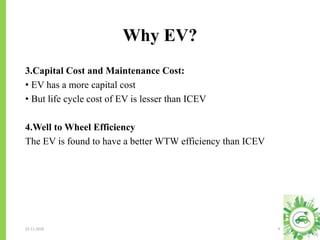
3.Capital Cost and Maintenance Cost:
• EV has a more capital cost
• But life cycle cost of EV is lesser than ICEV
4.Well to Wheel Efficiency
The EV is found to have a better WTW efficiency than ICEV
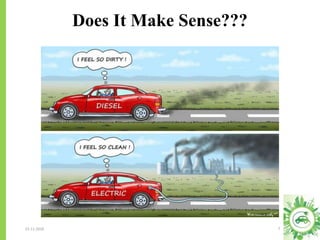
Does It Make Sense???
23-11-2018 7
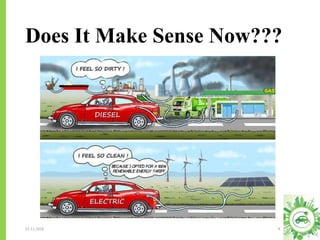
Does It Make Sense Now???
23-11-2018 8
EV Vs ICEV
23-11-2018 9
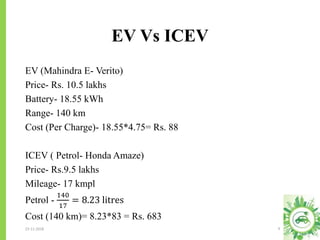
EV (Mahindra E- Verito)
Price- Rs. 10.5 lakhs
Battery- 18.55 kWh
Range- 140 km
Cost (Per Charge)- 18.55*4.75= Rs. 88
ICEV ( Petrol- Honda Amaze)
Price- Rs.9.5 lakhs
Mileage- 17 kmpl
Petrol -
140
17
= 8.23 litres
Cost (140 km)= 8.23*83 = Rs. 683
Payback Analysis
23-11-2018 10
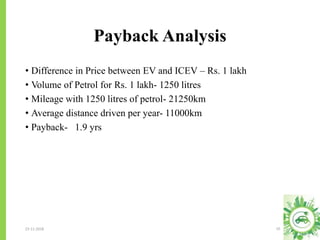
• Difference in Price between EV and ICEV – Rs. 1 lakh
• Volume of Petrol for Rs. 1 lakh- 1250 litres
• Mileage with 1250 litres of petrol- 21250km
• Average distance driven per year- 11000km
• Payback- 1.9 yrs
Regenerative Braking
23-11-2018 11
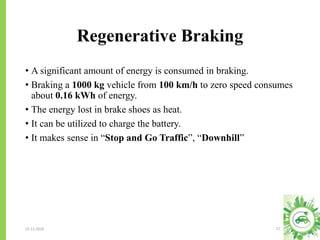
• A significant amount of energy is consumed in braking.
• Braking a 1000 kg vehicle from 100 km/h to zero speed consumes
about 0.16 kWh of energy.
• The energy lost in brake shoes as heat.
• It can be utilized to charge the battery.
• It makes sense in “Stop and Go Traffic”, “Downhill”
Alternate Vehicles: A broad
spectrum
23-11-2018 12
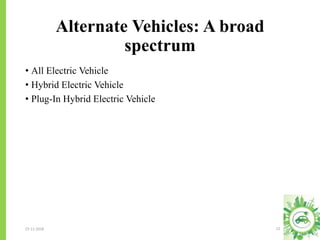
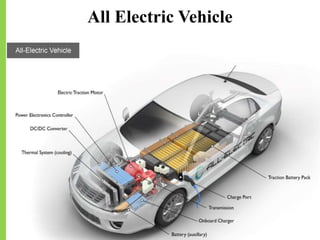
• All Electric Vehicle
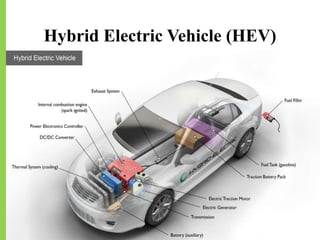
• Hybrid Electric Vehicle
• Plug-In Hybrid Electric Vehicle
All Electric Vehicle
23-11-2018 13
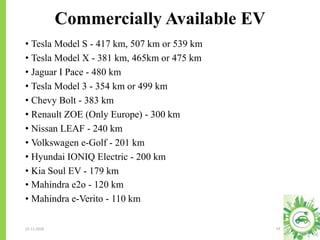
Commercially Available EV
23-11-2018 14
• Tesla Model S - 417 km, 507 km or 539 km
• Tesla Model X - 381 km, 465km or 475 km
• Jaguar I Pace - 480 km
• Tesla Model 3 - 354 km or 499 km
• Chevy Bolt - 383 km
• Renault ZOE (Only Europe) - 300 km
• Nissan LEAF - 240 km
• Volkswagen e-Golf - 201 km
• Hyundai IONIQ Electric - 200 km
• Kia Soul EV - 179 km
• Mahindra e2o - 120 km
• Mahindra e-Verito - 110 km
Hybrid Electric Vehicle (HEV)
23-11-2018 15
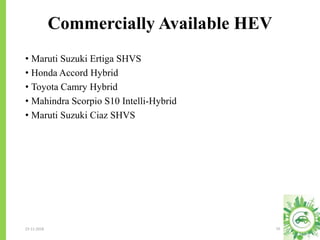
Commercially Available HEV
23-11-2018 16
• Maruti Suzuki Ertiga SHVS
• Honda Accord Hybrid
• Toyota Camry Hybrid
• Mahindra Scorpio S10 Intelli-Hybrid
• Maruti Suzuki Ciaz SHVS
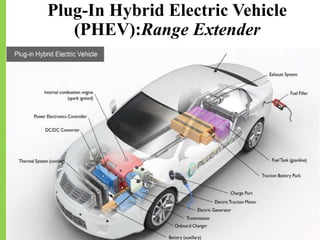
Plug-In Hybrid Electric Vehicle
(PHEV):Range Extender
23-11-2018 17
Commercially Available PHEV
23-11-2018 18
• BMW i8
• Toyota Yaris Hybrid
• Mercedes C-Class C300h
• Toyota Prius
• Volkswagen Golf GTI
• BMW i3
• Porsche Cayenne E-Hybrid
• Mercedes S500e
HEV Vs PHEV
HEV
• IC Engine is the primary
source
• Electric Motor is used to
complement the IC engine
• Electricity is generated on-
board
• Energy/Cost saving is doesn’t
payback the cost of vehicle
soon
PHEV
• Electric Motor powered by
battery is the primary source
• IC Engine supports the electric
motor and extends the range
• Battery is charged by Plugging
it into the socket
• Energy/Cost saving is
substantial
23-11-2018 19
Classification of HEV
23-11-2018 20
1.Based On Architecture
• Series
• Parallel
• Series – Parallel
2.Degree Of Hybridization
• Mild
• Power
• Energy
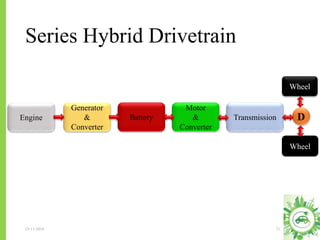
Series Hybrid Drivetrain
23-11-2018 21
Engine
Generator
&
Converter
Battery
Motor
&
Converter
Transmission D
Wheel
Wheel
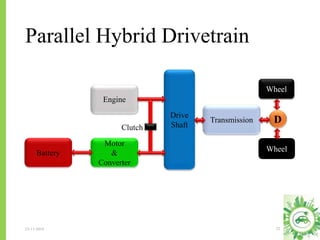
Parallel Hybrid Drivetrain
23-11-2018 22
Engine
Drive
Shaft
Battery
Motor
&
Converter
Transmission D
Wheel
Wheel
Clutch
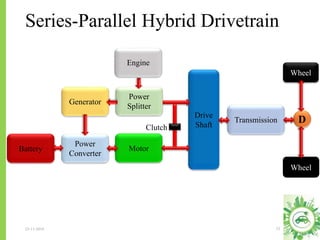
Series-Parallel Hybrid Drivetrain
23-11-2018 23
Engine
Drive
Shaft
Battery Motor
Transmission D
Wheel
Wheel
Clutch
Generator
Power
Converter
Power
Splitter
Degree of Hybridization
23-11-2018 24
I. Degree of downsizing the engine and upsizing the electric
motor.
II. That is the traction power provided by the IC engine is reduced
and that of the electric motor is increased by varying the
capacity of the prime movers respectively.
Types of Charging
Systems
23-11-2018 25
Conductive Charging
23-11-2018 26
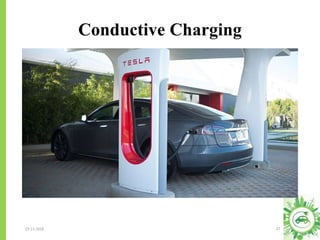
• Conductive charging scheme transfers power through direct
contact.
• This scheme uses a conductor to connect the electronic devices to
the extent of energy transfer.
• Conductive charging is simple and highly efficient. It can be a
non-board or off-board method.
• An on-board charger is mainly utilized for slow charging.
• An off-board charger is installed at fixed locations to offer rapid
charging service.
Conductive Charging
23-11-2018 27
Inductive Charging
23-11-2018 28
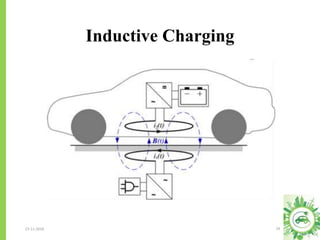
• Also known as wireless charging,
• Uses an electromagnetic field to transfer electricity to an EV
battery.
• The benefit of inductive charger is that it provides electrical safety
under all-weather conditions.
• The drawbacks of state-of-the-art inductive chargers are low
efficiency and high power loss
Inductive Charging
23-11-2018 29
Battery Swapping
23-11-2018 30
• Users can swap their empty battery with a fully charged one from a
battery swapping station.
• Batteries are not owned by the car owners so the cost is reduced by
15% approx.,.
• The peak demand on the grid is also reduced.
• Tesla proved to swap the batteries of two Tesla Model S with in the
time taken to fill the tank of a ICEV.
Charging Power Levels
23-11-2018 31
Level 1 Charging
23-11-2018 32
• Uses a standard 120 VAC, 15 A or 20 A
• Charging equipment is typically installed on the vehicle
• Time 8 to 16 hrs
• Power rating 1.4-1.9 kW (depends on Amp rating)
Level 2 Charging
23-11-2018 33
• Preferred method for a battery electric vehicle charger for both
private and public facilities.
• Private: 240 V AC, Single Phase, 40 A.
• Public: 400 V AC, Three Phase, 80 A.
• Power Rating 7.7 kW to 25.6 kW.
• Time 4-8 hrs.
• The conversion from AC to DC takes place on board.
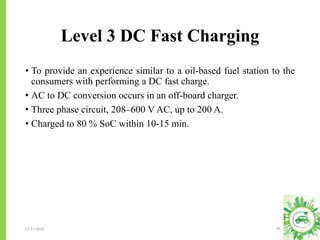
Level 3 DC Fast Charging
23-11-2018 34
• To provide an experience similar to a oil-based fuel station to the
consumers with performing a DC fast charge.
• AC to DC conversion occurs in an off-board charger.
• Three phase circuit, 208–600 V AC, up to 200 A.
• Charged to 80 % SoC within 10-15 min.
Interaction of EV with
Power Grid
23-11-2018 35
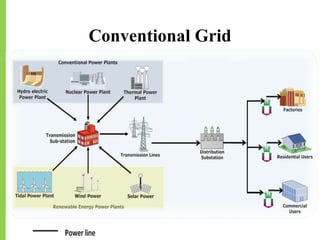
Conventional Grid
23-11-2018 36
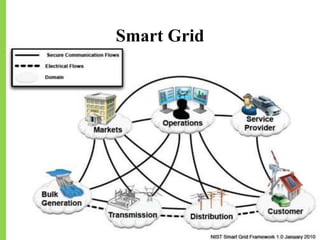
Smart Grid
23-11-2018 37
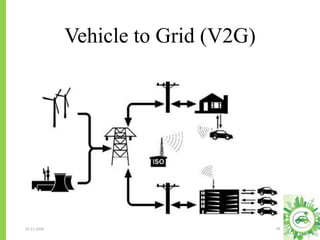
Vehicle to Grid (V2G)
23-11-2018 38
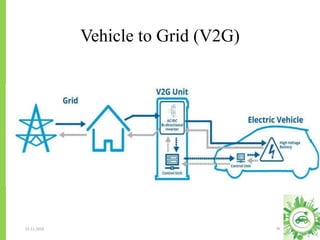
Vehicle to Grid (V2G)
23-11-2018 39
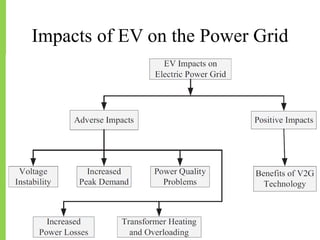
Impacts of EV on the Power Grid
23-11-2018 40
Ancillary Services of V2G
23-11-2018 41
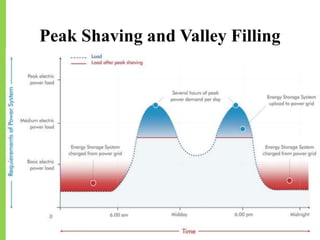
• Peak Load Shaving
• Voltage Regulation
• Spinning Reserve
• Load Levelling (Valley Filling)
Peak Shaving and Valley Filling
23-11-2018 42
All Electric Fleet by 2030: Can It
Happen???
23-11-2018 43
• EV penetration in to the electric power grid poses a threat to power
quality and reliability,
• The backbone network has to be strengthened before integrating the
EVs to the grid. The current distribution system has to be upgraded to
a whole new level to facilitate the rapid growth of EVs on the
distribution network.
• The other issue is the charging time or refueling time required by an
EV which varies from 6-8 hours, is significantly higher than the ICEV.
There is a DC fast charging and battery swapping method which is an
answer to it.
References
23-11-2018 44
1. Hussain Shareef et al.: “A review of the stage-of-the-art
charging technologies, placement methodologies, and impacts of
electric vehicles”, Renewable and Sustainable Energy Reviews.
2. Robert C. Green II et al.: “The impact of plug-in hybrid electric
vehicles on distribution networks: A review and outlook”,
Renewable and Sustainable Energy Reviews.
3. N. Shaukat et al.: “A survey on electric vehicle transportation
within smart grid system”, Renewable and Sustainable Energy
Reviews.
4. Electric and Hybrid Vehicles Design Fundamentals 2nd edition
by Iqbal Husain.
5. Modern Electric, Hybrid Electric, and Fuel Cell Vehicles by
Mehrdad Ehsani et al.
Contact
•Linkedin: Krishnakumar Vasudevan
•Email: vasudevkrishna.ceg@gmail.com
23-11-2018 45
Thank You
23-11-2018 46

Electric Vehicle: A Power Engineer's Perspective

  • 1.
    Electric Vehicle: APower Engineer’s Perspective Krishnakumar R V Research Associate Universiti Tenaga Nasional Malaysia 23-11-2018 1
  • 2.
    EV: A Jargon? 23-11-20182 • Traction of wheels by Electric Motors • Portable Energy source
  • 3.
    EV: The FirstInception 23-11-2018 3 Robert Anderson 1850s (Britain) William Morrison 1890 (Iowa, U.S) 1900 1/3rd of Vehicle population In USA
  • 4.
    EV: The Saga 23-11-20184 Industrial Revolution 1780s (Steam Engines) Post Industrial Revolution 1800s (IC Engines) Post 1850s Battery Vehicles Early 1900s Ford Model T And Invention of Electric starter
  • 5.
    Why EV? 23-11-2018 5 1.Pollution: Accordingto DOE (USA) • Transportation accounts for one third of all energy usage. • Use of 10% of ZEV cuts 1 million tons/year of air pollutants • With 100% EV - CO2 emission would be cut by half 2.Availability of Fuel Fast depletion of fossil fuel and dependence on middle east countries for fuel.
  • 6.
    Why EV? 23-11-2018 6 3.CapitalCost and Maintenance Cost: • EV has a more capital cost • But life cycle cost of EV is lesser than ICEV 4.Well to Wheel Efficiency The EV is found to have a better WTW efficiency than ICEV
  • 7.
    Does It MakeSense??? 23-11-2018 7
  • 8.
    Does It MakeSense Now??? 23-11-2018 8
  • 9.
    EV Vs ICEV 23-11-20189 EV (Mahindra E- Verito) Price- Rs. 10.5 lakhs Battery- 18.55 kWh Range- 140 km Cost (Per Charge)- 18.55*4.75= Rs. 88 ICEV ( Petrol- Honda Amaze) Price- Rs.9.5 lakhs Mileage- 17 kmpl Petrol - 140 17 = 8.23 litres Cost (140 km)= 8.23*83 = Rs. 683
  • 10.
    Payback Analysis 23-11-2018 10 •Difference in Price between EV and ICEV – Rs. 1 lakh • Volume of Petrol for Rs. 1 lakh- 1250 litres • Mileage with 1250 litres of petrol- 21250km • Average distance driven per year- 11000km • Payback- 1.9 yrs
  • 11.
    Regenerative Braking 23-11-2018 11 •A significant amount of energy is consumed in braking. • Braking a 1000 kg vehicle from 100 km/h to zero speed consumes about 0.16 kWh of energy. • The energy lost in brake shoes as heat. • It can be utilized to charge the battery. • It makes sense in “Stop and Go Traffic”, “Downhill”
  • 12.
    Alternate Vehicles: Abroad spectrum 23-11-2018 12 • All Electric Vehicle • Hybrid Electric Vehicle • Plug-In Hybrid Electric Vehicle
  • 13.
  • 14.
    Commercially Available EV 23-11-201814 • Tesla Model S - 417 km, 507 km or 539 km • Tesla Model X - 381 km, 465km or 475 km • Jaguar I Pace - 480 km • Tesla Model 3 - 354 km or 499 km • Chevy Bolt - 383 km • Renault ZOE (Only Europe) - 300 km • Nissan LEAF - 240 km • Volkswagen e-Golf - 201 km • Hyundai IONIQ Electric - 200 km • Kia Soul EV - 179 km • Mahindra e2o - 120 km • Mahindra e-Verito - 110 km
  • 15.
    Hybrid Electric Vehicle(HEV) 23-11-2018 15
  • 16.
    Commercially Available HEV 23-11-201816 • Maruti Suzuki Ertiga SHVS • Honda Accord Hybrid • Toyota Camry Hybrid • Mahindra Scorpio S10 Intelli-Hybrid • Maruti Suzuki Ciaz SHVS
  • 17.
    Plug-In Hybrid ElectricVehicle (PHEV):Range Extender 23-11-2018 17
  • 18.
    Commercially Available PHEV 23-11-201818 • BMW i8 • Toyota Yaris Hybrid • Mercedes C-Class C300h • Toyota Prius • Volkswagen Golf GTI • BMW i3 • Porsche Cayenne E-Hybrid • Mercedes S500e
  • 19.
    HEV Vs PHEV HEV •IC Engine is the primary source • Electric Motor is used to complement the IC engine • Electricity is generated on- board • Energy/Cost saving is doesn’t payback the cost of vehicle soon PHEV • Electric Motor powered by battery is the primary source • IC Engine supports the electric motor and extends the range • Battery is charged by Plugging it into the socket • Energy/Cost saving is substantial 23-11-2018 19
  • 20.
    Classification of HEV 23-11-201820 1.Based On Architecture • Series • Parallel • Series – Parallel 2.Degree Of Hybridization • Mild • Power • Energy
  • 21.
    Series Hybrid Drivetrain 23-11-201821 Engine Generator & Converter Battery Motor & Converter Transmission D Wheel Wheel
  • 22.
    Parallel Hybrid Drivetrain 23-11-201822 Engine Drive Shaft Battery Motor & Converter Transmission D Wheel Wheel Clutch
  • 23.
    Series-Parallel Hybrid Drivetrain 23-11-201823 Engine Drive Shaft Battery Motor Transmission D Wheel Wheel Clutch Generator Power Converter Power Splitter
  • 24.
    Degree of Hybridization 23-11-201824 I. Degree of downsizing the engine and upsizing the electric motor. II. That is the traction power provided by the IC engine is reduced and that of the electric motor is increased by varying the capacity of the prime movers respectively.
  • 25.
  • 26.
    Conductive Charging 23-11-2018 26 •Conductive charging scheme transfers power through direct contact. • This scheme uses a conductor to connect the electronic devices to the extent of energy transfer. • Conductive charging is simple and highly efficient. It can be a non-board or off-board method. • An on-board charger is mainly utilized for slow charging. • An off-board charger is installed at fixed locations to offer rapid charging service.
  • 27.
  • 28.
    Inductive Charging 23-11-2018 28 •Also known as wireless charging, • Uses an electromagnetic field to transfer electricity to an EV battery. • The benefit of inductive charger is that it provides electrical safety under all-weather conditions. • The drawbacks of state-of-the-art inductive chargers are low efficiency and high power loss
  • 29.
  • 30.
    Battery Swapping 23-11-2018 30 •Users can swap their empty battery with a fully charged one from a battery swapping station. • Batteries are not owned by the car owners so the cost is reduced by 15% approx.,. • The peak demand on the grid is also reduced. • Tesla proved to swap the batteries of two Tesla Model S with in the time taken to fill the tank of a ICEV.
  • 31.
  • 32.
    Level 1 Charging 23-11-201832 • Uses a standard 120 VAC, 15 A or 20 A • Charging equipment is typically installed on the vehicle • Time 8 to 16 hrs • Power rating 1.4-1.9 kW (depends on Amp rating)
  • 33.
    Level 2 Charging 23-11-201833 • Preferred method for a battery electric vehicle charger for both private and public facilities. • Private: 240 V AC, Single Phase, 40 A. • Public: 400 V AC, Three Phase, 80 A. • Power Rating 7.7 kW to 25.6 kW. • Time 4-8 hrs. • The conversion from AC to DC takes place on board.
  • 34.
    Level 3 DCFast Charging 23-11-2018 34 • To provide an experience similar to a oil-based fuel station to the consumers with performing a DC fast charge. • AC to DC conversion occurs in an off-board charger. • Three phase circuit, 208–600 V AC, up to 200 A. • Charged to 80 % SoC within 10-15 min.
  • 35.
    Interaction of EVwith Power Grid 23-11-2018 35
  • 36.
  • 37.
  • 38.
    Vehicle to Grid(V2G) 23-11-2018 38
  • 39.
    Vehicle to Grid(V2G) 23-11-2018 39
  • 40.
    Impacts of EVon the Power Grid 23-11-2018 40
  • 41.
    Ancillary Services ofV2G 23-11-2018 41 • Peak Load Shaving • Voltage Regulation • Spinning Reserve • Load Levelling (Valley Filling)
  • 42.
    Peak Shaving andValley Filling 23-11-2018 42
  • 43.
    All Electric Fleetby 2030: Can It Happen??? 23-11-2018 43 • EV penetration in to the electric power grid poses a threat to power quality and reliability, • The backbone network has to be strengthened before integrating the EVs to the grid. The current distribution system has to be upgraded to a whole new level to facilitate the rapid growth of EVs on the distribution network. • The other issue is the charging time or refueling time required by an EV which varies from 6-8 hours, is significantly higher than the ICEV. There is a DC fast charging and battery swapping method which is an answer to it.
  • 44.
    References 23-11-2018 44 1. HussainShareef et al.: “A review of the stage-of-the-art charging technologies, placement methodologies, and impacts of electric vehicles”, Renewable and Sustainable Energy Reviews. 2. Robert C. Green II et al.: “The impact of plug-in hybrid electric vehicles on distribution networks: A review and outlook”, Renewable and Sustainable Energy Reviews. 3. N. Shaukat et al.: “A survey on electric vehicle transportation within smart grid system”, Renewable and Sustainable Energy Reviews. 4. Electric and Hybrid Vehicles Design Fundamentals 2nd edition by Iqbal Husain. 5. Modern Electric, Hybrid Electric, and Fuel Cell Vehicles by Mehrdad Ehsani et al.
  • 45.
    Contact •Linkedin: Krishnakumar Vasudevan •Email:vasudevkrishna.ceg@gmail.com 23-11-2018 45
  • 46.

Editor's Notes

  • #5 Steam vehicles required long startup times -- sometimes up to 45 minutes in the cold -- and would need to be refilled with water, limiting their range Ford Model T was cheaper 650 USD but EV was 1750 USD
  • #12 It doesn’t contribute much in highway cruising
  • #14 Converter selection depends on Type of motor used
  • #40 Charging Algorithms Placing of Charging stations