SMART HIGHWAY SYSTEM
Contents
 What is Wireless Charging?
 Types of Charging
 Need of Electric Vehicles
 Problems with Electric vehicles
 Wireless Charging of Electric Vehicles
What is Wireless Charging?
Wireless charging is one of the several methods of
charging batteries without the use of cable or
device specific AC adaptors
Wireless charging can be used for a wide variety
of devices including cell phones laptop
computers and MP3 players as well as larger
objects such as robots and electric cars.
Methods of Charging
There are three types of wireless charging :
 Resonance Charging
 Inductive Charging
 Radio Charging
Inductive Charging
o Inductive charging is one kind of short distance
wireless charging
• This method works on the principle of
“ELECTROMAGNETIC INDUCTION” where the
charger device will create an E.M field with alternating
polarity using a coil of insulated copper wire & a
similar coil will be placed inside the mobile device
which will convert E.M field back to electric current
there by charging the battery.
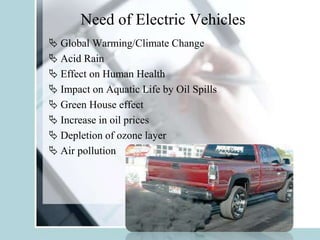
Need of Electric Vehicles
 Global Warming/Climate Change
 Acid Rain
 Effect on Human Health
 Impact on Aquatic Life by Oil Spills
 Green House effect
 Increase in oil prices
 Depletion of ozone layer
 Air pollution
DIFFERENCES
Gasoline-Fuel Car
 Emit Pollutants By
Battery-Fuel Car
 Noisy Engine
 Low-Efficiency of 18%-
20%
Battery-Fuel Car
 Little Pollutants By
Products
 Quiet to drive
 High Efficiency of up to
80%
Problems with EVs
a) Affordability - Expensive Batteries
b) Limited Travel Range
c) Costly Charging Stations
d) Prolonged full charge time
WHAT NEXT ?
Wireless Charging of
Electric Vehicle
Wireless Power Transfer (WPT)
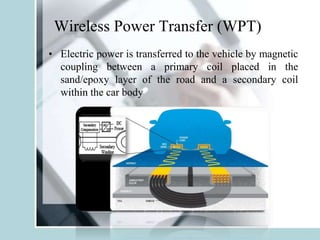
• Electric power is transferred to the vehicle by magnetic
coupling between a primary coil placed in the
sand/epoxy layer of the road and a secondary coil
within the car body
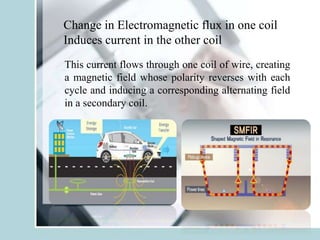
Change in Electromagnetic flux in one coil
Induces current in the other coil
This current flows through one coil of wire, creating
a magnetic field whose polarity reverses with each
cycle and inducing a corresponding alternating field
in a secondary coil.
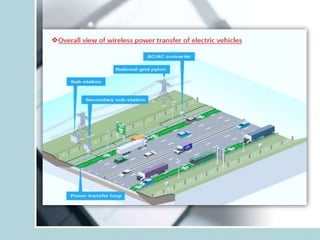
Wireless charging roads

Wireless charging roads

  • 1.
  • 2.
    Contents  What isWireless Charging?  Types of Charging  Need of Electric Vehicles  Problems with Electric vehicles  Wireless Charging of Electric Vehicles
  • 3.
    What is WirelessCharging? Wireless charging is one of the several methods of charging batteries without the use of cable or device specific AC adaptors Wireless charging can be used for a wide variety of devices including cell phones laptop computers and MP3 players as well as larger objects such as robots and electric cars.
  • 4.
    Methods of Charging Thereare three types of wireless charging :  Resonance Charging  Inductive Charging  Radio Charging
  • 5.
    Inductive Charging o Inductivecharging is one kind of short distance wireless charging • This method works on the principle of “ELECTROMAGNETIC INDUCTION” where the charger device will create an E.M field with alternating polarity using a coil of insulated copper wire & a similar coil will be placed inside the mobile device which will convert E.M field back to electric current there by charging the battery.
  • 6.
    Need of ElectricVehicles  Global Warming/Climate Change  Acid Rain  Effect on Human Health  Impact on Aquatic Life by Oil Spills  Green House effect  Increase in oil prices  Depletion of ozone layer  Air pollution
  • 7.
    DIFFERENCES Gasoline-Fuel Car  EmitPollutants By Battery-Fuel Car  Noisy Engine  Low-Efficiency of 18%- 20% Battery-Fuel Car  Little Pollutants By Products  Quiet to drive  High Efficiency of up to 80%
  • 8.
    Problems with EVs a)Affordability - Expensive Batteries b) Limited Travel Range c) Costly Charging Stations d) Prolonged full charge time
  • 9.
  • 10.
  • 11.
    Wireless Power Transfer(WPT) • Electric power is transferred to the vehicle by magnetic coupling between a primary coil placed in the sand/epoxy layer of the road and a secondary coil within the car body
  • 12.
    Change in Electromagneticflux in one coil Induces current in the other coil This current flows through one coil of wire, creating a magnetic field whose polarity reverses with each cycle and inducing a corresponding alternating field in a secondary coil.