SEMINAR
WIRELESS CHARGING OF
ELECTRIC VEHICALS
ON
Submitted To: Deepak Sir Submitted By: Rajat Kumar Agrawal
CONTENTS
1. Introduction
2. What are EV’s?
3. Need of EV’s?
4. Types of charging systems for EV’s
5. What is wireless charging?
6. Types of Wireless charging
7. History
8. Working
9. Construction of roads
10.Advantage and Disadvantages
11.Conclusion
INTRODUCTION
 The eco-friendly vehicle is the global trend in the automobile industry.
 The electrical vehicle (EV) is the most suitable alternative of petroleum
vehicles.
 The large capacity, weight, expensive price, short life time, and charging time
of battery obstruct the commercialization of EV.
 To solve these problems, wireless charging of electric vehicle is Introduced.
WHAT ARE EV’S(ELECTRIC VEHICLAS)
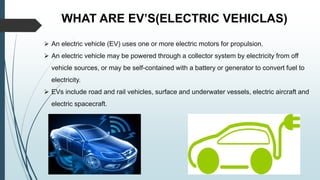
 An electric vehicle (EV) uses one or more electric motors for propulsion.
 An electric vehicle may be powered through a collector system by electricity from off
vehicle sources, or may be self-contained with a battery or generator to convert fuel to
electricity.
 EVs include road and rail vehicles, surface and underwater vessels, electric aircraft and
electric spacecraft.
NEED OF EV’S
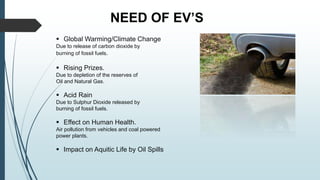
 Global Warming/Climate Change
Due to release of carbon dioxide by
burning of fossil fuels.
 Rising Prizes.
Due to depletion of the reserves of
Oil and Natural Gas.
 Acid Rain
Due to Sulphur Dioxide released by
burning of fossil fuels.
 Effect on Human Health.
Air pollution from vehicles and coal powered
power plants.
 Impact on Aquitic Life by Oil Spills
TYPES OF CHARGING SYSTEM’S
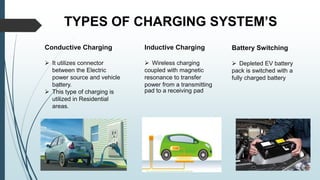
Conductive Charging
 It utilizes connector
between the Electric
power source and vehicle
battery.
 This type of charging is
utilized in Residential
areas.
Inductive Charging
 Wireless charging
coupled with magnetic
resonance to transfer
power from a transmitting
pad to a receiving pad
Battery Switching
 Depleted EV battery
pack is switched with a
fully charged battery
WIRELESS CHARGING
• The technology depends on the same principle of electromagnetic
induction that enables a transformer to change the voltage of an
alternating current. This current flows through one coil of wire, creating a
magnetic field whose polarity reverses with each cycle and inducing a
corresponding alternating field in a secondary coil.
• Transformers usually include an iron-rich core, which links the coils and
increases the field strength, but you don’t really need it. If the two coils
are separated by air, current flowing through the first coil will still create a
magnetic field, which will still be picked up by the second coil—it just
won’t be picked up as well. The greater the air gap, the less efficient the
transfer of power will be.
TYPES OF WIRELESS CHARGING
A. STATIC WIRELESS CHARGING
 the vehicle gets charged when it remains static. So here we could simply park the EV at
the parking spot or in garage which is incorporated with WCS. Transmitter is fitted
underneath the ground and receiver is arranged in vehicle’s underneath. To charge the
vehicle align the transmitter and receiver and leave it for charging. The charging time
depends on the AC supply power level, distance between the transmitter & receiver and
their pad sizes. This SWCS is best to build in areas where EV is being parked for a
certain time interval.
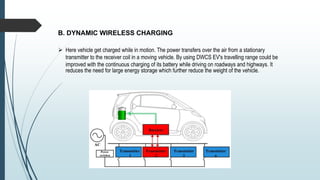
B. DYNAMIC WIRELESS CHARGING
 Here vehicle get charged while in motion. The power transfers over the air from a stationary
transmitter to the receiver coil in a moving vehicle. By using DWCS EV's travelling range could be
improved with the continuous charging of its battery while driving on roadways and highways. It
reduces the need for large energy storage which further reduce the weight of the vehicle.
HISTORY OF WIRELESS POWER
TRANSMISSION
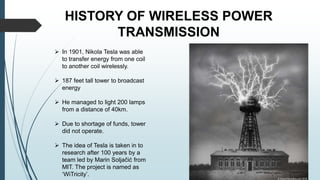
 In 1901, Nikola Tesla was able
to transfer energy from one coil
to another coil wirelessly.
 187 feet tall tower to broadcast
energy
 He managed to light 200 lamps
from a distance of 40km.
 Due to shortage of funds, tower
did not operate.
 The idea of Tesla is taken in to
research after 100 years by a
team led by Marin Soljačić from
MIT. The project is named as
‘WiTricity’.
HOW IT WORKS
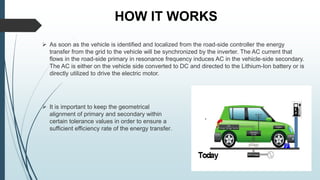
 As soon as the vehicle is identified and localized from the road-side controller the energy
transfer from the grid to the vehicle will be synchronized by the inverter. The AC current that
flows in the road-side primary in resonance frequency induces AC in the vehicle-side secondary.
The AC is either on the vehicle side converted to DC and directed to the Lithium-Ion battery or is
directly utilized to drive the electric motor.
 It is important to keep the geometrical
alignment of primary and secondary within
certain tolerance values in order to ensure a
sufficient efficiency rate of the energy transfer.
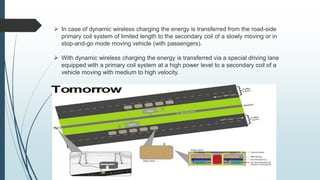
 In case of dynamic wireless charging the energy is transferred from the road-side
primary coil system of limited length to the secondary coil of a slowly moving or in
stop-and-go mode moving vehicle (with passengers).
 With dynamic wireless charging the energy is transferred via a special driving lane
equipped with a primary coil system at a high power level to a secondary coil of a
vehicle moving with medium to high velocity.
CONSTRUCTION OF ROADS
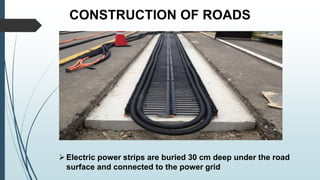
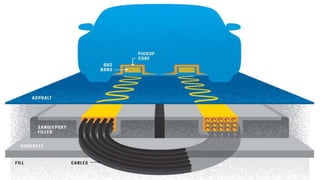
Electric power strips are buried 30 cm deep under the road
surface and connected to the power grid
ADVANTAGES
 80 % reduced operating cost than equivalent gas powered vehicles.
 Lower maintenance costs than gas powered vehicles .
 Pollution free.
 Zero recharging time and unlimited range (when operating on an grid
road).
 Light weight vehicles.
 A number of EVs can be charged at a time.
 Electrically safe.
 Charging is convenient.
DISADVANTAGES
 Initial installation cost is very high.
 Working area is limited.
 Currently the speed is limited to 40 miles per hour.
 power outage might cause the EVs to run out of charge.
 Heat generation is more than traditional charging.
 Complex design.
 Construction of wireless charging road is required
CONCLUSION
Charging electric vehicles wirelessly- a reality.
Low maintenance cost but high initial cost.
Better then conventional wired system.
Energy crisis can be decreased.
Low power loss
In the future world will be completely wireless.

Wireless charging of ev's

  • 1.
    SEMINAR WIRELESS CHARGING OF ELECTRICVEHICALS ON Submitted To: Deepak Sir Submitted By: Rajat Kumar Agrawal
  • 2.
    CONTENTS 1. Introduction 2. Whatare EV’s? 3. Need of EV’s? 4. Types of charging systems for EV’s 5. What is wireless charging? 6. Types of Wireless charging 7. History 8. Working 9. Construction of roads 10.Advantage and Disadvantages 11.Conclusion
  • 3.
    INTRODUCTION  The eco-friendlyvehicle is the global trend in the automobile industry.  The electrical vehicle (EV) is the most suitable alternative of petroleum vehicles.  The large capacity, weight, expensive price, short life time, and charging time of battery obstruct the commercialization of EV.  To solve these problems, wireless charging of electric vehicle is Introduced.
  • 4.
    WHAT ARE EV’S(ELECTRICVEHICLAS)  An electric vehicle (EV) uses one or more electric motors for propulsion.  An electric vehicle may be powered through a collector system by electricity from off vehicle sources, or may be self-contained with a battery or generator to convert fuel to electricity.  EVs include road and rail vehicles, surface and underwater vessels, electric aircraft and electric spacecraft.
  • 5.
    NEED OF EV’S Global Warming/Climate Change Due to release of carbon dioxide by burning of fossil fuels.  Rising Prizes. Due to depletion of the reserves of Oil and Natural Gas.  Acid Rain Due to Sulphur Dioxide released by burning of fossil fuels.  Effect on Human Health. Air pollution from vehicles and coal powered power plants.  Impact on Aquitic Life by Oil Spills
  • 6.
    TYPES OF CHARGINGSYSTEM’S Conductive Charging  It utilizes connector between the Electric power source and vehicle battery.  This type of charging is utilized in Residential areas. Inductive Charging  Wireless charging coupled with magnetic resonance to transfer power from a transmitting pad to a receiving pad Battery Switching  Depleted EV battery pack is switched with a fully charged battery
  • 7.
    WIRELESS CHARGING • Thetechnology depends on the same principle of electromagnetic induction that enables a transformer to change the voltage of an alternating current. This current flows through one coil of wire, creating a magnetic field whose polarity reverses with each cycle and inducing a corresponding alternating field in a secondary coil. • Transformers usually include an iron-rich core, which links the coils and increases the field strength, but you don’t really need it. If the two coils are separated by air, current flowing through the first coil will still create a magnetic field, which will still be picked up by the second coil—it just won’t be picked up as well. The greater the air gap, the less efficient the transfer of power will be.
  • 8.
    TYPES OF WIRELESSCHARGING A. STATIC WIRELESS CHARGING  the vehicle gets charged when it remains static. So here we could simply park the EV at the parking spot or in garage which is incorporated with WCS. Transmitter is fitted underneath the ground and receiver is arranged in vehicle’s underneath. To charge the vehicle align the transmitter and receiver and leave it for charging. The charging time depends on the AC supply power level, distance between the transmitter & receiver and their pad sizes. This SWCS is best to build in areas where EV is being parked for a certain time interval.
  • 9.
    B. DYNAMIC WIRELESSCHARGING  Here vehicle get charged while in motion. The power transfers over the air from a stationary transmitter to the receiver coil in a moving vehicle. By using DWCS EV's travelling range could be improved with the continuous charging of its battery while driving on roadways and highways. It reduces the need for large energy storage which further reduce the weight of the vehicle.
  • 10.
    HISTORY OF WIRELESSPOWER TRANSMISSION  In 1901, Nikola Tesla was able to transfer energy from one coil to another coil wirelessly.  187 feet tall tower to broadcast energy  He managed to light 200 lamps from a distance of 40km.  Due to shortage of funds, tower did not operate.  The idea of Tesla is taken in to research after 100 years by a team led by Marin Soljačić from MIT. The project is named as ‘WiTricity’.
  • 11.
    HOW IT WORKS As soon as the vehicle is identified and localized from the road-side controller the energy transfer from the grid to the vehicle will be synchronized by the inverter. The AC current that flows in the road-side primary in resonance frequency induces AC in the vehicle-side secondary. The AC is either on the vehicle side converted to DC and directed to the Lithium-Ion battery or is directly utilized to drive the electric motor.  It is important to keep the geometrical alignment of primary and secondary within certain tolerance values in order to ensure a sufficient efficiency rate of the energy transfer.
  • 12.
     In caseof dynamic wireless charging the energy is transferred from the road-side primary coil system of limited length to the secondary coil of a slowly moving or in stop-and-go mode moving vehicle (with passengers).  With dynamic wireless charging the energy is transferred via a special driving lane equipped with a primary coil system at a high power level to a secondary coil of a vehicle moving with medium to high velocity.
  • 13.
    CONSTRUCTION OF ROADS Electricpower strips are buried 30 cm deep under the road surface and connected to the power grid
  • 15.
    ADVANTAGES  80 %reduced operating cost than equivalent gas powered vehicles.  Lower maintenance costs than gas powered vehicles .  Pollution free.  Zero recharging time and unlimited range (when operating on an grid road).  Light weight vehicles.  A number of EVs can be charged at a time.  Electrically safe.  Charging is convenient.
  • 16.
    DISADVANTAGES  Initial installationcost is very high.  Working area is limited.  Currently the speed is limited to 40 miles per hour.  power outage might cause the EVs to run out of charge.  Heat generation is more than traditional charging.  Complex design.  Construction of wireless charging road is required
  • 17.
    CONCLUSION Charging electric vehicleswirelessly- a reality. Low maintenance cost but high initial cost. Better then conventional wired system. Energy crisis can be decreased. Low power loss In the future world will be completely wireless.