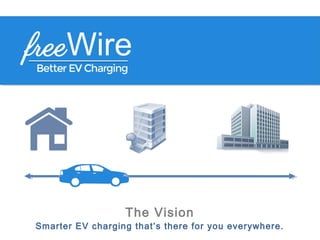
The Vision
Smarter EV charging that’s there for you everywhere.
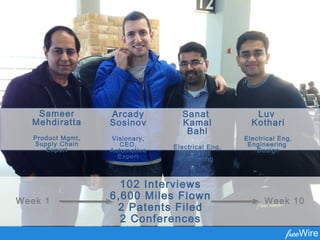
102 Interviews
6,600 Miles Flown
2 Patents Filed
2 Conferences
Week 1 Week 10
Sameer
Mehdiratta
Product Mgmt,
Supply Chain
Expert
Arcady
Sosinov
Visionary,
CEO,
Automotive
Expert
Sanat
Kamal
Bahl
Electrical Eng,
Product
Marketing
Luv
Kothari
Electrical Eng,
Engineering
Design
A Growth Market
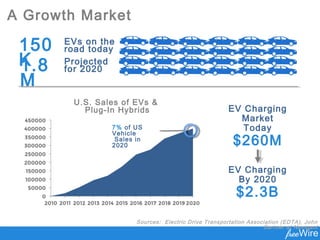
150
K
EVs on the
road today
1.8
M
Projected
for 2020
U.S. Sales of EVs &
Plug-In Hybrids
7% of US
Vehicle
Sales in
2020
EV Charging
Market
Today
$260M
EV Charging
By 2020
$2.3B
Sources: Electric Drive Transportation Association (EDTA), John
Gartner at Navigant
The Journey
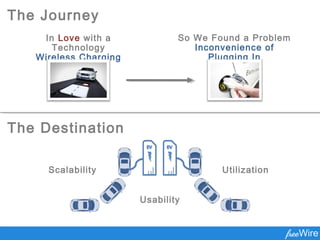
So We Found a Problem
Inconvenience of
Plugging In
In Love with a
Technology
Wireless Charging
Scalability
Usability
Utilization
The Destination
The Beacon: Business Model Canvas
Licensed from businessmodelgeneration.com under a Creative Commons Attribution-ShareAlike 3.0 Unported License
LaunchPad Central
o
Key Partners
Strategic Alliance:
Electrical grid utilities
(PG&E).
Strategic Alliance /
Coopetition: Software &
Network (ChargePoint).
 Strategic Alliance /
Supplier: Robotics
(Knightscope, Berkeley
Robotics Lab)
 Supplier: Workspace to
build and test prototype.
 Supplier: Second-life
battery suppliers (Tesla,
Nissan, BMW).
Traffic Partner / Supplier:
Electrical contractors
(EPCs - Rosendin,
Cupertino Electric).
Key Activities
Fast EV charging.
Autonomous robotic
movement.
 Prototype
demonstration.
Gov't funding for
cleantech/energy/EV
projects.
Value Propositions
 USABILITY: Increase
capacity of each charger.
 USABILITY: Prevent
charge rage amongst
employees.
 USABILITY: Increase
utilization of the charging
infrastructure.
 SCALABILITY: Ease of
installation to electrify a
large area.
 SCALABILITY: A cheaper
way to electrify a large
area.
Customer
Relationships
 GET: Product demo to
facilities managers.
 KEEP: Service &
maintenance contract.
 KEEP: Analytics
platform.
 GROW: Demand
response software.
Customer Segments
 Companies with large
parking areas and a high
percentage of employees
who commute using EVs -
Google, Cisco
Local and state-level
government agencies who
have a large fleet of EVs.
Key Resources
 Physical: Second-life li-
ion batteries.
 Physical:
Manufacturing
subcontractor specializing
in high-power electronics.
 Human: Battery
engineer.
Channels
 Direct Sales (charging
equipment)
 Value Added Resellers,
such as electrical
contractors (charging
equipment)
Cost Structure
Variable: Service & maintenance of chargers.
Variable: Product manufacturing (AC/DC converter, battery charger,
batteries, boost converter, CHAdeMO controller, etc).
Variable: Power electronics testing equipment (incubator, borrow,
rent).
Fixed: Product designer.
Fixed: Robotics software engineer.
Revenue Streams
 Charging as a Service (CaaS): Provide an attendant and
several Mobi units. Includes a guaranteed capacity per day,
maintenance, and data analytics. Customers pay a monthly
fee.
 Lease Mobi: Customers provide their own attendant and
pay monthly for the product, maintenance, and data
analytics.
 Buy Mobi: Customers buy a unit, and they have to sign up for a
maintenance & data analytics contract.
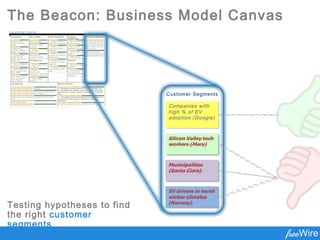
Testing hypotheses to find
the right customer
segments
Customer Segments
Companies with
high % of EV
adoption (Google)
Companies with
high % of EV
adoption (Google)
The Beacon: Business Model Canvas
Licensed from businessmodelgeneration.com under a Creative Commons Attribution-ShareAlike 3.0 Unported License
LaunchPad Central
o
Key Partners
Strategic Alliance:
Electrical grid utilities
(PG&E).
Strategic Alliance /
Coopetition: Software &
Network (ChargePoint).
 Strategic Alliance /
Supplier: Robotics
(Knightscope, Berkeley
Robotics Lab)
 Supplier: Workspace to
build and test prototype.
 Supplier: Second-life
battery suppliers (Tesla,
Nissan, BMW).
Traffic Partner / Supplier:
Electrical contractors
(EPCs - Rosendin,
Cupertino Electric).
Key Activities
Fast EV charging.
Autonomous robotic
movement.
 Prototype
demonstration.
Gov't funding for
cleantech/energy/EV
projects.
Value Propositions
 USABILITY: Increase
capacity of each charger.
 USABILITY: Prevent
charge rage amongst
employees.
 USABILITY: Increase
utilization of the charging
infrastructure.
 SCALABILITY: Ease of
installation to electrify a
large area.
 SCALABILITY: A cheaper
way to electrify a large
area.
Customer
Relationships
 GET: Product demo to
facilities managers.
 KEEP: Service &
maintenance contract.
 KEEP: Analytics
platform.
 GROW: Demand
response software.
Customer Segments
 Companies with large
parking areas and a high
percentage of employees
who commute using EVs -
Google, Cisco
Local and state-level
government agencies who
have a large fleet of EVs.
Key Resources
 Physical: Second-life li-
ion batteries.
 Physical:
Manufacturing
subcontractor specializing
in high-power electronics.
 Human: Battery
engineer.
Channels
 Direct Sales (charging
equipment)
 Value Added Resellers,
such as electrical
contractors (charging
equipment)
Cost Structure
Variable: Service & maintenance of chargers.
Variable: Product manufacturing (AC/DC converter, battery charger,
batteries, boost converter, CHAdeMO controller, etc).
Variable: Power electronics testing equipment (incubator, borrow,
rent).
Fixed: Product designer.
Fixed: Robotics software engineer.
Revenue Streams
 Charging as a Service (CaaS): Provide an attendant and
several Mobi units. Includes a guaranteed capacity per day,
maintenance, and data analytics. Customers pay a monthly
fee.
 Lease Mobi: Customers provide their own attendant and
pay monthly for the product, maintenance, and data
analytics.
 Buy Mobi: Customers buy a unit, and they have to sign up for a
maintenance & data analytics contract.
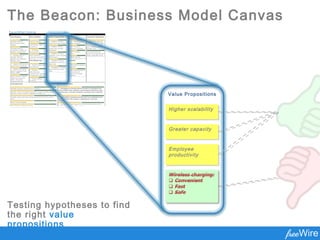
Testing hypotheses to find
the right value
propositions
Value Propositions
Higher scalabilityHigher scalability
Greater capacityGreater capacity
Employee
productivity
Employee
productivity
The Beacon: Business Model Canvas
Licensed from businessmodelgeneration.com under a Creative Commons Attribution-ShareAlike 3.0 Unported License
LaunchPad Central
o
Key Partners
Strategic Alliance:
Electrical grid utilities
(PG&E).
Strategic Alliance /
Coopetition: Software &
Network (ChargePoint).
 Strategic Alliance /
Supplier: Robotics
(Knightscope, Berkeley
Robotics Lab)
 Supplier: Workspace to
build and test prototype.
 Supplier: Second-life
battery suppliers (Tesla,
Nissan, BMW).
Traffic Partner / Supplier:
Electrical contractors
(EPCs - Rosendin,
Cupertino Electric).
Key Activities
Fast EV charging.
Autonomous robotic
movement.
 Prototype
demonstration.
Gov't funding for
cleantech/energy/EV
projects.
Value Propositions
 USABILITY: Increase
capacity of each charger.
 USABILITY: Prevent
charge rage amongst
employees.
 USABILITY: Increase
utilization of the charging
infrastructure.
 SCALABILITY: Ease of
installation to electrify a
large area.
 SCALABILITY: A cheaper
way to electrify a large
area.
Customer
Relationships
 GET: Product demo to
facilities managers.
 KEEP: Service &
maintenance contract.
 KEEP: Analytics
platform.
 GROW: Demand
response software.
Customer Segments
 Companies with large
parking areas and a high
percentage of employees
who commute using EVs -
Google, Cisco
Local and state-level
government agencies who
have a large fleet of EVs.
Key Resources
 Physical: Second-life li-
ion batteries.
 Physical:
Manufacturing
subcontractor specializing
in high-power electronics.
 Human: Battery
engineer.
Channels
 Direct Sales (charging
equipment)
 Value Added Resellers,
such as electrical
contractors (charging
equipment)
Cost Structure
Variable: Service & maintenance of chargers.
Variable: Product manufacturing (AC/DC converter, battery charger,
batteries, boost converter, CHAdeMO controller, etc).
Variable: Power electronics testing equipment (incubator, borrow,
rent).
Fixed: Product designer.
Fixed: Robotics software engineer.
Revenue Streams
 Charging as a Service (CaaS): Provide an attendant and
several Mobi units. Includes a guaranteed capacity per day,
maintenance, and data analytics. Customers pay a monthly
fee.
 Lease Mobi: Customers provide their own attendant and
pay monthly for the product, maintenance, and data
analytics.
 Buy Mobi: Customers buy a unit, and they have to sign up for a
maintenance & data analytics contract.
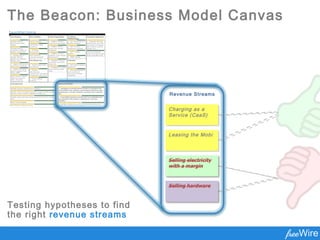
Testing hypotheses to find
the right revenue streams
Revenue Streams
Charging as a
Service (CaaS)
Charging as a
Service (CaaS)
Leasing the MobiLeasing the Mobi
The Beacon: Business Model Canvas
Licensed from businessmodelgeneration.com under a Creative Commons Attribution-ShareAlike 3.0 Unported License
LaunchPad Central
o
Key Partners
Strategic Alliance:
Electrical grid utilities
(PG&E).
Strategic Alliance /
Coopetition: Software &
Network (ChargePoint).
 Strategic Alliance /
Supplier: Robotics
(Knightscope, Berkeley
Robotics Lab)
 Supplier: Workspace to
build and test prototype.
 Supplier: Second-life
battery suppliers (Tesla,
Nissan, BMW).
Traffic Partner / Supplier:
Electrical contractors
(EPCs - Rosendin,
Cupertino Electric).
Key Activities
Fast EV charging.
Autonomous robotic
movement.
 Prototype
demonstration.
Gov't funding for
cleantech/energy/EV
projects.
Value Propositions
 USABILITY: Increase
capacity of each charger.
 USABILITY: Prevent
charge rage amongst
employees.
 USABILITY: Increase
utilization of the charging
infrastructure.
 SCALABILITY: Ease of
installation to electrify a
large area.
 SCALABILITY: A cheaper
way to electrify a large
area.
Customer
Relationships
 GET: Product demo to
facilities managers.
 KEEP: Service &
maintenance contract.
 KEEP: Analytics
platform.
 GROW: Demand
response software.
Customer Segments
 Companies with large
parking areas and a high
percentage of employees
who commute using EVs -
Google, Cisco
Local and state-level
government agencies who
have a large fleet of EVs.
Key Resources
 Physical: Second-life li-
ion batteries.
 Physical:
Manufacturing
subcontractor specializing
in high-power electronics.
 Human: Battery
engineer.
Channels
 Direct Sales (charging
equipment)
 Value Added Resellers,
such as electrical
contractors (charging
equipment)
Cost Structure
Variable: Service & maintenance of chargers.
Variable: Product manufacturing (AC/DC converter, battery charger,
batteries, boost converter, CHAdeMO controller, etc).
Variable: Power electronics testing equipment (incubator, borrow,
rent).
Fixed: Product designer.
Fixed: Robotics software engineer.
Revenue Streams
 Charging as a Service (CaaS): Provide an attendant and
several Mobi units. Includes a guaranteed capacity per day,
maintenance, and data analytics. Customers pay a monthly
fee.
 Lease Mobi: Customers provide their own attendant and
pay monthly for the product, maintenance, and data
analytics.
 Buy Mobi: Customers buy a unit, and they have to sign up for a
maintenance & data analytics contract.
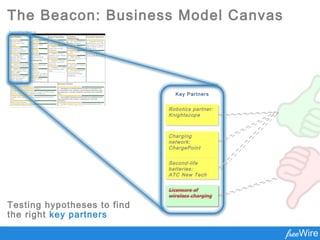
Testing hypotheses to find
the right key partners
Key Partners
Robotics partner:
Knightscope
Robotics partner:
Knightscope
Charging
network:
ChargePoint
Charging
network:
ChargePoint
Second-life
batteries:
ATC New Tech
Second-life
batteries:
ATC New Tech
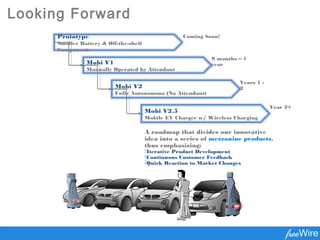
Looking Forward
Prototype
Smaller Battery & Off-the-shelf
Components
Mobi V1
Manually Operated by Attendant
Mobi V2
Fully Autonomous (No Attendant)
Mobi V2.5
Mobile EV Charger w/ Wireless Charging
Coming Soon!
9 months – 1
year
Years 1 -
2
Year 2+
A roadmap that divides our innovative
idea into a series of mezzanine products,
thus emphasizing:
Iterative Product Development
Continuous Customer Feedback
Quick Reaction to Market Changes
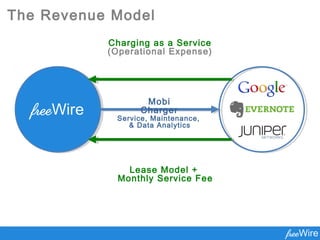
The Revenue Model
Mobi
Charger
Service, Maintenance,
& Data Analytics
Lease Model +
Monthly Service Fee
Charging as a Service
(Operational Expense)
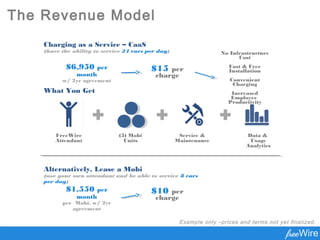
The Revenue Model
Example only –prices and terms not yet finalized.
Charging as a Service – CaaS
(have the ability to service 24 cars per day)
$6,950 per
month
w/ 2yr agreement
$15 per
charge
What You Get
FreeWire
Attendant
(3) Mobi
Units
Service &
Maintenance
Data &
Usage
Analytics
No Infrastructure
Cost
Fast & Free
Installation
Convenient
Charging
Increased
Employee
Productivity
Alternatively, Lease a Mobi
(use your own attendant and be able to service 8 cars
per day)
$1,550 per
month
per Mobi, w/ 2yr
agreement
$10 per
charge
Before we conclude,
we want to show you
just one more thing…
Thank
You
arcady@freewiretech.com
luv@freewiretech.com
sameer@freewiretech.com
Appendix
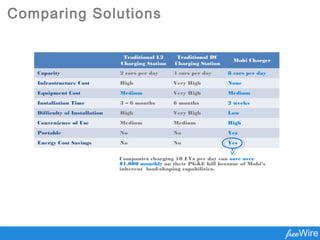
Comparing Solutions
Traditional L2
Charging Station
Traditional DC
Charging Station
Mobi Charger
Capacity 2 cars per day 4 cars per day 8 cars per day
Infrastructure Cost High Very High None
Equipment Cost Medium Very High Medium
Installation Time 3 – 6 months 6 months 2 weeks
Difficulty of Installation High Very High Low
Convenience of Use Medium Medium High
Portable No No Yes
Energy Cost Savings No No Yes
Companies charging 10 EVs per day can save over
$1,000 monthly on their PG&E bill because of Mobi’s
inherent load-shaping capabilities.
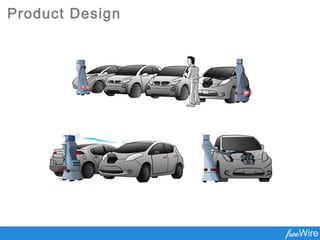
Product Design
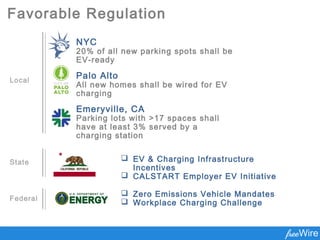
Favorable Regulation
NYC
20% of all new parking spots shall be
EV-ready
Palo Alto
All new homes shall be wired for EV
charging
Emeryville, CA
Parking lots with >17 spaces shall
have at least 3% served by a
charging station
Local
 EV & Charging Infrastructure
Incentives
 CALSTART Employer EV Initiative
 Zero Emissions Vehicle Mandates
 Workplace Charging Challenge
State
Federal
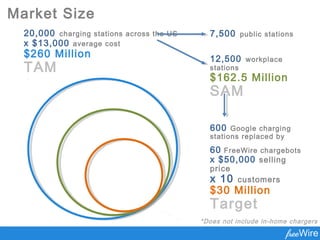
Market Size
20,000 charging stations across the US
x $13,000 average cost
$260 Million
TAM
7,500 public stations
12,500 workplace
stations
$162.5 Million
SAM
*Does not include in-home chargers
600 Google charging
stations replaced by
60 FreeWire chargebots
x $50,000 selling
price
x 10 customers
$30 Million
Target
EV Projections
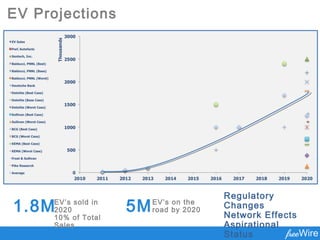
1.8MEV’s sold in
2020
10% of Total
Sales
5MEV’s on the
road by 2020
Regulatory
Changes
Network Effects
Aspirational
Status
Charging Infrastructure
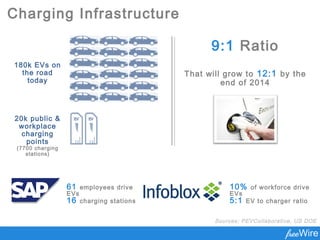
180k EVs on
the road
today
20k public &
workplace
charging
points
(7700 charging
stations)
9:1 Ratio
That will grow to 12:1 by the
end of 2014
Sources: PEVCollaborative, US DOE
61 employees drive
EVs
16 charging stations
10% of workforce drive
EVs
5:1 EV to charger ratio
Current Paradigm
EVEV EVEV
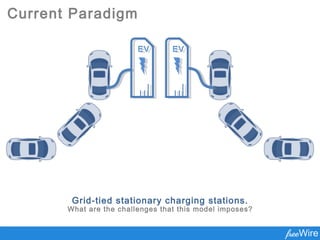
Grid-tied stationary charging stations.
What are the challenges that this model imposes?
Utilization
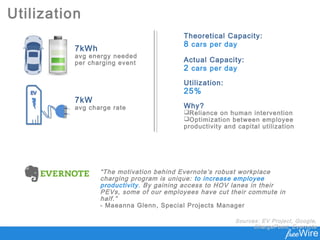
7kWh
avg energy needed
per charging event
7kW
avg charge rate
Theoretical Capacity:
8 cars per day
Actual Capacity:
2 cars per day
Utilization:
25%
Why?
Reliance on human intervention
Optimization between employee
productivity and capital utilization
Sources: EV Project, Google,
ChargePoint, Evernote
“The motivation behind Evernote’s robust workplace
charging program is unique: to increase employee
productivity. By gaining access to HOV lanes in their
PEVs, some of our employees have cut their commute in
half.”
- Maeanna Glenn, Special Projects Manager
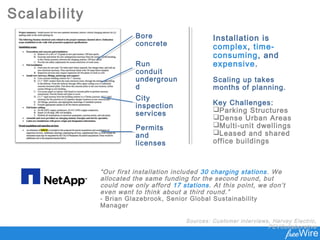
Scalability
Bore
concrete
Sources: Customer interviews, Harvey Electric,
PEVCollaborative
“Our first installation included 30 charging stations. We
allocated the same funding for the second round, but
could now only afford 17 stations. At this point, we don’t
even want to think about a third round.”
- Brian Glazebrook, Senior Global Sustainability
Manager
Run
conduit
undergroun
d
City
inspection
services
Permits
and
licenses
Installation is
complex, time-
consuming, and
expensive.
Scaling up takes
months of planning.
Key Challenges:
Parking Structures
Dense Urban Areas
Multi-unit dwellings
Leased and shared
office buildings
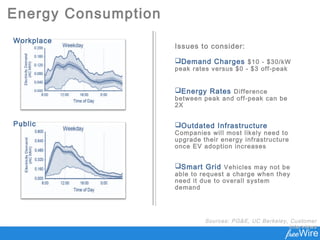
Energy Consumption
Issues to consider:
Demand Charges $10 - $30/kW
peak rates versus $0 - $3 off-peak
Energy Rates Difference
between peak and off-peak can be
2X
Outdated Infrastructure
Companies will most likely need to
upgrade their energy infrastructure
once EV adoption increases
Smart Grid Vehicles may not be
able to request a charge when they
need it due to overall system
demand
Sources: PG&E, UC Berkeley, Customer
interviews
Workplace
Public
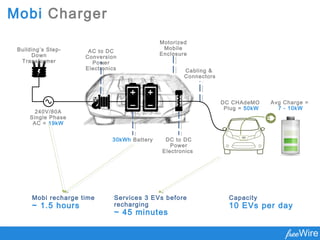
Mobi Charger
Building’s Step-
Down
Transformer
240V/80A
Single Phase
AC = 19kW
AC to DC
Conversion
Power
Electronics
30kWh Battery DC to DC
Power
Electronics
Cabling &
Connectors
DC CHAdeMO
Plug = 50kW
Motorized
Mobile
Enclosure
Mobi recharge time
~ 1.5 hours
Avg Charge =
7 - 10kW
Services 3 EVs before
recharging
~ 45 minutes
Capacity
10 EVs per day
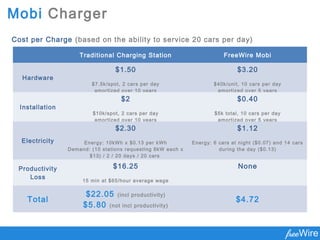
Mobi Charger
Traditional Charging Station FreeWire Mobi
Hardware
$1.50
$7.5k/spot, 2 cars per day
amortized over 10 years
$3.20
$40k/unit, 10 cars per day
amortized over 5 years
Installation
$2
$10k/spot, 2 cars per day
amortized over 10 years
$0.40
$5k total, 10 cars per day
amortized over 5 years
Electricity
$2.30
Energy: 10kWh x $0.13 per kWh
Demand: (10 stations requesting 6kW each x
$13) / 2 / 20 days / 20 cars
$1.12
Energy: 6 cars at night ($0.07) and 14 cars
during the day ($0.13)
Productivity
Loss
$16.25
15 min at $65/hour average wage
None
Total
$22.05 (incl productivity)
$5.80 (not incl productivity)
$4.72
Cost per Charge (based on the ability to service 20 cars per day)
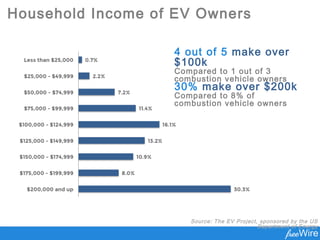
Household Income of EV Owners
4 out of 5 make over
$100k
Compared to 1 out of 3
combustion vehicle owners
30% make over $200k
Compared to 8% of
combustion vehicle owners
Source: The EV Project, sponsored by the US
Department of Energy
End of
Appendix

Freewire Berkeley final presentation

  • 1.
    The Vision Smarter EVcharging that’s there for you everywhere.
  • 2.
    102 Interviews 6,600 MilesFlown 2 Patents Filed 2 Conferences Week 1 Week 10 Sameer Mehdiratta Product Mgmt, Supply Chain Expert Arcady Sosinov Visionary, CEO, Automotive Expert Sanat Kamal Bahl Electrical Eng, Product Marketing Luv Kothari Electrical Eng, Engineering Design
  • 3.
    A Growth Market 150 K EVson the road today 1.8 M Projected for 2020 U.S. Sales of EVs & Plug-In Hybrids 7% of US Vehicle Sales in 2020 EV Charging Market Today $260M EV Charging By 2020 $2.3B Sources: Electric Drive Transportation Association (EDTA), John Gartner at Navigant
  • 4.
    The Journey So WeFound a Problem Inconvenience of Plugging In In Love with a Technology Wireless Charging Scalability Usability Utilization The Destination
  • 5.
    The Beacon: BusinessModel Canvas Licensed from businessmodelgeneration.com under a Creative Commons Attribution-ShareAlike 3.0 Unported License LaunchPad Central o Key Partners Strategic Alliance: Electrical grid utilities (PG&E). Strategic Alliance / Coopetition: Software & Network (ChargePoint).  Strategic Alliance / Supplier: Robotics (Knightscope, Berkeley Robotics Lab)  Supplier: Workspace to build and test prototype.  Supplier: Second-life battery suppliers (Tesla, Nissan, BMW). Traffic Partner / Supplier: Electrical contractors (EPCs - Rosendin, Cupertino Electric). Key Activities Fast EV charging. Autonomous robotic movement.  Prototype demonstration. Gov't funding for cleantech/energy/EV projects. Value Propositions  USABILITY: Increase capacity of each charger.  USABILITY: Prevent charge rage amongst employees.  USABILITY: Increase utilization of the charging infrastructure.  SCALABILITY: Ease of installation to electrify a large area.  SCALABILITY: A cheaper way to electrify a large area. Customer Relationships  GET: Product demo to facilities managers.  KEEP: Service & maintenance contract.  KEEP: Analytics platform.  GROW: Demand response software. Customer Segments  Companies with large parking areas and a high percentage of employees who commute using EVs - Google, Cisco Local and state-level government agencies who have a large fleet of EVs. Key Resources  Physical: Second-life li- ion batteries.  Physical: Manufacturing subcontractor specializing in high-power electronics.  Human: Battery engineer. Channels  Direct Sales (charging equipment)  Value Added Resellers, such as electrical contractors (charging equipment) Cost Structure Variable: Service & maintenance of chargers. Variable: Product manufacturing (AC/DC converter, battery charger, batteries, boost converter, CHAdeMO controller, etc). Variable: Power electronics testing equipment (incubator, borrow, rent). Fixed: Product designer. Fixed: Robotics software engineer. Revenue Streams  Charging as a Service (CaaS): Provide an attendant and several Mobi units. Includes a guaranteed capacity per day, maintenance, and data analytics. Customers pay a monthly fee.  Lease Mobi: Customers provide their own attendant and pay monthly for the product, maintenance, and data analytics.  Buy Mobi: Customers buy a unit, and they have to sign up for a maintenance & data analytics contract. Testing hypotheses to find the right customer segments Customer Segments Companies with high % of EV adoption (Google) Companies with high % of EV adoption (Google)
  • 6.
    The Beacon: BusinessModel Canvas Licensed from businessmodelgeneration.com under a Creative Commons Attribution-ShareAlike 3.0 Unported License LaunchPad Central o Key Partners Strategic Alliance: Electrical grid utilities (PG&E). Strategic Alliance / Coopetition: Software & Network (ChargePoint).  Strategic Alliance / Supplier: Robotics (Knightscope, Berkeley Robotics Lab)  Supplier: Workspace to build and test prototype.  Supplier: Second-life battery suppliers (Tesla, Nissan, BMW). Traffic Partner / Supplier: Electrical contractors (EPCs - Rosendin, Cupertino Electric). Key Activities Fast EV charging. Autonomous robotic movement.  Prototype demonstration. Gov't funding for cleantech/energy/EV projects. Value Propositions  USABILITY: Increase capacity of each charger.  USABILITY: Prevent charge rage amongst employees.  USABILITY: Increase utilization of the charging infrastructure.  SCALABILITY: Ease of installation to electrify a large area.  SCALABILITY: A cheaper way to electrify a large area. Customer Relationships  GET: Product demo to facilities managers.  KEEP: Service & maintenance contract.  KEEP: Analytics platform.  GROW: Demand response software. Customer Segments  Companies with large parking areas and a high percentage of employees who commute using EVs - Google, Cisco Local and state-level government agencies who have a large fleet of EVs. Key Resources  Physical: Second-life li- ion batteries.  Physical: Manufacturing subcontractor specializing in high-power electronics.  Human: Battery engineer. Channels  Direct Sales (charging equipment)  Value Added Resellers, such as electrical contractors (charging equipment) Cost Structure Variable: Service & maintenance of chargers. Variable: Product manufacturing (AC/DC converter, battery charger, batteries, boost converter, CHAdeMO controller, etc). Variable: Power electronics testing equipment (incubator, borrow, rent). Fixed: Product designer. Fixed: Robotics software engineer. Revenue Streams  Charging as a Service (CaaS): Provide an attendant and several Mobi units. Includes a guaranteed capacity per day, maintenance, and data analytics. Customers pay a monthly fee.  Lease Mobi: Customers provide their own attendant and pay monthly for the product, maintenance, and data analytics.  Buy Mobi: Customers buy a unit, and they have to sign up for a maintenance & data analytics contract. Testing hypotheses to find the right value propositions Value Propositions Higher scalabilityHigher scalability Greater capacityGreater capacity Employee productivity Employee productivity
  • 7.
    The Beacon: BusinessModel Canvas Licensed from businessmodelgeneration.com under a Creative Commons Attribution-ShareAlike 3.0 Unported License LaunchPad Central o Key Partners Strategic Alliance: Electrical grid utilities (PG&E). Strategic Alliance / Coopetition: Software & Network (ChargePoint).  Strategic Alliance / Supplier: Robotics (Knightscope, Berkeley Robotics Lab)  Supplier: Workspace to build and test prototype.  Supplier: Second-life battery suppliers (Tesla, Nissan, BMW). Traffic Partner / Supplier: Electrical contractors (EPCs - Rosendin, Cupertino Electric). Key Activities Fast EV charging. Autonomous robotic movement.  Prototype demonstration. Gov't funding for cleantech/energy/EV projects. Value Propositions  USABILITY: Increase capacity of each charger.  USABILITY: Prevent charge rage amongst employees.  USABILITY: Increase utilization of the charging infrastructure.  SCALABILITY: Ease of installation to electrify a large area.  SCALABILITY: A cheaper way to electrify a large area. Customer Relationships  GET: Product demo to facilities managers.  KEEP: Service & maintenance contract.  KEEP: Analytics platform.  GROW: Demand response software. Customer Segments  Companies with large parking areas and a high percentage of employees who commute using EVs - Google, Cisco Local and state-level government agencies who have a large fleet of EVs. Key Resources  Physical: Second-life li- ion batteries.  Physical: Manufacturing subcontractor specializing in high-power electronics.  Human: Battery engineer. Channels  Direct Sales (charging equipment)  Value Added Resellers, such as electrical contractors (charging equipment) Cost Structure Variable: Service & maintenance of chargers. Variable: Product manufacturing (AC/DC converter, battery charger, batteries, boost converter, CHAdeMO controller, etc). Variable: Power electronics testing equipment (incubator, borrow, rent). Fixed: Product designer. Fixed: Robotics software engineer. Revenue Streams  Charging as a Service (CaaS): Provide an attendant and several Mobi units. Includes a guaranteed capacity per day, maintenance, and data analytics. Customers pay a monthly fee.  Lease Mobi: Customers provide their own attendant and pay monthly for the product, maintenance, and data analytics.  Buy Mobi: Customers buy a unit, and they have to sign up for a maintenance & data analytics contract. Testing hypotheses to find the right revenue streams Revenue Streams Charging as a Service (CaaS) Charging as a Service (CaaS) Leasing the MobiLeasing the Mobi
  • 8.
    The Beacon: BusinessModel Canvas Licensed from businessmodelgeneration.com under a Creative Commons Attribution-ShareAlike 3.0 Unported License LaunchPad Central o Key Partners Strategic Alliance: Electrical grid utilities (PG&E). Strategic Alliance / Coopetition: Software & Network (ChargePoint).  Strategic Alliance / Supplier: Robotics (Knightscope, Berkeley Robotics Lab)  Supplier: Workspace to build and test prototype.  Supplier: Second-life battery suppliers (Tesla, Nissan, BMW). Traffic Partner / Supplier: Electrical contractors (EPCs - Rosendin, Cupertino Electric). Key Activities Fast EV charging. Autonomous robotic movement.  Prototype demonstration. Gov't funding for cleantech/energy/EV projects. Value Propositions  USABILITY: Increase capacity of each charger.  USABILITY: Prevent charge rage amongst employees.  USABILITY: Increase utilization of the charging infrastructure.  SCALABILITY: Ease of installation to electrify a large area.  SCALABILITY: A cheaper way to electrify a large area. Customer Relationships  GET: Product demo to facilities managers.  KEEP: Service & maintenance contract.  KEEP: Analytics platform.  GROW: Demand response software. Customer Segments  Companies with large parking areas and a high percentage of employees who commute using EVs - Google, Cisco Local and state-level government agencies who have a large fleet of EVs. Key Resources  Physical: Second-life li- ion batteries.  Physical: Manufacturing subcontractor specializing in high-power electronics.  Human: Battery engineer. Channels  Direct Sales (charging equipment)  Value Added Resellers, such as electrical contractors (charging equipment) Cost Structure Variable: Service & maintenance of chargers. Variable: Product manufacturing (AC/DC converter, battery charger, batteries, boost converter, CHAdeMO controller, etc). Variable: Power electronics testing equipment (incubator, borrow, rent). Fixed: Product designer. Fixed: Robotics software engineer. Revenue Streams  Charging as a Service (CaaS): Provide an attendant and several Mobi units. Includes a guaranteed capacity per day, maintenance, and data analytics. Customers pay a monthly fee.  Lease Mobi: Customers provide their own attendant and pay monthly for the product, maintenance, and data analytics.  Buy Mobi: Customers buy a unit, and they have to sign up for a maintenance & data analytics contract. Testing hypotheses to find the right key partners Key Partners Robotics partner: Knightscope Robotics partner: Knightscope Charging network: ChargePoint Charging network: ChargePoint Second-life batteries: ATC New Tech Second-life batteries: ATC New Tech
  • 10.
    Looking Forward Prototype Smaller Battery& Off-the-shelf Components Mobi V1 Manually Operated by Attendant Mobi V2 Fully Autonomous (No Attendant) Mobi V2.5 Mobile EV Charger w/ Wireless Charging Coming Soon! 9 months – 1 year Years 1 - 2 Year 2+ A roadmap that divides our innovative idea into a series of mezzanine products, thus emphasizing: Iterative Product Development Continuous Customer Feedback Quick Reaction to Market Changes
  • 11.
    The Revenue Model Mobi Charger Service,Maintenance, & Data Analytics Lease Model + Monthly Service Fee Charging as a Service (Operational Expense)
  • 12.
    The Revenue Model Exampleonly –prices and terms not yet finalized. Charging as a Service – CaaS (have the ability to service 24 cars per day) $6,950 per month w/ 2yr agreement $15 per charge What You Get FreeWire Attendant (3) Mobi Units Service & Maintenance Data & Usage Analytics No Infrastructure Cost Fast & Free Installation Convenient Charging Increased Employee Productivity Alternatively, Lease a Mobi (use your own attendant and be able to service 8 cars per day) $1,550 per month per Mobi, w/ 2yr agreement $10 per charge
  • 13.
    Before we conclude, wewant to show you just one more thing…
  • 14.
  • 15.
  • 16.
    Comparing Solutions Traditional L2 ChargingStation Traditional DC Charging Station Mobi Charger Capacity 2 cars per day 4 cars per day 8 cars per day Infrastructure Cost High Very High None Equipment Cost Medium Very High Medium Installation Time 3 – 6 months 6 months 2 weeks Difficulty of Installation High Very High Low Convenience of Use Medium Medium High Portable No No Yes Energy Cost Savings No No Yes Companies charging 10 EVs per day can save over $1,000 monthly on their PG&E bill because of Mobi’s inherent load-shaping capabilities.
  • 17.
  • 18.
    Favorable Regulation NYC 20% ofall new parking spots shall be EV-ready Palo Alto All new homes shall be wired for EV charging Emeryville, CA Parking lots with >17 spaces shall have at least 3% served by a charging station Local  EV & Charging Infrastructure Incentives  CALSTART Employer EV Initiative  Zero Emissions Vehicle Mandates  Workplace Charging Challenge State Federal
  • 19.
    Market Size 20,000 chargingstations across the US x $13,000 average cost $260 Million TAM 7,500 public stations 12,500 workplace stations $162.5 Million SAM *Does not include in-home chargers 600 Google charging stations replaced by 60 FreeWire chargebots x $50,000 selling price x 10 customers $30 Million Target
  • 20.
    EV Projections 1.8MEV’s soldin 2020 10% of Total Sales 5MEV’s on the road by 2020 Regulatory Changes Network Effects Aspirational Status
  • 21.
    Charging Infrastructure 180k EVson the road today 20k public & workplace charging points (7700 charging stations) 9:1 Ratio That will grow to 12:1 by the end of 2014 Sources: PEVCollaborative, US DOE 61 employees drive EVs 16 charging stations 10% of workforce drive EVs 5:1 EV to charger ratio
  • 22.
    Current Paradigm EVEV EVEV Grid-tiedstationary charging stations. What are the challenges that this model imposes?
  • 23.
    Utilization 7kWh avg energy needed percharging event 7kW avg charge rate Theoretical Capacity: 8 cars per day Actual Capacity: 2 cars per day Utilization: 25% Why? Reliance on human intervention Optimization between employee productivity and capital utilization Sources: EV Project, Google, ChargePoint, Evernote “The motivation behind Evernote’s robust workplace charging program is unique: to increase employee productivity. By gaining access to HOV lanes in their PEVs, some of our employees have cut their commute in half.” - Maeanna Glenn, Special Projects Manager
  • 24.
    Scalability Bore concrete Sources: Customer interviews,Harvey Electric, PEVCollaborative “Our first installation included 30 charging stations. We allocated the same funding for the second round, but could now only afford 17 stations. At this point, we don’t even want to think about a third round.” - Brian Glazebrook, Senior Global Sustainability Manager Run conduit undergroun d City inspection services Permits and licenses Installation is complex, time- consuming, and expensive. Scaling up takes months of planning. Key Challenges: Parking Structures Dense Urban Areas Multi-unit dwellings Leased and shared office buildings
  • 25.
    Energy Consumption Issues toconsider: Demand Charges $10 - $30/kW peak rates versus $0 - $3 off-peak Energy Rates Difference between peak and off-peak can be 2X Outdated Infrastructure Companies will most likely need to upgrade their energy infrastructure once EV adoption increases Smart Grid Vehicles may not be able to request a charge when they need it due to overall system demand Sources: PG&E, UC Berkeley, Customer interviews Workplace Public
  • 26.
    Mobi Charger Building’s Step- Down Transformer 240V/80A SinglePhase AC = 19kW AC to DC Conversion Power Electronics 30kWh Battery DC to DC Power Electronics Cabling & Connectors DC CHAdeMO Plug = 50kW Motorized Mobile Enclosure Mobi recharge time ~ 1.5 hours Avg Charge = 7 - 10kW Services 3 EVs before recharging ~ 45 minutes Capacity 10 EVs per day
  • 27.
    Mobi Charger Traditional ChargingStation FreeWire Mobi Hardware $1.50 $7.5k/spot, 2 cars per day amortized over 10 years $3.20 $40k/unit, 10 cars per day amortized over 5 years Installation $2 $10k/spot, 2 cars per day amortized over 10 years $0.40 $5k total, 10 cars per day amortized over 5 years Electricity $2.30 Energy: 10kWh x $0.13 per kWh Demand: (10 stations requesting 6kW each x $13) / 2 / 20 days / 20 cars $1.12 Energy: 6 cars at night ($0.07) and 14 cars during the day ($0.13) Productivity Loss $16.25 15 min at $65/hour average wage None Total $22.05 (incl productivity) $5.80 (not incl productivity) $4.72 Cost per Charge (based on the ability to service 20 cars per day)
  • 28.
    Household Income ofEV Owners 4 out of 5 make over $100k Compared to 1 out of 3 combustion vehicle owners 30% make over $200k Compared to 8% of combustion vehicle owners Source: The EV Project, sponsored by the US Department of Energy
  • 29.

Editor's Notes

  • #2 The vision of for FreeWIre.
  • #3 The team that can make it all happen.
  • #4 This is why we entered the EV market. Lots of opportunity.
  • #5 Our journey began with a technology that we found a problem for. But along the way, we realized there was a much bigger opportunity set.
  • #6 What guided us through the journey was the business model canvas. These are several major pivots and discoveries that happened because of our process testing hypotheses.
  • #7 Second major pivot.
  • #8 Third major pivot.
  • #9 Fourth major discovery.
  • #10 Play the video.
  • #11 Looking forward, where do we go from here?
  • #12 CaaS is a much better model. Decision makers can much more easily justify the operational expense.
  • #13 Here’s a potential model for CaaS that we’re actively testing now with customers.
  • #14 Before we conclude, there’s just one more thing…