Visit www.seminarlinks.blogspot.in
To Download

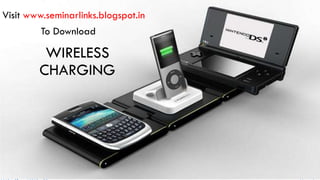
WIRELESS
CHARGING
ABSTRACT
As power requirements for portable devices increase, consumers are
looking for easy-to-use charging solutions that can be deployed in a
wide array of environments such as home, office, automobiles,
airports, schools and more.
INTRODUCTION
• Wireless charging (also known as " Inductive charging ") uses an
electromagnetic field to transfer energy between two objects.

• This is usually done with a charging station.
• Energy is sent through an inductive coupling to an electrical device,
which can then use that energy to charge batteries or run the
device.
WIRELESS CHARGING MODULE
HISTORY
•

In 1902 Tesla filed a patent titled “Apparatus for Transmitting Electrical Energy” in which he
describes a device that he believed could transmit electrical power from one conductor to
another without the need for wires.

•

An early example of inductive power transfer is the crystal radio which used the power of
the radio signal itself to power headphones.

•

In 2006, researchers at the MIT reported that they had discovered an efficient way to
transfer power between coils separated by a few meters.

•

In August 2009, a consortium of interested companies called the Wireless Power
Consortium announced they were nearing completion for a new industry standard for lowpower Inductive charging called Qi.

•

More than 180 members of WPC include industry leaders in mobile phones, consumer
electronics, batteries, semiconductors, components, wireless power technology and
infrastructure.
WIRELESS POWER CONSORTIUM (WPC)
• The Wireless Power Consortium (WPC) has created the industry’s first

interoperable standard (Qi) that allows any compliant transmitter to power
compliant receivers of varying power requirements from various vendors.

• The WPC developed the Qi interoperability standard based on inductive

power transfer that enables charging of handheld devices that consume less
than 5 W.

• The consortium is focused on making wireless power a ubiquitous technology
by enabling a global interoperable infrastructure.
BLOCK DIAGRAM
POWER SYSTEM
• The transmitter solution uses a single A1-type coil with magnetic
attractor driven by a half h-bridge circuit used in the bqTESLA
bq51013 receiver and bq500210 transmitter IC solutions.

• The wireless power transmitter is the fixed or non-portable portion of
the system operating from line power.

• The key circuits and operations of the power transmitter are the
receiver recognition, communications demodulation, coil power driver,
intelligent power control, operation status reporting, and safety
operations.
CONT..
•

For a WPC low-power-transmitter solution, a switching power supply drives the transmitter
coil.

•

It converts the DC input voltage (typically either +19 or +5 VDC) power to an AC voltage
between 110 and 205 kHz.

•

The coils of a WPC-compliant device operate as a resonant half-bridge with a 50% duty
cycle.

•

Two transmitter-coil drive circuits are recommended in the WPC specification: a halfbridge and a full-bridge.

•

The transmitter adjusts the transferred power level by changing the operating frequency
between 110 and 205 kHz with a lower frequency for more transferred power.
POWER RECEIVER
• Usually, the power receiver is a portable device.
• The key circuits of the power receiver are the secondary coil, rectification,
voltage conditioning, and communications circuits.

• The receiver's rectifier output voltage is monitored by the receiver.
• It generates signals to control the modulation circuit to pass coded information
from the receiver to the transmitter.

• The coded information is organized into information packets, which have
preamble, header, message, and checksum bytes.
CONT..
• Per the WPC specification, information packets can be related to
identification, configuration, control error, rectified power, charge status,
and end-of-power transfer information.

• A low-dropout (LDO) regulator buffers the unregulated DC voltage from
the rectification circuit into a regulated receiver output voltage.

• The coil voltage at the power receiver is full-wave rectified, with typical
efficiency of 70% at 5 V and 500 mA.
Figure shows the efficiency breakdown of the second generation bqTesla wireless
power system. The overall system efficiency tops at about 75 percent with individual
transmitter and receiver efficiencies exceeding 90 percent.
MAGNETICS
• WPC systems use inductive coupling between two planar coils to transfer
power from the power transmitter to power receiver.

• Coil assemblies for the transmitter and receiver are a combination of coil,
shield, and magnet/attractor.

•

The transmitter-side coil design allows consistent field strength to be applied
to the receiver coil. It enables reliable operation over a number of
interoperable devices.

• A1-type transmitter uses a magnet in the center of the transmitter coil to assist
with the alignment of the receiver coil over the transmitter coil for maximum
power-transfer efficiency.
CONT..
• The distance from the top of the transmitter coil and transmitter interface
surface is 2.0 to 2.5 mm.

• But distance between the receiver interface surface and receiver coil should
not exceed 2.5 mm. Therefore, the maximum distance between the two coils is
5.0 mm.
FIGURE

This cross-sectional view shows the stacked transmitter and receiver coil
COMMUNICATIONS SYSTEM
• The transmitter sends out an analog "ping" (query signal) approximately three
times a second to determine if a receiver is present.

• When the power transmitter detects the presence of a device on the
transmitter interface surface, it "wakes up" and begins interrogating the object
placed on the interface area.

• If the receiver properly identifies itself as a WPC-compliant device, power
transfer is initiated.

• When more or less power is required by the power receiver, the receiver
sends communications packets to the power transmitter to request more or less
power.
CONT..
This communication continues throughout the power transfer until one of the following
occurs:

• The receiver transmits an "end power" message or the transmitter does not detect
any communications packets for more than 1.25 s.

• When no power is being transmitted, the power transmitter enters low-standbypower mode. No inductive field is emitted.

• The power receiver uses communications packets to control the transmitter power.
• Each packet contains a preamble, header, message, and checksum.
• Clock frequency for the communications data is 2 kHz 4%.
COMMUNICATION SEQUENCE
When a power receiver is placed on a power transmitter, the system steps
through a predefined sequence:

• Analog ping from power transmitter detects the presence of an object.
• Digital ping (a longer version of the analog ping) gives the power receiver
time to reply with a signal-strength packet.

• Identification and configuration packets identify the power receiver and send
configuration and setup information to the power transmitter.

• In the power-transfer phase, the power receiver controls the power-transmitter
operating point.

• To stop power transfer, the power receiver sends an end-power transfer
packet
ADVANTAGES
Protected connections - no corrosion when the electronics are all enclosed, away from
water or oxygen in the atmosphere.
Safer for medical implants - for embedded medical devices, allows recharging/powering
through the skin rather than having wires penetrate the skin, which would increase the risk
of infection.
Durability - Without the need to constantly plug and unplug the device, there is
significantly less wear and tear on the socket of the device and the attaching cable.
DISADVANTAGES
• Lower efficiency, waste heat - The main disadvantages of inductive charging are
its lower efficiency and increased resistive heating in comparison to direct contact.

• Slower charging - due to the lower efficiency, devices can take longer to charge
when supplied power is equal.

• More costly - Inductive charging also requires drive electronics and coils in both
device and charger, increasing the complexity and cost of manufacturing.

• Inconvenience - Can't be moved around or easily operated while charging
APPLICATIONS
• Mobile Charging – Available on Nokia Lumia (820,920), LG Nexus 4,
Samsung Galaxy S4, Asus Nexus 7, LG Nexus 5. Sony Xperia, etc.

• Laptop Charging – Intel and Samsung plan to launch Qi inductive charging
devices for laptops in 2014.

• Electric vehicles
ELECTRICAL VEHICLE CHARGING CONCEPT
CONCLUSION
Wireless power systems are constantly evolving as more and more practical
options for conveniently charging smartphones and other mobile devices. User
experience is the key factor that drives technology development, paving the
way for safer and more convenient devices accompanying us in everyday life.
REFERENCES
• http://www.electronicproducts.com/Analog_Mixed_Signal_ICs/SoCs_ASICs_A
SSPs_MEMS/Wireless_power_for_everyone.aspx

• http://www.ecnmag.com/articles/2012/10/wireless-power-technologyembraces-user-friendly-features

• http://www.ecnmag.com/articles/2012/10/wireless-power-technologyembraces-user-friendly-features

• http://en.wikipedia.org/wiki/Inductive_charging
• http://electronics.howstuffworks.com/gadgets/other-gadgets/wirelessmobile-charger1.htm
Thank You

Wireless Charging

  • 1.
  • 2.
    ABSTRACT As power requirementsfor portable devices increase, consumers are looking for easy-to-use charging solutions that can be deployed in a wide array of environments such as home, office, automobiles, airports, schools and more.
  • 3.
    INTRODUCTION • Wireless charging(also known as " Inductive charging ") uses an electromagnetic field to transfer energy between two objects. • This is usually done with a charging station. • Energy is sent through an inductive coupling to an electrical device, which can then use that energy to charge batteries or run the device.
  • 4.
  • 5.
    HISTORY • In 1902 Teslafiled a patent titled “Apparatus for Transmitting Electrical Energy” in which he describes a device that he believed could transmit electrical power from one conductor to another without the need for wires. • An early example of inductive power transfer is the crystal radio which used the power of the radio signal itself to power headphones. • In 2006, researchers at the MIT reported that they had discovered an efficient way to transfer power between coils separated by a few meters. • In August 2009, a consortium of interested companies called the Wireless Power Consortium announced they were nearing completion for a new industry standard for lowpower Inductive charging called Qi. • More than 180 members of WPC include industry leaders in mobile phones, consumer electronics, batteries, semiconductors, components, wireless power technology and infrastructure.
  • 6.
    WIRELESS POWER CONSORTIUM(WPC) • The Wireless Power Consortium (WPC) has created the industry’s first interoperable standard (Qi) that allows any compliant transmitter to power compliant receivers of varying power requirements from various vendors. • The WPC developed the Qi interoperability standard based on inductive power transfer that enables charging of handheld devices that consume less than 5 W. • The consortium is focused on making wireless power a ubiquitous technology by enabling a global interoperable infrastructure.
  • 7.
  • 8.
    POWER SYSTEM • Thetransmitter solution uses a single A1-type coil with magnetic attractor driven by a half h-bridge circuit used in the bqTESLA bq51013 receiver and bq500210 transmitter IC solutions. • The wireless power transmitter is the fixed or non-portable portion of the system operating from line power. • The key circuits and operations of the power transmitter are the receiver recognition, communications demodulation, coil power driver, intelligent power control, operation status reporting, and safety operations.
  • 9.
    CONT.. • For a WPClow-power-transmitter solution, a switching power supply drives the transmitter coil. • It converts the DC input voltage (typically either +19 or +5 VDC) power to an AC voltage between 110 and 205 kHz. • The coils of a WPC-compliant device operate as a resonant half-bridge with a 50% duty cycle. • Two transmitter-coil drive circuits are recommended in the WPC specification: a halfbridge and a full-bridge. • The transmitter adjusts the transferred power level by changing the operating frequency between 110 and 205 kHz with a lower frequency for more transferred power.
  • 11.
    POWER RECEIVER • Usually,the power receiver is a portable device. • The key circuits of the power receiver are the secondary coil, rectification, voltage conditioning, and communications circuits. • The receiver's rectifier output voltage is monitored by the receiver. • It generates signals to control the modulation circuit to pass coded information from the receiver to the transmitter. • The coded information is organized into information packets, which have preamble, header, message, and checksum bytes.
  • 12.
    CONT.. • Per theWPC specification, information packets can be related to identification, configuration, control error, rectified power, charge status, and end-of-power transfer information. • A low-dropout (LDO) regulator buffers the unregulated DC voltage from the rectification circuit into a regulated receiver output voltage. • The coil voltage at the power receiver is full-wave rectified, with typical efficiency of 70% at 5 V and 500 mA.
  • 14.
    Figure shows theefficiency breakdown of the second generation bqTesla wireless power system. The overall system efficiency tops at about 75 percent with individual transmitter and receiver efficiencies exceeding 90 percent.
  • 15.
    MAGNETICS • WPC systemsuse inductive coupling between two planar coils to transfer power from the power transmitter to power receiver. • Coil assemblies for the transmitter and receiver are a combination of coil, shield, and magnet/attractor. • The transmitter-side coil design allows consistent field strength to be applied to the receiver coil. It enables reliable operation over a number of interoperable devices. • A1-type transmitter uses a magnet in the center of the transmitter coil to assist with the alignment of the receiver coil over the transmitter coil for maximum power-transfer efficiency.
  • 16.
    CONT.. • The distancefrom the top of the transmitter coil and transmitter interface surface is 2.0 to 2.5 mm. • But distance between the receiver interface surface and receiver coil should not exceed 2.5 mm. Therefore, the maximum distance between the two coils is 5.0 mm.
  • 17.
    FIGURE This cross-sectional viewshows the stacked transmitter and receiver coil
  • 18.
    COMMUNICATIONS SYSTEM • Thetransmitter sends out an analog "ping" (query signal) approximately three times a second to determine if a receiver is present. • When the power transmitter detects the presence of a device on the transmitter interface surface, it "wakes up" and begins interrogating the object placed on the interface area. • If the receiver properly identifies itself as a WPC-compliant device, power transfer is initiated. • When more or less power is required by the power receiver, the receiver sends communications packets to the power transmitter to request more or less power.
  • 19.
    CONT.. This communication continuesthroughout the power transfer until one of the following occurs: • The receiver transmits an "end power" message or the transmitter does not detect any communications packets for more than 1.25 s. • When no power is being transmitted, the power transmitter enters low-standbypower mode. No inductive field is emitted. • The power receiver uses communications packets to control the transmitter power. • Each packet contains a preamble, header, message, and checksum. • Clock frequency for the communications data is 2 kHz 4%.
  • 20.
    COMMUNICATION SEQUENCE When apower receiver is placed on a power transmitter, the system steps through a predefined sequence: • Analog ping from power transmitter detects the presence of an object. • Digital ping (a longer version of the analog ping) gives the power receiver time to reply with a signal-strength packet. • Identification and configuration packets identify the power receiver and send configuration and setup information to the power transmitter. • In the power-transfer phase, the power receiver controls the power-transmitter operating point. • To stop power transfer, the power receiver sends an end-power transfer packet
  • 21.
    ADVANTAGES Protected connections -no corrosion when the electronics are all enclosed, away from water or oxygen in the atmosphere. Safer for medical implants - for embedded medical devices, allows recharging/powering through the skin rather than having wires penetrate the skin, which would increase the risk of infection. Durability - Without the need to constantly plug and unplug the device, there is significantly less wear and tear on the socket of the device and the attaching cable.
  • 22.
    DISADVANTAGES • Lower efficiency,waste heat - The main disadvantages of inductive charging are its lower efficiency and increased resistive heating in comparison to direct contact. • Slower charging - due to the lower efficiency, devices can take longer to charge when supplied power is equal. • More costly - Inductive charging also requires drive electronics and coils in both device and charger, increasing the complexity and cost of manufacturing. • Inconvenience - Can't be moved around or easily operated while charging
  • 23.
    APPLICATIONS • Mobile Charging– Available on Nokia Lumia (820,920), LG Nexus 4, Samsung Galaxy S4, Asus Nexus 7, LG Nexus 5. Sony Xperia, etc. • Laptop Charging – Intel and Samsung plan to launch Qi inductive charging devices for laptops in 2014. • Electric vehicles
  • 24.
  • 25.
    CONCLUSION Wireless power systemsare constantly evolving as more and more practical options for conveniently charging smartphones and other mobile devices. User experience is the key factor that drives technology development, paving the way for safer and more convenient devices accompanying us in everyday life.
  • 26.
    REFERENCES • http://www.electronicproducts.com/Analog_Mixed_Signal_ICs/SoCs_ASICs_A SSPs_MEMS/Wireless_power_for_everyone.aspx • http://www.ecnmag.com/articles/2012/10/wireless-power-technologyembraces-user-friendly-features •http://www.ecnmag.com/articles/2012/10/wireless-power-technologyembraces-user-friendly-features • http://en.wikipedia.org/wiki/Inductive_charging • http://electronics.howstuffworks.com/gadgets/other-gadgets/wirelessmobile-charger1.htm
  • 27.