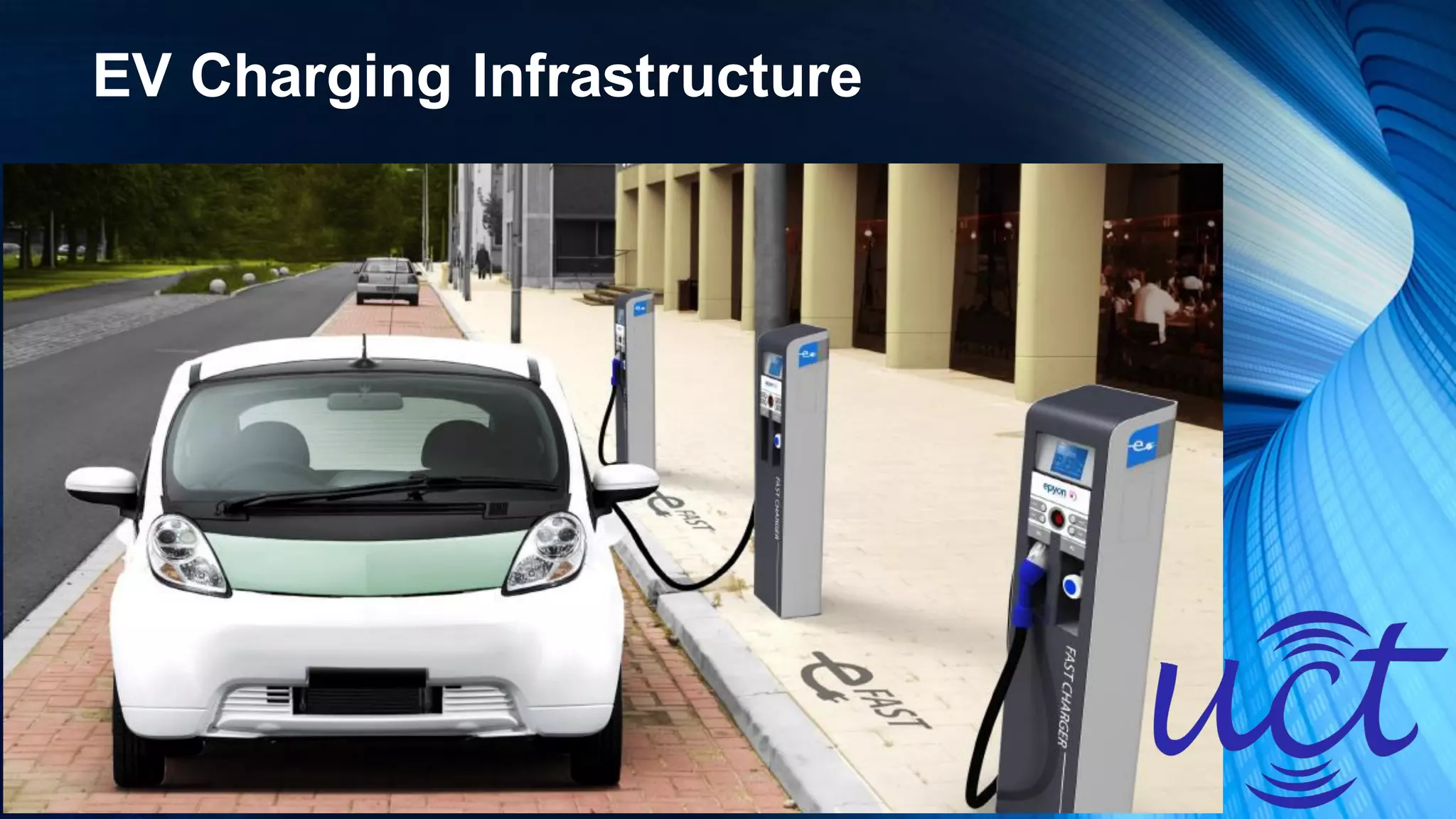

EV Charging Infrastructure
About Myself
• IIT KanpurAlumnus
• 19+ year Industry experience
• Presently working as Director at UniConvergeTechnologies Pvt. Ltd.
(UCT)
• Chief Mentor ofThe IoT Academy “Skill development andTrainings”
• Worked with many MNCs
• Ericsson AB, Sweden (for 7 years)
• STMicroelectronics Pvt. Ltd, Noida
• UbiNetics India Pvt Ltd, Bangalore
• SASKENCommunicationTech., Bangalore
What to discuss today?
• Brief history of electric vehicles
• Mandate and Motivation
• Architecture and components
• Stakeholders
• Status In India and worldwide
• Challenges in EV Market
• Entrepreneurship Ideas/R&DAreas whereAcademia can
support
• UCT Work
• Q&A
3
Brief history of Electric Vehicles
Brief history of electric vehicles
Brief history of Electric vehicles
Mandate and Motivation
Motivation and Mandate
• Domestic Policy Goals
 Reduce dependence on foreign oil
 Job creation
 Economic Growth (energy sources local)
• Energy Independence
 Local energy sources reduce price volatility
 Reduce rising oil imports, export of dollars, particularly to unstable regions of the world
 Reduce dependence on few key regions – roughly half of the EU’s gas consumption comes from
only three countries (Russia,Norway,Algeria)
• Climate Change
 Governments around the world have allocated funding for clean technology
 Global support for climate change has gained momentum with Europe leading the way.
 Transportation accounts for roughly 15% of energy related CO2 emissions globally.
8
Why Electrical vehicles?
India: e-Mobility Market Development
Policy push for EV Adoption
Economic
reality of EV
Stakeholders
Stakeholders in EV
EV Ecosystem: Architecture and Components
• EV
• Charger (EVSE)
• Charging station
• Central System
EV CHARGING SOLUTION
EV Charging Simplified
http://electronicsbeliever.com/ev-charging-basic-things-and-information-you-
need-to-know/
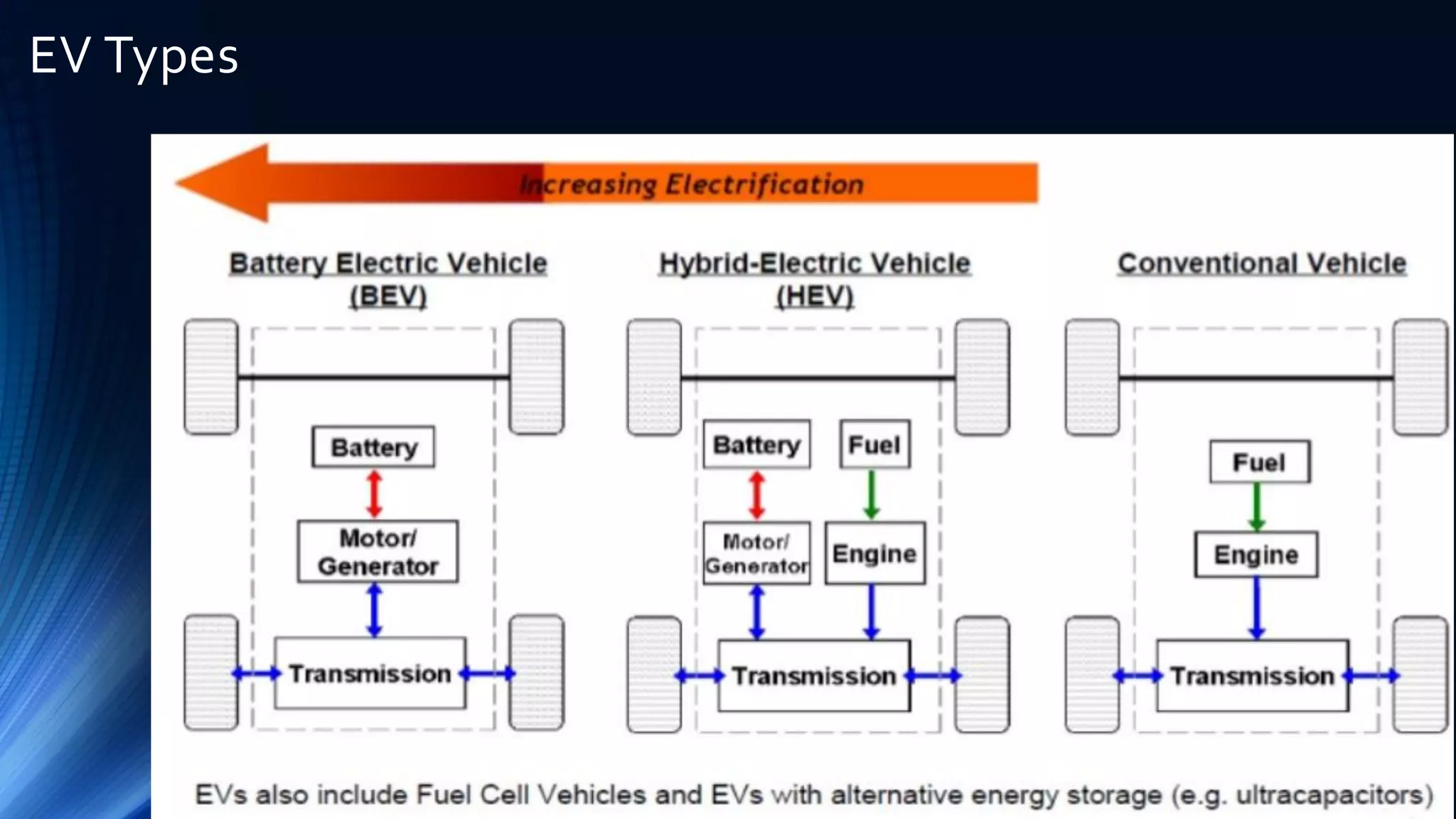
EV Types
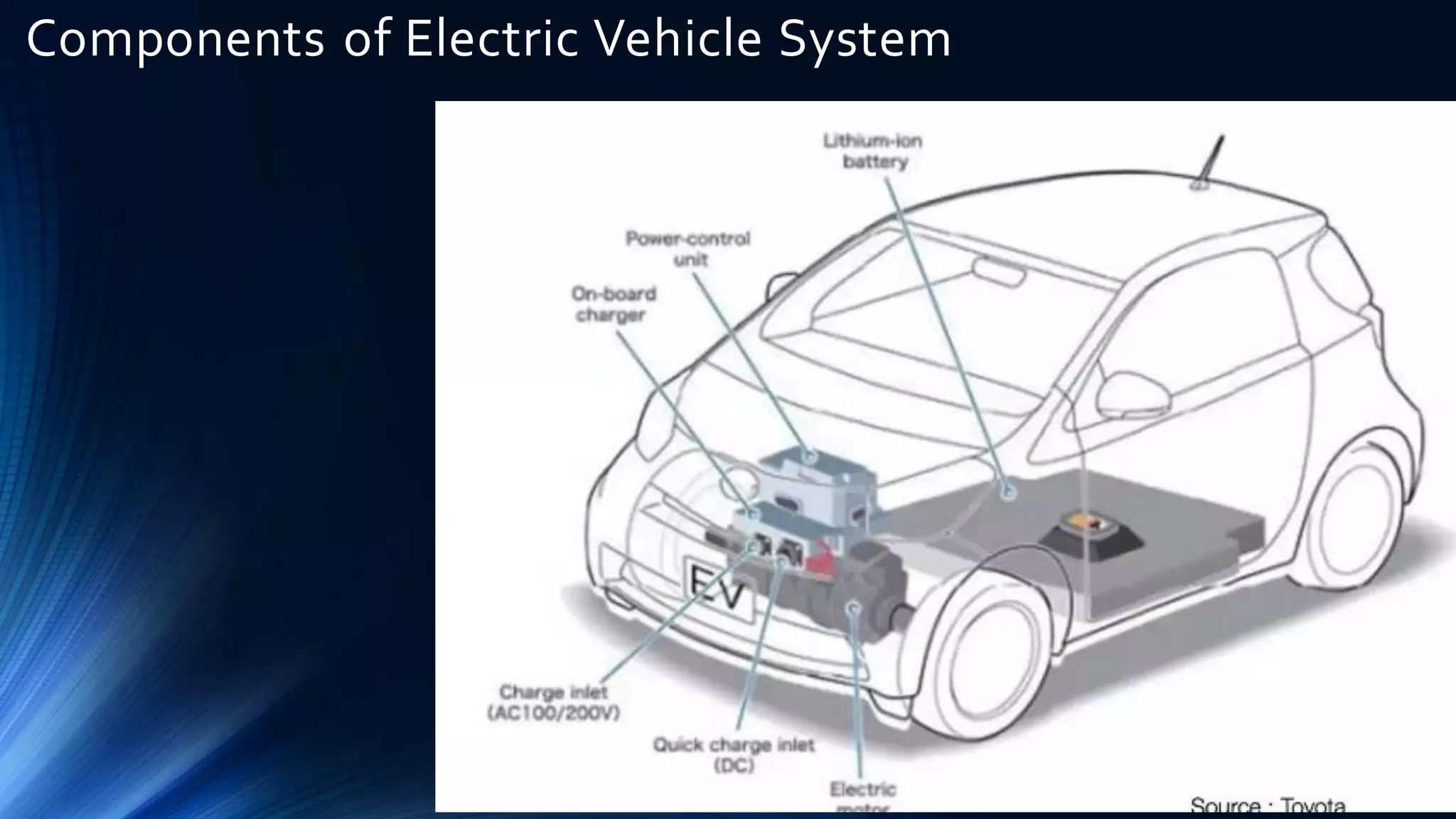
Components of Electric Vehicle System
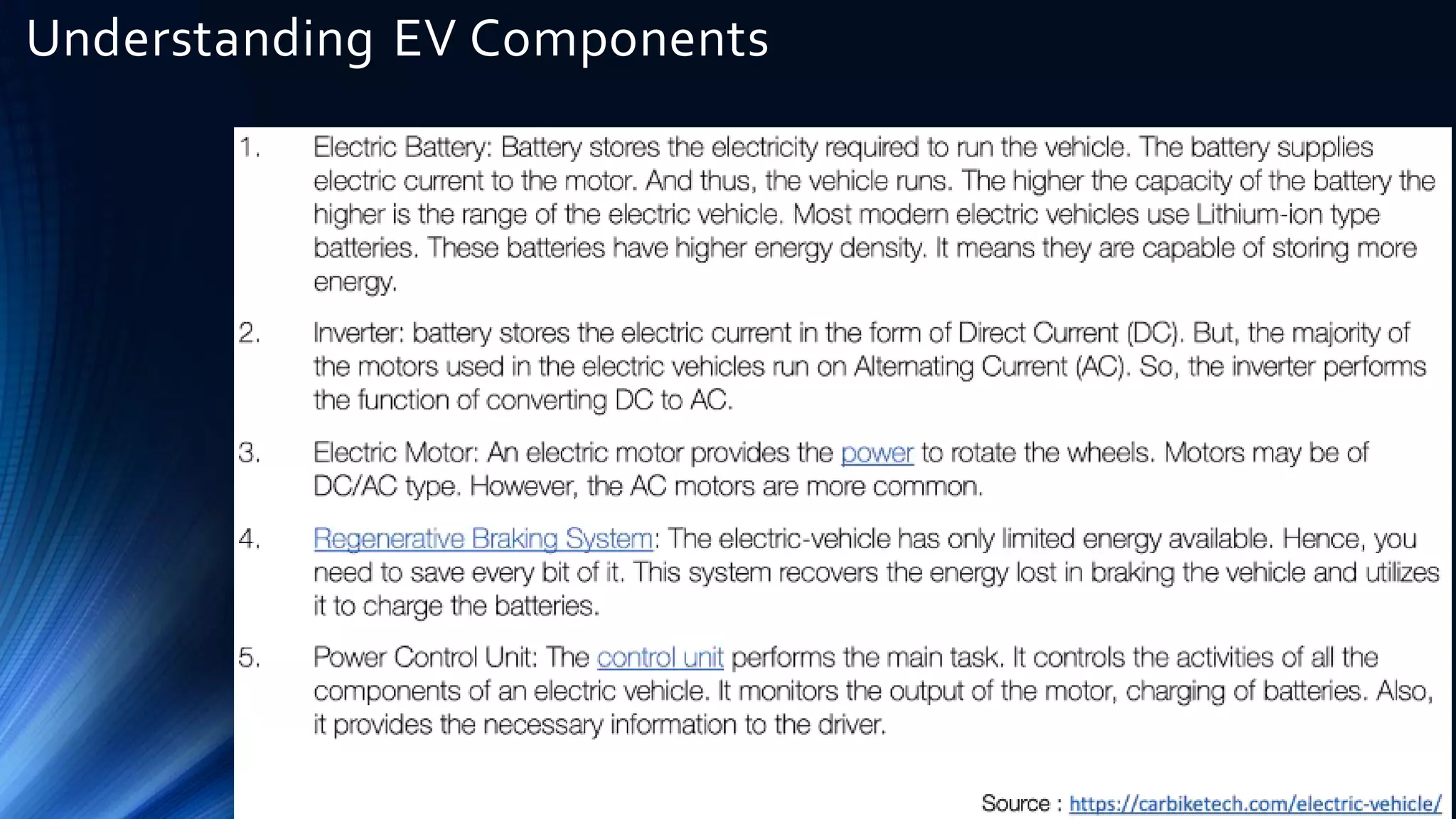
Understanding EV Components
Battery Management System
EV Chargers
AC
In case of AC EVSE, the
vehicle has an on-board
charger that converts AC into
the DC first. AC EVSE comes
in different power rating
ranging from 3.3 kW to 43 kW.
TYPES OF
CHARGING
DC
DC EVSE can
supply higher
power rating
ranging from 10
kW to 240+ kW.
Specification of charging equipment (level)
AC/DC chargers
AC chargers DC chargers
Level
1
120V single phaseAC up to
1.9 kW (upto 16A)
200-450V DC up
to 36 kW (upto
80A)
Level
2
240V single phase AC up to
19.2 kW (upto 80A)
200-450V DC up
to 90 kW (upto
200A)
Level
3
Greater than 20 kW 200-600 V DC up
to 240 kW (upto
400A)
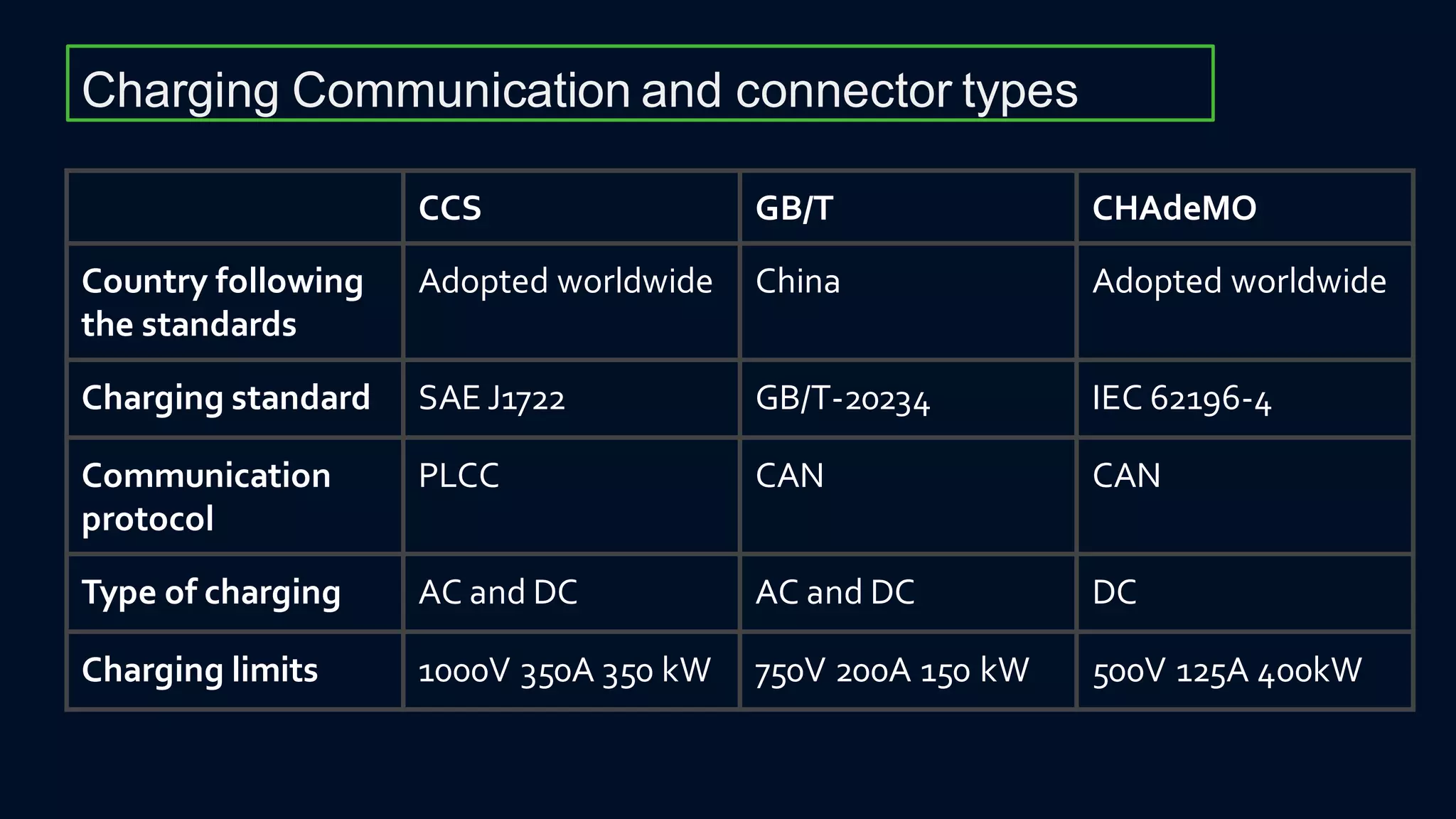
CCS GB/T CHAdeMO
Country following
the standards
Adopted worldwide China Adopted worldwide
Charging standard SAE J1722 GB/T-20234 IEC 62196-4
Communication
protocol
PLCC CAN CAN
Type of charging AC and DC AC and DC DC
Charging limits 1000V 350A 350 kW 750V 200A 150 kW 500V 125A 400kW
Charging Communication and connector types
EV Chargers – How to spot them
EV Chargers Connector Types
https://evcharging.enelx.com/eu/about/news/blog/552-ev-charging-connector-types
Bharat Chargers
AC001 and DC001
Charging Options
Specification of Charging Options
EV Charging Stations
Types of charging stations
● Public charging stations: Stations available for public use and are
not dedicated to any consumer category.
.
● Private charging stations: charging stations
available for specific authorized users.
● Fleet charging stations: stations dedicated to fleet
charging (Ola/Uber).
● Battery swapping stations: A battery swapping (or switching) station is a place where a
vehicle's discharged battery or battery pack can be immediately swapped for a fully charged one,
eliminating the waiting period for charging the vehicle's battery
Charging Stations
Complete Swapping Infrastructure
EV Charging CMS
EV Charging – Central Management System (CMS)
EV Status worldwide
Key Growth drivers
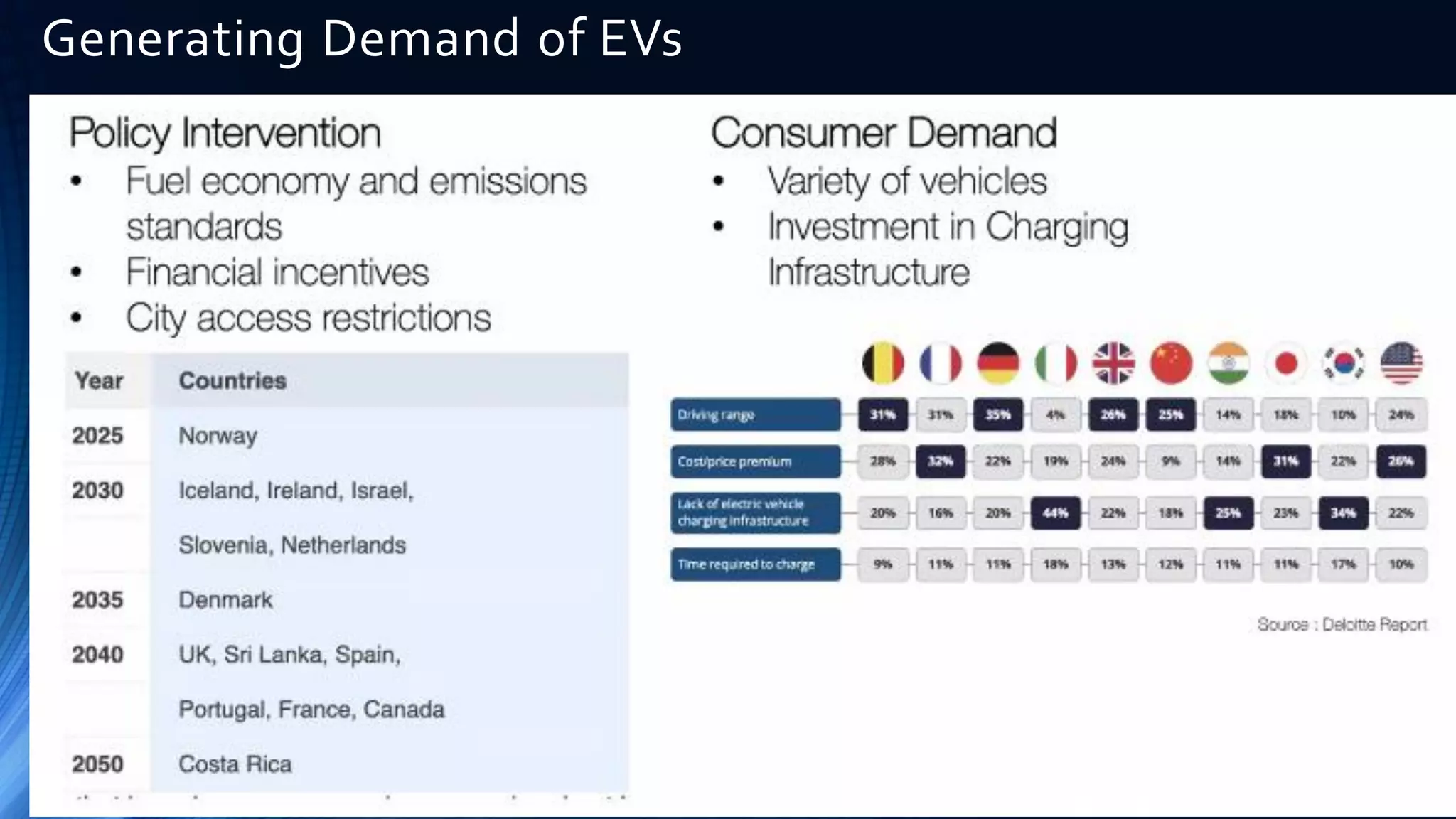
Generating Demand of EVs
EV Manufacturers worldwide
EV Sales around the World
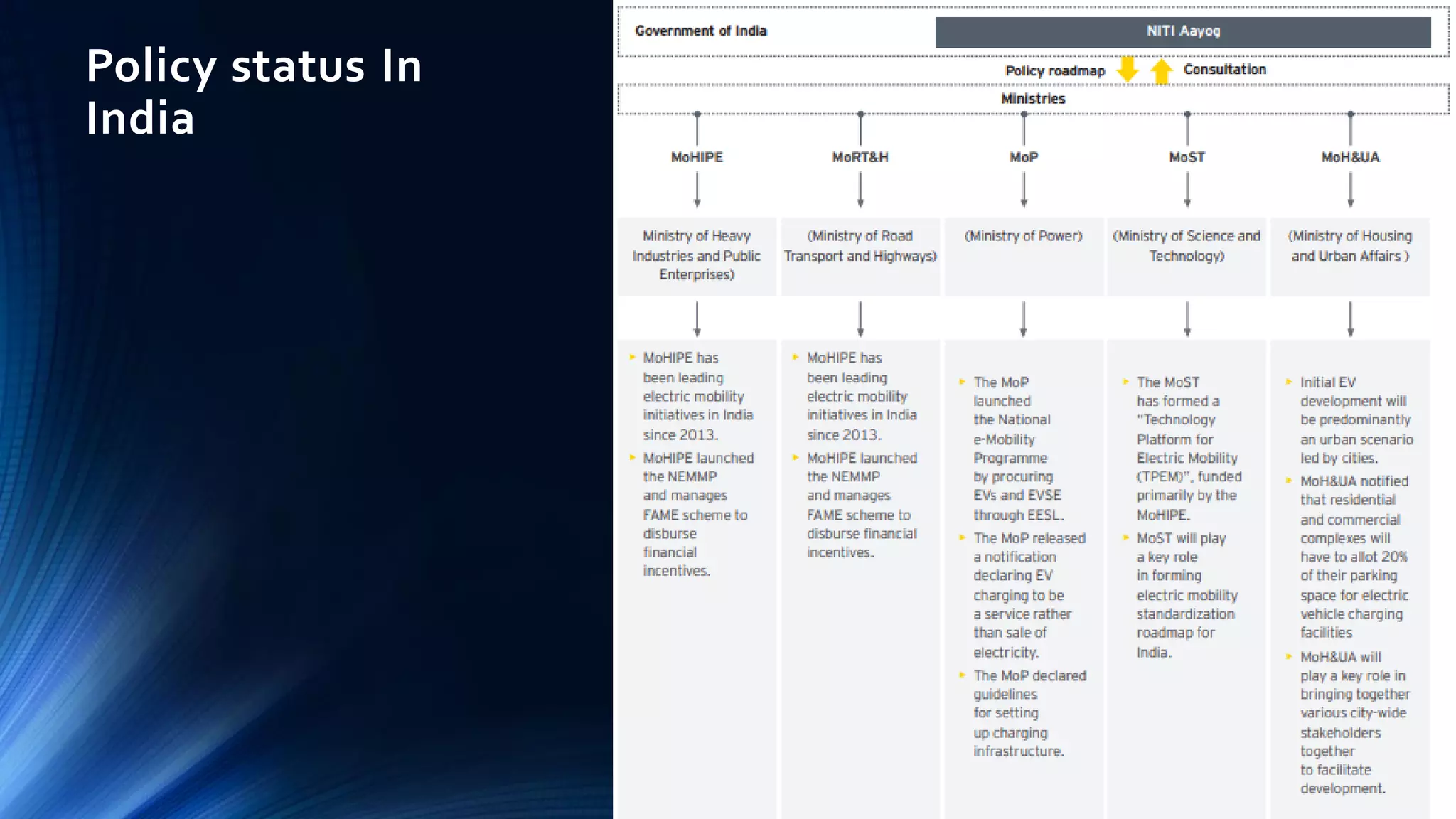
Policy status In
India
Challenges in EV Market
EV Global Adoption Challenges
Commercialization Dilemma
Charger First or Vehicle First
Challenges in Indian Market
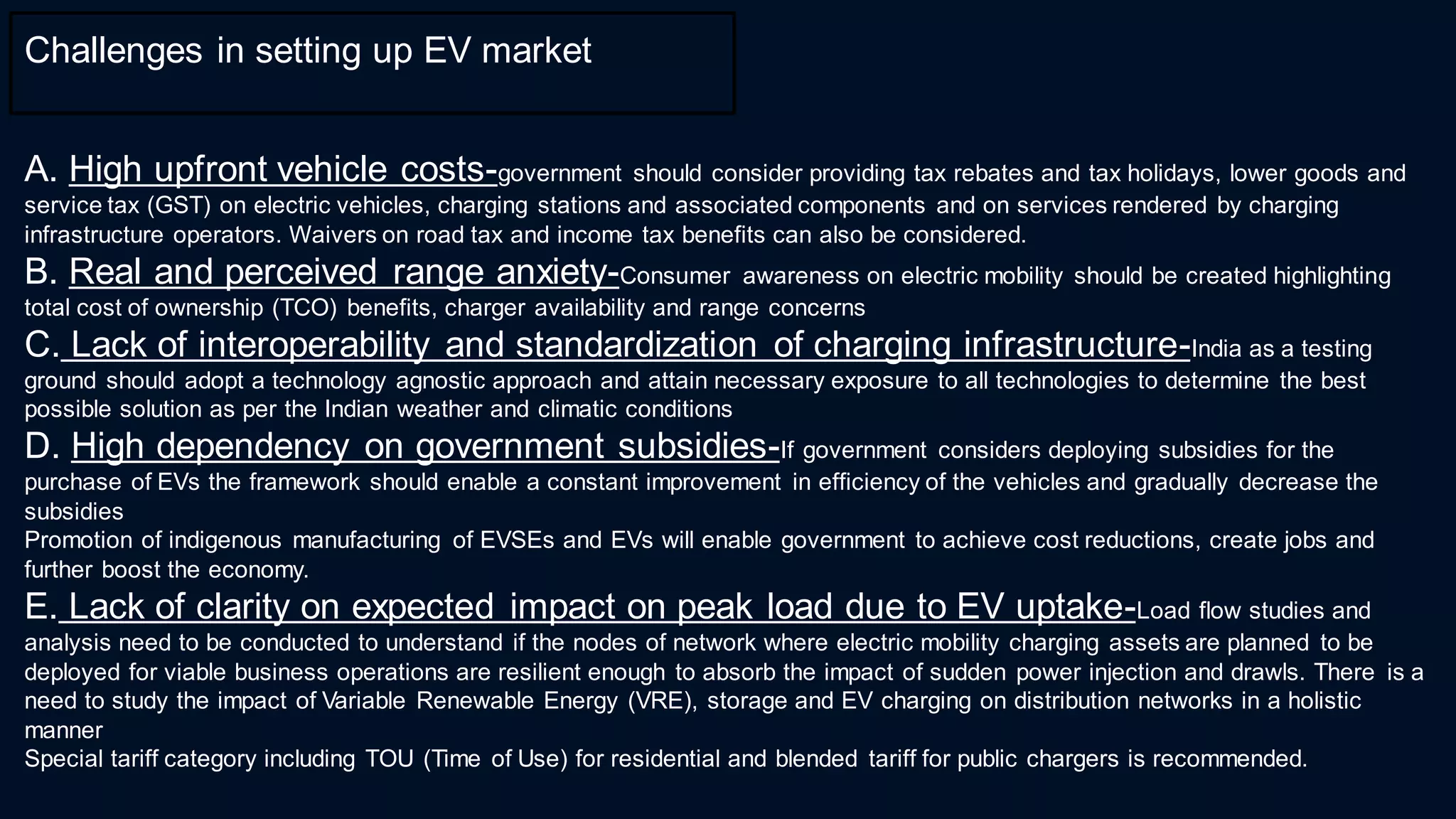
Challenges in setting up EV market
A. High upfront vehicle costs-government should consider providing tax rebates and tax holidays, lower goods and
service tax (GST) on electric vehicles, charging stations and associated components and on services rendered by charging
infrastructure operators. Waivers on road tax and income tax benefits can also be considered.
B. Real and perceived range anxiety-Consumer awareness on electric mobility should be created highlighting
total cost of ownership (TCO) benefits, charger availability and range concerns
C. Lack of interoperability and standardization of charging infrastructure-India as a testing
ground should adopt a technology agnostic approach and attain necessary exposure to all technologies to determine the best
possible solution as per the Indian weather and climatic conditions
D. High dependency on government subsidies-If government considers deploying subsidies for the
purchase of EVs the framework should enable a constant improvement in efficiency of the vehicles and gradually decrease the
subsidies
Promotion of indigenous manufacturing of EVSEs and EVs will enable government to achieve cost reductions, create jobs and
further boost the economy.
E. Lack of clarity on expected impact on peak load due to EV uptake-Load flow studies and
analysis need to be conducted to understand if the nodes of network where electric mobility charging assets are planned to be
deployed for viable business operations are resilient enough to absorb the impact of sudden power injection and drawls. There is a
need to study the impact of Variable Renewable Energy (VRE), storage and EV charging on distribution networks in a holistic
manner
Special tariff category including TOU (Time of Use) for residential and blended tariff for public chargers is recommended.
Business Model in EV Infrastructure
Investment recovery: EV Charge Ready
Cost Components
Estimated Cost for DC Charger
Investment recovery: EV Charge Ready
Entrepreneurship Ideas/R&D Areas where
Academia can support
Entrepreneurship Ideas for Academia
• BMS
• Smart Charging solutions
• Data aggregation/ Connecting all ecosystem
• Based on area,Vehiclespassing, Fooding, recreation, fun, gaming activities
• SuggestRoI using DataScience/ML
• Grid Load management solution
• Predictive Maintenance of EVs
55
UCT Work
Solution Scope
● Authentication (RFID, OTP, APP)
● Monitor
• Battery’s status.
• Temperature & humidity of contact point of port
• Total Energy Consumption of the Charging Station
• Charging Session time details
• Temp, Humidity data
● LED Indications
• The Charging Status
• Status of charging station grid whether working or not
● Display
● Keypad
● Logging on SD Card
● Connection to Server over OCPP and send all monitored data to Cloud Server
● Protection
EV CHARGING AUTOMATION SOLUTION
THANKS
UniConverge Technologies Pvt. Ltd.
(www.uniconvergetech.in)
&
The IoT Academy
(www.theiotacademy.co)
C56/11, Sector-62, Noida

UCT Electrical Vehicle Infrastructure

  • 1.
  • 2.
    About Myself • IITKanpurAlumnus • 19+ year Industry experience • Presently working as Director at UniConvergeTechnologies Pvt. Ltd. (UCT) • Chief Mentor ofThe IoT Academy “Skill development andTrainings” • Worked with many MNCs • Ericsson AB, Sweden (for 7 years) • STMicroelectronics Pvt. Ltd, Noida • UbiNetics India Pvt Ltd, Bangalore • SASKENCommunicationTech., Bangalore
  • 3.
    What to discusstoday? • Brief history of electric vehicles • Mandate and Motivation • Architecture and components • Stakeholders • Status In India and worldwide • Challenges in EV Market • Entrepreneurship Ideas/R&DAreas whereAcademia can support • UCT Work • Q&A 3
  • 4.
    Brief history ofElectric Vehicles
  • 5.
    Brief history ofelectric vehicles
  • 6.
    Brief history ofElectric vehicles
  • 7.
  • 8.
    Motivation and Mandate •Domestic Policy Goals  Reduce dependence on foreign oil  Job creation  Economic Growth (energy sources local) • Energy Independence  Local energy sources reduce price volatility  Reduce rising oil imports, export of dollars, particularly to unstable regions of the world  Reduce dependence on few key regions – roughly half of the EU’s gas consumption comes from only three countries (Russia,Norway,Algeria) • Climate Change  Governments around the world have allocated funding for clean technology  Global support for climate change has gained momentum with Europe leading the way.  Transportation accounts for roughly 15% of energy related CO2 emissions globally. 8
  • 9.
  • 10.
    India: e-Mobility MarketDevelopment Policy push for EV Adoption
  • 11.
  • 12.
  • 13.
  • 14.
  • 15.
    EV Ecosystem: Architectureand Components • EV • Charger (EVSE) • Charging station • Central System
  • 16.
  • 17.
  • 19.
  • 20.
    Components of ElectricVehicle System
  • 21.
  • 22.
  • 23.
  • 24.
    AC In case ofAC EVSE, the vehicle has an on-board charger that converts AC into the DC first. AC EVSE comes in different power rating ranging from 3.3 kW to 43 kW. TYPES OF CHARGING DC DC EVSE can supply higher power rating ranging from 10 kW to 240+ kW.
  • 25.
    Specification of chargingequipment (level) AC/DC chargers AC chargers DC chargers Level 1 120V single phaseAC up to 1.9 kW (upto 16A) 200-450V DC up to 36 kW (upto 80A) Level 2 240V single phase AC up to 19.2 kW (upto 80A) 200-450V DC up to 90 kW (upto 200A) Level 3 Greater than 20 kW 200-600 V DC up to 240 kW (upto 400A)
  • 26.
    CCS GB/T CHAdeMO Countryfollowing the standards Adopted worldwide China Adopted worldwide Charging standard SAE J1722 GB/T-20234 IEC 62196-4 Communication protocol PLCC CAN CAN Type of charging AC and DC AC and DC DC Charging limits 1000V 350A 350 kW 750V 200A 150 kW 500V 125A 400kW Charging Communication and connector types
  • 27.
    EV Chargers –How to spot them
  • 28.
    EV Chargers ConnectorTypes https://evcharging.enelx.com/eu/about/news/blog/552-ev-charging-connector-types
  • 29.
  • 30.
  • 31.
  • 32.
  • 33.
    Types of chargingstations ● Public charging stations: Stations available for public use and are not dedicated to any consumer category. . ● Private charging stations: charging stations available for specific authorized users. ● Fleet charging stations: stations dedicated to fleet charging (Ola/Uber). ● Battery swapping stations: A battery swapping (or switching) station is a place where a vehicle's discharged battery or battery pack can be immediately swapped for a fully charged one, eliminating the waiting period for charging the vehicle's battery
  • 34.
  • 35.
  • 36.
  • 37.
    EV Charging –Central Management System (CMS)
  • 38.
  • 39.
  • 40.
  • 41.
  • 42.
    EV Sales aroundthe World
  • 43.
  • 44.
  • 45.
  • 46.
  • 47.
  • 48.
    Challenges in settingup EV market A. High upfront vehicle costs-government should consider providing tax rebates and tax holidays, lower goods and service tax (GST) on electric vehicles, charging stations and associated components and on services rendered by charging infrastructure operators. Waivers on road tax and income tax benefits can also be considered. B. Real and perceived range anxiety-Consumer awareness on electric mobility should be created highlighting total cost of ownership (TCO) benefits, charger availability and range concerns C. Lack of interoperability and standardization of charging infrastructure-India as a testing ground should adopt a technology agnostic approach and attain necessary exposure to all technologies to determine the best possible solution as per the Indian weather and climatic conditions D. High dependency on government subsidies-If government considers deploying subsidies for the purchase of EVs the framework should enable a constant improvement in efficiency of the vehicles and gradually decrease the subsidies Promotion of indigenous manufacturing of EVSEs and EVs will enable government to achieve cost reductions, create jobs and further boost the economy. E. Lack of clarity on expected impact on peak load due to EV uptake-Load flow studies and analysis need to be conducted to understand if the nodes of network where electric mobility charging assets are planned to be deployed for viable business operations are resilient enough to absorb the impact of sudden power injection and drawls. There is a need to study the impact of Variable Renewable Energy (VRE), storage and EV charging on distribution networks in a holistic manner Special tariff category including TOU (Time of Use) for residential and blended tariff for public chargers is recommended.
  • 49.
    Business Model inEV Infrastructure
  • 50.
  • 51.
  • 52.
  • 53.
  • 54.
    Entrepreneurship Ideas/R&D Areaswhere Academia can support
  • 55.
    Entrepreneurship Ideas forAcademia • BMS • Smart Charging solutions • Data aggregation/ Connecting all ecosystem • Based on area,Vehiclespassing, Fooding, recreation, fun, gaming activities • SuggestRoI using DataScience/ML • Grid Load management solution • Predictive Maintenance of EVs 55
  • 56.
  • 57.
    Solution Scope ● Authentication(RFID, OTP, APP) ● Monitor • Battery’s status. • Temperature & humidity of contact point of port • Total Energy Consumption of the Charging Station • Charging Session time details • Temp, Humidity data ● LED Indications • The Charging Status • Status of charging station grid whether working or not ● Display ● Keypad ● Logging on SD Card ● Connection to Server over OCPP and send all monitored data to Cloud Server ● Protection
  • 58.
  • 59.
    THANKS UniConverge Technologies Pvt.Ltd. (www.uniconvergetech.in) & The IoT Academy (www.theiotacademy.co) C56/11, Sector-62, Noida