BLOCK CHAIN SECURITY
WHO IS SATOSHI NAKAMOTO?
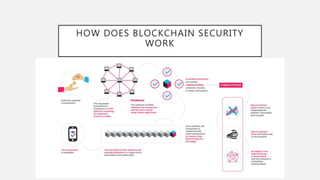
WHAT IS BLOCKCHAIN SECURITY?
• Each transaction is a digital ‘block’ that needs to be verified before it’s allowed to enter the
system.
• Questions include:
• Is the money there?
• Are sender and receiver reputable?
• Is the request legitimate? And so forth.
• Each computer on the network competes on unscrambling the answers, and the winning
computer adds this ‘block’ to the ‘blockchain’ in the order that the ‘block’ arrived. The winner
broadcasts his proof to the rest of the network, which checks that proof and verifies it before
queuing the ‘block’ to complete the transaction. Parties involved are assured that
participants have screened and okayed the transaction.
• The process not only cuts down on fraud, such as double spending or spams, but also
transfers funds simply, safely, and fast.
HOW DOES BLOCKCHAIN SECURITY
WORK
HOW DOES IT OPERATE?
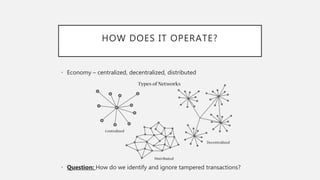
• Economy – centralized, decentralized, distributed
• Question: How do we identify and ignore tampered transactions?
USES OF BLOCK CHAIN
• Cryptocurrency
• Supply chain
• Financial Services
• Smart Property
• Healthcare
• Music
• Identity
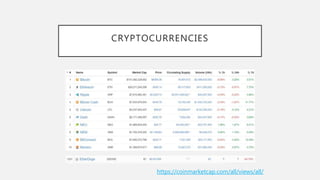
CRYPTOCURRENCIES
https://coinmarketcap.com/all/views/all/
BITCOIN
• Bitcoin is open source, managed by UMass Amherst
• https://github.com/bitcoin
GETTING STARTED
• Crypto-Currency Exchange – converting
crypto to physical currency or vice versa
• Not regulated by FDIC
• Wild West
• Sketchy
• Question: Why is it sketchy?
MINING
• Randomly guessing Nonce
• Currently 12.5 cents to make a block
• Transaction fee awarded to the first to
complete the chain
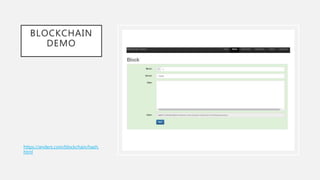
BLOCKCHAIN
DEMO
https://anders.com/blockchain/hash.
html

Block chain security

  • 1.
  • 2.
    WHO IS SATOSHINAKAMOTO?
  • 3.
    WHAT IS BLOCKCHAINSECURITY? • Each transaction is a digital ‘block’ that needs to be verified before it’s allowed to enter the system. • Questions include: • Is the money there? • Are sender and receiver reputable? • Is the request legitimate? And so forth. • Each computer on the network competes on unscrambling the answers, and the winning computer adds this ‘block’ to the ‘blockchain’ in the order that the ‘block’ arrived. The winner broadcasts his proof to the rest of the network, which checks that proof and verifies it before queuing the ‘block’ to complete the transaction. Parties involved are assured that participants have screened and okayed the transaction. • The process not only cuts down on fraud, such as double spending or spams, but also transfers funds simply, safely, and fast.
  • 4.
    HOW DOES BLOCKCHAINSECURITY WORK
  • 5.
    HOW DOES ITOPERATE? • Economy – centralized, decentralized, distributed • Question: How do we identify and ignore tampered transactions?
  • 6.
    USES OF BLOCKCHAIN • Cryptocurrency • Supply chain • Financial Services • Smart Property • Healthcare • Music • Identity
  • 7.
  • 8.
    BITCOIN • Bitcoin isopen source, managed by UMass Amherst • https://github.com/bitcoin
  • 9.
    GETTING STARTED • Crypto-CurrencyExchange – converting crypto to physical currency or vice versa • Not regulated by FDIC • Wild West • Sketchy • Question: Why is it sketchy?
  • 10.
    MINING • Randomly guessingNonce • Currently 12.5 cents to make a block • Transaction fee awarded to the first to complete the chain
  • 11.