Data Backup and
Disaster Recovery
Objectives
 Explain what backup is.
 Explain data backup and recovery plan.
 Explain the types of backup.
 Explain the types of backup media.
 Explain the need for data backup security.
 Explain what disaster recovery is.
 Explain the disaster recovery strategies.
What is Backup?
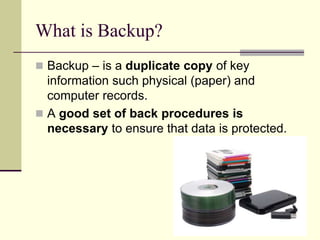
 Backup – is a duplicate copy of key
information such physical (paper) and
computer records.
 A good set of back procedures is
necessary to ensure that data is protected.
What is Backup?
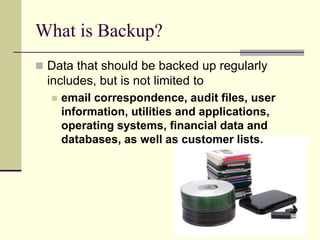
 Data that should be backed up regularly
includes, but is not limited to
 email correspondence, audit files, user
information, utilities and applications,
operating systems, financial data and
databases, as well as customer lists.
Data Backup and Recovery Plan
The following are some factors that you might
consider in creating a backup and recovery
plan.
 Schedule of Backup
 Backing up data should be done at a convenient
time.
 Location of Backup Storage
 It is highly recommended that another set of data
backup is stored remotely in case of a natural
disaster as fire, leak, etc.
Data Backup and Recovery Plan
(cont’d)
 Data Backup Contents
 This will help you to decide it the data needs
to be backed up, how it should be backed up
and when it should be backed up.
 Frequency of Backups
 The rate at which the data changes effects
the frequency the data should be backed up.
Data Backup and Recovery Plan
(cont’d)
 Time of data restoration
 The planning of backup depends a lot on the
time it takes to recover a system
 Type of information contained in the
system
 It is important to know what information the
data contains so that you can identify it as
critical, confidential and etc.
Data Backup and Recovery Plan
(cont’d)
 Backup media
 Backup tapes are cheap, compact and can
store large amounts of data.
Types of Backup
 There are different combinations of
backups available:
 Full (Normal)
 Back up all data from the hard disk or a directory
or folder of the hard drive.
 Copy
 All the selected files and folders are backed up
and archive attribute is not changed to allow other
types of backup to be performed on the same
data.
Types of Backup (cont’d)
 Incremental
 only files that have changed or been created
since the last back up, whether the backup
itself is an incremental or full backup.
 Differential
 files that have changed or been created since
the last full backup.
 Daily
 files that have changed since the last daily
backup
Types of Backup Media
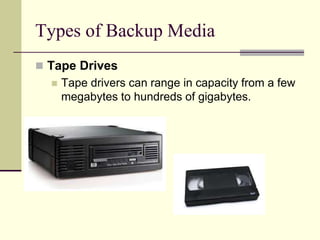
 Tape Drives
 Tape drivers can range in capacity from a few
megabytes to hundreds of gigabytes.
Types of Backup Media (cont’d)
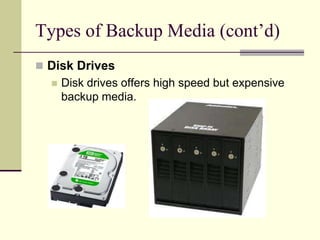
 Disk Drives
 Disk drives offers high speed but expensive
backup media.
Types of Backup Media (cont’d)
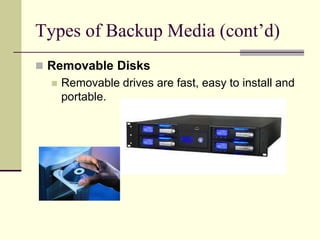
 Removable Disks
 Removable drives are fast, easy to install and
portable.
Types of Backup Media (cont’d)
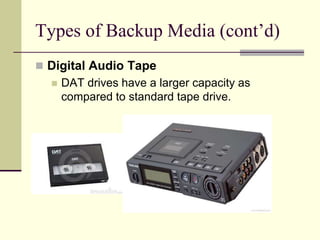
 Digital Audio Tape
 DAT drives have a larger capacity as
compared to standard tape drive.
Types of Backup Media (cont’d)
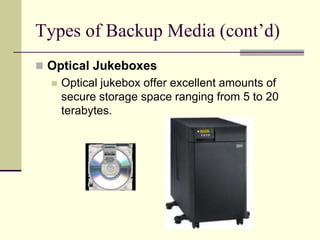
 Optical Jukeboxes
 Optical jukebox offer excellent amounts of
secure storage space ranging from 5 to 20
terabytes.
Types of Backup Media (cont’d)
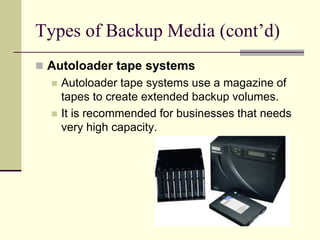
 Autoloader tape systems
 Autoloader tape systems use a magazine of
tapes to create extended backup volumes.
 It is recommended for businesses that needs
very high capacity.
Factors in Choosing Backup Media
 Factors to consider in selecting an
appropriate backup solution:
 Speed
 It refers to how fast data can be backed up and
recovered.
 Reliability
 It refers to the reliability of the backup service and
media.
Factors in Choosing Backup Media
 Capacity
 It refers to the amount of data to backup given the
time and resource constraints.
 Extensibility
 It refers to the ability of the backup solution to
address the current needs of the organization
 Cost
 It refers to the cost of the backup solution and it
should conform to the budget availability.
Backup Tips
 Provide a point person to perform rollback in
the case of an emergency.
 Keep a record of the contents of the backup
media and date of backup.
Always verify backup.
 Create a restore point.
Backup Tips
 Encrypt and provide high permission on the
backup file.
 Create a detailed guideline on backup
recovery.
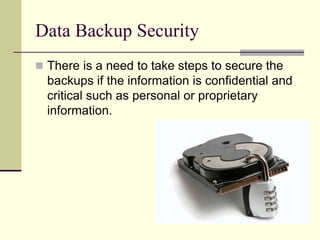
Data Backup Security
 There is a need to take steps to secure the
backups if the information is confidential and
critical such as personal or proprietary
information.
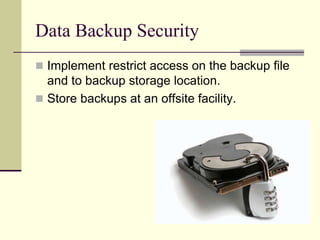
Data Backup Security
 Implement restrict access on the backup file
and to backup storage location.
 Store backups at an offsite facility.
What is Disaster Recovery?
 Disaster Recovery is the restoration of
system operations after a disaster has
occurred which causes damage or
physical loss.
 Three types of sites
 Hot Site
 It has the systems, communications and data on
stand by thus allowing to get back online and
resume operations within a few hours of failure.
What is Disaster Recovery?
 Warm Site
 Has systems and communications on stand by
but requires data to be restored first before
operation can be resumed.
 Cold Site
 Simply a physical location that has all the
resources necessary to support the system
Disaster Recovery Strategies
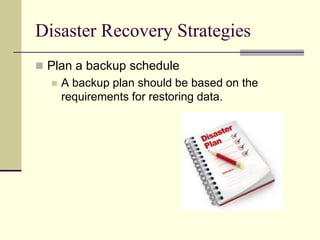
 Plan a backup schedule
 A backup plan should be based on the
requirements for restoring data.
Disaster Recovery Strategies
 Plan to backup open files
 Open files are files that are normally skipped
during the backup process.
Disaster Recovery Strategies
 Plan restore with automated System
Recovery (ASR)
 ASR is a new tool to automatically restore the
system after a system failure.
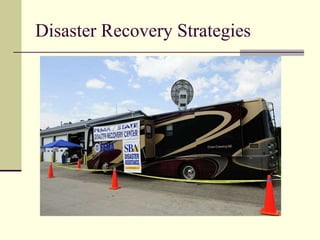
Disaster Recovery Strategies
Disaster Recovery Strategies (cont’d)
 Test restores
 Verifying the backup by testing restore is one
of the most overloaded aspect of disaster
recovery planning.
 Backup should be tested to validate the
backup and prepare for recovery.
 By testing restore, restore procedures can be
modified and documented conclusively.
Disaster Recovery Strategies (cont’d)
 Some of the common problems encountered
during restoration are the following:
 Incompatibility in hardware
 Missing hardware driver
 Corrupted backup media.
Summary
 Explain what backup is.
 Explain data backup and recovery plan.
 Explain the types of backup.
 Explain the types of backup media.
 Explain the need for data backup security.
 Explain what disaster recovery is.
 Explain the disaster recovery strategies.

Data backup and disaster recovery

  • 1.
  • 2.
    Objectives  Explain whatbackup is.  Explain data backup and recovery plan.  Explain the types of backup.  Explain the types of backup media.  Explain the need for data backup security.  Explain what disaster recovery is.  Explain the disaster recovery strategies.
  • 3.
    What is Backup? Backup – is a duplicate copy of key information such physical (paper) and computer records.  A good set of back procedures is necessary to ensure that data is protected.
  • 4.
    What is Backup? Data that should be backed up regularly includes, but is not limited to  email correspondence, audit files, user information, utilities and applications, operating systems, financial data and databases, as well as customer lists.
  • 5.
    Data Backup andRecovery Plan The following are some factors that you might consider in creating a backup and recovery plan.  Schedule of Backup  Backing up data should be done at a convenient time.  Location of Backup Storage  It is highly recommended that another set of data backup is stored remotely in case of a natural disaster as fire, leak, etc.
  • 6.
    Data Backup andRecovery Plan (cont’d)  Data Backup Contents  This will help you to decide it the data needs to be backed up, how it should be backed up and when it should be backed up.  Frequency of Backups  The rate at which the data changes effects the frequency the data should be backed up.
  • 7.
    Data Backup andRecovery Plan (cont’d)  Time of data restoration  The planning of backup depends a lot on the time it takes to recover a system  Type of information contained in the system  It is important to know what information the data contains so that you can identify it as critical, confidential and etc.
  • 8.
    Data Backup andRecovery Plan (cont’d)  Backup media  Backup tapes are cheap, compact and can store large amounts of data.
  • 9.
    Types of Backup There are different combinations of backups available:  Full (Normal)  Back up all data from the hard disk or a directory or folder of the hard drive.  Copy  All the selected files and folders are backed up and archive attribute is not changed to allow other types of backup to be performed on the same data.
  • 10.
    Types of Backup(cont’d)  Incremental  only files that have changed or been created since the last back up, whether the backup itself is an incremental or full backup.  Differential  files that have changed or been created since the last full backup.  Daily  files that have changed since the last daily backup
  • 11.
    Types of BackupMedia  Tape Drives  Tape drivers can range in capacity from a few megabytes to hundreds of gigabytes.
  • 12.
    Types of BackupMedia (cont’d)  Disk Drives  Disk drives offers high speed but expensive backup media.
  • 13.
    Types of BackupMedia (cont’d)  Removable Disks  Removable drives are fast, easy to install and portable.
  • 14.
    Types of BackupMedia (cont’d)  Digital Audio Tape  DAT drives have a larger capacity as compared to standard tape drive.
  • 15.
    Types of BackupMedia (cont’d)  Optical Jukeboxes  Optical jukebox offer excellent amounts of secure storage space ranging from 5 to 20 terabytes.
  • 16.
    Types of BackupMedia (cont’d)  Autoloader tape systems  Autoloader tape systems use a magazine of tapes to create extended backup volumes.  It is recommended for businesses that needs very high capacity.
  • 17.
    Factors in ChoosingBackup Media  Factors to consider in selecting an appropriate backup solution:  Speed  It refers to how fast data can be backed up and recovered.  Reliability  It refers to the reliability of the backup service and media.
  • 18.
    Factors in ChoosingBackup Media  Capacity  It refers to the amount of data to backup given the time and resource constraints.  Extensibility  It refers to the ability of the backup solution to address the current needs of the organization  Cost  It refers to the cost of the backup solution and it should conform to the budget availability.
  • 19.
    Backup Tips  Providea point person to perform rollback in the case of an emergency.  Keep a record of the contents of the backup media and date of backup. Always verify backup.  Create a restore point.
  • 20.
    Backup Tips  Encryptand provide high permission on the backup file.  Create a detailed guideline on backup recovery.
  • 21.
    Data Backup Security There is a need to take steps to secure the backups if the information is confidential and critical such as personal or proprietary information.
  • 22.
    Data Backup Security Implement restrict access on the backup file and to backup storage location.  Store backups at an offsite facility.
  • 23.
    What is DisasterRecovery?  Disaster Recovery is the restoration of system operations after a disaster has occurred which causes damage or physical loss.  Three types of sites  Hot Site  It has the systems, communications and data on stand by thus allowing to get back online and resume operations within a few hours of failure.
  • 24.
    What is DisasterRecovery?  Warm Site  Has systems and communications on stand by but requires data to be restored first before operation can be resumed.  Cold Site  Simply a physical location that has all the resources necessary to support the system
  • 25.
    Disaster Recovery Strategies Plan a backup schedule  A backup plan should be based on the requirements for restoring data.
  • 26.
    Disaster Recovery Strategies Plan to backup open files  Open files are files that are normally skipped during the backup process.
  • 27.
    Disaster Recovery Strategies Plan restore with automated System Recovery (ASR)  ASR is a new tool to automatically restore the system after a system failure.
  • 28.
  • 29.
    Disaster Recovery Strategies(cont’d)  Test restores  Verifying the backup by testing restore is one of the most overloaded aspect of disaster recovery planning.  Backup should be tested to validate the backup and prepare for recovery.  By testing restore, restore procedures can be modified and documented conclusively.
  • 30.
    Disaster Recovery Strategies(cont’d)  Some of the common problems encountered during restoration are the following:  Incompatibility in hardware  Missing hardware driver  Corrupted backup media.
  • 31.
    Summary  Explain whatbackup is.  Explain data backup and recovery plan.  Explain the types of backup.  Explain the types of backup media.  Explain the need for data backup security.  Explain what disaster recovery is.  Explain the disaster recovery strategies.