Operations on
Processes
BY NAVID DANESHVARAN
SOFTWARE ENGINEERING STUDENT AT KHARAZMI
UNIVERSITY
2 /
11Process Creation
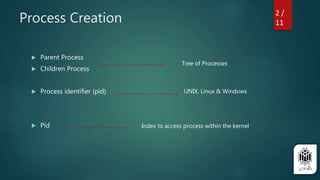
 Parent Process
 Children Process
 Process identifier (pid)
 Pid
Tree of Processes
UNIX, Linux & Windows
Index to access process within the kernel
3 /
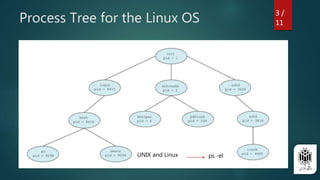
11Process Tree for the Linux OS
UNIX and Linux ps -el
4 /
11Parent and Child Process
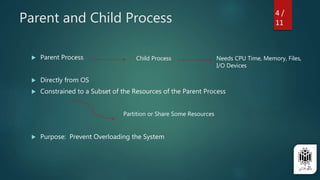
 Parent Process
 Directly from OS
 Constrained to a Subset of the Resources of the Parent Process
 Purpose: Prevent Overloading the System
Child Process Needs CPU Time, Memory, Files,
I/O Devices
Partition or Share Some Resources
5 /
11Parent and Child Process
 Parent Process
 Create New Process
 1- Parent Continues to Execute
 2- Parent Waits
 Address-Space Possibilities
 1- Duplicate of the Parent Process
 2- New Program Loaded
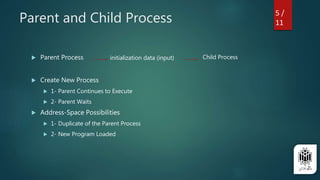
Child Processinitialization data (input)
6 /
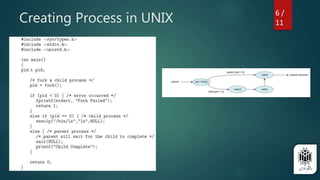
11Creating Process in UNIX
7 /
11Process Creation in Windows
8 /
11Process Termination
 Finishes Executing Its Final Statement
 Delete it by exit() System Call
 Status Value (Typically int) Its Parent
 TerminateProcess() in Windows Parent of the Process
 Reasons: 1- child has exceeded its usage 2- task assigned to the child is no
longer required 3- parent terminates
9 /
11Process Termination
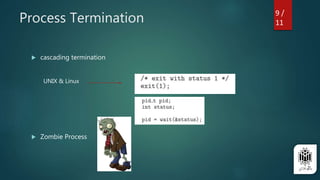
 cascading termination
 Zombie Process
UNIX & Linux
10 /
11Thank You for Your Attention
Any Question?
11 /
11Resources
 A. Silberschatz, Operating System Concepts, 2012.

Operations on Processes

  • 1.
    Operations on Processes BY NAVIDDANESHVARAN SOFTWARE ENGINEERING STUDENT AT KHARAZMI UNIVERSITY
  • 2.
    2 / 11Process Creation Parent Process  Children Process  Process identifier (pid)  Pid Tree of Processes UNIX, Linux & Windows Index to access process within the kernel
  • 3.
    3 / 11Process Treefor the Linux OS UNIX and Linux ps -el
  • 4.
    4 / 11Parent andChild Process  Parent Process  Directly from OS  Constrained to a Subset of the Resources of the Parent Process  Purpose: Prevent Overloading the System Child Process Needs CPU Time, Memory, Files, I/O Devices Partition or Share Some Resources
  • 5.
    5 / 11Parent andChild Process  Parent Process  Create New Process  1- Parent Continues to Execute  2- Parent Waits  Address-Space Possibilities  1- Duplicate of the Parent Process  2- New Program Loaded Child Processinitialization data (input)
  • 6.
  • 7.
  • 8.
    8 / 11Process Termination Finishes Executing Its Final Statement  Delete it by exit() System Call  Status Value (Typically int) Its Parent  TerminateProcess() in Windows Parent of the Process  Reasons: 1- child has exceeded its usage 2- task assigned to the child is no longer required 3- parent terminates
  • 9.
    9 / 11Process Termination cascading termination  Zombie Process UNIX & Linux
  • 10.
    10 / 11Thank Youfor Your Attention Any Question?
  • 11.
    11 / 11Resources  A.Silberschatz, Operating System Concepts, 2012.

Editor's Notes

  • #3 Pid -> integer Number -> Unique Number for each process
  • #4 init process -> serves as the root parent process for all user processes kthreadd -> creating additional processes that perform tasks on behalf of the kernel sshd -> managing clients that connect to the system by using ssh (secure shell) login -> managing clients that directly log onto the system
  • #5 The parent may have to partition its resources among its children, or it may be able to share some resources (such as memory or files) among several of its children
  • #6 display the contents of a file —say, image.jpg— -> name of the file, name of the output device
  • #7 The new process consists of a copy of the address space of the original process. Both processes (the parent and the child) continue execution at the instruction after the fork(). The child process inherits privileges and scheduling attributes from the parent, as well certain resources, such as open files. /bin/ls -> The child process then overlays its address space -> used to get a directory listing. Child process completes (by either implicitly or explicitly invoking exit()).
  • #8 CreateProcess() -> requires loading a specified program into the address space STARTUPINFO and PROCESS INFORMATION -> Structure. STARTUPINFO -> specifies many properties of the new process, such as window size and appearance and handles to standard input and output files. PROCESS INFORMATION -> contains a handle and the identifiers to the newly created process and its thread. ZeroMemory() -> allocate memory for each of these structures. Use the parent’s existing environment block and starting directory pi.hProcess -> passed a handle of the child process.
  • #9 All the resources of the process -> deallocated by the operating system Parent needs to know the identities of its children.
  • #10 entry in the process table -> until the parent calls wait() -> process table contains the process’s exit status. Zombie Process -> A process that has terminated, but whose parent has not yet called wait(). Orphans Process -> Now consider what would happen if a parent did not invoke wait() and instead terminated -> Linux and UNIX -> assigning the init process as the new parent ->The init process periodically invokes wait().