Page 1 of 5
Department of Computer Science
Govt. Municipal Degree College, Abdullahpur, Faisalabad.
Course Number CSI-603
Section Number Morning
Course Title System Programming
Semester/Year 7th
/2017
Instructor Prof.Daniyal Ahmed
Obtained Marks
ASSIGNMENT No. 1
Assignment Title File System
Submission Date 30-10-2017
Due Date 30-10-2017
Student Name Qasim Ali
Roll No. 1425
Signature*
(Note: All fields must be filled properly)
*By signing above you attest that you have contributed to this submission and
confirm that all work you have contributed to this submission is your own work. Any
suspicion of copying or plagiarism in this work will result in an investigation of
Academic Misconduct and may result in a “0” on the work, an “F” in the course.
Page 2 of 5
File System
FAT File System
FAT stands for "File Allocation Table". File Allocation Table (FAT) is a file system that was created
by Microsoft in 1977.The file allocation table is used by the operating system to locate files on a disk.
A file may be divided into many sections and scattered around the disk due to fragmentation. FAT
keeps track of all pieces of a file. In DOS systems, FAT is stored after boot sector. The file system has
been used since the advent of PC. FAT is still in use today as the preferred file system for floppy
drive media and portable, high capacity storage devices like flash drives and other solid-state memory
devices like SD cards. The File Allocation Table file system has seen advancements over time primarily
due to the need to support larger hard disk drives and larger file sizes.
FAT8
The oldest FAT, FAT8 was used on 8-inch floppies with the 8086 processor.FAT8, introduced in
1977, was the first true version of the FAT file system but had limited use and only on some terminal-
style computer systems of the time.
FAT12
The first widely used version of the FAT file system, FAT12, was introduced in 1980, right along with
the first versions of DOS.The FAT12 is the file system on a floppy disk. The number “12” is derived
from the fact that the FAT consists of 12-bit entries.The File Allocation Table (FAT) is a table stored
on a hard disk or floppy disk that indicates the status and location of all data clusters that are on the
disk. The location of files on a floppy disk is listed in a one-column table in the FAT. Because the
width of each entry in a floppy disk column is 12 bits, the FAT is called FAT12.
It had a number of limitations:
 No support for hierarchical directories,
 Cluster addresses were “only” 12-bits long (which made the code manipulating the FAT a bit
tricky)
 And the disk size was stored as a 16-bit count of sectors,
 Which limited the size to 32MB.
 FAT12 supports drive sizes and file sizes of up to 16 MB using 4 KB clusters or 32 MB using
8 KB ones, with a maximum number of 4,084 files on a single volume (when using 8KB
clusters).
 File names under FAT12 cannot exceed the maximum character limit of 8 characters, plus 3 for
the extension.
FAT16
The FAT used for older systems, and for small partitions on modern systems, uses a 16-bit binary
number to hold cluster numbers. .A slightly more improved version of FAT16, called FAT16B, was the
primary file system for MS-DOS 4.0 up through MS-DOS 6.22. Beginning with MS-DOS 7.0 and
Windows 95, a further improved version, called FAT16X, was used instead.
Page 3 of 5
 File allocation table that uses 16 bits for addressing clusters. Commonly used with DOS and
Windows 95 systems.
 Depending on the operating system and the cluster size used,
 The maximum drive size a FAT16-formatted drive can be ranges from 2 GB up to 16 GB, the
latter only in Windows NT 4 with 256 KB clusters.
 File sizes on FAT16 drives max out at 4 GB with Large File Support enabled, or 2 GB without
it.
 The maximum number of files that can be held on a FAT16 volume is 65,536. Just like with
FAT12, file names were limited to 8+3 characters but was extended to 255 characters starting
with Windows 95.
FAT32
It was introduced in 1996 for Windows 95 OSR2 / MS-DOS 7.1 users and was the primary file system
for consumer Windows versions through Windows ME. The purpose of FAT32 was to overcome the
limitations of FAT16 and add support for larger media. The major enhancements introduced by FAT32
included support for much larger volumes, better performance and more flexibility and robustness. A
disk file allocation system from Microsoft that uses 32-bit values for FAT entries instead of 16-bit
values used by the original FAT system, enabling partition sizes up to 2TB (terabytes). FAT32 first
appeared in Windows 95B and is also found in Windows 98 and Windows NT 5.0.
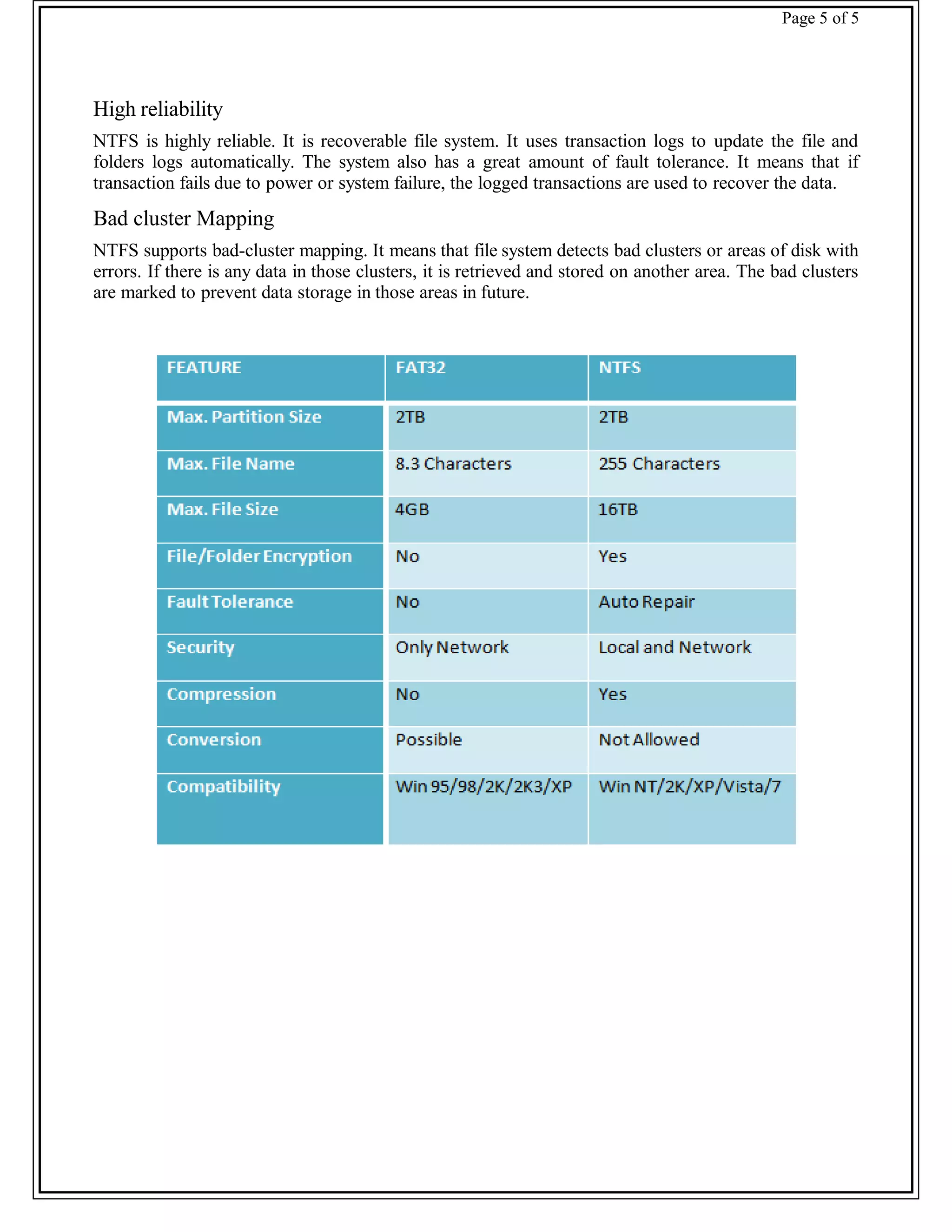
 FAT32 supports basic drive sizes up to 2 TB or even as high as 16 TB with 64 KB clusters.
 Like with FAT16, file sizes on FAT32 drives max out at 4 GB with Large File Support turned
on or 2 GB without it.
 A modified version of FAT32, called FAT32+, supports files close to 256 GB in size!
 Up to 268,173,300 files can be contained on a FAT32 volume so long as it's using 32 KB
clusters.
 FAT32 is more robust. FAT32 can relocate the root folder and use the backup copy of the file
allocation table instead of the default copy. In addition, the boot record on FAT32 drives is
expanded to include a backup copy of critical data structures.
 Creating FAT32 Drives.
Features of FAT32 File System
Partition size
FAT32 increases the number of bits used to address cluster. A cluster is a set of sectors. It reduces the
size of each cluster. It supports larger disk (up to 2TB) and better storage efficiency.
Access Speed
FAT32 provides good file access in partition sizes less than 500 MB or greater than 2 GB. It provides
better disk space utilization.
Performance
Converting to the FAT32 file system is one of the biggest performance enhancements you can make to
your Windows 98-based computer.
Page 4 of 5
NTFS (New Technology File System)
NTFS, an acronym that stands for New Technology File System, is a system first introduced by
Microsoft in 1993 with the release of Windows NT 3.1.NTFS is the primary file system used in
Microsoft's Windows 10, Windows 8, Windows 7, Windows Vista, Windows XP, Windows 2000, and
Windows NT operating systems. NTFS is the Windows NT equivalent of the Windows 95 file
allocation table (FAT) and the OS/2 High Performance File System (HPFS). However, NTFS offers a
number of improvements over FAT and HPFS in terms of performance, extendibility, and security.
Main features of NTFS 5.0 file system are as follows:
 It can support 2TB partition or volume.
 It is a recoverable file system.
 It uses a small cluster to perfectly manage disk space.
 NTFS partition allows users to share resources.
 NTFS uses a “changeable” log to track the record-oriented files.
Features of NTFS File System
Naming Conventions
 File names can be up to 255 characters
 File names can contain most characters except “ /  < > * | :
 File names are not case sensitive
Security
NTFS provides file and folder security. Files and folders are safer than FAT. Security is maintained by
assigning NTFS permissions to files and folders. Security is maintained at the local level and the
network level. The permissions can be assigned to individual files and folders. Each file or folder in an
NTFS partition has an Access Control List. It contains the users and group security identifier (SID)
and the privileges granted to them.
Partition Size
The NTFS partition and file sizes are much bigger than FAT partitions and files. The maximum size of
an NTFS partition or file can be 16 Exabyte. However, the practical limitation is two Terabytes. The
file size can be in the range of 4GB to 64GB.
Compatibility
Works with all versions of Windows and modern versions of Mac OS X, but requires additional
software on Linux. More devices support exFAT than support NTFS, but some—particularly older
ones—may only support FAT32.
File compression
NTFS provides file compression of as much as 50%.
Page 5 of 5
High reliability
NTFS is highly reliable. It is recoverable file system. It uses transaction logs to update the file and
folders logs automatically. The system also has a great amount of fault tolerance. It means that if
transaction fails due to power or system failure, the logged transactions are used to recover the data.
Bad cluster Mapping
NTFS supports bad-cluster mapping. It means that file system detects bad clusters or areas of disk with
errors. If there is any data in those clusters, it is retrieved and stored on another area. The bad clusters
are marked to prevent data storage in those areas in future.
Page 5 of 5
High reliability
NTFS is highly reliable. It is recoverable file system. It uses transaction logs to update the file and
folders logs automatically. The system also has a great amount of fault tolerance. It means that if
transaction fails due to power or system failure, the logged transactions are used to recover the data.
Bad cluster Mapping
NTFS supports bad-cluster mapping. It means that file system detects bad clusters or areas of disk with
errors. If there is any data in those clusters, it is retrieved and stored on another area. The bad clusters
are marked to prevent data storage in those areas in future.

File System FAT And NTFS

  • 1.
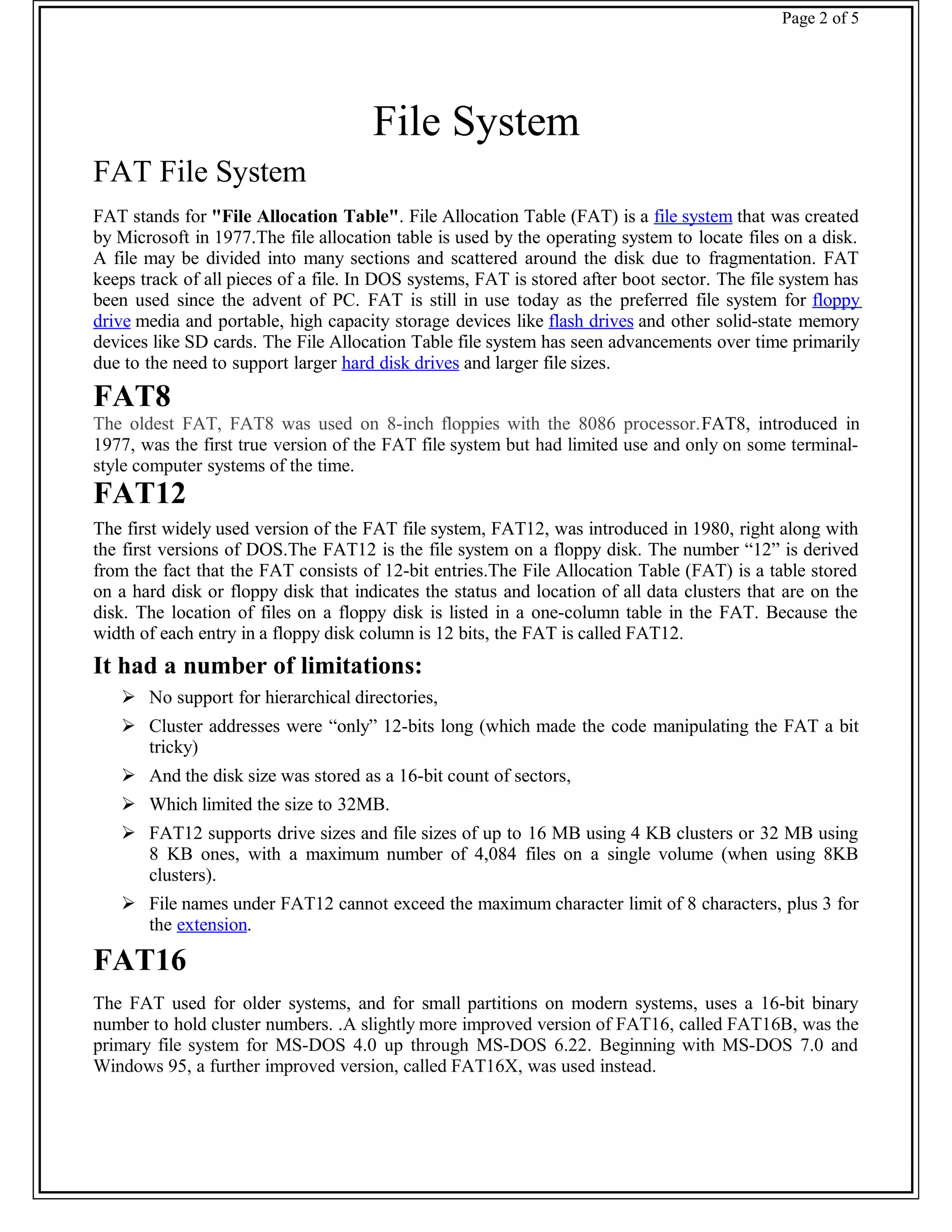
    Page 1 of5 Department of Computer Science Govt. Municipal Degree College, Abdullahpur, Faisalabad. Course Number CSI-603 Section Number Morning Course Title System Programming Semester/Year 7th /2017 Instructor Prof.Daniyal Ahmed Obtained Marks ASSIGNMENT No. 1 Assignment Title File System Submission Date 30-10-2017 Due Date 30-10-2017 Student Name Qasim Ali Roll No. 1425 Signature* (Note: All fields must be filled properly) *By signing above you attest that you have contributed to this submission and confirm that all work you have contributed to this submission is your own work. Any suspicion of copying or plagiarism in this work will result in an investigation of Academic Misconduct and may result in a “0” on the work, an “F” in the course.
  • 2.
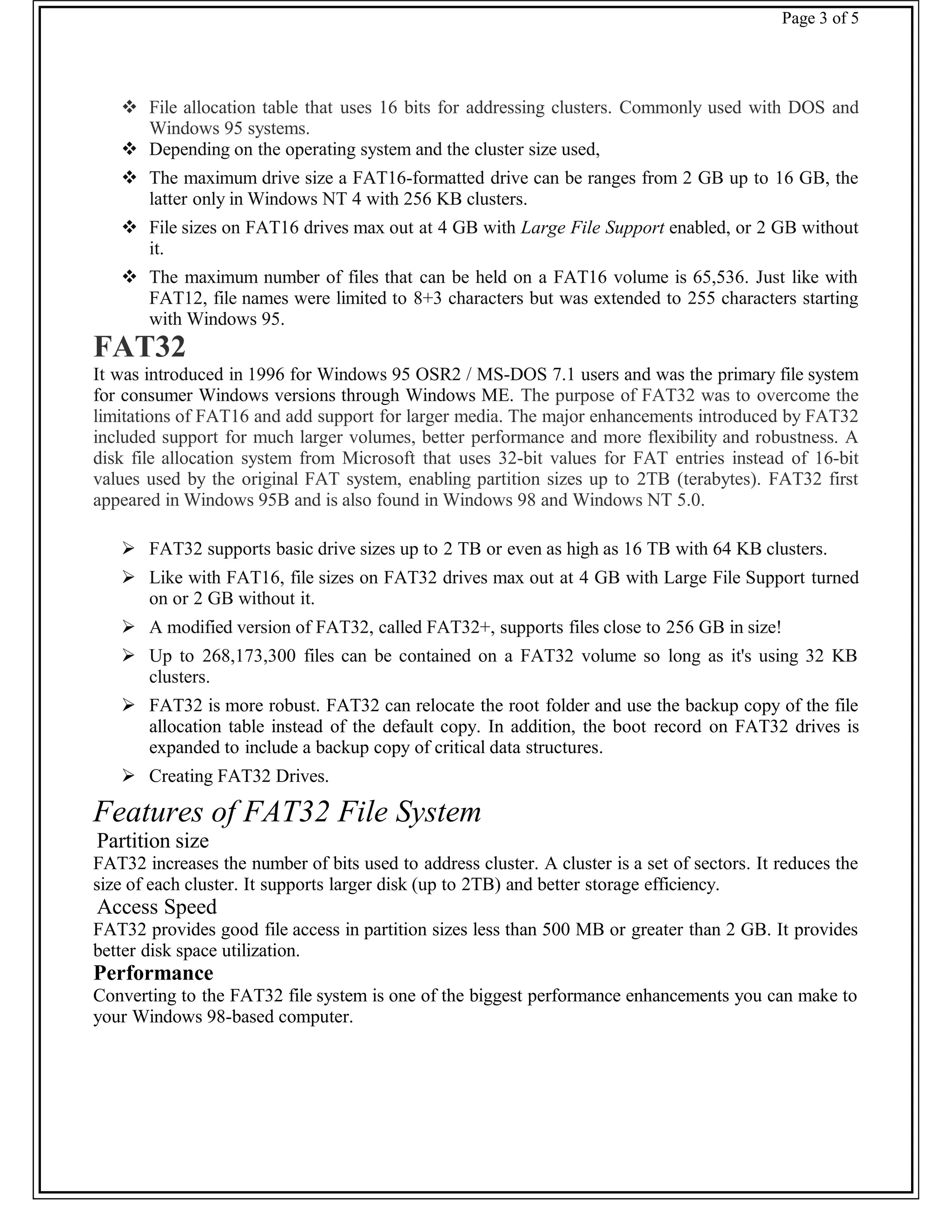
    Page 2 of5 File System FAT File System FAT stands for "File Allocation Table". File Allocation Table (FAT) is a file system that was created by Microsoft in 1977.The file allocation table is used by the operating system to locate files on a disk. A file may be divided into many sections and scattered around the disk due to fragmentation. FAT keeps track of all pieces of a file. In DOS systems, FAT is stored after boot sector. The file system has been used since the advent of PC. FAT is still in use today as the preferred file system for floppy drive media and portable, high capacity storage devices like flash drives and other solid-state memory devices like SD cards. The File Allocation Table file system has seen advancements over time primarily due to the need to support larger hard disk drives and larger file sizes. FAT8 The oldest FAT, FAT8 was used on 8-inch floppies with the 8086 processor.FAT8, introduced in 1977, was the first true version of the FAT file system but had limited use and only on some terminal- style computer systems of the time. FAT12 The first widely used version of the FAT file system, FAT12, was introduced in 1980, right along with the first versions of DOS.The FAT12 is the file system on a floppy disk. The number “12” is derived from the fact that the FAT consists of 12-bit entries.The File Allocation Table (FAT) is a table stored on a hard disk or floppy disk that indicates the status and location of all data clusters that are on the disk. The location of files on a floppy disk is listed in a one-column table in the FAT. Because the width of each entry in a floppy disk column is 12 bits, the FAT is called FAT12. It had a number of limitations:  No support for hierarchical directories,  Cluster addresses were “only” 12-bits long (which made the code manipulating the FAT a bit tricky)  And the disk size was stored as a 16-bit count of sectors,  Which limited the size to 32MB.  FAT12 supports drive sizes and file sizes of up to 16 MB using 4 KB clusters or 32 MB using 8 KB ones, with a maximum number of 4,084 files on a single volume (when using 8KB clusters).  File names under FAT12 cannot exceed the maximum character limit of 8 characters, plus 3 for the extension. FAT16 The FAT used for older systems, and for small partitions on modern systems, uses a 16-bit binary number to hold cluster numbers. .A slightly more improved version of FAT16, called FAT16B, was the primary file system for MS-DOS 4.0 up through MS-DOS 6.22. Beginning with MS-DOS 7.0 and Windows 95, a further improved version, called FAT16X, was used instead.
  • 3.
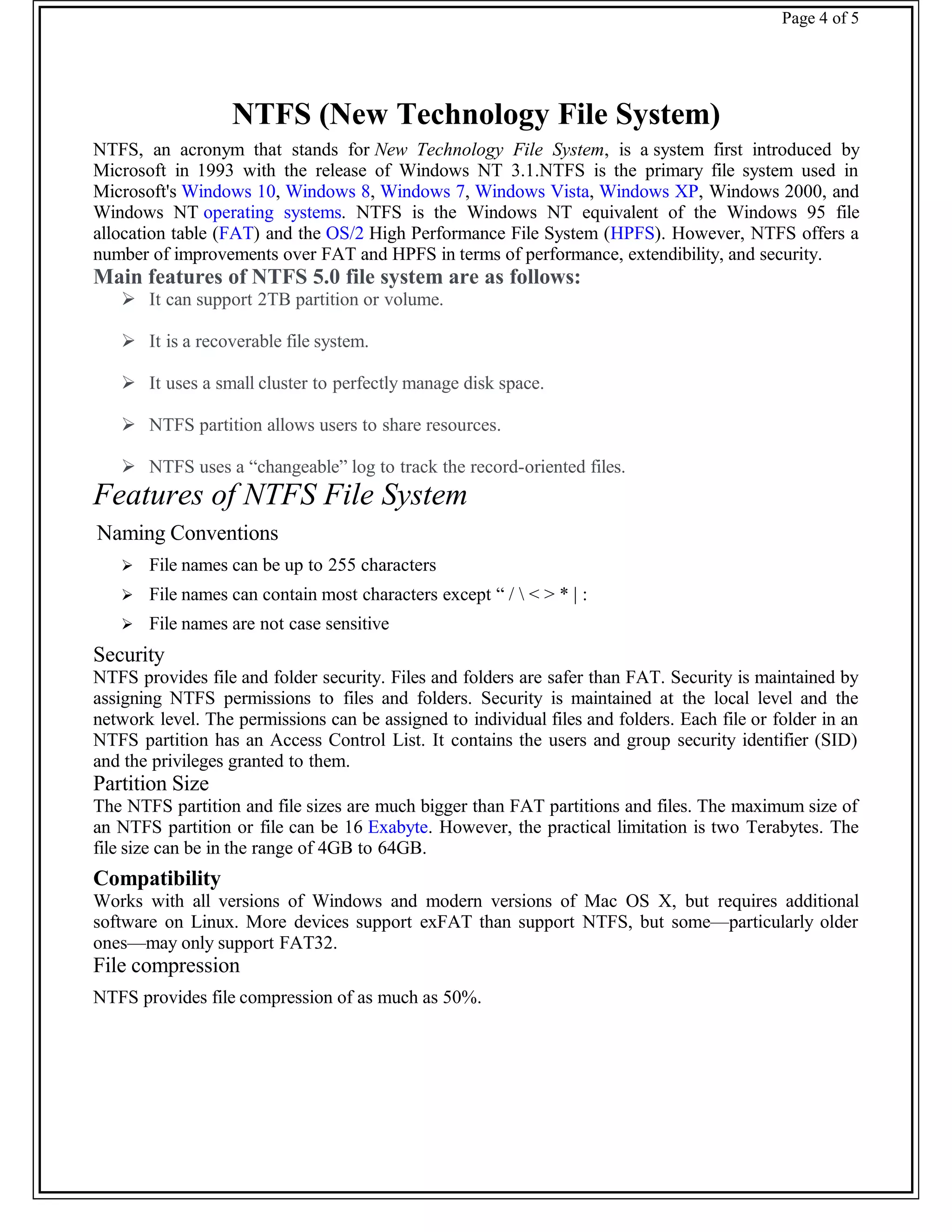
    Page 3 of5  File allocation table that uses 16 bits for addressing clusters. Commonly used with DOS and Windows 95 systems.  Depending on the operating system and the cluster size used,  The maximum drive size a FAT16-formatted drive can be ranges from 2 GB up to 16 GB, the latter only in Windows NT 4 with 256 KB clusters.  File sizes on FAT16 drives max out at 4 GB with Large File Support enabled, or 2 GB without it.  The maximum number of files that can be held on a FAT16 volume is 65,536. Just like with FAT12, file names were limited to 8+3 characters but was extended to 255 characters starting with Windows 95. FAT32 It was introduced in 1996 for Windows 95 OSR2 / MS-DOS 7.1 users and was the primary file system for consumer Windows versions through Windows ME. The purpose of FAT32 was to overcome the limitations of FAT16 and add support for larger media. The major enhancements introduced by FAT32 included support for much larger volumes, better performance and more flexibility and robustness. A disk file allocation system from Microsoft that uses 32-bit values for FAT entries instead of 16-bit values used by the original FAT system, enabling partition sizes up to 2TB (terabytes). FAT32 first appeared in Windows 95B and is also found in Windows 98 and Windows NT 5.0.  FAT32 supports basic drive sizes up to 2 TB or even as high as 16 TB with 64 KB clusters.  Like with FAT16, file sizes on FAT32 drives max out at 4 GB with Large File Support turned on or 2 GB without it.  A modified version of FAT32, called FAT32+, supports files close to 256 GB in size!  Up to 268,173,300 files can be contained on a FAT32 volume so long as it's using 32 KB clusters.  FAT32 is more robust. FAT32 can relocate the root folder and use the backup copy of the file allocation table instead of the default copy. In addition, the boot record on FAT32 drives is expanded to include a backup copy of critical data structures.  Creating FAT32 Drives. Features of FAT32 File System Partition size FAT32 increases the number of bits used to address cluster. A cluster is a set of sectors. It reduces the size of each cluster. It supports larger disk (up to 2TB) and better storage efficiency. Access Speed FAT32 provides good file access in partition sizes less than 500 MB or greater than 2 GB. It provides better disk space utilization. Performance Converting to the FAT32 file system is one of the biggest performance enhancements you can make to your Windows 98-based computer.
  • 4.
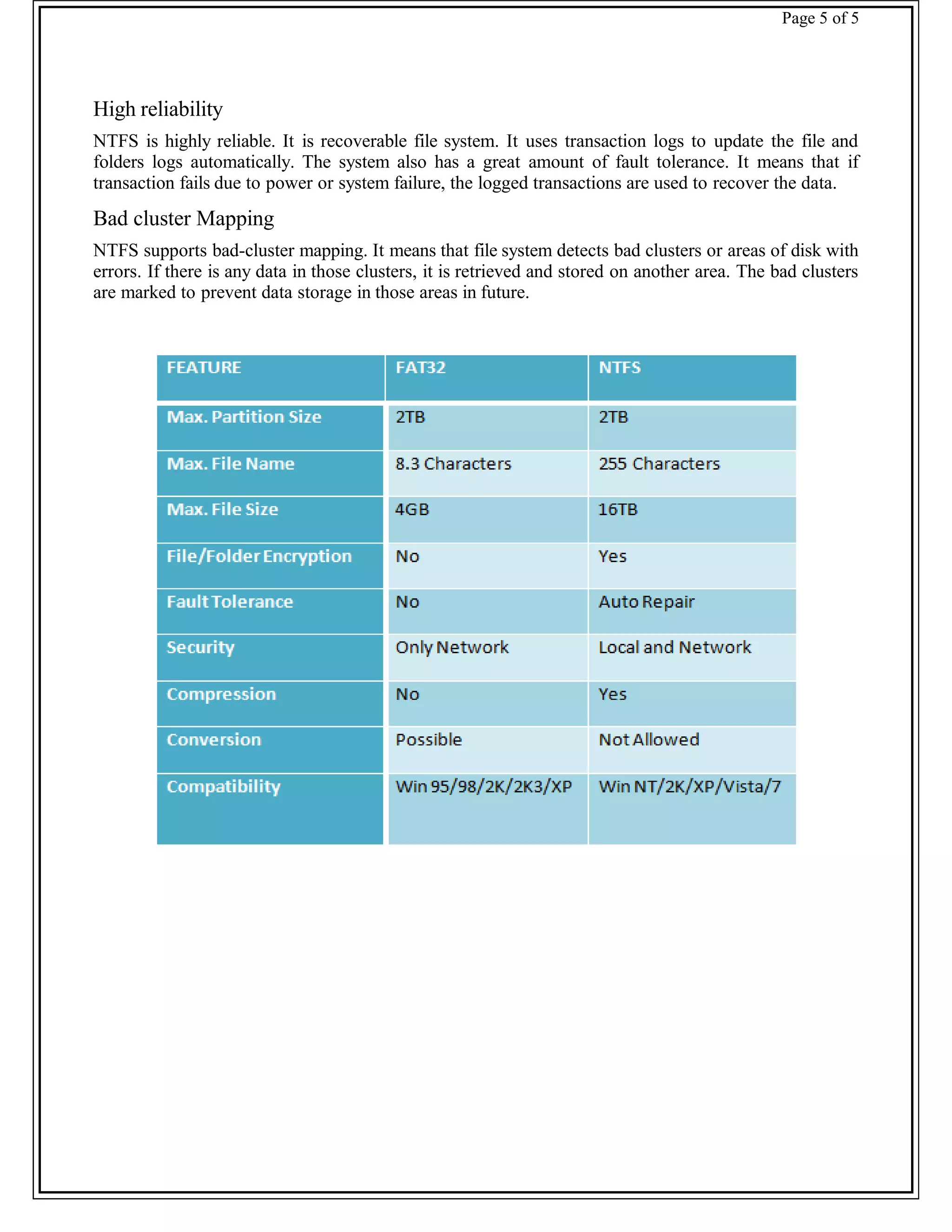
    Page 4 of5 NTFS (New Technology File System) NTFS, an acronym that stands for New Technology File System, is a system first introduced by Microsoft in 1993 with the release of Windows NT 3.1.NTFS is the primary file system used in Microsoft's Windows 10, Windows 8, Windows 7, Windows Vista, Windows XP, Windows 2000, and Windows NT operating systems. NTFS is the Windows NT equivalent of the Windows 95 file allocation table (FAT) and the OS/2 High Performance File System (HPFS). However, NTFS offers a number of improvements over FAT and HPFS in terms of performance, extendibility, and security. Main features of NTFS 5.0 file system are as follows:  It can support 2TB partition or volume.  It is a recoverable file system.  It uses a small cluster to perfectly manage disk space.  NTFS partition allows users to share resources.  NTFS uses a “changeable” log to track the record-oriented files. Features of NTFS File System Naming Conventions  File names can be up to 255 characters  File names can contain most characters except “ / < > * | :  File names are not case sensitive Security NTFS provides file and folder security. Files and folders are safer than FAT. Security is maintained by assigning NTFS permissions to files and folders. Security is maintained at the local level and the network level. The permissions can be assigned to individual files and folders. Each file or folder in an NTFS partition has an Access Control List. It contains the users and group security identifier (SID) and the privileges granted to them. Partition Size The NTFS partition and file sizes are much bigger than FAT partitions and files. The maximum size of an NTFS partition or file can be 16 Exabyte. However, the practical limitation is two Terabytes. The file size can be in the range of 4GB to 64GB. Compatibility Works with all versions of Windows and modern versions of Mac OS X, but requires additional software on Linux. More devices support exFAT than support NTFS, but some—particularly older ones—may only support FAT32. File compression NTFS provides file compression of as much as 50%.
  • 5.
    Page 5 of5 High reliability NTFS is highly reliable. It is recoverable file system. It uses transaction logs to update the file and folders logs automatically. The system also has a great amount of fault tolerance. It means that if transaction fails due to power or system failure, the logged transactions are used to recover the data. Bad cluster Mapping NTFS supports bad-cluster mapping. It means that file system detects bad clusters or areas of disk with errors. If there is any data in those clusters, it is retrieved and stored on another area. The bad clusters are marked to prevent data storage in those areas in future.
  • 6.
    Page 5 of5 High reliability NTFS is highly reliable. It is recoverable file system. It uses transaction logs to update the file and folders logs automatically. The system also has a great amount of fault tolerance. It means that if transaction fails due to power or system failure, the logged transactions are used to recover the data. Bad cluster Mapping NTFS supports bad-cluster mapping. It means that file system detects bad clusters or areas of disk with errors. If there is any data in those clusters, it is retrieved and stored on another area. The bad clusters are marked to prevent data storage in those areas in future.