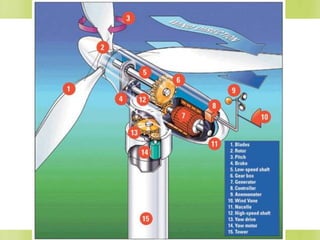

Wind Energy Technology
What works & what doesn’t
www.kidwind.org
KidWind Project | www.kidwind.orgKidWind Project | www.kidwind.org
What is KidWind?
The KidWind Project is a team of teachers,
students, engineers and practitioners
exploring the science behind wind energy
in classrooms around the US. Our goal is to
introduce as many people as possible to
the elegance of wind power through
hands-on science activities which are
challenging, engaging and teach basic
science principles.
KidWind Project | www.kidwind.org
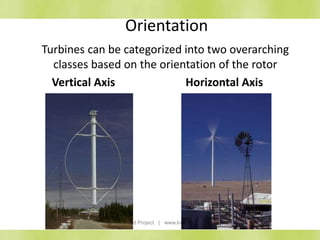
Orientation
Turbines can be categorized into two overarching
classes based on the orientation of the rotor
Vertical Axis Horizontal Axis
KidWind Project | www.kidwind.org
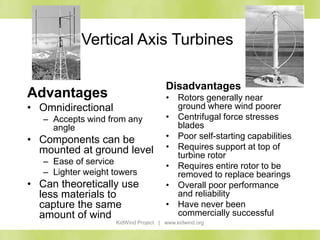
Vertical Axis Turbines
Advantages
• Omnidirectional
– Accepts wind from any
angle
• Components can be
mounted at ground level
– Ease of service
– Lighter weight towers
• Can theoretically use
less materials to
capture the same
amount of wind
Disadvantages
• Rotors generally near
ground where wind poorer
• Centrifugal force stresses
blades
• Poor self-starting capabilities
• Requires support at top of
turbine rotor
• Requires entire rotor to be
removed to replace bearings
• Overall poor performance
and reliability
• Have never been
commercially successful
Lift vs Drag
VAWTs
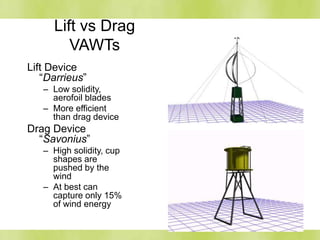
Lift Device
“Darrieus”
– Low solidity,
aerofoil blades
– More efficient
than drag device
Drag Device
“Savonius”
– High solidity, cup
shapes are
pushed by the
wind
– At best can
capture only 15%
of wind energy
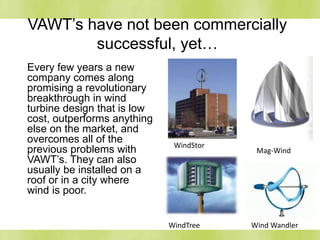
VAWT’s have not been commercially
successful, yet…
Every few years a new
company comes along
promising a revolutionary
breakthrough in wind
turbine design that is low
cost, outperforms anything
else on the market, and
overcomes all of the
previous problems with
VAWT’s. They can also
usually be installed on a
roof or in a city where
wind is poor.
WindStor
Mag-Wind
WindTree Wind Wandler
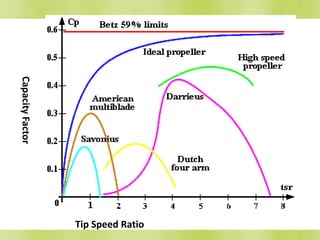
Tip Speed Ratio
CapacityFactor
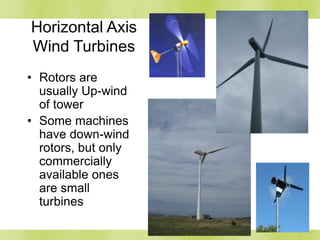
Horizontal Axis
Wind Turbines
• Rotors are
usually Up-wind
of tower
• Some machines
have down-wind
rotors, but only
commercially
available ones
are small
turbines
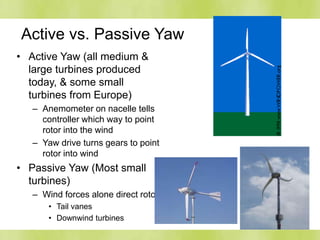
Active vs. Passive Yaw
• Active Yaw (all medium &
large turbines produced
today, & some small
turbines from Europe)
– Anemometer on nacelle tells
controller which way to point
rotor into the wind
– Yaw drive turns gears to point
rotor into wind
• Passive Yaw (Most small
turbines)
– Wind forces alone direct rotor
• Tail vanes
• Downwind turbines
KidWind Project | www.kidwind.org
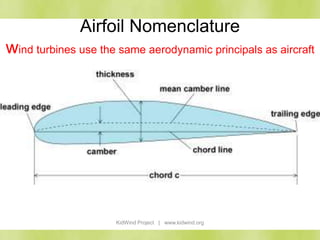
Airfoil Nomenclature
wind turbines use the same aerodynamic principals as aircraft
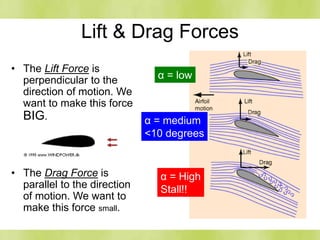
Lift & Drag Forces
• The Lift Force is
perpendicular to the
direction of motion. We
want to make this force
BIG.
• The Drag Force is
parallel to the direction
of motion. We want to
make this force small.
α = low
α = medium
<10 degrees
α = High
Stall!!
α
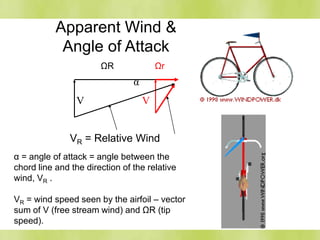
VR = Relative Wind
V
ΩR Ωr
V
α = angle of attack = angle between the
chord line and the direction of the relative
wind, VR .
VR = wind speed seen by the airfoil – vector
sum of V (free stream wind) and ΩR (tip
speed).
Apparent Wind &
Angle of Attack
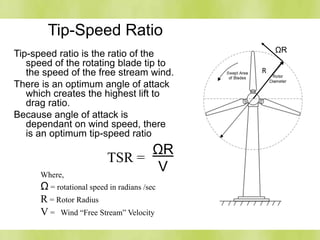
Tip-Speed Ratio
Tip-speed ratio is the ratio of the
speed of the rotating blade tip to
the speed of the free stream wind.
There is an optimum angle of attack
which creates the highest lift to
drag ratio.
Because angle of attack is
dependant on wind speed, there
is an optimum tip-speed ratio
ΩR
V
TSR =
ΩR
R
Where,
Ω = rotational speed in radians /sec
R = Rotor Radius
V = Wind “Free Stream” Velocity
ΩR
R
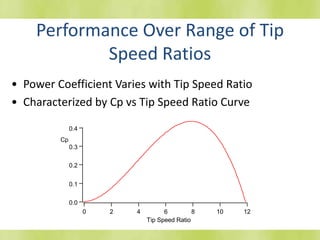
Performance Over Range of Tip
Speed Ratios
• Power Coefficient Varies with Tip Speed Ratio
• Characterized by Cp vs Tip Speed Ratio Curve
0.4
0.3
0.2
0.1
0.0
Cp
121086420
Tip Speed Ratio
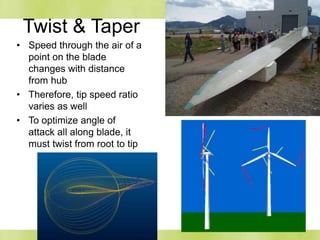
Twist & Taper
• Speed through the air of a
point on the blade
changes with distance
from hub
• Therefore, tip speed ratio
varies as well
• To optimize angle of
attack all along blade, it
must twist from root to tip
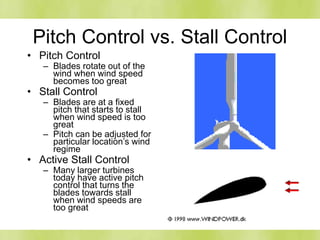
Pitch Control vs. Stall Control
• Pitch Control
– Blades rotate out of the
wind when wind speed
becomes too great
• Stall Control
– Blades are at a fixed
pitch that starts to stall
when wind speed is too
great
– Pitch can be adjusted for
particular location’s wind
regime
• Active Stall Control
– Many larger turbines
today have active pitch
control that turns the
blades towards stall
when wind speeds are
too great
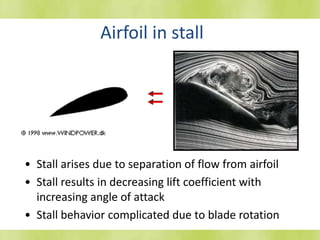
Airfoil in stall
• Stall arises due to separation of flow from airfoil
• Stall results in decreasing lift coefficient with
increasing angle of attack
• Stall behavior complicated due to blade rotation
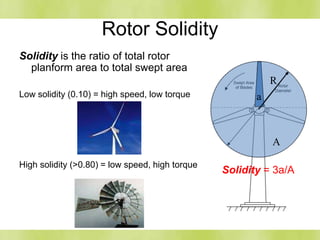
Rotor Solidity
Solidity is the ratio of total rotor
planform area to total swept area
Low solidity (0.10) = high speed, low torque
High solidity (>0.80) = low speed, high torque
R
A
a
Solidity = 3a/A
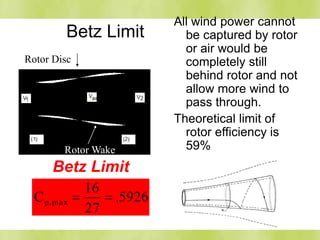
Betz Limit
Betz Limit
5926.
27
16
C max,p 
Rotor Wake
Rotor Disc
All wind power cannot
be captured by rotor
or air would be
completely still
behind rotor and not
allow more wind to
pass through.
Theoretical limit of
rotor efficiency is
59%
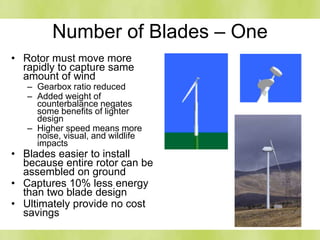
Number of Blades – One
• Rotor must move more
rapidly to capture same
amount of wind
– Gearbox ratio reduced
– Added weight of
counterbalance negates
some benefits of lighter
design
– Higher speed means more
noise, visual, and wildlife
impacts
• Blades easier to install
because entire rotor can be
assembled on ground
• Captures 10% less energy
than two blade design
• Ultimately provide no cost
savings
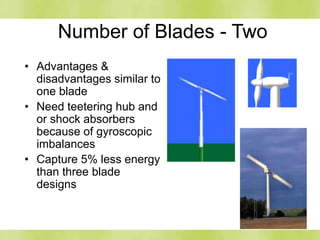
Number of Blades - Two
• Advantages &
disadvantages similar to
one blade
• Need teetering hub and
or shock absorbers
because of gyroscopic
imbalances
• Capture 5% less energy
than three blade
designs
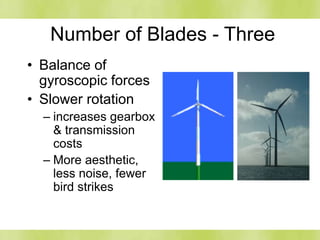
Number of Blades - Three
• Balance of
gyroscopic forces
• Slower rotation
– increases gearbox
& transmission
costs
– More aesthetic,
less noise, fewer
bird strikes
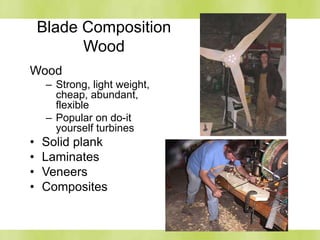
Blade Composition
Wood
Wood
– Strong, light weight,
cheap, abundant,
flexible
– Popular on do-it
yourself turbines
• Solid plank
• Laminates
• Veneers
• Composites
Blade Composition
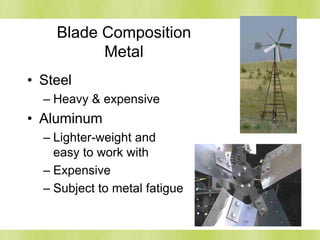
Metal
• Steel
– Heavy & expensive
• Aluminum
– Lighter-weight and
easy to work with
– Expensive
– Subject to metal fatigue
Blade Construction
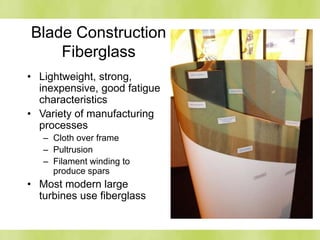
Fiberglass
• Lightweight, strong,
inexpensive, good fatigue
characteristics
• Variety of manufacturing
processes
– Cloth over frame
– Pultrusion
– Filament winding to
produce spars
• Most modern large
turbines use fiberglass
Hubs
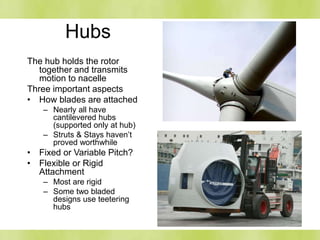
The hub holds the rotor
together and transmits
motion to nacelle
Three important aspects
• How blades are attached
– Nearly all have
cantilevered hubs
(supported only at hub)
– Struts & Stays haven’t
proved worthwhile
• Fixed or Variable Pitch?
• Flexible or Rigid
Attachment
– Most are rigid
– Some two bladed
designs use teetering
hubs
Drive Trains
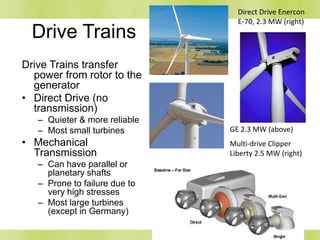
Drive Trains transfer
power from rotor to the
generator
• Direct Drive (no
transmission)
– Quieter & more reliable
– Most small turbines
• Mechanical
Transmission
– Can have parallel or
planetary shafts
– Prone to failure due to
very high stresses
– Most large turbines
(except in Germany)
Direct Drive Enercon
E-70, 2.3 MW (right)
GE 2.3 MW (above)
Multi-drive Clipper
Liberty 2.5 MW (right)
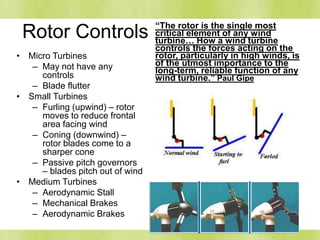
Rotor Controls “The rotor is the single most
critical element of any wind
turbine… How a wind turbine
controls the forces acting on the
rotor, particularly in high winds, is
of the utmost importance to the
long-term, reliable function of any
wind turbine.” Paul Gipe
• Micro Turbines
– May not have any
controls
– Blade flutter
• Small Turbines
– Furling (upwind) – rotor
moves to reduce frontal
area facing wind
– Coning (downwind) –
rotor blades come to a
sharper cone
– Passive pitch governors
– blades pitch out of wind
• Medium Turbines
– Aerodynamic Stall
– Mechanical Brakes
– Aerodynamic Brakes
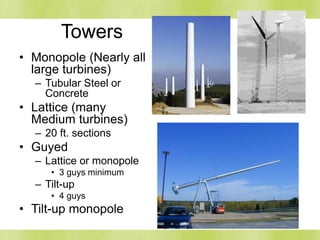
Towers
• Monopole (Nearly all
large turbines)
– Tubular Steel or
Concrete
• Lattice (many
Medium turbines)
– 20 ft. sections
• Guyed
– Lattice or monopole
• 3 guys minimum
– Tilt-up
• 4 guys
• Tilt-up monopole
The KidWind Project
www.kidwind.org

Wind energy technology

  • 1.
    Wind Energy Technology Whatworks & what doesn’t www.kidwind.org
  • 2.
    KidWind Project |www.kidwind.orgKidWind Project | www.kidwind.org What is KidWind? The KidWind Project is a team of teachers, students, engineers and practitioners exploring the science behind wind energy in classrooms around the US. Our goal is to introduce as many people as possible to the elegance of wind power through hands-on science activities which are challenging, engaging and teach basic science principles.
  • 3.
    KidWind Project |www.kidwind.org Orientation Turbines can be categorized into two overarching classes based on the orientation of the rotor Vertical Axis Horizontal Axis
  • 4.
    KidWind Project |www.kidwind.org Vertical Axis Turbines Advantages • Omnidirectional – Accepts wind from any angle • Components can be mounted at ground level – Ease of service – Lighter weight towers • Can theoretically use less materials to capture the same amount of wind Disadvantages • Rotors generally near ground where wind poorer • Centrifugal force stresses blades • Poor self-starting capabilities • Requires support at top of turbine rotor • Requires entire rotor to be removed to replace bearings • Overall poor performance and reliability • Have never been commercially successful
  • 5.
    Lift vs Drag VAWTs LiftDevice “Darrieus” – Low solidity, aerofoil blades – More efficient than drag device Drag Device “Savonius” – High solidity, cup shapes are pushed by the wind – At best can capture only 15% of wind energy
  • 6.
    VAWT’s have notbeen commercially successful, yet… Every few years a new company comes along promising a revolutionary breakthrough in wind turbine design that is low cost, outperforms anything else on the market, and overcomes all of the previous problems with VAWT’s. They can also usually be installed on a roof or in a city where wind is poor. WindStor Mag-Wind WindTree Wind Wandler
  • 7.
  • 8.
    Horizontal Axis Wind Turbines •Rotors are usually Up-wind of tower • Some machines have down-wind rotors, but only commercially available ones are small turbines
  • 10.
    Active vs. PassiveYaw • Active Yaw (all medium & large turbines produced today, & some small turbines from Europe) – Anemometer on nacelle tells controller which way to point rotor into the wind – Yaw drive turns gears to point rotor into wind • Passive Yaw (Most small turbines) – Wind forces alone direct rotor • Tail vanes • Downwind turbines
  • 11.
    KidWind Project |www.kidwind.org Airfoil Nomenclature wind turbines use the same aerodynamic principals as aircraft
  • 12.
    Lift & DragForces • The Lift Force is perpendicular to the direction of motion. We want to make this force BIG. • The Drag Force is parallel to the direction of motion. We want to make this force small. α = low α = medium <10 degrees α = High Stall!!
  • 13.
    α VR = RelativeWind V ΩR Ωr V α = angle of attack = angle between the chord line and the direction of the relative wind, VR . VR = wind speed seen by the airfoil – vector sum of V (free stream wind) and ΩR (tip speed). Apparent Wind & Angle of Attack
  • 14.
    Tip-Speed Ratio Tip-speed ratiois the ratio of the speed of the rotating blade tip to the speed of the free stream wind. There is an optimum angle of attack which creates the highest lift to drag ratio. Because angle of attack is dependant on wind speed, there is an optimum tip-speed ratio ΩR V TSR = ΩR R Where, Ω = rotational speed in radians /sec R = Rotor Radius V = Wind “Free Stream” Velocity ΩR R
  • 15.
    Performance Over Rangeof Tip Speed Ratios • Power Coefficient Varies with Tip Speed Ratio • Characterized by Cp vs Tip Speed Ratio Curve 0.4 0.3 0.2 0.1 0.0 Cp 121086420 Tip Speed Ratio
  • 16.
    Twist & Taper •Speed through the air of a point on the blade changes with distance from hub • Therefore, tip speed ratio varies as well • To optimize angle of attack all along blade, it must twist from root to tip
  • 17.
    Pitch Control vs.Stall Control • Pitch Control – Blades rotate out of the wind when wind speed becomes too great • Stall Control – Blades are at a fixed pitch that starts to stall when wind speed is too great – Pitch can be adjusted for particular location’s wind regime • Active Stall Control – Many larger turbines today have active pitch control that turns the blades towards stall when wind speeds are too great
  • 18.
    Airfoil in stall •Stall arises due to separation of flow from airfoil • Stall results in decreasing lift coefficient with increasing angle of attack • Stall behavior complicated due to blade rotation
  • 19.
    Rotor Solidity Solidity isthe ratio of total rotor planform area to total swept area Low solidity (0.10) = high speed, low torque High solidity (>0.80) = low speed, high torque R A a Solidity = 3a/A
  • 20.
    Betz Limit Betz Limit 5926. 27 16 Cmax,p  Rotor Wake Rotor Disc All wind power cannot be captured by rotor or air would be completely still behind rotor and not allow more wind to pass through. Theoretical limit of rotor efficiency is 59%
  • 21.
    Number of Blades– One • Rotor must move more rapidly to capture same amount of wind – Gearbox ratio reduced – Added weight of counterbalance negates some benefits of lighter design – Higher speed means more noise, visual, and wildlife impacts • Blades easier to install because entire rotor can be assembled on ground • Captures 10% less energy than two blade design • Ultimately provide no cost savings
  • 22.
    Number of Blades- Two • Advantages & disadvantages similar to one blade • Need teetering hub and or shock absorbers because of gyroscopic imbalances • Capture 5% less energy than three blade designs
  • 23.
    Number of Blades- Three • Balance of gyroscopic forces • Slower rotation – increases gearbox & transmission costs – More aesthetic, less noise, fewer bird strikes
  • 24.
    Blade Composition Wood Wood – Strong,light weight, cheap, abundant, flexible – Popular on do-it yourself turbines • Solid plank • Laminates • Veneers • Composites
  • 25.
    Blade Composition Metal • Steel –Heavy & expensive • Aluminum – Lighter-weight and easy to work with – Expensive – Subject to metal fatigue
  • 26.
    Blade Construction Fiberglass • Lightweight,strong, inexpensive, good fatigue characteristics • Variety of manufacturing processes – Cloth over frame – Pultrusion – Filament winding to produce spars • Most modern large turbines use fiberglass
  • 27.
    Hubs The hub holdsthe rotor together and transmits motion to nacelle Three important aspects • How blades are attached – Nearly all have cantilevered hubs (supported only at hub) – Struts & Stays haven’t proved worthwhile • Fixed or Variable Pitch? • Flexible or Rigid Attachment – Most are rigid – Some two bladed designs use teetering hubs
  • 28.
    Drive Trains Drive Trainstransfer power from rotor to the generator • Direct Drive (no transmission) – Quieter & more reliable – Most small turbines • Mechanical Transmission – Can have parallel or planetary shafts – Prone to failure due to very high stresses – Most large turbines (except in Germany) Direct Drive Enercon E-70, 2.3 MW (right) GE 2.3 MW (above) Multi-drive Clipper Liberty 2.5 MW (right)
  • 29.
    Rotor Controls “Therotor is the single most critical element of any wind turbine… How a wind turbine controls the forces acting on the rotor, particularly in high winds, is of the utmost importance to the long-term, reliable function of any wind turbine.” Paul Gipe • Micro Turbines – May not have any controls – Blade flutter • Small Turbines – Furling (upwind) – rotor moves to reduce frontal area facing wind – Coning (downwind) – rotor blades come to a sharper cone – Passive pitch governors – blades pitch out of wind • Medium Turbines – Aerodynamic Stall – Mechanical Brakes – Aerodynamic Brakes
  • 30.
    Towers • Monopole (Nearlyall large turbines) – Tubular Steel or Concrete • Lattice (many Medium turbines) – 20 ft. sections • Guyed – Lattice or monopole • 3 guys minimum – Tilt-up • 4 guys • Tilt-up monopole
  • 31.