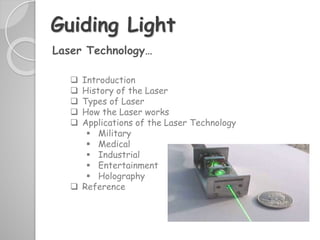

Guiding Light
Laser Technology…
 Introduction
 History of the Laser
 Types of Laser
 How the Laser works
 Applications of the Laser Technology
 Military
 Medical
 Industrial
 Entertainment
 Holography
 Reference
Introduction
In the Beginning There Was Light
Industrial Cutting Tools
CD & DVD Players
Dental Drills
Lasik eye Surgery
Tattoo Removal
Surgical Cutting Tool
Printers
 The laser was developed about fifty years ago.
 Arthur Schawlow and Charles Townes could have had no
possible way of knowing the profound effects.
 Most people don’t recognize that laser technology is
already present as an integral part of our daily lives,
allowing us to listen to CD’s, watch DVD’s, and play
computer games.
 Additionally, lasers are becoming increasingly visible in
medicine in ophthalmologic, cosmetic, and general surgery.
 This presentation focuses on giving the viewer better
insight to the impacts this technology has had on society
as a whole as well as an understanding of the functions
lasers play in our daily lives.
Introduction
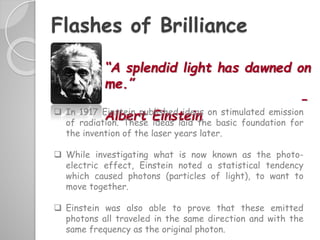
Flashes of Brilliance
“A splendid light has dawned on
me.”
–
Albert Einstein In 1917 Einstein published ideas on stimulated emission
of radiation. These ideas laid the basic foundation for
the invention of the laser years later.
 While investigating what is now known as the photo-
electric effect, Einstein noted a statistical tendency
which caused photons (particles of light), to want to
move together.
 Einstein was also able to prove that these emitted
photons all traveled in the same direction and with the
same frequency as the original photon.
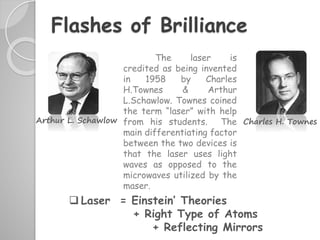
Arthur L. Schawlow Charles H. Townes
The laser is
credited as being invented
in 1958 by Charles
H.Townes & Arthur
L.Schawlow. Townes coined
the term “laser” with help
from his students. The
main differentiating factor
between the two devices is
that the laser uses light
waves as opposed to the
microwaves utilized by the
maser.
 Laser = Einstein’ Theories
+ Right Type of Atoms
+ Reflecting Mirrors
Flashes of Brilliance
Types of Laser Outputs
 Continuous-Wave (CW)
Continuous with respect to time. Higher level must be
long-lived relative to lower level, else the laser is self-
terminating.
 Pulsed (not continuous)
Higher peak powers (kW to > MW). Nanosecond pulse
widths are typical
 Q-Switched
“Giant pulse laser” Spoil the cavity resonance so that the
lasing threshold is greatly exceeded. Then let it out all at
once. Hundreds of MW/pulse achieved.
 Mode-Locked
Picosecond or less laser pulses. Force all longitudinal modes
to be coherent. Generates short (ps or less) and intense
(MW) pulses.
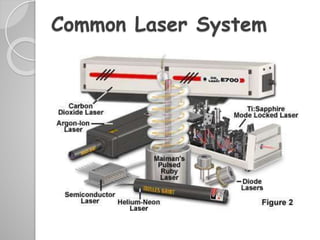
Common Laser System
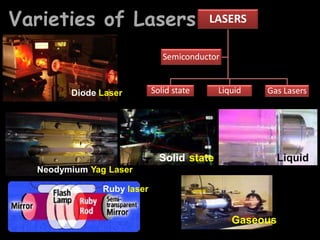
LASERS
Semiconductor
Solid state Liquid Gas LasersDiode Laser
Solid state Liquid
Neodymium Yag Laser
Ruby laser
Gaseous
Varieties of Lasers
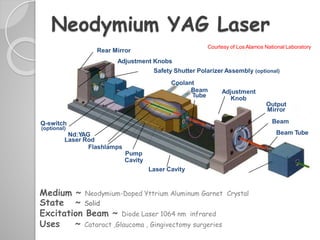
Courtesy of Los Alamos National Laboratory
Rear Mirror
Adjustment Knobs
Safety Shutter Polarizer Assembly (optional)
Coolant
Beam
Tube
Adjustment
Knob
Output
Mirror
Beam
Beam Tube
Q-switch
(optional)
Nd:YAG
Laser Rod
Flashlamps
Pump
Cavity
Laser Cavity
Medium ~ Neodymium-Doped Yttrium Aluminum Garnet Crystal
State ~ Solid
Excitation Beam ~ Diode Laser 1064 nm infrared
Uses ~ Cataract ,Glaucoma , Gingivectomy surgeries
Neodymium YAG Laser
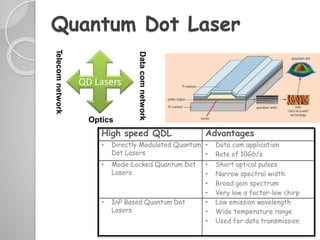
QD Lasers
Optics
Datacomnetwork
Telecomnetwork
High speed QDL Advantages
• Directly Modulated Quantum
Dot Lasers
• Data com application
• Rate of 10Gb/s
• Mode-Locked Quantum Dot
Lasers
• Short optical pulses
• Narrow spectral width
• Broad gain spectrum
• Very low α factor-low chirp
• InP Based Quantum Dot
Lasers
• Low emission wavelength
• Wide temperature range
• Used for data transmission
Quantum Dot Laser
Varieties of Lasers
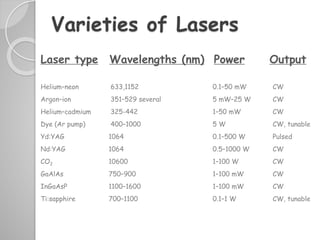
Laser type Wavelengths (nm) Power Output
Helium–neon 633,1152 0.1–50 mW CW
Argon–ion 351–529 several 5 mW–25 W CW
Helium–cadmium 325-442 1–50 mW CW
Dye (Ar pump) 400–1000 5 W CW, tunable
Yd:YAG 1064 0.1–500 W Pulsed
Nd:YAG 1064 0.5–1000 W CW
CO2 10600 1–100 W CW
GaAlAs 750–900 1–100 mW CW
InGaAsP 1100–1600 1–100 mW CW
Ti:sapphire 700–1100 0.1–1 W CW, tunable
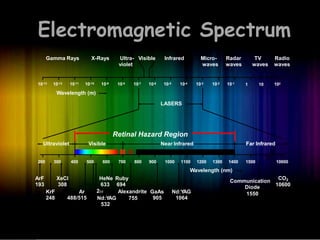
Gamma Rays X-Rays Ultra- Visible
violet
Infrared Micro-
waves
Radar
waves
TV
waves
Radio
waves
10-13 10-12 10-11 10-10 10-9 10-8 10-7 10-6 10-5 10-4 10-3 10-2 10-1 1021 10
Wavelength (m)
LASERS
Far Infrared
200 300 400 500 600 700 800 900 1000 1100 1200 1300 1400 1500 10600
Wavelength (nm)
ArF
193
XeCl
308
HeNe
633
2
Ruby
694
Alexandrite
CO2
10600
Communication
Diode
1550KrF
248
Ar
488/515
GaAs
905
Nd:YAG
1064Nd:YAG
532
755
Ultraviolet
Retinal Hazard Region
Far InfrarVisible Near Infrared
Electromagnetic Spectrum
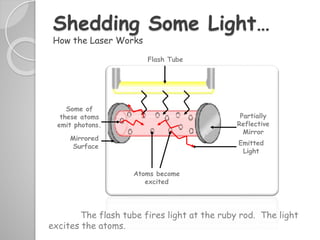
Shedding Some Light…
How the Laser Works
Flash Tube
Partially
Reflective
Mirror
Mirrored
Surface
Atoms become
excited
The flash tube fires light at the ruby rod. The light
excites the atoms.
Emitted
Light
Some of
these atoms
emit photons.
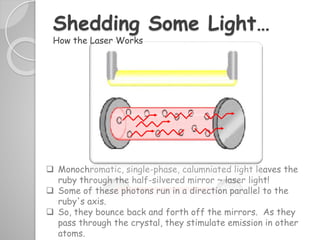
 Monochromatic, single-phase, calumniated light leaves the
ruby through the half-silvered mirror ~ laser light!
 Some of these photons run in a direction parallel to the
ruby's axis.
 So, they bounce back and forth off the mirrors. As they
pass through the crystal, they stimulate emission in other
atoms.
Shedding Some Light…
How the Laser Works
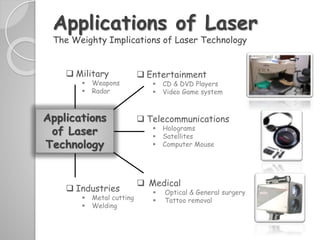
Applications of Laser
The Weighty Implications of Laser Technology
Applications
of Laser
Technology
 Medical
 Optical & General surgery
 Tattoo removal
 Military
 Weapons
 Radar
 Entertainment
 CD & DVD Players
 Video Game system
 Telecommunications
 Holograms
 Satellites
 Computer Mouse
 Industries
 Metal cutting
 Welding
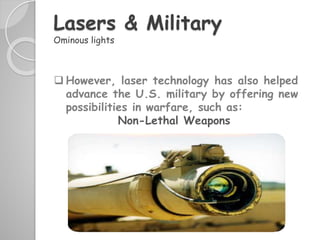
 However, laser technology has also helped
advance the U.S. military by offering new
possibilities in warfare, such as:
Non-Lethal Weapons
Lasers & Military
Ominous lights
 The Reagan Star-Wars era program did much to initially
support laser weapons research, resulting in many of
today’s military advancements.
 Optical Guidance, Night Vision & Thermal homing missiles
 Lasers are used to drive fusion machines fueling
thermonuclear explosions and used in most nuclear devices.
 The most potent and deadly application of laser technology
is the Space Based Laser.
 As tensions over the growing arsenals of nations grow,
arms agreements have done little to slow down the
development of these technologies.
Lasers & Military
Ominous lights
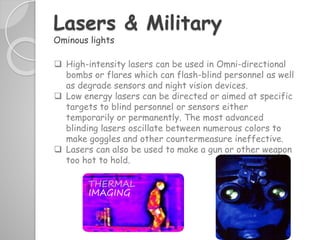
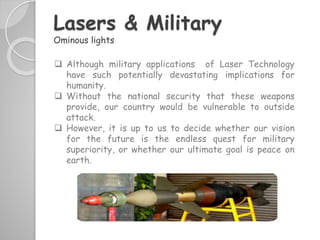
 High-intensity lasers can be used in Omni-directional
bombs or flares which can flash-blind personnel as well
as degrade sensors and night vision devices.
 Low energy lasers can be directed or aimed at specific
targets to blind personnel or sensors either
temporarily or permanently. The most advanced
blinding lasers oscillate between numerous colors to
make goggles and other countermeasure ineffective.
 Lasers can also be used to make a gun or other weapon
too hot to hold.
Lasers & Military
Ominous lights
THERMAL
IMAGING
 Although military applications of Laser Technology
have such potentially devastating implications for
humanity.
 Without the national security that these weapons
provide, our country would be vulnerable to outside
attack.
 However, it is up to us to decide whether our vision
for the future is the endless quest for military
superiority, or whether our ultimate goal is peace on
earth.
Lasers & Military
Ominous lights
 Advantages for the Laser as a Medical Cutting Tool
 The laser is extremely precise, and can be tuned to
work on a micro-level, barely visible to the human eye.
 Reduces pain & trauma for the patient.
 Lasers can be inserted inside the body with little risk
or discomfort.
 Certain conditions which were once inoperable due to
the accuracy of incisions necessary are now possible.
 Incisions can be guided by computers.
 Speeds healing – thereby shortening costly hospital
stays.
 compact lasers can be inserted inside the body with
little risk or discomfort, going places and performing
surgeries that were not humanly possible before.
Lasers & Medicine
Going where no man has gone before
Lasers & Medicine
Going where no man has gone before
 Advantages for the Laser as a
Medical Cutting Tool
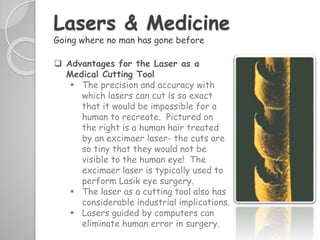
 The precision and accuracy with
which lasers can cut is so exact
that it would be impossible for a
human to recreate. Pictured on
the right is a human hair treated
by an excimaer laser- the cuts are
so tiny that they would not be
visible to the human eye! The
excimaer laser is typically used to
perform Lasik eye surgery.
 The laser as a cutting tool also has
considerable industrial implications.
 Lasers guided by computers can
eliminate human error in surgery.
Lasers & Medicine
Going where no man has gone before
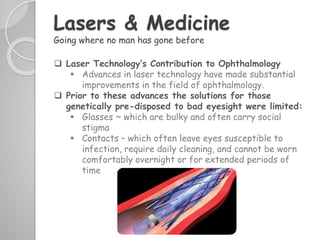
 Laser Technology’s Contribution to Ophthalmology
 Advances in laser technology have made substantial
improvements in the field of ophthalmology.
 Prior to these advances the solutions for those
genetically pre-disposed to bad eyesight were limited:
 Glasses ~ which are bulky and often carry social
stigma
 Contacts – which often leave eyes susceptible to
infection, require daily cleaning, and cannot be worn
comfortably overnight or for extended periods of
time
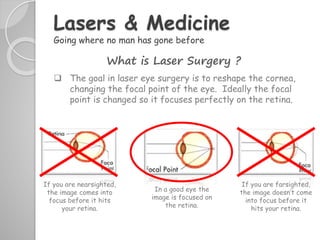
What is Laser Surgery ?
 The goal in laser eye surgery is to reshape the cornea,
changing the focal point of the eye. Ideally the focal
point is changed so it focuses perfectly on the retina.
Lasers & Medicine
Going where no man has gone before
If you are nearsighted,
the image comes into
focus before it hits
your retina.
If you are farsighted,
the image doesn’t come
into focus before it
hits your retina.
In a good eye the
image is focused on
the retina.
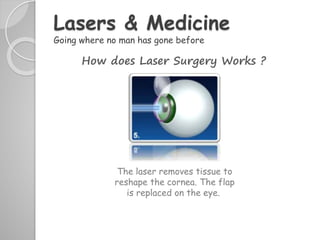
After applying anesthetizing
drops, the surgeon marks the
eye to indicate where the flap
will be cut and then replaced.
A suction ring holds the eye
still and pressurizes it so
it is firm enough to cut.
The microkeratome slices a
tiny flap in the cornea.
The flap is moved out of the
way, but it is still attached.
The laser removes tissue to
reshape the cornea. The flap
is replaced on the eye.
Lasers & Medicine
Going where no man has gone before
How does Laser Surgery Works ?
Lasers & Industry
Something Heavy
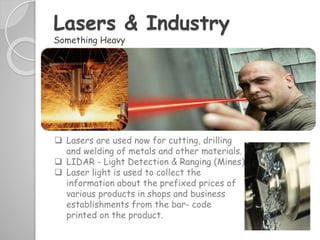
 Lasers are used now for cutting, drilling
and welding of metals and other materials.
 LIDAR - Light Detection & Ranging (Mines)
 Laser light is used to collect the
information about the prefixed prices of
various products in shops and business
establishments from the bar- code
printed on the product.
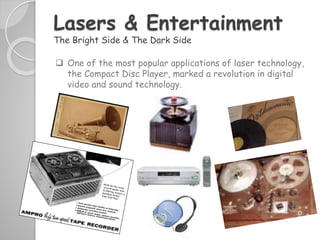
 One of the most popular applications of laser technology,
the Compact Disc Player, marked a revolution in digital
video and sound technology.
Lasers & Entertainment
The Bright Side & The Dark Side
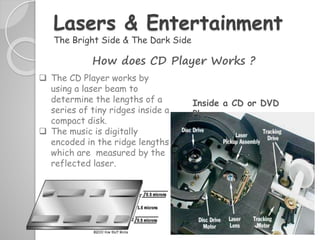
 The CD Player works by
using a laser beam to
determine the lengths of a
series of tiny ridges inside a
compact disk.
 The music is digitally
encoded in the ridge lengths
which are measured by the
reflected laser.
Lasers & Entertainment
The Bright Side & The Dark Side
How does CD Player Works ?
Inside a CD or DVD
Player
Lasers & Holography
Production of Holo things
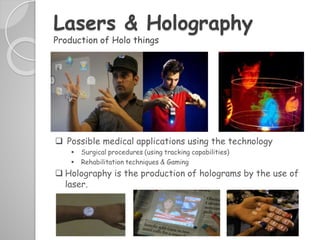
 Possible medical applications using the technology
 Surgical procedures (using tracking capabilities)
 Rehabilitation techniques & Gaming
 Holography is the production of holograms by the use of
laser.
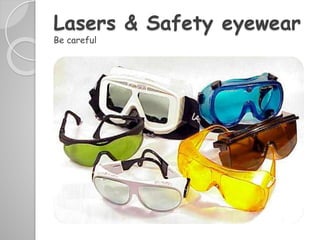
Lasers & Safety eyewear
Be careful
Reference
 How Stuff Works (howstuffworks.com)
 Wikipedia (wikipedia.org)
 Principle of Physics (Book by Dr. Serway)
Laser & it's applications

Laser & it's applications

  • 3.
    Guiding Light Laser Technology… Introduction  History of the Laser  Types of Laser  How the Laser works  Applications of the Laser Technology  Military  Medical  Industrial  Entertainment  Holography  Reference
  • 4.
    Introduction In the BeginningThere Was Light Industrial Cutting Tools CD & DVD Players Dental Drills Lasik eye Surgery Tattoo Removal Surgical Cutting Tool Printers
  • 5.
     The laserwas developed about fifty years ago.  Arthur Schawlow and Charles Townes could have had no possible way of knowing the profound effects.  Most people don’t recognize that laser technology is already present as an integral part of our daily lives, allowing us to listen to CD’s, watch DVD’s, and play computer games.  Additionally, lasers are becoming increasingly visible in medicine in ophthalmologic, cosmetic, and general surgery.  This presentation focuses on giving the viewer better insight to the impacts this technology has had on society as a whole as well as an understanding of the functions lasers play in our daily lives. Introduction
  • 6.
    Flashes of Brilliance “Asplendid light has dawned on me.” – Albert Einstein In 1917 Einstein published ideas on stimulated emission of radiation. These ideas laid the basic foundation for the invention of the laser years later.  While investigating what is now known as the photo- electric effect, Einstein noted a statistical tendency which caused photons (particles of light), to want to move together.  Einstein was also able to prove that these emitted photons all traveled in the same direction and with the same frequency as the original photon.
  • 7.
    Arthur L. SchawlowCharles H. Townes The laser is credited as being invented in 1958 by Charles H.Townes & Arthur L.Schawlow. Townes coined the term “laser” with help from his students. The main differentiating factor between the two devices is that the laser uses light waves as opposed to the microwaves utilized by the maser.  Laser = Einstein’ Theories + Right Type of Atoms + Reflecting Mirrors Flashes of Brilliance
  • 8.
    Types of LaserOutputs  Continuous-Wave (CW) Continuous with respect to time. Higher level must be long-lived relative to lower level, else the laser is self- terminating.  Pulsed (not continuous) Higher peak powers (kW to > MW). Nanosecond pulse widths are typical  Q-Switched “Giant pulse laser” Spoil the cavity resonance so that the lasing threshold is greatly exceeded. Then let it out all at once. Hundreds of MW/pulse achieved.  Mode-Locked Picosecond or less laser pulses. Force all longitudinal modes to be coherent. Generates short (ps or less) and intense (MW) pulses.
  • 9.
  • 10.
    LASERS Semiconductor Solid state LiquidGas LasersDiode Laser Solid state Liquid Neodymium Yag Laser Ruby laser Gaseous Varieties of Lasers
  • 11.
    Courtesy of LosAlamos National Laboratory Rear Mirror Adjustment Knobs Safety Shutter Polarizer Assembly (optional) Coolant Beam Tube Adjustment Knob Output Mirror Beam Beam Tube Q-switch (optional) Nd:YAG Laser Rod Flashlamps Pump Cavity Laser Cavity Medium ~ Neodymium-Doped Yttrium Aluminum Garnet Crystal State ~ Solid Excitation Beam ~ Diode Laser 1064 nm infrared Uses ~ Cataract ,Glaucoma , Gingivectomy surgeries Neodymium YAG Laser
  • 12.
    QD Lasers Optics Datacomnetwork Telecomnetwork High speedQDL Advantages • Directly Modulated Quantum Dot Lasers • Data com application • Rate of 10Gb/s • Mode-Locked Quantum Dot Lasers • Short optical pulses • Narrow spectral width • Broad gain spectrum • Very low α factor-low chirp • InP Based Quantum Dot Lasers • Low emission wavelength • Wide temperature range • Used for data transmission Quantum Dot Laser
  • 13.
    Varieties of Lasers Lasertype Wavelengths (nm) Power Output Helium–neon 633,1152 0.1–50 mW CW Argon–ion 351–529 several 5 mW–25 W CW Helium–cadmium 325-442 1–50 mW CW Dye (Ar pump) 400–1000 5 W CW, tunable Yd:YAG 1064 0.1–500 W Pulsed Nd:YAG 1064 0.5–1000 W CW CO2 10600 1–100 W CW GaAlAs 750–900 1–100 mW CW InGaAsP 1100–1600 1–100 mW CW Ti:sapphire 700–1100 0.1–1 W CW, tunable
  • 14.
    Gamma Rays X-RaysUltra- Visible violet Infrared Micro- waves Radar waves TV waves Radio waves 10-13 10-12 10-11 10-10 10-9 10-8 10-7 10-6 10-5 10-4 10-3 10-2 10-1 1021 10 Wavelength (m) LASERS Far Infrared 200 300 400 500 600 700 800 900 1000 1100 1200 1300 1400 1500 10600 Wavelength (nm) ArF 193 XeCl 308 HeNe 633 2 Ruby 694 Alexandrite CO2 10600 Communication Diode 1550KrF 248 Ar 488/515 GaAs 905 Nd:YAG 1064Nd:YAG 532 755 Ultraviolet Retinal Hazard Region Far InfrarVisible Near Infrared Electromagnetic Spectrum
  • 15.
    Shedding Some Light… Howthe Laser Works Flash Tube Partially Reflective Mirror Mirrored Surface Atoms become excited The flash tube fires light at the ruby rod. The light excites the atoms. Emitted Light Some of these atoms emit photons.
  • 16.
     Monochromatic, single-phase,calumniated light leaves the ruby through the half-silvered mirror ~ laser light!  Some of these photons run in a direction parallel to the ruby's axis.  So, they bounce back and forth off the mirrors. As they pass through the crystal, they stimulate emission in other atoms. Shedding Some Light… How the Laser Works
  • 17.
    Applications of Laser TheWeighty Implications of Laser Technology Applications of Laser Technology  Medical  Optical & General surgery  Tattoo removal  Military  Weapons  Radar  Entertainment  CD & DVD Players  Video Game system  Telecommunications  Holograms  Satellites  Computer Mouse  Industries  Metal cutting  Welding
  • 18.
     However, lasertechnology has also helped advance the U.S. military by offering new possibilities in warfare, such as: Non-Lethal Weapons Lasers & Military Ominous lights
  • 19.
     The ReaganStar-Wars era program did much to initially support laser weapons research, resulting in many of today’s military advancements.  Optical Guidance, Night Vision & Thermal homing missiles  Lasers are used to drive fusion machines fueling thermonuclear explosions and used in most nuclear devices.  The most potent and deadly application of laser technology is the Space Based Laser.  As tensions over the growing arsenals of nations grow, arms agreements have done little to slow down the development of these technologies. Lasers & Military Ominous lights
  • 20.
     High-intensity laserscan be used in Omni-directional bombs or flares which can flash-blind personnel as well as degrade sensors and night vision devices.  Low energy lasers can be directed or aimed at specific targets to blind personnel or sensors either temporarily or permanently. The most advanced blinding lasers oscillate between numerous colors to make goggles and other countermeasure ineffective.  Lasers can also be used to make a gun or other weapon too hot to hold. Lasers & Military Ominous lights THERMAL IMAGING
  • 21.
     Although militaryapplications of Laser Technology have such potentially devastating implications for humanity.  Without the national security that these weapons provide, our country would be vulnerable to outside attack.  However, it is up to us to decide whether our vision for the future is the endless quest for military superiority, or whether our ultimate goal is peace on earth. Lasers & Military Ominous lights
  • 22.
     Advantages forthe Laser as a Medical Cutting Tool  The laser is extremely precise, and can be tuned to work on a micro-level, barely visible to the human eye.  Reduces pain & trauma for the patient.  Lasers can be inserted inside the body with little risk or discomfort.  Certain conditions which were once inoperable due to the accuracy of incisions necessary are now possible.  Incisions can be guided by computers.  Speeds healing – thereby shortening costly hospital stays.  compact lasers can be inserted inside the body with little risk or discomfort, going places and performing surgeries that were not humanly possible before. Lasers & Medicine Going where no man has gone before
  • 23.
    Lasers & Medicine Goingwhere no man has gone before  Advantages for the Laser as a Medical Cutting Tool  The precision and accuracy with which lasers can cut is so exact that it would be impossible for a human to recreate. Pictured on the right is a human hair treated by an excimaer laser- the cuts are so tiny that they would not be visible to the human eye! The excimaer laser is typically used to perform Lasik eye surgery.  The laser as a cutting tool also has considerable industrial implications.  Lasers guided by computers can eliminate human error in surgery.
  • 24.
    Lasers & Medicine Goingwhere no man has gone before  Laser Technology’s Contribution to Ophthalmology  Advances in laser technology have made substantial improvements in the field of ophthalmology.  Prior to these advances the solutions for those genetically pre-disposed to bad eyesight were limited:  Glasses ~ which are bulky and often carry social stigma  Contacts – which often leave eyes susceptible to infection, require daily cleaning, and cannot be worn comfortably overnight or for extended periods of time
  • 25.
    What is LaserSurgery ?  The goal in laser eye surgery is to reshape the cornea, changing the focal point of the eye. Ideally the focal point is changed so it focuses perfectly on the retina. Lasers & Medicine Going where no man has gone before If you are nearsighted, the image comes into focus before it hits your retina. If you are farsighted, the image doesn’t come into focus before it hits your retina. In a good eye the image is focused on the retina.
  • 26.
    After applying anesthetizing drops,the surgeon marks the eye to indicate where the flap will be cut and then replaced. A suction ring holds the eye still and pressurizes it so it is firm enough to cut. The microkeratome slices a tiny flap in the cornea. The flap is moved out of the way, but it is still attached. The laser removes tissue to reshape the cornea. The flap is replaced on the eye. Lasers & Medicine Going where no man has gone before How does Laser Surgery Works ?
  • 27.
    Lasers & Industry SomethingHeavy  Lasers are used now for cutting, drilling and welding of metals and other materials.  LIDAR - Light Detection & Ranging (Mines)  Laser light is used to collect the information about the prefixed prices of various products in shops and business establishments from the bar- code printed on the product.
  • 28.
     One ofthe most popular applications of laser technology, the Compact Disc Player, marked a revolution in digital video and sound technology. Lasers & Entertainment The Bright Side & The Dark Side
  • 29.
     The CDPlayer works by using a laser beam to determine the lengths of a series of tiny ridges inside a compact disk.  The music is digitally encoded in the ridge lengths which are measured by the reflected laser. Lasers & Entertainment The Bright Side & The Dark Side How does CD Player Works ? Inside a CD or DVD Player
  • 30.
    Lasers & Holography Productionof Holo things  Possible medical applications using the technology  Surgical procedures (using tracking capabilities)  Rehabilitation techniques & Gaming  Holography is the production of holograms by the use of laser.
  • 31.
    Lasers & Safetyeyewear Be careful
  • 32.
    Reference  How StuffWorks (howstuffworks.com)  Wikipedia (wikipedia.org)  Principle of Physics (Book by Dr. Serway)