Wind Turbine
Blade Design
Joseph RandJoseph Rand
The Kidwind ProjectThe Kidwind Project
joe@kidwind.orgjoe@kidwind.org
877-917-0079877-917-0079
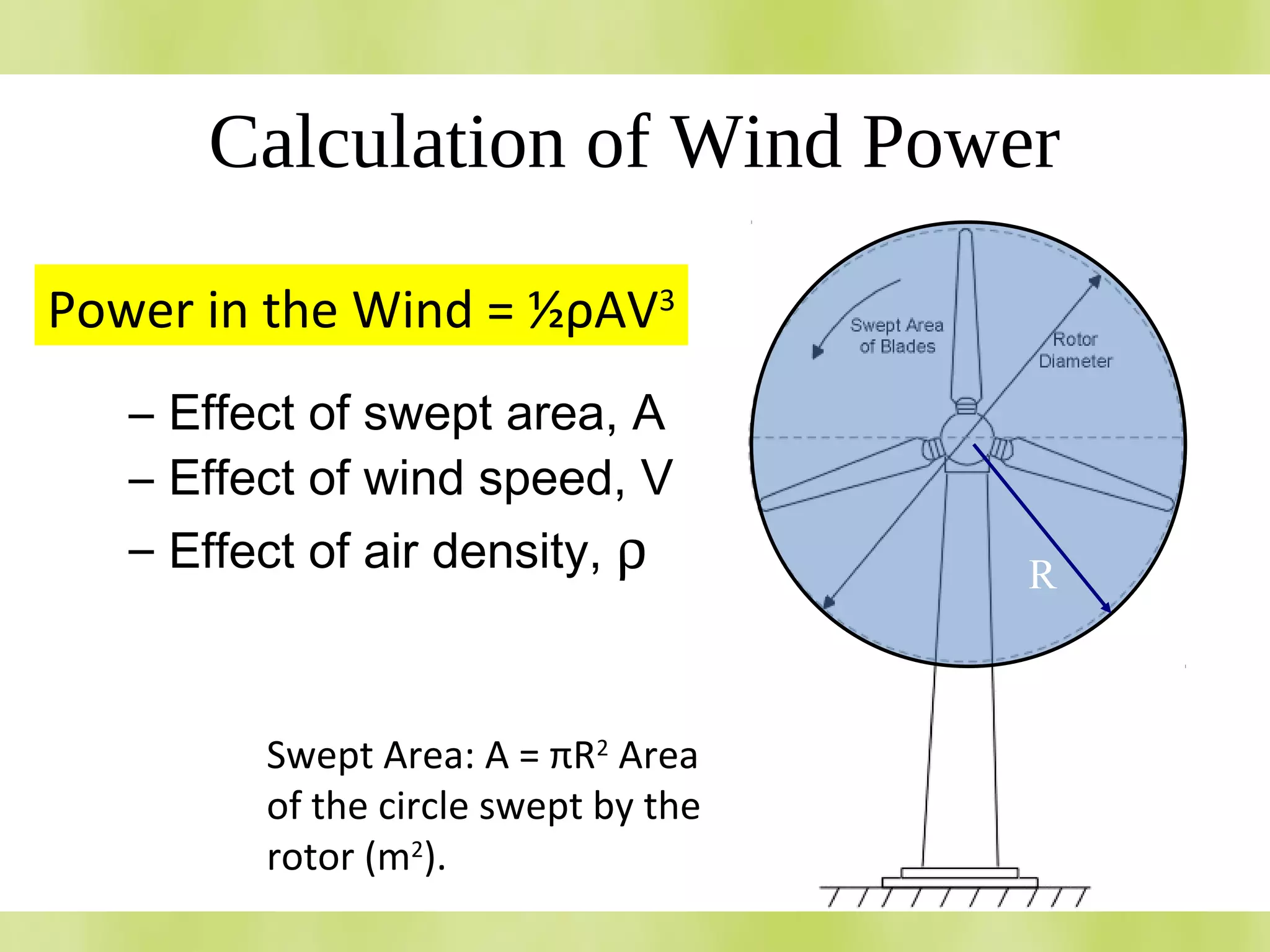
Calculation of Wind Power
•Power in the windPower in the wind
– Effect of swept area, A
– Effect of wind speed, V
– Effect of air density, ρ R
Swept Area: A = πR2
Area
of the circle swept by the
rotor (m2
).
Power in the Wind = ½ρAV3
Many Different Rotors…
KidWind Project | www.kidwind.org
Number of Blades – One
• Rotor must move more
rapidly to capture same
amount of wind
– Gearbox ratio reduced
– Added weight of
counterbalance negates
some benefits of lighter
design
– Higher speed means more
noise, visual, and wildlife
impacts
• Blades easier to install
because entire rotor can be
assembled on ground
• Captures 10% less energy
than two blade design
• Ultimately provide no cost
savings
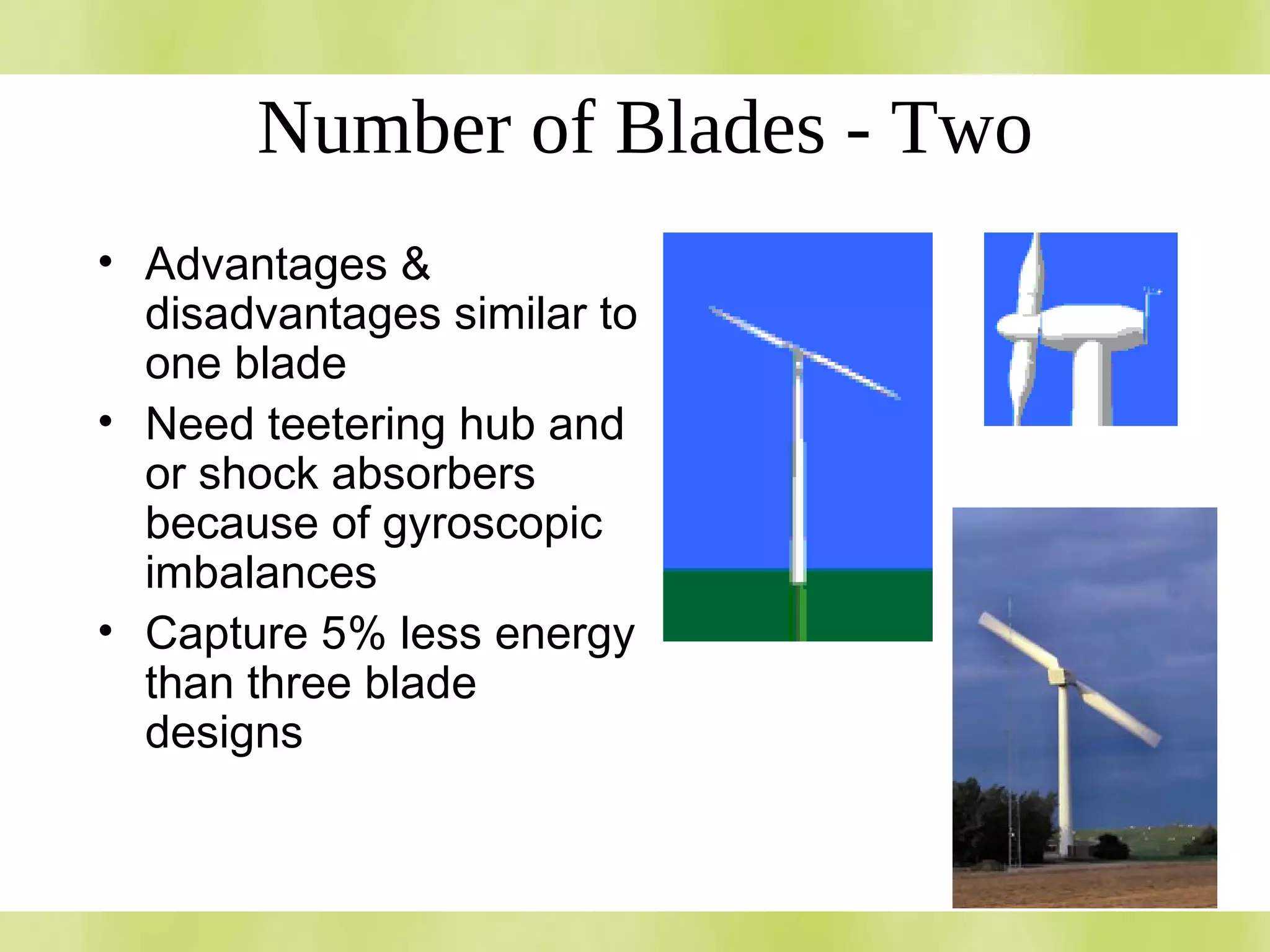
Number of Blades - Two
• Advantages &
disadvantages similar to
one blade
• Need teetering hub and
or shock absorbers
because of gyroscopic
imbalances
• Capture 5% less energy
than three blade
designs
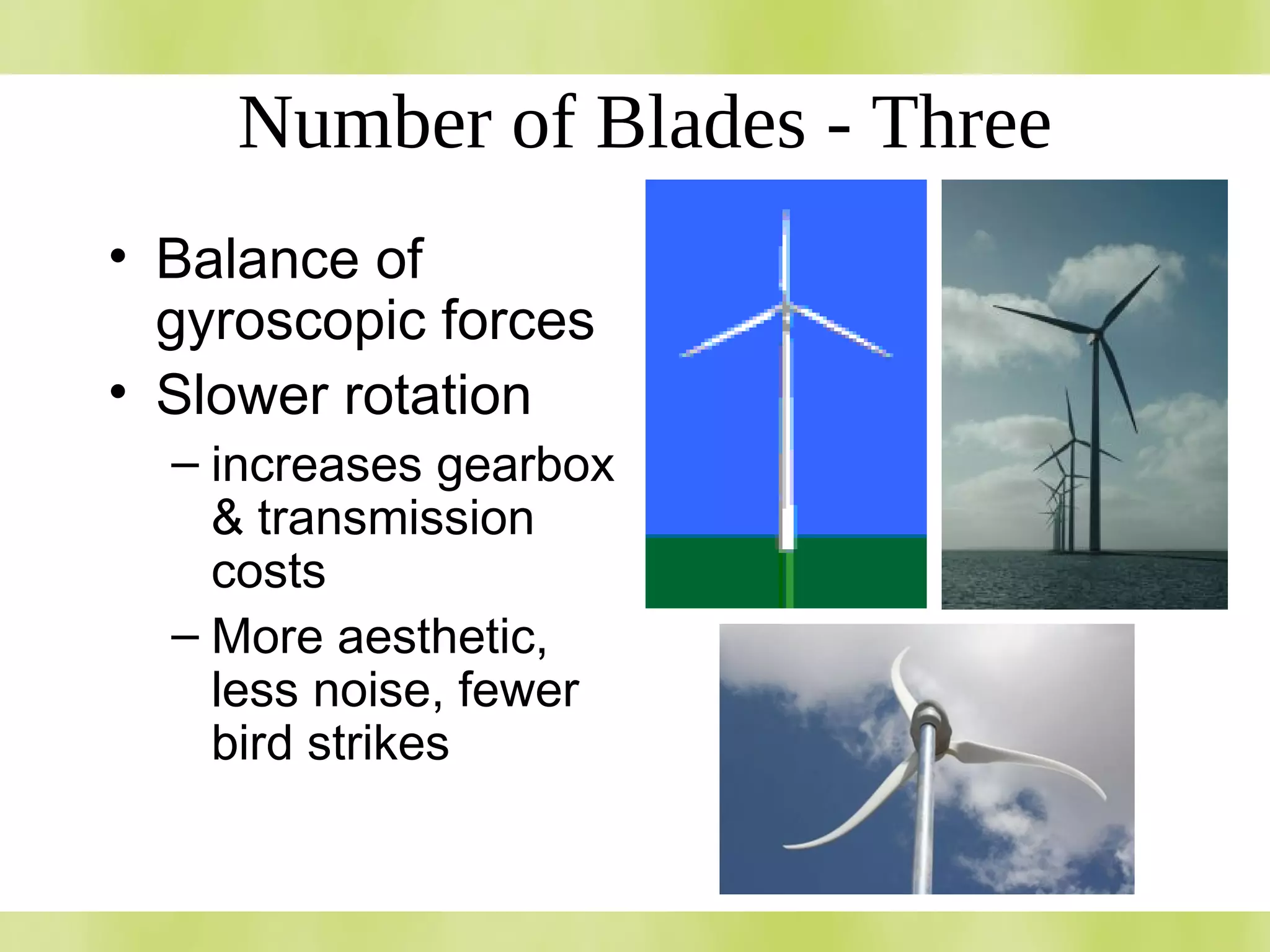
Number of Blades - Three
• Balance of
gyroscopic forces
• Slower rotation
– increases gearbox
& transmission
costs
– More aesthetic,
less noise, fewer
bird strikes
Blade Composition
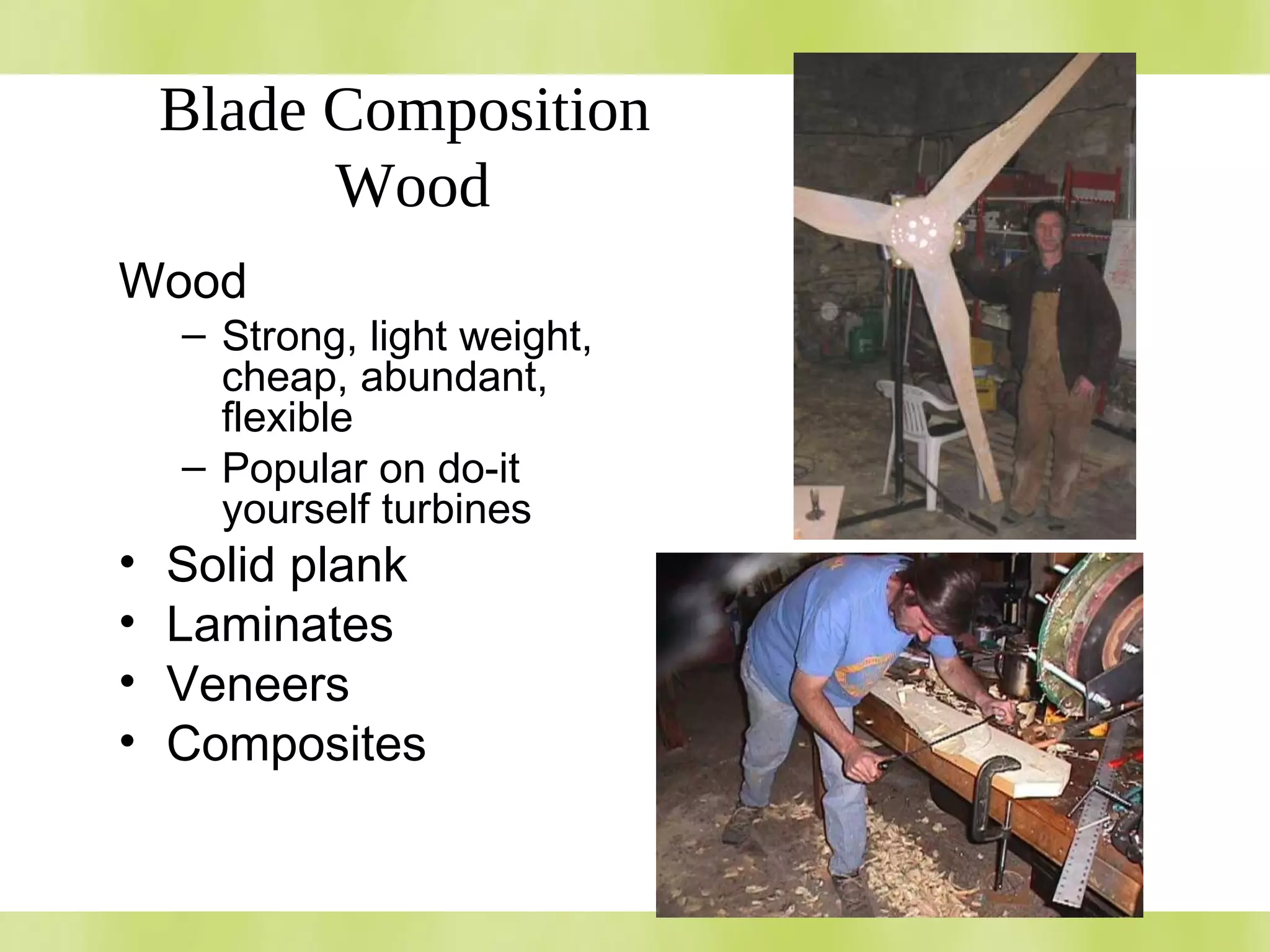
Wood
Wood
– Strong, light weight,
cheap, abundant,
flexible
– Popular on do-it
yourself turbines
• Solid plank
• Laminates
• Veneers
• Composites
Blade Composition
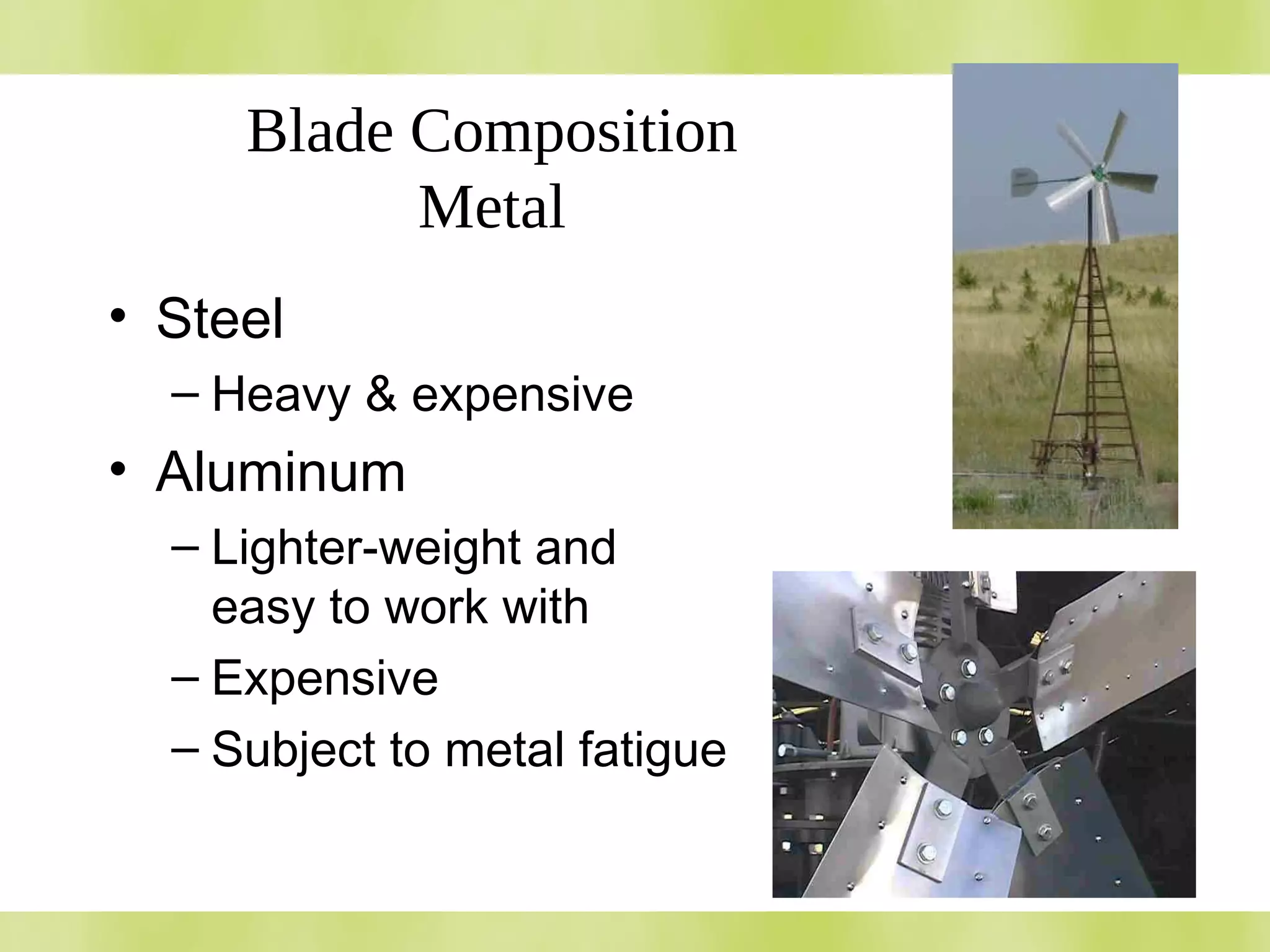
Metal
• Steel
– Heavy & expensive
• Aluminum
– Lighter-weight and
easy to work with
– Expensive
– Subject to metal fatigue
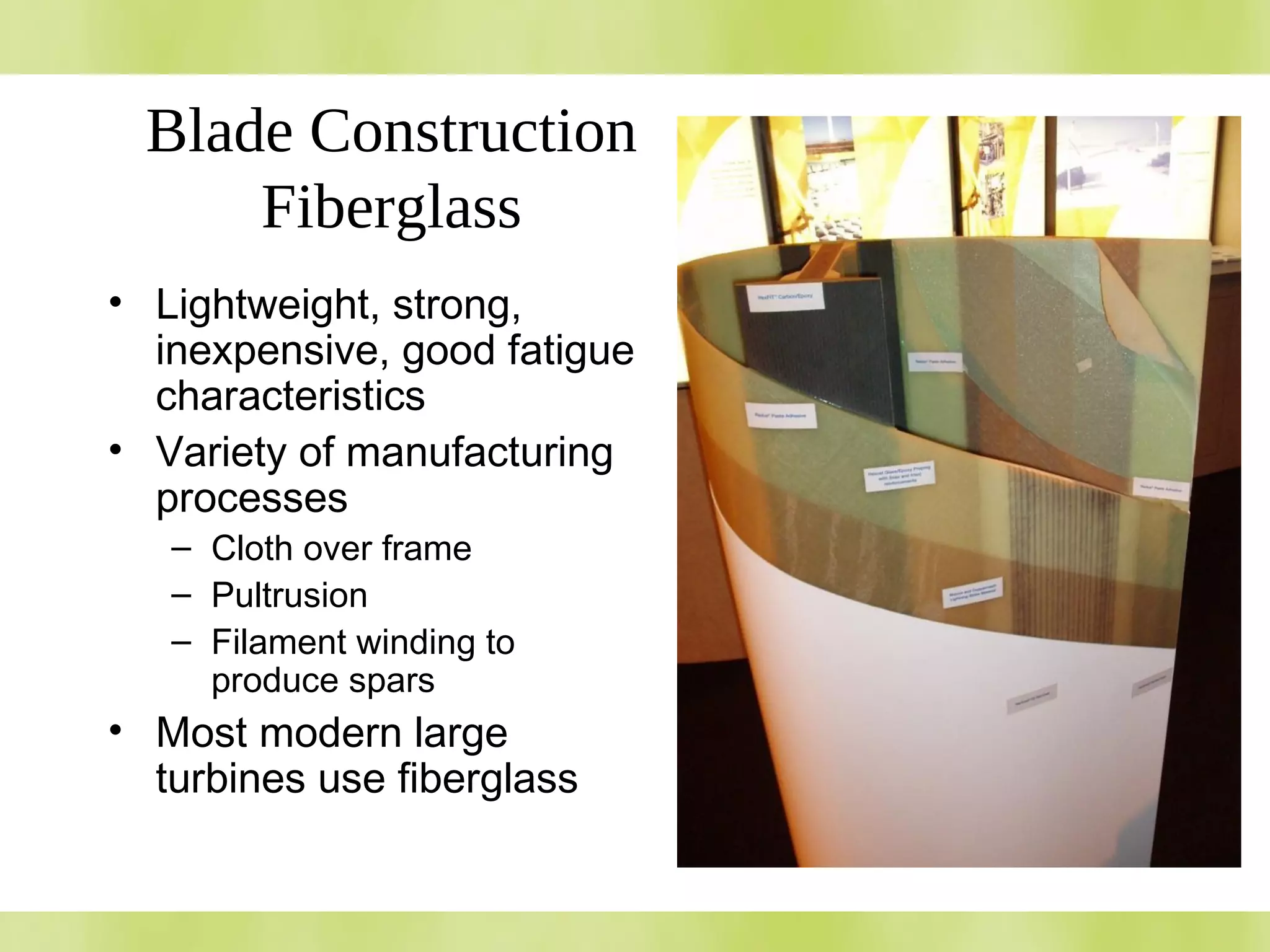
Blade Construction
Fiberglass
• Lightweight, strong,
inexpensive, good fatigue
characteristics
• Variety of manufacturing
processes
– Cloth over frame
– Pultrusion
– Filament winding to
produce spars
• Most modern large
turbines use fiberglass
KidWind Project | www.kidwind.org
Lift & Drag Forces
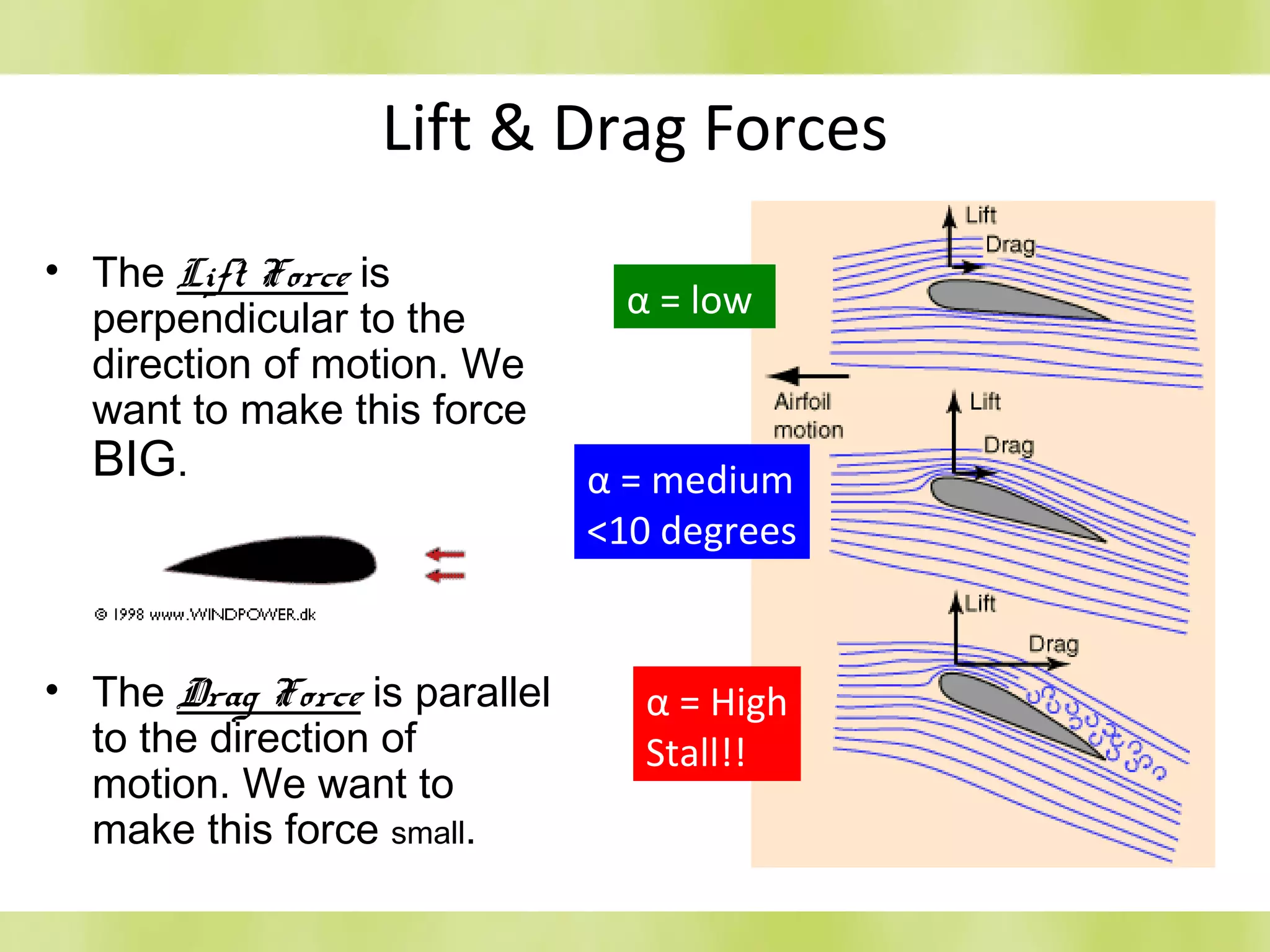
• The Lift Force is
perpendicular to the
direction of motion. We
want to make this force
BIG.
• The Drag Force is parallel
to the direction of
motion. We want to
make this force small.
α = low
α = medium
<10 degrees
α = High
Stall!!
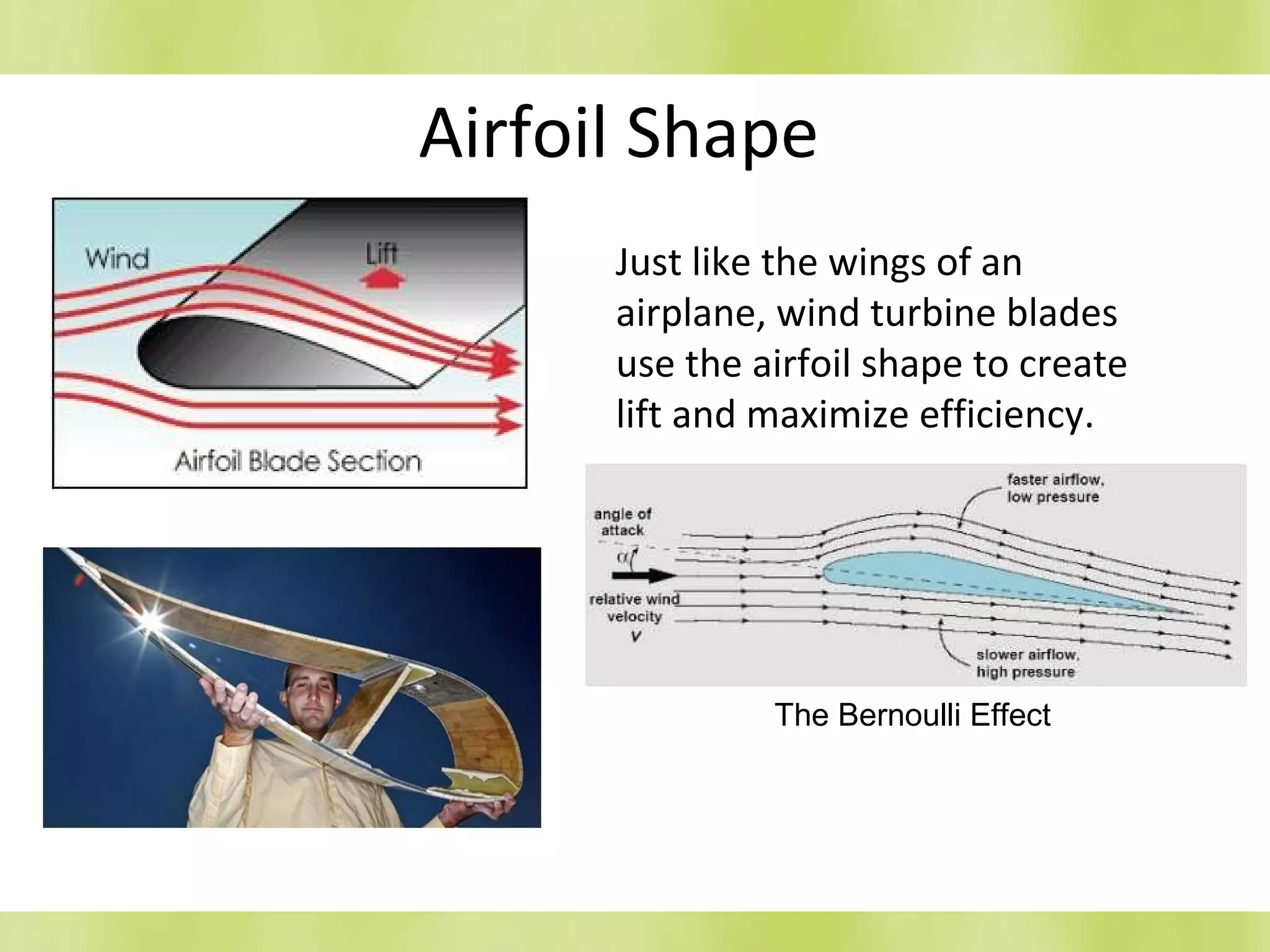
Airfoil Shape
Just like the wings of an
airplane, wind turbine blades
use the airfoil shape to create
lift and maximize efficiency.
The Bernoulli Effect
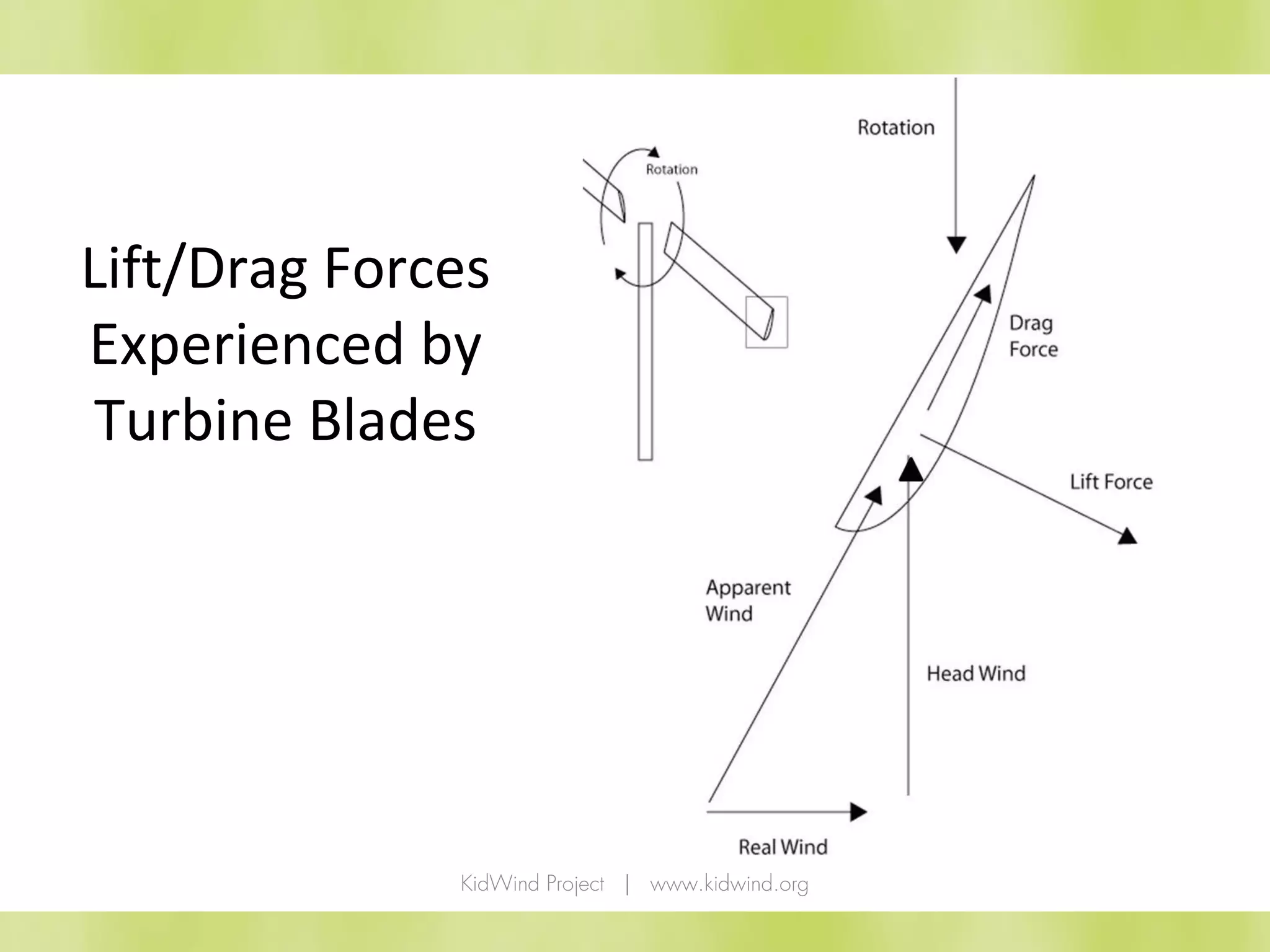
Lift/Drag Forces
Experienced by
Turbine Blades
KidWind Project | www.kidwind.org
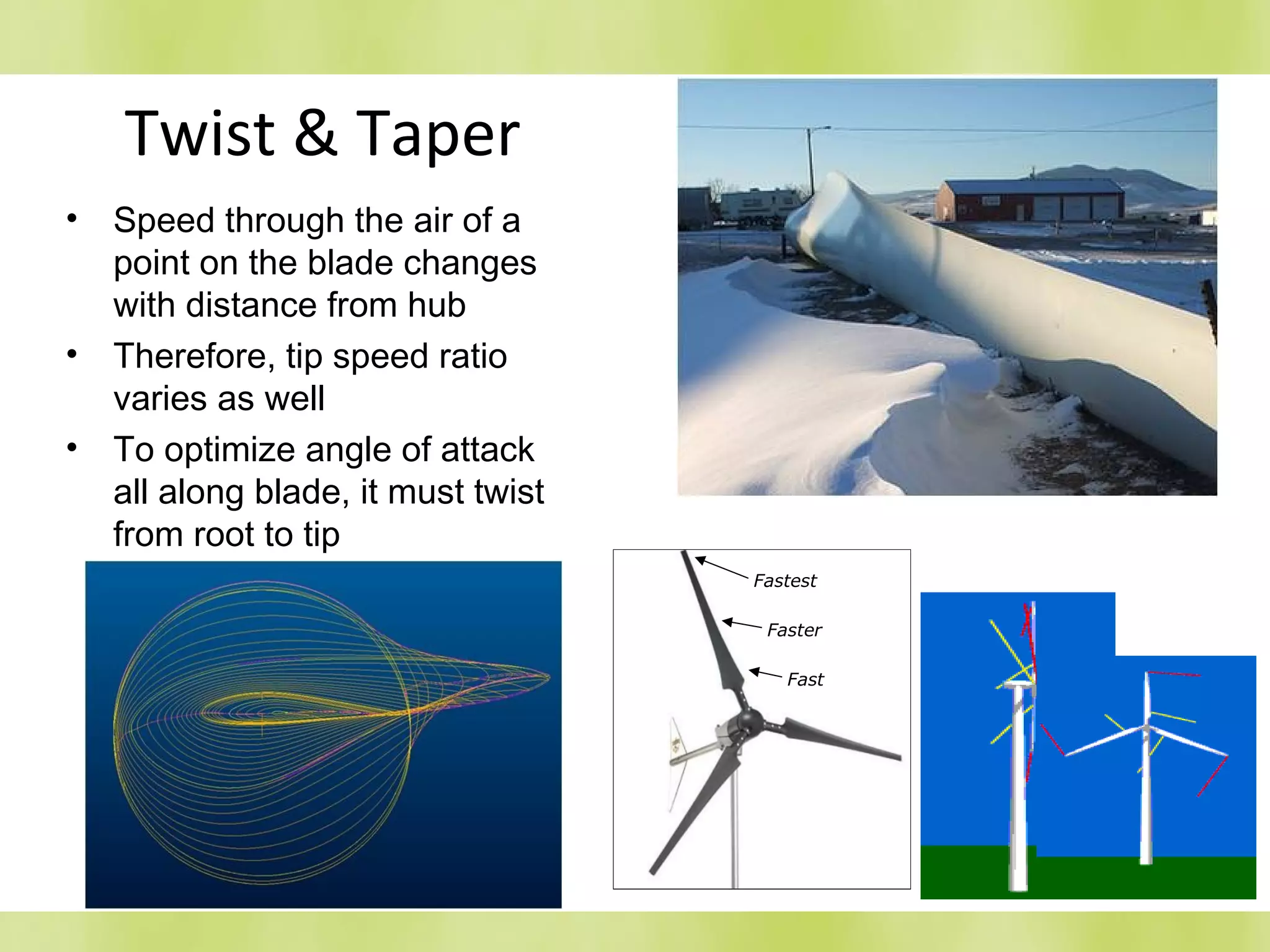
Twist & Taper
• Speed through the air of a
point on the blade changes
with distance from hub
• Therefore, tip speed ratio
varies as well
• To optimize angle of attack
all along blade, it must twist
from root to tip
Fast
Faster
Fastest
Tip-Speed Ratio
Tip-speed ratio is the ratio of the
speed of the rotating blade tip to
the speed of the free stream wind.
There is an optimum angle of attack
which creates the highest lift to
drag ratio.
Because angle of attack is
dependant on wind speed, there is
an optimum tip-speed ratio
ΩR
V
TSR =
Where,
Ω = rotational speed in radians /sec
R = Rotor Radius
V = Wind “Free Stream” Velocity
ΩR
R
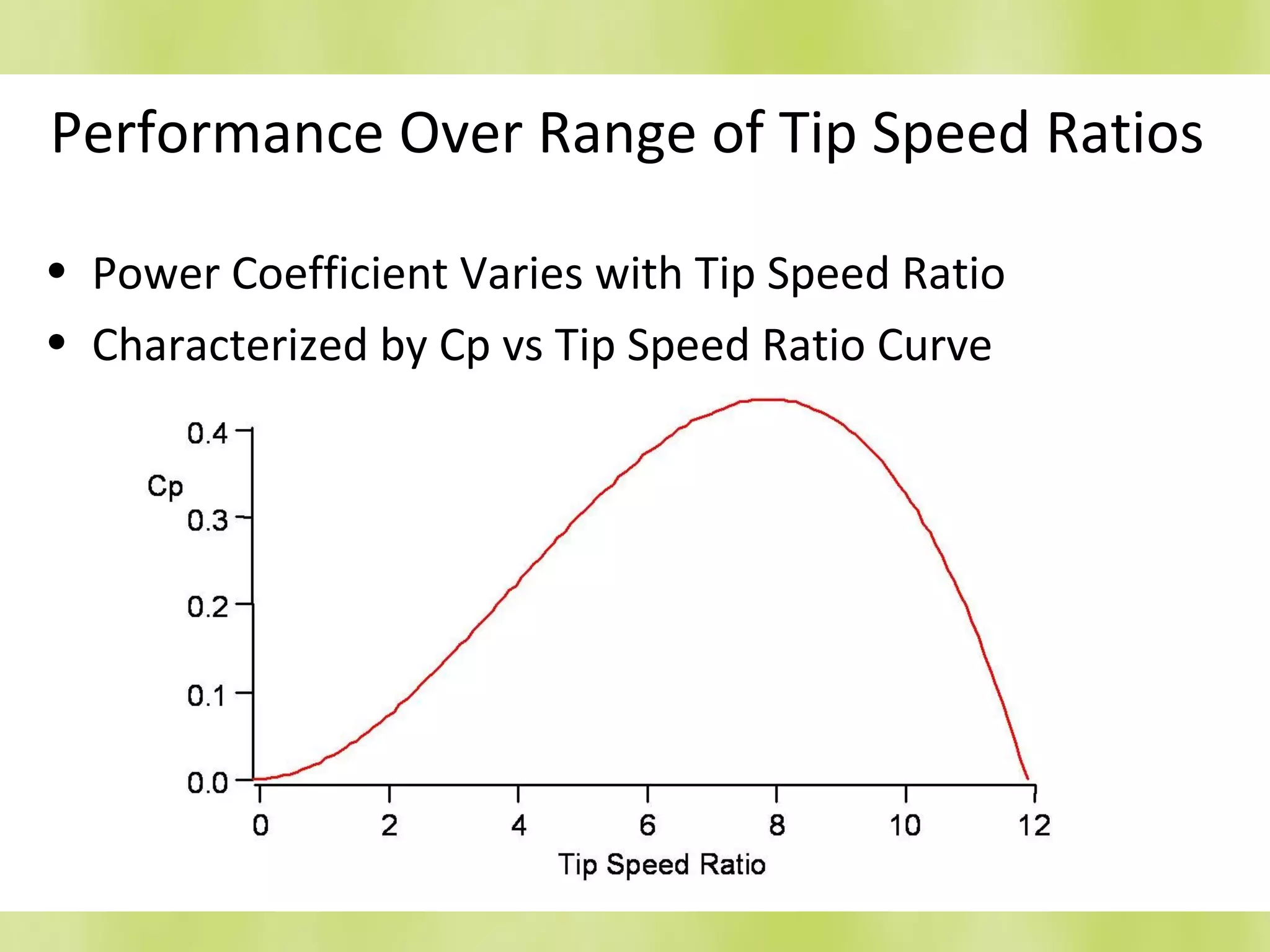
Performance Over Range of Tip Speed Ratios
• Power Coefficient Varies with Tip Speed Ratio
• Characterized by Cp vs Tip Speed Ratio Curve
Betz Limit
All wind power cannot be
captured by rotor or air
would be completely still
behind rotor and not
allow more wind to pass
through.
Theoretical limit of rotor
efficiency is 59%
Most modern wind turbines
are in the 35 – 45% range
Rotor Solidity
Solidity is the ratio of total rotor
planform area to total swept area
Low solidity (0.10) = high speed, low torque
High solidity (>0.80) = low speed, high torque
A
R
a
Solidity = 3a/A
KidWind Project | www.kidwind.org
Pitch Control Mechanisms
Some Wacky Ideas…
Manufacturing Blades
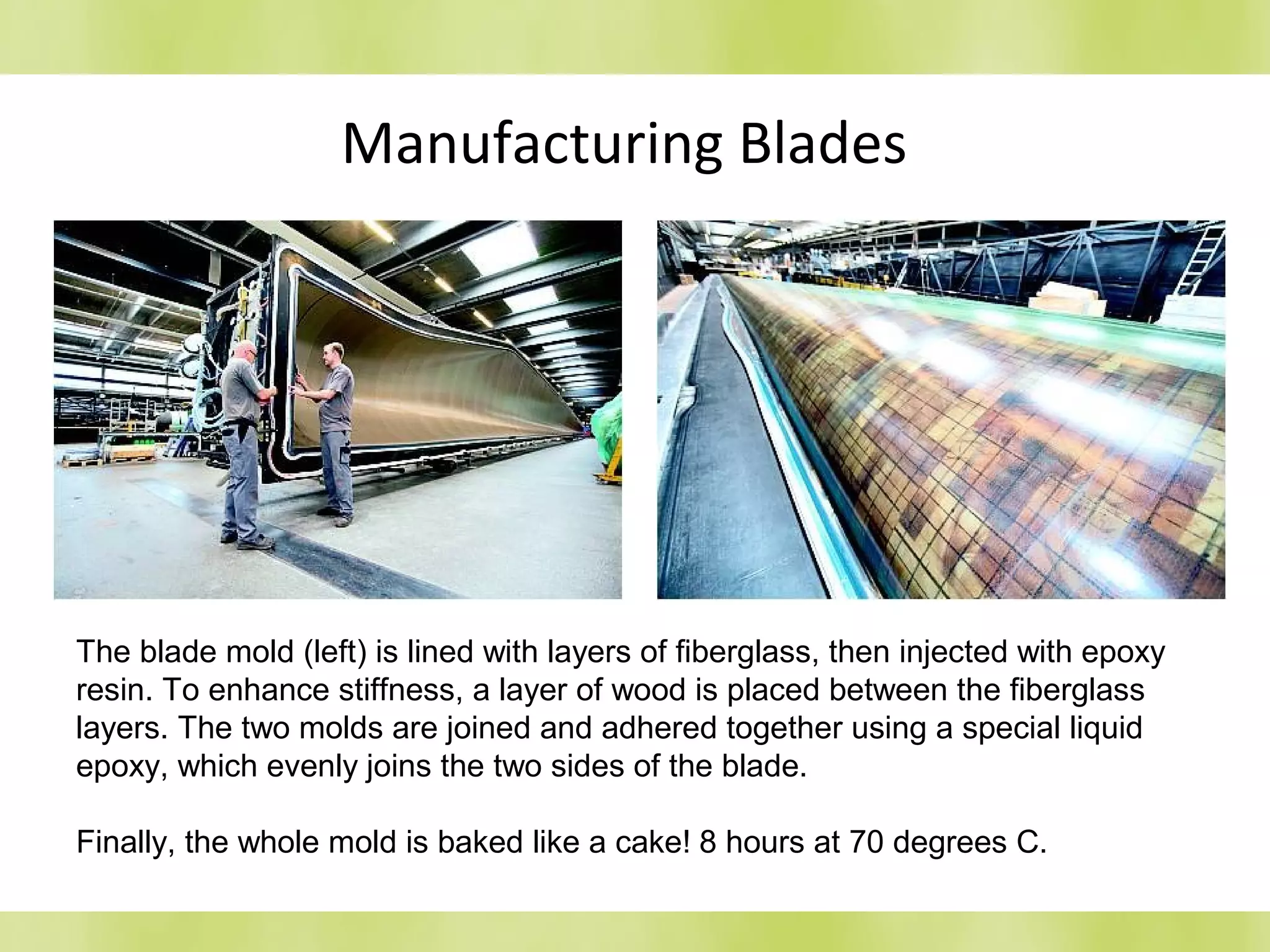
The blade mold (left) is lined with layers of fiberglass, then injected with epoxy
resin. To enhance stiffness, a layer of wood is placed between the fiberglass
layers. The two molds are joined and adhered together using a special liquid
epoxy, which evenly joins the two sides of the blade.
Finally, the whole mold is baked like a cake! 8 hours at 70 degrees C.
Manufacturing Blades
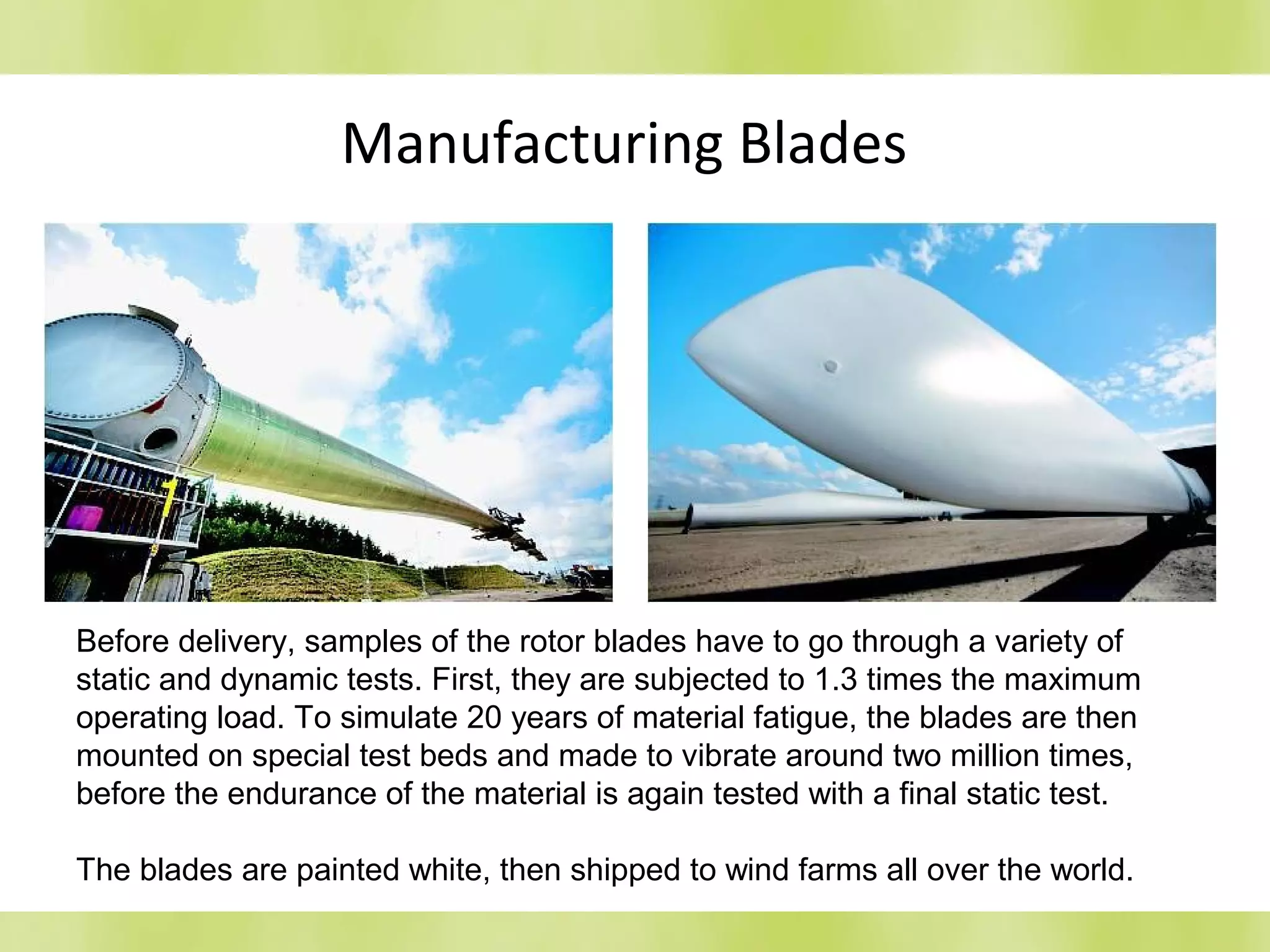
Before delivery, samples of the rotor blades have to go through a variety of
static and dynamic tests. First, they are subjected to 1.3 times the maximum
operating load. To simulate 20 years of material fatigue, the blades are then
mounted on special test beds and made to vibrate around two million times,
before the endurance of the material is again tested with a final static test.
The blades are painted white, then shipped to wind farms all over the world.
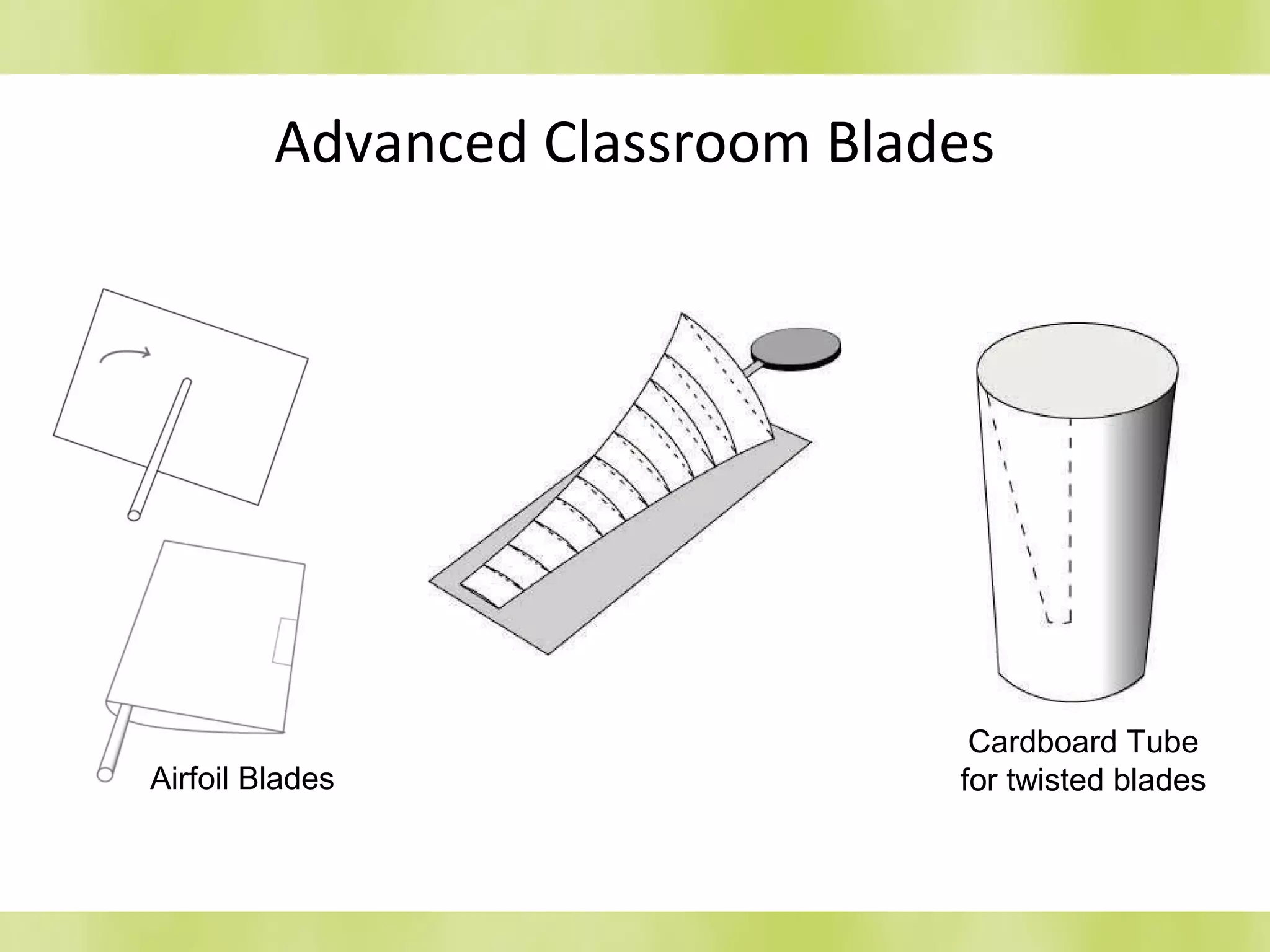
Advanced Classroom Blades
Cardboard Tube
for twisted bladesAirfoil Blades
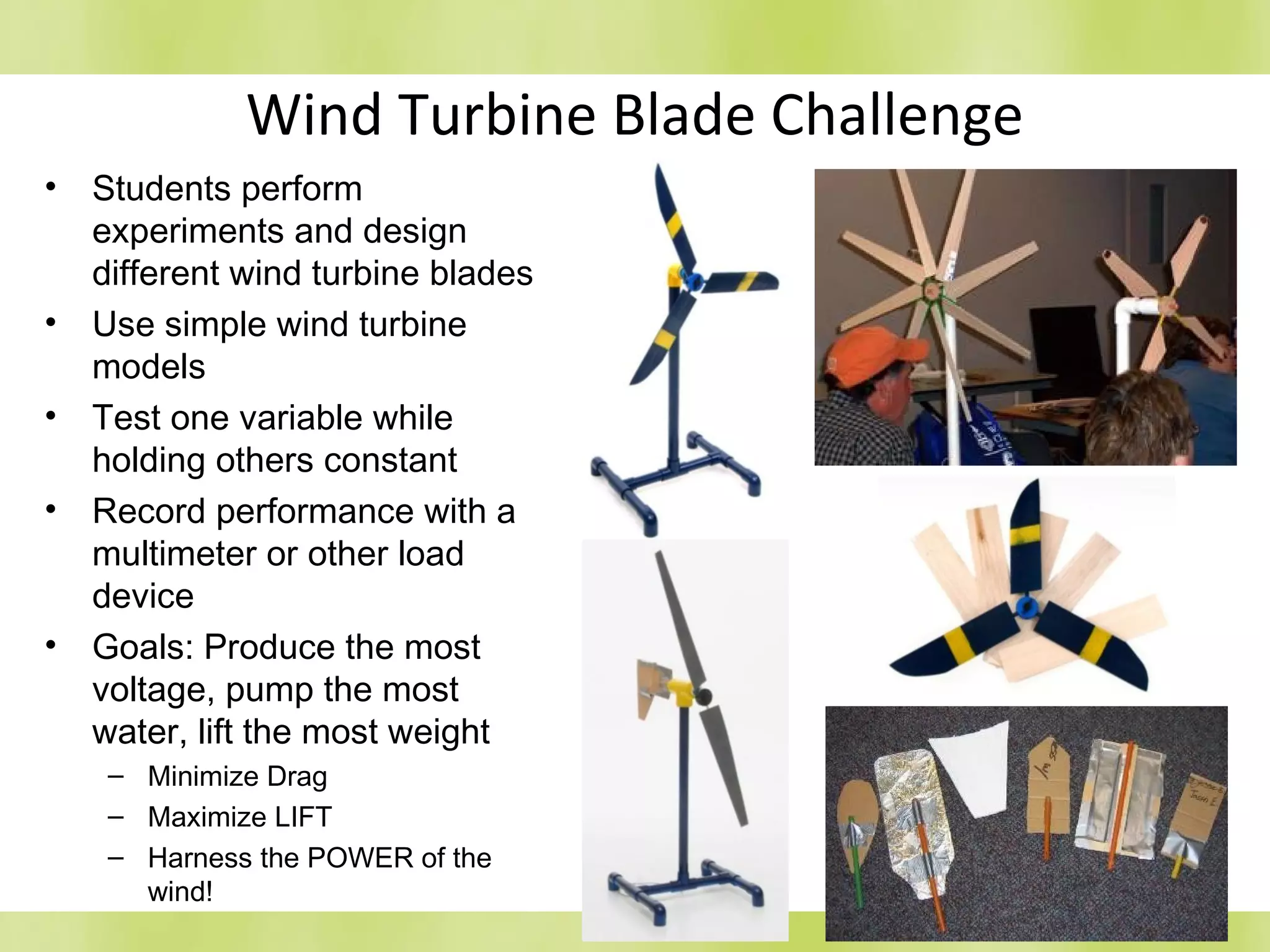
Wind Turbine Blade Challenge
• Students perform
experiments and design
different wind turbine blades
• Use simple wind turbine
models
• Test one variable while
holding others constant
• Record performance with a
multimeter or other load
device
• Goals: Produce the most
voltage, pump the most
water, lift the most weight
– Minimize Drag
– Maximize LIFT
– Harness the POWER of the
wind!
Questions?
Joe Rand
KidWind Project
joe@kidwind.org

Wind turbine blade design

  • 1.
    Wind Turbine Blade Design JosephRandJoseph Rand The Kidwind ProjectThe Kidwind Project joe@kidwind.orgjoe@kidwind.org 877-917-0079877-917-0079
  • 3.
    Calculation of WindPower •Power in the windPower in the wind – Effect of swept area, A – Effect of wind speed, V – Effect of air density, ρ R Swept Area: A = πR2 Area of the circle swept by the rotor (m2 ). Power in the Wind = ½ρAV3
  • 4.
    Many Different Rotors… KidWindProject | www.kidwind.org
  • 5.
    Number of Blades– One • Rotor must move more rapidly to capture same amount of wind – Gearbox ratio reduced – Added weight of counterbalance negates some benefits of lighter design – Higher speed means more noise, visual, and wildlife impacts • Blades easier to install because entire rotor can be assembled on ground • Captures 10% less energy than two blade design • Ultimately provide no cost savings
  • 6.
    Number of Blades- Two • Advantages & disadvantages similar to one blade • Need teetering hub and or shock absorbers because of gyroscopic imbalances • Capture 5% less energy than three blade designs
  • 7.
    Number of Blades- Three • Balance of gyroscopic forces • Slower rotation – increases gearbox & transmission costs – More aesthetic, less noise, fewer bird strikes
  • 8.
    Blade Composition Wood Wood – Strong,light weight, cheap, abundant, flexible – Popular on do-it yourself turbines • Solid plank • Laminates • Veneers • Composites
  • 9.
    Blade Composition Metal • Steel –Heavy & expensive • Aluminum – Lighter-weight and easy to work with – Expensive – Subject to metal fatigue
  • 10.
    Blade Construction Fiberglass • Lightweight,strong, inexpensive, good fatigue characteristics • Variety of manufacturing processes – Cloth over frame – Pultrusion – Filament winding to produce spars • Most modern large turbines use fiberglass
  • 11.
    KidWind Project |www.kidwind.org
  • 12.
    KidWind Project |www.kidwind.org
  • 13.
    Lift & DragForces • The Lift Force is perpendicular to the direction of motion. We want to make this force BIG. • The Drag Force is parallel to the direction of motion. We want to make this force small. α = low α = medium <10 degrees α = High Stall!!
  • 14.
    Airfoil Shape Just likethe wings of an airplane, wind turbine blades use the airfoil shape to create lift and maximize efficiency. The Bernoulli Effect
  • 15.
    Lift/Drag Forces Experienced by TurbineBlades KidWind Project | www.kidwind.org
  • 16.
    Twist & Taper •Speed through the air of a point on the blade changes with distance from hub • Therefore, tip speed ratio varies as well • To optimize angle of attack all along blade, it must twist from root to tip Fast Faster Fastest
  • 17.
    Tip-Speed Ratio Tip-speed ratiois the ratio of the speed of the rotating blade tip to the speed of the free stream wind. There is an optimum angle of attack which creates the highest lift to drag ratio. Because angle of attack is dependant on wind speed, there is an optimum tip-speed ratio ΩR V TSR = Where, Ω = rotational speed in radians /sec R = Rotor Radius V = Wind “Free Stream” Velocity ΩR R
  • 18.
    Performance Over Rangeof Tip Speed Ratios • Power Coefficient Varies with Tip Speed Ratio • Characterized by Cp vs Tip Speed Ratio Curve
  • 19.
    Betz Limit All windpower cannot be captured by rotor or air would be completely still behind rotor and not allow more wind to pass through. Theoretical limit of rotor efficiency is 59% Most modern wind turbines are in the 35 – 45% range
  • 20.
    Rotor Solidity Solidity isthe ratio of total rotor planform area to total swept area Low solidity (0.10) = high speed, low torque High solidity (>0.80) = low speed, high torque A R a Solidity = 3a/A
  • 21.
    KidWind Project |www.kidwind.org Pitch Control Mechanisms
  • 22.
  • 23.
    Manufacturing Blades The blademold (left) is lined with layers of fiberglass, then injected with epoxy resin. To enhance stiffness, a layer of wood is placed between the fiberglass layers. The two molds are joined and adhered together using a special liquid epoxy, which evenly joins the two sides of the blade. Finally, the whole mold is baked like a cake! 8 hours at 70 degrees C.
  • 24.
    Manufacturing Blades Before delivery,samples of the rotor blades have to go through a variety of static and dynamic tests. First, they are subjected to 1.3 times the maximum operating load. To simulate 20 years of material fatigue, the blades are then mounted on special test beds and made to vibrate around two million times, before the endurance of the material is again tested with a final static test. The blades are painted white, then shipped to wind farms all over the world.
  • 25.
    Advanced Classroom Blades CardboardTube for twisted bladesAirfoil Blades
  • 26.
    Wind Turbine BladeChallenge • Students perform experiments and design different wind turbine blades • Use simple wind turbine models • Test one variable while holding others constant • Record performance with a multimeter or other load device • Goals: Produce the most voltage, pump the most water, lift the most weight – Minimize Drag – Maximize LIFT – Harness the POWER of the wind!
  • 27.

Editor's Notes

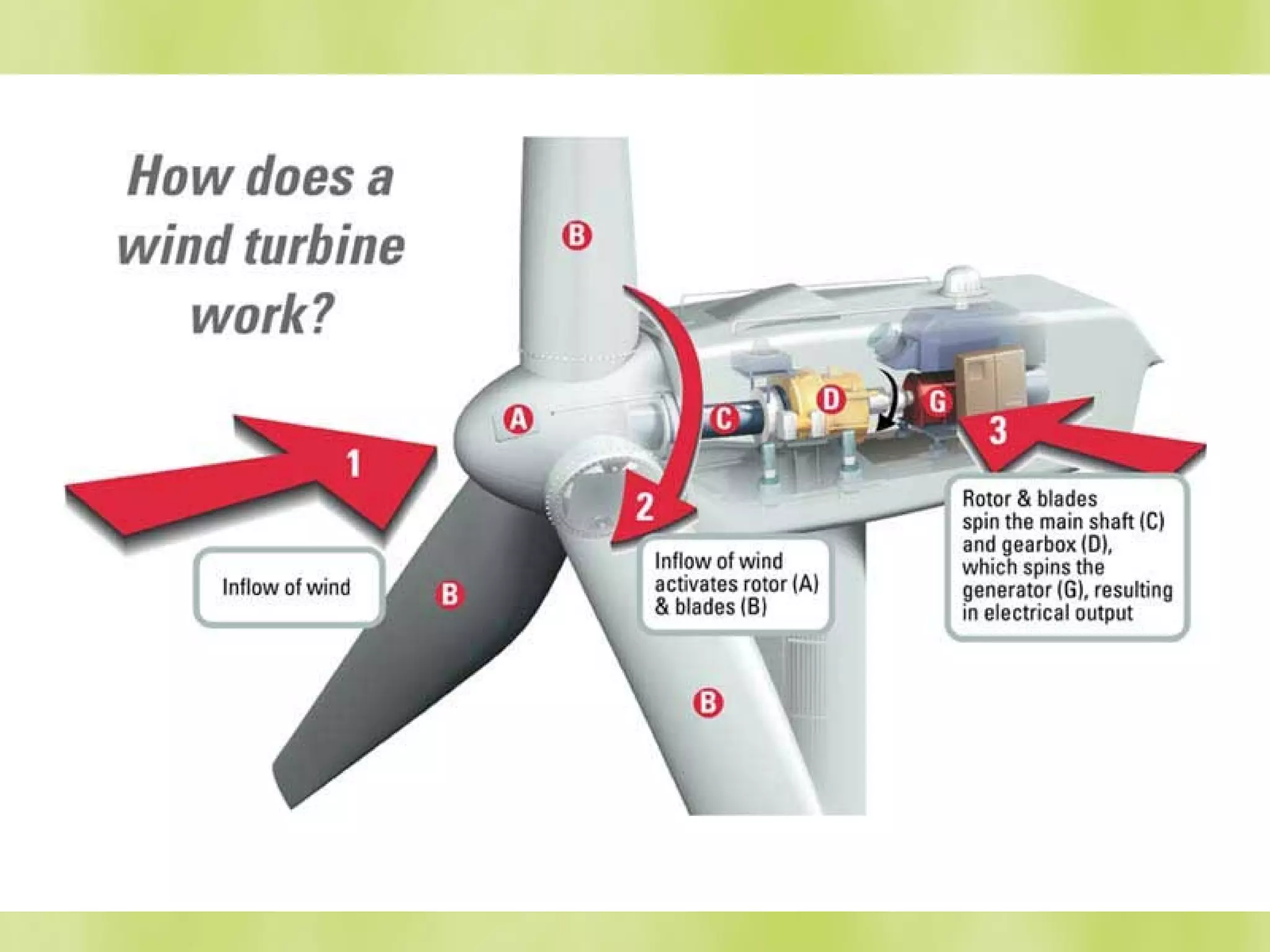
  • #3 A look inside. Blades are a very important component (duh!) Things to note as compared to Small Wind Turbines Blades can be actively pitched by hydraulics. Spin at 12-20 RPM --- much slower than a small wind turbine Large driveshaft attached to a gearbox….must go from 12-20 RPM to 1600 RPM for the generator. Generator creates electricity. Small Wind Turbines use vanes (typcally) to track the wind…they uses and anemometer and hydraulics to move the turbine. Highly computerized and automated….senses conditions and can turn itself off if there is a problem. Often connected by computers to one location and run from there.
  • #4 This is the equation for the power in the wind. (Don’t fear – there are only 2 equations in this presentation.) Each of the terms in this equation can tell us a lot about wind turbines and how they work. Lets look at wind speed (V), swept area (A), and density (Greek letter “rho,” ) one at a time. First, let’s look at wind speed, V. Because V is cubed in the equation, a small increase in V makes for a increase in power. (illustrated on next slide) (Click on the links at the bottom to get the values of both k and .)
  • #5 Various rotor configurations… all used to convert wind into usable energy. Why do the rotors differ so greatly? Why have we come to use the typical 3-blade rotor in nearly all industrial wind turbines today?
  • #13 These “scimitar” shaped blades are designed to be efficient while also reducing NOISE coming off the blades. Since this is a downwind rotor there are more variables to consider… downwind turbines can be noisier and experience turbulent wind going around the tower.
  • #16 These vectors represent the forces experienced by an airfoil wind turbine blade as it rotates. Notice that the “apparent wind” is a combination of the “real wind” and the “head wind” Well designed blades should minimize the drag force.