Alternative Sources of Energy
WIND POWER & WIND TURBINE
• What is it?
• How does it work?
• Components of wind
turbine
• Design considerations
WIND POWER - What is it?
 All renewable energy (except tidal and geothermal power), ultimately
comes from the sun
 The earth receives 1.74 x 10¹⁷ watts of power (per hour) from the sun
 About one or 2 percent of this energy is converted to wind energy
(which is about 50-100 times more than the energy converted to
biomass by all plants on earth
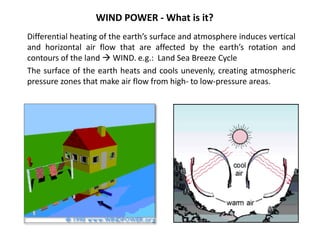
WIND POWER - What is it?
Differential heating of the earth’s surface and atmosphere induces vertical
and horizontal air flow that are affected by the earth’s rotation and
contours of the land  WIND. e.g.: Land Sea Breeze Cycle
The surface of the earth heats and cools unevenly, creating atmospheric
pressure zones that make air flow from high- to low-pressure areas.
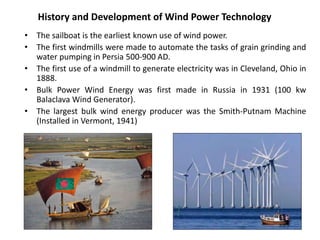
History and Development of Wind Power Technology
• The sailboat is the earliest known use of wind power.
• The first windmills were made to automate the tasks of grain grinding and
water pumping in Persia 500-900 AD.
• The first use of a windmill to generate electricity was in Cleveland, Ohio in
1888.
• Bulk Power Wind Energy was first made in Russia in 1931 (100 kw
Balaclava Wind Generator).
• The largest bulk wind energy producer was the Smith-Putnam Machine
(Installed in Vermont, 1941)
Design considerations of a Wind Mill
• When designing a windmill, one must decide on the size of the turbine, and the
size of the generator.
• Type of turbine- horizontal axis and vertical axis orientation of the blades
• Height and location of the tower. i.e. site (off shore, desert, hilly area, valley etc)
• Number of blades of the turbine
• Air mass and wind speed/velocity
• Materials of the blades (wood, fiberglass, metal etc)
• Shapes of the blades (pitch control)
• Roughness and obstacle of the surface of the earth
• Rotor diameter and rotor sweep area in square meter
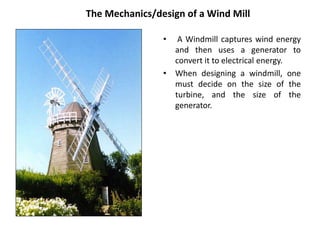
The Mechanics/design of a Wind Mill
• A Windmill captures wind energy
and then uses a generator to
convert it to electrical energy.
• When designing a windmill, one
must decide on the size of the
turbine, and the size of the
generator.
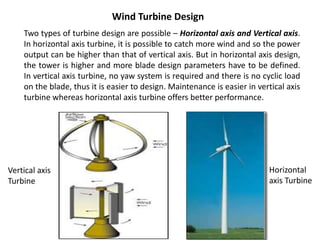
Two types of turbine design are possible – Horizontal axis and Vertical axis.
In horizontal axis turbine, it is possible to catch more wind and so the power
output can be higher than that of vertical axis. But in horizontal axis design,
the tower is higher and more blade design parameters have to be defined.
In vertical axis turbine, no yaw system is required and there is no cyclic load
on the blade, thus it is easier to design. Maintenance is easier in vertical axis
turbine whereas horizontal axis turbine offers better performance.
Wind Turbine Design
Horizontal
axis Turbine
Vertical axis
Turbine
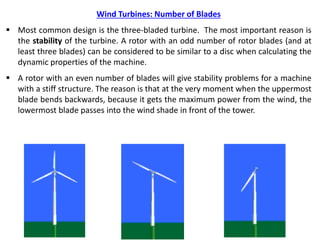
Wind Turbines: Number of Blades
 Most common design is the three-bladed turbine. The most important reason is
the stability of the turbine. A rotor with an odd number of rotor blades (and at
least three blades) can be considered to be similar to a disc when calculating the
dynamic properties of the machine.
 A rotor with an even number of blades will give stability problems for a machine
with a stiff structure. The reason is that at the very moment when the uppermost
blade bends backwards, because it gets the maximum power from the wind, the
lowermost blade passes into the wind shade in front of the tower.
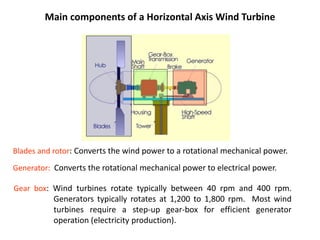
Main components of a Horizontal Axis Wind Turbine
Gear box: Wind turbines rotate typically between 40 rpm and 400 rpm.
Generators typically rotates at 1,200 to 1,800 rpm. Most wind
turbines require a step-up gear-box for efficient generator
operation (electricity production).
Blades and rotor: Converts the wind power to a rotational mechanical power.
Generator: Converts the rotational mechanical power to electrical power.
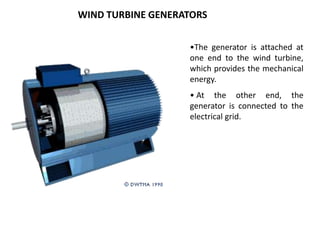
•The generator is attached at
one end to the wind turbine,
which provides the mechanical
energy.
• At the other end, the
generator is connected to the
electrical grid.
WIND TURBINE GENERATORS
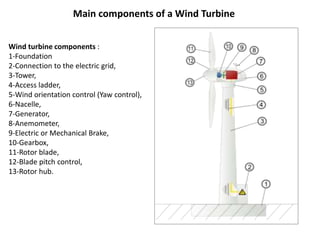
Wind turbine components :
1-Foundation
2-Connection to the electric grid,
3-Tower,
4-Access ladder,
5-Wind orientation control (Yaw control),
6-Nacelle,
7-Generator,
8-Anemometer,
9-Electric or Mechanical Brake,
10-Gearbox,
11-Rotor blade,
12-Blade pitch control,
13-Rotor hub.
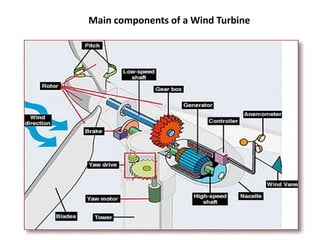
Main components of a Wind Turbine
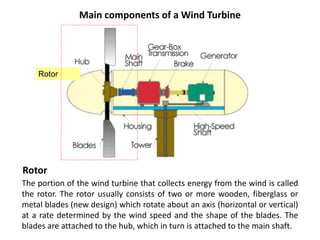
The portion of the wind turbine that collects energy from the wind is called
the rotor. The rotor usually consists of two or more wooden, fiberglass or
metal blades (new design) which rotate about an axis (horizontal or vertical)
at a rate determined by the wind speed and the shape of the blades. The
blades are attached to the hub, which in turn is attached to the main shaft.
Rotor
Rotor
Main components of a Wind Turbine
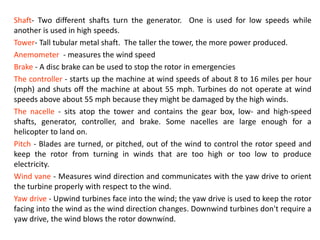
Shaft- Two different shafts turn the generator. One is used for low speeds while
another is used in high speeds.
Tower- Tall tubular metal shaft. The taller the tower, the more power produced.
Anemometer - measures the wind speed
Brake - A disc brake can be used to stop the rotor in emergencies
The controller - starts up the machine at wind speeds of about 8 to 16 miles per hour
(mph) and shuts off the machine at about 55 mph. Turbines do not operate at wind
speeds above about 55 mph because they might be damaged by the high winds.
The nacelle - sits atop the tower and contains the gear box, low- and high-speed
shafts, generator, controller, and brake. Some nacelles are large enough for a
helicopter to land on.
Pitch - Blades are turned, or pitched, out of the wind to control the rotor speed and
keep the rotor from turning in winds that are too high or too low to produce
electricity.
Wind vane - Measures wind direction and communicates with the yaw drive to orient
the turbine properly with respect to the wind.
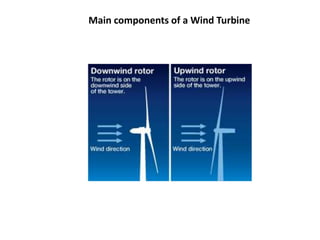
Yaw drive - Upwind turbines face into the wind; the yaw drive is used to keep the rotor
facing into the wind as the wind direction changes. Downwind turbines don't require a
yaw drive, the wind blows the rotor downwind.
Main components of a Wind Turbine
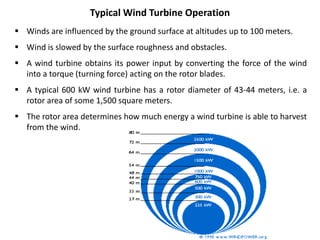
 Winds are influenced by the ground surface at altitudes up to 100 meters.
 Wind is slowed by the surface roughness and obstacles.
 A wind turbine obtains its power input by converting the force of the wind
into a torque (turning force) acting on the rotor blades.
 A typical 600 kW wind turbine has a rotor diameter of 43-44 meters, i.e. a
rotor area of some 1,500 square meters.
 The rotor area determines how much energy a wind turbine is able to harvest
from the wind.
Typical Wind Turbine Operation
0 ~ 10 mph --- Wind speed is too low for generating power. Turbine is not
operational. Rotor is locked.
10 ~ 25 mph --- 10 mph is the minimum operational speed. It is called “Cut-
in speed”. In 10 ~ 25 mph wind, generated power increases
with the wind speed.
25 ~ 50 mph -Typical wind turbines reach the rated power (maximum
operating power) at wind speed of 25 mph (called “Rated
wind speed”). Further increase in wind speed will not result
in substantially higher generated power by design. This is
accomplished by, for example, pitching the blade angle to
reduce the turbine efficiency.
> 50 mph --- Turbine is shut down when wind speed is higher than 50 mph
(called “Cut-out” speed) to prevent structure failure.
Typical Wind Turbine Operation
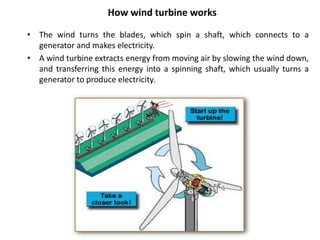
How wind turbine works
• The wind turns the blades, which spin a shaft, which connects to a
generator and makes electricity.
• A wind turbine extracts energy from moving air by slowing the wind down,
and transferring this energy into a spinning shaft, which usually turns a
generator to produce electricity.
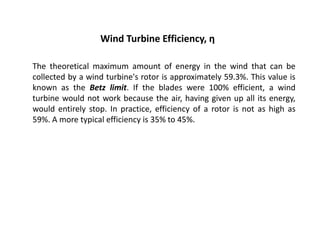
Wind Turbine Efficiency, η
The theoretical maximum amount of energy in the wind that can be
collected by a wind turbine's rotor is approximately 59.3%. This value is
known as the Betz limit. If the blades were 100% efficient, a wind
turbine would not work because the air, having given up all its energy,
would entirely stop. In practice, efficiency of a rotor is not as high as
59%. A more typical efficiency is 35% to 45%.
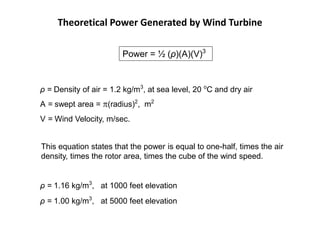
Theoretical Power Generated by Wind Turbine
Power = ½ (ρ)(A)(V)3
A = swept area = (radius)2
, m2
V = Wind Velocity, m/sec.
ρ = 1.16 kg/m3
, at 1000 feet elevation
ρ = 1.00 kg/m3
, at 5000 feet elevation
ρ = Density of air = 1.2 kg/m3
, at sea level, 20 o
C and dry air
This equation states that the power is equal to one-half, times the air
density, times the rotor area, times the cube of the wind speed.
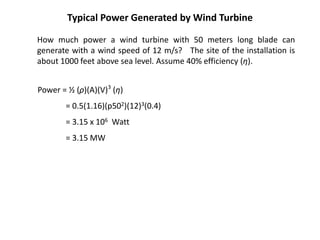
Typical Power Generated by Wind Turbine
Power = ½ (ρ)(A)(V)3
(η)
= 0.5(1.16)(p502)(12)3(0.4)
= 3.15 x 10⁶ Watt
= 3.15 MW
How much power a wind turbine with 50 meters long blade can
generate with a wind speed of 12 m/s? The site of the installation is
about 1000 feet above sea level. Assume 40% efficiency (η).
Power Generated by Wind Turbine
Wind turbines with rotors that are about 8 feet in diameter (50 square feet of
swept area) may peak at about 1 kW and generate about 75 kilowatt-hours
(kWh) per month with a 10 mph average wind speed.
For wind turbine farms, it’s reasonable to use turbines with rotors up to 56
feet in diameter (2,500 square feet of swept area). These turbines may peak at
about 90,000 watts (90 kW), and generate 3,000 to 5,000 kWh per month at a
10 mph average wind speed, enough to supply 200 homes with electricity.
Investment
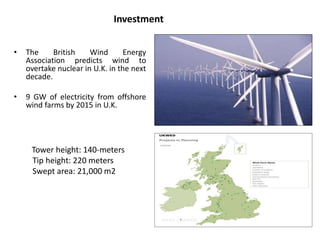
• The British Wind Energy
Association predicts wind to
overtake nuclear in U.K. in the next
decade.
• 9 GW of electricity from offshore
wind farms by 2015 in U.K.
Tower height: 140-meters
Tip height: 220 meters
Swept area: 21,000 m2
Investment – cont.
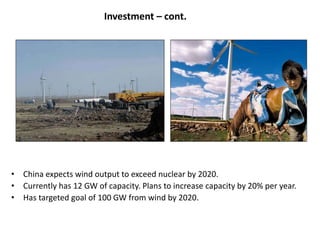
• China expects wind output to exceed nuclear by 2020.
• Currently has 12 GW of capacity. Plans to increase capacity by 20% per year.
• Has targeted goal of 100 GW from wind by 2020.
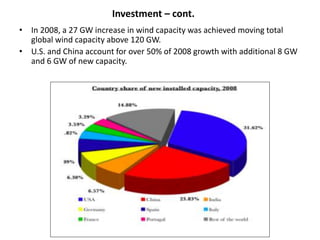
• In 2008, a 27 GW increase in wind capacity was achieved moving total
global wind capacity above 120 GW.
• U.S. and China account for over 50% of 2008 growth with additional 8 GW
and 6 GW of new capacity.
Investment – cont.
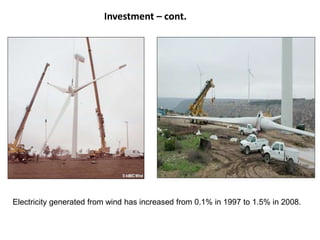
Electricity generated from wind has increased from 0.1% in 1997 to 1.5% in 2008.
Investment – cont.
Advantages of Wind Power
 The wind blows day and night, which allows windmills to produce
electricity throughout the day. (Faster during the day)
 Wind energy is a domestic, renewable source of energy that
generates no pollution and has little environmental impact. Up to 95
percent of land used for wind farms can also be used for other
profitable activities including ranching, farming and forestry.
 The decreasing cost of wind power and the growing interest in
renewable energy sources should ensure that wind power will
become a viable energy source worldwide.

Wind Power & Wind Turbine

  • 1.
  • 2.
    WIND POWER &WIND TURBINE • What is it? • How does it work? • Components of wind turbine • Design considerations
  • 3.
    WIND POWER -What is it?  All renewable energy (except tidal and geothermal power), ultimately comes from the sun  The earth receives 1.74 x 10¹⁷ watts of power (per hour) from the sun  About one or 2 percent of this energy is converted to wind energy (which is about 50-100 times more than the energy converted to biomass by all plants on earth
  • 4.
    WIND POWER -What is it? Differential heating of the earth’s surface and atmosphere induces vertical and horizontal air flow that are affected by the earth’s rotation and contours of the land  WIND. e.g.: Land Sea Breeze Cycle The surface of the earth heats and cools unevenly, creating atmospheric pressure zones that make air flow from high- to low-pressure areas.
  • 5.
    History and Developmentof Wind Power Technology • The sailboat is the earliest known use of wind power. • The first windmills were made to automate the tasks of grain grinding and water pumping in Persia 500-900 AD. • The first use of a windmill to generate electricity was in Cleveland, Ohio in 1888. • Bulk Power Wind Energy was first made in Russia in 1931 (100 kw Balaclava Wind Generator). • The largest bulk wind energy producer was the Smith-Putnam Machine (Installed in Vermont, 1941)
  • 6.
    Design considerations ofa Wind Mill • When designing a windmill, one must decide on the size of the turbine, and the size of the generator. • Type of turbine- horizontal axis and vertical axis orientation of the blades • Height and location of the tower. i.e. site (off shore, desert, hilly area, valley etc) • Number of blades of the turbine • Air mass and wind speed/velocity • Materials of the blades (wood, fiberglass, metal etc) • Shapes of the blades (pitch control) • Roughness and obstacle of the surface of the earth • Rotor diameter and rotor sweep area in square meter
  • 7.
    The Mechanics/design ofa Wind Mill • A Windmill captures wind energy and then uses a generator to convert it to electrical energy. • When designing a windmill, one must decide on the size of the turbine, and the size of the generator.
  • 8.
    Two types ofturbine design are possible – Horizontal axis and Vertical axis. In horizontal axis turbine, it is possible to catch more wind and so the power output can be higher than that of vertical axis. But in horizontal axis design, the tower is higher and more blade design parameters have to be defined. In vertical axis turbine, no yaw system is required and there is no cyclic load on the blade, thus it is easier to design. Maintenance is easier in vertical axis turbine whereas horizontal axis turbine offers better performance. Wind Turbine Design Horizontal axis Turbine Vertical axis Turbine
  • 9.
    Wind Turbines: Numberof Blades  Most common design is the three-bladed turbine. The most important reason is the stability of the turbine. A rotor with an odd number of rotor blades (and at least three blades) can be considered to be similar to a disc when calculating the dynamic properties of the machine.  A rotor with an even number of blades will give stability problems for a machine with a stiff structure. The reason is that at the very moment when the uppermost blade bends backwards, because it gets the maximum power from the wind, the lowermost blade passes into the wind shade in front of the tower.
  • 10.
    Main components ofa Horizontal Axis Wind Turbine Gear box: Wind turbines rotate typically between 40 rpm and 400 rpm. Generators typically rotates at 1,200 to 1,800 rpm. Most wind turbines require a step-up gear-box for efficient generator operation (electricity production). Blades and rotor: Converts the wind power to a rotational mechanical power. Generator: Converts the rotational mechanical power to electrical power.
  • 11.
    •The generator isattached at one end to the wind turbine, which provides the mechanical energy. • At the other end, the generator is connected to the electrical grid. WIND TURBINE GENERATORS
  • 12.
    Wind turbine components: 1-Foundation 2-Connection to the electric grid, 3-Tower, 4-Access ladder, 5-Wind orientation control (Yaw control), 6-Nacelle, 7-Generator, 8-Anemometer, 9-Electric or Mechanical Brake, 10-Gearbox, 11-Rotor blade, 12-Blade pitch control, 13-Rotor hub. Main components of a Wind Turbine
  • 13.
    Main components ofa Wind Turbine The portion of the wind turbine that collects energy from the wind is called the rotor. The rotor usually consists of two or more wooden, fiberglass or metal blades (new design) which rotate about an axis (horizontal or vertical) at a rate determined by the wind speed and the shape of the blades. The blades are attached to the hub, which in turn is attached to the main shaft. Rotor Rotor
  • 14.
    Main components ofa Wind Turbine
  • 15.
    Shaft- Two differentshafts turn the generator. One is used for low speeds while another is used in high speeds. Tower- Tall tubular metal shaft. The taller the tower, the more power produced. Anemometer - measures the wind speed Brake - A disc brake can be used to stop the rotor in emergencies The controller - starts up the machine at wind speeds of about 8 to 16 miles per hour (mph) and shuts off the machine at about 55 mph. Turbines do not operate at wind speeds above about 55 mph because they might be damaged by the high winds. The nacelle - sits atop the tower and contains the gear box, low- and high-speed shafts, generator, controller, and brake. Some nacelles are large enough for a helicopter to land on. Pitch - Blades are turned, or pitched, out of the wind to control the rotor speed and keep the rotor from turning in winds that are too high or too low to produce electricity. Wind vane - Measures wind direction and communicates with the yaw drive to orient the turbine properly with respect to the wind. Yaw drive - Upwind turbines face into the wind; the yaw drive is used to keep the rotor facing into the wind as the wind direction changes. Downwind turbines don't require a yaw drive, the wind blows the rotor downwind.
  • 16.
    Main components ofa Wind Turbine
  • 17.
     Winds areinfluenced by the ground surface at altitudes up to 100 meters.  Wind is slowed by the surface roughness and obstacles.  A wind turbine obtains its power input by converting the force of the wind into a torque (turning force) acting on the rotor blades.  A typical 600 kW wind turbine has a rotor diameter of 43-44 meters, i.e. a rotor area of some 1,500 square meters.  The rotor area determines how much energy a wind turbine is able to harvest from the wind. Typical Wind Turbine Operation
  • 18.
    0 ~ 10mph --- Wind speed is too low for generating power. Turbine is not operational. Rotor is locked. 10 ~ 25 mph --- 10 mph is the minimum operational speed. It is called “Cut- in speed”. In 10 ~ 25 mph wind, generated power increases with the wind speed. 25 ~ 50 mph -Typical wind turbines reach the rated power (maximum operating power) at wind speed of 25 mph (called “Rated wind speed”). Further increase in wind speed will not result in substantially higher generated power by design. This is accomplished by, for example, pitching the blade angle to reduce the turbine efficiency. > 50 mph --- Turbine is shut down when wind speed is higher than 50 mph (called “Cut-out” speed) to prevent structure failure. Typical Wind Turbine Operation
  • 19.
    How wind turbineworks • The wind turns the blades, which spin a shaft, which connects to a generator and makes electricity. • A wind turbine extracts energy from moving air by slowing the wind down, and transferring this energy into a spinning shaft, which usually turns a generator to produce electricity.
  • 20.
    Wind Turbine Efficiency,η The theoretical maximum amount of energy in the wind that can be collected by a wind turbine's rotor is approximately 59.3%. This value is known as the Betz limit. If the blades were 100% efficient, a wind turbine would not work because the air, having given up all its energy, would entirely stop. In practice, efficiency of a rotor is not as high as 59%. A more typical efficiency is 35% to 45%.
  • 21.
    Theoretical Power Generatedby Wind Turbine Power = ½ (ρ)(A)(V)3 A = swept area = (radius)2 , m2 V = Wind Velocity, m/sec. ρ = 1.16 kg/m3 , at 1000 feet elevation ρ = 1.00 kg/m3 , at 5000 feet elevation ρ = Density of air = 1.2 kg/m3 , at sea level, 20 o C and dry air This equation states that the power is equal to one-half, times the air density, times the rotor area, times the cube of the wind speed.
  • 22.
    Typical Power Generatedby Wind Turbine Power = ½ (ρ)(A)(V)3 (η) = 0.5(1.16)(p502)(12)3(0.4) = 3.15 x 10⁶ Watt = 3.15 MW How much power a wind turbine with 50 meters long blade can generate with a wind speed of 12 m/s? The site of the installation is about 1000 feet above sea level. Assume 40% efficiency (η).
  • 23.
    Power Generated byWind Turbine Wind turbines with rotors that are about 8 feet in diameter (50 square feet of swept area) may peak at about 1 kW and generate about 75 kilowatt-hours (kWh) per month with a 10 mph average wind speed. For wind turbine farms, it’s reasonable to use turbines with rotors up to 56 feet in diameter (2,500 square feet of swept area). These turbines may peak at about 90,000 watts (90 kW), and generate 3,000 to 5,000 kWh per month at a 10 mph average wind speed, enough to supply 200 homes with electricity.
  • 24.
    Investment • The BritishWind Energy Association predicts wind to overtake nuclear in U.K. in the next decade. • 9 GW of electricity from offshore wind farms by 2015 in U.K. Tower height: 140-meters Tip height: 220 meters Swept area: 21,000 m2
  • 25.
    Investment – cont. •China expects wind output to exceed nuclear by 2020. • Currently has 12 GW of capacity. Plans to increase capacity by 20% per year. • Has targeted goal of 100 GW from wind by 2020.
  • 26.
    • In 2008,a 27 GW increase in wind capacity was achieved moving total global wind capacity above 120 GW. • U.S. and China account for over 50% of 2008 growth with additional 8 GW and 6 GW of new capacity. Investment – cont.
  • 27.
    Electricity generated fromwind has increased from 0.1% in 1997 to 1.5% in 2008. Investment – cont.
  • 28.
    Advantages of WindPower  The wind blows day and night, which allows windmills to produce electricity throughout the day. (Faster during the day)  Wind energy is a domestic, renewable source of energy that generates no pollution and has little environmental impact. Up to 95 percent of land used for wind farms can also be used for other profitable activities including ranching, farming and forestry.  The decreasing cost of wind power and the growing interest in renewable energy sources should ensure that wind power will become a viable energy source worldwide.