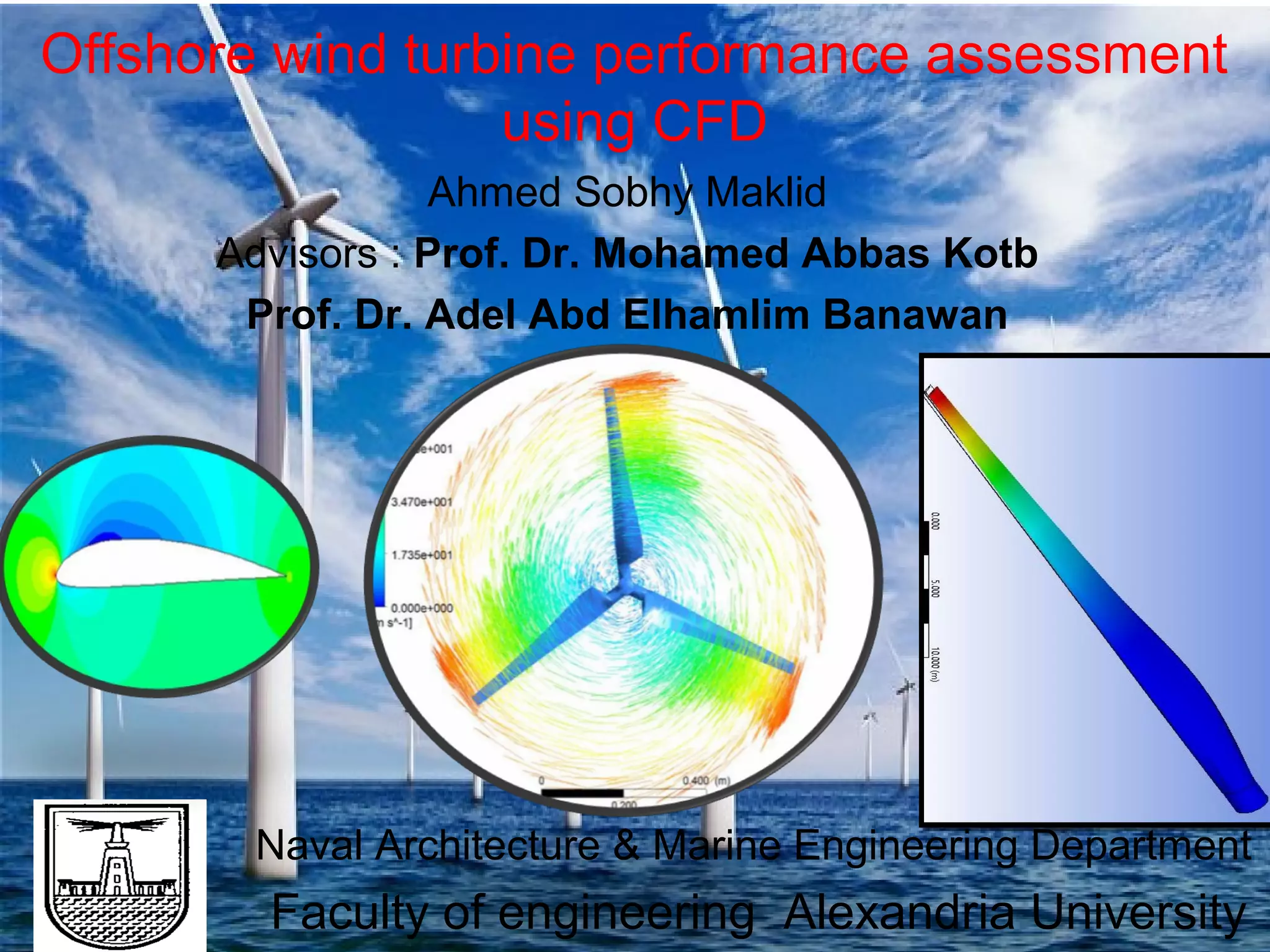
Offshore wind turbine performance assessment
using CFD
Ahmed Sobhy Maklid
Advisors : Prof. Dr. Mohamed Abbas Kotb
Prof. Dr. Adel Abd Elhamlim Banawan
Faculty of engineering Alexandria University
Naval Architecture & Marine Engineering Department
Presentation Outline
 Title Slide: «backstory»
 Outline
Introduction/Motivation
 Background
Verification & Validation
2-D case study
Full turbine case study
FSI case study
Related work
Conclusions and Future work
"Live in danger" Nietzsche
Presentation Outline
 Title Slide: «backstory»
 Outline
Introduction/Motivation
 Background
Verification & Validation
2-D case study
Full turbine case study
FSI case study
Related work
Conclusions and Future work
Introduction
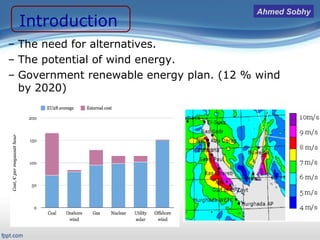
– The need for alternatives.
– The potential of wind energy.
– Government renewable energy plan. (12 % wind
by 2020)
Ahmed Sobhy
Presentation Outline
 Title Slide: «backstory»
 Outline
Introduction/Motivation
 Background
Verification & Validation
2-D case study
Full turbine case study
FSI case study
Related work
Conclusions and Future work
Why offshore Energy
– higher wind speeds and less turbulence( 50% energy )
– environmental constraints
– Subject to technical innovations and revolutionary developments
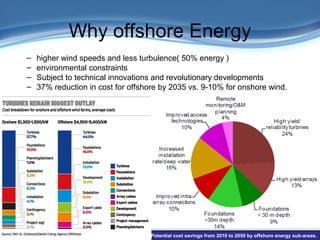
– 37% reduction in cost for offshore by 2035 vs. 9-10% for onshore wind.
Potential cost savings from 2010 to 2050 by offshore energy sub-areas.
Presentation Outline
 Title Slide: «backstory»
 Outline
Introduction/Motivation
 Background
Verification & Validation
2-D case study
Full turbine case study
FSI case study
Related work
Conclusions and Future work
Aims & objectives
Aims:
• Develop a more reliable CFD analysis to investigate the major
problems affecting offshore wind turbine reliability (turbine &
foundation) hence help in decrease its overall cost.
Objectives
• Model the geometry for both the 2-D case and the 3-D case using
CAD programs.
• Set up the appropriate operating condition for each case
• Accurately create the rotating effect of the wind turbine using
desktop capabilities.
• Assess the impact of Performing Verification and validation studies
• Perform FSI simulation and calculate the wind load impact on wind
turbine blade and offshore foundation.
Presentation Outline
 Title Slide: «backstory»
 Outline
Introduction/Motivation
 Background
Verification & Validation
2-D case study
Full turbine case study
FSI case study
Related work
Conclusions and Future work
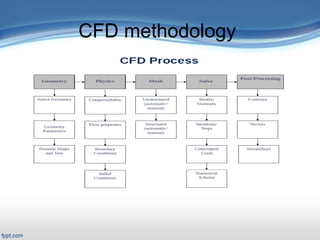
CFD methodology
Presentation Outline
 Title Slide: «backstory»
 Outline
Introduction/Motivation
 Background
Verification & Validation
2-D case study
Full turbine case study
FSI case study
Related work
Conclusions and Future work
Verification & Validation
• Errors: deficiencies in a CFD model that are not caused by lack
of knowledge
• Uncertainty: deficiencies in a CFD model that are caused by
lack of knowledge
• Verification :" solving the equations right ". Roache (1998)
quantifies the errors
• Validation :"solving the right equations". Roache (1998)
quantifies the uncertainty
Presentation Outline
 Title Slide: «backstory»
 Outline
Introduction/Motivation
 Background
Verification & Validation
2-D case study
Full turbine case study
FSI case study
Related work
Conclusions and Future work
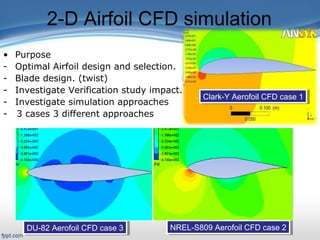
2-D Airfoil CFD simulation
• Purpose
- Optimal Airfoil design and selection.
- Blade design. (twist)
- Investigate Verification study impact.
- Investigate simulation approaches
- 3 cases 3 different approaches
DU-82 Aerofoil CFD case 3DU-82 Aerofoil CFD case 3 NREL-S809 Aerofoil CFD case 2NREL-S809 Aerofoil CFD case 2
Clark-Y Aerofoil CFD case 1Clark-Y Aerofoil CFD case 1
Presentation Outline
 Title Slide: «backstory»
 Outline
Introduction/Motivation
 Background
Verification & Validation
2-D case study
Full turbine case study
FSI case study
Related work
Conclusions and Future work
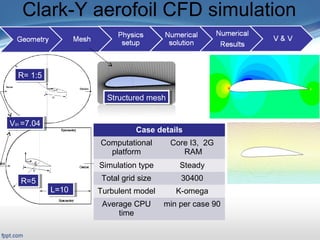
Clark-Y aerofoil CFD simulation
Structured meshStructured mesh
R= 1:5R= 1:5
R=5R=5
L=10L=10
Case details
Computational
platform
Core I3, 2G
RAM
Simulation type Steady
Total grid size 30400
Turbulent model K-omega
Average CPU
time
90min per case
Vin =7.04Vin =7.04
Presentation Outline
 Title Slide: «backstory»
 Outline
Introduction/Motivation
 Background
Verification & Validation
2-D case study
Full turbine case study
FSI case study
Related work
Conclusions and Future work
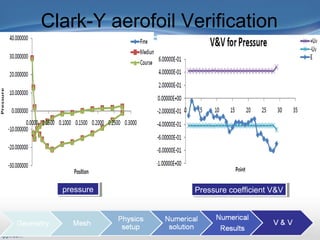
Clark-Y aerofoil Verification
pressurepressure Pressure coefficient V&VPressure coefficient V&V
Presentation Outline
 Title Slide: «backstory»
 Outline
Introduction/Motivation
 Background
Verification & Validation
2-D case study
Full turbine case study
FSI case study
Related work
Conclusions and Future work
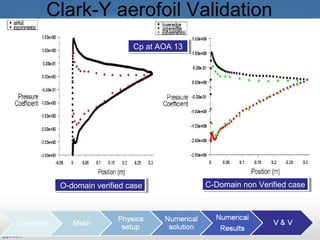
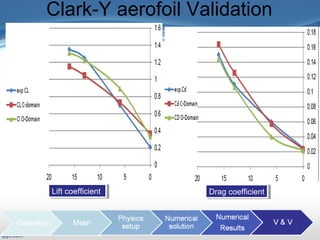
Clark-Y aerofoil Validation
O-domain verified caseO-domain verified case C-Domain non Verified caseC-Domain non Verified case
Cp at AOA 13Cp at AOA 13
Presentation Outline
 Title Slide: «backstory»
 Outline
Introduction/Motivation
 Background
Verification & Validation
2-D case study
Full turbine case study
FSI case study
Related work
Conclusions and Future work
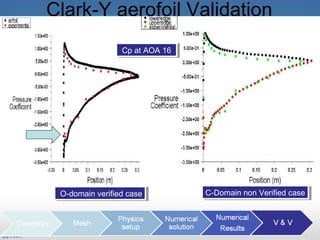
Clark-Y aerofoil Validation
O-domain verified caseO-domain verified case C-Domain non Verified caseC-Domain non Verified case
Cp at AOA 16Cp at AOA 16
Presentation Outline
 Title Slide: «backstory»
 Outline
Introduction/Motivation
 Background
Verification & Validation
2-D case study
Full turbine case study
FSI case study
Related work
Conclusions and Future work
Clark-Y aerofoil Validation
Lift coefficientLift coefficient Drag coefficientDrag coefficient
Presentation Outline
 Title Slide: «backstory»
 Outline
Introduction/Motivation
 Background
Verification & Validation
2-D case study
Full turbine case study
FSI case study
Related work
Conclusions and Future work
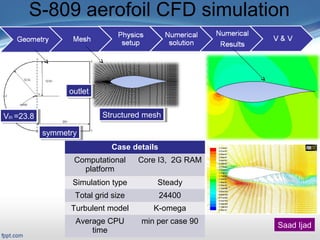
S-809 aerofoil CFD simulation
Saad Ijad
Structured meshStructured mesh
Case details
Computational
platform
Core I3, 2G RAM
Simulation type Steady
Total grid size 24400
Turbulent model K-omega
Average CPU
time
90min per case
outletoutlet
symmetrysymmetry
Vin =23.8Vin =23.8
Presentation Outline
 Title Slide: «backstory»
 Outline
Introduction/Motivation
 Background
Verification & Validation
2-D case study
Full turbine case study
FSI case study
Related work
Conclusions and Future work
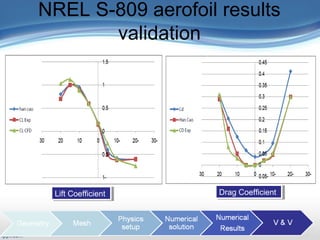
NREL S-809 aerofoil results
validation
Lift CoefficientLift Coefficient Drag CoefficientDrag Coefficient
Presentation Outline
 Title Slide: «backstory»
 Outline
Introduction/Motivation
 Background
Verification & Validation
2-D case study
Full turbine case study
FSI case study
Related work
Conclusions and Future work
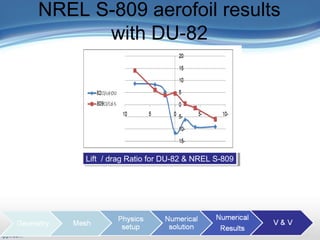
NREL S-809 aerofoil results
with DU-82
Lift / drag Ratio for DU-82 & NREL S-809Lift / drag Ratio for DU-82 & NREL S-809
Presentation Outline
 Title Slide: «backstory»
 Outline
Introduction/Motivation
 Background
Verification & Validation
2-D case study
Full turbine case study
FSI case study
Related work
Conclusions and Future work
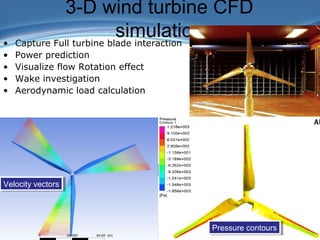
3-D wind turbine CFD
simulation• Capture Full turbine blade interaction
• Power prediction
• Visualize flow Rotation effect
• Wake investigation
• Aerodynamic load calculation
NREL-S809 Aerofoil CFD case 2NREL-S809 Aerofoil CFD case 2
Pressure contoursPressure contours
Velocity vectorsVelocity vectors
Presentation Outline
 Title Slide: «backstory»
 Outline
Introduction/Motivation
 Background
Verification & Validation
2-D case study
Full turbine case study
FSI case study
Related work
Conclusions and Future work
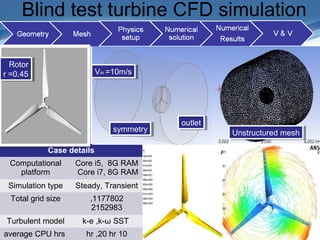
Blind test turbine CFD simulation
Case details
Computational
platform
Core i5, 8G RAM
Core i7, 8G RAM
Simulation type Steady, Transient
Total grid size 1177802,
2152983
Turbulent model k-e ,k-ω SST
average CPU hrs 10hr ,20 hr
outletoutlet
symmetrysymmetry
Unstructured meshUnstructured mesh
Rotor
r =0.45
Rotor
r =0.45 Vin =10m/sVin =10m/s
Presentation Outline
 Title Slide: «backstory»
 Outline
Introduction/Motivation
 Background
Verification & Validation
2-D case study
Full turbine case study
FSI case study
Related work
Conclusions and Future work
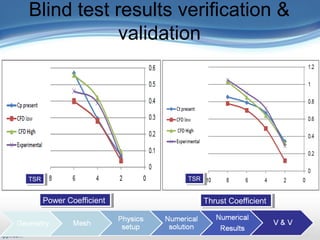
Blind test results verification &
validation
Power CoefficientPower Coefficient Thrust CoefficientThrust Coefficient
TSRTSR TSRTSR
Presentation Outline
 Title Slide: «backstory»
 Outline
Introduction/Motivation
 Background
Verification & Validation
2-D case study
Full turbine case study
FSI case study
Related work
Conclusions and Future work
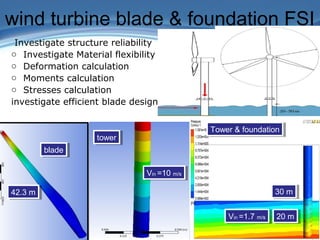
wind turbine blade & foundation FSI
Investigate structure reliability
o Investigate Material flexibility
o Deformation calculation
o Moments calculation
o Stresses calculation
investigate efficient blade designs
bladeblade
towertower
Tower & foundationTower & foundation
20 m20 m
30 m30 m42.3 m42.3 m
Vin =1.7 m/sVin =1.7 m/s
Vin =10 m/sVin =10 m/s
Presentation Outline
 Title Slide: «backstory»
 Outline
Introduction/Motivation
 Background
Verification & Validation
2-D case study
Full turbine case study
FSI case study
Related work
Conclusions and Future work
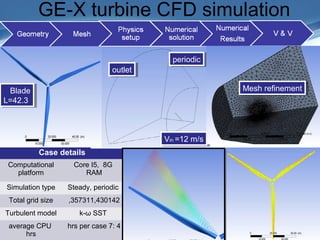
GE-X turbine CFD simulation
Case details
Computational
platform
Core I5, 8G
RAM
Simulation type Steady, periodic
Total grid size 357311,430142,
Turbulent model k-ω SST
average CPU
hrs
4:7hrs per case
outletoutlet
periodicperiodic
Vin =12 m/sVin =12 m/s
Blade
L=42.3
Blade
L=42.3
Mesh refinementMesh refinement
Presentation Outline
 Title Slide: «backstory»
 Outline
Introduction/Motivation
 Background
Verification & Validation
2-D case study
Full turbine case study
FSI case study
Related work
Conclusions and Future work
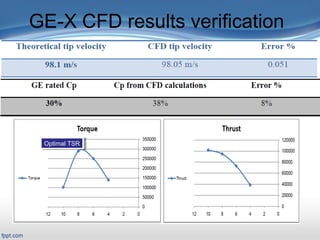
GE-X CFD results verification
Optimal TSROptimal TSR
Presentation Outline
 Title Slide: «backstory»
 Outline
Introduction/Motivation
 Background
Verification & Validation
2-D case study
Full turbine case study
FSI case study
Related work
Conclusions and Future work
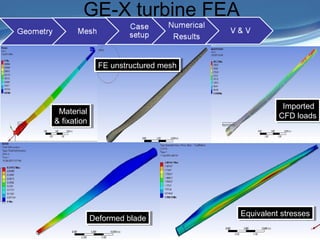
GE-X turbine FEA
Material
& fixation
Material
& fixation
Imported
CFD loads
Imported
CFD loads
Deformed bladeDeformed blade
Equivalent stressesEquivalent stresses
FE unstructured meshFE unstructured mesh
Presentation Outline
 Title Slide: «backstory»
 Outline
Introduction/Motivation
 Background
Verification & Validation
2-D case study
Full turbine case study
FSI case study
Related work
Conclusions and Future work
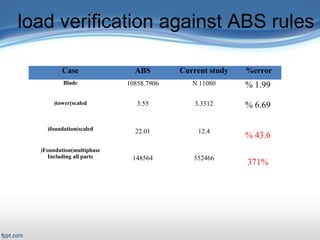
load verification against ABS rules
Case ABS Current study error%
Blade 10858.7906 11080N 1.99%
tower(scaled( 3.55 3.3312 6.69%
foundation(scaled( 22.01 12.4
43.6%
Foundation(multiphase(
Including all parts 148564 552466
371%
Presentation Outline
 Title Slide: «backstory»
 Outline
Introduction/Motivation
 Background
Verification & Validation
2-D case study
Full turbine case study
FSI case study
Related work
Conclusions and Future work
Conclusion
• CFD RANS-Code ANSYS-Fluent proved to be a useful tool in
offshore wind turbine design application ( 2-D, 3-D )
• Verifications studies can help increase simulation accuracy
• Similar case approach proved to be very useful in both 2-D and 3-D
simulation
• Present Turbulent models is suitable for Aerodynamic applications
• Finer mesh does not necessarily improve accuracy only around
source of disturbance
• CFD results can not be trusted without validation.
• Common sense verification approach is less time consuming.
• FSI can be performed using ANSYS
• CFD + FEA is very powerful tool in blade design
Presentation Outline
 Title Slide: «backstory»
 Outline
Introduction/Motivation
 Background
Verification & Validation
2-D case study
Full turbine case study
FSI case study
Related work
Conclusions and Future work
Recommendations
• Use more points to describe the aerofoil curve.
• Refine the grid around the blade of the blind test case.
• Use higher computer and increase the total grid size
• Apply smaller time steps to accurately predict flow details
• Assign tower & foundation material
• Survey appropriate turbulent models for Hydrodynamic applications
Presentation Outline
 Title Slide: «backstory»
 Outline
Introduction/Motivation
 Background
Verification & Validation
2-D case study
Full turbine case study
FSI case study
Related work
Conclusions and Future work
Future Work
• Study the wake impact of 2 in line wind turbines
• Include nacelle in CFD wake simulation
• perform a transient 2-way FSI simulation
• Study interaction between floating foundation for offshore wind
turbines and the wave, wind and current using the multiphase VOF
open channel and the JONSWAP or Pierson Moskowitz for fully
developed sea.
• Apply different solution algorithms
• Apply LES and DES turbulent simulation techniques.
• Study the Impact of using AIAA (1998) ERCOFTAC (2000)
guidelines
Presentation Outline
 Title Slide: «backstory»
 Outline
Introduction/Motivation
 Background
Verification & Validation
2-D case study
Full turbine case study
FSI case study
Related work
Conclusions and Future work
References
[1]. The New and Renewable Energy Authority, Cairo, Egypt NREA.
http://www.nrea.gov.eg/english1.html
[2]. www.windpowermonthly.com/article/1317185/onshore-wind-cheaper-coal-nuclear-gas.
[3]. “Offshore Wind Power Summary Report” (TINA) www.lowcarboninnovation.co.uk.
[4]. Zahedi A, “Current status and future prospects of the wind energy”, Conference on Power &
Energy, IEEE
[5].‘Introduction to Computational Fluid Dynamics (CFD)” University of Iowa,
http://css.engineering.uiowa.edu/~fluids.
[6] Dan M. Somers, “Design and Experimental Results for the S809 Airfoil”, National Renewable
Energy Laboratory, NREL.
[7] Hamid Rahimi, “Computational Modeling of Wind Turbines in Open FOAM” presentation on the
Center for Wind Energy Research Institute of Physics, University of Oldenburg, Germany.
[8] Blind test calculations of the performance and wake development for a model wind turbine”,
Norwegian University of Science and Technology NTNU,
[9]. https://confluence.cornell.edu/pages/viewpage.action?pageId=262012971.
[47] H K Versteeg and W Malalasekera, “An Introduction to Computational Fluid Dynamics THE
FINITE VOLUME METHOD” Second edition © Pearson Education Limited 1995, 2007.

Offshore wind turbine performance assessment using CFD

  • 1.
    Offshore wind turbineperformance assessment using CFD Ahmed Sobhy Maklid Advisors : Prof. Dr. Mohamed Abbas Kotb Prof. Dr. Adel Abd Elhamlim Banawan Faculty of engineering Alexandria University Naval Architecture & Marine Engineering Department
  • 2.
    Presentation Outline  TitleSlide: «backstory»  Outline Introduction/Motivation  Background Verification & Validation 2-D case study Full turbine case study FSI case study Related work Conclusions and Future work "Live in danger" Nietzsche
  • 3.
    Presentation Outline  TitleSlide: «backstory»  Outline Introduction/Motivation  Background Verification & Validation 2-D case study Full turbine case study FSI case study Related work Conclusions and Future work Introduction – The need for alternatives. – The potential of wind energy. – Government renewable energy plan. (12 % wind by 2020) Ahmed Sobhy
  • 4.
    Presentation Outline  TitleSlide: «backstory»  Outline Introduction/Motivation  Background Verification & Validation 2-D case study Full turbine case study FSI case study Related work Conclusions and Future work Why offshore Energy – higher wind speeds and less turbulence( 50% energy ) – environmental constraints – Subject to technical innovations and revolutionary developments – 37% reduction in cost for offshore by 2035 vs. 9-10% for onshore wind. Potential cost savings from 2010 to 2050 by offshore energy sub-areas.
  • 5.
    Presentation Outline  TitleSlide: «backstory»  Outline Introduction/Motivation  Background Verification & Validation 2-D case study Full turbine case study FSI case study Related work Conclusions and Future work Aims & objectives Aims: • Develop a more reliable CFD analysis to investigate the major problems affecting offshore wind turbine reliability (turbine & foundation) hence help in decrease its overall cost. Objectives • Model the geometry for both the 2-D case and the 3-D case using CAD programs. • Set up the appropriate operating condition for each case • Accurately create the rotating effect of the wind turbine using desktop capabilities. • Assess the impact of Performing Verification and validation studies • Perform FSI simulation and calculate the wind load impact on wind turbine blade and offshore foundation.
  • 6.
    Presentation Outline  TitleSlide: «backstory»  Outline Introduction/Motivation  Background Verification & Validation 2-D case study Full turbine case study FSI case study Related work Conclusions and Future work CFD methodology
  • 7.
    Presentation Outline  TitleSlide: «backstory»  Outline Introduction/Motivation  Background Verification & Validation 2-D case study Full turbine case study FSI case study Related work Conclusions and Future work Verification & Validation • Errors: deficiencies in a CFD model that are not caused by lack of knowledge • Uncertainty: deficiencies in a CFD model that are caused by lack of knowledge • Verification :" solving the equations right ". Roache (1998) quantifies the errors • Validation :"solving the right equations". Roache (1998) quantifies the uncertainty
  • 8.
    Presentation Outline  TitleSlide: «backstory»  Outline Introduction/Motivation  Background Verification & Validation 2-D case study Full turbine case study FSI case study Related work Conclusions and Future work 2-D Airfoil CFD simulation • Purpose - Optimal Airfoil design and selection. - Blade design. (twist) - Investigate Verification study impact. - Investigate simulation approaches - 3 cases 3 different approaches DU-82 Aerofoil CFD case 3DU-82 Aerofoil CFD case 3 NREL-S809 Aerofoil CFD case 2NREL-S809 Aerofoil CFD case 2 Clark-Y Aerofoil CFD case 1Clark-Y Aerofoil CFD case 1
  • 9.
    Presentation Outline  TitleSlide: «backstory»  Outline Introduction/Motivation  Background Verification & Validation 2-D case study Full turbine case study FSI case study Related work Conclusions and Future work Clark-Y aerofoil CFD simulation Structured meshStructured mesh R= 1:5R= 1:5 R=5R=5 L=10L=10 Case details Computational platform Core I3, 2G RAM Simulation type Steady Total grid size 30400 Turbulent model K-omega Average CPU time 90min per case Vin =7.04Vin =7.04
  • 10.
    Presentation Outline  TitleSlide: «backstory»  Outline Introduction/Motivation  Background Verification & Validation 2-D case study Full turbine case study FSI case study Related work Conclusions and Future work Clark-Y aerofoil Verification pressurepressure Pressure coefficient V&VPressure coefficient V&V
  • 11.
    Presentation Outline  TitleSlide: «backstory»  Outline Introduction/Motivation  Background Verification & Validation 2-D case study Full turbine case study FSI case study Related work Conclusions and Future work Clark-Y aerofoil Validation O-domain verified caseO-domain verified case C-Domain non Verified caseC-Domain non Verified case Cp at AOA 13Cp at AOA 13
  • 12.
    Presentation Outline  TitleSlide: «backstory»  Outline Introduction/Motivation  Background Verification & Validation 2-D case study Full turbine case study FSI case study Related work Conclusions and Future work Clark-Y aerofoil Validation O-domain verified caseO-domain verified case C-Domain non Verified caseC-Domain non Verified case Cp at AOA 16Cp at AOA 16
  • 13.
    Presentation Outline  TitleSlide: «backstory»  Outline Introduction/Motivation  Background Verification & Validation 2-D case study Full turbine case study FSI case study Related work Conclusions and Future work Clark-Y aerofoil Validation Lift coefficientLift coefficient Drag coefficientDrag coefficient
  • 14.
    Presentation Outline  TitleSlide: «backstory»  Outline Introduction/Motivation  Background Verification & Validation 2-D case study Full turbine case study FSI case study Related work Conclusions and Future work S-809 aerofoil CFD simulation Saad Ijad Structured meshStructured mesh Case details Computational platform Core I3, 2G RAM Simulation type Steady Total grid size 24400 Turbulent model K-omega Average CPU time 90min per case outletoutlet symmetrysymmetry Vin =23.8Vin =23.8
  • 15.
    Presentation Outline  TitleSlide: «backstory»  Outline Introduction/Motivation  Background Verification & Validation 2-D case study Full turbine case study FSI case study Related work Conclusions and Future work NREL S-809 aerofoil results validation Lift CoefficientLift Coefficient Drag CoefficientDrag Coefficient
  • 16.
    Presentation Outline  TitleSlide: «backstory»  Outline Introduction/Motivation  Background Verification & Validation 2-D case study Full turbine case study FSI case study Related work Conclusions and Future work NREL S-809 aerofoil results with DU-82 Lift / drag Ratio for DU-82 & NREL S-809Lift / drag Ratio for DU-82 & NREL S-809
  • 17.
    Presentation Outline  TitleSlide: «backstory»  Outline Introduction/Motivation  Background Verification & Validation 2-D case study Full turbine case study FSI case study Related work Conclusions and Future work 3-D wind turbine CFD simulation• Capture Full turbine blade interaction • Power prediction • Visualize flow Rotation effect • Wake investigation • Aerodynamic load calculation NREL-S809 Aerofoil CFD case 2NREL-S809 Aerofoil CFD case 2 Pressure contoursPressure contours Velocity vectorsVelocity vectors
  • 18.
    Presentation Outline  TitleSlide: «backstory»  Outline Introduction/Motivation  Background Verification & Validation 2-D case study Full turbine case study FSI case study Related work Conclusions and Future work Blind test turbine CFD simulation Case details Computational platform Core i5, 8G RAM Core i7, 8G RAM Simulation type Steady, Transient Total grid size 1177802, 2152983 Turbulent model k-e ,k-ω SST average CPU hrs 10hr ,20 hr outletoutlet symmetrysymmetry Unstructured meshUnstructured mesh Rotor r =0.45 Rotor r =0.45 Vin =10m/sVin =10m/s
  • 19.
    Presentation Outline  TitleSlide: «backstory»  Outline Introduction/Motivation  Background Verification & Validation 2-D case study Full turbine case study FSI case study Related work Conclusions and Future work Blind test results verification & validation Power CoefficientPower Coefficient Thrust CoefficientThrust Coefficient TSRTSR TSRTSR
  • 20.
    Presentation Outline  TitleSlide: «backstory»  Outline Introduction/Motivation  Background Verification & Validation 2-D case study Full turbine case study FSI case study Related work Conclusions and Future work wind turbine blade & foundation FSI Investigate structure reliability o Investigate Material flexibility o Deformation calculation o Moments calculation o Stresses calculation investigate efficient blade designs bladeblade towertower Tower & foundationTower & foundation 20 m20 m 30 m30 m42.3 m42.3 m Vin =1.7 m/sVin =1.7 m/s Vin =10 m/sVin =10 m/s
  • 21.
    Presentation Outline  TitleSlide: «backstory»  Outline Introduction/Motivation  Background Verification & Validation 2-D case study Full turbine case study FSI case study Related work Conclusions and Future work GE-X turbine CFD simulation Case details Computational platform Core I5, 8G RAM Simulation type Steady, periodic Total grid size 357311,430142, Turbulent model k-ω SST average CPU hrs 4:7hrs per case outletoutlet periodicperiodic Vin =12 m/sVin =12 m/s Blade L=42.3 Blade L=42.3 Mesh refinementMesh refinement
  • 22.
    Presentation Outline  TitleSlide: «backstory»  Outline Introduction/Motivation  Background Verification & Validation 2-D case study Full turbine case study FSI case study Related work Conclusions and Future work GE-X CFD results verification Optimal TSROptimal TSR
  • 23.
    Presentation Outline  TitleSlide: «backstory»  Outline Introduction/Motivation  Background Verification & Validation 2-D case study Full turbine case study FSI case study Related work Conclusions and Future work GE-X turbine FEA Material & fixation Material & fixation Imported CFD loads Imported CFD loads Deformed bladeDeformed blade Equivalent stressesEquivalent stresses FE unstructured meshFE unstructured mesh
  • 24.
    Presentation Outline  TitleSlide: «backstory»  Outline Introduction/Motivation  Background Verification & Validation 2-D case study Full turbine case study FSI case study Related work Conclusions and Future work load verification against ABS rules Case ABS Current study error% Blade 10858.7906 11080N 1.99% tower(scaled( 3.55 3.3312 6.69% foundation(scaled( 22.01 12.4 43.6% Foundation(multiphase( Including all parts 148564 552466 371%
  • 25.
    Presentation Outline  TitleSlide: «backstory»  Outline Introduction/Motivation  Background Verification & Validation 2-D case study Full turbine case study FSI case study Related work Conclusions and Future work Conclusion • CFD RANS-Code ANSYS-Fluent proved to be a useful tool in offshore wind turbine design application ( 2-D, 3-D ) • Verifications studies can help increase simulation accuracy • Similar case approach proved to be very useful in both 2-D and 3-D simulation • Present Turbulent models is suitable for Aerodynamic applications • Finer mesh does not necessarily improve accuracy only around source of disturbance • CFD results can not be trusted without validation. • Common sense verification approach is less time consuming. • FSI can be performed using ANSYS • CFD + FEA is very powerful tool in blade design
  • 26.
    Presentation Outline  TitleSlide: «backstory»  Outline Introduction/Motivation  Background Verification & Validation 2-D case study Full turbine case study FSI case study Related work Conclusions and Future work Recommendations • Use more points to describe the aerofoil curve. • Refine the grid around the blade of the blind test case. • Use higher computer and increase the total grid size • Apply smaller time steps to accurately predict flow details • Assign tower & foundation material • Survey appropriate turbulent models for Hydrodynamic applications
  • 27.
    Presentation Outline  TitleSlide: «backstory»  Outline Introduction/Motivation  Background Verification & Validation 2-D case study Full turbine case study FSI case study Related work Conclusions and Future work Future Work • Study the wake impact of 2 in line wind turbines • Include nacelle in CFD wake simulation • perform a transient 2-way FSI simulation • Study interaction between floating foundation for offshore wind turbines and the wave, wind and current using the multiphase VOF open channel and the JONSWAP or Pierson Moskowitz for fully developed sea. • Apply different solution algorithms • Apply LES and DES turbulent simulation techniques. • Study the Impact of using AIAA (1998) ERCOFTAC (2000) guidelines
  • 28.
    Presentation Outline  TitleSlide: «backstory»  Outline Introduction/Motivation  Background Verification & Validation 2-D case study Full turbine case study FSI case study Related work Conclusions and Future work References [1]. The New and Renewable Energy Authority, Cairo, Egypt NREA. http://www.nrea.gov.eg/english1.html [2]. www.windpowermonthly.com/article/1317185/onshore-wind-cheaper-coal-nuclear-gas. [3]. “Offshore Wind Power Summary Report” (TINA) www.lowcarboninnovation.co.uk. [4]. Zahedi A, “Current status and future prospects of the wind energy”, Conference on Power & Energy, IEEE [5].‘Introduction to Computational Fluid Dynamics (CFD)” University of Iowa, http://css.engineering.uiowa.edu/~fluids. [6] Dan M. Somers, “Design and Experimental Results for the S809 Airfoil”, National Renewable Energy Laboratory, NREL. [7] Hamid Rahimi, “Computational Modeling of Wind Turbines in Open FOAM” presentation on the Center for Wind Energy Research Institute of Physics, University of Oldenburg, Germany. [8] Blind test calculations of the performance and wake development for a model wind turbine”, Norwegian University of Science and Technology NTNU, [9]. https://confluence.cornell.edu/pages/viewpage.action?pageId=262012971. [47] H K Versteeg and W Malalasekera, “An Introduction to Computational Fluid Dynamics THE FINITE VOLUME METHOD” Second edition © Pearson Education Limited 1995, 2007.