Methods of Interpreting Test Scores
(Grade Norms )
By
DR.SHAZIA ZAMIR
Grading, like testing, is necessary
procedure; the progress and
achievement of students must be
reported to parents and other, and
grading serves this purpose.
Definition and Purpose
 A grade is an alphabetical and numerical
symbol, or mark, that indicates the
degree to which intended outcomes have
been achieved.
 The major purpose of grades is to
communicate how well a student is doing
in the various subject areas.
 Another purpose often attributed grades is
that they serve as a motivator for student’s
performance.
 Grades also serve as an indication of
achievement to be expected in the future;
past performance is the best single
predictor of future performance.
 The major objection is that there is
considerable variability in the meaning of
a given grade; further, there are so many
different methods of grading and diversity
of symbols that is difficult to interpret
exactly what a given set of grades means.
 A second serious charge made by
opponents of grading is that it is
basically an inhuman process with
many negative effects; some parents
and teacher use them negatively and
the pressures on students can produce
negative behaviors as a result.
 As for the pressure grades place on
students, it can be argued that a
reasonable amount of pressure leads to
increase the achievement.
General principles of grading
 Grades should be based on a sufficient
amount of valid data systematically
collected over a period of time.
 Any given test represents a sampling of
behavior; thus, a grade based on a
combination of a number of test score is
more likely accurately reflect a student’s
achievement level than a grade based
on a single test score.
 Students should know in advance which
grades “count” and which do not, and
should be informed concerning how
final grades will be determined and on
what basis.
 A final grade may be based on a
combination of any number of factors
such as written tests and various
procedures and products.
 Grading is usually done on relative
basis; that is, achievement is labeled as
“good” or “poor” in relation to the
performance of the total group.
 Grading represents a complex
combination of achievement and effort;
achievement is assessed partly in
relation to objective standards and partly
in relation to performance of other
students.
Methods of grading
 Users of grades, such as admission
personnel and employers, invariably prefer
norm-referenced, relative grading systems.
Percent Grading
 Percent grading involves averaging scores
and converting them to a percent.
 The percent itself may be reported as the
grade, e.g., History, 84%, or the percent
may be translated into a letter grade
equivalent (e.g., A=94-100%).
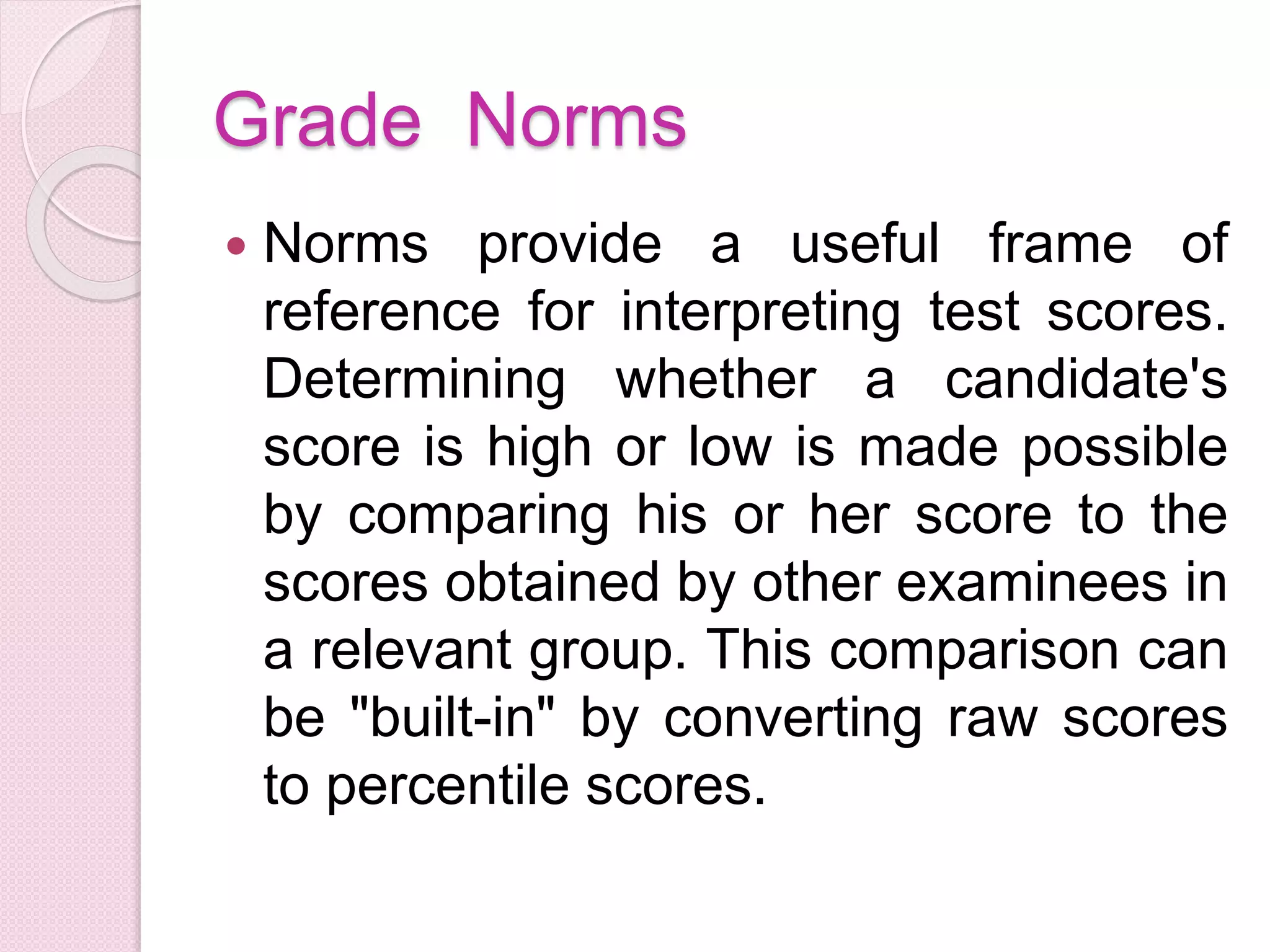
Grade Norms
 Norms provide a useful frame of
reference for interpreting test scores.
Determining whether a candidate's
score is high or low is made possible
by comparing his or her score to the
scores obtained by other examinees in
a relevant group. This comparison can
be "built-in" by converting raw scores
to percentile scores.
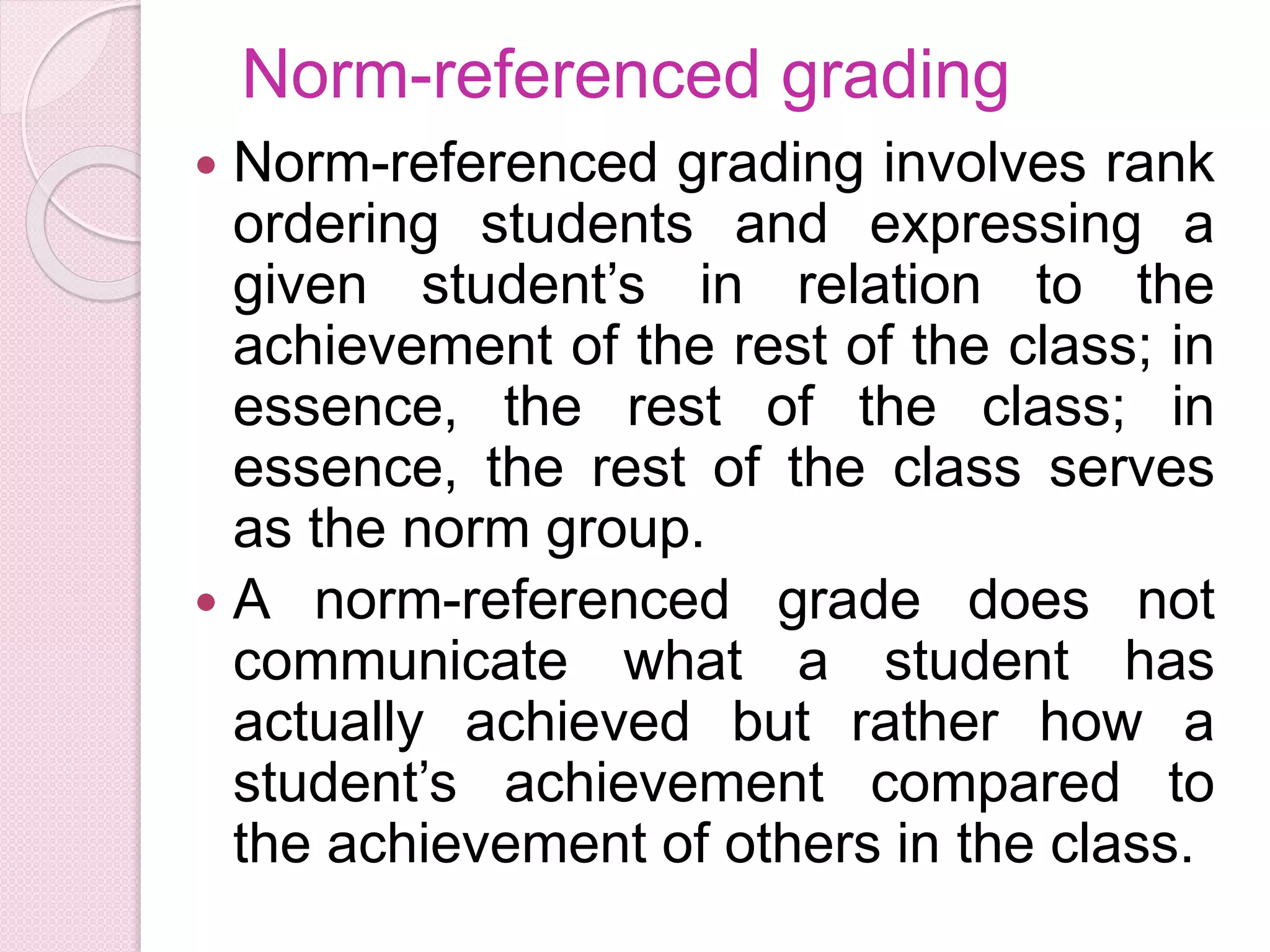
Norm-referenced grading
 Norm-referenced grading involves rank
ordering students and expressing a
given student’s in relation to the
achievement of the rest of the class; in
essence, the rest of the class; in
essence, the rest of the class serves
as the norm group.
 A norm-referenced grade does not
communicate what a student has
actually achieved but rather how a
student’s achievement compared to
the achievement of others in the class.
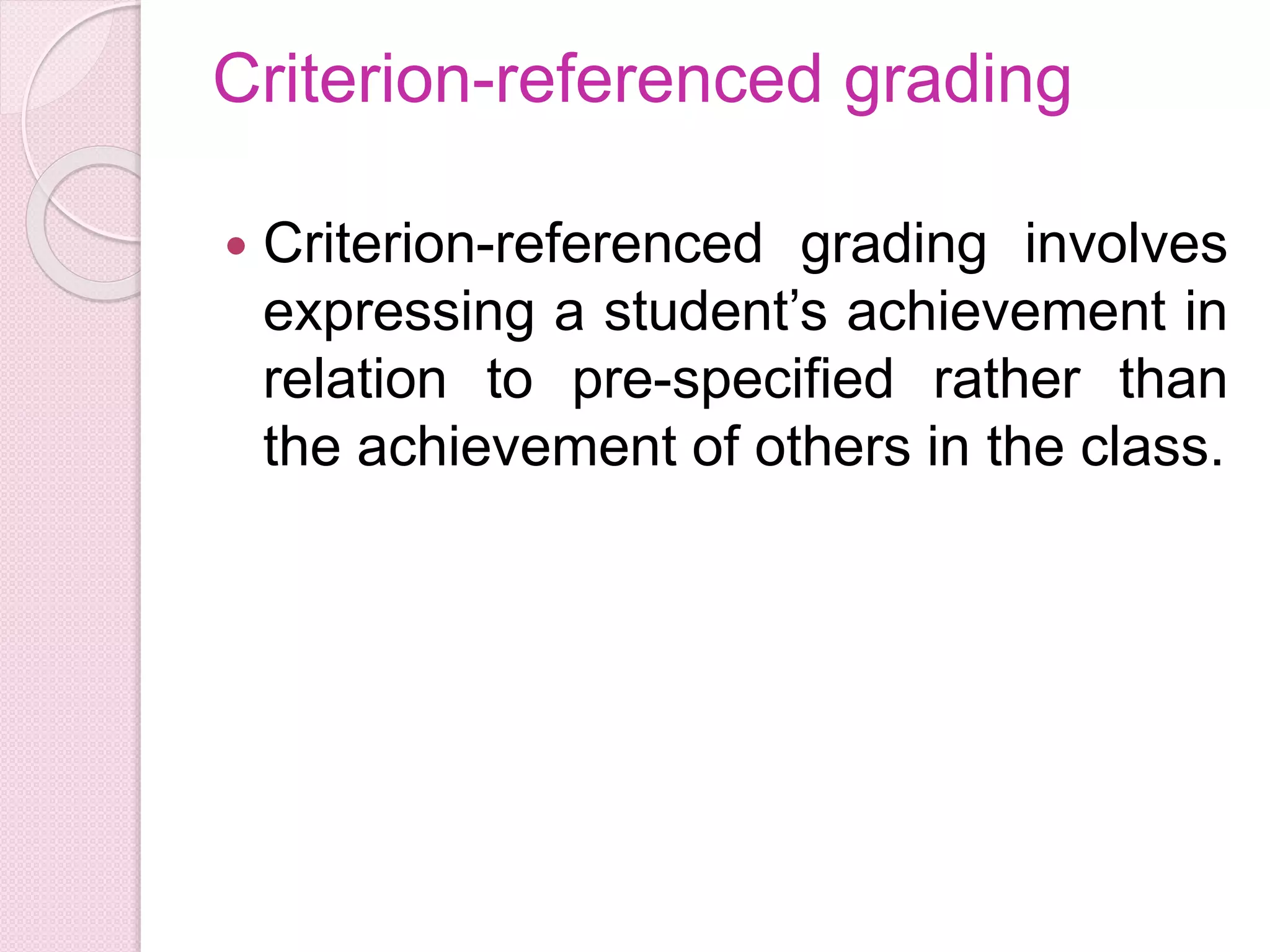
Criterion-referenced grading
 Criterion-referenced grading involves
expressing a student’s achievement in
relation to pre-specified rather than
the achievement of others in the class.
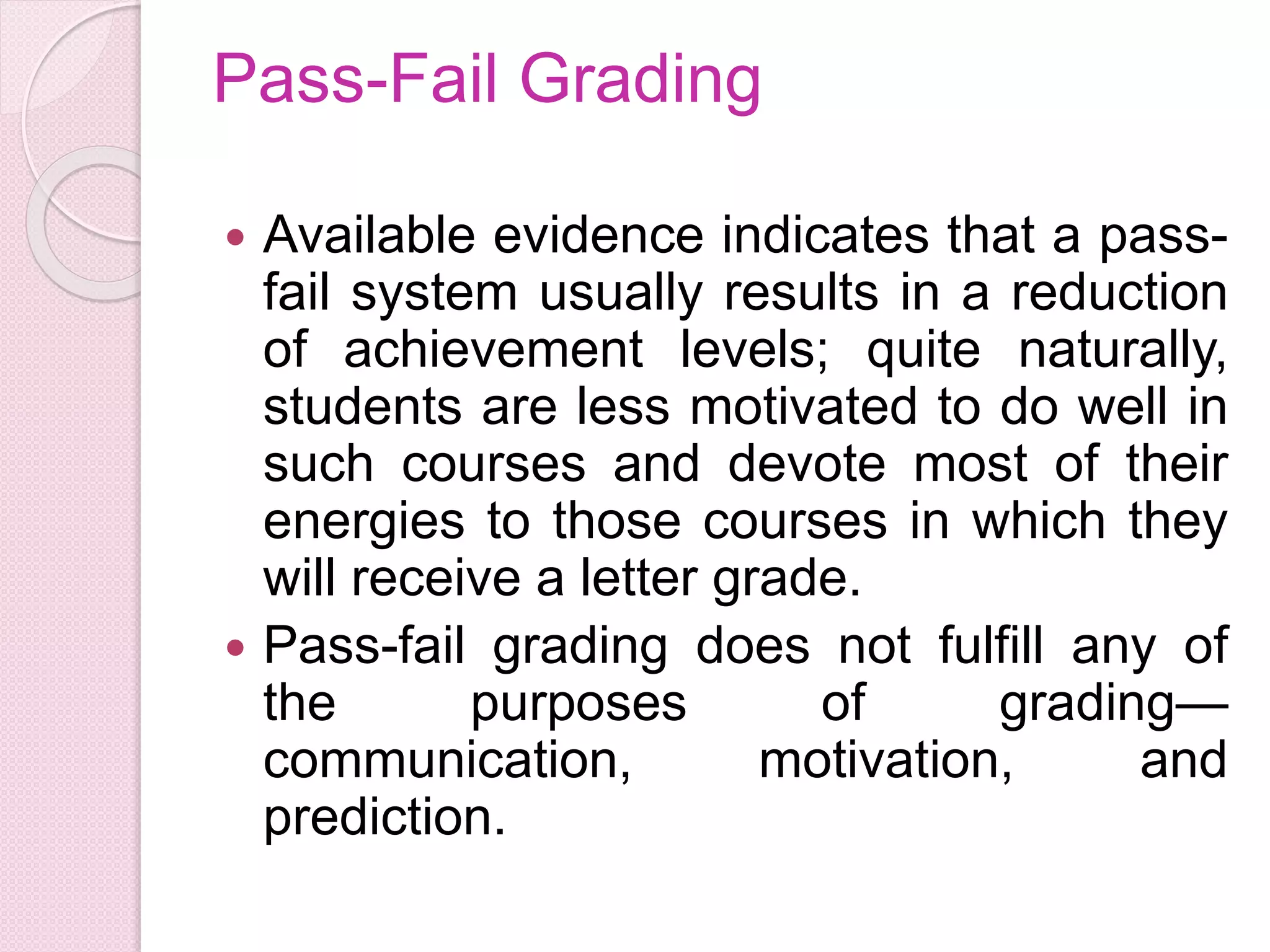
Pass-Fail Grading
 Available evidence indicates that a pass-
fail system usually results in a reduction
of achievement levels; quite naturally,
students are less motivated to do well in
such courses and devote most of their
energies to those courses in which they
will receive a letter grade.
 Pass-fail grading does not fulfill any of
the purposes of grading—
communication, motivation, and
prediction.
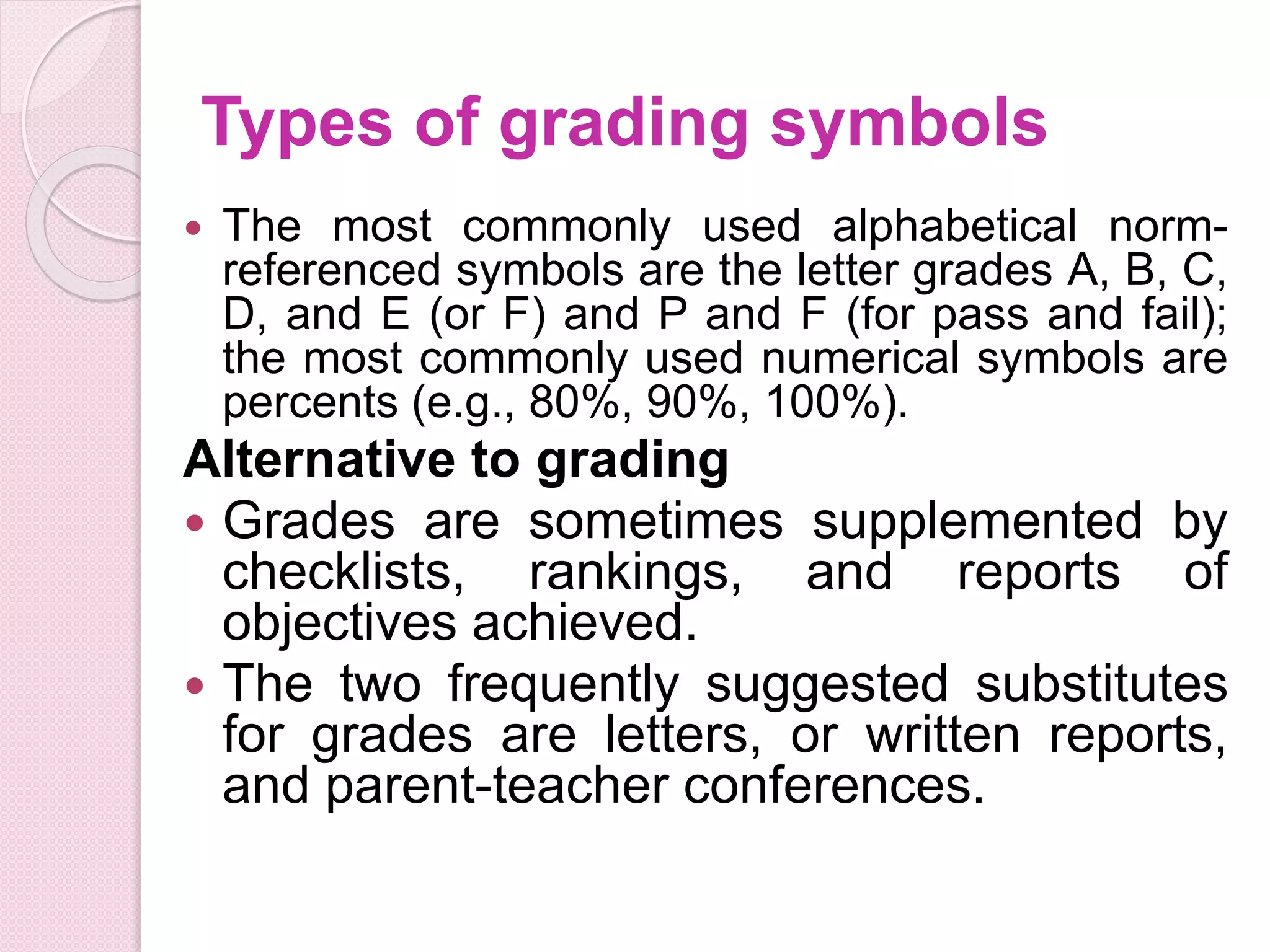
Types of grading symbols
 The most commonly used alphabetical norm-
referenced symbols are the letter grades A, B, C,
D, and E (or F) and P and F (for pass and fail);
the most commonly used numerical symbols are
percents (e.g., 80%, 90%, 100%).
Alternative to grading
 Grades are sometimes supplemented by
checklists, rankings, and reports of
objectives achieved.
 The two frequently suggested substitutes
for grades are letters, or written reports,
and parent-teacher conferences.

Methods of interpreting test scores by Dr.Shazia Zamir

  • 1.
    Methods of InterpretingTest Scores (Grade Norms ) By DR.SHAZIA ZAMIR
  • 2.
    Grading, like testing,is necessary procedure; the progress and achievement of students must be reported to parents and other, and grading serves this purpose. Definition and Purpose  A grade is an alphabetical and numerical symbol, or mark, that indicates the degree to which intended outcomes have been achieved.  The major purpose of grades is to communicate how well a student is doing in the various subject areas.
  • 3.
     Another purposeoften attributed grades is that they serve as a motivator for student’s performance.  Grades also serve as an indication of achievement to be expected in the future; past performance is the best single predictor of future performance.  The major objection is that there is considerable variability in the meaning of a given grade; further, there are so many different methods of grading and diversity of symbols that is difficult to interpret exactly what a given set of grades means.
  • 4.
     A secondserious charge made by opponents of grading is that it is basically an inhuman process with many negative effects; some parents and teacher use them negatively and the pressures on students can produce negative behaviors as a result.  As for the pressure grades place on students, it can be argued that a reasonable amount of pressure leads to increase the achievement.
  • 5.
    General principles ofgrading  Grades should be based on a sufficient amount of valid data systematically collected over a period of time.  Any given test represents a sampling of behavior; thus, a grade based on a combination of a number of test score is more likely accurately reflect a student’s achievement level than a grade based on a single test score.
  • 6.
     Students shouldknow in advance which grades “count” and which do not, and should be informed concerning how final grades will be determined and on what basis.  A final grade may be based on a combination of any number of factors such as written tests and various procedures and products.
  • 7.
     Grading isusually done on relative basis; that is, achievement is labeled as “good” or “poor” in relation to the performance of the total group.  Grading represents a complex combination of achievement and effort; achievement is assessed partly in relation to objective standards and partly in relation to performance of other students.
  • 8.
    Methods of grading Users of grades, such as admission personnel and employers, invariably prefer norm-referenced, relative grading systems. Percent Grading  Percent grading involves averaging scores and converting them to a percent.  The percent itself may be reported as the grade, e.g., History, 84%, or the percent may be translated into a letter grade equivalent (e.g., A=94-100%).
  • 9.
    Grade Norms  Normsprovide a useful frame of reference for interpreting test scores. Determining whether a candidate's score is high or low is made possible by comparing his or her score to the scores obtained by other examinees in a relevant group. This comparison can be "built-in" by converting raw scores to percentile scores.
  • 10.
    Norm-referenced grading  Norm-referencedgrading involves rank ordering students and expressing a given student’s in relation to the achievement of the rest of the class; in essence, the rest of the class; in essence, the rest of the class serves as the norm group.  A norm-referenced grade does not communicate what a student has actually achieved but rather how a student’s achievement compared to the achievement of others in the class.
  • 11.
    Criterion-referenced grading  Criterion-referencedgrading involves expressing a student’s achievement in relation to pre-specified rather than the achievement of others in the class.
  • 12.
    Pass-Fail Grading  Availableevidence indicates that a pass- fail system usually results in a reduction of achievement levels; quite naturally, students are less motivated to do well in such courses and devote most of their energies to those courses in which they will receive a letter grade.  Pass-fail grading does not fulfill any of the purposes of grading— communication, motivation, and prediction.
  • 13.
    Types of gradingsymbols  The most commonly used alphabetical norm- referenced symbols are the letter grades A, B, C, D, and E (or F) and P and F (for pass and fail); the most commonly used numerical symbols are percents (e.g., 80%, 90%, 100%). Alternative to grading  Grades are sometimes supplemented by checklists, rankings, and reports of objectives achieved.  The two frequently suggested substitutes for grades are letters, or written reports, and parent-teacher conferences.