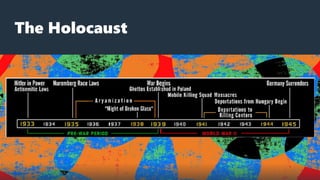
The Holocaust
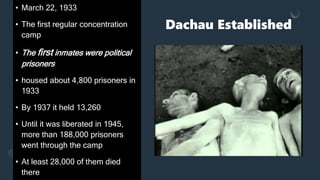
Dachau Established
• March 22, 1933
• The first regular concentration
camp
• The first inmates were political
prisoners
• housed about 4,800 prisoners in
1933
• By 1937 it held 13,260
• Until it was liberated in 1945,
more than 188,000 prisoners
went through the camp
• At least 28,000 of them died
there
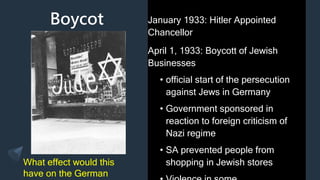
Boycot
t
January 1933: Hitler Appointed
Chancellor
April 1, 1933: Boycott of Jewish
Businesses
• official start of the persecution
against Jews in Germany
• Government sponsored in
reaction to foreign criticism of
Nazi regime
• SA prevented people from
shopping in Jewish stores
What effect would this
have on the German
Boycott
Boycott of Jewish Businesses
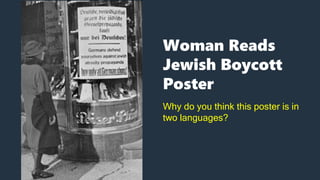
Woman Reads
Jewish Boycott
Poster
Why do you think this poster is in
two languages?
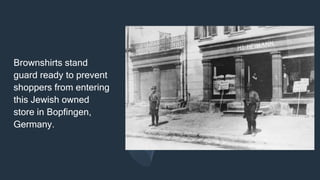
Brownshirts stand
guard ready to prevent
shoppers from entering
this Jewish owned
store in Bopfingen,
Germany.
Anti-Jewish Legislation
1933
March 31
• Decree of the Berlin City Commissioner for Health suspends Jewish
doctors from the city's social welfare services.
April 7
• The Law for the Restoration of the Professional Civil Service
removes Jews from government service.
April 7
• The Law on the Admission to the Legal Profession forbids the
admission of Jews to the bar.
Anti-Jewish Legislation
1933
April 25
• The Law against Overcrowding in Schools and Universities limits the number
of Jewish students in public schools.
July 14
• The Denaturalization Law revokes the citizenship of naturalized Jews and
“undesirables.”
July 14
• The Law for the Prevention of Progeny with Hereditary Diseases allowed gov’t
physicians to sterilize ‘inferiors’
October 4
• The Law on Editors bans Jews from editorial posts.
Anti-Jewish Legislation
1934
Jewish Actors were not allowed to perform
Local laws restricted Jewish Cultural Practices
• example: Saxony-Jews were no longer allowed to slaughter
animals according to Kashrut (to make their food kosher)
Anti-Jewish Legislation
September 15, 1935 The Nuremberg Laws
The Reich Citizenship Law
• Revoked citizenship of Jews
• couldn’t vote or hold political offices
• weren’t entitled to civil/political rights
Anti-Jewish Legislation
September 15, 1935 The Nuremberg Laws
The Law for the Protection of German Blood and German Honor
• Outlawed marriage between Jews and Non-Jews
• women under the age of 45 could not work in Jewish households
• outlawed sexual relations between Jews and non-Jews out of
wedlock as well
There were other laws added like:
• Jews are forbidden from flying the Nazi flag
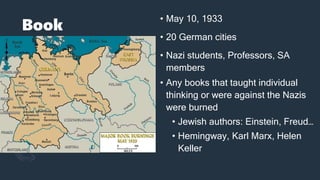
Book
Burnings
• May 10, 1933
• 20 German cities
• Nazi students, Professors, SA
members
• Any books that taught individual
thinking or were against the Nazis
were burned
• Jewish authors: Einstein, Freud…
• Hemingway, Karl Marx, Helen
Keller
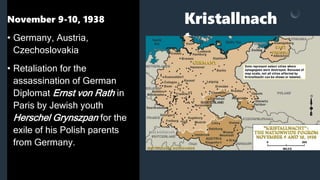
Kristallnach
t
November 9-10, 1938
• Germany, Austria,
Czechoslovakia
• Retaliation for the
assassination of German
Diplomat Ernst von Rath in
Paris by Jewish youth
Herschel Grynszpan for the
exile of his Polish parents
from Germany.
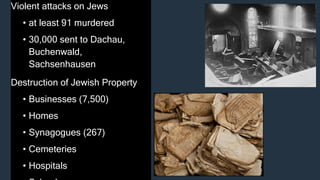
Violent attacks on Jews
• at least 91 murdered
• 30,000 sent to Dachau,
Buchenwald,
Sachsenhausen
Destruction of Jewish Property
• Businesses (7,500)
• Homes
• Synagogues (267)
• Cemeteries
• Hospitals
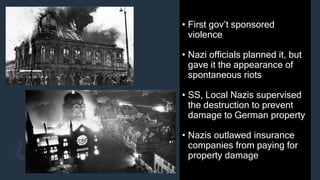
• First gov’t sponsored
violence
• Nazi officials planned it, but
gave it the appearance of
spontaneous riots
• SS, Local Nazis supervised
the destruction to prevent
damage to German property
• Nazis outlawed insurance
companies from paying for
property damage
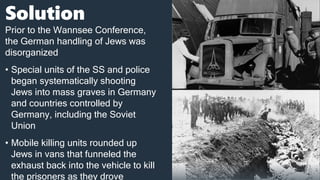
Solution
Prior to the Wannsee Conference,
the German handling of Jews was
disorganized
• Special units of the SS and police
began systematically shooting
Jews into mass graves in Germany
and countries controlled by
Germany, including the Soviet
Union
• Mobile killing units rounded up
Jews in vans that funneled the
exhaust back into the vehicle to kill
the prisoners as they drove
The Final
Solution
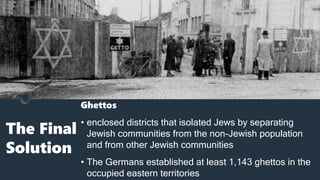
Ghettos
• enclosed districts that isolated Jews by separating
Jewish communities from the non-Jewish population
and from other Jewish communities
• The Germans established at least 1,143 ghettos in the
occupied eastern territories
The Final
Solution
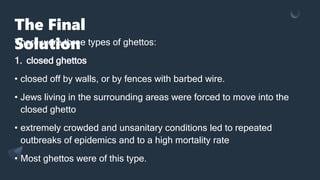
There were three types of ghettos:
1. closed ghettos
• closed off by walls, or by fences with barbed wire.
• Jews living in the surrounding areas were forced to move into the
closed ghetto
• extremely crowded and unsanitary conditions led to repeated
outbreaks of epidemics and to a high mortality rate
• Most ghettos were of this type.
The Final
Solution
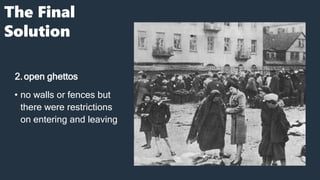
2.open ghettos
• no walls or fences but
there were restrictions
on entering and leaving
The Final
Solution
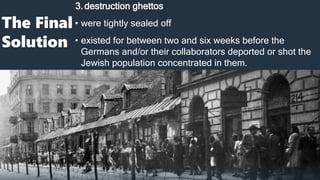
3.destruction ghettos
• were tightly sealed off
• existed for between two and six weeks before the
Germans and/or their collaborators deported or shot the
Jewish population concentrated in them.
The Final Solution
Concentration camps: For the detention of civilians seen as real or
perceived “enemies of the Reich.”
• Forced-labor camps: In forced-labor camps, the Nazi regime brutally
exploited the labor of prisoners for economic gain and to meet labor
shortages. Prisoners lacked proper equipment, clothing,
nourishment, or rest.
• Transit camps: Transit camps functioned as temporary holding
facilities for Jews awaiting deportation. These camps were usually
the last stop before deportations to a killing center.
The Final Solution
• Prisoner-of-war camps: For Allied prisoners of war, including Poles
and Soviet soldiers.
• Killing centers: Established primarily or exclusively for the assembly-
line style murder of large numbers of people immediately upon
arrival to the site. There were 5 killing centers for the murder
primarily of Jews. The term is also used to describe “euthanasia”
sites for the murder of disabled patients.

The Holocaust

  • 1.
  • 2.
    Dachau Established • March22, 1933 • The first regular concentration camp • The first inmates were political prisoners • housed about 4,800 prisoners in 1933 • By 1937 it held 13,260 • Until it was liberated in 1945, more than 188,000 prisoners went through the camp • At least 28,000 of them died there
  • 3.
    Boycot t January 1933: HitlerAppointed Chancellor April 1, 1933: Boycott of Jewish Businesses • official start of the persecution against Jews in Germany • Government sponsored in reaction to foreign criticism of Nazi regime • SA prevented people from shopping in Jewish stores What effect would this have on the German
  • 4.
  • 5.
    Woman Reads Jewish Boycott Poster Whydo you think this poster is in two languages?
  • 6.
    Brownshirts stand guard readyto prevent shoppers from entering this Jewish owned store in Bopfingen, Germany.
  • 7.
    Anti-Jewish Legislation 1933 March 31 •Decree of the Berlin City Commissioner for Health suspends Jewish doctors from the city's social welfare services. April 7 • The Law for the Restoration of the Professional Civil Service removes Jews from government service. April 7 • The Law on the Admission to the Legal Profession forbids the admission of Jews to the bar.
  • 8.
    Anti-Jewish Legislation 1933 April 25 •The Law against Overcrowding in Schools and Universities limits the number of Jewish students in public schools. July 14 • The Denaturalization Law revokes the citizenship of naturalized Jews and “undesirables.” July 14 • The Law for the Prevention of Progeny with Hereditary Diseases allowed gov’t physicians to sterilize ‘inferiors’ October 4 • The Law on Editors bans Jews from editorial posts.
  • 9.
    Anti-Jewish Legislation 1934 Jewish Actorswere not allowed to perform Local laws restricted Jewish Cultural Practices • example: Saxony-Jews were no longer allowed to slaughter animals according to Kashrut (to make their food kosher)
  • 10.
    Anti-Jewish Legislation September 15,1935 The Nuremberg Laws The Reich Citizenship Law • Revoked citizenship of Jews • couldn’t vote or hold political offices • weren’t entitled to civil/political rights
  • 11.
    Anti-Jewish Legislation September 15,1935 The Nuremberg Laws The Law for the Protection of German Blood and German Honor • Outlawed marriage between Jews and Non-Jews • women under the age of 45 could not work in Jewish households • outlawed sexual relations between Jews and non-Jews out of wedlock as well There were other laws added like: • Jews are forbidden from flying the Nazi flag
  • 12.
    Book Burnings • May 10,1933 • 20 German cities • Nazi students, Professors, SA members • Any books that taught individual thinking or were against the Nazis were burned • Jewish authors: Einstein, Freud… • Hemingway, Karl Marx, Helen Keller
  • 13.
    Kristallnach t November 9-10, 1938 •Germany, Austria, Czechoslovakia • Retaliation for the assassination of German Diplomat Ernst von Rath in Paris by Jewish youth Herschel Grynszpan for the exile of his Polish parents from Germany.
  • 14.
    Violent attacks onJews • at least 91 murdered • 30,000 sent to Dachau, Buchenwald, Sachsenhausen Destruction of Jewish Property • Businesses (7,500) • Homes • Synagogues (267) • Cemeteries • Hospitals
  • 15.
    • First gov’tsponsored violence • Nazi officials planned it, but gave it the appearance of spontaneous riots • SS, Local Nazis supervised the destruction to prevent damage to German property • Nazis outlawed insurance companies from paying for property damage
  • 16.
    Solution Prior to theWannsee Conference, the German handling of Jews was disorganized • Special units of the SS and police began systematically shooting Jews into mass graves in Germany and countries controlled by Germany, including the Soviet Union • Mobile killing units rounded up Jews in vans that funneled the exhaust back into the vehicle to kill the prisoners as they drove
  • 17.
    The Final Solution Ghettos • encloseddistricts that isolated Jews by separating Jewish communities from the non-Jewish population and from other Jewish communities • The Germans established at least 1,143 ghettos in the occupied eastern territories
  • 18.
    The Final Solution There werethree types of ghettos: 1. closed ghettos • closed off by walls, or by fences with barbed wire. • Jews living in the surrounding areas were forced to move into the closed ghetto • extremely crowded and unsanitary conditions led to repeated outbreaks of epidemics and to a high mortality rate • Most ghettos were of this type.
  • 19.
    The Final Solution 2.open ghettos •no walls or fences but there were restrictions on entering and leaving
  • 20.
    The Final Solution 3.destruction ghettos •were tightly sealed off • existed for between two and six weeks before the Germans and/or their collaborators deported or shot the Jewish population concentrated in them.
  • 21.
    The Final Solution Concentrationcamps: For the detention of civilians seen as real or perceived “enemies of the Reich.” • Forced-labor camps: In forced-labor camps, the Nazi regime brutally exploited the labor of prisoners for economic gain and to meet labor shortages. Prisoners lacked proper equipment, clothing, nourishment, or rest. • Transit camps: Transit camps functioned as temporary holding facilities for Jews awaiting deportation. These camps were usually the last stop before deportations to a killing center.
  • 22.
    The Final Solution •Prisoner-of-war camps: For Allied prisoners of war, including Poles and Soviet soldiers. • Killing centers: Established primarily or exclusively for the assembly- line style murder of large numbers of people immediately upon arrival to the site. There were 5 killing centers for the murder primarily of Jews. The term is also used to describe “euthanasia” sites for the murder of disabled patients.

Editor's Notes

  • #6 A: To send an international message