1. Grounds for Judicial Separation
2. Civil Procedure code
3. Muthuranee v. Thuraisingham
4. Tennakoon v. Somawathie Perera
5. Analysis
 The Civil Procedure Code
constitutes the general
law on judicial separation.
 The code provides that
either party may petition
for separation "on any
ground on which by the
law applicable to Sri
Lanka such separation
may be granted."
 Thus, Roman-Dutch law
grounds for separation are
applicable, the essential
feature of which is proof
that further cohabitation
has become dangerous or
intolerable due to
unlawful conduct by the
defendant.
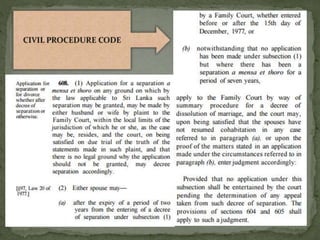
 No. 2 of 1889 as
amended by Law No.
20 of 1977
 Sec. 608 (2) (a):- A
decree of judicial
separation may be
converted to a decree of
divorce after the lapse of
two years .
 Sec. 608 (2) (b):- Mere
separation a mensa et
thoro for a period of
seven years is sufficient
to find an action for
divorce.
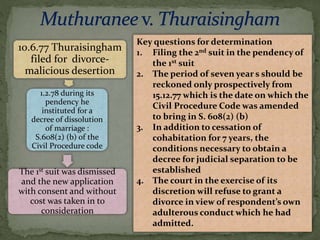
10.6.77 Thuraisingham
filed for divorce-
malicious desertion
1.2.78 during its
pendency he
instituted for a
decree of dissolution
of marriage :
S.608(2) (b) of the
Civil Procedure code
The 1st suit was dismissed
and the new application
with consent and without
cost was taken in to
consideration
Key questions for determination
1. Filing the 2nd suit in the pendency of
the 1st suit
2. The period of seven year s should be
reckoned only prospectively from
15.12.77 which is the date on which the
Civil Procedure Code was amended
to bring in S. 608(2) (b)
3. In addition to cessation of
cohabitation for 7 years, the
conditions necessary to obtain a
decree for judicial separation to be
established
4. The court in the exercise of its
discretion will refuse to grant a
divorce in view of respondent’s own
adulterous conduct which he had
admitted.
 No possibility of the appellant being vexed twice as the 1st
suit was withdrawn and dismissed with her consent.
 Section 608 (2) (b) applies even to cases where parties have
been separated a mens et thoro for more than seven years
prior to the subsection coming into operation.
 “Seperation a mens et thoro” contemplates physical
separation from bed, board, cohabitation and goods and
carries with no connotation to matrimonial fault. 608 (2) (b)
aims to relief irrespective of fault where marriage has broken
down beyond repair.
 The adultery of the plaintiff is no longer a bar to his obtaining
a divorce, whether the application is based on fault under S.
597(1) or the S.608(2)(b) of the Civil procedure code.
 The English law principle
of irretrievable breakdown
of marriage impliedly
introduced to SL law via
S.608 (2) (b).
 Applicant for divorce to
only prove the cessation of
cohabitation for 7 years.
 Discretionary bars to
divorce are no longer
applicable in SL
 When a divorce is claimed
on the basis of a
breakdown of the
marriage, the
matrimonial misconduct
of the plaintiff would only
facilitate the court in
arriving at the conclusion
that the marriage bond is
permanently severe with
no hope of reconciliation.
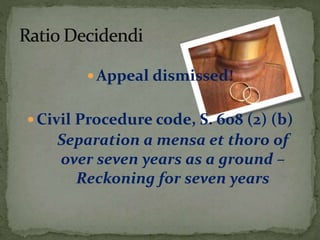
 Appeal dismissed!
 Civil Procedure code, S. 608 (2) (b)
Separation a mensa et thoro of
over seven years as a ground –
Reckoning for seven years
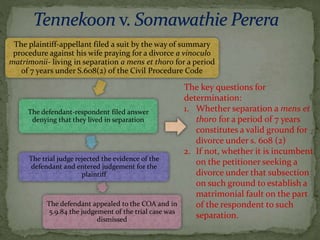
The plaintiff-appellant filed a suit by the way of summary
procedure against his wife praying for a divorce a vinoculo
matrimonii- living in separation a mens et thoro for a period
of 7 years under S.608(2) of the Civil Procedure Code
The defendant-respondent filed answer
denying that they lived in separation
The trial judge rejected the evidence of the
defendant and entered judgement for the
plaintiff
The defendant appealed to the COA and in
5.9.84 the judgement of the trial case was
dismissed
The key questions for
determination:
1. Whether separation a mens et
thoro for a period of 7 years
constitutes a valid ground for
divorce under s. 608 (2)
2. If not, whether it is incumbent
on the petitioner seeking a
divorce under that subsection
on such ground to establish a
matrimonial fault on the part
of the respondent to such
separation.
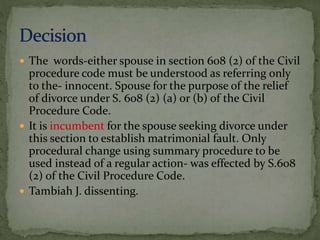
 The words-either spouse in section 608 (2) of the Civil
procedure code must be understood as referring only
to the- innocent. Spouse for the purpose of the relief
of divorce under S. 608 (2) (a) or (b) of the Civil
Procedure Code.
 It is incumbent for the spouse seeking divorce under
this section to establish matrimonial fault. Only
procedural change using summary procedure to be
used instead of a regular action- was effected by S.608
(2) of the Civil Procedure Code.
 Tambiah J. dissenting.
 Appeal dismissed!
 Muthuranee v. Thuraisingham(1984) 1 SRI L. R.
381 overruled.
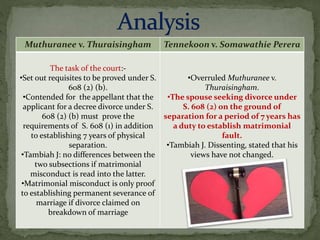
Muthuranee v. Thuraisingham Tennekoon v. Somawathie Perera
The task of the court:-
•Set out requisites to be proved under S.
608 (2) (b).
•Contended for the appellant that the
applicant for a decree divorce under S.
608 (2) (b) must prove the
requirements of S. 608 (1) in addition
to establishing 7 years of physical
separation.
•Tambiah J: no differences between the
two subsections if matrimonial
misconduct is read into the latter.
•Matrimonial misconduct is only proof
to establishing permanent severance of
marriage if divorce claimed on
breakdown of marriage
•Overruled Muthuranee v.
Thuraisingham.
•The spouse seeking divorce under
S. 608 (2) on the ground of
separation for a period of 7 years has
a duty to establish matrimonial
fault.
•Tambiah J. Dissenting, stated that his
views have not changed.
Judicial Separation in Sri Lanka

Judicial Separation in Sri Lanka

  • 2.
    1. Grounds forJudicial Separation 2. Civil Procedure code 3. Muthuranee v. Thuraisingham 4. Tennakoon v. Somawathie Perera 5. Analysis
  • 3.
     The CivilProcedure Code constitutes the general law on judicial separation.  The code provides that either party may petition for separation "on any ground on which by the law applicable to Sri Lanka such separation may be granted."  Thus, Roman-Dutch law grounds for separation are applicable, the essential feature of which is proof that further cohabitation has become dangerous or intolerable due to unlawful conduct by the defendant.
  • 5.
     No. 2of 1889 as amended by Law No. 20 of 1977  Sec. 608 (2) (a):- A decree of judicial separation may be converted to a decree of divorce after the lapse of two years .  Sec. 608 (2) (b):- Mere separation a mensa et thoro for a period of seven years is sufficient to find an action for divorce.
  • 6.
    10.6.77 Thuraisingham filed fordivorce- malicious desertion 1.2.78 during its pendency he instituted for a decree of dissolution of marriage : S.608(2) (b) of the Civil Procedure code The 1st suit was dismissed and the new application with consent and without cost was taken in to consideration Key questions for determination 1. Filing the 2nd suit in the pendency of the 1st suit 2. The period of seven year s should be reckoned only prospectively from 15.12.77 which is the date on which the Civil Procedure Code was amended to bring in S. 608(2) (b) 3. In addition to cessation of cohabitation for 7 years, the conditions necessary to obtain a decree for judicial separation to be established 4. The court in the exercise of its discretion will refuse to grant a divorce in view of respondent’s own adulterous conduct which he had admitted.
  • 7.
     No possibilityof the appellant being vexed twice as the 1st suit was withdrawn and dismissed with her consent.  Section 608 (2) (b) applies even to cases where parties have been separated a mens et thoro for more than seven years prior to the subsection coming into operation.  “Seperation a mens et thoro” contemplates physical separation from bed, board, cohabitation and goods and carries with no connotation to matrimonial fault. 608 (2) (b) aims to relief irrespective of fault where marriage has broken down beyond repair.  The adultery of the plaintiff is no longer a bar to his obtaining a divorce, whether the application is based on fault under S. 597(1) or the S.608(2)(b) of the Civil procedure code.
  • 8.
     The Englishlaw principle of irretrievable breakdown of marriage impliedly introduced to SL law via S.608 (2) (b).  Applicant for divorce to only prove the cessation of cohabitation for 7 years.  Discretionary bars to divorce are no longer applicable in SL  When a divorce is claimed on the basis of a breakdown of the marriage, the matrimonial misconduct of the plaintiff would only facilitate the court in arriving at the conclusion that the marriage bond is permanently severe with no hope of reconciliation.
  • 9.
     Appeal dismissed! Civil Procedure code, S. 608 (2) (b) Separation a mensa et thoro of over seven years as a ground – Reckoning for seven years
  • 10.
    The plaintiff-appellant fileda suit by the way of summary procedure against his wife praying for a divorce a vinoculo matrimonii- living in separation a mens et thoro for a period of 7 years under S.608(2) of the Civil Procedure Code The defendant-respondent filed answer denying that they lived in separation The trial judge rejected the evidence of the defendant and entered judgement for the plaintiff The defendant appealed to the COA and in 5.9.84 the judgement of the trial case was dismissed The key questions for determination: 1. Whether separation a mens et thoro for a period of 7 years constitutes a valid ground for divorce under s. 608 (2) 2. If not, whether it is incumbent on the petitioner seeking a divorce under that subsection on such ground to establish a matrimonial fault on the part of the respondent to such separation.
  • 11.
     The words-eitherspouse in section 608 (2) of the Civil procedure code must be understood as referring only to the- innocent. Spouse for the purpose of the relief of divorce under S. 608 (2) (a) or (b) of the Civil Procedure Code.  It is incumbent for the spouse seeking divorce under this section to establish matrimonial fault. Only procedural change using summary procedure to be used instead of a regular action- was effected by S.608 (2) of the Civil Procedure Code.  Tambiah J. dissenting.
  • 12.
     Appeal dismissed! Muthuranee v. Thuraisingham(1984) 1 SRI L. R. 381 overruled.
  • 13.
    Muthuranee v. ThuraisinghamTennekoon v. Somawathie Perera The task of the court:- •Set out requisites to be proved under S. 608 (2) (b). •Contended for the appellant that the applicant for a decree divorce under S. 608 (2) (b) must prove the requirements of S. 608 (1) in addition to establishing 7 years of physical separation. •Tambiah J: no differences between the two subsections if matrimonial misconduct is read into the latter. •Matrimonial misconduct is only proof to establishing permanent severance of marriage if divorce claimed on breakdown of marriage •Overruled Muthuranee v. Thuraisingham. •The spouse seeking divorce under S. 608 (2) on the ground of separation for a period of 7 years has a duty to establish matrimonial fault. •Tambiah J. Dissenting, stated that his views have not changed.