Web 2.0: The Potential Of RSS And Location Based Services Brian Kelly UKOLN University of Bath Bath Email [email_address] UKOLN is supported by: http://www.ukoln.ac.uk/web-focus/events/meetings/edinburgh-2006-09/ This work is licensed under a Attribution-NonCommercial-ShareAlike 2.0 licence (but note caveat) Resources bookmarked using ' edinburgh-2006-09 ' tag  Aims: Build on recent Scottish-web-people and JISC meetings Explore options for enhancing use of RSS Advice to JISC & JISC Services  Discuss institutional perspective Start discussions on simple location-based services
Contents This brief talk (14 slides) will cover: RSS: News feeds  Syndication Navigation   Maximising impact Location-Based Services Google Maps mashups Location-based metadata (and microformats) Deployment Challenges Should we do it? What are the barriers? Where to from here? General discussion
RSS RSS: Killer lightweight format Initially used to allow news to be embedded in others Web sites Now used for general syndication of content Use in Blogs helped in take-up Lots of ways of using RSS, creating RSS, RSS tools, etc. RSS See  An Introduction To RSS And News Feeds   QA Focus briefing document no. 78
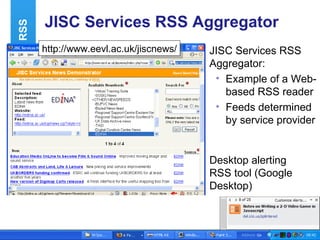
JISC Services RSS Aggregator JISC Services RSS Aggregator: Example of a Web-based RSS reader Feeds determined by service provider RSS http://www.eevl.ac.uk/jiscnews/ Desktop alerting RSS tool (Google Desktop)
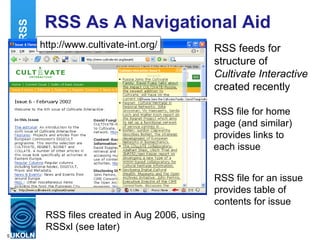
RSS As A Navigational Aid RSS feeds for structure of  Cultivate Interactive  created recently RSS http://www.cultivate-int.org/ RSS files created in Aug 2006, using RSSxl (see later) RSS file for home page (and similar) provides links to each issue RSS file for an issue provides table of contents for issue
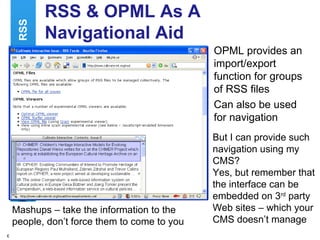
RSS & OPML As A Navigational Aid OPML provides an import/export function for groups of RSS files Can also be used for navigation RSS But I can provide such navigation using my CMS? Yes, but remember that the interface can be embedded on 3 rd  party Web sites – which your CMS doesn’t manage Mashups – take the information to the people, don’t force them to come to you
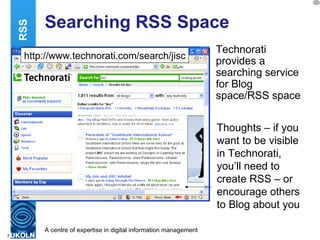
Searching RSS Space Technorati provides a searching service for Blog space/RSS space RSS http://www.technorati.com/search/edina http://www.technorati.com/search/jisc Thoughts – if you want to be visible in Technorati, you’ll need to create RSS – or encourage others to Blog about you
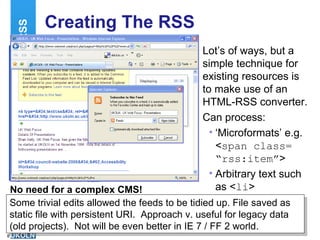
Creating The RSS Lot’s of ways, but a simple technique for existing resources is to make use of an HTML-RSS converter. Can process: ‘ Microformats’ e.g. < span class= “rss:item” > Arbitrary text such as < li > RSS http://www.wotzwot.com/ No need for a complex CMS! Some trivial edits allowed the feeds to be tidied up. File saved as static file with persistent URI.  Approach v. useful for legacy data (old projects).  Not will be even better in IE 7 / FF 2 world.
Mapping Services & The Web Web 2.0 provides valuable opportunity to provide mapping & location services: Embedding Google maps on your Web sites Developing rich services using this Providing location metadata / microformats which can be processed by simple browser tools Location Services
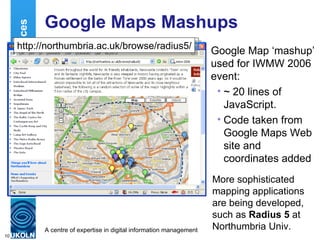
Google Maps Mashups Google Map ‘mashup’ used for IWMW 2006 event: ~ 20 lines of JavaScript. Code taken from Google Maps Web site and coordinates added Location Services http://www.ukoln.ac.uk/web-focus/events/ workshops/webmaster-2006/maps/ http://northumbria.ac.uk/browse/radius5/ More sophisticated mapping applications are being developed, such as  Radius 5  at Northumbria Univ.
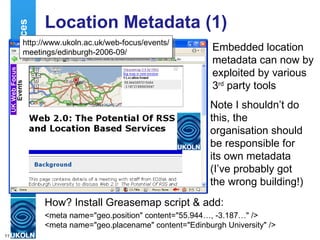
Location Metadata (1) Embedded location metadata can now by exploited by various 3 rd  party tools Location Services How? Install Greasemap script & add: <meta name=&quot;geo.position&quot; content=&quot;55.944…, -3.187…&quot; />  <meta name=&quot;geo.placename&quot; content=&quot;Edinburgh University&quot; />  http://www.ukoln.ac.uk/web-focus/events/ meetings/edinburgh-2006-09/ Note I shouldn’t do this, the organisation should be responsible for its own metadata (I’ve probably got the wrong building!)
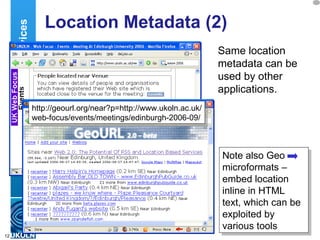
Location Metadata (2) Same location metadata can be used by other applications. Location Services Note also Geo microformats – embed location inline in HTML text, which can be exploited by various tools http://geourl.org/near?p=http://www.ukoln.ac.uk/ web-focus/events/meetings/edinburgh-2006-09/
Challenges & Opportunities  Challenges: Accessibility (can be addressed) Resourcing Reliability, robustness, quality, trust, etc. Will users use it?  Do they want it? Opportunities: Significant benefits at low cost Being (slightly) at the leading edge Discussing & sharing best practices, coordination Software development (EDINA, UK, … scripts, etc) …  Key points: Much of this stuff can be easy to do, so let’s do it! Remember the benefits of scale (Metcalfe’s Law) that we (developers & our users) gain as more of us do this. What Next?
Discussion Opportunity for general discussion Note resources cited in the talk are bookmarked in del.icio.us using tag '‘ edinburgh-2006-09 &quot; Also note that briefing documents on various Web 2.0 issues (and other areas) are available on QA Focus Web site What Next?

Web 2.0: The Potential Of RSS and Location Based Services

  • 1.
    Web 2.0: ThePotential Of RSS And Location Based Services Brian Kelly UKOLN University of Bath Bath Email [email_address] UKOLN is supported by: http://www.ukoln.ac.uk/web-focus/events/meetings/edinburgh-2006-09/ This work is licensed under a Attribution-NonCommercial-ShareAlike 2.0 licence (but note caveat) Resources bookmarked using ' edinburgh-2006-09 ' tag Aims: Build on recent Scottish-web-people and JISC meetings Explore options for enhancing use of RSS Advice to JISC & JISC Services Discuss institutional perspective Start discussions on simple location-based services
  • 2.
    Contents This brieftalk (14 slides) will cover: RSS: News feeds  Syndication Navigation  Maximising impact Location-Based Services Google Maps mashups Location-based metadata (and microformats) Deployment Challenges Should we do it? What are the barriers? Where to from here? General discussion
  • 3.
    RSS RSS: Killerlightweight format Initially used to allow news to be embedded in others Web sites Now used for general syndication of content Use in Blogs helped in take-up Lots of ways of using RSS, creating RSS, RSS tools, etc. RSS See An Introduction To RSS And News Feeds QA Focus briefing document no. 78
  • 4.
    JISC Services RSSAggregator JISC Services RSS Aggregator: Example of a Web-based RSS reader Feeds determined by service provider RSS http://www.eevl.ac.uk/jiscnews/ Desktop alerting RSS tool (Google Desktop)
  • 5.
    RSS As ANavigational Aid RSS feeds for structure of Cultivate Interactive created recently RSS http://www.cultivate-int.org/ RSS files created in Aug 2006, using RSSxl (see later) RSS file for home page (and similar) provides links to each issue RSS file for an issue provides table of contents for issue
  • 6.
    RSS & OPMLAs A Navigational Aid OPML provides an import/export function for groups of RSS files Can also be used for navigation RSS But I can provide such navigation using my CMS? Yes, but remember that the interface can be embedded on 3 rd party Web sites – which your CMS doesn’t manage Mashups – take the information to the people, don’t force them to come to you
  • 7.
    Searching RSS SpaceTechnorati provides a searching service for Blog space/RSS space RSS http://www.technorati.com/search/edina http://www.technorati.com/search/jisc Thoughts – if you want to be visible in Technorati, you’ll need to create RSS – or encourage others to Blog about you
  • 8.
    Creating The RSSLot’s of ways, but a simple technique for existing resources is to make use of an HTML-RSS converter. Can process: ‘ Microformats’ e.g. < span class= “rss:item” > Arbitrary text such as < li > RSS http://www.wotzwot.com/ No need for a complex CMS! Some trivial edits allowed the feeds to be tidied up. File saved as static file with persistent URI. Approach v. useful for legacy data (old projects). Not will be even better in IE 7 / FF 2 world.
  • 9.
    Mapping Services &The Web Web 2.0 provides valuable opportunity to provide mapping & location services: Embedding Google maps on your Web sites Developing rich services using this Providing location metadata / microformats which can be processed by simple browser tools Location Services
  • 10.
    Google Maps MashupsGoogle Map ‘mashup’ used for IWMW 2006 event: ~ 20 lines of JavaScript. Code taken from Google Maps Web site and coordinates added Location Services http://www.ukoln.ac.uk/web-focus/events/ workshops/webmaster-2006/maps/ http://northumbria.ac.uk/browse/radius5/ More sophisticated mapping applications are being developed, such as Radius 5 at Northumbria Univ.
  • 11.
    Location Metadata (1)Embedded location metadata can now by exploited by various 3 rd party tools Location Services How? Install Greasemap script & add: <meta name=&quot;geo.position&quot; content=&quot;55.944…, -3.187…&quot; /> <meta name=&quot;geo.placename&quot; content=&quot;Edinburgh University&quot; /> http://www.ukoln.ac.uk/web-focus/events/ meetings/edinburgh-2006-09/ Note I shouldn’t do this, the organisation should be responsible for its own metadata (I’ve probably got the wrong building!)
  • 12.
    Location Metadata (2)Same location metadata can be used by other applications. Location Services Note also Geo microformats – embed location inline in HTML text, which can be exploited by various tools http://geourl.org/near?p=http://www.ukoln.ac.uk/ web-focus/events/meetings/edinburgh-2006-09/
  • 13.
    Challenges & Opportunities Challenges: Accessibility (can be addressed) Resourcing Reliability, robustness, quality, trust, etc. Will users use it? Do they want it? Opportunities: Significant benefits at low cost Being (slightly) at the leading edge Discussing & sharing best practices, coordination Software development (EDINA, UK, … scripts, etc) … Key points: Much of this stuff can be easy to do, so let’s do it! Remember the benefits of scale (Metcalfe’s Law) that we (developers & our users) gain as more of us do this. What Next?
  • 14.
    Discussion Opportunity forgeneral discussion Note resources cited in the talk are bookmarked in del.icio.us using tag '‘ edinburgh-2006-09 &quot; Also note that briefing documents on various Web 2.0 issues (and other areas) are available on QA Focus Web site What Next?