Web 2.0: What Can It Offer The Research Community? (or let’s stop talking and start doing!) Brian Kelly UKOLN University of Bath Bath Email [email_address] UKOLN is supported by: http://www.ukoln.ac.uk/web-focus/events/meetings/pparc-2007-03/ Acceptable Use Policy Recording/broadcasting of this talk, taking photographs, discussing the content using email, instant messaging, Blogs, SMS, etc. is permitted providing distractions to others is minimised. This work is licensed under a Attribution-NonCommercial-ShareAlike 2.0 licence (but note caveat) Resources bookmarked using ‘ pparc-2007-03 ' tag
About Me Brian Kelly: UK Web Focus: a Web advisory post based at UKOLN Funded by JISC and MLA to advise HE/FE and cultural heritage sectors Web enthusiast since Jan 1993 (helped set up 1 st  institutional Web server in UK HE) Published many papers & given many presentations on variety of Web issues UKOLN: National centre of expertise in digital information management Located at the University of Bath
Contents Web 2.0 – What Is It? (Talking …) Blogs  Wikis RSS    Mashups Microformats    Comms tools Social bookmarking    … Deployment Strategies (… doing) User focus Information literacy; staff development Risk assessment Safe experimentation
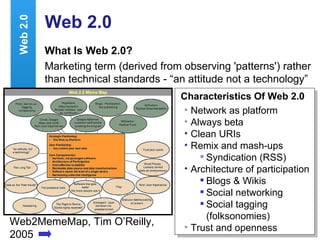
Web 2.0 What Is Web 2.0? Marketing term (derived from observing 'patterns') rather than technical standards - “an attitude not a technology”  Web2MemeMap, Tim O’Reilly, 2005 Characteristics Of Web 2.0 Network as platform Always beta Clean URIs Remix and mash-ups  Syndication (RSS) Architecture of participation Blogs & Wikis Social networking  Social tagging (folksonomies) Trust and openness Web 2.0
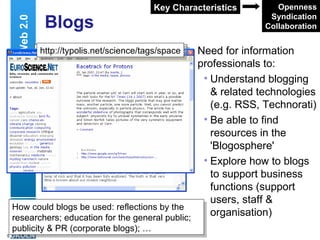
Blogs Need for information professionals to: Understand blogging & related technologies (e.g. RSS, Technorati) Be able to find resources in the 'Blogosphere' Explore how to blogs to support business functions (support users, staff & organisation) Web 2.0 Openness Syndication Collaboration Key Characteristics http://www.engineeringbritain.com/space/ archives/66-Shooting-for-the-Moon.html http://typolis.net/science/tags/space How could blogs be used: reflections by the researchers; education for the general public; publicity & PR (corporate blogs); …
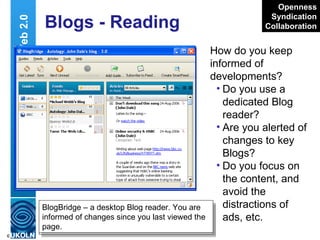
Blogs - Reading How do you keep informed of developments?  Do you use a dedicated Blog reader? Are you alerted of changes to key Blogs? Do you focus on the content, and avoid the distractions of ads, etc. Web 2.0 Bloglines – a Web-based Blog reader. You are informed of changes since you last viewed the page. http://www.bloglines.com/myblogs Openness Syndication Collaboration BlogBridge – a desktop Blog reader. You are informed of changes since you last viewed the page.
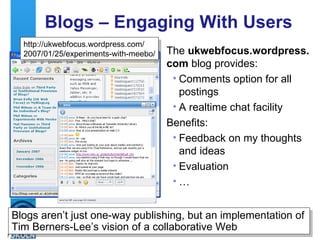
Blogs – Engaging With Users The  ukwebfocus.wordpress. com  blog provides: Comments option for all postings A realtime chat facility Benefits: Feedback on my thoughts and ideas Evaluation  … http://ukwebfocus.wordpress.com/ 2007/01/25/experiments-with-meebo/ Blogs aren’t just one-way publishing, but an implementation of Tim Berners-Lee’s vision of a collaborative Web
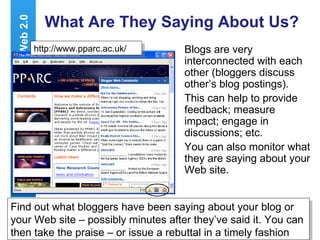
What Are They Saying About Us? Blogs are very interconnected with each other (bloggers discuss other’s blog postings). This can help to provide feedback; measure impact; engage in discussions; etc. You can also monitor what they are saying about your Web site. Web 2.0 Find out what bloggers have been saying about your blog or your Web site – possibly minutes after they’ve said it. You can then take the praise – or issue a rebuttal in a timely fashion  http://www.pparc.ac.uk/
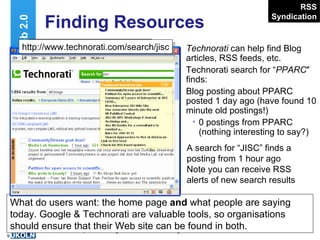
Finding Resources Technorati  can help find Blog articles, RSS feeds, etc. Technorati search for “ PPARC " finds: Blog posting about PPARC posted 1 day ago (have found 10 minute old postings!) 0 postings from PPARC (nothing interesting to say?) Web 2.0 RSS Syndication http://www.technorati.com/ … What do users want: the home page  and  what people are saying today. Google & Technorati are valuable tools, so organisations should ensure that their Web site can be found in both. A search for “JISC” finds a posting from 1 hour ago Note you can receive RSS alerts of new search results http://www.technorati.com/search/jisc
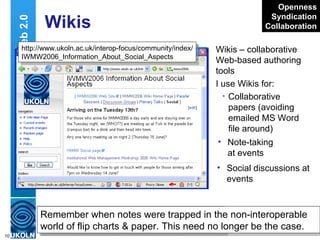
Wikis Wikis – collaborative Web-based authoring tools I use Wikis for: Collaborative papers (avoiding emailed MS Word file around) Web 2.0 Writely  – Web-based word processor or Wiki?  Does it matter, it does the job http://www.writely.com/ Openness Syndication Collaboration http://www.ukoln.ac.uk/interop-focus/community/index/ IWMW2006_Discussion_Group_Notes_for_Group_A Note-taking at events Remember when   notes were trapped in the non-interoperable world of flip charts & paper. This need no longer be the case. Social discussions at events http://www.ukoln.ac.uk/interop-focus/community/index/ IWMW2006_Information_About_Social_Aspects
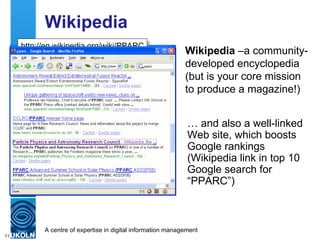
Wikipedia Wikipedia  –a community-developed encyclopedia  (but is your core mission to produce a magazine!) http://en.wikipedia.org/wiki/PPARC …  and also a well-linked Web site, which boosts Google rankings (Wikipedia link in top 10 Google search for “PPARC”)
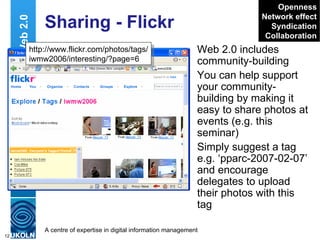
Sharing - Flickr Web 2.0 includes community-building You can help support your community-building by making it easy to share photos at events (e.g. this seminar) Simply suggest a tag e.g. ‘pparc-2007-02-07’ and encourage delegates to upload their photos with this tag Web 2.0 http://www.flickr.com/search/ ?w=all&q=iwmw2006&m=text Openness Network effect Syndication Collaboration http://www.flickr.com/photos/tags/ iwmw2006/interesting/?page=6
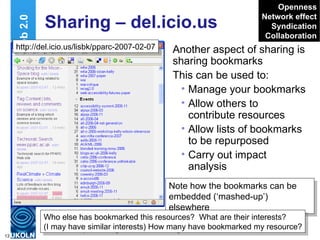
Sharing – del.icio.us Another aspect of sharing is sharing bookmarks This can be used to: Manage your bookmarks Allow others to contribute resources Allow lists of bookmarks to be repurposed Carry out impact analysis Web 2.0 Openness Network effect Syndication Collaboration Note how the bookmarks can be embedded (‘mashed-up’) elsewhere  http://del.icio.us/lisbk/pparc-2007-02-07 Who else has bookmarked this resources?  What are their interests? (I may have similar interests) How many have bookmarked my resource?
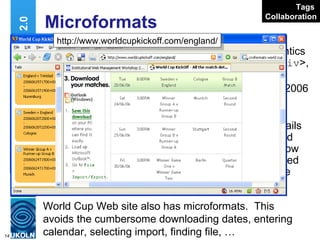
Microformats Add simple semantics using < span >, < div >, etc. classes: Pages on IWMW 2006 Web site have microformats Plugins such as Tails display contact and event details & allow them to be uploaded to Outlook, Google Calendar, etc Web 2.0 http://www.ukoln.ac.uk/web-focus/events/ workshops/webmaster-2006/sessions/kelly World Cup Web site also has microformats.  This avoids the cumbersome downloading dates, entering calendar, selecting import, finding file, …  http://www.worldcupkickoff.com/england/ Tags   Collaboration
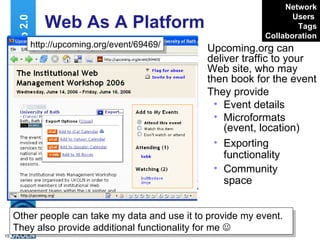
Upcoming.org can deliver traffic to your Web site, who may then book for the event They provide Event details Microformats (event, location) Web As A Platform  Exporting functionality Community space Web 2.0 http://upcoming.org/event/69469/ Other people can take my data and use it to provide my event. They also provide additional functionality for me   Network Users   Tags Collaboration
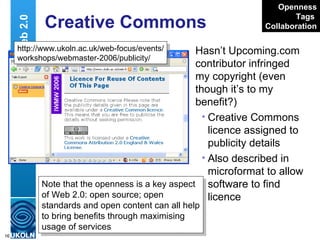
Creative Commons Hasn’t Upcoming.com contributor infringed my copyright (even though it’s to my benefit?)  Creative Commons licence assigned to publicity details Also described in microformat to allow software to find licence Web 2.0 http://www.ukoln.ac.uk/web-focus/events/ workshops/webmaster-2006/publicity/ Openness Tags   Collaboration Note that the openness is a key aspect of Web 2.0: open source; open standards and open content can all help to bring benefits through maximising usage of services
Mapping Services & The Web Web 2.0 provides valuable opportunity to provide mapping & location services: Embedding Google maps on your Web sites Developing rich services using this Providing location metadata / microformats which can be processed by simple browser tools Web 2.0
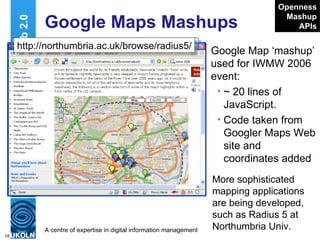
Google Maps Mashups Google Map ‘mashup’ used for IWMW 2006 event: ~ 20 lines of JavaScript. Code taken from Googler Maps Web site and coordinates added Web 2.0 http://www.ukoln.ac.uk/web-focus/events/ workshops/webmaster-2006/maps/ Openness Mashup APIs http://northumbria.ac.uk/browse/radius5/ More sophisticated mapping applications are being developed, such as Radius 5 at Northumbria Univ.
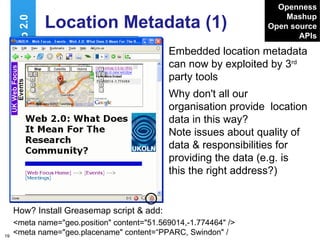
Location Metadata (1) Embedded location metadata can now by exploited by 3 rd  party tools Web 2.0 Openness Mashup Open source APIs Why don't all our organisation provide  location data in this way? Note issues about quality of data & responsibilities for providing the data (e.g. is this the right address?) http://www.ukoln.ac.uk/web-focus/ events/meetings/pparc-2007-02-07/ How? Install Greasemap script & add: <meta name=&quot;geo.position&quot; content=&quot;51.569014,-1.774464&quot; />  <meta name=&quot;geo.placename&quot; content=“PPARC, Swindon&quot; /
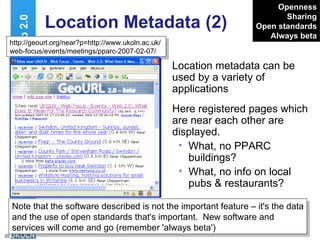
Location Metadata (2) Location metadata can be used by a variety of applications Web 2.0 Openness Sharing Open standards Always beta http://geourl.org/near?p=http://www.ukoln.ac.uk/web-focus/events/meetings/pparc-2007-02-07/ Note that the software described is not the important feature – it's the data and the use of open standards that's important.  New software and services will come and go (remember 'always beta') Here registered pages which are near each other are displayed. What, no PPARC buildings? What, no info on local pubs & restaurants?
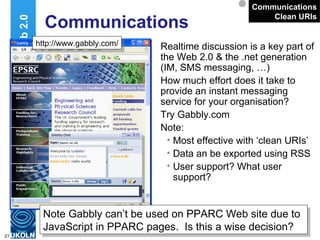
Communications Realtime discussion is a key part of the Web 2.0 & the .net generation (IM, SMS messaging, …) How much effort does it take to provide an instant messaging service for your organisation? Try Gabbly.com Note: Most effective with ‘clean URIs’ Data an be exported using RSS User support? What user support? Web 2.0 Communications Clean URIs http://www.gabbly.com/ Note Gabbly can’t be used on PPARC Web site due to JavaScript in PPARC pages.  Is this a wise decision?
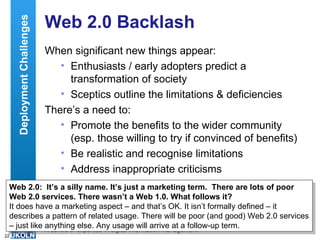
Web 2.0 Backlash When significant new things appear: Enthusiasts / early adopters predict a transformation of society Sceptics outline the limitations & deficiencies There’s a need to: Promote the benefits to the wider community (esp. those willing to try if convinced of benefits) Be realistic and recognise limitations Address inappropriate criticisms Web 2.0:  It’s a silly name. It’s just a marketing term.  There are lots of poor Web 2.0 services. There wasn’t a Web 1.0. What follows it? It does have a marketing aspect – and that’s OK. It isn’t formally defined – it describes a pattern of related usage. There will be poor (and good) Web 2.0 services – just like anything else. Any usage will arrive at a follow-up term. Deployment Challenges
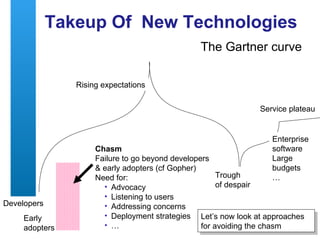
Takeup Of  New Technologies The Gartner curve Developers Rising expectations Trough  of despair Service plateau Enterprise software Large budgets … Early  adopters Chasm Failure to go beyond developers & early adopters (cf Gopher) Need for: Advocacy Listening to users Addressing concerns Deployment strategies … Let’s now look at approaches for avoiding the chasm
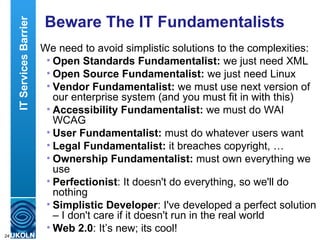
Beware The IT Fundamentalists We need to avoid simplistic solutions to the complexities: Open Standards Fundamentalist:  we just need XML Open Source Fundamentalist:  we just need Linux Vendor Fundamentalist:  we must use next version of our enterprise system (and you must fit in with this) Accessibility Fundamentalist:  we must do WAI WCAG User Fundamentalist:  must do whatever users want Legal Fundamentalist:  it breaches copyright, … Ownership   Fundamentalist:  must own everything we use Perfectionist : It doesn't do everything, so we'll do nothing Simplistic Developer : I've developed a perfect solution – I don't care if it doesn't run in the real world Web 2.0 : It’s new; its cool! IT Services Barrier
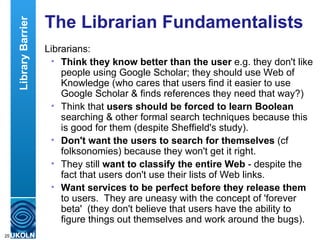
The Librarian Fundamentalists Librarians: Think they know better than the user  e.g. they don't like people using Google Scholar; they should use Web of Knowledge (who cares that users find it easier to use Google Scholar & finds references they need that way?) Think that  users should be forced to learn Boolean  searching & other formal search techniques because this is good for them (despite Sheffield's study).  Don't want the users to search for themselves  (cf folksonomies) because they won't get it right. They still  want to classify the entire Web  - despite the fact that users don't use their lists of Web links. Want services to be perfect before they release them  to users.  They are uneasy with the concept of 'forever beta'  (they don't believe that users have the ability to figure things out themselves and work around the bugs). Library Barrier
Deployment Strategies Interested in using Web 2.0 in your organisation? Worried about corporate inertia, power struggles, etc? There’s a need for a deployment strategy: Addressing business needs Low-hanging fruits Encouraging the enthusiasts Gain experience of the browser tools – and see what you’re missing! Staff training & development Address areas you feel comfortable with Risk management strategy …  Deployment Challenges
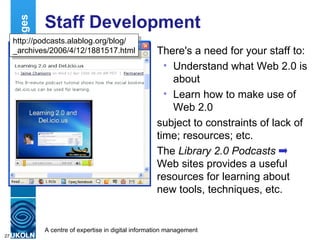
Staff Development There's a need for your staff to: Understand what Web 2.0 is about Learn how to make use of Web 2.0 subject to constraints of lack of time; resources; etc. The  Library 2.0 Podcasts   Web sites provides a useful resources for learning about new tools, techniques, etc. Deployment Challenges http://podcasts.alablog.org/blog/ _archives/2006/4/12/1881517.html
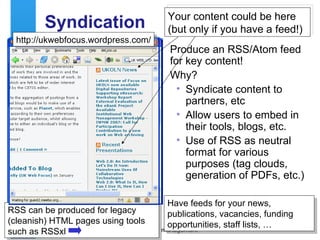
Syndication Produce an RSS/Atom feed for key content! Why? Syndicate content to partners, etc Allow users to embed in their tools, blogs, etc. Use of RSS as neutral format for various purposes (tag clouds, generation of PDFs, etc.) http://www.ukoln.ac.uk/qa-focus/rss/ RSS can be produced for legacy (cleanish) HTML pages using tools such as RSSxl  http://ukwebfocus.wordpress.com/ Your content could be here (but only if you have a feed!) Have feeds for your news, publications, vacancies, funding opportunities, staff lists, …
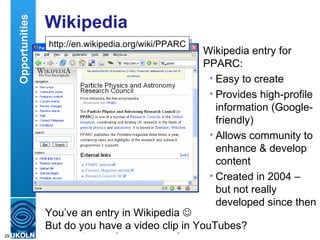
Wikipedia Wikipedia entry for PPARC: Easy to create Provides high-profile information (Google-friendly) Allows community to enhance & develop content Created in 2004 – but not really developed since then Opportunities You’ve an entry in Wikipedia   But do you have a video clip in YouTubes? http://en.wikipedia.org/wiki/PPARC
IWMW 2006 & Risk Management  IWMW 2006 has taken a risk management approach to its evaluation of Web 2.0 technologies: Agreements : e.g. in the case of the Chatbot. Use of  well-established services : Google & del.icio.us are well-established and have financial security.  Notification : warnings that services could be lost.  Engagement : with the user community: users actively engage in the evaluation of the services.  Provision of  alternative  services: multiple OMPL tools.  Use in  non-mission critical  areas: not for bookings!  Long term experiences  of services:  usage stats Availability of  alternative sources of data : e.g. standard Web server log files. Data  export  and aggregation: RSS feeds, aggregated in Suprglu, OPML viewers, etc. Deployment Strategy
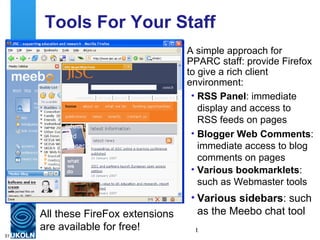
Tools For Your Staff A simple approach for PPARC staff: provide Firefox to give a rich client environment: All these FireFox extensions  are available for free! RSS Panel : immediate display and access to RSS feeds on pages  Blogger Web Comments : immediate access to blog comments on pages  Various bookmarklets : such as Webmaster tools Various sidebars : such as the Meebo chat tool
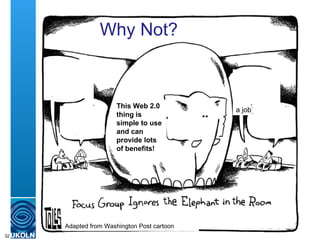
Why Not? JISC   Adapted from Washington Post cartoon JISC   Civil Service  prefers ‘best of breed’ systems Where’s the vendor’s roadmap? Google might go bankrupt I want to develop stuff  so I’ll always have a job) This Web 2.0 thing is simple to use and can provide lots of benefits! Why Not?
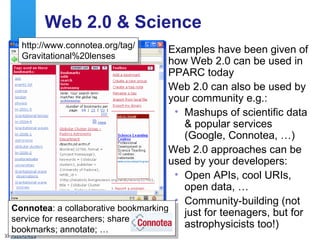
Web 2.0 & Science Examples have been given of how Web 2.0 can be used in PPARC today Web 2.0 can also be used by your community e.g.: Mashups of scientific data & popular services (Google, Connotea, …) Web 2.0 approaches can be used by your developers: Open APIs, cool URIs, open data, … Community-building (not just for teenagers, but for astrophysicists too!) http://moon.google.com/ http://www.connotea.org/tag/ Gravitational%20lenses Connotea : a collaborative bookmarking service for researchers; share bookmarks; annotate; …
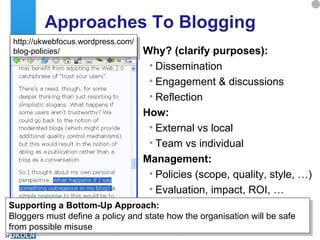
Approaches To Blogging  Why? (clarify purposes): Dissemination Engagement & discussions Reflection How: External vs local Team vs individual Management: Policies (scope, quality, style, …) Evaluation, impact, ROI, … Supporting a Bottom-Up Approach: Bloggers must define a policy and state how the organisation will be safe from possible misuse http://ukwebfocus.wordpress.com/ blog-policies/
PPARC 2.0 PPARC 2.0: An opportunity for PPARC to rethink traditional approaches & assumptions An opportunity provided by organisational changes An opportunity to identify the ‘low-hanging fruit’
Conclusions To conclude: Web 2.0 can provide real benefits for our users However organisations tend to be conservative We therefore need: Advocacy To listen to users' concerns To address users' concerns e.g. risk management We can all benefit by adopting Web 2.0 principles of openness and sharing. So let us: Share our advocacy resources, risk management techniques, etc. Develop your own social network based on openness, trust, collaboration, .. Read my  UKWebFocus.wordpress.com  Blog Conclusions

Web 2.0: What Can It Offer The Research Community?

  • 1.
    Web 2.0: WhatCan It Offer The Research Community? (or let’s stop talking and start doing!) Brian Kelly UKOLN University of Bath Bath Email [email_address] UKOLN is supported by: http://www.ukoln.ac.uk/web-focus/events/meetings/pparc-2007-03/ Acceptable Use Policy Recording/broadcasting of this talk, taking photographs, discussing the content using email, instant messaging, Blogs, SMS, etc. is permitted providing distractions to others is minimised. This work is licensed under a Attribution-NonCommercial-ShareAlike 2.0 licence (but note caveat) Resources bookmarked using ‘ pparc-2007-03 ' tag
  • 2.
    About Me BrianKelly: UK Web Focus: a Web advisory post based at UKOLN Funded by JISC and MLA to advise HE/FE and cultural heritage sectors Web enthusiast since Jan 1993 (helped set up 1 st institutional Web server in UK HE) Published many papers & given many presentations on variety of Web issues UKOLN: National centre of expertise in digital information management Located at the University of Bath
  • 3.
    Contents Web 2.0– What Is It? (Talking …) Blogs  Wikis RSS  Mashups Microformats  Comms tools Social bookmarking  … Deployment Strategies (… doing) User focus Information literacy; staff development Risk assessment Safe experimentation
  • 4.
    Web 2.0 WhatIs Web 2.0? Marketing term (derived from observing 'patterns') rather than technical standards - “an attitude not a technology” Web2MemeMap, Tim O’Reilly, 2005 Characteristics Of Web 2.0 Network as platform Always beta Clean URIs Remix and mash-ups Syndication (RSS) Architecture of participation Blogs & Wikis Social networking Social tagging (folksonomies) Trust and openness Web 2.0
  • 5.
    Blogs Need forinformation professionals to: Understand blogging & related technologies (e.g. RSS, Technorati) Be able to find resources in the 'Blogosphere' Explore how to blogs to support business functions (support users, staff & organisation) Web 2.0 Openness Syndication Collaboration Key Characteristics http://www.engineeringbritain.com/space/ archives/66-Shooting-for-the-Moon.html http://typolis.net/science/tags/space How could blogs be used: reflections by the researchers; education for the general public; publicity & PR (corporate blogs); …
  • 6.
    Blogs - ReadingHow do you keep informed of developments? Do you use a dedicated Blog reader? Are you alerted of changes to key Blogs? Do you focus on the content, and avoid the distractions of ads, etc. Web 2.0 Bloglines – a Web-based Blog reader. You are informed of changes since you last viewed the page. http://www.bloglines.com/myblogs Openness Syndication Collaboration BlogBridge – a desktop Blog reader. You are informed of changes since you last viewed the page.
  • 7.
    Blogs – EngagingWith Users The ukwebfocus.wordpress. com blog provides: Comments option for all postings A realtime chat facility Benefits: Feedback on my thoughts and ideas Evaluation … http://ukwebfocus.wordpress.com/ 2007/01/25/experiments-with-meebo/ Blogs aren’t just one-way publishing, but an implementation of Tim Berners-Lee’s vision of a collaborative Web
  • 8.
    What Are TheySaying About Us? Blogs are very interconnected with each other (bloggers discuss other’s blog postings). This can help to provide feedback; measure impact; engage in discussions; etc. You can also monitor what they are saying about your Web site. Web 2.0 Find out what bloggers have been saying about your blog or your Web site – possibly minutes after they’ve said it. You can then take the praise – or issue a rebuttal in a timely fashion http://www.pparc.ac.uk/
  • 9.
    Finding Resources Technorati can help find Blog articles, RSS feeds, etc. Technorati search for “ PPARC &quot; finds: Blog posting about PPARC posted 1 day ago (have found 10 minute old postings!) 0 postings from PPARC (nothing interesting to say?) Web 2.0 RSS Syndication http://www.technorati.com/ … What do users want: the home page and what people are saying today. Google & Technorati are valuable tools, so organisations should ensure that their Web site can be found in both. A search for “JISC” finds a posting from 1 hour ago Note you can receive RSS alerts of new search results http://www.technorati.com/search/jisc
  • 10.
    Wikis Wikis –collaborative Web-based authoring tools I use Wikis for: Collaborative papers (avoiding emailed MS Word file around) Web 2.0 Writely – Web-based word processor or Wiki? Does it matter, it does the job http://www.writely.com/ Openness Syndication Collaboration http://www.ukoln.ac.uk/interop-focus/community/index/ IWMW2006_Discussion_Group_Notes_for_Group_A Note-taking at events Remember when notes were trapped in the non-interoperable world of flip charts & paper. This need no longer be the case. Social discussions at events http://www.ukoln.ac.uk/interop-focus/community/index/ IWMW2006_Information_About_Social_Aspects
  • 11.
    Wikipedia Wikipedia –a community-developed encyclopedia (but is your core mission to produce a magazine!) http://en.wikipedia.org/wiki/PPARC … and also a well-linked Web site, which boosts Google rankings (Wikipedia link in top 10 Google search for “PPARC”)
  • 12.
    Sharing - FlickrWeb 2.0 includes community-building You can help support your community-building by making it easy to share photos at events (e.g. this seminar) Simply suggest a tag e.g. ‘pparc-2007-02-07’ and encourage delegates to upload their photos with this tag Web 2.0 http://www.flickr.com/search/ ?w=all&q=iwmw2006&m=text Openness Network effect Syndication Collaboration http://www.flickr.com/photos/tags/ iwmw2006/interesting/?page=6
  • 13.
    Sharing – del.icio.usAnother aspect of sharing is sharing bookmarks This can be used to: Manage your bookmarks Allow others to contribute resources Allow lists of bookmarks to be repurposed Carry out impact analysis Web 2.0 Openness Network effect Syndication Collaboration Note how the bookmarks can be embedded (‘mashed-up’) elsewhere http://del.icio.us/lisbk/pparc-2007-02-07 Who else has bookmarked this resources? What are their interests? (I may have similar interests) How many have bookmarked my resource?
  • 14.
    Microformats Add simplesemantics using < span >, < div >, etc. classes: Pages on IWMW 2006 Web site have microformats Plugins such as Tails display contact and event details & allow them to be uploaded to Outlook, Google Calendar, etc Web 2.0 http://www.ukoln.ac.uk/web-focus/events/ workshops/webmaster-2006/sessions/kelly World Cup Web site also has microformats. This avoids the cumbersome downloading dates, entering calendar, selecting import, finding file, … http://www.worldcupkickoff.com/england/ Tags Collaboration
  • 15.
    Upcoming.org can delivertraffic to your Web site, who may then book for the event They provide Event details Microformats (event, location) Web As A Platform Exporting functionality Community space Web 2.0 http://upcoming.org/event/69469/ Other people can take my data and use it to provide my event. They also provide additional functionality for me  Network Users Tags Collaboration
  • 16.
    Creative Commons Hasn’tUpcoming.com contributor infringed my copyright (even though it’s to my benefit?) Creative Commons licence assigned to publicity details Also described in microformat to allow software to find licence Web 2.0 http://www.ukoln.ac.uk/web-focus/events/ workshops/webmaster-2006/publicity/ Openness Tags Collaboration Note that the openness is a key aspect of Web 2.0: open source; open standards and open content can all help to bring benefits through maximising usage of services
  • 17.
    Mapping Services &The Web Web 2.0 provides valuable opportunity to provide mapping & location services: Embedding Google maps on your Web sites Developing rich services using this Providing location metadata / microformats which can be processed by simple browser tools Web 2.0
  • 18.
    Google Maps MashupsGoogle Map ‘mashup’ used for IWMW 2006 event: ~ 20 lines of JavaScript. Code taken from Googler Maps Web site and coordinates added Web 2.0 http://www.ukoln.ac.uk/web-focus/events/ workshops/webmaster-2006/maps/ Openness Mashup APIs http://northumbria.ac.uk/browse/radius5/ More sophisticated mapping applications are being developed, such as Radius 5 at Northumbria Univ.
  • 19.
    Location Metadata (1)Embedded location metadata can now by exploited by 3 rd party tools Web 2.0 Openness Mashup Open source APIs Why don't all our organisation provide location data in this way? Note issues about quality of data & responsibilities for providing the data (e.g. is this the right address?) http://www.ukoln.ac.uk/web-focus/ events/meetings/pparc-2007-02-07/ How? Install Greasemap script & add: <meta name=&quot;geo.position&quot; content=&quot;51.569014,-1.774464&quot; /> <meta name=&quot;geo.placename&quot; content=“PPARC, Swindon&quot; /
  • 20.
    Location Metadata (2)Location metadata can be used by a variety of applications Web 2.0 Openness Sharing Open standards Always beta http://geourl.org/near?p=http://www.ukoln.ac.uk/web-focus/events/meetings/pparc-2007-02-07/ Note that the software described is not the important feature – it's the data and the use of open standards that's important. New software and services will come and go (remember 'always beta') Here registered pages which are near each other are displayed. What, no PPARC buildings? What, no info on local pubs & restaurants?
  • 21.
    Communications Realtime discussionis a key part of the Web 2.0 & the .net generation (IM, SMS messaging, …) How much effort does it take to provide an instant messaging service for your organisation? Try Gabbly.com Note: Most effective with ‘clean URIs’ Data an be exported using RSS User support? What user support? Web 2.0 Communications Clean URIs http://www.gabbly.com/ Note Gabbly can’t be used on PPARC Web site due to JavaScript in PPARC pages. Is this a wise decision?
  • 22.
    Web 2.0 BacklashWhen significant new things appear: Enthusiasts / early adopters predict a transformation of society Sceptics outline the limitations & deficiencies There’s a need to: Promote the benefits to the wider community (esp. those willing to try if convinced of benefits) Be realistic and recognise limitations Address inappropriate criticisms Web 2.0: It’s a silly name. It’s just a marketing term. There are lots of poor Web 2.0 services. There wasn’t a Web 1.0. What follows it? It does have a marketing aspect – and that’s OK. It isn’t formally defined – it describes a pattern of related usage. There will be poor (and good) Web 2.0 services – just like anything else. Any usage will arrive at a follow-up term. Deployment Challenges
  • 23.
    Takeup Of New Technologies The Gartner curve Developers Rising expectations Trough of despair Service plateau Enterprise software Large budgets … Early adopters Chasm Failure to go beyond developers & early adopters (cf Gopher) Need for: Advocacy Listening to users Addressing concerns Deployment strategies … Let’s now look at approaches for avoiding the chasm
  • 24.
    Beware The ITFundamentalists We need to avoid simplistic solutions to the complexities: Open Standards Fundamentalist: we just need XML Open Source Fundamentalist: we just need Linux Vendor Fundamentalist: we must use next version of our enterprise system (and you must fit in with this) Accessibility Fundamentalist: we must do WAI WCAG User Fundamentalist: must do whatever users want Legal Fundamentalist: it breaches copyright, … Ownership Fundamentalist: must own everything we use Perfectionist : It doesn't do everything, so we'll do nothing Simplistic Developer : I've developed a perfect solution – I don't care if it doesn't run in the real world Web 2.0 : It’s new; its cool! IT Services Barrier
  • 25.
    The Librarian FundamentalistsLibrarians: Think they know better than the user e.g. they don't like people using Google Scholar; they should use Web of Knowledge (who cares that users find it easier to use Google Scholar & finds references they need that way?) Think that users should be forced to learn Boolean searching & other formal search techniques because this is good for them (despite Sheffield's study). Don't want the users to search for themselves (cf folksonomies) because they won't get it right. They still want to classify the entire Web - despite the fact that users don't use their lists of Web links. Want services to be perfect before they release them to users. They are uneasy with the concept of 'forever beta' (they don't believe that users have the ability to figure things out themselves and work around the bugs). Library Barrier
  • 26.
    Deployment Strategies Interestedin using Web 2.0 in your organisation? Worried about corporate inertia, power struggles, etc? There’s a need for a deployment strategy: Addressing business needs Low-hanging fruits Encouraging the enthusiasts Gain experience of the browser tools – and see what you’re missing! Staff training & development Address areas you feel comfortable with Risk management strategy … Deployment Challenges
  • 27.
    Staff Development There'sa need for your staff to: Understand what Web 2.0 is about Learn how to make use of Web 2.0 subject to constraints of lack of time; resources; etc. The Library 2.0 Podcasts Web sites provides a useful resources for learning about new tools, techniques, etc. Deployment Challenges http://podcasts.alablog.org/blog/ _archives/2006/4/12/1881517.html
  • 28.
    Syndication Produce anRSS/Atom feed for key content! Why? Syndicate content to partners, etc Allow users to embed in their tools, blogs, etc. Use of RSS as neutral format for various purposes (tag clouds, generation of PDFs, etc.) http://www.ukoln.ac.uk/qa-focus/rss/ RSS can be produced for legacy (cleanish) HTML pages using tools such as RSSxl http://ukwebfocus.wordpress.com/ Your content could be here (but only if you have a feed!) Have feeds for your news, publications, vacancies, funding opportunities, staff lists, …
  • 29.
    Wikipedia Wikipedia entryfor PPARC: Easy to create Provides high-profile information (Google-friendly) Allows community to enhance & develop content Created in 2004 – but not really developed since then Opportunities You’ve an entry in Wikipedia  But do you have a video clip in YouTubes? http://en.wikipedia.org/wiki/PPARC
  • 30.
    IWMW 2006 &Risk Management IWMW 2006 has taken a risk management approach to its evaluation of Web 2.0 technologies: Agreements : e.g. in the case of the Chatbot. Use of well-established services : Google & del.icio.us are well-established and have financial security. Notification : warnings that services could be lost. Engagement : with the user community: users actively engage in the evaluation of the services. Provision of alternative services: multiple OMPL tools. Use in non-mission critical areas: not for bookings! Long term experiences of services: usage stats Availability of alternative sources of data : e.g. standard Web server log files. Data export and aggregation: RSS feeds, aggregated in Suprglu, OPML viewers, etc. Deployment Strategy
  • 31.
    Tools For YourStaff A simple approach for PPARC staff: provide Firefox to give a rich client environment: All these FireFox extensions are available for free! RSS Panel : immediate display and access to RSS feeds on pages Blogger Web Comments : immediate access to blog comments on pages Various bookmarklets : such as Webmaster tools Various sidebars : such as the Meebo chat tool
  • 32.
    Why Not? JISC Adapted from Washington Post cartoon JISC Civil Service prefers ‘best of breed’ systems Where’s the vendor’s roadmap? Google might go bankrupt I want to develop stuff so I’ll always have a job) This Web 2.0 thing is simple to use and can provide lots of benefits! Why Not?
  • 33.
    Web 2.0 &Science Examples have been given of how Web 2.0 can be used in PPARC today Web 2.0 can also be used by your community e.g.: Mashups of scientific data & popular services (Google, Connotea, …) Web 2.0 approaches can be used by your developers: Open APIs, cool URIs, open data, … Community-building (not just for teenagers, but for astrophysicists too!) http://moon.google.com/ http://www.connotea.org/tag/ Gravitational%20lenses Connotea : a collaborative bookmarking service for researchers; share bookmarks; annotate; …
  • 34.
    Approaches To Blogging Why? (clarify purposes): Dissemination Engagement & discussions Reflection How: External vs local Team vs individual Management: Policies (scope, quality, style, …) Evaluation, impact, ROI, … Supporting a Bottom-Up Approach: Bloggers must define a policy and state how the organisation will be safe from possible misuse http://ukwebfocus.wordpress.com/ blog-policies/
  • 35.
    PPARC 2.0 PPARC2.0: An opportunity for PPARC to rethink traditional approaches & assumptions An opportunity provided by organisational changes An opportunity to identify the ‘low-hanging fruit’
  • 36.
    Conclusions To conclude:Web 2.0 can provide real benefits for our users However organisations tend to be conservative We therefore need: Advocacy To listen to users' concerns To address users' concerns e.g. risk management We can all benefit by adopting Web 2.0 principles of openness and sharing. So let us: Share our advocacy resources, risk management techniques, etc. Develop your own social network based on openness, trust, collaboration, .. Read my UKWebFocus.wordpress.com Blog Conclusions