Principles and definitions of Web 2.0 Martin Weller & Patrick McAndrew
Outline Some web 2.0 definitions Web 2.0 transitions Web 2.0 examples Implications VLE 2.0 Web 2.0 and openlearn
What is Web 2.0 Both an approach and a set of technologies Web as platform  Harnessing collective intelligence  Evolutionary development Lightweight programming models  This time, though, the clash isn't between a platform and an application, but between two platforms, each with a radically different business model: On the one side, a single software provider, whose massive installed base and tightly integrated operating system and APIs give control over the programming paradigm; on the other, a system without an owner, tied together by a set of protocols, open standards and agreements for cooperation  “ users add value and the technology or site needs to be set up so that it encourages participation” Users must be treated as co-developers , … The open source dictum, “release early and release often” in fact has morphed into an even more radical position, “the perpetual beta,” in which the product is developed in the open, with new features slipstreamed in on a monthly, weekly, or even daily basis….
What is Web 2.0? The transition of websites from isolated information silos to  sources of content and functionality , thus becoming computing platforms serving web applications to end users  A  social phenomenon  referring to an approach to creating and distributing Web content itself, characterized by  open  communication,  decentralization  of authority, freedom to  share  and  re-use , and "the market as a conversation"  A more organized and  categorized  content, with a far more developed deeplinking web architecture  A shift in  economic value  of the web, possibly surpassing that of the dot com boom of the late 1990s  A  marketing  term to differentiate new web businesses from those of the dot com boom, which due to the bust now seem discredited  The resurgence of excitement around the possibilities of innovative web applications and services that gained a lot of momentum around mid 2005   Wikipedia
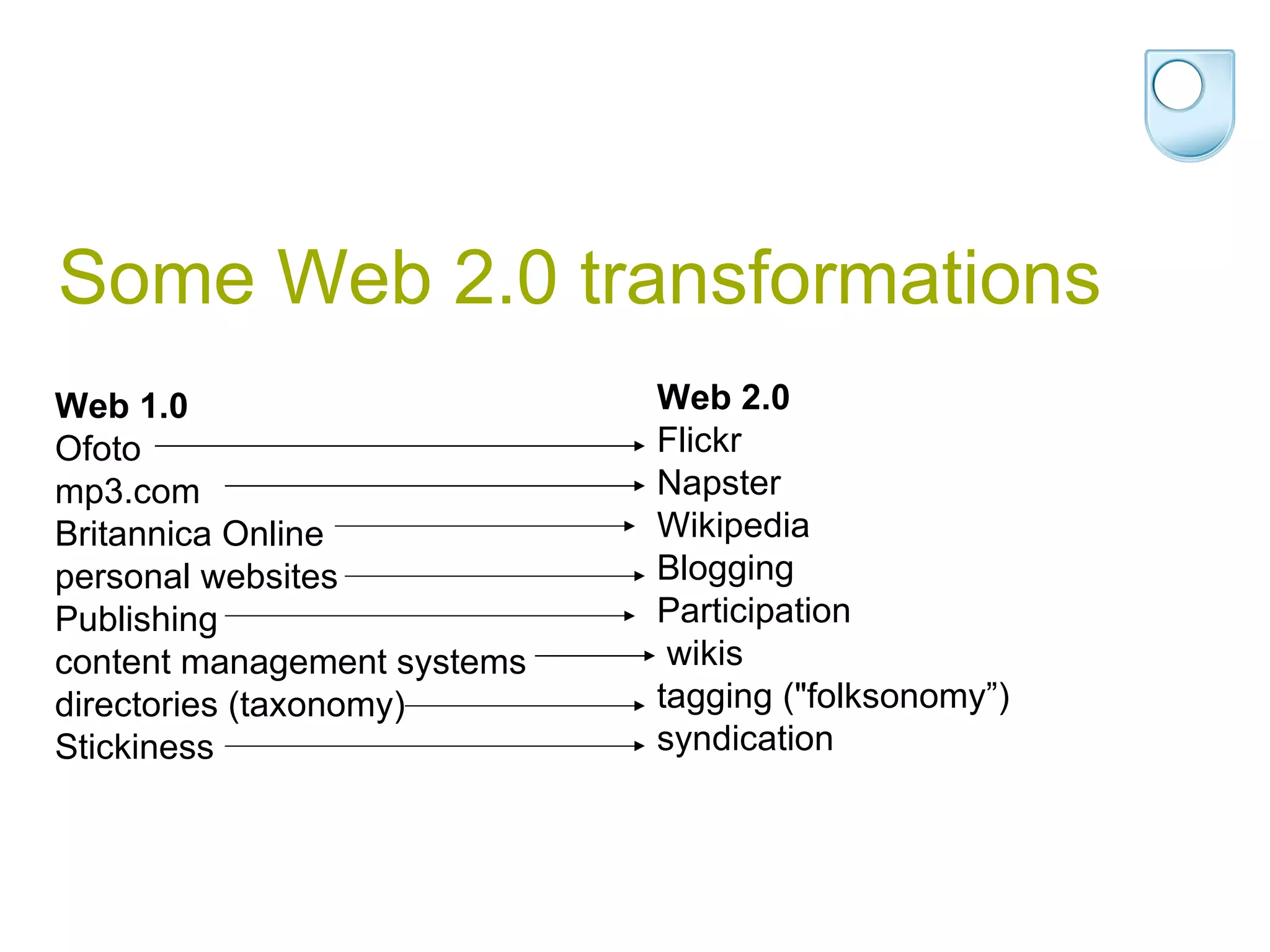
Some Web 2.0 transformations Web 1.0  Ofoto mp3.com Britannica Online personal websites Publishing  content management systems directories (taxonomy) Stickiness Web 2.0   Flickr  Napster  Wikipedia  Blogging Participation wikis  tagging ("folksonomy”) syndication
It’s a mash-up Mixing two or more different services together to create a new type of service  http:// www.housingmaps.com /  Gmap -pedometer
Some web 2.0 examples Netvibes Flickr Wikipedia Del.icio.us 43Things YouTube
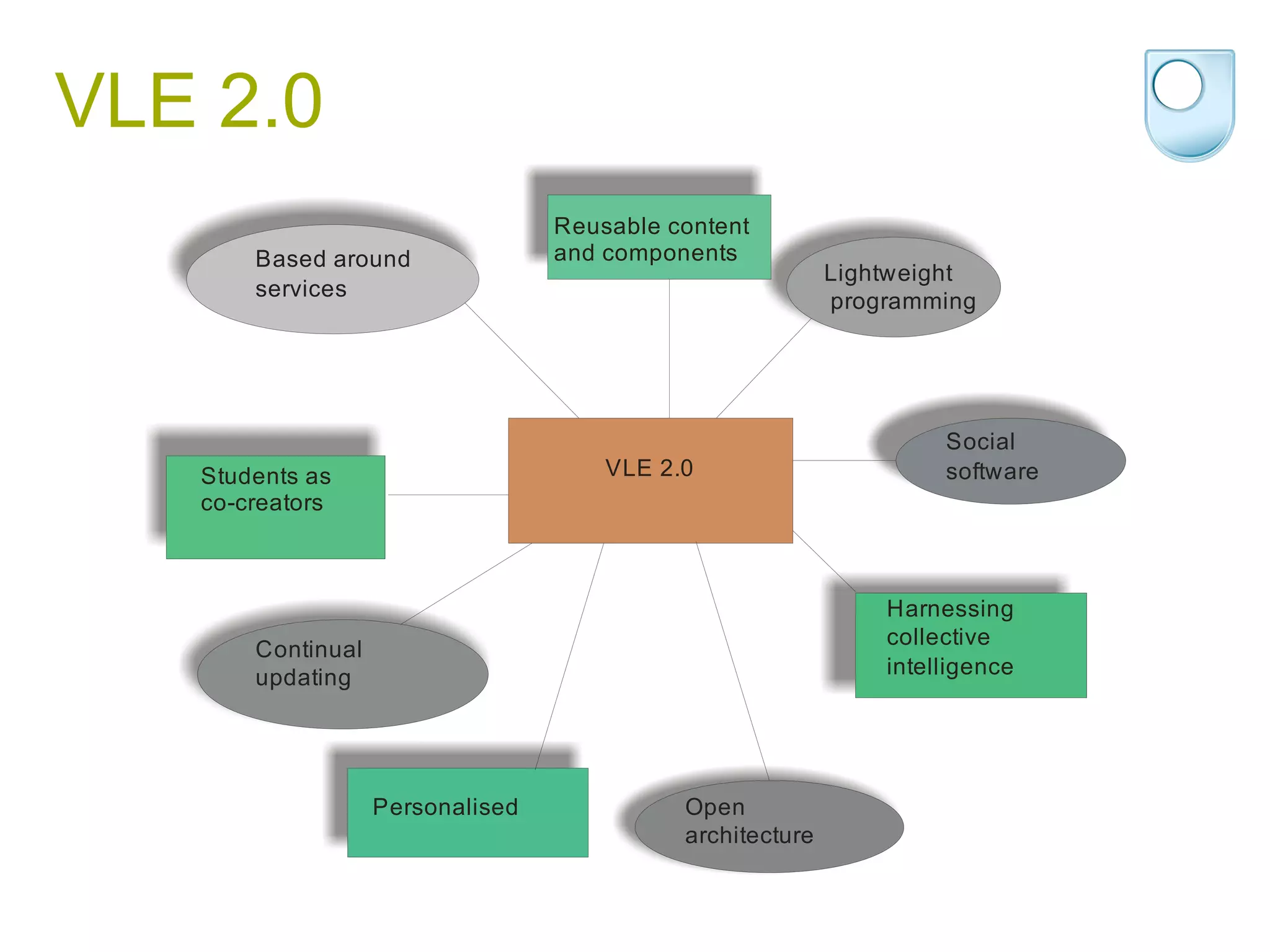
Implications Students as  co-creators Sites set up for  participation Personalised  content  and  tools User  Control  over content Greater use of  feeds  and  external  content Less distinction between content and tools Automatically updating courses
VLE 2.0
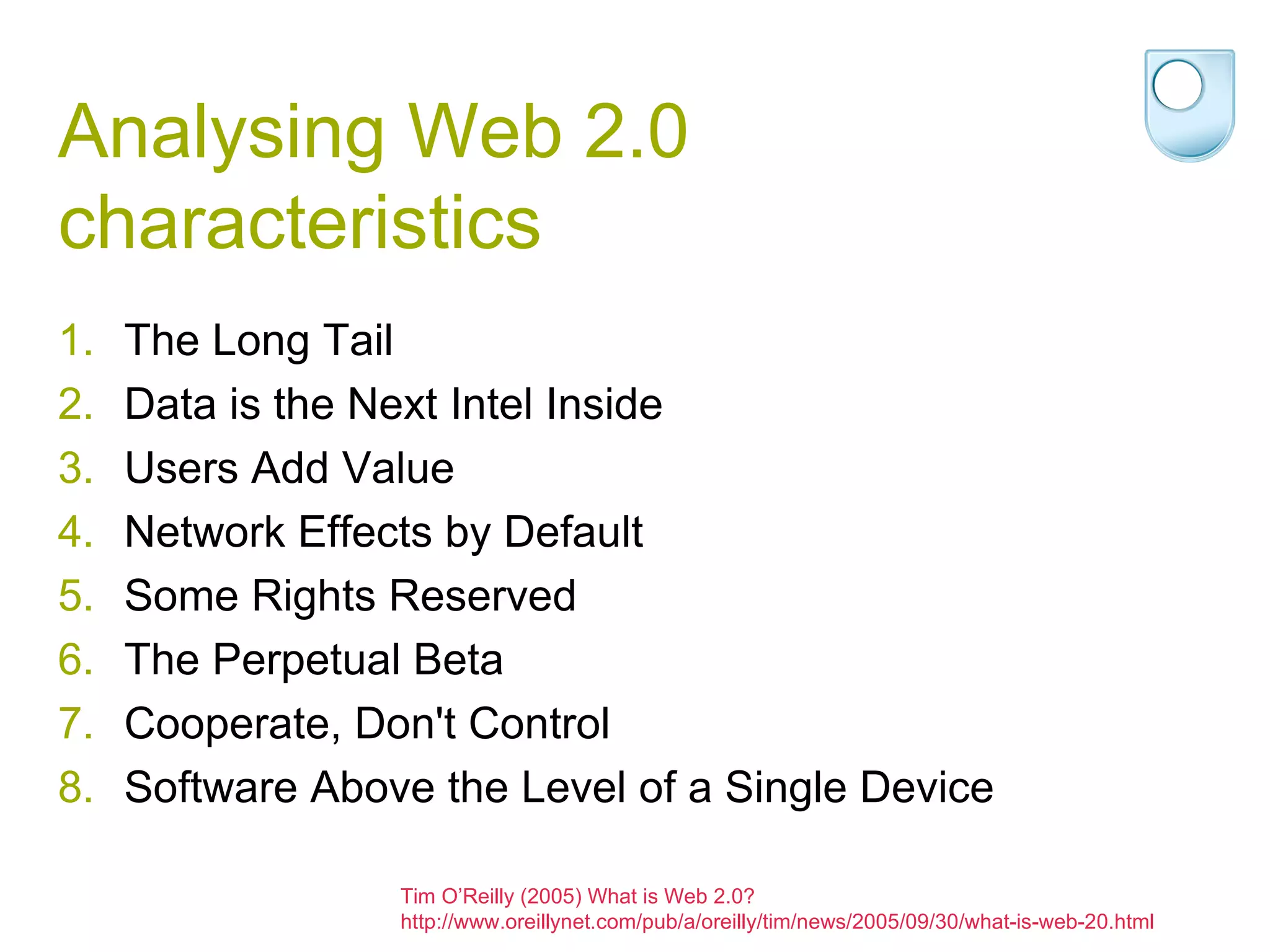
Analysing Web 2.0 characteristics The Long Tail Data is the Next Intel Inside Users Add Value Network Effects by Default Some Rights Reserved The Perpetual Beta Cooperate, Don't Control Software Above the Level of a Single Device Tim O’Reilly (2005) What is Web 2.0? http://www.oreillynet.com/pub/a/oreilly/tim/news/2005/09/30/what-is-web-20.html
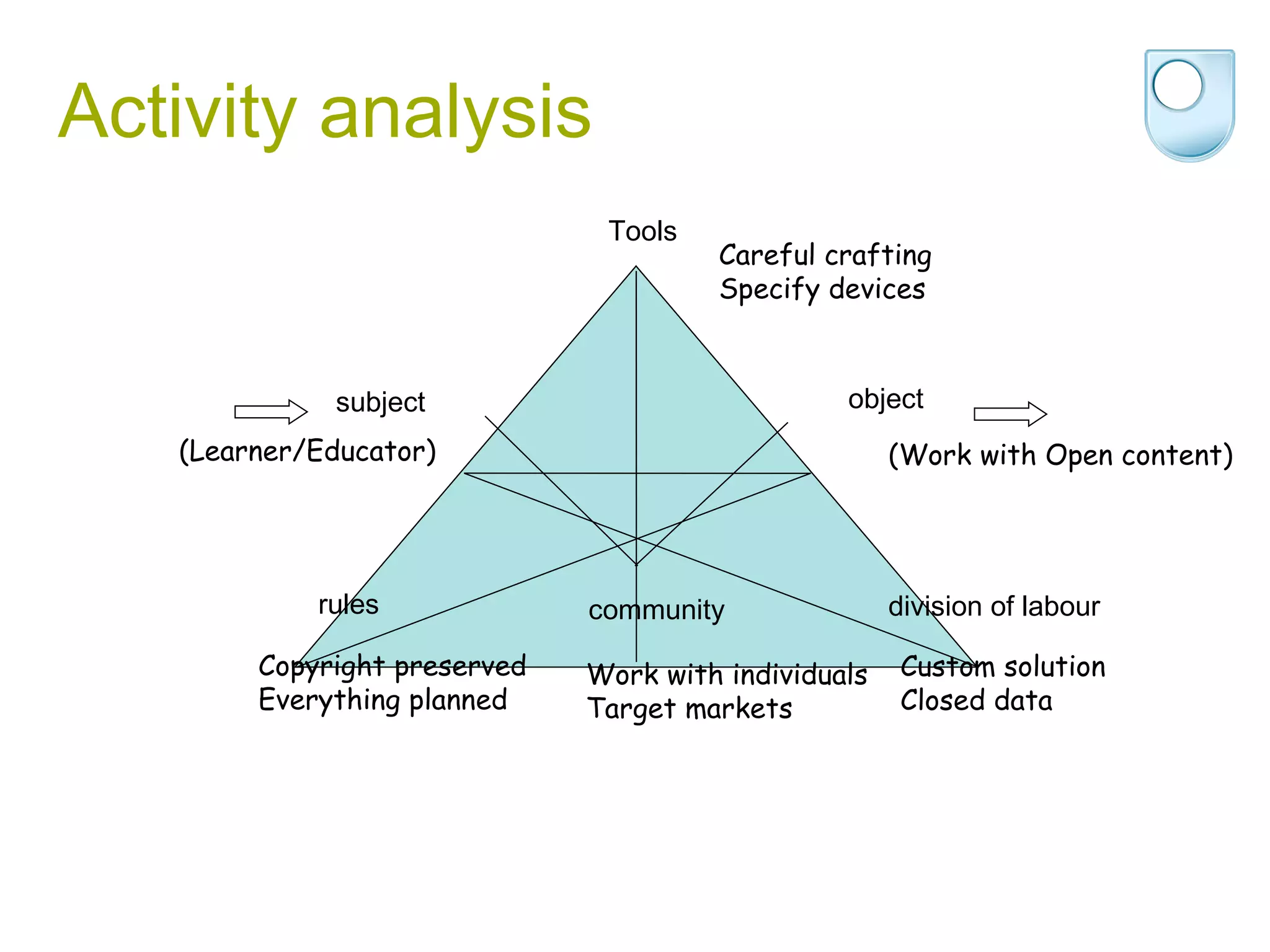
Activity analysis (Work with Open content) Tools object subject community rules division of labour Custom solution Closed data Work with individuals Target markets Careful crafting Specify devices Copyright preserved Everything planned (Learner/Educator)
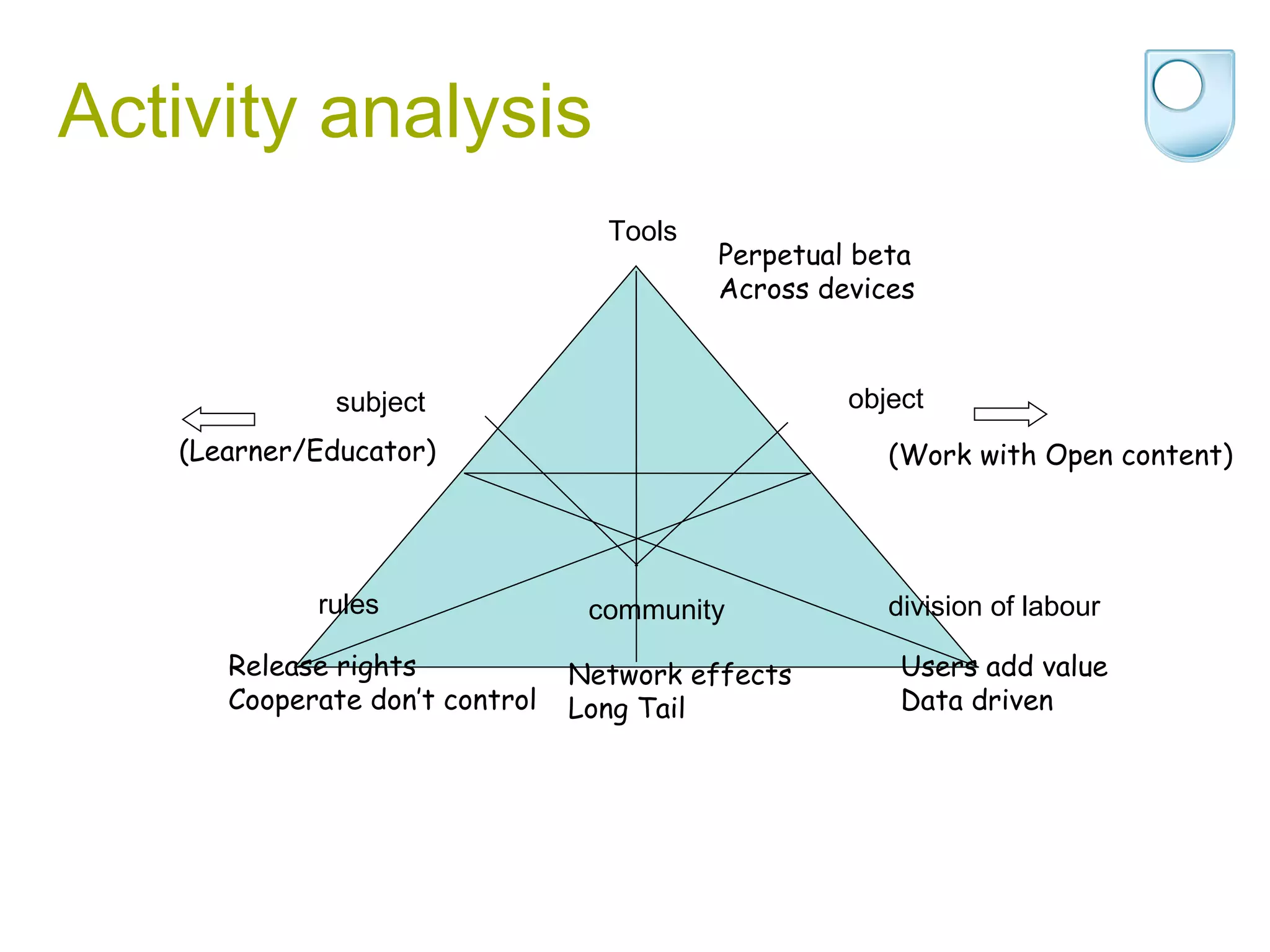
Activity analysis (Work with Open content) Tools object subject community rules division of labour Users add value Data driven Network effects Long Tail Perpetual beta Across devices Release rights Cooperate don’t control (Learner/Educator)
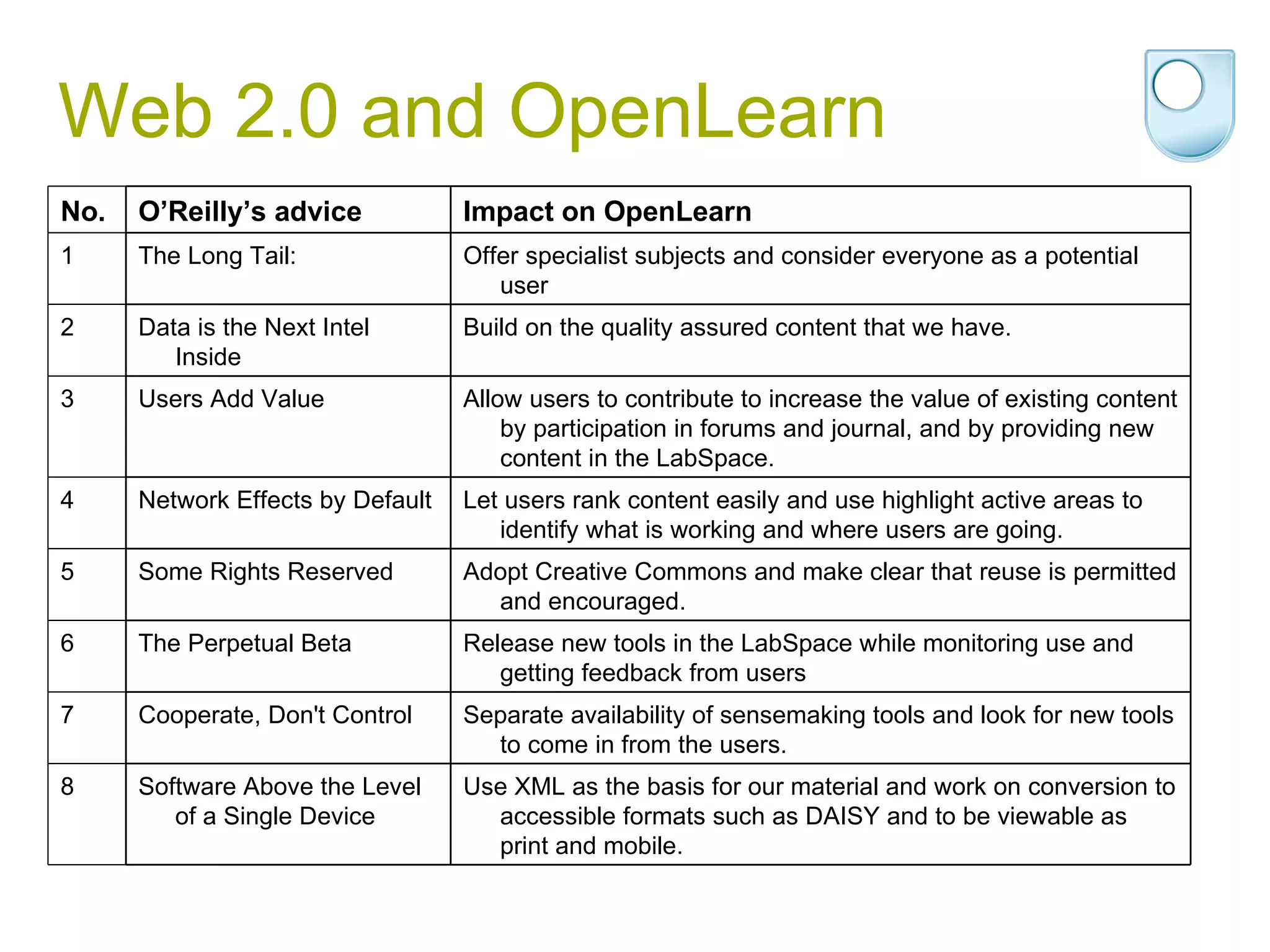
Web 2.0 and OpenLearn Use XML as the basis for our material and work on conversion to accessible formats such as DAISY and to be viewable as print and mobile. Software Above the Level of a Single Device 8 Separate availability of sensemaking tools and look for new tools to come in from the users. Cooperate, Don't Control 7 Release new tools in the LabSpace while monitoring use and getting feedback from users The Perpetual Beta 6 Adopt Creative Commons and make clear that reuse is permitted and encouraged. Some Rights Reserved 5 Let users rank content easily and use highlight active areas to identify what is working and where users are going.  Network Effects by Default 4 Allow users to contribute to increase the value of existing content by participation in forums and journal, and by providing new content in the LabSpace. Users Add Value 3 Build on the quality assured content that we have. Data is the Next Intel Inside 2 Offer specialist subjects and consider everyone as a potential user The Long Tail: 1 Impact on OpenLearn O’Reilly’s advice No.
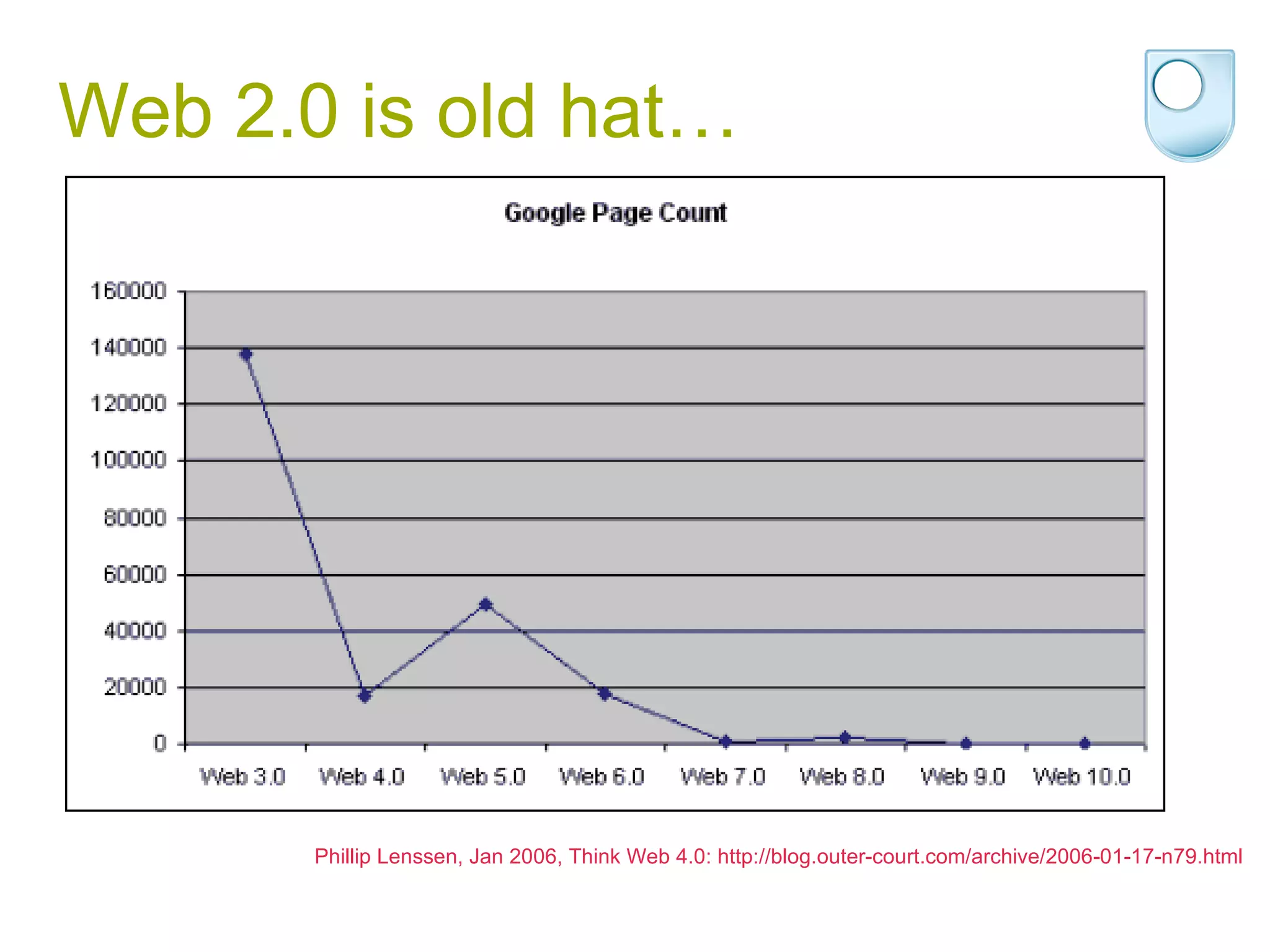
Web 2.0 is old hat… Phillip Lenssen, Jan 2006, Think Web 4.0: http://blog.outer-court.com/archive/2006-01-17-n79.html
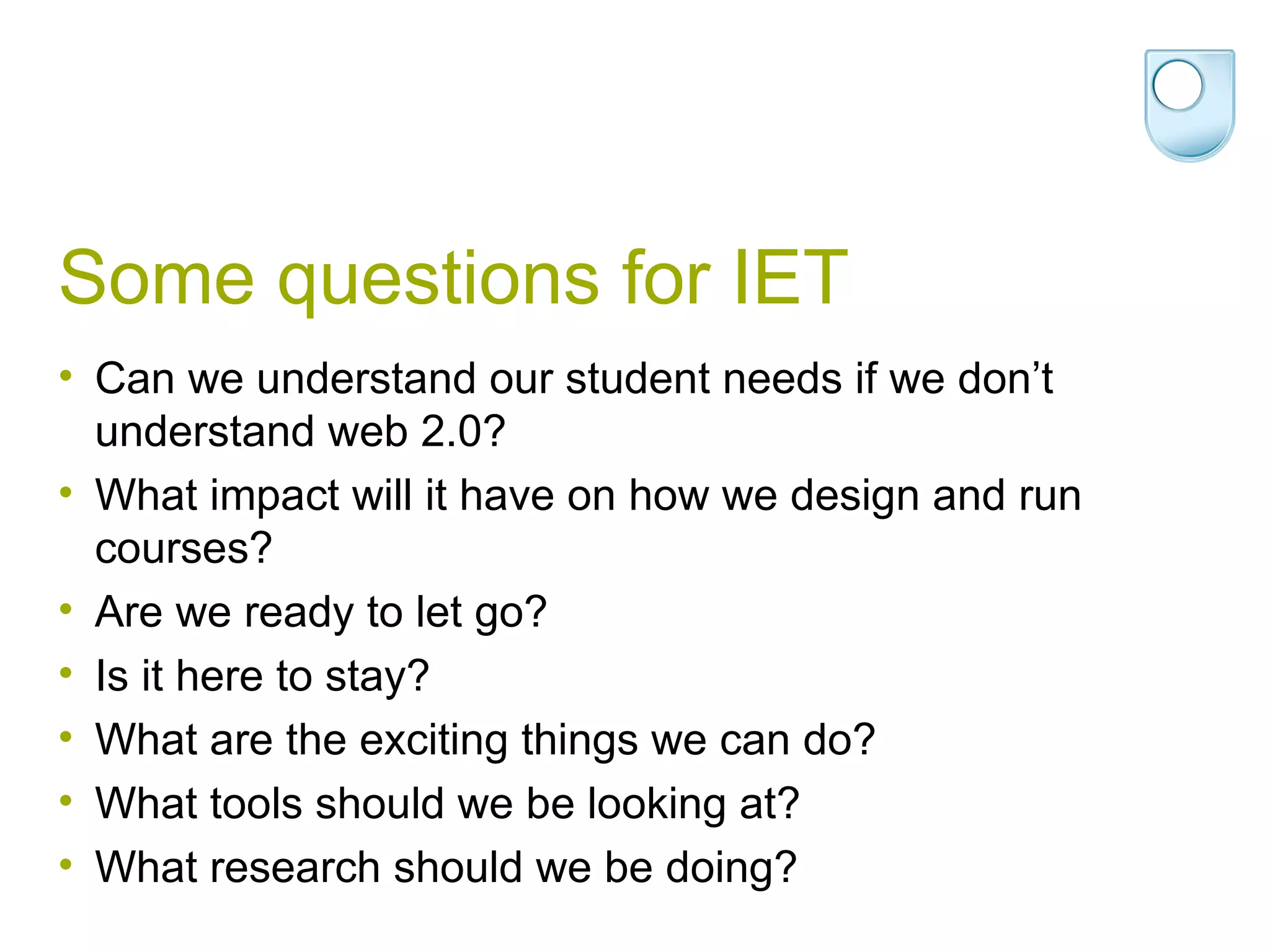
Some questions for IET Can we understand our student needs if we don’t understand web 2.0? What impact will it have on how we design and run courses? Are we ready to let go? Is it here to stay? What are the exciting things we can do? What tools should we be looking at? What research should we be doing?

Web 2.0 - principles and implications

  • 1.
    Principles and definitionsof Web 2.0 Martin Weller & Patrick McAndrew
  • 2.
    Outline Some web2.0 definitions Web 2.0 transitions Web 2.0 examples Implications VLE 2.0 Web 2.0 and openlearn
  • 3.
    What is Web2.0 Both an approach and a set of technologies Web as platform Harnessing collective intelligence Evolutionary development Lightweight programming models This time, though, the clash isn't between a platform and an application, but between two platforms, each with a radically different business model: On the one side, a single software provider, whose massive installed base and tightly integrated operating system and APIs give control over the programming paradigm; on the other, a system without an owner, tied together by a set of protocols, open standards and agreements for cooperation “ users add value and the technology or site needs to be set up so that it encourages participation” Users must be treated as co-developers , … The open source dictum, “release early and release often” in fact has morphed into an even more radical position, “the perpetual beta,” in which the product is developed in the open, with new features slipstreamed in on a monthly, weekly, or even daily basis….
  • 4.
    What is Web2.0? The transition of websites from isolated information silos to sources of content and functionality , thus becoming computing platforms serving web applications to end users A social phenomenon referring to an approach to creating and distributing Web content itself, characterized by open communication, decentralization of authority, freedom to share and re-use , and "the market as a conversation" A more organized and categorized content, with a far more developed deeplinking web architecture A shift in economic value of the web, possibly surpassing that of the dot com boom of the late 1990s A marketing term to differentiate new web businesses from those of the dot com boom, which due to the bust now seem discredited The resurgence of excitement around the possibilities of innovative web applications and services that gained a lot of momentum around mid 2005 Wikipedia
  • 5.
    Some Web 2.0transformations Web 1.0  Ofoto mp3.com Britannica Online personal websites Publishing content management systems directories (taxonomy) Stickiness Web 2.0 Flickr Napster Wikipedia Blogging Participation wikis tagging ("folksonomy”) syndication
  • 6.
    It’s a mash-upMixing two or more different services together to create a new type of service http:// www.housingmaps.com / Gmap -pedometer
  • 7.
    Some web 2.0examples Netvibes Flickr Wikipedia Del.icio.us 43Things YouTube
  • 8.
    Implications Students as co-creators Sites set up for participation Personalised content and tools User Control over content Greater use of feeds and external content Less distinction between content and tools Automatically updating courses
  • 9.
  • 10.
    Analysing Web 2.0characteristics The Long Tail Data is the Next Intel Inside Users Add Value Network Effects by Default Some Rights Reserved The Perpetual Beta Cooperate, Don't Control Software Above the Level of a Single Device Tim O’Reilly (2005) What is Web 2.0? http://www.oreillynet.com/pub/a/oreilly/tim/news/2005/09/30/what-is-web-20.html
  • 11.
    Activity analysis (Workwith Open content) Tools object subject community rules division of labour Custom solution Closed data Work with individuals Target markets Careful crafting Specify devices Copyright preserved Everything planned (Learner/Educator)
  • 12.
    Activity analysis (Workwith Open content) Tools object subject community rules division of labour Users add value Data driven Network effects Long Tail Perpetual beta Across devices Release rights Cooperate don’t control (Learner/Educator)
  • 13.
    Web 2.0 andOpenLearn Use XML as the basis for our material and work on conversion to accessible formats such as DAISY and to be viewable as print and mobile. Software Above the Level of a Single Device 8 Separate availability of sensemaking tools and look for new tools to come in from the users. Cooperate, Don't Control 7 Release new tools in the LabSpace while monitoring use and getting feedback from users The Perpetual Beta 6 Adopt Creative Commons and make clear that reuse is permitted and encouraged. Some Rights Reserved 5 Let users rank content easily and use highlight active areas to identify what is working and where users are going. Network Effects by Default 4 Allow users to contribute to increase the value of existing content by participation in forums and journal, and by providing new content in the LabSpace. Users Add Value 3 Build on the quality assured content that we have. Data is the Next Intel Inside 2 Offer specialist subjects and consider everyone as a potential user The Long Tail: 1 Impact on OpenLearn O’Reilly’s advice No.
  • 14.
    Web 2.0 isold hat… Phillip Lenssen, Jan 2006, Think Web 4.0: http://blog.outer-court.com/archive/2006-01-17-n79.html
  • 15.
    Some questions forIET Can we understand our student needs if we don’t understand web 2.0? What impact will it have on how we design and run courses? Are we ready to let go? Is it here to stay? What are the exciting things we can do? What tools should we be looking at? What research should we be doing?