- Tim O’reilly - What is the web 2.0
Contents Definitions of Web 2.0 2.  Web 1.0/2.0 comparison 3.  Web 2.0 Features 4.  Web 2.0 Technologies 5.  Web 2.0 Business Model
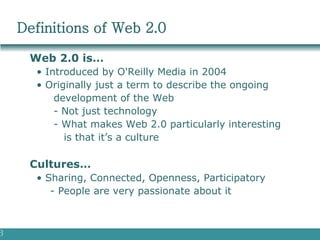
Definitions of Web 2.0 Web 2.0 is… •  Introduced by O'Reilly Media in 2004 •  Originally just a term to describe the ongoing  development of the Web - Not just technology  - What makes Web 2.0 particularly interesting  is that it’s a culture Cultures… •  Sharing, Connected, Openness, Participatory - People are very passionate about it
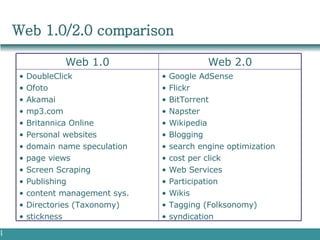
Web 1.0/2.0 comparison •  Google AdSense •  Flickr •  BitTorrent •  Napster •  Wikipedia •  Blogging •  search engine optimization •  cost per click •  Web Services •  Participation •  Wikis •  Tagging (Folksonomy) •  syndication •  DoubleClick •  Ofoto  •  Akamai •  mp3.com •  Britannica Online •  Personal websites •  domain name speculation •  page views •  Screen Scraping •  Publishing •  content management sys. •  Directories (Taxonomy) •  stickness Web 2.0 Web 1.0
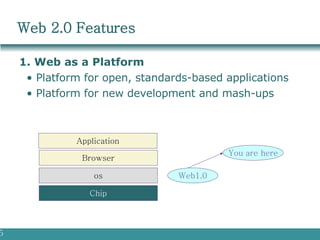
Web 2.0 Features  1. Web as a Platform •  Platform for open, standards-based applications •  Platform for new development and mash-ups   Chip os Browser Application Web1.0 You are here
Web 2.0 Features  service Software, License Business Need sever data DB not needed DB Web service (no update) Install and update use Service on the platform a product Product Web2.0 (Google) Web1.0 (Netscape)
Web 2.0 Features  2. Collective Intelligence •  Folksonomy – Collaborative Categorization The wisdom of crowds 3.   Data is the Next Intel Inside •  Data is key and should be shared 4. End of the Software Release Cycle •  Software is in constantly evolving
Web 2.0 Features 5. Lightweight Programming Models •  open API/mesh up 6. Software Above the Level of a Single Device •  The Network is the computer 7. Rich User Experience
Web 2.0 Technologies •   Blogging, Syndication, RSS/Atom •   Wikis, Web Services (REST) •   AJAX, Rich Internet Clients •   web2.0 의  10 가지 기술들    1.  웹 표준 (XHTML/CSS)   2.  브라우저 지원 (Firefox.Safari)   3.  유니코드 (UTF-8)   4.  논리 주소체계 (Logical URL)   5.  컨텐츠 신디케이션 (RSS/Atom,RDF)   6.  오픈 API (REST,SOAP,Web Service)   7.  집단지성  (Folksonomy, Tag)   8.  가벼운 서비스 프레임웍 (Python, Ruby on Rails)   9.  풍부한 사용자 경험 (Ajax, Flex)   10.  확장기능 (Firefox Extentions, Widget) * [Web2.0 Conference, 2006.3  :  윤석찬  Daum R&D Center]
Web 2.0 Business Model 1. Openness and Participation - Adv. Business : Google AdSense - User Participation : eBay, Amazon.com 2. Long Tail - minority niche market : Neflix, Rhapsody - syndication market  3. Web Platform - Web Platform service : salesforce.com, ringfo.com * Web 2.0 Business Strategy (Lee junki/ Lim il)
Another viewpoint on Web 2.0 These world Of internet Those world Of internet Trust Not Trust google Trust in The mass  Of people   The Way of thinking * Web evolution (Ueda Mochio) Yahoo Corporation Information system Web 2.0 Linux
Thanks

Web2.0 Ppt

  • 1.
    - Tim O’reilly- What is the web 2.0
  • 2.
    Contents Definitions ofWeb 2.0 2. Web 1.0/2.0 comparison 3. Web 2.0 Features 4. Web 2.0 Technologies 5. Web 2.0 Business Model
  • 3.
    Definitions of Web2.0 Web 2.0 is… • Introduced by O'Reilly Media in 2004 • Originally just a term to describe the ongoing development of the Web - Not just technology - What makes Web 2.0 particularly interesting is that it’s a culture Cultures… • Sharing, Connected, Openness, Participatory - People are very passionate about it
  • 4.
    Web 1.0/2.0 comparison• Google AdSense • Flickr • BitTorrent • Napster • Wikipedia • Blogging • search engine optimization • cost per click • Web Services • Participation • Wikis • Tagging (Folksonomy) • syndication • DoubleClick • Ofoto • Akamai • mp3.com • Britannica Online • Personal websites • domain name speculation • page views • Screen Scraping • Publishing • content management sys. • Directories (Taxonomy) • stickness Web 2.0 Web 1.0
  • 5.
    Web 2.0 Features 1. Web as a Platform • Platform for open, standards-based applications • Platform for new development and mash-ups Chip os Browser Application Web1.0 You are here
  • 6.
    Web 2.0 Features service Software, License Business Need sever data DB not needed DB Web service (no update) Install and update use Service on the platform a product Product Web2.0 (Google) Web1.0 (Netscape)
  • 7.
    Web 2.0 Features 2. Collective Intelligence • Folksonomy – Collaborative Categorization The wisdom of crowds 3. Data is the Next Intel Inside • Data is key and should be shared 4. End of the Software Release Cycle • Software is in constantly evolving
  • 8.
    Web 2.0 Features5. Lightweight Programming Models • open API/mesh up 6. Software Above the Level of a Single Device • The Network is the computer 7. Rich User Experience
  • 9.
    Web 2.0 Technologies• Blogging, Syndication, RSS/Atom • Wikis, Web Services (REST) • AJAX, Rich Internet Clients • web2.0 의 10 가지 기술들   1. 웹 표준 (XHTML/CSS)   2. 브라우저 지원 (Firefox.Safari)   3. 유니코드 (UTF-8)   4. 논리 주소체계 (Logical URL)   5. 컨텐츠 신디케이션 (RSS/Atom,RDF)   6. 오픈 API (REST,SOAP,Web Service)   7. 집단지성 (Folksonomy, Tag)   8. 가벼운 서비스 프레임웍 (Python, Ruby on Rails)   9. 풍부한 사용자 경험 (Ajax, Flex)   10. 확장기능 (Firefox Extentions, Widget) * [Web2.0 Conference, 2006.3 : 윤석찬 Daum R&D Center]
  • 10.
    Web 2.0 BusinessModel 1. Openness and Participation - Adv. Business : Google AdSense - User Participation : eBay, Amazon.com 2. Long Tail - minority niche market : Neflix, Rhapsody - syndication market 3. Web Platform - Web Platform service : salesforce.com, ringfo.com * Web 2.0 Business Strategy (Lee junki/ Lim il)
  • 11.
    Another viewpoint onWeb 2.0 These world Of internet Those world Of internet Trust Not Trust google Trust in The mass Of people The Way of thinking * Web evolution (Ueda Mochio) Yahoo Corporation Information system Web 2.0 Linux
  • 12.