Preparing for the Future: Technological
Challenges and Beyond
Workshop at ILI 2015 conference, London on 19 October 2015
Brian Kelly
Independent researcher/consultant at
UK Web Focus Ltd.
Tony Hirst
Senior lecturer at The Open University
Contact Details
Brian Kelly Tony Hirst
Email: ukwebfocus@gmail.com Email: tony.hirst@gmail.com
Twitter: @briankelly Twitter: @psychemedia
Blog: http://ukwebfocus.com/ Blog: http://blog.ouseful.info/
Slides and further information available at
http://ukwebfocus.com/events/ili-2015-preparing-for-the-future/
UK Web Focus Event hashtag: #ili2015fut
A: Introduction
2 2
You are free to:
copy, share, adapt, or re-mix;
photograph, film, or broadcast;
blog, live-blog, or post video of
this presentation provided that:
You attribute the work to its author and respect the rights
and licences associated with its components.
Idea from Cameron Neylon c
Slide Concept by Cameron Neylon, who has waived all copyright and related or neighbouring rights. This slide only CCZero.
Social Media Icons adapted with permission from originals by Christopher Ross. Original images are available under GPL at:
http://www.thisismyurl.com/free-downloads/15-free-speech-bubble-icons-for-popular-websites
A: Introduction
About This Workshop
Abstract
Despite the uncertainties faced by librarians and information
professionals, technology continues to develop at breakneck speed
offering many new opportunities for the sector. At the same time,
technological developments can be distracting and may result in
wasted time and effort.
This workshop will help participants identify potentially relevant
technological developments by learning about and making use of
processes for spotting and prioritising signals which may indicate
early use of technologies of future importance.
Having identified potentially important technological developments,
organisations then need to decide how to respond. What will be the
impact on existing technologies? What are the strategic implications
and what are the implications for staff within the organisation?
This interactive workshop will provide opportunities to address the
challenges in understanding the implications of technological
developments and making appropriate organisational interventions.
3
A: Introduction
In Brief
Aims of the workshop are to:
• Learn about new technological / technology-related
developments
• Understand how the wider environment may affect
the take-up of new technologies
• Understand the limitations of predicting
methodologies
• Make use of methodologies for detecting future
developments
• Provide resources which can be used in your own
institution
• Engage in discussions with others
• Have fun! 4
A: Introduction
About The Facilitators
Brian Kelly:
• Worked at:
 UKOLN, University of Bath from 1996-2013
 Cetis, University of Bolton from 2013-2015
• Web adviser to HE & cultural heritage sectors
• Since 2000 attended all ILI conferences, except
ILI 2008
• Now independent consultant
Tony Hirst:
• Data wrangler
• Works at Open University
• Data Storyteller at the School of Data
5
A: Introduction
About You
In small groups:
• Introduce yourselves: your name, where you work
and what you do.
• Say what made you decide to sign up for this
workshop and what you hope to gain from it.
Feel free to include both specific and general areas of
interest
6
GE
16 participants have booked from UK, Switzerland,
Netherlands, Sweden, Norway, Singapore and Kuwait
A: Introduction
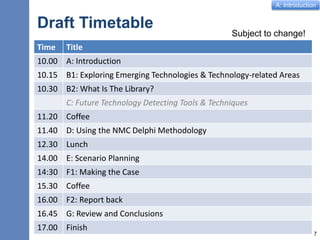
Draft Timetable
Subject to change!
7
Time Title
10.00 A: Introduction
10.15 B1: Exploring Emerging Technologies & Technology-related Areas
10.30 B2: What Is The Library?
C: Future Technology Detecting Tools & Techniques
11.20 Coffee
11.40 D: Using the NMC Delphi Methodology
12.30 Lunch
14.00 E: Scenario Planning
14:30 F1: Making the Case
15.30 Coffee
16.00 F2: Report back
16.45 G: Review and Conclusions
17.00 Finish
A: Introduction
Workshop Format
Features of the workshop:
• Participative
• Questions and discussion welcomed
• Welcoming of alternative views
• Open (feel free to take photos, tweet, ….)
• Appreciative of limitations of openness (feel
free to state if comments are ‘off the record’)
• Reusing slides and approaches in your own
institution encouraged!
8
Links to slides available from
http://ukwebfocus.wordpress.com/events/#2015-10-19
A: Introduction
Questions?
9

Preparing for the Future: Technological Challenges and Beyond A1 Introduction

  • 1.
    Preparing for theFuture: Technological Challenges and Beyond Workshop at ILI 2015 conference, London on 19 October 2015 Brian Kelly Independent researcher/consultant at UK Web Focus Ltd. Tony Hirst Senior lecturer at The Open University Contact Details Brian Kelly Tony Hirst Email: ukwebfocus@gmail.com Email: tony.hirst@gmail.com Twitter: @briankelly Twitter: @psychemedia Blog: http://ukwebfocus.com/ Blog: http://blog.ouseful.info/ Slides and further information available at http://ukwebfocus.com/events/ili-2015-preparing-for-the-future/ UK Web Focus Event hashtag: #ili2015fut
  • 2.
    A: Introduction 2 2 Youare free to: copy, share, adapt, or re-mix; photograph, film, or broadcast; blog, live-blog, or post video of this presentation provided that: You attribute the work to its author and respect the rights and licences associated with its components. Idea from Cameron Neylon c Slide Concept by Cameron Neylon, who has waived all copyright and related or neighbouring rights. This slide only CCZero. Social Media Icons adapted with permission from originals by Christopher Ross. Original images are available under GPL at: http://www.thisismyurl.com/free-downloads/15-free-speech-bubble-icons-for-popular-websites
  • 3.
    A: Introduction About ThisWorkshop Abstract Despite the uncertainties faced by librarians and information professionals, technology continues to develop at breakneck speed offering many new opportunities for the sector. At the same time, technological developments can be distracting and may result in wasted time and effort. This workshop will help participants identify potentially relevant technological developments by learning about and making use of processes for spotting and prioritising signals which may indicate early use of technologies of future importance. Having identified potentially important technological developments, organisations then need to decide how to respond. What will be the impact on existing technologies? What are the strategic implications and what are the implications for staff within the organisation? This interactive workshop will provide opportunities to address the challenges in understanding the implications of technological developments and making appropriate organisational interventions. 3
  • 4.
    A: Introduction In Brief Aimsof the workshop are to: • Learn about new technological / technology-related developments • Understand how the wider environment may affect the take-up of new technologies • Understand the limitations of predicting methodologies • Make use of methodologies for detecting future developments • Provide resources which can be used in your own institution • Engage in discussions with others • Have fun! 4
  • 5.
    A: Introduction About TheFacilitators Brian Kelly: • Worked at:  UKOLN, University of Bath from 1996-2013  Cetis, University of Bolton from 2013-2015 • Web adviser to HE & cultural heritage sectors • Since 2000 attended all ILI conferences, except ILI 2008 • Now independent consultant Tony Hirst: • Data wrangler • Works at Open University • Data Storyteller at the School of Data 5
  • 6.
    A: Introduction About You Insmall groups: • Introduce yourselves: your name, where you work and what you do. • Say what made you decide to sign up for this workshop and what you hope to gain from it. Feel free to include both specific and general areas of interest 6 GE 16 participants have booked from UK, Switzerland, Netherlands, Sweden, Norway, Singapore and Kuwait
  • 7.
    A: Introduction Draft Timetable Subjectto change! 7 Time Title 10.00 A: Introduction 10.15 B1: Exploring Emerging Technologies & Technology-related Areas 10.30 B2: What Is The Library? C: Future Technology Detecting Tools & Techniques 11.20 Coffee 11.40 D: Using the NMC Delphi Methodology 12.30 Lunch 14.00 E: Scenario Planning 14:30 F1: Making the Case 15.30 Coffee 16.00 F2: Report back 16.45 G: Review and Conclusions 17.00 Finish
  • 8.
    A: Introduction Workshop Format Featuresof the workshop: • Participative • Questions and discussion welcomed • Welcoming of alternative views • Open (feel free to take photos, tweet, ….) • Appreciative of limitations of openness (feel free to state if comments are ‘off the record’) • Reusing slides and approaches in your own institution encouraged! 8 Links to slides available from http://ukwebfocus.wordpress.com/events/#2015-10-19
  • 9.

Editor's Notes

  • #10 I’d welcome questions and comments. Note that I’ve published a blog post on which can be used for questions. Thank you.