How Far Have We Come?   From eLib to NOF-digi and Beyond Brian Kelly UKOLN University of Bath Bath, UK UKOLN is supported by: This work is licensed under a Attribution-NonCommercial-ShareAlike 2.0 licence (but note caveat) Acceptable Use Policy Recording of this talk, taking photos, discussing the content using email, instant messaging, blogs, SMS, etc. is permitted providing distractions to others is minimised. Resources bookmarked using ‘ cilips09 ' tag  Email: [email_address] Twitter: http://twitter.com/briankelly/   Blog: http://ukwebfocus.wordpress.com/ http://www.ukoln.ac.uk/cultural-heritage/events/cilip-scotland-2009/
Contents Introduction About me About this talk The National Programmes (provider’s perspective) The technical standards The support infrastructure What We Learnt What succeeded, what failed and what we discovered along the way What Should We Do In The Future What do we do next? Introduction
About This Talk Talk is based on experiences of national programmes: eLib NOF-digi DNER/IE Michael Common characteristics: Interoperability through open standards Managed view of roadmap Issues: Did we get it right? Are there alternative approaches? Introduction
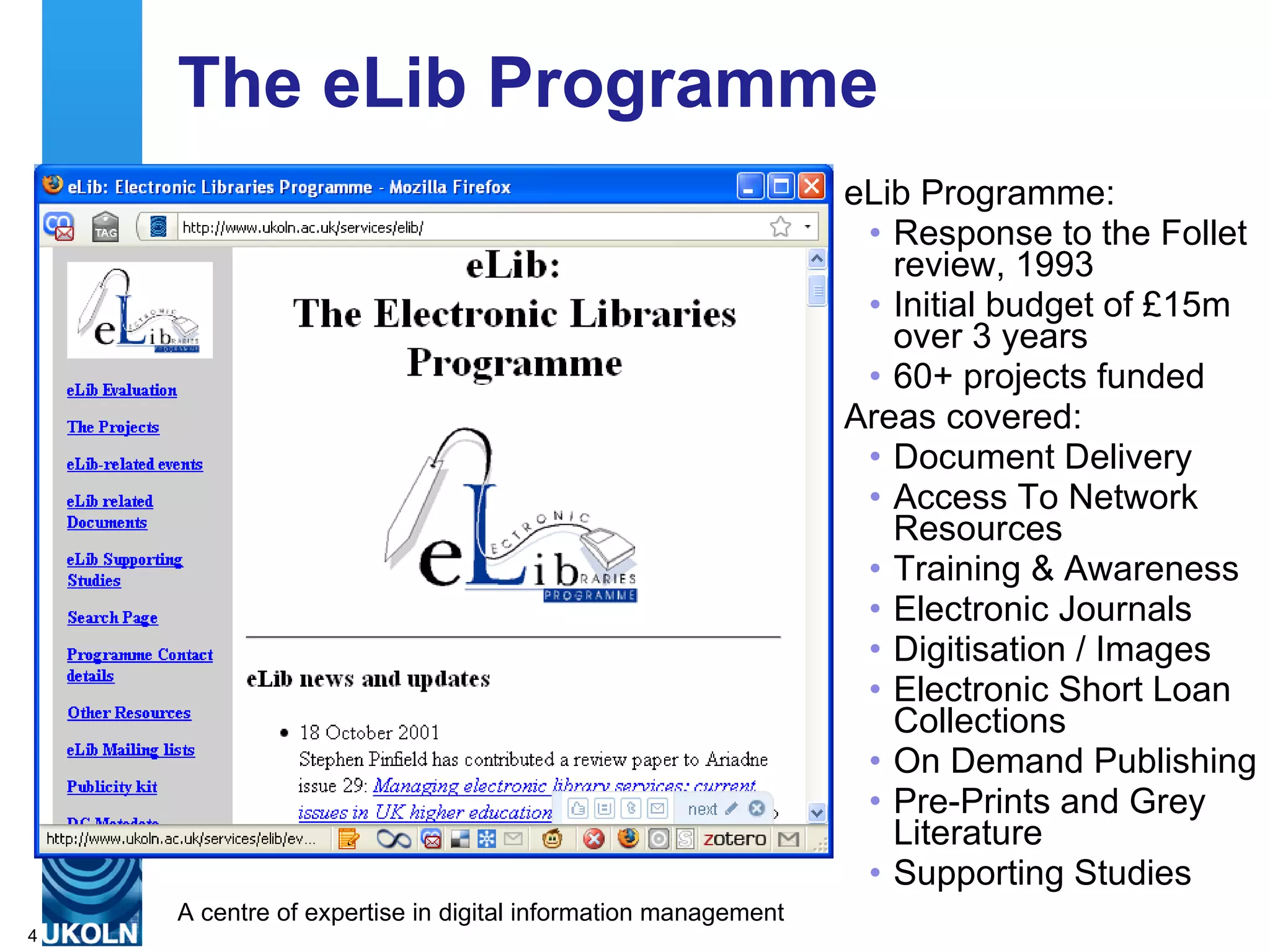
The eLib Programme eLib Programme: Response to the Follet review, 1993 Initial budget of £15m over 3 years 60+ projects funded Areas covered: Document Delivery  Access To Network Resources  Training & Awareness  Electronic Journals  Digitisation / Images  Electronic Short Loan Collections  On Demand Publishing  Pre-Prints and Grey Literature  Supporting Studies
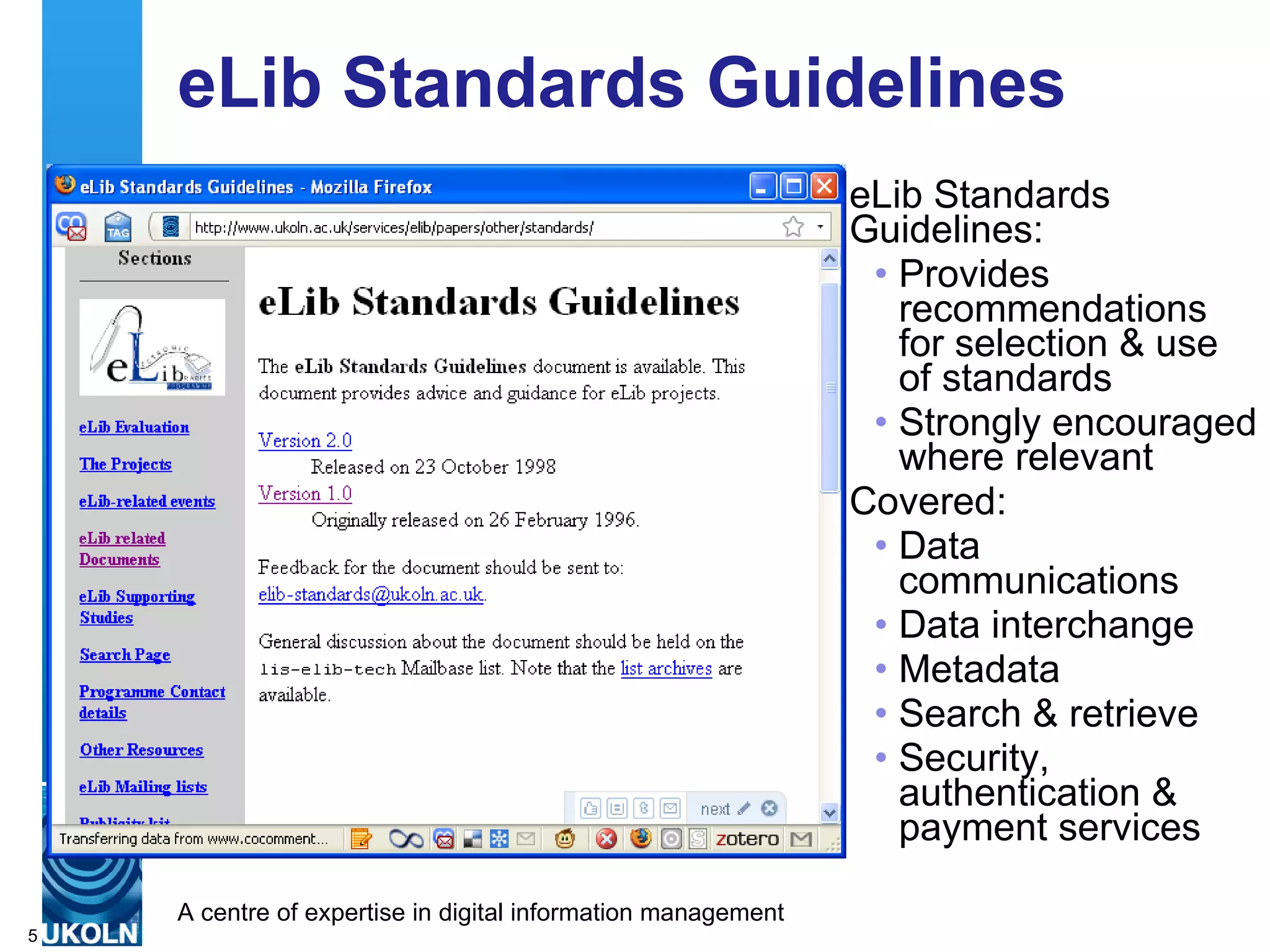
eLib Standards Guidelines eLib Standards Guidelines: Provides recommendations for selection & use of standards Strongly encouraged where relevant  Covered:  Data communications Data interchange Metadata Search & retrieve Security, authentication & payment services
eLib Standards Things we don’t care about (?): Email (SMTP, not X.400), … Areas we correctly hedged our bets: GIF is OK, keep eye on PNG Areas we were evasive about: PostScript & PDF Areas we got wrong: “ It is anticipated that SGML will be a key standard ... Projects are encouraged to .. agree or, where necessary, develop document type definitions ” “ projects should … supply a URL for public services, and be prepared to adopt URNs when they are stabilised ” Standards which seem to have disappeared: CGM Editors : Chris Rusbridge & Ann Mumford (myself as contributor)
eLib Standards version 2 eLib Standards version 2 Published in 1998 (2 years after v 1) Introduced a template for descriptions Relevant standards : Comments : Consensus : Templates on recommended standards complemented by technical summaries – and speculation e.g.  “ HTTP-NG should support more secure authentication and encryption ”
Beyond The Standards Cross-Searching: The Vision whois++  lightweight distributed cross-searching protocol ROADS : Open source software used by most eLib subject gateways (e.g. SOSIG) Z39.50 : More heavy-weight solution used in library context eLib  SBIGs/RDN : implementation in a distributed environment (with departmental providers) Cross-Searching: Today’s Reality Intute : Centralised database, distributed data collection. Cross-searching interfaces, but how widely used? Note dangers of using standards outside of DL programmes – JISC Web site upgrade mandated Z39.50 support  
Later, in NOF-digitise NOF-Digitise programme: Ran from August 1999 to December 2004 £50 million funding to put information that supports lifelong learning into digitised form. Brought together wide range of partnerships & organisations  NOF Technical Advisory Service (NOF TAS) provided: Informed support and advocacy of Technical Standards and Guidelines Assistance in achieving standards compliance  Detailed and project-specific advice Repository of standard and generic advice  Provide by UKOLN and AHDS
Development Culture Different culture to HE digital library development community: Tell us the standards which we must mandate Caused problems: “ NOF-digi project Web sites must have 24x7 availability ” – very expensive! Requirement was availability at weekends! Recommended standards weren’t mature (e.g. SMIL) whereas proprietary solutions (Flash) provided compelling user services Providing pragmatic solutions: “ NOF-digi project Web sites should seek to maximise  their uptime ” Quarterly reporting template provided a get-out clause:  “ You must (a) describe the areas in which compliance will not be achieved; (b) explain why compliance will not be achieved (including research on appropriate open standards); (c) describe your migration strategies to ensure compliance in the future and (d) how the migration may be funded ”
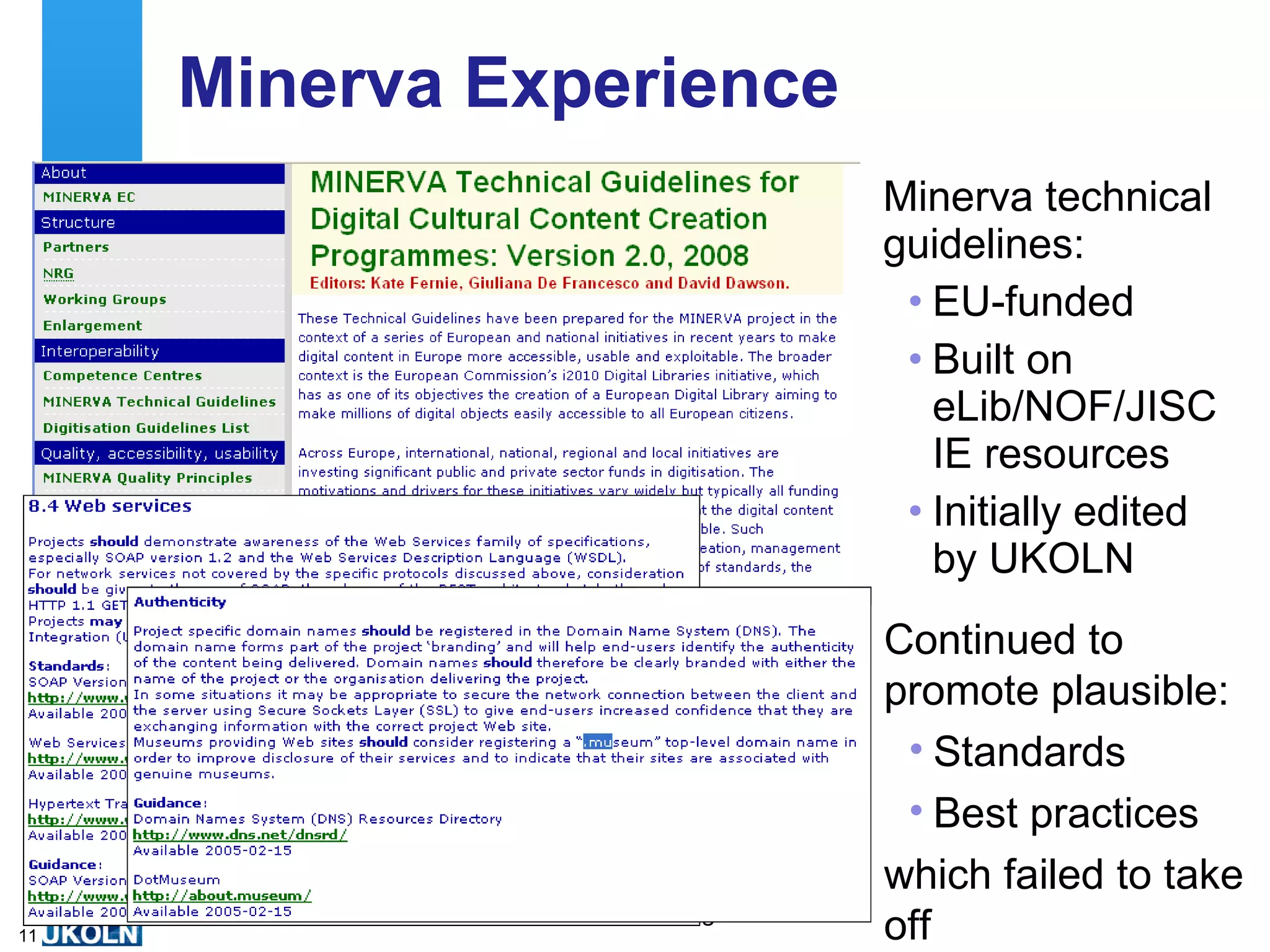
Minerva Experience Minerva technical guidelines: EU-funded Built on eLib/NOF/JISC IE resources Initially edited by UKOLN  Continued to promote plausible: Standards Best practices which failed to take off
Compliance Issues What does  must  mean? You  must  comply with HTML standards What if I don't? What if nobody does? What if I use PDF? You  must  clear rights  on all resources you digitise You  must  provide properly audited accounts What if I don't? There is a need to clarify the meaning of  must   and for an understandable, realistic and reasonable compliance regime JISC 5/99 programme  ~80% of project home pages were not HTML compliant
QA Focus  QA Focus: JISC-funded project provided by UKOLN and (initially) TASI, then AHDS from 2002-2004 What QA regime should JISC provide for its development programmes? What actions should be taken if standards not conformed with? Recommendations: Self-assessment, not external validation (projects explained complexities of standards-compliance) Build on culture of sharing and openness Have a pragmatic view of ‘open standards’ Understand complexities of non-conformance / ‘failure’: The standard failed, not the project The standard may be too expensive to deploy Alternatives may become available
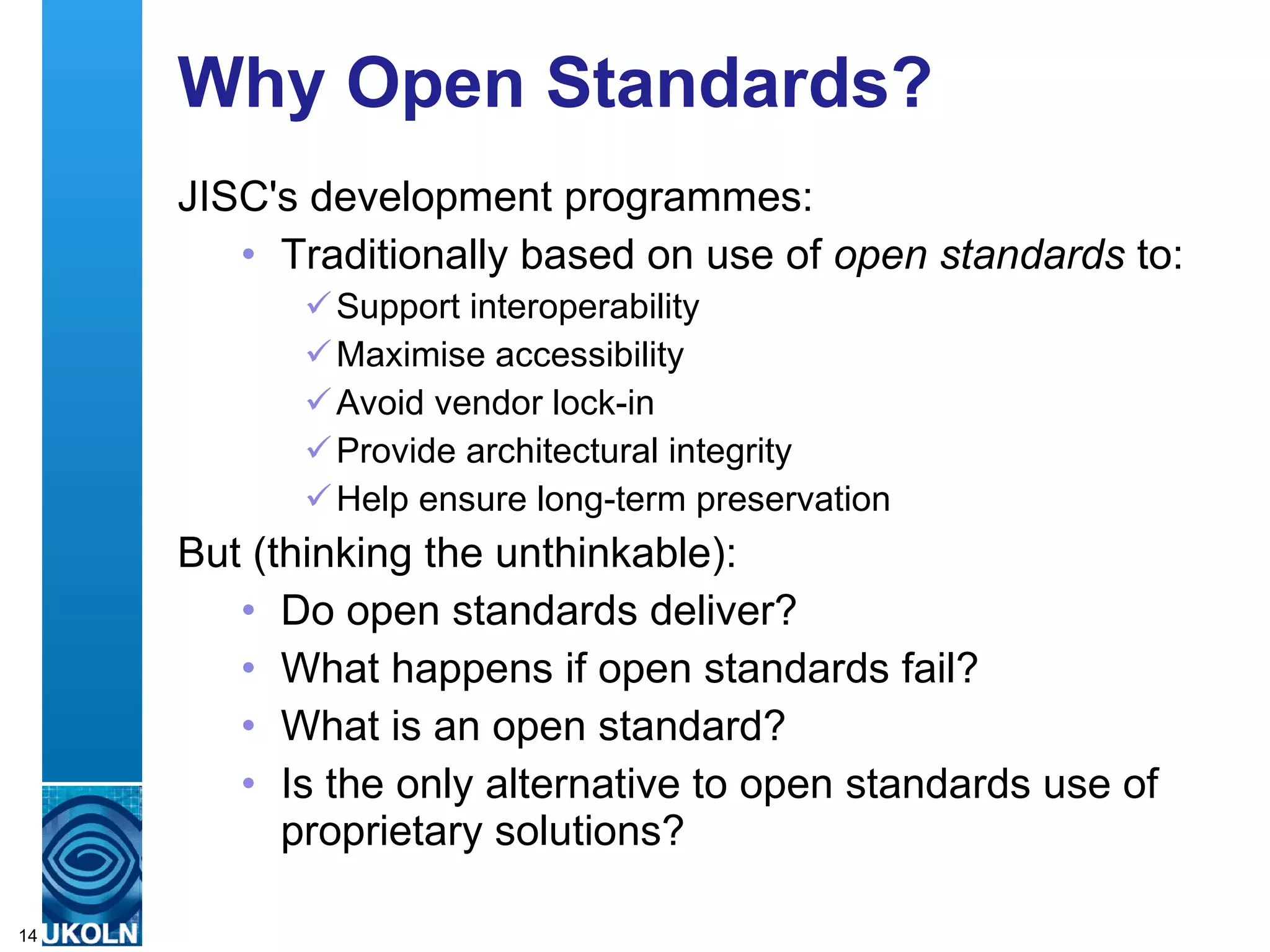
Why Open Standards? JISC's development programmes: Traditionally based on use of  open standards  to: Support interoperability Maximise accessibility Avoid vendor lock-in Provide architectural integrity Help ensure long-term preservation  But (thinking the unthinkable): Do open standards deliver? What happens if open standards fail? What is an open standard? Is the only alternative to open standards use of proprietary solutions?
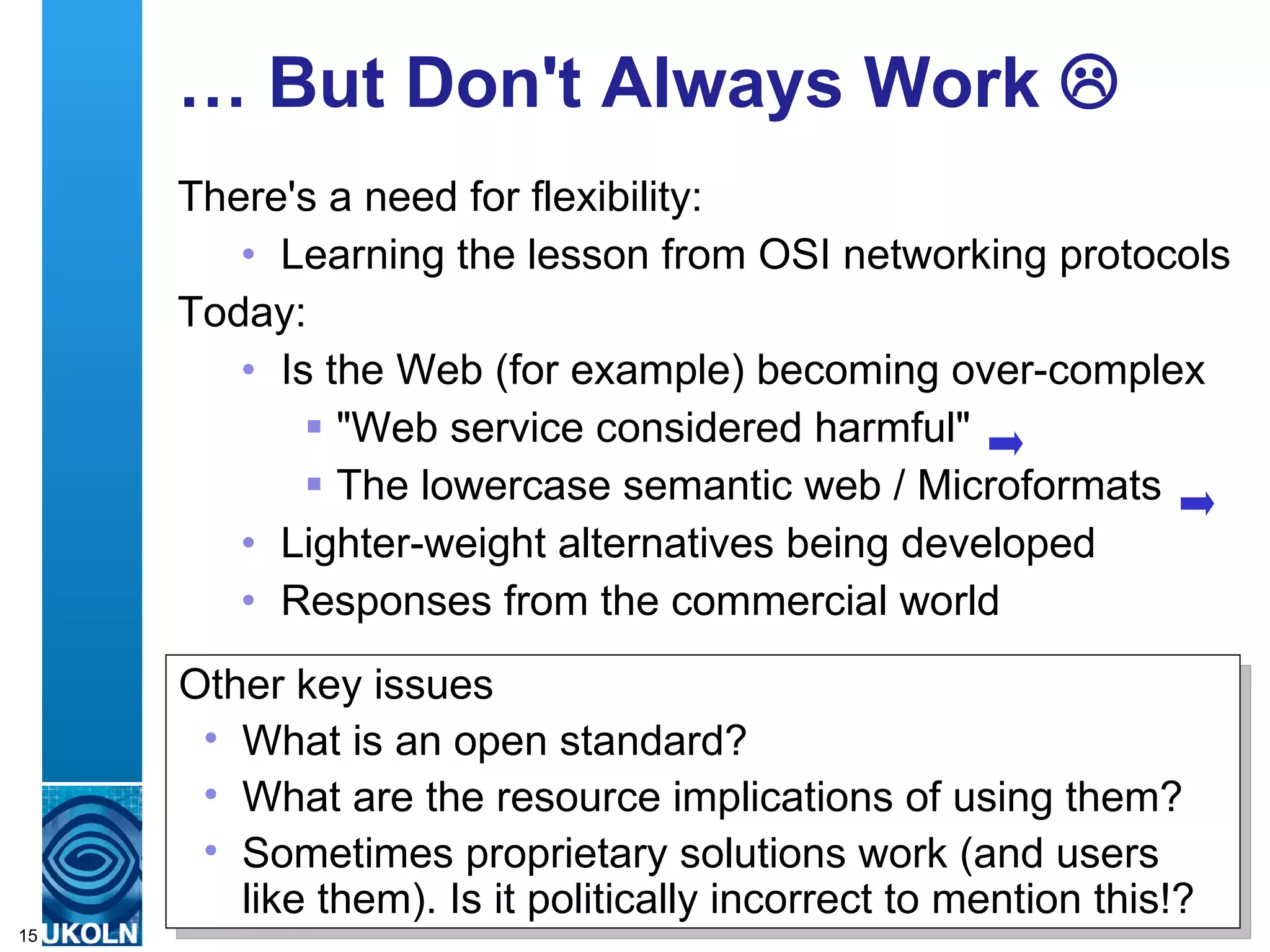
…  But Don't Always Work   There's a need for flexibility: Learning the lesson from OSI networking protocols Today: Is the Web (for example) becoming over-complex "Web service considered harmful" The lowercase semantic web / Microformats Lighter-weight alternatives being developed Responses from the commercial world Other key issues What is an open standard? What are the resource implications of using them? Sometimes proprietary solutions work (and users like them). Is it politically incorrect to mention this!?
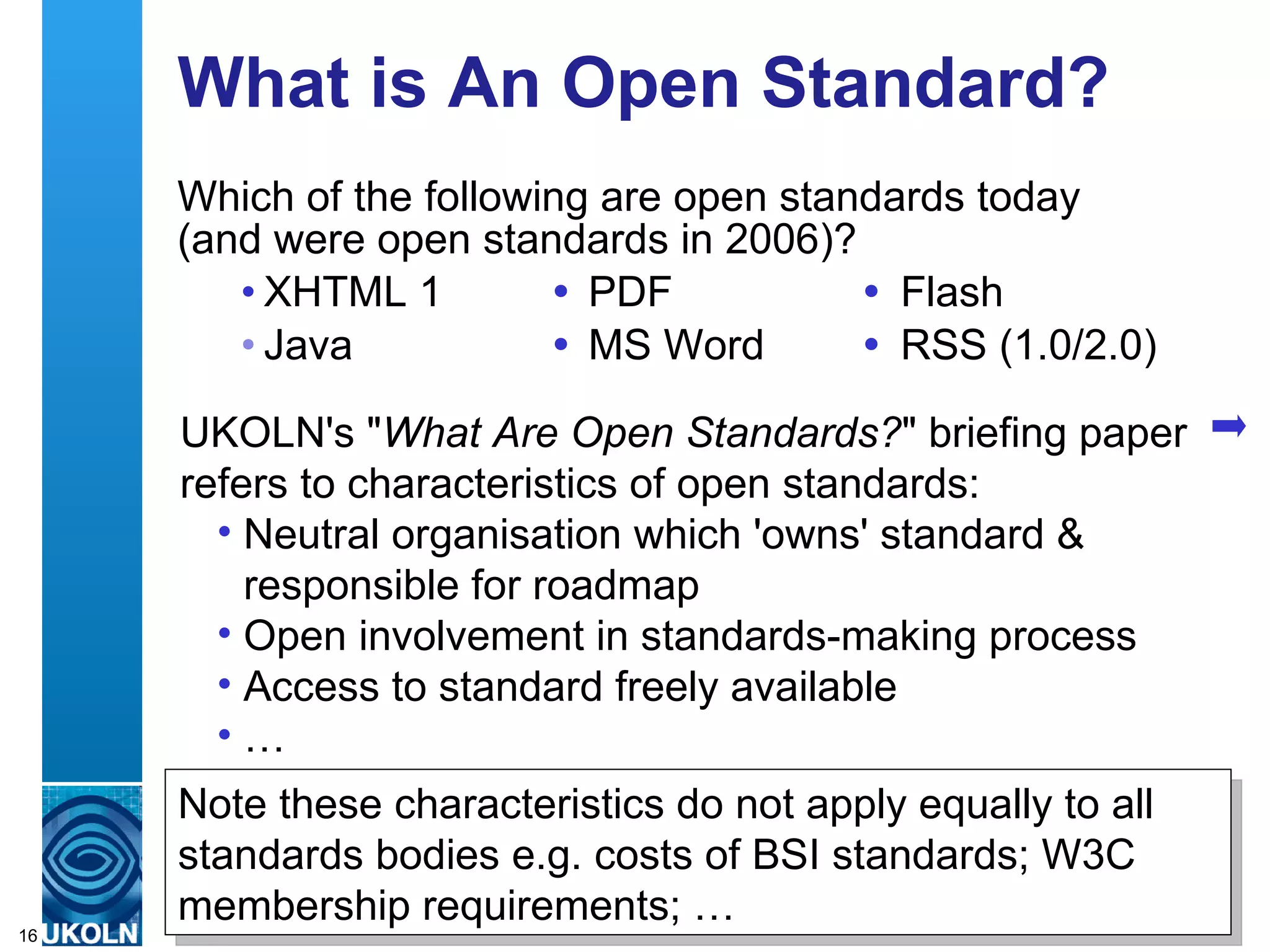
What is An Open Standard? Which of the following are open standards today  (and were open standards in 2006)? XHTML 1  PDF  Flash Java  MS Word  RSS (1.0/2.0) UKOLN's " What Are Open Standards? " briefing paper refers to characteristics of open standards: Neutral organisation which 'owns' standard & responsible for roadmap Open involvement in standards-making process Access to standard freely available … Note these characteristics do not apply equally to all standards bodies e.g. costs of BSI standards; W3C membership requirements; …
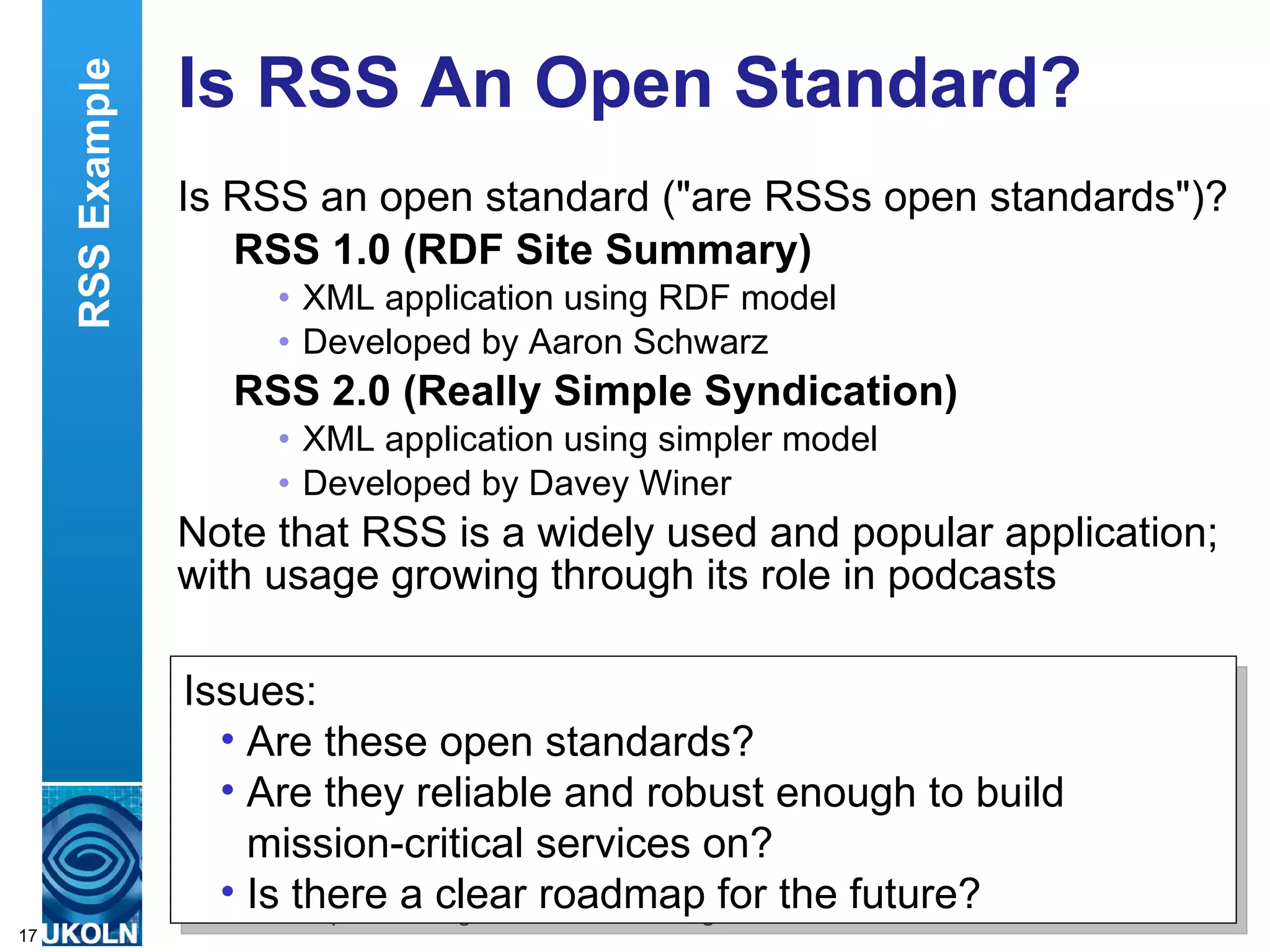
Is RSS An Open Standard?  Is RSS an open standard ("are RSSs open standards")? RSS 1.0 (RDF Site Summary) XML application using RDF model Developed by Aaron Schwarz RSS 2.0 (Really Simple Syndication) XML application using simpler model Developed by Davey Winer Note that RSS is a widely used and popular application; with usage growing through its role in podcasts Issues: Are these open standards? Are they reliable and robust enough to build mission-critical services on? Is there a clear roadmap for the future? RSS Example
RSS – Governance Issues Governance Issues: RSS 1.0 spec maintained by Aaron Schwartz: " Aaron Swartz is a teenage writer, hacker, and activist. He was a finalist for the ArsDigita Prize for excellence in building non-commercial web sites at the age of 13. At 14 he co-authored the RSS 1.0 specification, now used by thousands of sites to notify their readers of updates. " RSS 2.0 specification developed by Dave Winer: " Winer is known as one of the more polarizing figures in the blogging community.  …  However .. there are many people and organizations who seem unable to maintain a good working relationship with Dave. "  RSS Example
RSS 1.0 – Roadmap Issues RSS 1.1: In Jan 2005 RSS 1.1 draft released: "[we] expressed our mutual frustrations with 1.0 …, we decided that rather than lauch (sic) ... another … diatribe against the quality of the RSS 1.0 spec, … [we would] simply write a new specification ourselves.  " But it is no longer being developed: Draft technically good (addressed ambiguities & interoperability flaws) but political reaction apathetic RSS 2.0 has (a) better acronym and (b) momentum (through podcasting) And RSS 2.0 sounds newer RSS 3.0 (joke?) proposal has caused confusion and arguments on Slashdot and elsewhere RSS Example
RSS 2.0 – Roadmap Issues RSS 2.0: Spec published by Harvard Law School with a Creative Commons licence RSS-Board YahooGroups used for governance body Many arguments (e.g. on proposal to expand board in April 2006): Note Wikipedia has useful links to the history and politics of RSS "Winer has now decided that the board doesn't exist and never had authority over the RSS specification, even though it has published six revisions from July 2003 to the present.  I don't agree, but now that the board's fully public, we're in a position to make his wish a reality." RSS Example
RSS – Summary  To summarise : We thought RSS was a great lightweight syndication technology It was – but competing alternatives were developed No clear winner (RSS 1.0's extensibility & W3C's support versus RSS 2.0's simplicity and take-up in podcasting, iTunes, etc)  Conclusions Life can be complex, even with simple standards Technical merit is never enough – market acceptance can change things RSS can still be useful, and interoperability can be provided by RSS libraries supporting multiple formats Need for a more sophisticated approach such as model in “ A Contextual Framework For Standards ”, WWW 2006 RSS Example
The Context There will be a context to use of standards: The intended use: Mainstream  Innovative / research Key middleware component  Small-scale deliverable Organisational culture: HE vs FE  Teaching vs Research Service vs Development  … Available Funding & Resources: Significant funding & training to use new standards  Minimal funding - current skills should be used … Contextual Issues An open standards culture is being developed, which is supportive of use of open standards, but which recognises the complexities and can avoid mistakes made in the past
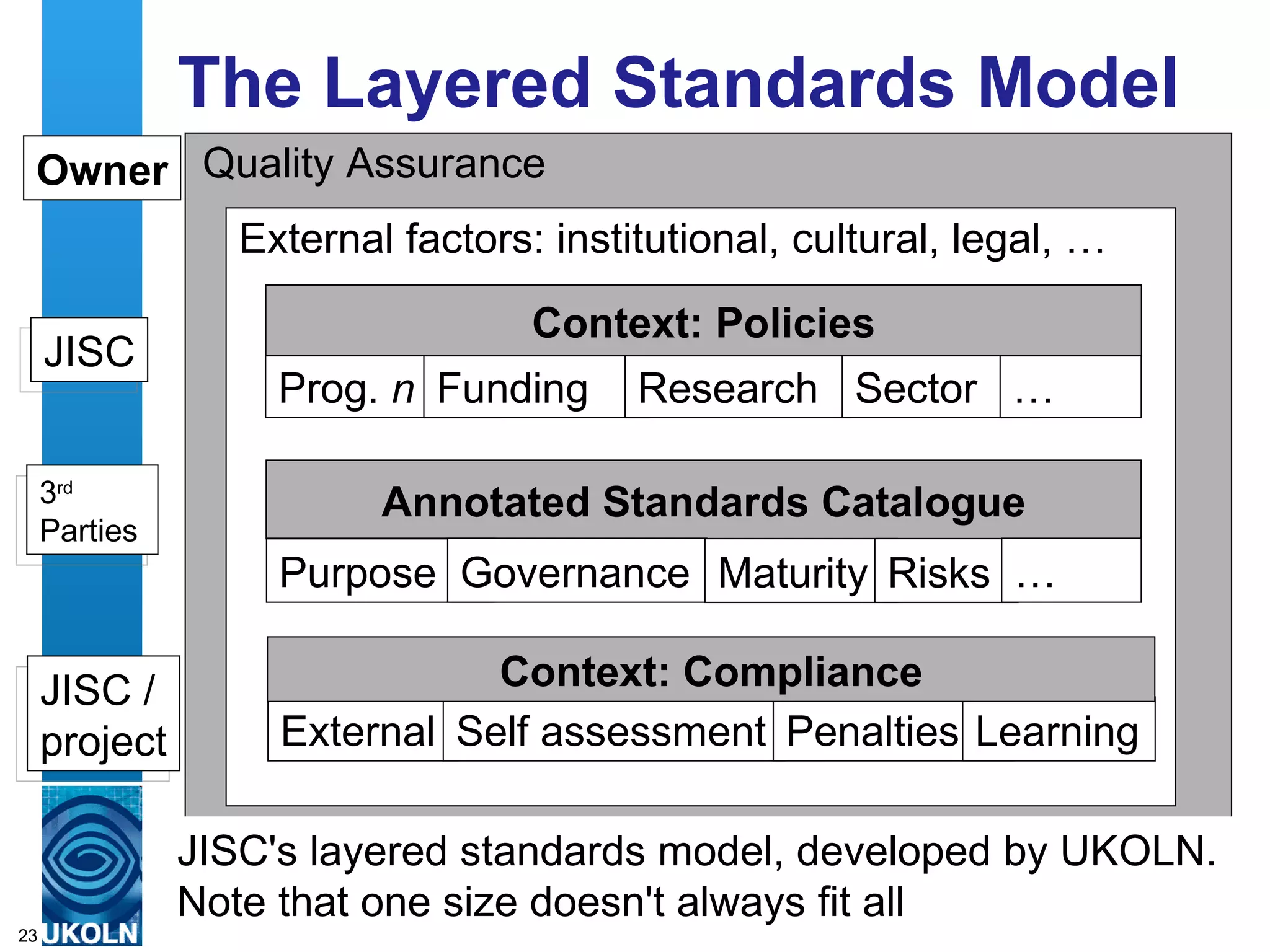
The Layered Standards Model JISC JISC /  project 3 rd   Parties Owner External Self assessment Penalties Learning Context: Compliance JISC's layered standards model, developed by UKOLN.  Note that one size doesn't always fit all Quality Assurance External factors: institutional, cultural, legal, … Annotated Standards Catalogue Purpose Governance Maturity Risks … Prog.  n Funding Research Sector … Context: Policies
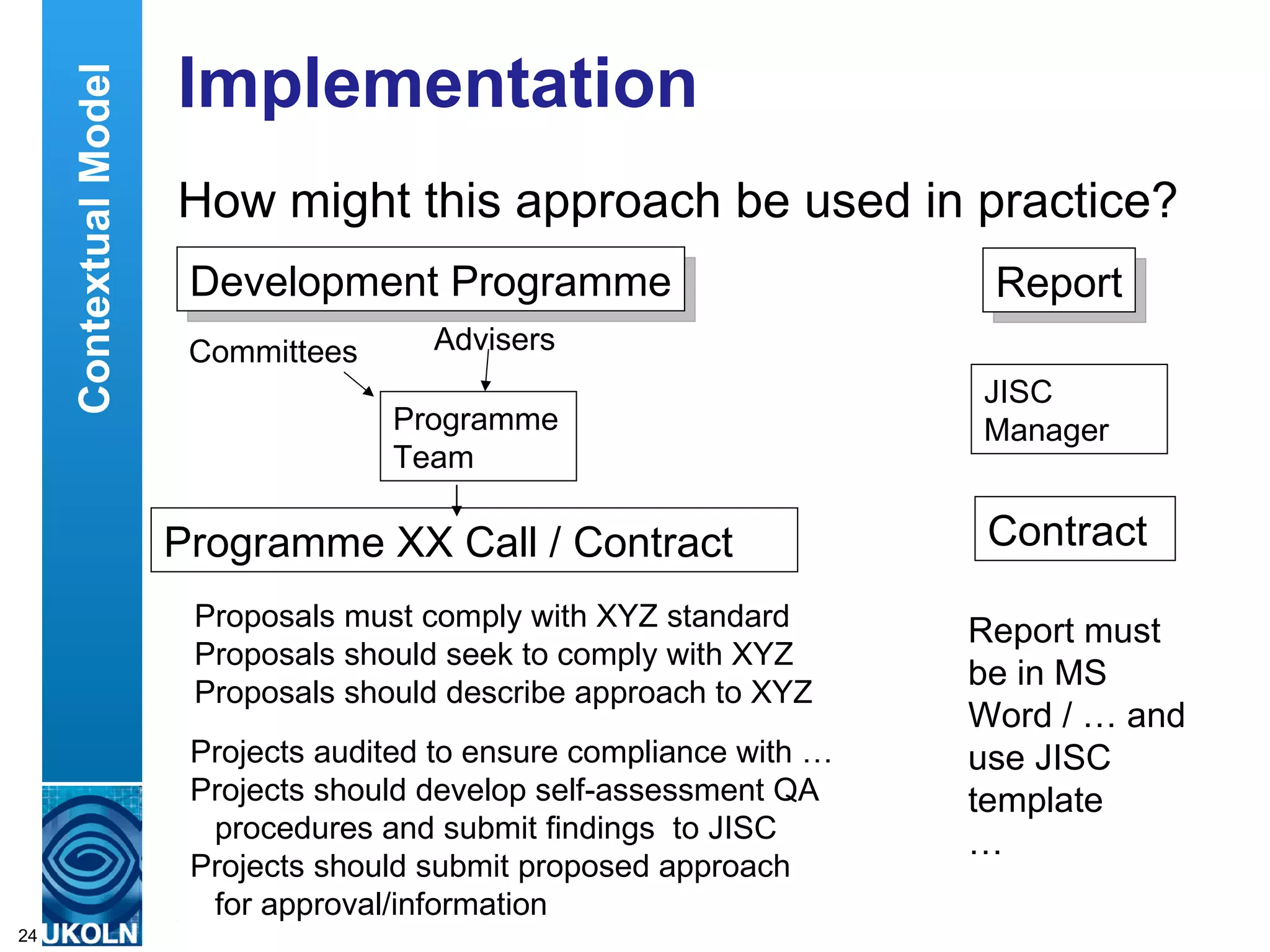
Implementation How might this approach be used in practice? Contextual Model Programme XX Call / Contract Committees Advisers Programme Team Proposals must comply with XYZ standard Proposals should seek to comply with XYZ Proposals should describe approach to XYZ Projects audited to ensure compliance with … Projects should develop self-assessment QA procedures and submit findings  to JISC Projects should submit proposed approach for approval/information Development Programme JISC Manager Report Contract Report must be in MS Word / … and use JISC template …
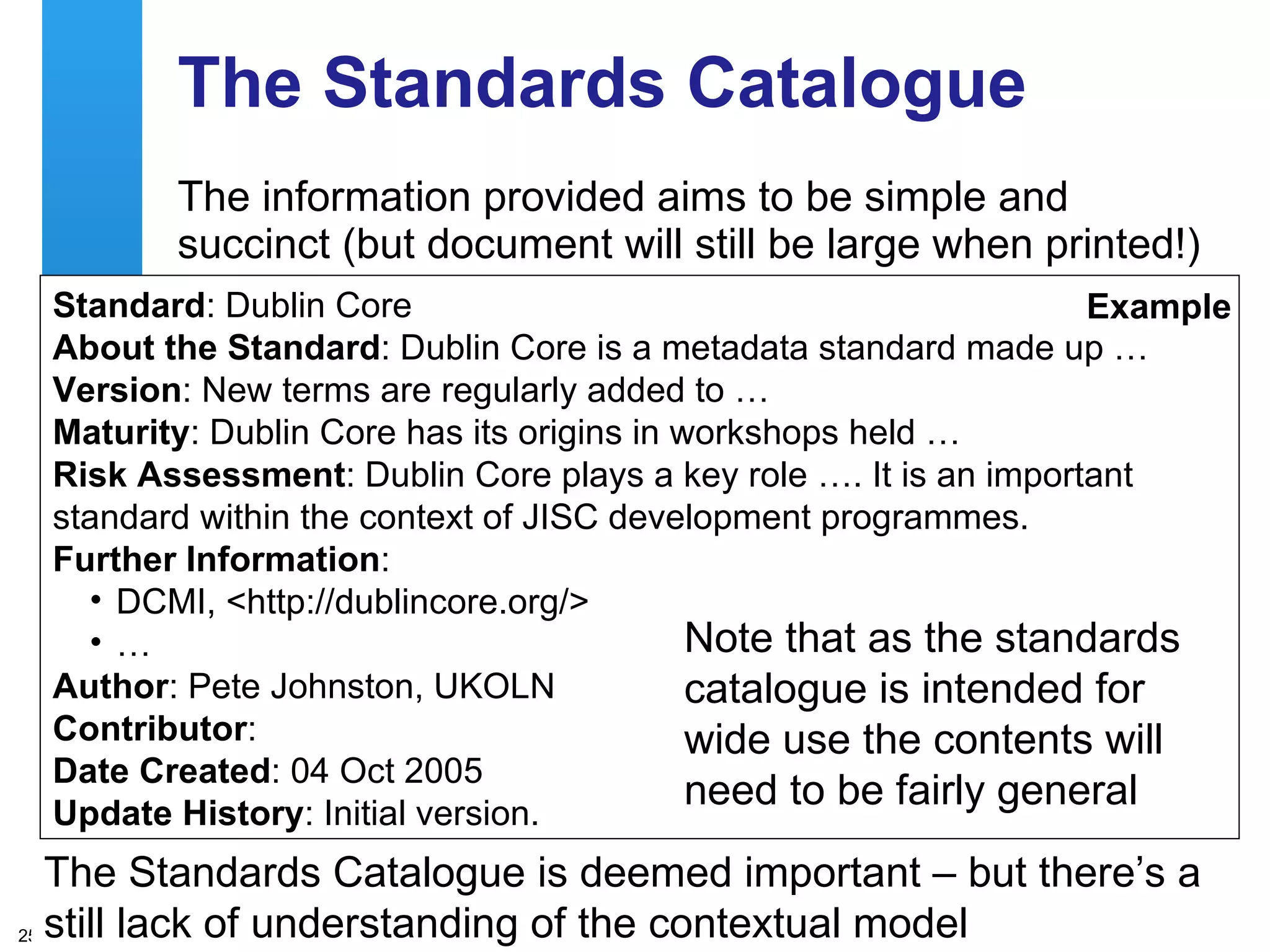
The Standards Catalogue The information provided aims to be simple and succinct (but document will still be large when printed!) The Standards Catalogue is deemed important – but there’s a still lack of understanding of the contextual model Standard : Dublin Core  About the Standard : Dublin Core is a metadata standard made up … Version : New terms are regularly added to …  Maturity : Dublin Core has its origins in workshops held … Risk Assessment : Dublin Core plays a key role …. It is an important standard within the context of JISC development programmes.  Further Information :  DCMI, <http://dublincore.org/>  … Author : Pete Johnston, UKOLN  Contributor :  Date Created : 04 Oct 2005  Update History : Initial version.  Example Note that as the standards catalogue is intended for wide use the contents will need to be fairly general
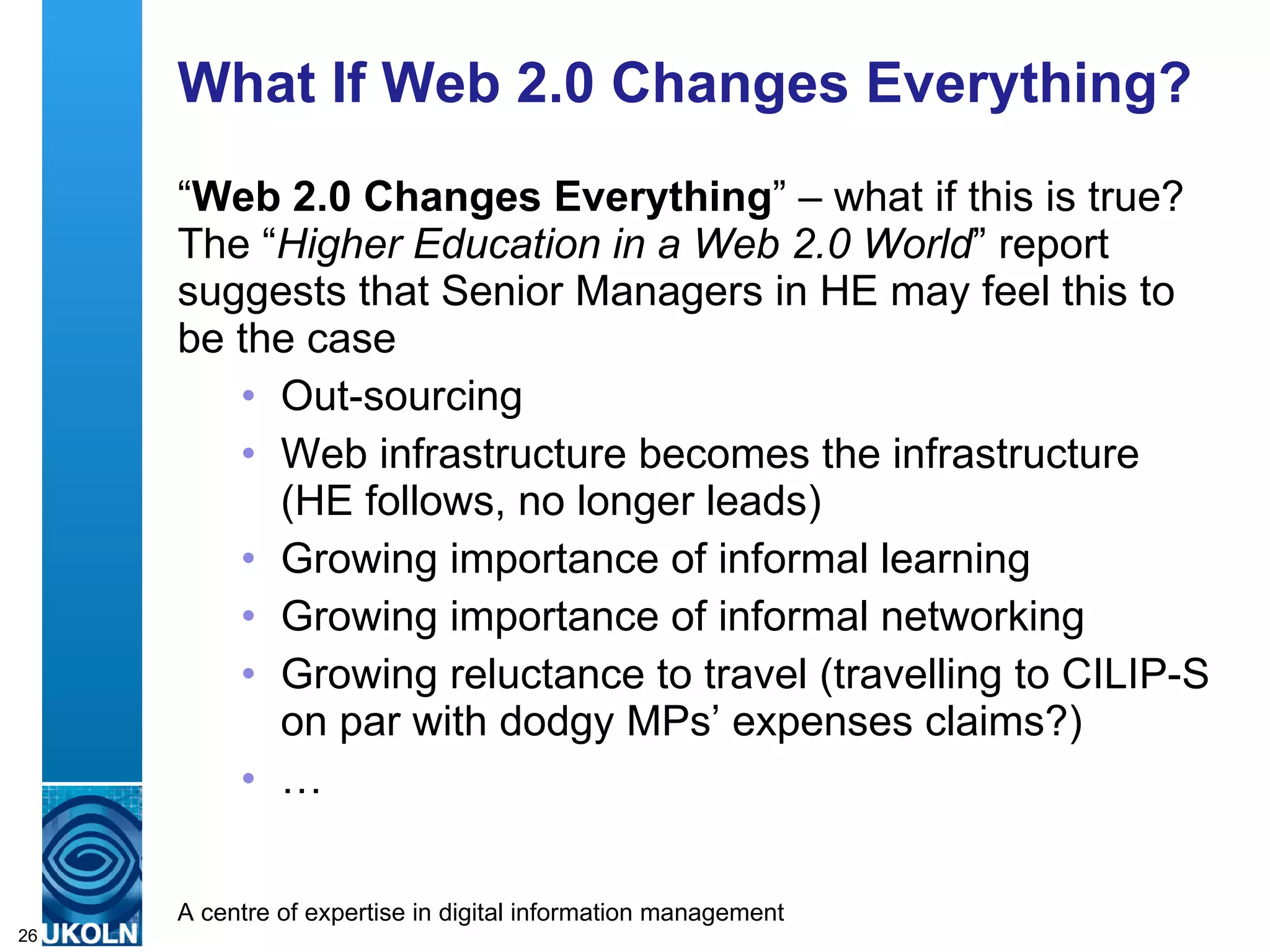
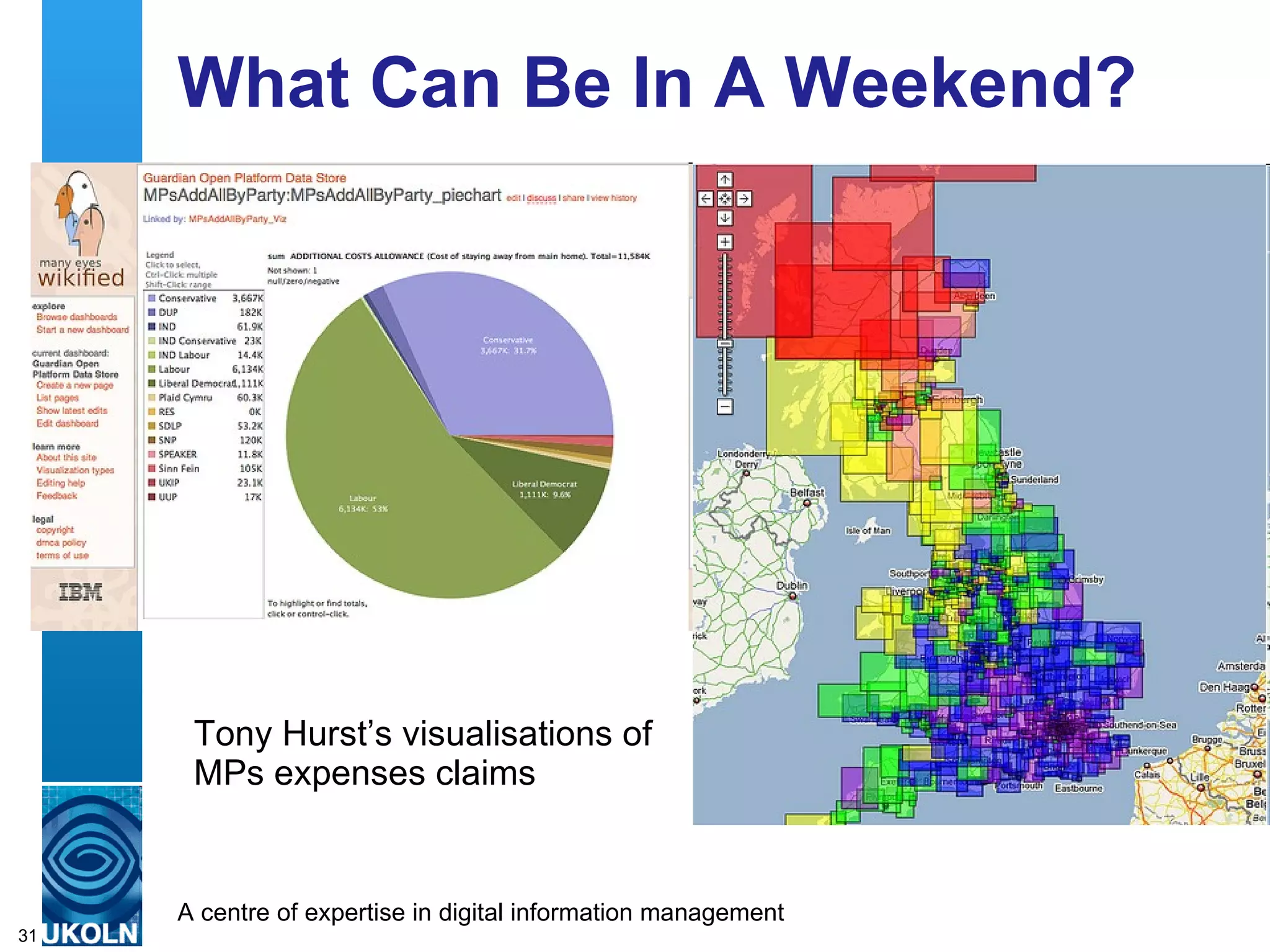
What If Web 2.0 Changes Everything? “ Web 2.0 Changes Everything ” – what if this is true? The “ Higher Education in a Web 2.0 World ” report suggests that Senior Managers in HE may feel this to be the case  Out-sourcing Web infrastructure becomes the infrastructure (HE follows, no longer leads) Growing importance of informal learning Growing importance of informal networking Growing reluctance to travel (travelling to CILIP-S on par with dodgy MPs’ expenses claims?) …
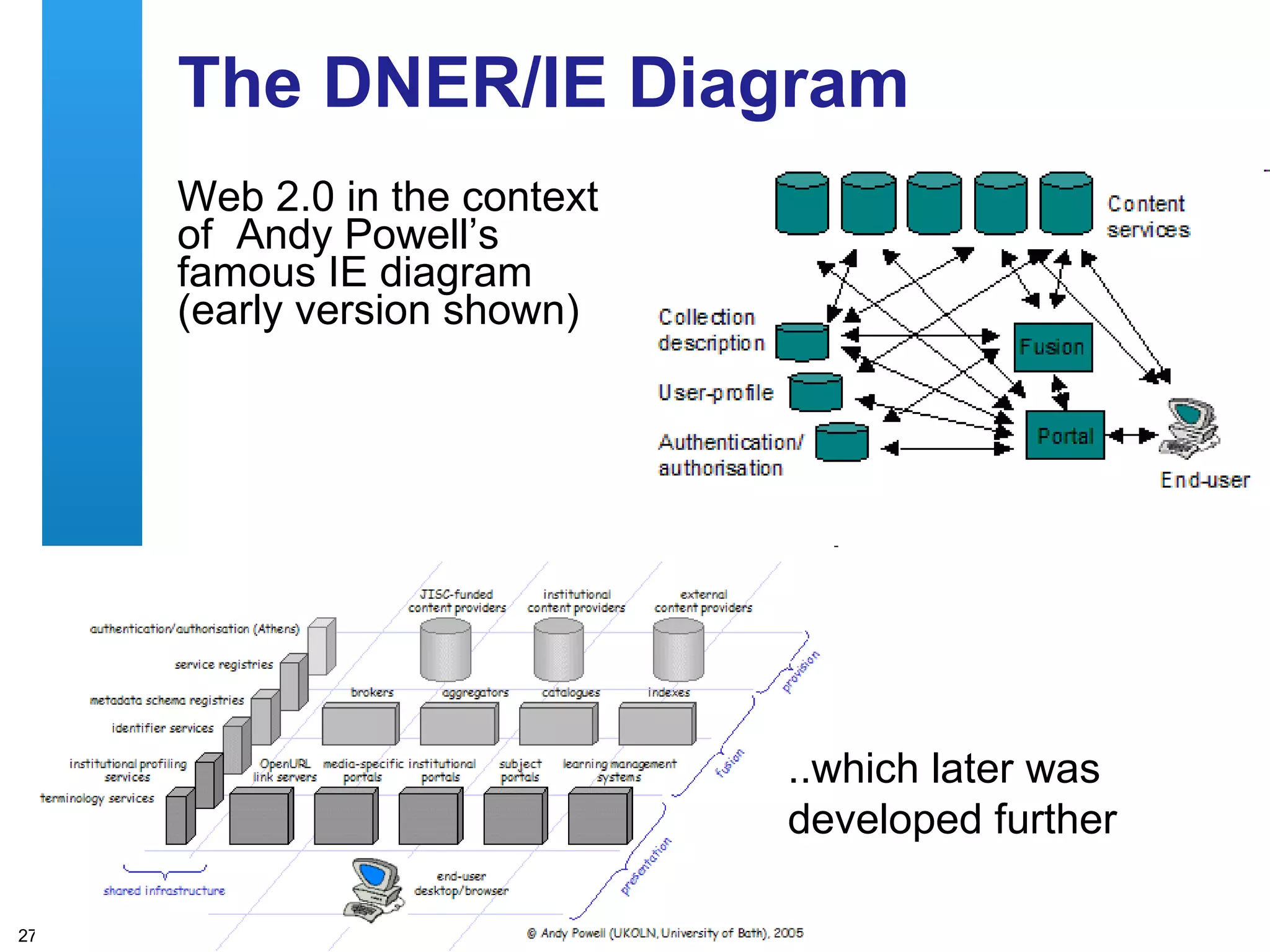
The DNER/IE Diagram Web 2.0 in the context of  Andy Powell’s famous IE diagram (early version shown) ..which later was developed further
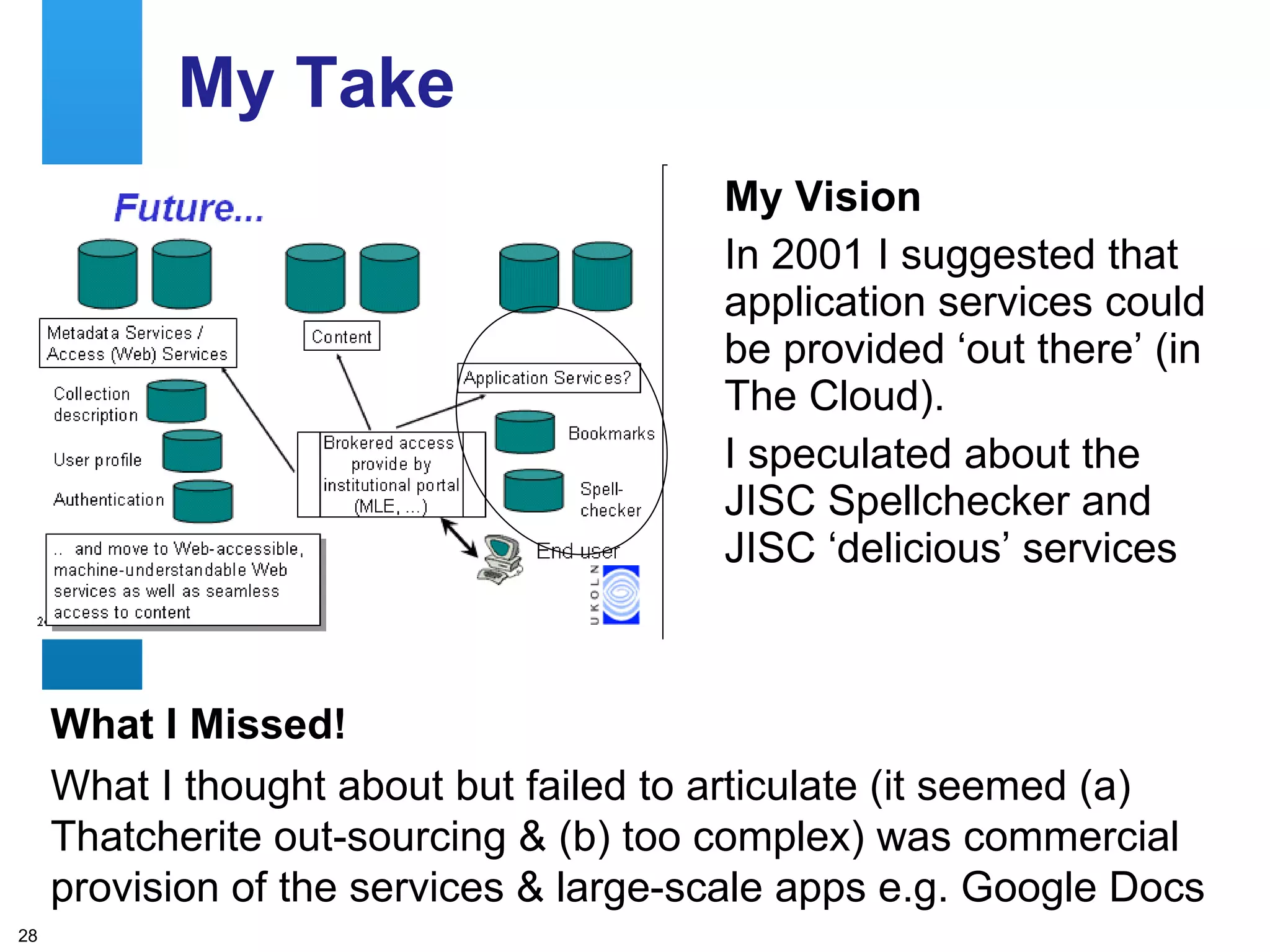
My Take My Vision In 2001 I suggested that application services could be provided ‘out there’ (in The Cloud).  I speculated about the JISC Spellchecker and JISC ‘delicious’ services What I Missed! What I thought about but failed to articulate (it seemed (a) Thatcherite out-sourcing & (b) too complex) was commercial provision of the services & large-scale apps e.g. Google Docs
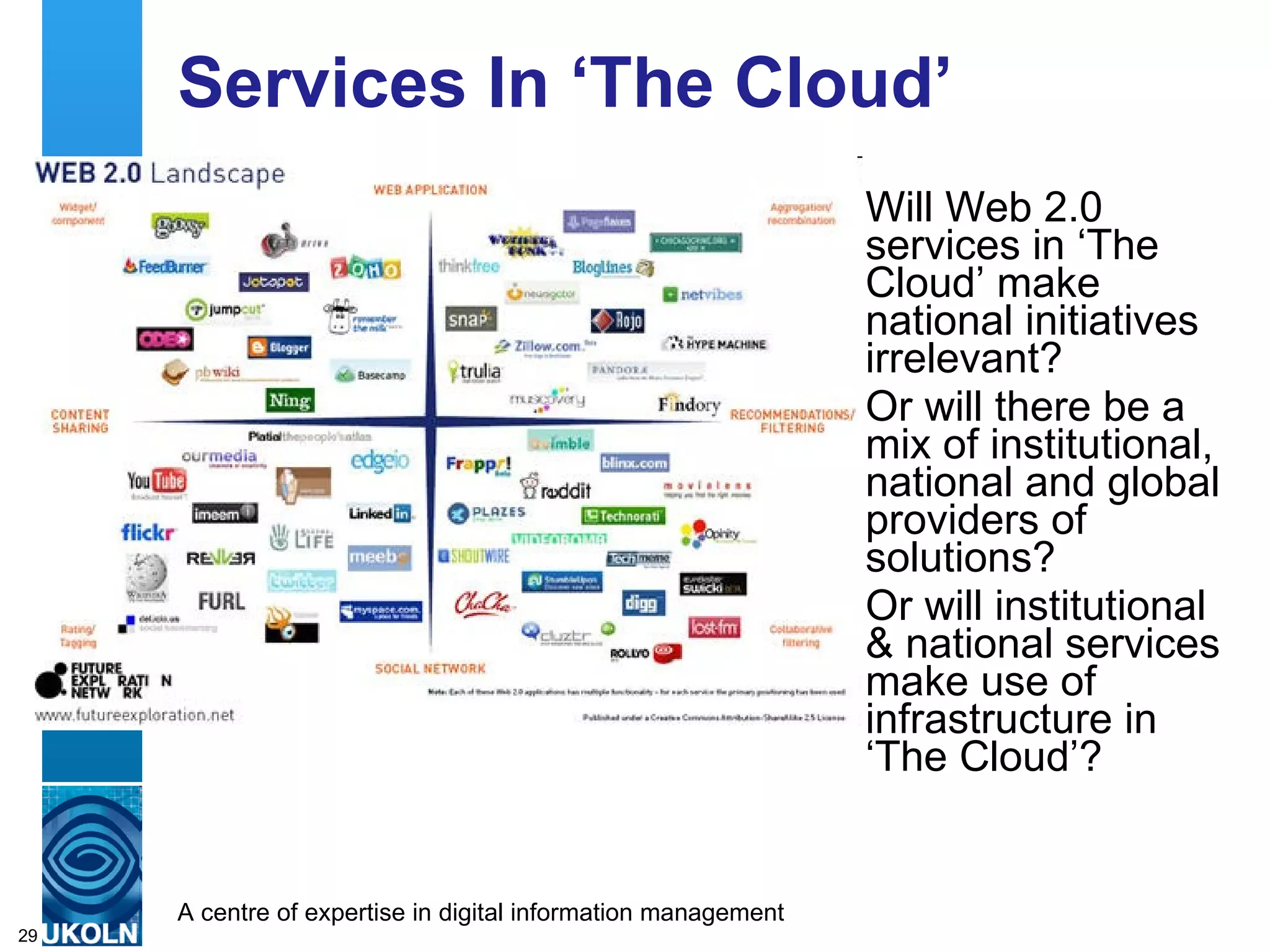
Services In ‘The Cloud’ Will Web 2.0 services in ‘The Cloud’ make national initiatives irrelevant? Or will there be a mix of institutional, national and global providers of solutions? Or will institutional & national services make use of infrastructure in ‘The Cloud’?
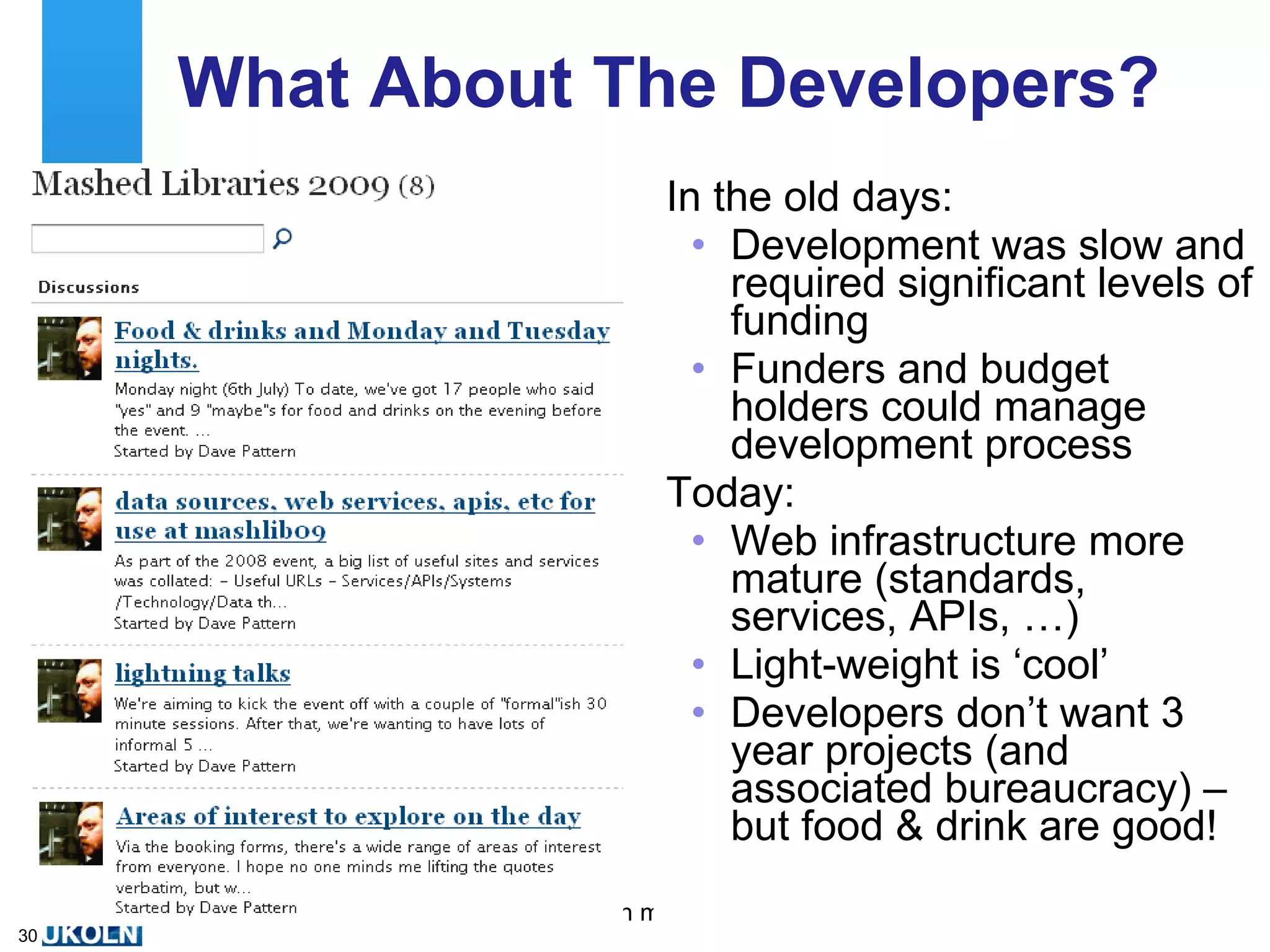
What About The Developers? In the old days: Development was slow and required significant levels of funding Funders and budget holders could manage development process Today: Web infrastructure more mature (standards, services, APIs, …) Light-weight is ‘cool’ Developers don’t want 3 year projects (and associated bureaucracy) – but food & drink are good!
What Can Be In A Weekend? Tony Hurst’s visualisations of MPs expenses claims
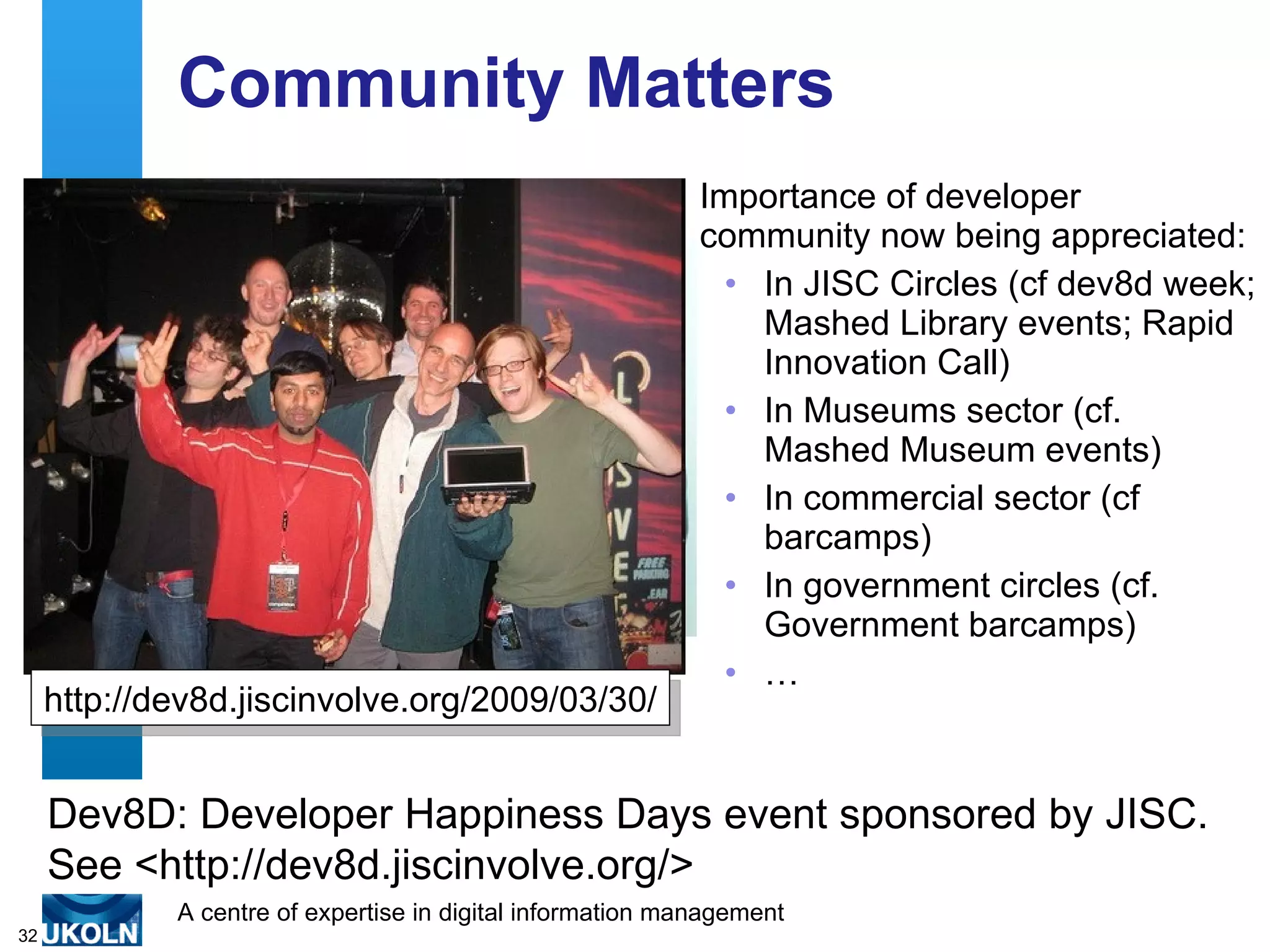
Community Matters Importance of developer community now being appreciated: In JISC Circles (cf dev8d week; Mashed Library events; Rapid Innovation Call) In Museums sector (cf. Mashed Museum events) In commercial sector (cf barcamps) In government circles (cf. Government barcamps) … http://dev8d.jiscinvolve.org/2009/03/30/ Dev8D: Developer Happiness Days event sponsored by JISC. See <http://dev8d.jiscinvolve.org/>
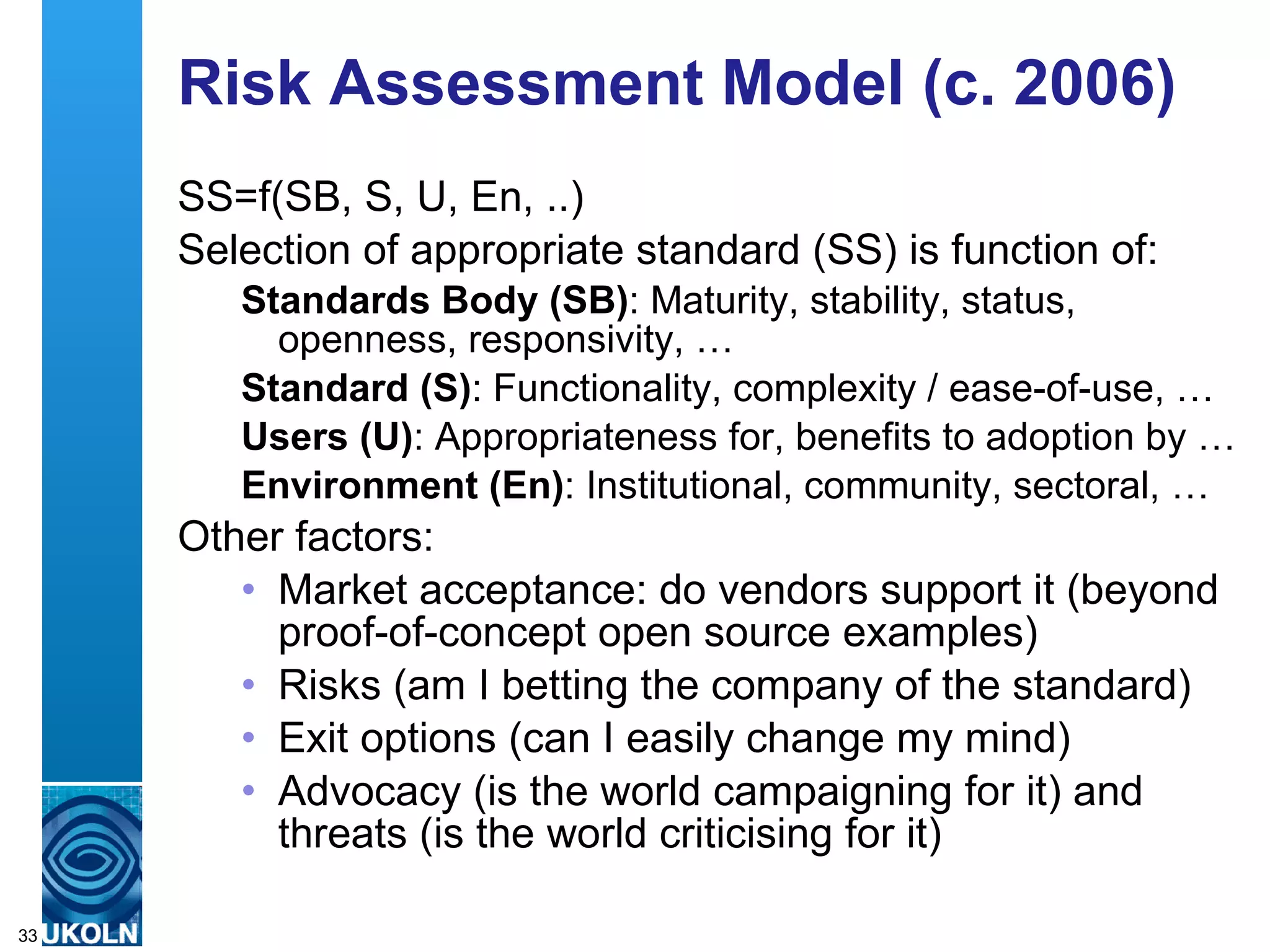
Risk Assessment Model (c. 2006) SS=f(SB, S, U, En, ..) Selection of appropriate standard (SS) is function of: Standards Body (SB) : Maturity, stability, status, openness, responsivity, … Standard (S) : Functionality, complexity / ease-of-use, … Users (U) : Appropriateness for, benefits to adoption by … Environment (En) : Institutional, community, sectoral, … Other factors: Market acceptance: do vendors support it (beyond proof-of-concept open source examples) Risks (am I betting the company of the standard) Exit options (can I easily change my mind) Advocacy (is the world campaigning for it) and threats (is the world criticising for it)
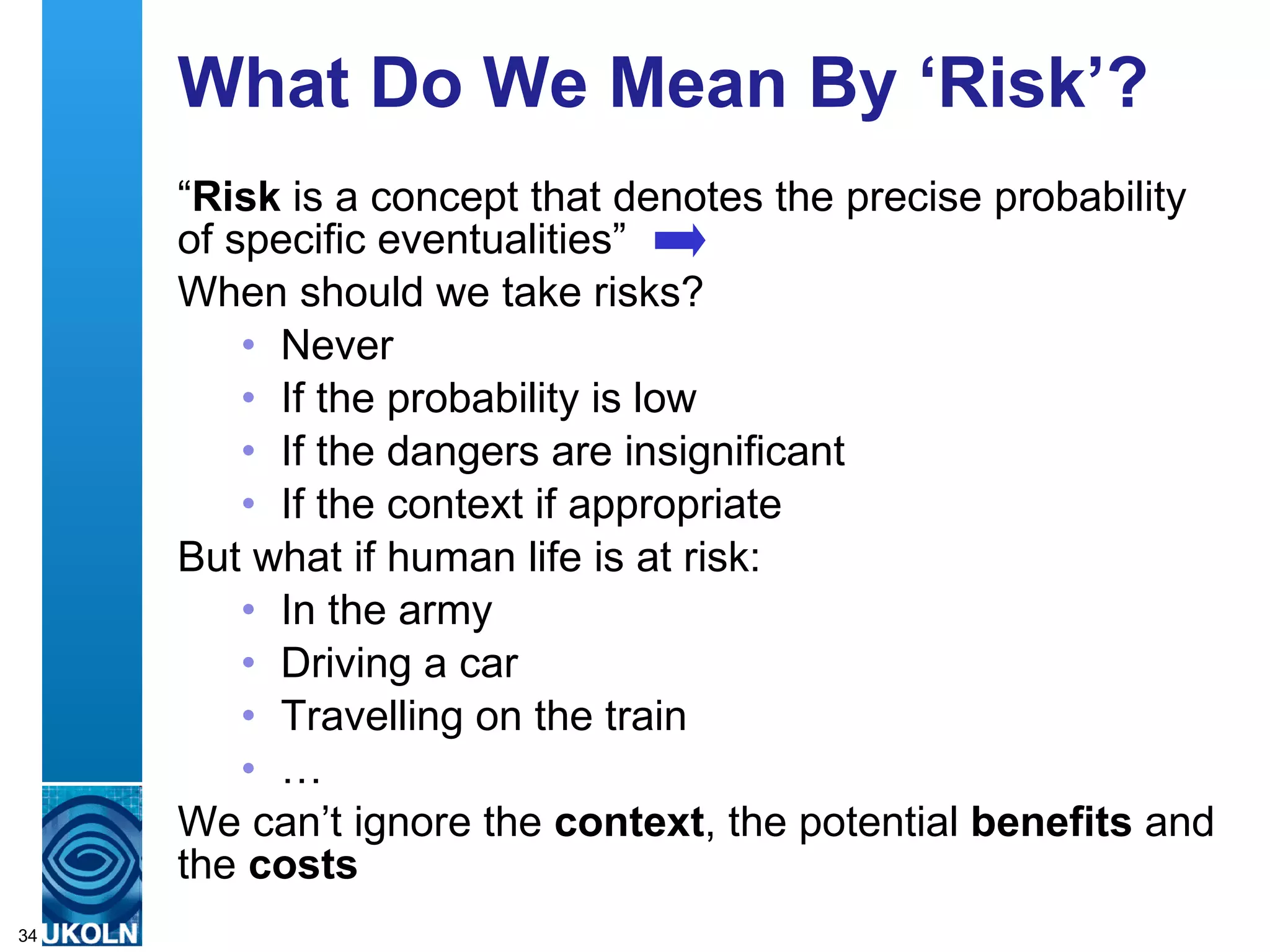
What Do We Mean By ‘Risk’? “ Risk  is a concept that denotes the precise probability of specific eventualities” When should we take risks? Never If the probability is low If the dangers are insignificant If the context if appropriate But what if human life is at risk: In the army Driving a car Travelling on the train … We can’t ignore the  context , the potential  benefits  and the  costs
Deployment Strategies Interested in using Web 2.0 in your organisation? Worried about corporate inertia, power struggles, etc? There’s a need for a deployment strategy: Addressing business needs Low-hanging fruits Encouraging the enthusiasts Gain experience of the browser tools – and see what you’re missing! Staff training & development Impact assessment and measurement Risk and opportunity management strategy Critical Friends and friendly critics Culture of sharing …
Risk Management  JISC infoNet Risk Management infoKit: “ In education, as in any other environment, you can’t decide not to take risks: that simply isn’t an option in today’s world. All of us take risks and it’s a question of which risks we take ”  Examples of people who are likely to be adverse stakeholders: People who fear loss of their jobs  People who will require re-training  People who may be moved to a different department / team  People .. required to commit resources to the project  People who fear loss of control over a function or resources  People who will have to do their job in a different way  People who will have to carry out new or additional functions  People who will have to use a new technology  Strategies
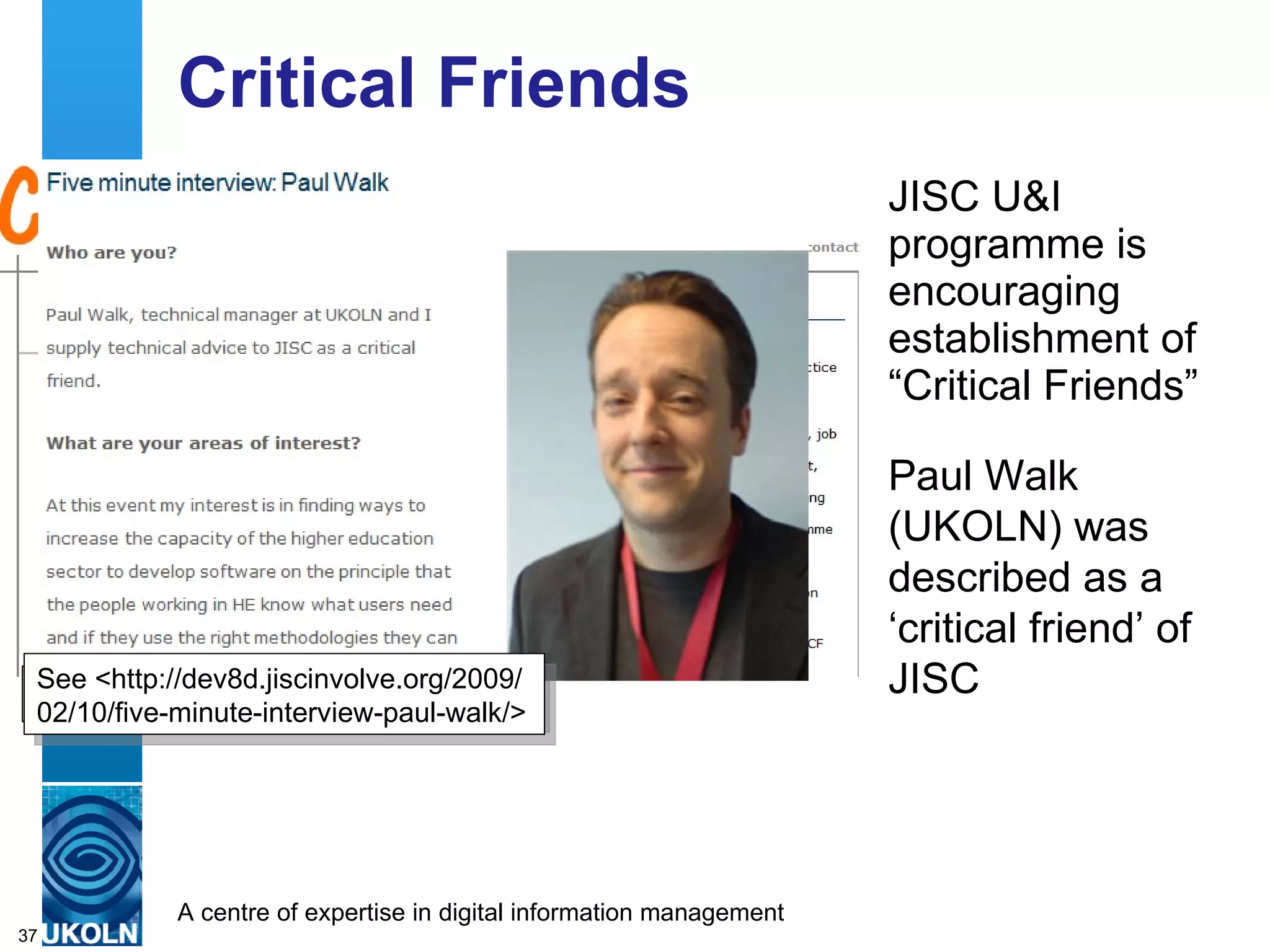
Critical Friends JISC U&I programme is encouraging establishment of “Critical Friends” See <http://critical-friends.org/> Paul Walk (UKOLN) was described as a ‘critical friend’ of JISC See <http://dev8d.jiscinvolve.org/2009/ 02/10/five-minute-interview-paul-walk/>
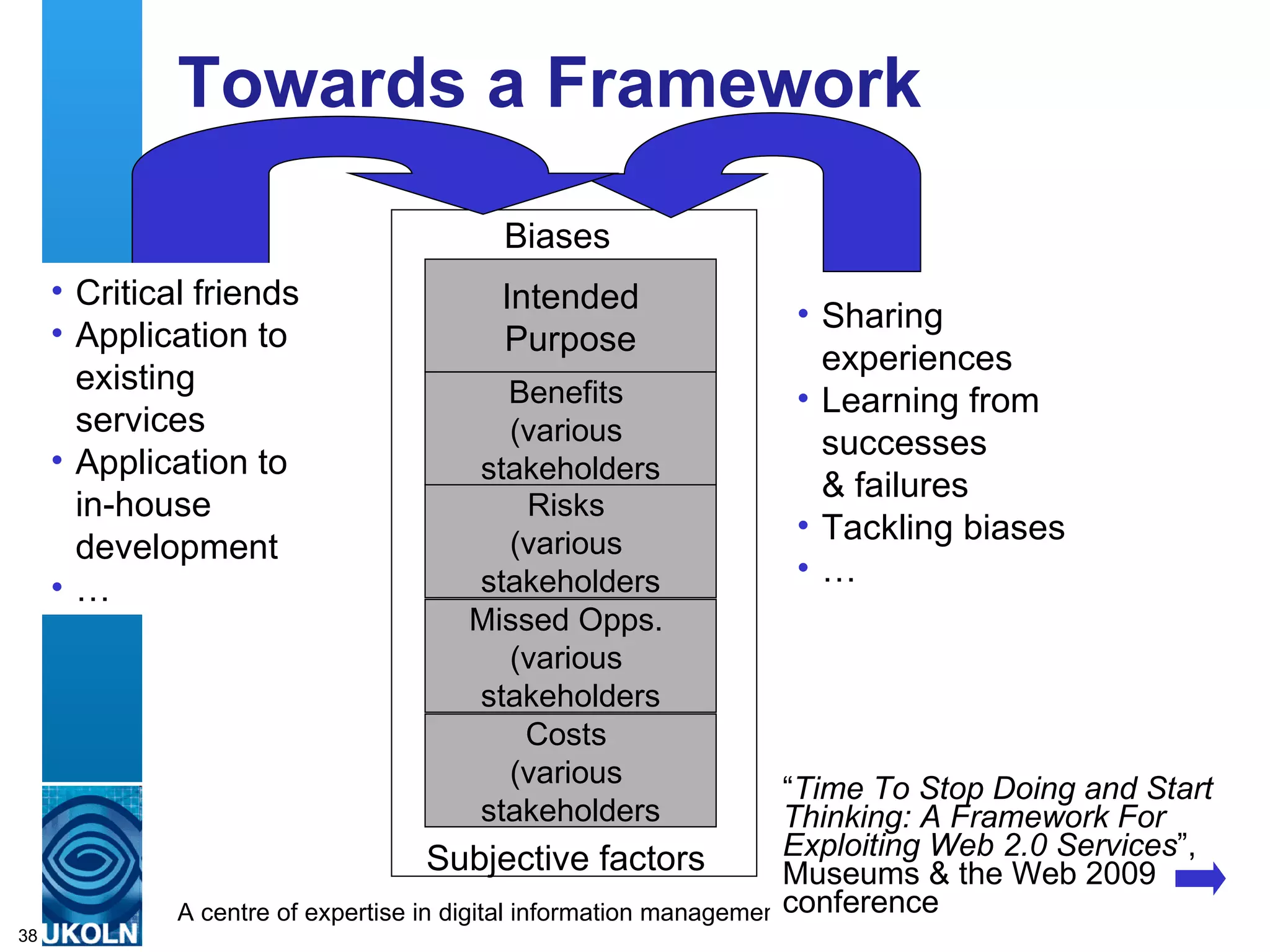
Towards a Framework “ Time To Stop Doing and Start Thinking: A Framework For Exploiting Web 2.0 Services ”, Museums & the Web 2009 conference Biases Subjective factors Intended Purpose Benefits  (various  stakeholders Risks  (various  stakeholders Missed Opps.  (various  stakeholders Costs  (various  stakeholders Sharing experiences Learning from successes & failures Tackling biases … Critical friends Application to existing services Application to in-house development …
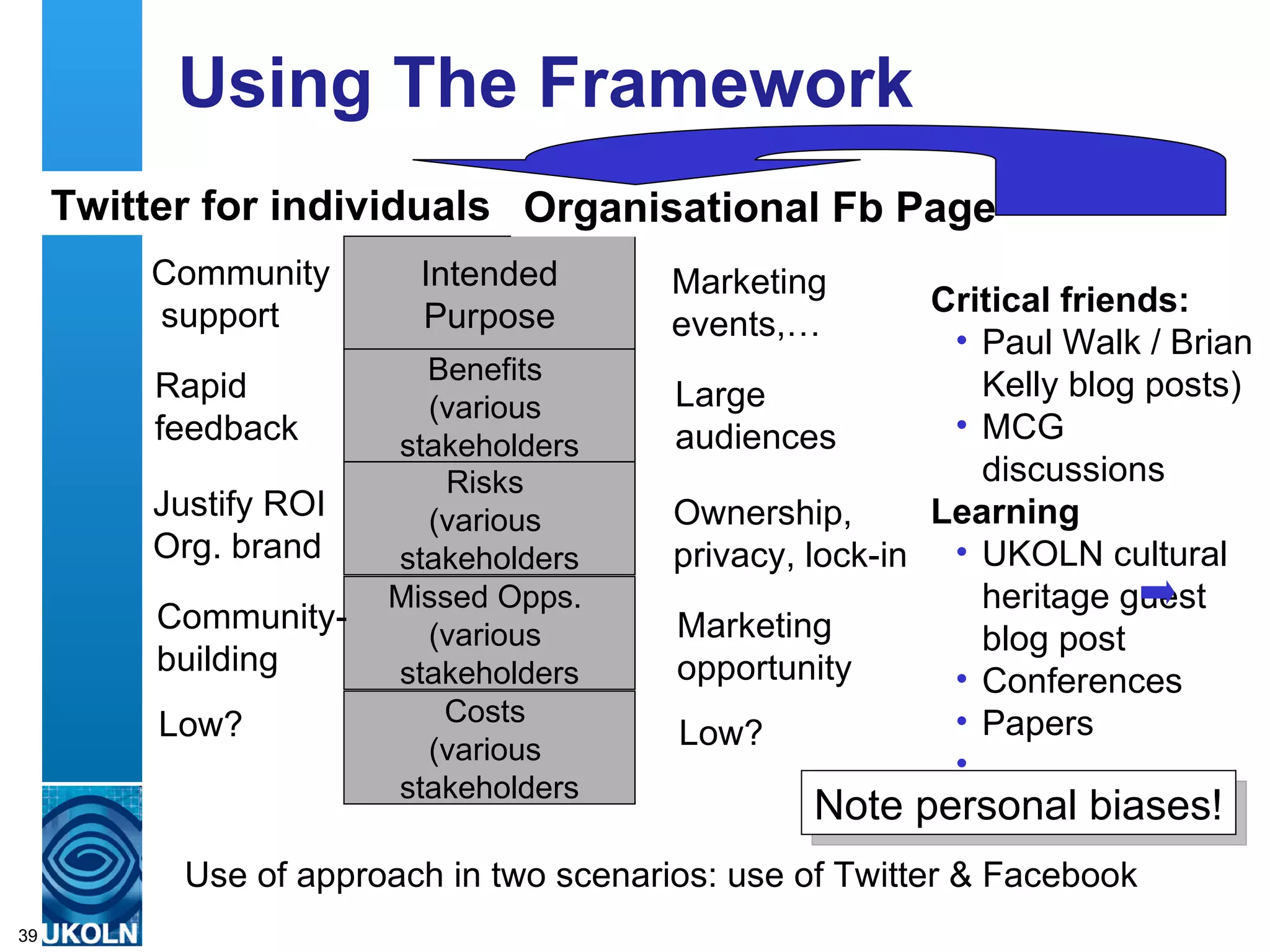
Using The Framework Use of approach in two scenarios: use of Twitter & Facebook Note personal biases! Intended Purpose Benefits  (various  stakeholders Risks  (various  stakeholders Missed Opps.  (various  stakeholders Costs  (various  stakeholders Community  support Rapid  feedback Justify ROI Org. brand Community- building Low? Twitter for individuals Organisational Fb Page Marketing  events,…  Large  audiences Ownership,  privacy, lock-in Marketing  opportunity Low? Critical friends: Paul Walk / Brian Kelly blog posts) MCG discussions Learning UKOLN cultural heritage guest blog post Conferences Papers …
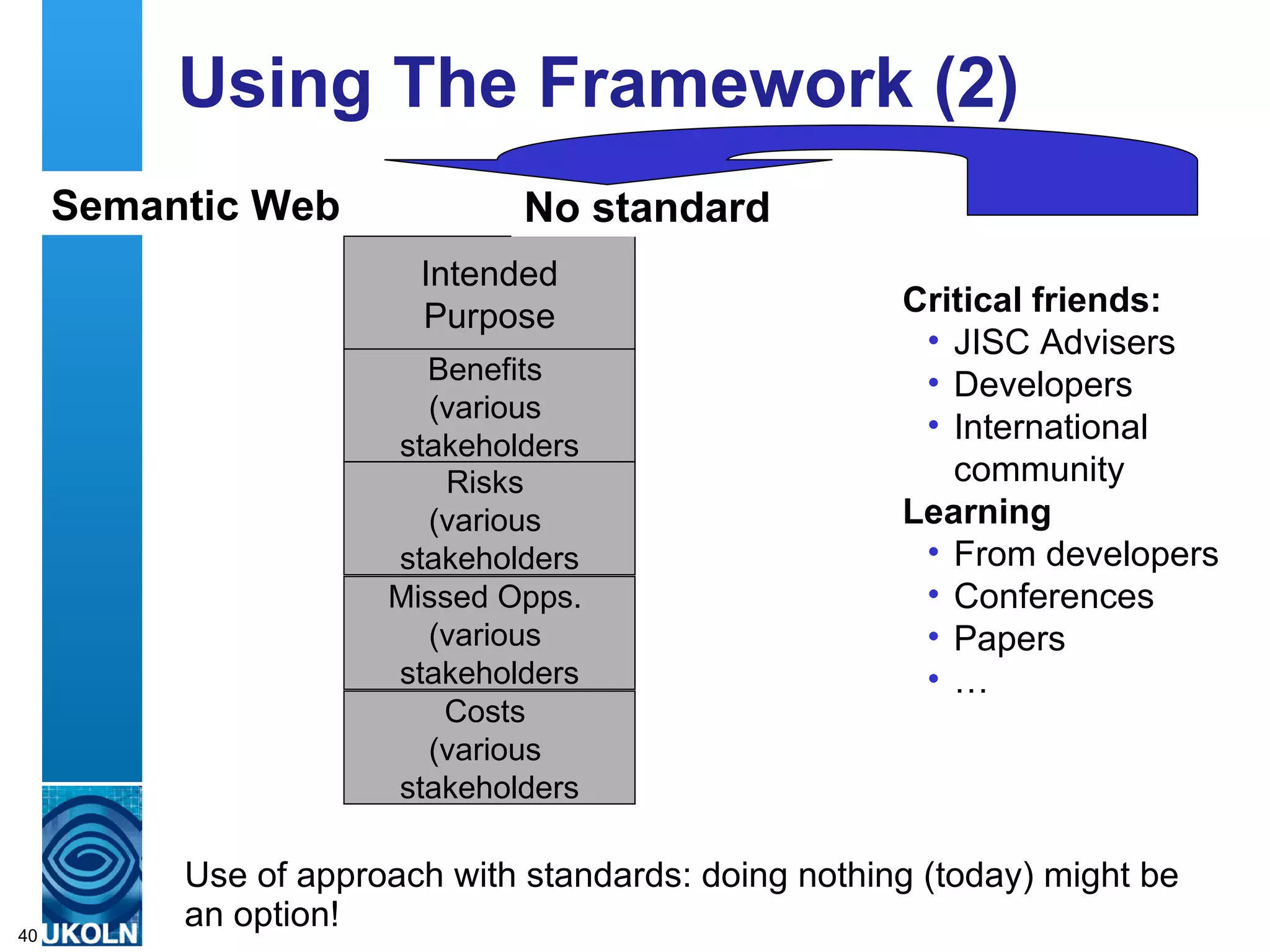
Using The Framework (2) Use of approach with standards: doing nothing (today) might be an option! Semantic Web No standard Intended Purpose Benefits  (various  stakeholders Risks  (various  stakeholders Missed Opps.  (various  stakeholders Costs  (various  stakeholders Critical friends: JISC Advisers Developers International community Learning From developers Conferences Papers …
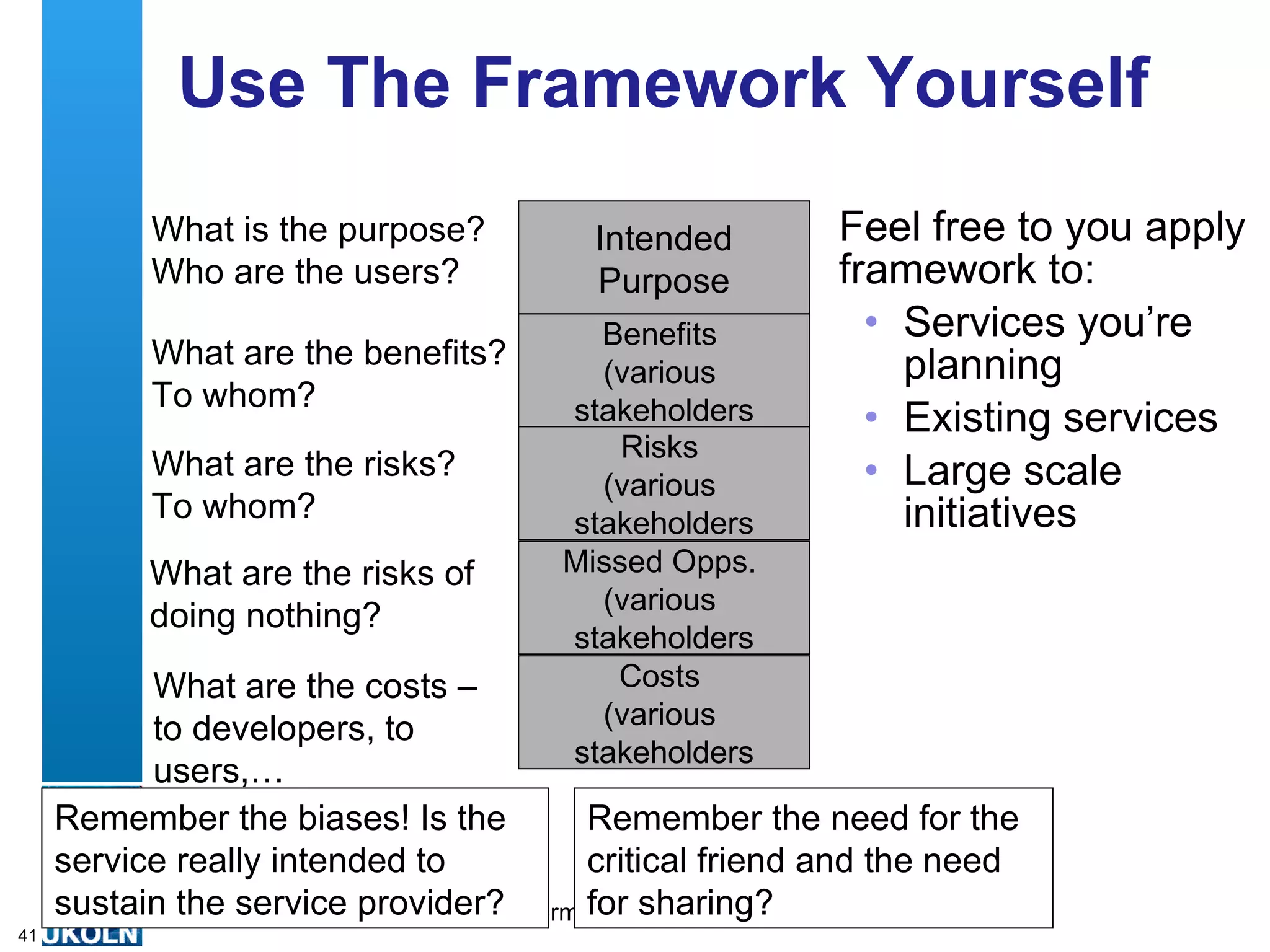
Use The Framework Yourself Feel free to you apply framework to: Services you’re planning Existing services Large scale initiatives What is the purpose? Who are the users? What are the benefits? To whom? What are the risks? To whom? What are the risks of doing nothing? What are the costs – to developers, to users,… Remember the biases! Is the service really intended to sustain the service provider? Remember the need for the critical friend and the need for sharing? Intended Purpose Benefits  (various  stakeholders Risks  (various  stakeholders Missed Opps.  (various  stakeholders Costs  (various  stakeholders
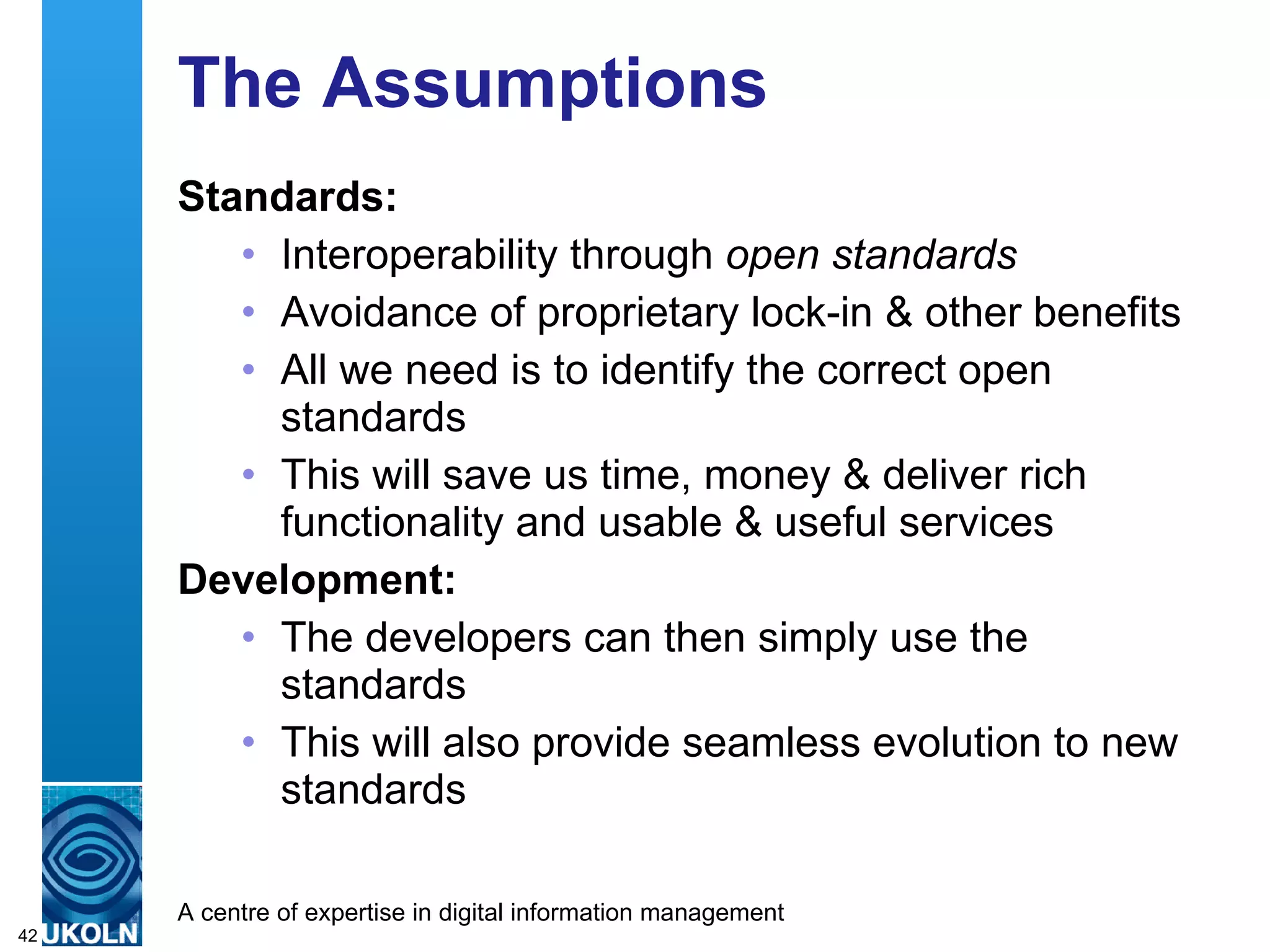
The Assumptions Standards: Interoperability through  open standards Avoidance of proprietary lock-in & other benefits All we need is to identify the correct open standards This will save us time, money & deliver rich functionality and usable & useful services Development: The developers can then simply use the standards  This will also provide seamless evolution to new standards
Challenging The Assumptions Maybe we want: To challenge the unthinking assumptions in national development programmes –using evidence rather than assertions The  benefits  promised (but not necessarily delivered) by open standards An understanding that it’s not a binary open standards vs proprietary world The world may choose good enough, whilst we want to provide the best To develop user-focussed services which the commercial sector seems to be better at To recognise the importance of the developers’ perspective  And we should also challenge these views!
Questions Any questions, comments, …? Additional Resources: Papers published on standards and national programmes: What Does Openness Mean To The Museum Community? , MW 2008 Openness in Higher Education: Open Source, Open Standards, Open Access , elPub 2008 Addressing The Limitations Of Open Standards , MW 2007 A Contextual Framework For Standards , WWW 2006 A Standards Framework For Digital Library Programmes , ichim05 Interoperability Across Digital Library Programmes? We Must Have QA! , ECDL 2004 Deployment Of Quality Assurance Procedures For Digital Library Programmes , IADIS 2003 Developing A Quality Culture For Digital Library Programmes , EUNIS 2003 Ideology Or Pragmatism? Open Standards And Cultural Heritage Web Sites , ichim03 See <http://www.ukoln.ac.uk/web-focus/papers/#standards>

How Far Have We Come? From eLib to NOF-digi and Beyond

  • 1.
    How Far HaveWe Come? From eLib to NOF-digi and Beyond Brian Kelly UKOLN University of Bath Bath, UK UKOLN is supported by: This work is licensed under a Attribution-NonCommercial-ShareAlike 2.0 licence (but note caveat) Acceptable Use Policy Recording of this talk, taking photos, discussing the content using email, instant messaging, blogs, SMS, etc. is permitted providing distractions to others is minimised. Resources bookmarked using ‘ cilips09 ' tag Email: [email_address] Twitter: http://twitter.com/briankelly/ Blog: http://ukwebfocus.wordpress.com/ http://www.ukoln.ac.uk/cultural-heritage/events/cilip-scotland-2009/
  • 2.
    Contents Introduction Aboutme About this talk The National Programmes (provider’s perspective) The technical standards The support infrastructure What We Learnt What succeeded, what failed and what we discovered along the way What Should We Do In The Future What do we do next? Introduction
  • 3.
    About This TalkTalk is based on experiences of national programmes: eLib NOF-digi DNER/IE Michael Common characteristics: Interoperability through open standards Managed view of roadmap Issues: Did we get it right? Are there alternative approaches? Introduction
  • 4.
    The eLib ProgrammeeLib Programme: Response to the Follet review, 1993 Initial budget of £15m over 3 years 60+ projects funded Areas covered: Document Delivery Access To Network Resources Training & Awareness Electronic Journals Digitisation / Images Electronic Short Loan Collections On Demand Publishing Pre-Prints and Grey Literature Supporting Studies
  • 5.
    eLib Standards GuidelineseLib Standards Guidelines: Provides recommendations for selection & use of standards Strongly encouraged where relevant Covered: Data communications Data interchange Metadata Search & retrieve Security, authentication & payment services
  • 6.
    eLib Standards Thingswe don’t care about (?): Email (SMTP, not X.400), … Areas we correctly hedged our bets: GIF is OK, keep eye on PNG Areas we were evasive about: PostScript & PDF Areas we got wrong: “ It is anticipated that SGML will be a key standard ... Projects are encouraged to .. agree or, where necessary, develop document type definitions ” “ projects should … supply a URL for public services, and be prepared to adopt URNs when they are stabilised ” Standards which seem to have disappeared: CGM Editors : Chris Rusbridge & Ann Mumford (myself as contributor)
  • 7.
    eLib Standards version2 eLib Standards version 2 Published in 1998 (2 years after v 1) Introduced a template for descriptions Relevant standards : Comments : Consensus : Templates on recommended standards complemented by technical summaries – and speculation e.g. “ HTTP-NG should support more secure authentication and encryption ”
  • 8.
    Beyond The StandardsCross-Searching: The Vision whois++ lightweight distributed cross-searching protocol ROADS : Open source software used by most eLib subject gateways (e.g. SOSIG) Z39.50 : More heavy-weight solution used in library context eLib SBIGs/RDN : implementation in a distributed environment (with departmental providers) Cross-Searching: Today’s Reality Intute : Centralised database, distributed data collection. Cross-searching interfaces, but how widely used? Note dangers of using standards outside of DL programmes – JISC Web site upgrade mandated Z39.50 support 
  • 9.
    Later, in NOF-digitiseNOF-Digitise programme: Ran from August 1999 to December 2004 £50 million funding to put information that supports lifelong learning into digitised form. Brought together wide range of partnerships & organisations NOF Technical Advisory Service (NOF TAS) provided: Informed support and advocacy of Technical Standards and Guidelines Assistance in achieving standards compliance Detailed and project-specific advice Repository of standard and generic advice Provide by UKOLN and AHDS
  • 10.
    Development Culture Differentculture to HE digital library development community: Tell us the standards which we must mandate Caused problems: “ NOF-digi project Web sites must have 24x7 availability ” – very expensive! Requirement was availability at weekends! Recommended standards weren’t mature (e.g. SMIL) whereas proprietary solutions (Flash) provided compelling user services Providing pragmatic solutions: “ NOF-digi project Web sites should seek to maximise their uptime ” Quarterly reporting template provided a get-out clause: “ You must (a) describe the areas in which compliance will not be achieved; (b) explain why compliance will not be achieved (including research on appropriate open standards); (c) describe your migration strategies to ensure compliance in the future and (d) how the migration may be funded ”
  • 11.
    Minerva Experience Minervatechnical guidelines: EU-funded Built on eLib/NOF/JISC IE resources Initially edited by UKOLN Continued to promote plausible: Standards Best practices which failed to take off
  • 12.
    Compliance Issues Whatdoes must mean? You must comply with HTML standards What if I don't? What if nobody does? What if I use PDF? You must clear rights on all resources you digitise You must provide properly audited accounts What if I don't? There is a need to clarify the meaning of must and for an understandable, realistic and reasonable compliance regime JISC 5/99 programme ~80% of project home pages were not HTML compliant
  • 13.
    QA Focus QA Focus: JISC-funded project provided by UKOLN and (initially) TASI, then AHDS from 2002-2004 What QA regime should JISC provide for its development programmes? What actions should be taken if standards not conformed with? Recommendations: Self-assessment, not external validation (projects explained complexities of standards-compliance) Build on culture of sharing and openness Have a pragmatic view of ‘open standards’ Understand complexities of non-conformance / ‘failure’: The standard failed, not the project The standard may be too expensive to deploy Alternatives may become available
  • 14.
    Why Open Standards?JISC's development programmes: Traditionally based on use of open standards to: Support interoperability Maximise accessibility Avoid vendor lock-in Provide architectural integrity Help ensure long-term preservation But (thinking the unthinkable): Do open standards deliver? What happens if open standards fail? What is an open standard? Is the only alternative to open standards use of proprietary solutions?
  • 15.
    … ButDon't Always Work  There's a need for flexibility: Learning the lesson from OSI networking protocols Today: Is the Web (for example) becoming over-complex &quot;Web service considered harmful&quot; The lowercase semantic web / Microformats Lighter-weight alternatives being developed Responses from the commercial world Other key issues What is an open standard? What are the resource implications of using them? Sometimes proprietary solutions work (and users like them). Is it politically incorrect to mention this!?
  • 16.
    What is AnOpen Standard? Which of the following are open standards today (and were open standards in 2006)? XHTML 1  PDF  Flash Java  MS Word  RSS (1.0/2.0) UKOLN's &quot; What Are Open Standards? &quot; briefing paper refers to characteristics of open standards: Neutral organisation which 'owns' standard & responsible for roadmap Open involvement in standards-making process Access to standard freely available … Note these characteristics do not apply equally to all standards bodies e.g. costs of BSI standards; W3C membership requirements; …
  • 17.
    Is RSS AnOpen Standard? Is RSS an open standard (&quot;are RSSs open standards&quot;)? RSS 1.0 (RDF Site Summary) XML application using RDF model Developed by Aaron Schwarz RSS 2.0 (Really Simple Syndication) XML application using simpler model Developed by Davey Winer Note that RSS is a widely used and popular application; with usage growing through its role in podcasts Issues: Are these open standards? Are they reliable and robust enough to build mission-critical services on? Is there a clear roadmap for the future? RSS Example
  • 18.
    RSS – GovernanceIssues Governance Issues: RSS 1.0 spec maintained by Aaron Schwartz: &quot; Aaron Swartz is a teenage writer, hacker, and activist. He was a finalist for the ArsDigita Prize for excellence in building non-commercial web sites at the age of 13. At 14 he co-authored the RSS 1.0 specification, now used by thousands of sites to notify their readers of updates. &quot; RSS 2.0 specification developed by Dave Winer: &quot; Winer is known as one of the more polarizing figures in the blogging community. … However .. there are many people and organizations who seem unable to maintain a good working relationship with Dave. &quot; RSS Example
  • 19.
    RSS 1.0 –Roadmap Issues RSS 1.1: In Jan 2005 RSS 1.1 draft released: &quot;[we] expressed our mutual frustrations with 1.0 …, we decided that rather than lauch (sic) ... another … diatribe against the quality of the RSS 1.0 spec, … [we would] simply write a new specification ourselves. &quot; But it is no longer being developed: Draft technically good (addressed ambiguities & interoperability flaws) but political reaction apathetic RSS 2.0 has (a) better acronym and (b) momentum (through podcasting) And RSS 2.0 sounds newer RSS 3.0 (joke?) proposal has caused confusion and arguments on Slashdot and elsewhere RSS Example
  • 20.
    RSS 2.0 –Roadmap Issues RSS 2.0: Spec published by Harvard Law School with a Creative Commons licence RSS-Board YahooGroups used for governance body Many arguments (e.g. on proposal to expand board in April 2006): Note Wikipedia has useful links to the history and politics of RSS &quot;Winer has now decided that the board doesn't exist and never had authority over the RSS specification, even though it has published six revisions from July 2003 to the present. I don't agree, but now that the board's fully public, we're in a position to make his wish a reality.&quot; RSS Example
  • 21.
    RSS – Summary To summarise : We thought RSS was a great lightweight syndication technology It was – but competing alternatives were developed No clear winner (RSS 1.0's extensibility & W3C's support versus RSS 2.0's simplicity and take-up in podcasting, iTunes, etc) Conclusions Life can be complex, even with simple standards Technical merit is never enough – market acceptance can change things RSS can still be useful, and interoperability can be provided by RSS libraries supporting multiple formats Need for a more sophisticated approach such as model in “ A Contextual Framework For Standards ”, WWW 2006 RSS Example
  • 22.
    The Context Therewill be a context to use of standards: The intended use: Mainstream  Innovative / research Key middleware component  Small-scale deliverable Organisational culture: HE vs FE  Teaching vs Research Service vs Development  … Available Funding & Resources: Significant funding & training to use new standards Minimal funding - current skills should be used … Contextual Issues An open standards culture is being developed, which is supportive of use of open standards, but which recognises the complexities and can avoid mistakes made in the past
  • 23.
    The Layered StandardsModel JISC JISC / project 3 rd Parties Owner External Self assessment Penalties Learning Context: Compliance JISC's layered standards model, developed by UKOLN. Note that one size doesn't always fit all Quality Assurance External factors: institutional, cultural, legal, … Annotated Standards Catalogue Purpose Governance Maturity Risks … Prog. n Funding Research Sector … Context: Policies
  • 24.
    Implementation How mightthis approach be used in practice? Contextual Model Programme XX Call / Contract Committees Advisers Programme Team Proposals must comply with XYZ standard Proposals should seek to comply with XYZ Proposals should describe approach to XYZ Projects audited to ensure compliance with … Projects should develop self-assessment QA procedures and submit findings to JISC Projects should submit proposed approach for approval/information Development Programme JISC Manager Report Contract Report must be in MS Word / … and use JISC template …
  • 25.
    The Standards CatalogueThe information provided aims to be simple and succinct (but document will still be large when printed!) The Standards Catalogue is deemed important – but there’s a still lack of understanding of the contextual model Standard : Dublin Core About the Standard : Dublin Core is a metadata standard made up … Version : New terms are regularly added to … Maturity : Dublin Core has its origins in workshops held … Risk Assessment : Dublin Core plays a key role …. It is an important standard within the context of JISC development programmes. Further Information : DCMI, <http://dublincore.org/> … Author : Pete Johnston, UKOLN Contributor : Date Created : 04 Oct 2005 Update History : Initial version. Example Note that as the standards catalogue is intended for wide use the contents will need to be fairly general
  • 26.
    What If Web2.0 Changes Everything? “ Web 2.0 Changes Everything ” – what if this is true? The “ Higher Education in a Web 2.0 World ” report suggests that Senior Managers in HE may feel this to be the case Out-sourcing Web infrastructure becomes the infrastructure (HE follows, no longer leads) Growing importance of informal learning Growing importance of informal networking Growing reluctance to travel (travelling to CILIP-S on par with dodgy MPs’ expenses claims?) …
  • 27.
    The DNER/IE DiagramWeb 2.0 in the context of Andy Powell’s famous IE diagram (early version shown) ..which later was developed further
  • 28.
    My Take MyVision In 2001 I suggested that application services could be provided ‘out there’ (in The Cloud). I speculated about the JISC Spellchecker and JISC ‘delicious’ services What I Missed! What I thought about but failed to articulate (it seemed (a) Thatcherite out-sourcing & (b) too complex) was commercial provision of the services & large-scale apps e.g. Google Docs
  • 29.
    Services In ‘TheCloud’ Will Web 2.0 services in ‘The Cloud’ make national initiatives irrelevant? Or will there be a mix of institutional, national and global providers of solutions? Or will institutional & national services make use of infrastructure in ‘The Cloud’?
  • 30.
    What About TheDevelopers? In the old days: Development was slow and required significant levels of funding Funders and budget holders could manage development process Today: Web infrastructure more mature (standards, services, APIs, …) Light-weight is ‘cool’ Developers don’t want 3 year projects (and associated bureaucracy) – but food & drink are good!
  • 31.
    What Can BeIn A Weekend? Tony Hurst’s visualisations of MPs expenses claims
  • 32.
    Community Matters Importanceof developer community now being appreciated: In JISC Circles (cf dev8d week; Mashed Library events; Rapid Innovation Call) In Museums sector (cf. Mashed Museum events) In commercial sector (cf barcamps) In government circles (cf. Government barcamps) … http://dev8d.jiscinvolve.org/2009/03/30/ Dev8D: Developer Happiness Days event sponsored by JISC. See <http://dev8d.jiscinvolve.org/>
  • 33.
    Risk Assessment Model(c. 2006) SS=f(SB, S, U, En, ..) Selection of appropriate standard (SS) is function of: Standards Body (SB) : Maturity, stability, status, openness, responsivity, … Standard (S) : Functionality, complexity / ease-of-use, … Users (U) : Appropriateness for, benefits to adoption by … Environment (En) : Institutional, community, sectoral, … Other factors: Market acceptance: do vendors support it (beyond proof-of-concept open source examples) Risks (am I betting the company of the standard) Exit options (can I easily change my mind) Advocacy (is the world campaigning for it) and threats (is the world criticising for it)
  • 34.
    What Do WeMean By ‘Risk’? “ Risk is a concept that denotes the precise probability of specific eventualities” When should we take risks? Never If the probability is low If the dangers are insignificant If the context if appropriate But what if human life is at risk: In the army Driving a car Travelling on the train … We can’t ignore the context , the potential benefits and the costs
  • 35.
    Deployment Strategies Interestedin using Web 2.0 in your organisation? Worried about corporate inertia, power struggles, etc? There’s a need for a deployment strategy: Addressing business needs Low-hanging fruits Encouraging the enthusiasts Gain experience of the browser tools – and see what you’re missing! Staff training & development Impact assessment and measurement Risk and opportunity management strategy Critical Friends and friendly critics Culture of sharing …
  • 36.
    Risk Management JISC infoNet Risk Management infoKit: “ In education, as in any other environment, you can’t decide not to take risks: that simply isn’t an option in today’s world. All of us take risks and it’s a question of which risks we take ” Examples of people who are likely to be adverse stakeholders: People who fear loss of their jobs People who will require re-training People who may be moved to a different department / team People .. required to commit resources to the project People who fear loss of control over a function or resources People who will have to do their job in a different way People who will have to carry out new or additional functions People who will have to use a new technology Strategies
  • 37.
    Critical Friends JISCU&I programme is encouraging establishment of “Critical Friends” See <http://critical-friends.org/> Paul Walk (UKOLN) was described as a ‘critical friend’ of JISC See <http://dev8d.jiscinvolve.org/2009/ 02/10/five-minute-interview-paul-walk/>
  • 38.
    Towards a Framework“ Time To Stop Doing and Start Thinking: A Framework For Exploiting Web 2.0 Services ”, Museums & the Web 2009 conference Biases Subjective factors Intended Purpose Benefits (various stakeholders Risks (various stakeholders Missed Opps. (various stakeholders Costs (various stakeholders Sharing experiences Learning from successes & failures Tackling biases … Critical friends Application to existing services Application to in-house development …
  • 39.
    Using The FrameworkUse of approach in two scenarios: use of Twitter & Facebook Note personal biases! Intended Purpose Benefits (various stakeholders Risks (various stakeholders Missed Opps. (various stakeholders Costs (various stakeholders Community support Rapid feedback Justify ROI Org. brand Community- building Low? Twitter for individuals Organisational Fb Page Marketing events,… Large audiences Ownership, privacy, lock-in Marketing opportunity Low? Critical friends: Paul Walk / Brian Kelly blog posts) MCG discussions Learning UKOLN cultural heritage guest blog post Conferences Papers …
  • 40.
    Using The Framework(2) Use of approach with standards: doing nothing (today) might be an option! Semantic Web No standard Intended Purpose Benefits (various stakeholders Risks (various stakeholders Missed Opps. (various stakeholders Costs (various stakeholders Critical friends: JISC Advisers Developers International community Learning From developers Conferences Papers …
  • 41.
    Use The FrameworkYourself Feel free to you apply framework to: Services you’re planning Existing services Large scale initiatives What is the purpose? Who are the users? What are the benefits? To whom? What are the risks? To whom? What are the risks of doing nothing? What are the costs – to developers, to users,… Remember the biases! Is the service really intended to sustain the service provider? Remember the need for the critical friend and the need for sharing? Intended Purpose Benefits (various stakeholders Risks (various stakeholders Missed Opps. (various stakeholders Costs (various stakeholders
  • 42.
    The Assumptions Standards:Interoperability through open standards Avoidance of proprietary lock-in & other benefits All we need is to identify the correct open standards This will save us time, money & deliver rich functionality and usable & useful services Development: The developers can then simply use the standards This will also provide seamless evolution to new standards
  • 43.
    Challenging The AssumptionsMaybe we want: To challenge the unthinking assumptions in national development programmes –using evidence rather than assertions The benefits promised (but not necessarily delivered) by open standards An understanding that it’s not a binary open standards vs proprietary world The world may choose good enough, whilst we want to provide the best To develop user-focussed services which the commercial sector seems to be better at To recognise the importance of the developers’ perspective And we should also challenge these views!
  • 44.
    Questions Any questions,comments, …? Additional Resources: Papers published on standards and national programmes: What Does Openness Mean To The Museum Community? , MW 2008 Openness in Higher Education: Open Source, Open Standards, Open Access , elPub 2008 Addressing The Limitations Of Open Standards , MW 2007 A Contextual Framework For Standards , WWW 2006 A Standards Framework For Digital Library Programmes , ichim05 Interoperability Across Digital Library Programmes? We Must Have QA! , ECDL 2004 Deployment Of Quality Assurance Procedures For Digital Library Programmes , IADIS 2003 Developing A Quality Culture For Digital Library Programmes , EUNIS 2003 Ideology Or Pragmatism? Open Standards And Cultural Heritage Web Sites , ichim03 See <http://www.ukoln.ac.uk/web-focus/papers/#standards>