Preparing for the Future: Technological
Challenges and Beyond
E1: Scenario Planning
Brian Kelly
Independent researcher/consultant at
UK Web Focus Ltd.
Tony Hirst
Senior lecturer at The Open University
Contact Details
Brian Kelly Tony Hirst
Email: ukwebfocus@gmail.com Email: tony.hirst@gmail.com
Twitter: @briankelly Twitter: @psychemedia
Blog: http://ukwebfocus.com/ Blog: http://blog.ouseful.info/
Slides and further information available at
http://ukwebfocus.com/events/ili-2015-preparing-for-the-future/
UK Web Focus Event hashtag: #ili2015fut
E: Scenario Planning
Scenario Planning
Scenario planning is:
• A strategic planning method that some organisations
use to make flexible long-term plans.
• An adaptation and generalization of classic methods
used by military intelligence.
Processes:
• Step 1 - decide assumptions/drivers for change
• Step 2 - bring drivers together into a viable framework
• Step 3 - produce initial mini-scenarios
• Step 4 - reduce to two or three scenarios
• Step 5 - write the scenarios
• Step 6 - identify issues arising
2
From http://en.wikipedia.org/
wiki/Scenario_planning
E: Scenario Planning
Radical Scenarios
Two day planning meeting for Intute (formerly RDN
(Resource Discovery Network) in 2007
External facilitator set group exercise:
“The Martians have landed and taken away Intute’s
servers. You decide to launch a rescue mission.
What aspects of your service are your top priority?”
Suggestions:
• The catalogue records
• The management tools
• The personalisation features
• They can have the technology: the most important
aspect is our community of cataloguers!
3
Note the Martians (in the form of money men) did arrive and removed
the Intute servers, offices and staff!)
E: Scenario Planning
Examples of Scenarios
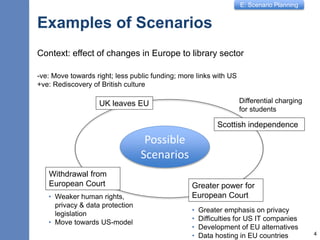
Context: effect of changes in Europe to library sector
4
Possible
Scenarios
UK leaves EU
Scottish independence
Greater power for
European Court
Withdrawal from
European Court
-ve: Move towards right; less public funding; more links with US
+ve: Rediscovery of British culture
Differential charging
for students
• Greater emphasis on privacy
• Difficulties for US IT companies
• Development of EU alternatives
• Data hosting in EU countries
• Weaker human rights,
privacy & data protection
legislation
• Move towards US-model
E: Scenario Planning
Need for Scenarios
Context from NMC Horizon report – two difficult
challenges:
5
E: Scenario Planning
Scenario Design
In small groups:
• Choose a context:
 Competition from alternative sources of discovery
 Significantly changed roles for librarians
 Your own choice
• Provide a set of bullet points:
 Highlighting possible scenarios
 (Possible implications of scenarios)
 (Ways of spotting signals of scenarios becoming
true)
6
GroupExercise
E: Scenario Planning
Scenarios From ILI 2013 Workshop
• Possible
scenarios
7
Commercialisation Devolved ownership
Everyone’s a
librarian
The niche librarian
E: Scenario Planning
Scenario 1: Commercialisation
By 2016:
• Libraries had responded by financial pressures by
making significant use of commercial services
• Companies are now looking to respond to pressure
from shareholders to increase profits
8
Scenario 2: Devolution
By 2016:
• Facebook, Amazon, … had alienated users due to
abuse of privacy, failure to pay taxes, …
• There was a move towards small-scale services
which were owned/managed by trusted organisations
E: Scenario Planning
Scenario 3: Everyone’s a Librarian
By 2016:
• The majority are now connected using social networks and
are comfortable in using the services
• Skills which previously librarians possessed (cataloging
resources, resource discovery, …) are now held by many
• The role of the dedicated generalist librarian is questioned
9
Scenario 4: The Niche Librarian
By 2016:
• We had seen a decline in student numbers in library schools
and the demise of their professional organisation following
significant government cuts
• The professional body asked its few remaining members for
thoughts on the future of the profession
E: Scenario Planning
Conclusions
10
• People typically don’t envisage the demise of
their organisation or key services
• But organisations and services do fold
(Intute, UKOLN, Netskills, AHDS, …)
• Scenario planning can provide a non-
threatening ways of exploring implications

E1 Scenario Planning

  • 1.
    Preparing for theFuture: Technological Challenges and Beyond E1: Scenario Planning Brian Kelly Independent researcher/consultant at UK Web Focus Ltd. Tony Hirst Senior lecturer at The Open University Contact Details Brian Kelly Tony Hirst Email: ukwebfocus@gmail.com Email: tony.hirst@gmail.com Twitter: @briankelly Twitter: @psychemedia Blog: http://ukwebfocus.com/ Blog: http://blog.ouseful.info/ Slides and further information available at http://ukwebfocus.com/events/ili-2015-preparing-for-the-future/ UK Web Focus Event hashtag: #ili2015fut
  • 2.
    E: Scenario Planning ScenarioPlanning Scenario planning is: • A strategic planning method that some organisations use to make flexible long-term plans. • An adaptation and generalization of classic methods used by military intelligence. Processes: • Step 1 - decide assumptions/drivers for change • Step 2 - bring drivers together into a viable framework • Step 3 - produce initial mini-scenarios • Step 4 - reduce to two or three scenarios • Step 5 - write the scenarios • Step 6 - identify issues arising 2 From http://en.wikipedia.org/ wiki/Scenario_planning
  • 3.
    E: Scenario Planning RadicalScenarios Two day planning meeting for Intute (formerly RDN (Resource Discovery Network) in 2007 External facilitator set group exercise: “The Martians have landed and taken away Intute’s servers. You decide to launch a rescue mission. What aspects of your service are your top priority?” Suggestions: • The catalogue records • The management tools • The personalisation features • They can have the technology: the most important aspect is our community of cataloguers! 3 Note the Martians (in the form of money men) did arrive and removed the Intute servers, offices and staff!)
  • 4.
    E: Scenario Planning Examplesof Scenarios Context: effect of changes in Europe to library sector 4 Possible Scenarios UK leaves EU Scottish independence Greater power for European Court Withdrawal from European Court -ve: Move towards right; less public funding; more links with US +ve: Rediscovery of British culture Differential charging for students • Greater emphasis on privacy • Difficulties for US IT companies • Development of EU alternatives • Data hosting in EU countries • Weaker human rights, privacy & data protection legislation • Move towards US-model
  • 5.
    E: Scenario Planning Needfor Scenarios Context from NMC Horizon report – two difficult challenges: 5
  • 6.
    E: Scenario Planning ScenarioDesign In small groups: • Choose a context:  Competition from alternative sources of discovery  Significantly changed roles for librarians  Your own choice • Provide a set of bullet points:  Highlighting possible scenarios  (Possible implications of scenarios)  (Ways of spotting signals of scenarios becoming true) 6 GroupExercise
  • 7.
    E: Scenario Planning ScenariosFrom ILI 2013 Workshop • Possible scenarios 7 Commercialisation Devolved ownership Everyone’s a librarian The niche librarian
  • 8.
    E: Scenario Planning Scenario1: Commercialisation By 2016: • Libraries had responded by financial pressures by making significant use of commercial services • Companies are now looking to respond to pressure from shareholders to increase profits 8 Scenario 2: Devolution By 2016: • Facebook, Amazon, … had alienated users due to abuse of privacy, failure to pay taxes, … • There was a move towards small-scale services which were owned/managed by trusted organisations
  • 9.
    E: Scenario Planning Scenario3: Everyone’s a Librarian By 2016: • The majority are now connected using social networks and are comfortable in using the services • Skills which previously librarians possessed (cataloging resources, resource discovery, …) are now held by many • The role of the dedicated generalist librarian is questioned 9 Scenario 4: The Niche Librarian By 2016: • We had seen a decline in student numbers in library schools and the demise of their professional organisation following significant government cuts • The professional body asked its few remaining members for thoughts on the future of the profession
  • 10.
    E: Scenario Planning Conclusions 10 •People typically don’t envisage the demise of their organisation or key services • But organisations and services do fold (Intute, UKOLN, Netskills, AHDS, …) • Scenario planning can provide a non- threatening ways of exploring implications

Editor's Notes

  • #11 I’d welcome questions and comments. Note that I’ve published a blog post on which can be used for questions. Thank you.