Thinking The Unthinkable   Interoperability Through Open Standards! Really? Brian Kelly UKOLN University of Bath Bath Email [email_address] UKOLN is supported by: http://www.ukoln.ac.uk/web-focus/events/conferences/cetis-2006/ Acceptable Use Policy Recording/broadcasting of this talk, taking photographs, discussing the content using Blogs, IM, SMS, etc. is permitted providing distractions to others is minimised. This work is licensed under a Attribution-NonCommercial-ShareAlike 2.0 licence (but note caveat) Resources related to this talk are bookmarked in del.icio.us using the ‘ cetis-2006-conference-unthinkable ' tag
Contents Why do we need standards? But standards don’t always work! What are open standards anyway?  Examples of the problems Alternatives to open standards So what should we do? Questions Group discussion
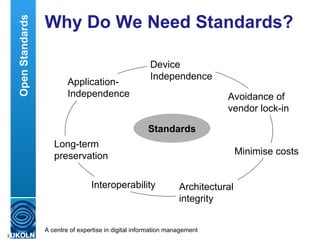
Why Do We Need Standards? Open Standards Standards Application- Independence Device Independence Avoidance of vendor lock-in Minimise costs Interoperability Long-term preservation Architectural integrity
Open Standards Are Great    … JISC's development programmes: Traditionally based on use of  open standards  to: Support interoperability Maximise accessibility Avoid vendor lock-in Provide architectural integrity Help ensure long-term preservation  History in UK HE development work: eLib Standards document (v1 – 1996, v2 – 1998) DNER Standards document (2001) which influenced: NOF-digi Technical Standards .. Open Standards
…  But Don't Always Work   There's a need for flexibility: Learning the lesson from OSI networking protocols Today: Is the Web (for example) becoming over-complex "Web service considered harmful" The lowercase semantic web / Microformats Lighter-weight alternatives being developed Responses from the commercial world Open Standards Other key issues What is an open standard? What are the resource implications of using them? Sometimes proprietary solutions work (and users like them). Is it politically incorrect to mention this!?
Open Standards: an EU View European Interoperability Framework for pan-European eGovernment Services  defines open standards as: The standard is adopted and will be maintained by a not-for-profit organization  The standard specification document is available either freely or at a nominal charge  The intellectual property of the standard is made irrevocably available on a royalty free basis  No constraints on the re-use of the standard.  Taken from    W3C’s Technologies and e-Government  talk by Ivan Herman at Workshop on E-Government, Edinburgh, May 2006 Open Standards
What is an Open Standard? Which of the following are open standards? XHTML 1  PDF  Flash Java  MS Word  RSS (1.0/2.0) Open Standards UKOLN's " What Are Open Standards? " briefing paper refers to characteristics of open standards: Neutral organisation which 'owns' standard & responsible for roadmap Open involvement in standards-making process Access to standard freely available … Note these characteristics do not apply equally to all standards bodies e.g. costs of BSI standards; W3C membership requirements; …
Compliance Issues What does  must  mean? You  must  comply with HTML standards What if I don't? What if nobody does? What if I use PDF? You  must  clear rights  on all resources you digitise You  must  provide properly audited accounts What if I don't? There is a need to clarify the meaning of  must   and for an understandable, realistic and reasonable compliance regime Compliance JISC 5/99 programme  ~80% of project home pages were not HTML compliant
Is RSS An Open Standard?  Is RSS an open standard ("are RSSs open standards")? RSS 1.0 (RDF Site Summary) XML application using RDF model Developed by Aaron Schwarz RSS 2.0 (Really Simple Syndication) XML application using simpler model Developed by Davey Winer Note that RSS is a widely used and popular application; with usage growing through its key role in Podcasts Issues: Are these open standards? Are they reliable and robust enough to build mission-critical services on? Is there a clear roadmap for the future? RSS Example
RSS – Governance Issues Governance Issues: RSS 1.0 specification maintained by Aaron Schwartz: " Aaron Swartz is a teenage writer, hacker, and activist. He was a finalist for the ArsDigita Prize for excellence in building non-commercial web sites at the age of 13. At 14 he co-authored the RSS 1.0 specification, now used by thousands of sites to notify their readers of updates. " RSS 2.0 specification developed by Dave Winer: " Winer is known as one of the more polarizing figures in the blogging community.  …  However .. there are many people and organizations who seem unable to maintain a good working relationship with Dave. "  RSS Example
RSS 1.0 – Roadmap Issues RSS 1.1: In Jan 2005 RSS 1.1 draft released: "[we] expressed our mutual frustrations with 1.0 …, we decided that rather than lauch (sic) ... another … diatribe against the quality of the RSS 1.0 spec, … [we would] simply write a new specification ourselves.  " But it is no longer being developed: Draft technically good (addressed ambiguities & interoperability flaws) but political reaction apathetic RSS 2.0 has (a) better acronym and (b) momentum (through Podcasting) And RSS 2.0 sounds newer RSS 3.0 (joke?) proposal has caused confusion and arguments on Slashdot and elsewhere RSS Example
RSS 2.0 – Roadmap Issues RSS 2.0: Spec published by Harvard Law School with a Creative Commons licence RSS-Board YahooGroups used for governance body Many arguments (most recently on proposal to expand board in April 2006): Note Wikipedia has useful links to the history and politics of RSS "Winer has now decided that the board doesn't exist and never had authority over the RSS specification, even though it has published six revisions from July 2003 to the present.  I don't agree, but now that the board's fully public, we're in a position to make his wish a reality." RSS Example
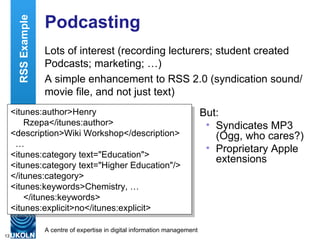
Podcasting Lots of interest (recording lecturers; student created Podcasts; marketing; …) A simple enhancement to RSS 2.0 (syndication sound/movie file, and not just text) <itunes:author>Henry Rzepa</itunes:author> <description>Wiki Workshop</description> … <itunes:category text=&quot;Education&quot;> <itunes:category text=&quot;Higher Education&quot;/> </itunes:category> <itunes:keywords>Chemistry, … </itunes:keywords> <itunes:explicit>no</itunes:explicit> But: Syndicates MP3 (Ogg, who cares?) Proprietary Apple extensions RSS Example
RSS – Summary  What can be learnt: We thought RSS was a great lightweight syndication technology It was – but competing alternatives were developed No clear winner (RSS 1.0's extensibility & W3C's support versus RSS 2.0's simplicity and take-up in Podcasting, iTunes, etc)  Conclusions Life can be complex, even with simple standards Technical merit is never enough – market acceptance can change things RSS can still be useful, and interoperability can be provided by RSS libraries supporting multiple formats RSS Example
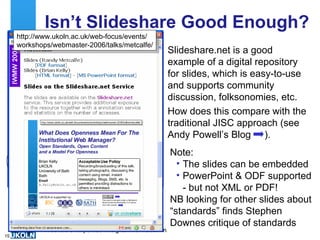
Isn’t Slideshare Good Enough? Slideshare.net is a good example of a digital repository for slides, which is easy-to-use and supports community discussion, folksonomies, etc. How does this compare with the traditional JISC approach (see Andy Powell’s Blog  ). http://slideshare.net/lisbk/profile Note: The slides can be embedded PowerPoint & ODF supported - but not XML or PDF! NB looking for other slides about “standards” finds Stephen Downes critique of standards http://www.ukoln.ac.uk/web-focus/events/ workshops/webmaster-2006/talks/metcalfe/
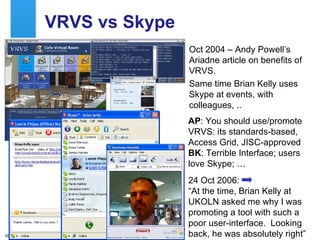
VRVS vs Skype Oct 2004 – Andy Powell’s Ariadne article on benefits of VRVS. Same time Brian Kelly uses Skype at events, with colleagues, .. AP : You should use/promote VRVS: its standards-based, Access Grid, JISC-approved  BK : Terrible Interface; users love Skype; … 24 Oct 2006:  “At the time, Brian Kelly at UKOLN asked me why I was promoting a tool with such a poor user-interface.  Looking back, he was absolutely right”
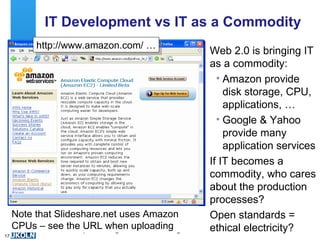
IT Development vs IT as a Commodity Web 2.0 is bringing IT as a commodity: Amazon provide disk storage, CPU, applications, … Google & Yahoo provide many application services If IT becomes a commodity, who cares about the production processes?  Open standards = ethical electricity? http://www.amazon.com/ … Note that Slideshare.net uses Amazon CPUs – see the URL when uploading
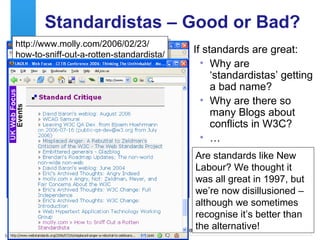
Standardistas – Good or Bad? If standards are great: Why are ‘standardistas’ getting a bad name? Why are there so many Blogs about conflicts in W3C? … http://www.molly.com/2006/02/23/ how-to-sniff-out-a-rotten-standardista/ Are standards like New Labour? We thought it was all great in 1997, but we’re now disillusioned – although we sometimes recognise it’s better than the alternative!
Issues For Discussion Some possible areas to discuss: Is there a limited scope in which open standards are critical (cf. “open source is best for e-science; IBM took MS on in the office environment and lost”) Standardisation is often an intensively political process – so is it surprising if open standards can be so flawed? User-focussed or standards-based development: how do we respond if they’re in conflict? Why are development projects deliverables often perceived as inferior?  “ Interoperability through open standards”  Is this the correct message to give? If not, what should we say?
Questions? Any questions What Next?

Standards Through Interoperability? Really?

  • 1.
    Thinking The Unthinkable Interoperability Through Open Standards! Really? Brian Kelly UKOLN University of Bath Bath Email [email_address] UKOLN is supported by: http://www.ukoln.ac.uk/web-focus/events/conferences/cetis-2006/ Acceptable Use Policy Recording/broadcasting of this talk, taking photographs, discussing the content using Blogs, IM, SMS, etc. is permitted providing distractions to others is minimised. This work is licensed under a Attribution-NonCommercial-ShareAlike 2.0 licence (but note caveat) Resources related to this talk are bookmarked in del.icio.us using the ‘ cetis-2006-conference-unthinkable ' tag
  • 2.
    Contents Why dowe need standards? But standards don’t always work! What are open standards anyway? Examples of the problems Alternatives to open standards So what should we do? Questions Group discussion
  • 3.
    Why Do WeNeed Standards? Open Standards Standards Application- Independence Device Independence Avoidance of vendor lock-in Minimise costs Interoperability Long-term preservation Architectural integrity
  • 4.
    Open Standards AreGreat  … JISC's development programmes: Traditionally based on use of open standards to: Support interoperability Maximise accessibility Avoid vendor lock-in Provide architectural integrity Help ensure long-term preservation History in UK HE development work: eLib Standards document (v1 – 1996, v2 – 1998) DNER Standards document (2001) which influenced: NOF-digi Technical Standards .. Open Standards
  • 5.
    … ButDon't Always Work  There's a need for flexibility: Learning the lesson from OSI networking protocols Today: Is the Web (for example) becoming over-complex &quot;Web service considered harmful&quot; The lowercase semantic web / Microformats Lighter-weight alternatives being developed Responses from the commercial world Open Standards Other key issues What is an open standard? What are the resource implications of using them? Sometimes proprietary solutions work (and users like them). Is it politically incorrect to mention this!?
  • 6.
    Open Standards: anEU View European Interoperability Framework for pan-European eGovernment Services defines open standards as: The standard is adopted and will be maintained by a not-for-profit organization The standard specification document is available either freely or at a nominal charge The intellectual property of the standard is made irrevocably available on a royalty free basis No constraints on the re-use of the standard. Taken from W3C’s Technologies and e-Government talk by Ivan Herman at Workshop on E-Government, Edinburgh, May 2006 Open Standards
  • 7.
    What is anOpen Standard? Which of the following are open standards? XHTML 1  PDF  Flash Java  MS Word  RSS (1.0/2.0) Open Standards UKOLN's &quot; What Are Open Standards? &quot; briefing paper refers to characteristics of open standards: Neutral organisation which 'owns' standard & responsible for roadmap Open involvement in standards-making process Access to standard freely available … Note these characteristics do not apply equally to all standards bodies e.g. costs of BSI standards; W3C membership requirements; …
  • 8.
    Compliance Issues Whatdoes must mean? You must comply with HTML standards What if I don't? What if nobody does? What if I use PDF? You must clear rights on all resources you digitise You must provide properly audited accounts What if I don't? There is a need to clarify the meaning of must and for an understandable, realistic and reasonable compliance regime Compliance JISC 5/99 programme ~80% of project home pages were not HTML compliant
  • 9.
    Is RSS AnOpen Standard? Is RSS an open standard (&quot;are RSSs open standards&quot;)? RSS 1.0 (RDF Site Summary) XML application using RDF model Developed by Aaron Schwarz RSS 2.0 (Really Simple Syndication) XML application using simpler model Developed by Davey Winer Note that RSS is a widely used and popular application; with usage growing through its key role in Podcasts Issues: Are these open standards? Are they reliable and robust enough to build mission-critical services on? Is there a clear roadmap for the future? RSS Example
  • 10.
    RSS – GovernanceIssues Governance Issues: RSS 1.0 specification maintained by Aaron Schwartz: &quot; Aaron Swartz is a teenage writer, hacker, and activist. He was a finalist for the ArsDigita Prize for excellence in building non-commercial web sites at the age of 13. At 14 he co-authored the RSS 1.0 specification, now used by thousands of sites to notify their readers of updates. &quot; RSS 2.0 specification developed by Dave Winer: &quot; Winer is known as one of the more polarizing figures in the blogging community. … However .. there are many people and organizations who seem unable to maintain a good working relationship with Dave. &quot; RSS Example
  • 11.
    RSS 1.0 –Roadmap Issues RSS 1.1: In Jan 2005 RSS 1.1 draft released: &quot;[we] expressed our mutual frustrations with 1.0 …, we decided that rather than lauch (sic) ... another … diatribe against the quality of the RSS 1.0 spec, … [we would] simply write a new specification ourselves. &quot; But it is no longer being developed: Draft technically good (addressed ambiguities & interoperability flaws) but political reaction apathetic RSS 2.0 has (a) better acronym and (b) momentum (through Podcasting) And RSS 2.0 sounds newer RSS 3.0 (joke?) proposal has caused confusion and arguments on Slashdot and elsewhere RSS Example
  • 12.
    RSS 2.0 –Roadmap Issues RSS 2.0: Spec published by Harvard Law School with a Creative Commons licence RSS-Board YahooGroups used for governance body Many arguments (most recently on proposal to expand board in April 2006): Note Wikipedia has useful links to the history and politics of RSS &quot;Winer has now decided that the board doesn't exist and never had authority over the RSS specification, even though it has published six revisions from July 2003 to the present. I don't agree, but now that the board's fully public, we're in a position to make his wish a reality.&quot; RSS Example
  • 13.
    Podcasting Lots ofinterest (recording lecturers; student created Podcasts; marketing; …) A simple enhancement to RSS 2.0 (syndication sound/movie file, and not just text) <itunes:author>Henry Rzepa</itunes:author> <description>Wiki Workshop</description> … <itunes:category text=&quot;Education&quot;> <itunes:category text=&quot;Higher Education&quot;/> </itunes:category> <itunes:keywords>Chemistry, … </itunes:keywords> <itunes:explicit>no</itunes:explicit> But: Syndicates MP3 (Ogg, who cares?) Proprietary Apple extensions RSS Example
  • 14.
    RSS – Summary What can be learnt: We thought RSS was a great lightweight syndication technology It was – but competing alternatives were developed No clear winner (RSS 1.0's extensibility & W3C's support versus RSS 2.0's simplicity and take-up in Podcasting, iTunes, etc) Conclusions Life can be complex, even with simple standards Technical merit is never enough – market acceptance can change things RSS can still be useful, and interoperability can be provided by RSS libraries supporting multiple formats RSS Example
  • 15.
    Isn’t Slideshare GoodEnough? Slideshare.net is a good example of a digital repository for slides, which is easy-to-use and supports community discussion, folksonomies, etc. How does this compare with the traditional JISC approach (see Andy Powell’s Blog ). http://slideshare.net/lisbk/profile Note: The slides can be embedded PowerPoint & ODF supported - but not XML or PDF! NB looking for other slides about “standards” finds Stephen Downes critique of standards http://www.ukoln.ac.uk/web-focus/events/ workshops/webmaster-2006/talks/metcalfe/
  • 16.
    VRVS vs SkypeOct 2004 – Andy Powell’s Ariadne article on benefits of VRVS. Same time Brian Kelly uses Skype at events, with colleagues, .. AP : You should use/promote VRVS: its standards-based, Access Grid, JISC-approved BK : Terrible Interface; users love Skype; … 24 Oct 2006: “At the time, Brian Kelly at UKOLN asked me why I was promoting a tool with such a poor user-interface.  Looking back, he was absolutely right”
  • 17.
    IT Development vsIT as a Commodity Web 2.0 is bringing IT as a commodity: Amazon provide disk storage, CPU, applications, … Google & Yahoo provide many application services If IT becomes a commodity, who cares about the production processes? Open standards = ethical electricity? http://www.amazon.com/ … Note that Slideshare.net uses Amazon CPUs – see the URL when uploading
  • 18.
    Standardistas – Goodor Bad? If standards are great: Why are ‘standardistas’ getting a bad name? Why are there so many Blogs about conflicts in W3C? … http://www.molly.com/2006/02/23/ how-to-sniff-out-a-rotten-standardista/ Are standards like New Labour? We thought it was all great in 1997, but we’re now disillusioned – although we sometimes recognise it’s better than the alternative!
  • 19.
    Issues For DiscussionSome possible areas to discuss: Is there a limited scope in which open standards are critical (cf. “open source is best for e-science; IBM took MS on in the office environment and lost”) Standardisation is often an intensively political process – so is it surprising if open standards can be so flawed? User-focussed or standards-based development: how do we respond if they’re in conflict? Why are development projects deliverables often perceived as inferior? “ Interoperability through open standards” Is this the correct message to give? If not, what should we say?
  • 20.