Web 2.0 in a Web Services and Grid Context Part I: CTS2007 Web 2.0 Tutorial CTS 2007 Embassy Suites Hotel-Lake Buena Vista Resort, Orlando, FL, USA May 25 2007 Geoffrey Fox and Marlon Pierce Computer Science, Informatics, Physics Pervasive Technology Laboratories Indiana University Bloomington IN 47401 [email_address] http:// www.infomall.org
Applications, Infrastructure, Technologies This field is confused by inconsistent use of terminology – this is what I mean Web Services ,  Grids  and  Web 2.0  ( Enterprise 2.0 ) are  technologies These technologies combine and compete to build  electronic infrastructures  termed  e-infrastructure  or  Cyberinfrastructure e-moreorlessanything  is an emerging application area of broad importance that is hosted on the infrastructures  e-infrastructure  or  Cyberinfrastructure
e-moreorlessanything is the Application ‘ e-Science  is about global collaboration in key areas of science, and the next generation of infrastructure that will enable it.’ from its inventor  John Taylor  Director General of Research Councils UK, Office of Science and Technology Similarly  e-Business  captures an emerging view of corporations as dynamic  virtual organizations  linking employees, customers and stakeholders across the world.  Net Centric  computing is a similar  DoD  vision This generalizes to  e-moreorlessanything A  deluge of data  of unprecedented and inevitable size must be managed and understood. People  (see  Web 2.0 ),  computers ,  data  and  instruments  must be linked.  On demand  assignment of experts, computers, networks and storage resources must be supported
Role of Electronic infrastructure Supports integration of data, people, computers  for Distributed Science or e-Science (US,  Cyberinfrastructure ) Command and Control (US,  Global Information Grid ) e-Business e-Science etc. (Europe,  e-Infrastructure ) Exploits  Internet technology  ( Web2.0 ) adding (via  Grid  technology) management, security, supercomputers etc. It has two aspects:  parallel  – low latency (microseconds) between nodes and  distributed  – highish latency (milliseconds) between nodes Parallel needed to get  high performance  on  individual  3D simulations, data analysis etc. Distributed aspect  integrates  already distinct components Electronic infrastructure is in general a  distributed collection of parallel systems and presented as services  (often  Web services ) that are “just” programs or data sources packaged for distributed access
Not so controversial Ideas Distributed software systems  are being “revolutionized” by developments from e-commerce, e-Science and the consumer Internet. There is rapid progress in technology families termed “ Web services ”, “ Grids ” and “ Web 2.0 ” The emerging distributed system picture is of  distributed services  with  advertised interfaces  but  opaque implementations  communicating by streams of messages over a variety of protocols Complete systems are built by combining either services or predefined/pre-existing collections of services together to achieve new capabilities Currently Grids are built using Web Services with possible enhancements like WSRF which we call  Narrow  or  Web service Grids We expect that future systems will be built as  Broad Grids  which are a collection of services mixing Web Service and Web 2.0 architectures
Web 2.0 and Web Services I Web Services  have clearly defined protocols (SOAP) and a well defined mechanism (WSDL) to define service interfaces There is good .NET and Java support The so-called WS-* specifications provide a rich sophisticated but complicated standard set of capabilities for security, fault tolerance, meta-data, discovery, notification etc. “ Narrow Grids ” build on  Web Services  and provide a robust managed environment with growing adoption in Enterprise systems and distributed science (so called e-Science) Web 2.0  supports a similar architecture to Web services but has developed in a more chaotic but remarkably successful fashion with a service architecture with a variety of protocols including those of Web and Grid services Over 400 Interfaces defined at  http:// www.programmableweb.com/apis   Web 2.0  also has many well known capabilities with  Google Maps  and  Amazon Compute/Storage services  of clear general relevance  There are also  Web 2.0 services  supporting novel collaboration modes and user interaction with the web as seen in social networking sites, portals, MySpace, YouTube,
Web 2.0 and Web Services II I once thought  Web Services  were  inevitable  but this is no longer clear to me Web services are  complicated ,  slow  and  non functional WS-Security  is unnecessarily slow and pedantic (canonicalization of XML) WS-RM  (Reliable Messaging) seems to have poor adoption and doesn’t work well in collaboration WSDM  (distributed management) specifies too much There are  de facto standards  like  Google Maps  and powerful suppliers like Google which “define the rules” One can easily  combine SOAP  (Web Service) based services/systems with HTTP messages but the “lowest common denominator” suggests additional structure/complexity  of SOAP will not easily survive
Old and New (Web 2.0) Community Tools e-mail  and  list-serves  are oldest and best used Kazaa ,  Instant Messengers ,  Skype ,  Napster ,  BitTorrent  for P2P Collaboration – text, audio-video conferencing, files del.icio.us ,  Connotea ,  Citeulike, Bibsonomy, Biolicious  manage shared bookmarks MySpace, YouTube, Bebo, Hotornot, Facebook,  or similar sites allow you to create (upload) community resources and share them;  Friendster ,  LinkedIn  create networks http:// en.wikipedia.org/wiki/List_of_social_networking_websites   Writely ,  Wikis  and  Blogs  are powerful specialized shared document systems ConferenceXP  and  WebEx  share general applications Google Scholar  tells you who has cited your papers while  publisher sites  tell you about co-authors Windows Live Academic Search  has similar goals Note sharing resources  creates  (implicit) communities Social network tools study graphs to both define communities and extract their properties
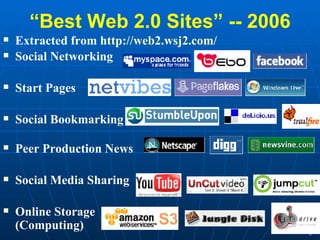
“Best Web 2.0 Sites” -- 2006 Extracted from  http://web2.wsj2.com/   Social Networking Start Pages Social Bookmarking Peer Production News  Social Media Sharing Online Storage  (Computing)
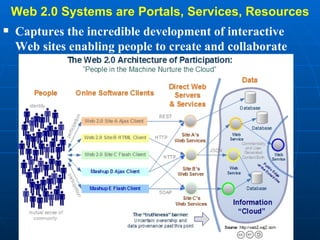
Web 2.0 Systems are Portals, Services, Resources Captures the incredible development of interactive Web sites enabling people to create and collaborate
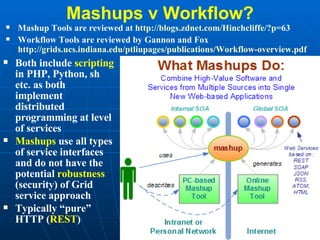
Mashups v Workflow? Mashup Tools are reviewed at  http:// blogs.zdnet.com/Hinchcliffe/?p =63   Workflow Tools are reviewed by Gannon and Fox  http://grids.ucs.indiana.edu/ptliupages/publications/Workflow-overview.pdf Both include  scripting  in PHP, Python, sh etc. as both implement distributed programming at level of services Mashups  use all types of service interfaces and do not have the potential  robustness  (security) of Grid service approach Typically “pure” HTTP ( REST )
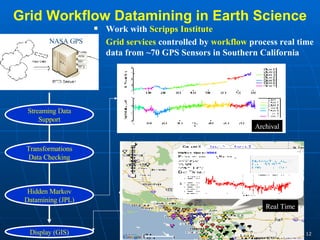
Grid Workflow Datamining in Earth Science Work with  Scripps Institute Grid services  controlled by  workflow  process real time data from ~70 GPS Sensors in Southern California  NASA GPS Earthquake Streaming Data Support Transformations Data Checking Hidden Markov Datamining (JPL) Display (GIS) Real Time Archival
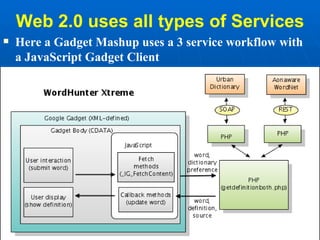
Web 2.0 uses all types of Services Here a Gadget Mashup uses a 3 service workflow with a JavaScript Gadget Client
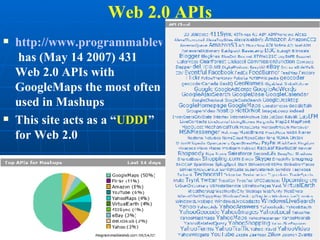
Web 2.0 APIs http://www.programmableweb.com/apis  has (May 14 2007) 431 Web 2.0 APIs with GoogleMaps the most often used in Mashups This site acts as a “ UDDI ” for Web 2.0
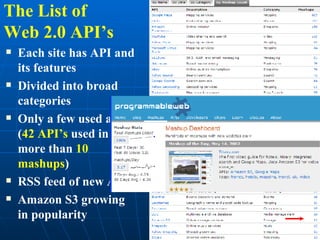
The List of Web 2.0 API’s Each site has API and its features Divided into broad categories Only a few used a lot ( 42 API’s  used in more than  10 mashups ) RSS feed of new APIs Amazon S3 growing in popularity
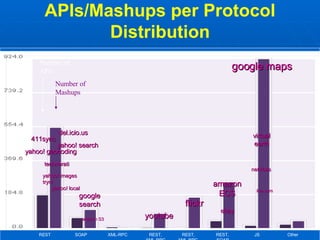
APIs/Mashups per Protocol Distribution Number of Mashups Number of APIs REST SOAP XML-RPC REST, XML-RPC REST, XML-RPC, SOAP REST, SOAP JS Other google maps netvibes live.com virtual earth google search amazon S3 amazon ECS flickr ebay youtube 411sync del.icio.us yahoo! search yahoo! geocoding technorati yahoo! images trynt yahoo! local
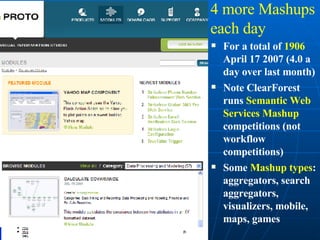
4 more Mashups each day For a total of  1906  April 17 2007 (4.0 a day over last month) Note ClearForest runs  Semantic Web Services Mashup  competitions (not workflow competitions) Some  Mashup types : aggregators, search aggregators, visualizers, mobile, maps, games Growing number of commercial Mashup Tools
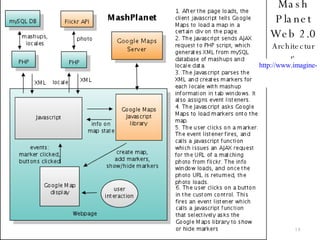
Mash Planet Web 2.0  Architecture http://www.imagine-it.org/mashplanet Display too large to be a Gadget
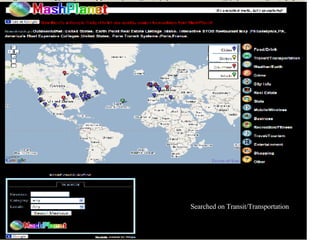
Searched on Transit/Transportation Searched on Transit/Transportation
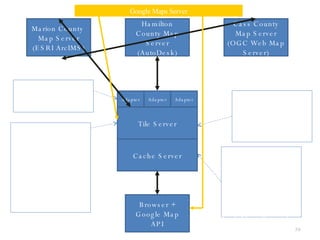
Browser + Google Map API Cass County Map Server (OGC Web Map Server) Hamilton County Map Server (AutoDesk) Marion County  Map Server (ESRI ArcIMS) Browser client fetches image tiles for the bounding box using Google Map API.  Tile Server requests map tiles at all zoom levels with all layers.  These are converted to uniform projection, indexed, and stored.  Overlapping images are combined.  Must provide adapters for each Map Server type . The cache server fulfills Google map calls with cached tiles at the requested bounding box that fill the bounding box. Google Maps Server A “Grid” Workflow (built in Java!) Uses Google Maps clients and server and non Google map APIs Tile Server Cache Server Adapter Adapter Adapter
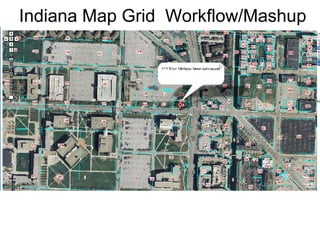
Indiana Map Grid  Workflow/Mashup GIS Grid of “Indiana Map” and ~10 Indiana counties with accessible Map (Feature) Servers from different vendors. Grids federate different data repositories (cf Astronomy VO federating different observatory collections)
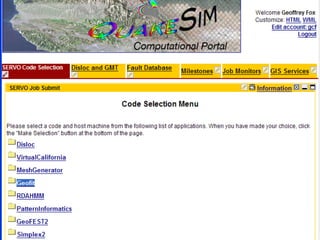
Grid-style portal as used in Earthquake Grid The Portal is built from portlets – providing user interface fragments for each service that are composed into the full interface – uses OGCE technology as does planetary science VLAB portal with University of Minnesota Now to Portals
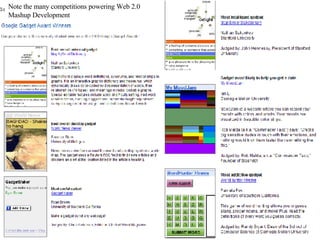
Portlets v. Google Gadgets Portals for Grid Systems are built using portlets with software like GridSphere integrating these on the server-side into a single web-page Google (at least) offers the Google sidebar and Google home page which support Web 2.0 services and do not use a server side aggregator Google is more user friendly! The many Web 2.0 competitions is an interesting model for promoting development in the world-wide distributed collection of Web 2.0 developers I guess Web 2.0 model will win! Note the many competitions powering Web 2.0  Mashup Development
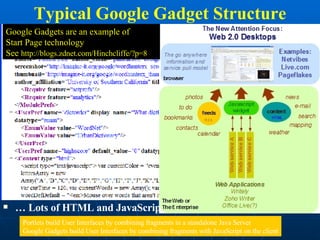
Typical Google Gadget Structure …  Lots of HTML and JavaScript </Content> </Module> Portlets build User Interfaces by combining fragments in a standalone Java Server Google Gadgets build User Interfaces by combining fragments with JavaScript on the client Google Gadgets are an example of  Start Page technology See  http://blogs.zdnet.com/Hinchcliffe/?p=8
Web 2.0 v Narrow Grid I Web 2.0 and Grids are addressing a  similar application class  although Web 2.0 has focused on user interactions So technology has similar requirements Web  2.0 chooses  simplicity  (REST rather than SOAP) to  lower barrier  to everyone participating Web 2.0 and Parallel Computing tend to use  traditional (possibly visual) (scripting) languages  for equivalent of workflow whereas Grids use  visual interface backend recorded in BPEL Web 2.0 and Grids both use  SOA Service Oriented Architectures “ System of Systems”:  Grids and Web 2.0 are likely to build systems hierarchically out of smaller systems We need to support Grids of Grids, Webs of Grids, Grids of Services etc. i.e. systems of systems of all sorts
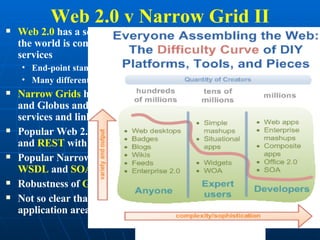
Web 2.0 v Narrow Grid II Web 2.0  has a set of major services like GoogleMaps or Flickr but the world is composing  Mashups  that make new composite services End-point standards are set by end-point owners Many different protocols covering a variety of de-facto standards Narrow Grids  have a set of major software systems like Condor and Globus and a different world is extending with custom services and linking with workflow Popular Web 2.0 technologies are  PHP,   JavaScript ,  JSON ,  AJAX  and  REST  with “ Start Page ” e.g. ( Google Gadgets)  interfaces Popular Narrow Grid technologies are  Apache Axis,   BPEL WSDL  and  SOAP  with  portlet  interfaces Robustness of  Grids  demanded by the  Enterprise ? Not so clear that  Web 2.0  won’t eventually dominate other application areas and with  Enterprise 2.0  it’s invading Grids The world does itself in large numbers!
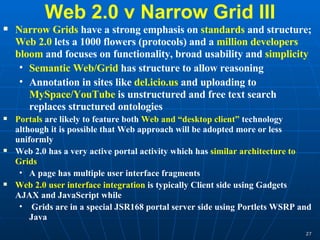
Web 2.0 v Narrow Grid III Narrow Grids  have a strong emphasis on  standards  and structure;  Web 2.0  lets a 1000 flowers (protocols) and a  million developers bloom  and focuses on functionality, broad usability and  simplicity Semantic Web/Grid  has structure to allow reasoning Annotation in sites like  del.icio.us  and uploading to  MySpace/YouTube  is unstructured and free text search replaces structured ontologies Portals  are likely to feature both  Web and “desktop client”  technology although it is possible that Web approach will be adopted more or less uniformly Web 2.0 has a very active portal activity which has  similar architecture to Grids  A page has multiple user interface fragments Web 2.0 user interface integration  is typically Client side using Gadgets AJAX and JavaScript while Grids are in a special JSR168 portal server side using Portlets WSRP and Java
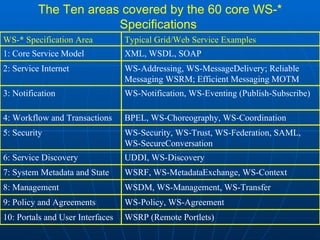
The Ten areas covered by the 60 core WS-* Specifications   WSRP (Remote Portlets) 10: Portals and User Interfaces WS-Policy, WS-Agreement 9: Policy and Agreements WSDM, WS-Management, WS-Transfer 8: Management WSRF, WS-MetadataExchange, WS-Context 7: System Metadata and State UDDI, WS-Discovery 6: Service Discovery WS-Security, WS-Trust, WS-Federation, SAML,  WS-SecureConversation 5: Security BPEL, WS-Choreography, WS-Coordination 4: Workflow and Transactions WS-Notification, WS-Eventing (Publish-Subscribe) 3: Notification WS-Addressing, WS-MessageDelivery; Reliable Messaging WSRM; Efficient Messaging MOTM 2: Service Internet XML, WSDL, SOAP 1: Core Service Model Typical Grid/Web Service Examples WS-* Specification Area
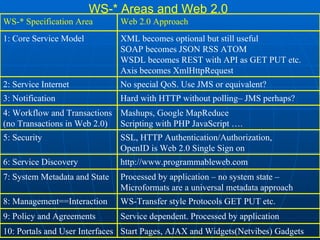
WS-* Areas and Web 2.0   Start Pages, AJAX and Widgets(Netvibes) Gadgets 10: Portals and User Interfaces Service dependent. Processed by application 9: Policy and Agreements WS-Transfer style Protocols GET PUT etc. 8: Management==Interaction Processed by application – no system state – Microformats are a universal metadata approach 7: System Metadata and State http://www.programmableweb.com 6: Service Discovery SSL, HTTP Authentication/Authorization,  OpenID is Web 2.0 Single Sign on 5: Security Mashups, Google MapReduce Scripting with PHP JavaScript …. 4: Workflow and Transactions (no Transactions in Web 2.0) Hard with HTTP  without polling – JMS perhaps?  3: Notification No special QoS. Use JMS or equivalent? 2: Service Internet XML becomes optional but still useful SOAP becomes JSON RSS ATOM  WSDL becomes REST with API as GET PUT etc. Axis becomes XmlHttpRequest  1: Core Service Model Web 2.0 Approach WS-* Specification Area
Drivers for Future Web 2.0 has momentum  as it is driven by success of  social web  sites and the user friendly protocols attracting  many developers  of mashups Grids momentum  driven by the success of  eScience  and the  commercial web service  thrusts largely aimed at Enterprise We expect applications such as  business  and  DoD  where  predictability  and  robustness  important to be built on a Web Service ( Narrow Grid )  core  with Web 2.0 functionality enhancements Simplicity ,  supporting many developers  are forces  pressuring Grids! Robustness  and coping with  unstructured blooming of a 1000 flowers  are forces  pressuring Web 2.0

CTS Conference Web 2.0 Tutorial Part 1

  • 1.
    Web 2.0 ina Web Services and Grid Context Part I: CTS2007 Web 2.0 Tutorial CTS 2007 Embassy Suites Hotel-Lake Buena Vista Resort, Orlando, FL, USA May 25 2007 Geoffrey Fox and Marlon Pierce Computer Science, Informatics, Physics Pervasive Technology Laboratories Indiana University Bloomington IN 47401 [email_address] http:// www.infomall.org
  • 2.
    Applications, Infrastructure, TechnologiesThis field is confused by inconsistent use of terminology – this is what I mean Web Services , Grids and Web 2.0 ( Enterprise 2.0 ) are technologies These technologies combine and compete to build electronic infrastructures termed e-infrastructure or Cyberinfrastructure e-moreorlessanything is an emerging application area of broad importance that is hosted on the infrastructures e-infrastructure or Cyberinfrastructure
  • 3.
    e-moreorlessanything is theApplication ‘ e-Science is about global collaboration in key areas of science, and the next generation of infrastructure that will enable it.’ from its inventor John Taylor Director General of Research Councils UK, Office of Science and Technology Similarly e-Business captures an emerging view of corporations as dynamic virtual organizations linking employees, customers and stakeholders across the world. Net Centric computing is a similar DoD vision This generalizes to e-moreorlessanything A deluge of data of unprecedented and inevitable size must be managed and understood. People (see Web 2.0 ), computers , data and instruments must be linked. On demand assignment of experts, computers, networks and storage resources must be supported
  • 4.
    Role of Electronicinfrastructure Supports integration of data, people, computers for Distributed Science or e-Science (US, Cyberinfrastructure ) Command and Control (US, Global Information Grid ) e-Business e-Science etc. (Europe, e-Infrastructure ) Exploits Internet technology ( Web2.0 ) adding (via Grid technology) management, security, supercomputers etc. It has two aspects: parallel – low latency (microseconds) between nodes and distributed – highish latency (milliseconds) between nodes Parallel needed to get high performance on individual 3D simulations, data analysis etc. Distributed aspect integrates already distinct components Electronic infrastructure is in general a distributed collection of parallel systems and presented as services (often Web services ) that are “just” programs or data sources packaged for distributed access
  • 5.
    Not so controversialIdeas Distributed software systems are being “revolutionized” by developments from e-commerce, e-Science and the consumer Internet. There is rapid progress in technology families termed “ Web services ”, “ Grids ” and “ Web 2.0 ” The emerging distributed system picture is of distributed services with advertised interfaces but opaque implementations communicating by streams of messages over a variety of protocols Complete systems are built by combining either services or predefined/pre-existing collections of services together to achieve new capabilities Currently Grids are built using Web Services with possible enhancements like WSRF which we call Narrow or Web service Grids We expect that future systems will be built as Broad Grids which are a collection of services mixing Web Service and Web 2.0 architectures
  • 6.
    Web 2.0 andWeb Services I Web Services have clearly defined protocols (SOAP) and a well defined mechanism (WSDL) to define service interfaces There is good .NET and Java support The so-called WS-* specifications provide a rich sophisticated but complicated standard set of capabilities for security, fault tolerance, meta-data, discovery, notification etc. “ Narrow Grids ” build on Web Services and provide a robust managed environment with growing adoption in Enterprise systems and distributed science (so called e-Science) Web 2.0 supports a similar architecture to Web services but has developed in a more chaotic but remarkably successful fashion with a service architecture with a variety of protocols including those of Web and Grid services Over 400 Interfaces defined at http:// www.programmableweb.com/apis Web 2.0 also has many well known capabilities with Google Maps and Amazon Compute/Storage services of clear general relevance There are also Web 2.0 services supporting novel collaboration modes and user interaction with the web as seen in social networking sites, portals, MySpace, YouTube,
  • 7.
    Web 2.0 andWeb Services II I once thought Web Services were inevitable but this is no longer clear to me Web services are complicated , slow and non functional WS-Security is unnecessarily slow and pedantic (canonicalization of XML) WS-RM (Reliable Messaging) seems to have poor adoption and doesn’t work well in collaboration WSDM (distributed management) specifies too much There are de facto standards like Google Maps and powerful suppliers like Google which “define the rules” One can easily combine SOAP (Web Service) based services/systems with HTTP messages but the “lowest common denominator” suggests additional structure/complexity of SOAP will not easily survive
  • 8.
    Old and New(Web 2.0) Community Tools e-mail and list-serves are oldest and best used Kazaa , Instant Messengers , Skype , Napster , BitTorrent for P2P Collaboration – text, audio-video conferencing, files del.icio.us , Connotea , Citeulike, Bibsonomy, Biolicious manage shared bookmarks MySpace, YouTube, Bebo, Hotornot, Facebook, or similar sites allow you to create (upload) community resources and share them; Friendster , LinkedIn create networks http:// en.wikipedia.org/wiki/List_of_social_networking_websites Writely , Wikis and Blogs are powerful specialized shared document systems ConferenceXP and WebEx share general applications Google Scholar tells you who has cited your papers while publisher sites tell you about co-authors Windows Live Academic Search has similar goals Note sharing resources creates (implicit) communities Social network tools study graphs to both define communities and extract their properties
  • 9.
    “Best Web 2.0Sites” -- 2006 Extracted from http://web2.wsj2.com/ Social Networking Start Pages Social Bookmarking Peer Production News Social Media Sharing Online Storage (Computing)
  • 10.
    Web 2.0 Systemsare Portals, Services, Resources Captures the incredible development of interactive Web sites enabling people to create and collaborate
  • 11.
    Mashups v Workflow?Mashup Tools are reviewed at http:// blogs.zdnet.com/Hinchcliffe/?p =63 Workflow Tools are reviewed by Gannon and Fox http://grids.ucs.indiana.edu/ptliupages/publications/Workflow-overview.pdf Both include scripting in PHP, Python, sh etc. as both implement distributed programming at level of services Mashups use all types of service interfaces and do not have the potential robustness (security) of Grid service approach Typically “pure” HTTP ( REST )
  • 12.
    Grid Workflow Dataminingin Earth Science Work with Scripps Institute Grid services controlled by workflow process real time data from ~70 GPS Sensors in Southern California NASA GPS Earthquake Streaming Data Support Transformations Data Checking Hidden Markov Datamining (JPL) Display (GIS) Real Time Archival
  • 13.
    Web 2.0 usesall types of Services Here a Gadget Mashup uses a 3 service workflow with a JavaScript Gadget Client
  • 14.
    Web 2.0 APIshttp://www.programmableweb.com/apis has (May 14 2007) 431 Web 2.0 APIs with GoogleMaps the most often used in Mashups This site acts as a “ UDDI ” for Web 2.0
  • 15.
    The List ofWeb 2.0 API’s Each site has API and its features Divided into broad categories Only a few used a lot ( 42 API’s used in more than 10 mashups ) RSS feed of new APIs Amazon S3 growing in popularity
  • 16.
    APIs/Mashups per ProtocolDistribution Number of Mashups Number of APIs REST SOAP XML-RPC REST, XML-RPC REST, XML-RPC, SOAP REST, SOAP JS Other google maps netvibes live.com virtual earth google search amazon S3 amazon ECS flickr ebay youtube 411sync del.icio.us yahoo! search yahoo! geocoding technorati yahoo! images trynt yahoo! local
  • 17.
    4 more Mashupseach day For a total of 1906 April 17 2007 (4.0 a day over last month) Note ClearForest runs Semantic Web Services Mashup competitions (not workflow competitions) Some Mashup types : aggregators, search aggregators, visualizers, mobile, maps, games Growing number of commercial Mashup Tools
  • 18.
    Mash Planet Web2.0 Architecture http://www.imagine-it.org/mashplanet Display too large to be a Gadget
  • 19.
    Searched on Transit/TransportationSearched on Transit/Transportation
  • 20.
    Browser + GoogleMap API Cass County Map Server (OGC Web Map Server) Hamilton County Map Server (AutoDesk) Marion County Map Server (ESRI ArcIMS) Browser client fetches image tiles for the bounding box using Google Map API. Tile Server requests map tiles at all zoom levels with all layers. These are converted to uniform projection, indexed, and stored. Overlapping images are combined. Must provide adapters for each Map Server type . The cache server fulfills Google map calls with cached tiles at the requested bounding box that fill the bounding box. Google Maps Server A “Grid” Workflow (built in Java!) Uses Google Maps clients and server and non Google map APIs Tile Server Cache Server Adapter Adapter Adapter
  • 21.
    Indiana Map Grid Workflow/Mashup GIS Grid of “Indiana Map” and ~10 Indiana counties with accessible Map (Feature) Servers from different vendors. Grids federate different data repositories (cf Astronomy VO federating different observatory collections)
  • 22.
    Grid-style portal asused in Earthquake Grid The Portal is built from portlets – providing user interface fragments for each service that are composed into the full interface – uses OGCE technology as does planetary science VLAB portal with University of Minnesota Now to Portals
  • 23.
    Portlets v. GoogleGadgets Portals for Grid Systems are built using portlets with software like GridSphere integrating these on the server-side into a single web-page Google (at least) offers the Google sidebar and Google home page which support Web 2.0 services and do not use a server side aggregator Google is more user friendly! The many Web 2.0 competitions is an interesting model for promoting development in the world-wide distributed collection of Web 2.0 developers I guess Web 2.0 model will win! Note the many competitions powering Web 2.0 Mashup Development
  • 24.
    Typical Google GadgetStructure … Lots of HTML and JavaScript </Content> </Module> Portlets build User Interfaces by combining fragments in a standalone Java Server Google Gadgets build User Interfaces by combining fragments with JavaScript on the client Google Gadgets are an example of Start Page technology See http://blogs.zdnet.com/Hinchcliffe/?p=8
  • 25.
    Web 2.0 vNarrow Grid I Web 2.0 and Grids are addressing a similar application class although Web 2.0 has focused on user interactions So technology has similar requirements Web 2.0 chooses simplicity (REST rather than SOAP) to lower barrier to everyone participating Web 2.0 and Parallel Computing tend to use traditional (possibly visual) (scripting) languages for equivalent of workflow whereas Grids use visual interface backend recorded in BPEL Web 2.0 and Grids both use SOA Service Oriented Architectures “ System of Systems”: Grids and Web 2.0 are likely to build systems hierarchically out of smaller systems We need to support Grids of Grids, Webs of Grids, Grids of Services etc. i.e. systems of systems of all sorts
  • 26.
    Web 2.0 vNarrow Grid II Web 2.0 has a set of major services like GoogleMaps or Flickr but the world is composing Mashups that make new composite services End-point standards are set by end-point owners Many different protocols covering a variety of de-facto standards Narrow Grids have a set of major software systems like Condor and Globus and a different world is extending with custom services and linking with workflow Popular Web 2.0 technologies are PHP, JavaScript , JSON , AJAX and REST with “ Start Page ” e.g. ( Google Gadgets) interfaces Popular Narrow Grid technologies are Apache Axis, BPEL WSDL and SOAP with portlet interfaces Robustness of Grids demanded by the Enterprise ? Not so clear that Web 2.0 won’t eventually dominate other application areas and with Enterprise 2.0 it’s invading Grids The world does itself in large numbers!
  • 27.
    Web 2.0 vNarrow Grid III Narrow Grids have a strong emphasis on standards and structure; Web 2.0 lets a 1000 flowers (protocols) and a million developers bloom and focuses on functionality, broad usability and simplicity Semantic Web/Grid has structure to allow reasoning Annotation in sites like del.icio.us and uploading to MySpace/YouTube is unstructured and free text search replaces structured ontologies Portals are likely to feature both Web and “desktop client” technology although it is possible that Web approach will be adopted more or less uniformly Web 2.0 has a very active portal activity which has similar architecture to Grids A page has multiple user interface fragments Web 2.0 user interface integration is typically Client side using Gadgets AJAX and JavaScript while Grids are in a special JSR168 portal server side using Portlets WSRP and Java
  • 28.
    The Ten areascovered by the 60 core WS-* Specifications WSRP (Remote Portlets) 10: Portals and User Interfaces WS-Policy, WS-Agreement 9: Policy and Agreements WSDM, WS-Management, WS-Transfer 8: Management WSRF, WS-MetadataExchange, WS-Context 7: System Metadata and State UDDI, WS-Discovery 6: Service Discovery WS-Security, WS-Trust, WS-Federation, SAML, WS-SecureConversation 5: Security BPEL, WS-Choreography, WS-Coordination 4: Workflow and Transactions WS-Notification, WS-Eventing (Publish-Subscribe) 3: Notification WS-Addressing, WS-MessageDelivery; Reliable Messaging WSRM; Efficient Messaging MOTM 2: Service Internet XML, WSDL, SOAP 1: Core Service Model Typical Grid/Web Service Examples WS-* Specification Area
  • 29.
    WS-* Areas andWeb 2.0 Start Pages, AJAX and Widgets(Netvibes) Gadgets 10: Portals and User Interfaces Service dependent. Processed by application 9: Policy and Agreements WS-Transfer style Protocols GET PUT etc. 8: Management==Interaction Processed by application – no system state – Microformats are a universal metadata approach 7: System Metadata and State http://www.programmableweb.com 6: Service Discovery SSL, HTTP Authentication/Authorization, OpenID is Web 2.0 Single Sign on 5: Security Mashups, Google MapReduce Scripting with PHP JavaScript …. 4: Workflow and Transactions (no Transactions in Web 2.0) Hard with HTTP without polling – JMS perhaps? 3: Notification No special QoS. Use JMS or equivalent? 2: Service Internet XML becomes optional but still useful SOAP becomes JSON RSS ATOM WSDL becomes REST with API as GET PUT etc. Axis becomes XmlHttpRequest 1: Core Service Model Web 2.0 Approach WS-* Specification Area
  • 30.
    Drivers for FutureWeb 2.0 has momentum as it is driven by success of social web sites and the user friendly protocols attracting many developers of mashups Grids momentum driven by the success of eScience and the commercial web service thrusts largely aimed at Enterprise We expect applications such as business and DoD where predictability and robustness important to be built on a Web Service ( Narrow Grid ) core with Web 2.0 functionality enhancements Simplicity , supporting many developers are forces pressuring Grids! Robustness and coping with unstructured blooming of a 1000 flowers are forces pressuring Web 2.0