Research on collaborative information sharing systems Davide Eynard [email_address] Dipartimento di Elettronica e Informazione Politecnico di Milano
Intro What I'm doing Collaborative systems Semantic Web Semantic Wikis Folksonomies
What I'm doing “Research on collaborative information sharing systems” They are designed to help people involved in a common task achieve their goals Actually, they do not only allow for information sharing, but also for collaborative work There are plenty of them: we are focusing on some we call  participative
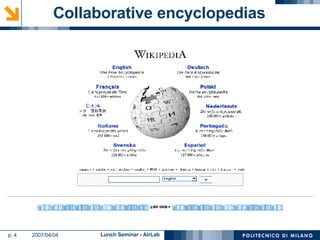
Collaborative encyclopedias
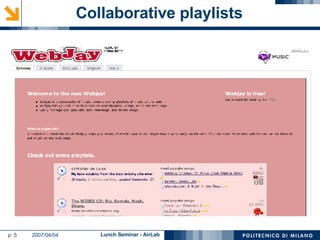
Collaborative playlists
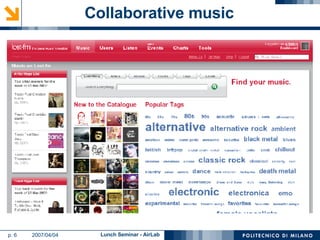
Collaborative music
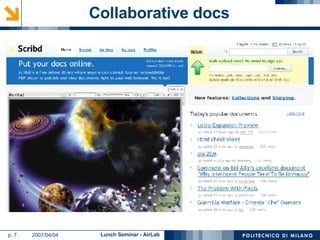
Collaborative docs
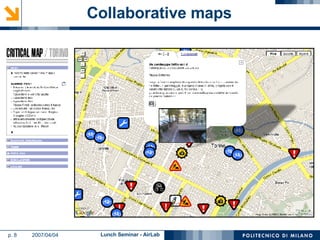
Collaborative maps
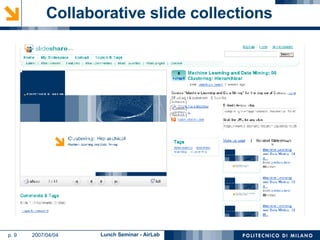
Collaborative slide collections
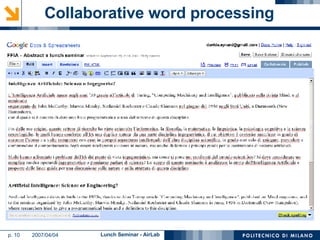
Collaborative word processing
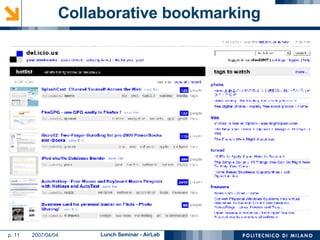
Collaborative bookmarking
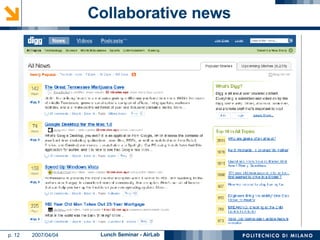
Collaborative news
Why? Why are collaborative systems having so much success lately? Give a look at “ What is Web2.0 ”  design patterns: The long tail Data is the next Intel Inside Users add value Network effects by default Some rights reserved The perpetual beta Cooperate, don't control Software above the level of the single device
How? How can you make your users actively contribute to a project? Instant gratification i.e. Napster, CDDB (now FreeDB, MusicBrainz) Communities of practice ( Etienne Wenger ) User interface So, systems should be very easy to use provide an immediate reward do most of the hard work automatically
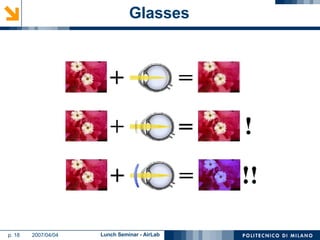
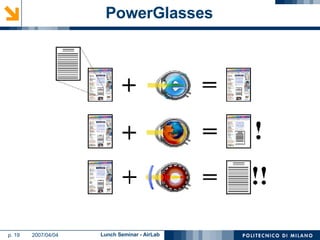
What? What do participative systems and Semantic Web have in common?
What? What do participative systems and Semantic Web have in common? “ The Semantic Web is not a separate Web but an extension of the current one, in which information is given well-defined meaning, better enabling  computers and people  to work in cooperation” Tim Berners-Lee, 2001
What is Semantic Web? HAH! 10^9$ Question! Semantic Web is not “making machines  understand  stuff” Semantic Web is about standards reasoning interoperability metadata (client-server-server model) ie. annotations, classifications, ratings, etc.
Glasses
PowerGlasses
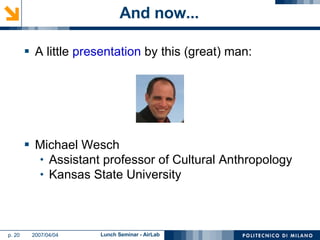
And now... A little  presentation  by this (great) man: Michael Wesch Assistant professor of Cultural Anthropology Kansas State University
So again... what? What do participative systems and Semantic Web have in common? Participative systems work thanks to contributions by people unstructured information, by humans for humans hard to find and organize Semantic Web works thanks to structured information not easy to publish, need more participation So, why don't we use semantics  to help people organize and find stuff people  to help Semantic Web bootstrap
Our work Our work is focused on two main fields: Semantic Wikis Wiki as in “Wikipedia”... ... but also (well, mostly) in enterprises Folksonomies expanding them with ontologies relations between users, resources, tags description of different families of tags applications
Semantic Wikis Wikis are one of the best examples of “read/write” Web they allow any user to easily create, modify, delete any page but the information is just plain, unstructured text: no interoperability, no way to organize them
Current approaches on SWikis semantics added  inside  pages pages as concepts and relations within them semantics added as metadata tags which describe the pages our approach: semantics on different levels wiki system context contents upper ontology
Folksonomies Term by Thomas Vander Wal (2004) “folks” + “taxonomy” First (and most cited) websites: flickr del.icio.us Growing interest users increase exponentially (1.5M in deli)
Advantages of folksonomies Folksonomies: are inclusive are current offer discovery are non-binary are democratic and self-moderating follow “desire lines” offer insight into user behavior are usable with a low cost
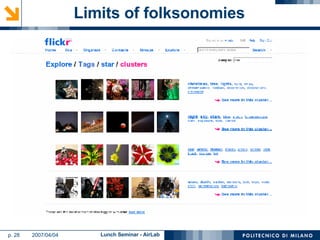
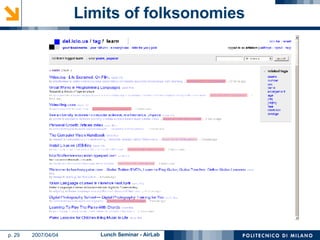
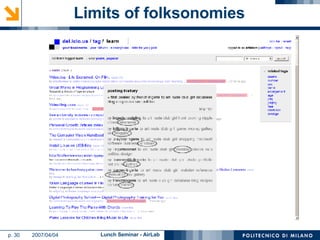
Limits of folksonomies Limits of folksonomies: no synonym control “basic level” variations lack of precision lack of recall (!) lack of hierarchy gaming no real standard
Limits of folksonomies
Studying folksonomies Tag usage and tag families Expanding folksonomies with ontologies Fuzzy queries inside folksonomies
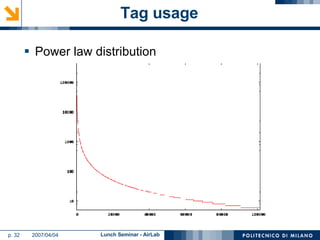
Tag usage Power law distribution
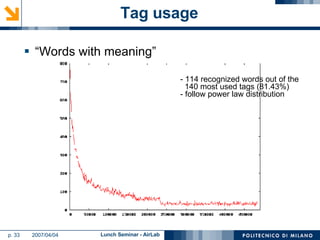
Tag usage “Words with meaning” - 114 recognized words out of the  140 most used tags (81.43%) - follow power law distribution
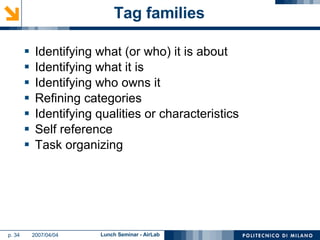
Tag families Identifying what (or who) it is about Identifying what it is Identifying who owns it Refining categories Identifying qualities or characteristics Self reference Task organizing
Fuzzy queries
Fuzzy queries
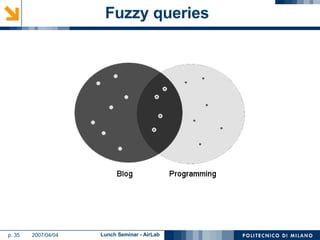
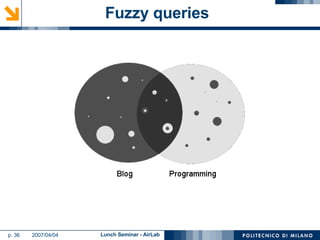
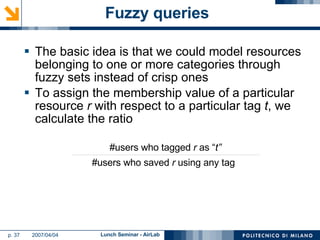
Fuzzy queries  The basic idea is that we could model resources belonging to one or more categories through fuzzy sets instead of crisp ones To assign the membership value of a particular resource  r  with respect to a particular tag  t , we calculate the ratio #users who tagged  r  as “ t” #users who saved  r  using any tag
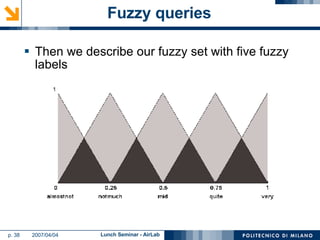
Fuzzy queries Then we describe our fuzzy set with five fuzzy labels
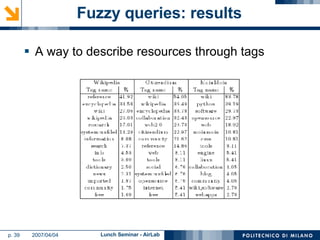
Fuzzy queries: results A way to describe resources through tags
Fuzzy queries: results A way to describe resources through tags A way to query folksonomies with a more intuitive interface to filter information ie. search for “very programming and not much java”
Fuzzy queries: results A way to describe resources through tags A way to query folksonomies with a more intuitive interface to filter information ie. search for “very programming and not much java” A way to learn something more about tag families ie. tag “toread”
Fuzzy queries: results A way to describe resources through tags A way to query folksonomies with a more intuitive interface to filter information ie. search for “very programming and not much java” A way to learn something more about tag families ie. tag “toread” A major drawback: the system is quite slow
That's All, Folks Thank you! Questions are welcome

Research on collaborative information sharing systems

  • 1.
    Research on collaborativeinformation sharing systems Davide Eynard [email_address] Dipartimento di Elettronica e Informazione Politecnico di Milano
  • 2.
    Intro What I'mdoing Collaborative systems Semantic Web Semantic Wikis Folksonomies
  • 3.
    What I'm doing“Research on collaborative information sharing systems” They are designed to help people involved in a common task achieve their goals Actually, they do not only allow for information sharing, but also for collaborative work There are plenty of them: we are focusing on some we call participative
  • 4.
  • 5.
  • 6.
  • 7.
  • 8.
  • 9.
  • 10.
  • 11.
  • 12.
  • 13.
    Why? Why arecollaborative systems having so much success lately? Give a look at “ What is Web2.0 ” design patterns: The long tail Data is the next Intel Inside Users add value Network effects by default Some rights reserved The perpetual beta Cooperate, don't control Software above the level of the single device
  • 14.
    How? How canyou make your users actively contribute to a project? Instant gratification i.e. Napster, CDDB (now FreeDB, MusicBrainz) Communities of practice ( Etienne Wenger ) User interface So, systems should be very easy to use provide an immediate reward do most of the hard work automatically
  • 15.
    What? What doparticipative systems and Semantic Web have in common?
  • 16.
    What? What doparticipative systems and Semantic Web have in common? “ The Semantic Web is not a separate Web but an extension of the current one, in which information is given well-defined meaning, better enabling computers and people to work in cooperation” Tim Berners-Lee, 2001
  • 17.
    What is SemanticWeb? HAH! 10^9$ Question! Semantic Web is not “making machines understand stuff” Semantic Web is about standards reasoning interoperability metadata (client-server-server model) ie. annotations, classifications, ratings, etc.
  • 18.
  • 19.
  • 20.
    And now... Alittle presentation by this (great) man: Michael Wesch Assistant professor of Cultural Anthropology Kansas State University
  • 21.
    So again... what?What do participative systems and Semantic Web have in common? Participative systems work thanks to contributions by people unstructured information, by humans for humans hard to find and organize Semantic Web works thanks to structured information not easy to publish, need more participation So, why don't we use semantics to help people organize and find stuff people to help Semantic Web bootstrap
  • 22.
    Our work Ourwork is focused on two main fields: Semantic Wikis Wiki as in “Wikipedia”... ... but also (well, mostly) in enterprises Folksonomies expanding them with ontologies relations between users, resources, tags description of different families of tags applications
  • 23.
    Semantic Wikis Wikisare one of the best examples of “read/write” Web they allow any user to easily create, modify, delete any page but the information is just plain, unstructured text: no interoperability, no way to organize them
  • 24.
    Current approaches onSWikis semantics added inside pages pages as concepts and relations within them semantics added as metadata tags which describe the pages our approach: semantics on different levels wiki system context contents upper ontology
  • 25.
    Folksonomies Term byThomas Vander Wal (2004) “folks” + “taxonomy” First (and most cited) websites: flickr del.icio.us Growing interest users increase exponentially (1.5M in deli)
  • 26.
    Advantages of folksonomiesFolksonomies: are inclusive are current offer discovery are non-binary are democratic and self-moderating follow “desire lines” offer insight into user behavior are usable with a low cost
  • 27.
    Limits of folksonomiesLimits of folksonomies: no synonym control “basic level” variations lack of precision lack of recall (!) lack of hierarchy gaming no real standard
  • 28.
  • 29.
  • 30.
  • 31.
    Studying folksonomies Tagusage and tag families Expanding folksonomies with ontologies Fuzzy queries inside folksonomies
  • 32.
    Tag usage Powerlaw distribution
  • 33.
    Tag usage “Wordswith meaning” - 114 recognized words out of the 140 most used tags (81.43%) - follow power law distribution
  • 34.
    Tag families Identifyingwhat (or who) it is about Identifying what it is Identifying who owns it Refining categories Identifying qualities or characteristics Self reference Task organizing
  • 35.
  • 36.
  • 37.
    Fuzzy queries The basic idea is that we could model resources belonging to one or more categories through fuzzy sets instead of crisp ones To assign the membership value of a particular resource r with respect to a particular tag t , we calculate the ratio #users who tagged r as “ t” #users who saved r using any tag
  • 38.
    Fuzzy queries Thenwe describe our fuzzy set with five fuzzy labels
  • 39.
    Fuzzy queries: resultsA way to describe resources through tags
  • 40.
    Fuzzy queries: resultsA way to describe resources through tags A way to query folksonomies with a more intuitive interface to filter information ie. search for “very programming and not much java”
  • 41.
    Fuzzy queries: resultsA way to describe resources through tags A way to query folksonomies with a more intuitive interface to filter information ie. search for “very programming and not much java” A way to learn something more about tag families ie. tag “toread”
  • 42.
    Fuzzy queries: resultsA way to describe resources through tags A way to query folksonomies with a more intuitive interface to filter information ie. search for “very programming and not much java” A way to learn something more about tag families ie. tag “toread” A major drawback: the system is quite slow
  • 43.
    That's All, FolksThank you! Questions are welcome