



Emerging Technologies Abhishek Srivastava Amit Sahni Mahmood Akhtar Shreya Das Sunal Kumar Umesh Parashar Vikram Razdan
What is del.icio.us? A bookmarking service with two significant differences: A flexible approach to bookmark organization A social software component
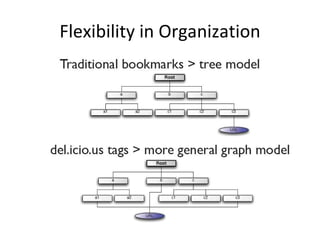
Flexibility in Organization
del.icio.us  as Social Software •  Three interconnected components: Links Tags Users Forms the basis for a folksonomy Folksonomy: folk + taxonomy
Why is  del.icio.us  so successful? It provides  instant feedback regarding  the location of any new link/tag/user addition in the network. It is  simple.
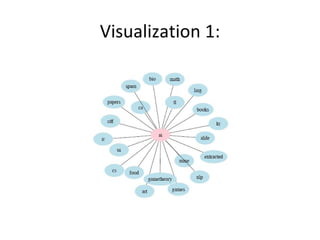
Visualization 1:
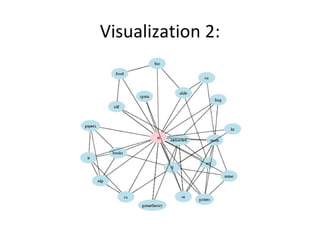
Visualization 2:
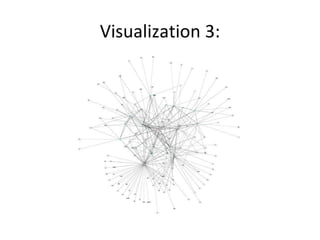
Visualization 3:
Wikis
Overview Open-ended, collaborative group sites Allow asynchronous communication across the internet Provide users with both author and editor privileges Incorporate sounds, movies and pictures Just need a web browser to start using
Details A combination of CGI script and a collection of plain text files used for creating web pages Allows dynamic web page creation Father of Wiki – Ward Cunningham in 1995 by creating WikiWikiWeb
Essential Characteristics The one that has most strikingly set wikis apart from other web based forums and discussions is that of multiple contributors. Unlike a blog, for example, which has one main identifiable author, a wiki web page may be authored and edited by a number of people. Not only may an individual contributor edit their own work, but also edit the work of others. Some speak of wiki pages in their purest form as never being finished and always in the process of being edited and expanded.
Uses Collaborating on business ideas with team across geographies Business Wikis are being used for Project Management, mission statement and cross-company collaborations Fosters trust between groups due to openness Wikibooks for collaborative nonfiction, recepies, wikimedia for citizen journalists.
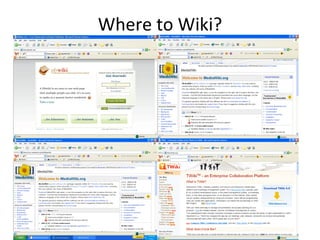
Where to Wiki?
SocialNetworking
• Communities of people who share interests and activities  •Social networks connect people at low cost
Most social network services such as chat, messaging, email, video, voicechat, file sharing, blogging, discussion groups, and so on.
 
• self-publishing within your network of friends and colleagues.  •what to listen to, what to watch, what's groovy
• The people's television network •It is being acquired by Google for a mere 1.65 billion dollars in stock
• Social Bookmaking •provide interesting and usually high quality web links (which users voted for) •a real-time record of who is interested in what right now
Wikipedia •Probably the best encyclopedia in the world •1.5 million user-contributed articles.
P2P •Share your computer power with everyone else in order to deliver their service  •Peer to Peer
eBay •This is not normally thought of as having a social network element  •1 million people worldwide make a living from eBay
SecondLife •3-D virtual world •makes money by selling virtual real-estate for hard cash •Several major companies have set up shop in SecondLife
World WarCraft •Hugely popular Internet-based multi-player game  •Most successful of several virtual worlds that the Internet has spawned  •very powerful (and commercially successful) social network
F reecycle •This is a goods recycling service that enable people to give away possessions that they no longer want and need.
Your Business •Social networking sites have become big business •can, your business take  advantage of these social  type site
RSS
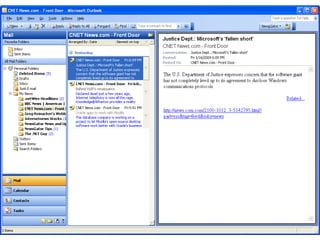
RSS, A “Killer App” Better than the Inbox Unspammable content delivery channel to individuals Viable replacement for enewsletters  Web-wide Syndication Propagate deep links that drive traffic and link gain
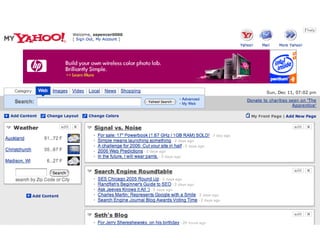
Client-side vs. Hosted App Web-based aggregator Bloglines (owned by Ask Jeeves), My Yahoo!, MyMSN, Google Reader, MyFeedster, etc. Installed application NewsGator (Outlook plug-in), Sage (Firefox plug-in), Pluck (IE plug-in), FeedReader, etc. IE7 supports RSS natively
Work RSS to the limit Give it away Make it easy to subscribe Track subscriber behavior Personalize the content Capture the link gain
 
 
BLOG – WEB LOG
What’s a blog •  Part web site •  Part journal •  Part free-form writing spaces that Have the potential to enhance writing and literary skills while offering a uniquely stylized form of expression •  An effective medium for many educators who lack strong computer skills •  A blog is about creating a conversation A Blog is a web site that often provides commentary or news on a particular subject, such as food, politics, or local news; some function as more personal online diaries. A Blog is a web site that allows an author to publish instantly from any Internet connection. A blog can be interactive, allowing teachers and students to begin conversations or add information published there.
Blog Glossary •  blogger  : blog author •  post/posting  : each chunk of content •  permalink  : permanent link to a particular post •  archives  : older posts •  categories  : subject headings •  blogroll  : list of favorite/recommended blogs •  comments  : readers can comment on your posts •  RSS:  Really Simple Syndication (news feed)
PODCAST
 
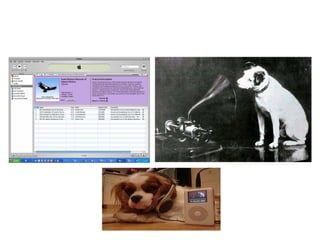
What is a PODCast? An audible information file that can be automatically downloaded from the Internet and stored on a digital audio player.
PODCasting The creation, management and promotion of podcasts on the Internet. Podcasting is unique as it uses the subscriber method to deliver the audio files through a feed program. Listeners subscribe to these feeds using a “podcatching” software. Any digital audio player or computer with audio-playing software can play podcasts. Podcasting opens another media vehicle that organizations can add to their marketing, advertising and PR arsenal. Podcasting will change the experience of travelers and how they experience a cultural attraction. Podcasting will provide another educational tool for adults and children.
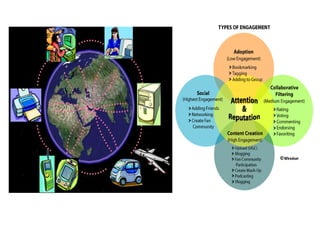
Web 1.0, 2.0 and 3.0
 
 
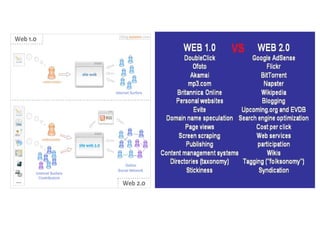
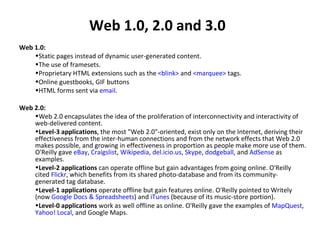
Web 1.0, 2.0 and 3.0 Web 1.0: Static pages instead of dynamic user-generated content. The use of framesets. Proprietary HTML extensions such as the  <blink>  and  <marquee>  tags. Online guestbooks, GIF buttons HTML forms sent via  email .  Web 2.0: Web 2.0 encapsulates the idea of the proliferation of interconnectivity and interactivity of web-delivered content.  Level-3 applications , the most &quot;Web 2.0&quot;-oriented, exist only on the Internet, deriving their effectiveness from the inter-human connections and from the network effects that Web 2.0 makes possible, and growing in effectiveness in proportion as people make more use of them. O'Reilly gave  eBay ,  Craigslist ,  Wikipedia ,  del.icio.us ,  Skype ,  dodgeball , and  AdSense  as examples.  Level-2 applications  can operate offline but gain advantages from going online. O'Reilly cited  Flickr , which benefits from its shared photo-database and from its community-generated tag database.  Level-1 applications  operate offline but gain features online. O'Reilly pointed to Writely (now  Google Docs & Spreadsheets ) and  iTunes  (because of its music-store portion).  Level-0 applications  work as well offline as online. O'Reilly gave the examples of  MapQuest ,  Yahoo! Local , and Google Maps.
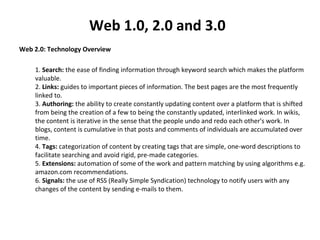
Web 1.0, 2.0 and 3.0 Web 2.0: Technology Overview 1.  Search:  the ease of finding information through keyword search which makes the platform valuable. 2.  Links:  guides to important pieces of information. The best pages are the most frequently linked to. 3.  Authoring:  the ability to create constantly updating content over a platform that is shifted from being the creation of a few to being the constantly updated, interlinked work. In wikis, the content is iterative in the sense that the people undo and redo each other's work. In blogs, content is cumulative in that posts and comments of individuals are accumulated over time. 4.  Tags:  categorization of content by creating tags that are simple, one-word descriptions to facilitate searching and avoid rigid, pre-made categories. 5.  Extensions:  automation of some of the work and pattern matching by using algorithms e.g. amazon.com recommendations. 6.  Signals:  the use of RSS (Really Simple Syndication) technology to notify users with any changes of the content by sending e-mails to them.
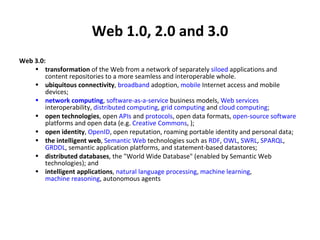
Web 1.0, 2.0 and 3.0 Web 3.0: transformation  of the Web from a network of separately  siloed  applications and content repositories to a more seamless and interoperable whole.  ubiquitous connectivity ,  broadband  adoption,  mobile  Internet access and mobile devices;  network computing ,  software-as-a-service  business models,  Web services  interoperability,  distributed computing ,  grid computing  and  cloud computing ;  open technologies , open  APIs  and  protocols , open data formats,  open-source software  platforms and open data (e.g.  Creative Commons , );  open identity ,  OpenID , open reputation, roaming portable identity and personal data;  the intelligent web ,  Semantic Web  technologies such as  RDF ,  OWL ,  SWRL ,  SPARQL ,  GRDDL , semantic application platforms, and statement-based datastores;  distributed databases , the &quot;World Wide Database&quot; (enabled by Semantic Web technologies); and  intelligent applications ,  natural language processing ,  machine learning ,  machine reasoning , autonomous agents
Questions

Emerging Technologies

  • 1.
    Emerging Technologies AbhishekSrivastava Amit Sahni Mahmood Akhtar Shreya Das Sunal Kumar Umesh Parashar Vikram Razdan
  • 2.
    What is del.icio.us?A bookmarking service with two significant differences: A flexible approach to bookmark organization A social software component
  • 3.
  • 4.
    del.icio.us asSocial Software • Three interconnected components: Links Tags Users Forms the basis for a folksonomy Folksonomy: folk + taxonomy
  • 5.
    Why is del.icio.us so successful? It provides instant feedback regarding the location of any new link/tag/user addition in the network. It is simple.
  • 6.
  • 7.
  • 8.
  • 9.
  • 10.
    Overview Open-ended, collaborativegroup sites Allow asynchronous communication across the internet Provide users with both author and editor privileges Incorporate sounds, movies and pictures Just need a web browser to start using
  • 11.
    Details A combinationof CGI script and a collection of plain text files used for creating web pages Allows dynamic web page creation Father of Wiki – Ward Cunningham in 1995 by creating WikiWikiWeb
  • 12.
    Essential Characteristics Theone that has most strikingly set wikis apart from other web based forums and discussions is that of multiple contributors. Unlike a blog, for example, which has one main identifiable author, a wiki web page may be authored and edited by a number of people. Not only may an individual contributor edit their own work, but also edit the work of others. Some speak of wiki pages in their purest form as never being finished and always in the process of being edited and expanded.
  • 13.
    Uses Collaborating onbusiness ideas with team across geographies Business Wikis are being used for Project Management, mission statement and cross-company collaborations Fosters trust between groups due to openness Wikibooks for collaborative nonfiction, recepies, wikimedia for citizen journalists.
  • 14.
  • 15.
  • 16.
    • Communities ofpeople who share interests and activities •Social networks connect people at low cost
  • 17.
    Most social networkservices such as chat, messaging, email, video, voicechat, file sharing, blogging, discussion groups, and so on.
  • 18.
  • 19.
    • self-publishing withinyour network of friends and colleagues. •what to listen to, what to watch, what's groovy
  • 20.
    • The people'stelevision network •It is being acquired by Google for a mere 1.65 billion dollars in stock
  • 21.
    • Social Bookmaking•provide interesting and usually high quality web links (which users voted for) •a real-time record of who is interested in what right now
  • 22.
    Wikipedia •Probably thebest encyclopedia in the world •1.5 million user-contributed articles.
  • 23.
    P2P •Share yourcomputer power with everyone else in order to deliver their service •Peer to Peer
  • 24.
    eBay •This isnot normally thought of as having a social network element •1 million people worldwide make a living from eBay
  • 25.
    SecondLife •3-D virtualworld •makes money by selling virtual real-estate for hard cash •Several major companies have set up shop in SecondLife
  • 26.
    World WarCraft •Hugelypopular Internet-based multi-player game •Most successful of several virtual worlds that the Internet has spawned •very powerful (and commercially successful) social network
  • 27.
    F reecycle •Thisis a goods recycling service that enable people to give away possessions that they no longer want and need.
  • 28.
    Your Business •Socialnetworking sites have become big business •can, your business take advantage of these social type site
  • 29.
  • 30.
    RSS, A “KillerApp” Better than the Inbox Unspammable content delivery channel to individuals Viable replacement for enewsletters Web-wide Syndication Propagate deep links that drive traffic and link gain
  • 31.
    Client-side vs. HostedApp Web-based aggregator Bloglines (owned by Ask Jeeves), My Yahoo!, MyMSN, Google Reader, MyFeedster, etc. Installed application NewsGator (Outlook plug-in), Sage (Firefox plug-in), Pluck (IE plug-in), FeedReader, etc. IE7 supports RSS natively
  • 32.
    Work RSS tothe limit Give it away Make it easy to subscribe Track subscriber behavior Personalize the content Capture the link gain
  • 33.
  • 34.
  • 35.
  • 36.
    What’s a blog• Part web site • Part journal • Part free-form writing spaces that Have the potential to enhance writing and literary skills while offering a uniquely stylized form of expression • An effective medium for many educators who lack strong computer skills • A blog is about creating a conversation A Blog is a web site that often provides commentary or news on a particular subject, such as food, politics, or local news; some function as more personal online diaries. A Blog is a web site that allows an author to publish instantly from any Internet connection. A blog can be interactive, allowing teachers and students to begin conversations or add information published there.
  • 37.
    Blog Glossary • blogger : blog author • post/posting : each chunk of content • permalink : permanent link to a particular post • archives : older posts • categories : subject headings • blogroll : list of favorite/recommended blogs • comments : readers can comment on your posts • RSS: Really Simple Syndication (news feed)
  • 38.
  • 39.
  • 40.
    What is aPODCast? An audible information file that can be automatically downloaded from the Internet and stored on a digital audio player.
  • 41.
    PODCasting The creation,management and promotion of podcasts on the Internet. Podcasting is unique as it uses the subscriber method to deliver the audio files through a feed program. Listeners subscribe to these feeds using a “podcatching” software. Any digital audio player or computer with audio-playing software can play podcasts. Podcasting opens another media vehicle that organizations can add to their marketing, advertising and PR arsenal. Podcasting will change the experience of travelers and how they experience a cultural attraction. Podcasting will provide another educational tool for adults and children.
  • 42.
    Web 1.0, 2.0and 3.0
  • 43.
  • 44.
  • 45.
    Web 1.0, 2.0and 3.0 Web 1.0: Static pages instead of dynamic user-generated content. The use of framesets. Proprietary HTML extensions such as the <blink> and <marquee> tags. Online guestbooks, GIF buttons HTML forms sent via email . Web 2.0: Web 2.0 encapsulates the idea of the proliferation of interconnectivity and interactivity of web-delivered content. Level-3 applications , the most &quot;Web 2.0&quot;-oriented, exist only on the Internet, deriving their effectiveness from the inter-human connections and from the network effects that Web 2.0 makes possible, and growing in effectiveness in proportion as people make more use of them. O'Reilly gave eBay , Craigslist , Wikipedia , del.icio.us , Skype , dodgeball , and AdSense as examples. Level-2 applications can operate offline but gain advantages from going online. O'Reilly cited Flickr , which benefits from its shared photo-database and from its community-generated tag database. Level-1 applications operate offline but gain features online. O'Reilly pointed to Writely (now Google Docs & Spreadsheets ) and iTunes (because of its music-store portion). Level-0 applications work as well offline as online. O'Reilly gave the examples of MapQuest , Yahoo! Local , and Google Maps.
  • 46.
    Web 1.0, 2.0and 3.0 Web 2.0: Technology Overview 1. Search: the ease of finding information through keyword search which makes the platform valuable. 2. Links: guides to important pieces of information. The best pages are the most frequently linked to. 3. Authoring: the ability to create constantly updating content over a platform that is shifted from being the creation of a few to being the constantly updated, interlinked work. In wikis, the content is iterative in the sense that the people undo and redo each other's work. In blogs, content is cumulative in that posts and comments of individuals are accumulated over time. 4. Tags: categorization of content by creating tags that are simple, one-word descriptions to facilitate searching and avoid rigid, pre-made categories. 5. Extensions: automation of some of the work and pattern matching by using algorithms e.g. amazon.com recommendations. 6. Signals: the use of RSS (Really Simple Syndication) technology to notify users with any changes of the content by sending e-mails to them.
  • 47.
    Web 1.0, 2.0and 3.0 Web 3.0: transformation of the Web from a network of separately siloed applications and content repositories to a more seamless and interoperable whole. ubiquitous connectivity , broadband adoption, mobile Internet access and mobile devices; network computing , software-as-a-service business models, Web services interoperability, distributed computing , grid computing and cloud computing ; open technologies , open APIs and protocols , open data formats, open-source software platforms and open data (e.g. Creative Commons , ); open identity , OpenID , open reputation, roaming portable identity and personal data; the intelligent web , Semantic Web technologies such as RDF , OWL , SWRL , SPARQL , GRDDL , semantic application platforms, and statement-based datastores; distributed databases , the &quot;World Wide Database&quot; (enabled by Semantic Web technologies); and intelligent applications , natural language processing , machine learning , machine reasoning , autonomous agents
  • 48.