Preparing for the Future: Technological
Challenges and Beyond
G: Conclusions
Brian Kelly
Independent researcher/consultant at
UK Web Focus Ltd.
Tony Hirst
Senior lecturer at The Open University
Contact Details
Brian Kelly Tony Hirst
Email: ukwebfocus@gmail.com Email: tony.hirst@gmail.com
Twitter: @briankelly Twitter: @psychemedia
Blog: http://ukwebfocus.com/ Blog: http://blog.ouseful.info/
Slides and further information available at
http://ukwebfocus.com/events/ili-2015-preparing-for-the-future/
UK Web Focus Event hashtag: #ili2015fut
G: Conclusions
Contents
• Recap:
 Thinking differently
 Delphi process
 Risk and opportunities framework
 Action brief
 Business case
• Other sources of information
• Your feedback
2
G: Conclusions
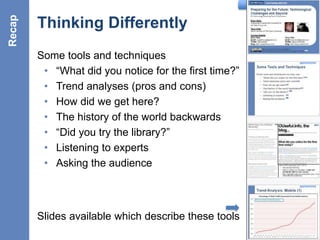
Thinking Differently
Some tools and techniques
• “What did you notice for the first time?”
• Trend analyses (pros and cons)
• How did we get here?
• The history of the world backwards
• “Did you try the library?”
• Listening to experts
• Asking the audience
3
Slides available which describe these tools
Recap
G: Conclusions
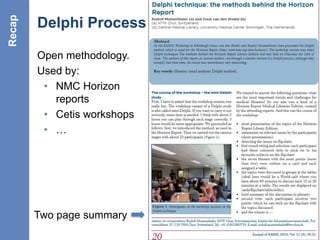
Delphi Process
Open methodology.
Used by:
• NMC Horizon
reports
• Cetis workshops
• …
4
Recap
Two page summary
G: Conclusions
Risk and Opportunities Framework
Remember:
• There are risks and opportunities
• There are risks in doing nothing (missed opportunities)
• There are risks in continuing to use existing technologies
(remember mainframe computers, dBase, …)
Need to explicitly address risks
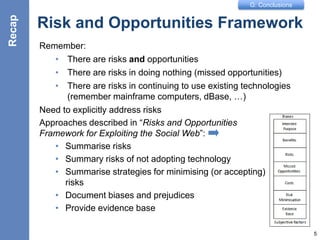
Approaches described in “Risks and Opportunities
Framework for Exploiting the Social Web”:
• Summarise risks
• Summary risks of not adopting technology
• Summarise strategies for minimising (or accepting)
risks
• Document biases and prejudices
• Provide evidence base
5
Recap
G: Conclusions
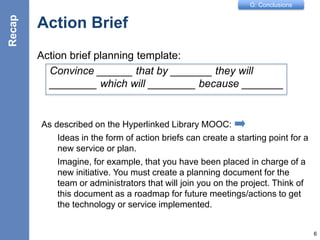
Action Brief
Action brief planning template:
Convince ______ that by _______ they will
________ which will ________ because _______
6
Recap
As described on the Hyperlinked Library MOOC:
Ideas in the form of action briefs can create a starting point for a
new service or plan.
Imagine, for example, that you have been placed in charge of a
new initiative. You must create a planning document for the
team or administrators that will join you on the project. Think of
this document as a roadmap for future meetings/actions to get
the technology or service implemented.
G: Conclusions
Making the Case
Remember need:
• To convince managers of reasons for providing
resources to investigate new developments
• To demonstrate that you have appreciated risks
and formulated risk mitigation plans
• To be aware of competing areas which are
seeking resources
7
Recap
G: Conclusions
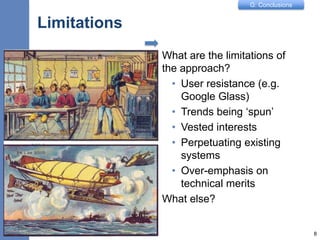
Limitations
What are the limitations of
the approach?
• User resistance (e.g.
Google Glass)
• Trends being ‘spun’
• Vested interests
• Perpetuating existing
systems
• Over-emphasis on
technical merits
What else?
8
G: Conclusions
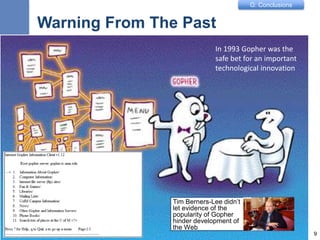
Warning From The Past
Tim Berners-Lee didn’t
let evidence of the
popularity of Gopher
hinder development of
the Web
9
In 1993 Gopher was the
safe bet for an important
technological innovation
G: Conclusions
The Serenity Prayer
• The Serenity Prayer
10Serenity Prayer
G: Conclusions
Do it For Yourself (1)
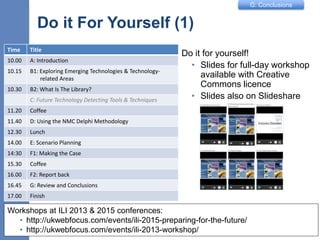
Do it for yourself!
• Slides for full-day workshop
available with Creative
Commons licence
• Slides also on Slideshare
11
Workshops at ILI 2013 & 2015 conferences:
• http://ukwebfocus.com/events/ili-2015-preparing-for-the-future/
• http://ukwebfocus.com/events/ili-2013-workshop/
Time Title
10.00 A: Introduction
10.15 B1: Exploring Emerging Technologies & Technology-
related Areas
10.30 B2: What Is The Library?
C: Future Technology Detecting Tools & Techniques
11.20 Coffee
11.40 D: Using the NMC Delphi Methodology
12.30 Lunch
14.00 E: Scenario Planning
14:30 F1: Making the Case
15.30 Coffee
16.00 F2: Report back
16.45 G: Review and Conclusions
17.00 Finish
G: Conclusions
Do it For Yourself (2)
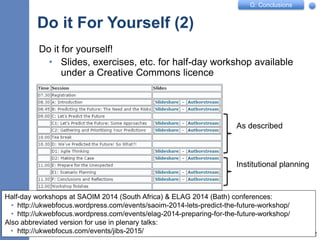
Do it for yourself!
• Slides, exercises, etc. for half-day workshop available
under a Creative Commons licence
12
Half-day workshops at SAOIM 2014 (South Africa) & ELAG 2014 (Bath) conferences:
• http://ukwebfocus.wordpress.com/events/saoim-2014-lets-predict-the-future-workshop/
• http://ukwebfocus.wordpress.com/events/elag-2014-preparing-for-the-future-workshop/
Also abbreviated version for use in plenary talks:
• http://ukwebfocus.com/events/jibs-2015/
As described
Institutional planning
G: Conclusions
Additional Resources
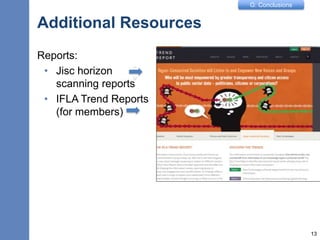
Reports:
• Jisc horizon
scanning reports
• IFLA Trend Reports
(for members)
13
c
v
G: Conclusions
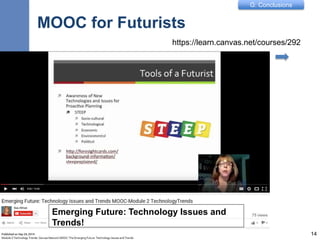
MOOC for Futurists
14
Emerging Future: Technology Issues and
Trends!
https://learn.canvas.net/courses/292
G: Conclusions
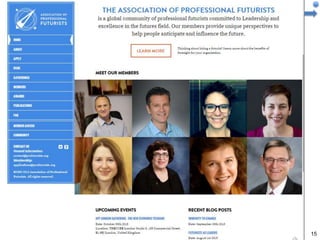
The Association of Professional
Futurists
See http://apf.org/
15
G: Conclusions
Questions?
16

G1 Conclusions

  • 1.
    Preparing for theFuture: Technological Challenges and Beyond G: Conclusions Brian Kelly Independent researcher/consultant at UK Web Focus Ltd. Tony Hirst Senior lecturer at The Open University Contact Details Brian Kelly Tony Hirst Email: ukwebfocus@gmail.com Email: tony.hirst@gmail.com Twitter: @briankelly Twitter: @psychemedia Blog: http://ukwebfocus.com/ Blog: http://blog.ouseful.info/ Slides and further information available at http://ukwebfocus.com/events/ili-2015-preparing-for-the-future/ UK Web Focus Event hashtag: #ili2015fut
  • 2.
    G: Conclusions Contents • Recap: Thinking differently  Delphi process  Risk and opportunities framework  Action brief  Business case • Other sources of information • Your feedback 2
  • 3.
    G: Conclusions Thinking Differently Sometools and techniques • “What did you notice for the first time?” • Trend analyses (pros and cons) • How did we get here? • The history of the world backwards • “Did you try the library?” • Listening to experts • Asking the audience 3 Slides available which describe these tools Recap
  • 4.
    G: Conclusions Delphi Process Openmethodology. Used by: • NMC Horizon reports • Cetis workshops • … 4 Recap Two page summary
  • 5.
    G: Conclusions Risk andOpportunities Framework Remember: • There are risks and opportunities • There are risks in doing nothing (missed opportunities) • There are risks in continuing to use existing technologies (remember mainframe computers, dBase, …) Need to explicitly address risks Approaches described in “Risks and Opportunities Framework for Exploiting the Social Web”: • Summarise risks • Summary risks of not adopting technology • Summarise strategies for minimising (or accepting) risks • Document biases and prejudices • Provide evidence base 5 Recap
  • 6.
    G: Conclusions Action Brief Actionbrief planning template: Convince ______ that by _______ they will ________ which will ________ because _______ 6 Recap As described on the Hyperlinked Library MOOC: Ideas in the form of action briefs can create a starting point for a new service or plan. Imagine, for example, that you have been placed in charge of a new initiative. You must create a planning document for the team or administrators that will join you on the project. Think of this document as a roadmap for future meetings/actions to get the technology or service implemented.
  • 7.
    G: Conclusions Making theCase Remember need: • To convince managers of reasons for providing resources to investigate new developments • To demonstrate that you have appreciated risks and formulated risk mitigation plans • To be aware of competing areas which are seeking resources 7 Recap
  • 8.
    G: Conclusions Limitations What arethe limitations of the approach? • User resistance (e.g. Google Glass) • Trends being ‘spun’ • Vested interests • Perpetuating existing systems • Over-emphasis on technical merits What else? 8
  • 9.
    G: Conclusions Warning FromThe Past Tim Berners-Lee didn’t let evidence of the popularity of Gopher hinder development of the Web 9 In 1993 Gopher was the safe bet for an important technological innovation
  • 10.
    G: Conclusions The SerenityPrayer • The Serenity Prayer 10Serenity Prayer
  • 11.
    G: Conclusions Do itFor Yourself (1) Do it for yourself! • Slides for full-day workshop available with Creative Commons licence • Slides also on Slideshare 11 Workshops at ILI 2013 & 2015 conferences: • http://ukwebfocus.com/events/ili-2015-preparing-for-the-future/ • http://ukwebfocus.com/events/ili-2013-workshop/ Time Title 10.00 A: Introduction 10.15 B1: Exploring Emerging Technologies & Technology- related Areas 10.30 B2: What Is The Library? C: Future Technology Detecting Tools & Techniques 11.20 Coffee 11.40 D: Using the NMC Delphi Methodology 12.30 Lunch 14.00 E: Scenario Planning 14:30 F1: Making the Case 15.30 Coffee 16.00 F2: Report back 16.45 G: Review and Conclusions 17.00 Finish
  • 12.
    G: Conclusions Do itFor Yourself (2) Do it for yourself! • Slides, exercises, etc. for half-day workshop available under a Creative Commons licence 12 Half-day workshops at SAOIM 2014 (South Africa) & ELAG 2014 (Bath) conferences: • http://ukwebfocus.wordpress.com/events/saoim-2014-lets-predict-the-future-workshop/ • http://ukwebfocus.wordpress.com/events/elag-2014-preparing-for-the-future-workshop/ Also abbreviated version for use in plenary talks: • http://ukwebfocus.com/events/jibs-2015/ As described Institutional planning
  • 13.
    G: Conclusions Additional Resources Reports: •Jisc horizon scanning reports • IFLA Trend Reports (for members) 13 c v
  • 14.
    G: Conclusions MOOC forFuturists 14 Emerging Future: Technology Issues and Trends! https://learn.canvas.net/courses/292
  • 15.
    G: Conclusions The Associationof Professional Futurists See http://apf.org/ 15
  • 16.

Editor's Notes

  • #17 I’d welcome questions and comments. Note that I’ve published a blog post on which can be used for questions. Thank you.