International Conference on Sustainable Energy and Environment
(23th
– 25th
February 2024)
Dr. Mohammad Mohsin Khan
Email: mohsinkhan@nitsri.ac.in
Assistant Professor
Department of Mechanical Engineering
National Institute of Technology Srinagar, India
Tapping into Potential: Kapton Tape-Enhanced Water-Solid
TENGs for Hydropower Harvesting
Sunday, February 25, 2024 Paper Id: 30 ICSEE-2024 2/22
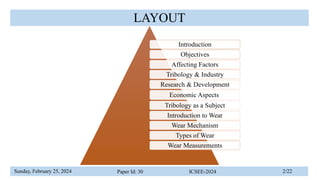
LAYOUT
Introduction
Objectives
Affecting Factors
Tribology & Industry
Research & Development
Economic Aspects
Tribology as a Subject
Introduction to Wear
Wear Mechanism
Types of Wear
Wear Measurements
Sunday, February 25, 2024 Paper Id: 30 ICSEE-2024 3/22
INTRODUCTION
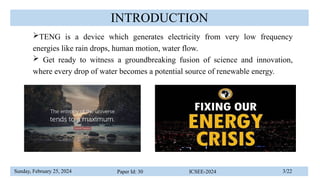
TENG is a device which generates electricity from very low frequency
energies like rain drops, human motion, water flow.
 Get ready to witness a groundbreaking fusion of science and innovation,
where every drop of water becomes a potential source of renewable energy.
Sunday, February 25, 2024 Paper Id: 30 ICSEE-2024 4/22
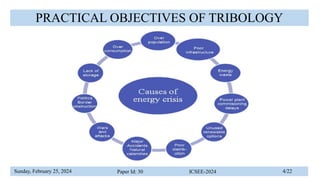
PRACTICAL OBJECTIVES OF TRIBOLOGY
Sunday, February 25, 2024 Paper Id: 30 ICSEE-2024 5/22
FACTORS AFFECTING FRICTION AND WEAR
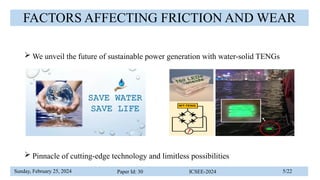
 We unveil the future of sustainable power generation with water-solid TENGs
 Pinnacle of cutting-edge technology and limitless possibilities
Sunday, February 25, 2024 Paper Id: 30 ICSEE-2024 6/22
OBJECTIVES
Sunday, February 25, 2024 Paper Id: 30 ICSEE-2024 7/22
TRIBOLOGY RESEARCH DEVELOPMENTS
TRIBOLOGY: RESEARCH & DEVELOPMENT
Sunday, February 25, 2024 Paper Id: 30 ICSEE-2024 8/22
ECONOMIC ASPECTS OF TRIBOLOGY
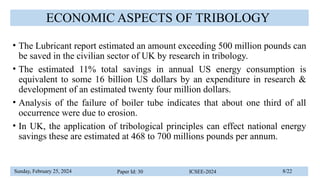
• The Lubricant report estimated an amount exceeding 500 million pounds can
be saved in the civilian sector of UK by research in tribology.
• The estimated 11% total savings in annual US energy consumption is
equivalent to some 16 billion US dollars by an expenditure in research &
development of an estimated twenty four million dollars.
• Analysis of the failure of boiler tube indicates that about one third of all
occurrence were due to erosion.
• In UK, the application of tribological principles can effect national energy
savings these are estimated at 468 to 700 millions pounds per annum.
Sunday, February 25, 2024 Paper Id: 30 ICSEE-2024 9/22
TRIBOLOGY AS A SUBJECT
Most tribological phenomenon are inherently complicated and interconnected. Integration
of knowledge from multifaceted disciplines is essential and therefore, a separate subject is
required.
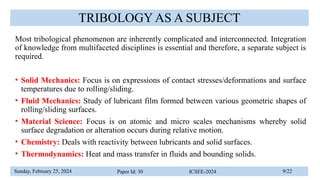
• Solid Mechanics: Focus is on expressions of contact stresses/deformations and surface
temperatures due to rolling/sliding.
• Fluid Mechanics: Study of lubricant film formed between various geometric shapes of
rolling/sliding surfaces.
• Material Science: Focus is on atomic and micro scales mechanisms whereby solid
surface degradation or alteration occurs during relative motion.
• Chemistry: Deals with reactivity between lubricants and solid surfaces.
• Thermodynamics: Heat and mass transfer in fluids and bounding solids.
Sunday, February 25, 2024 Paper Id: 30 ICSEE-2024 10/22
INTRODUCTION OF WEAR
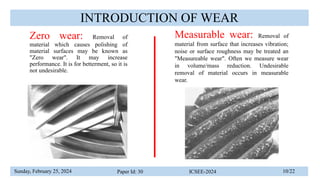
Zero wear: Removal of
material which causes polishing of
material surfaces may be known as
"Zero wear". It may increase
performance. It is for betterment, so it is
not undesirable.
Measurable wear: Removal of
material from surface that increases vibration;
noise or surface roughness may be treated an
"Measureable wear". Often we measure wear
in volume/mass reduction. Undesirable
removal of material occurs in measurable
wear.
Sunday, February 25, 2024 Paper Id: 30 ICSEE-2024 11/22
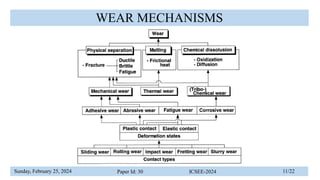
WEAR MECHANISMS
Sunday, February 25, 2024 Paper Id: 30 ICSEE-2024 12/22
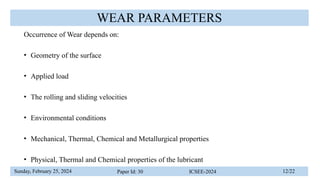
WEAR PARAMETERS
Occurrence of Wear depends on:
• Geometry of the surface
• Applied load
• The rolling and sliding velocities
• Environmental conditions
• Mechanical, Thermal, Chemical and Metallurgical properties
• Physical, Thermal and Chemical properties of the lubricant
Sunday, February 25, 2024 Paper Id: 30 ICSEE-2024 13/22
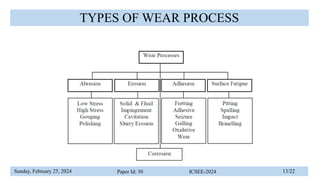
TYPES OF WEAR PROCESS
Sunday, February 25, 2024 Paper Id: 30 ICSEE-2024 14/22
ABRASIVE WEAR
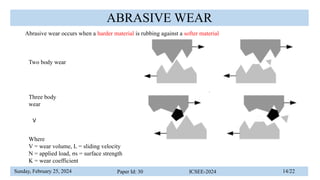
Abrasive wear occurs when a harder material is rubbing against a softer material
V
Where
V = wear volume, L = sliding velocity
N = applied load, σs = surface strength
K = wear coefficient
Two body wear
Three body
wear
Sunday, February 25, 2024 Paper Id: 30 ICSEE-2024 15/22
TYPES OF ABRASIVE WEAR
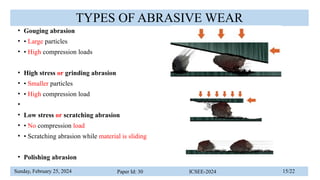
• Gouging abrasion
• • Large particles
• • High compression loads
• High stress or grinding abrasion
• • Smaller particles
• • High compression load
•
• Low stress or scratching abrasion
• • No compression load
• • Scratching abrasion while material is sliding
• Polishing abrasion
Sunday, February 25, 2024 Paper Id: 30 ICSEE-2024 16/22
EROSIVE WEAR
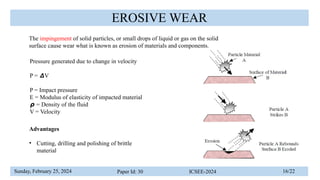
The impingement of solid particles, or small drops of liquid or gas on the solid
surface cause wear what is known as erosion of materials and components.
Pressure generated due to change in velocity
P = V
𝞓
P = Impact pressure
E = Modulus of elasticity of impacted material
𝞺 = Density of the fluid
V = Velocity
Advantages
• Cutting, drilling and polishing of brittle
material
Sunday, February 25, 2024 Paper Id: 30 ICSEE-2024 17/22
TYPES OF EROSION
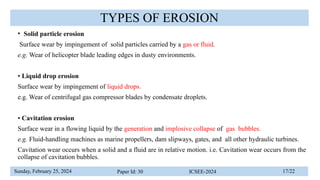
• Solid particle erosion
Surface wear by impingement of solid particles carried by a gas or fluid.
e.g. Wear of helicopter blade leading edges in dusty environments.
• Liquid drop erosion
Surface wear by impingement of liquid drops.
e.g. Wear of centrifugal gas compressor blades by condensate droplets.
• Cavitation erosion
Surface wear in a flowing liquid by the generation and implosive collapse of gas bubbles.
e.g. Fluid-handling machines as marine propellers, dam slipways, gates, and all other hydraulic turbines.
Cavitation wear occurs when a solid and a fluid are in relative motion. i.e. Cavitation wear occurs from the
collapse of cavitation bubbles.
Sunday, February 25, 2024 Paper Id: 30 ICSEE-2024 18/22
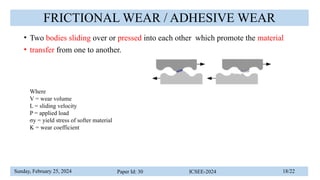
FRICTIONAL WEAR / ADHESIVE WEAR
• Two bodies sliding over or pressed into each other which promote the material
• transfer from one to another.
Where
V = wear volume
L = sliding velocity
P = applied load
σy = yield stress of softer material
K = wear coefficient
Sunday, February 25, 2024 Paper Id: 30 ICSEE-2024 19/22
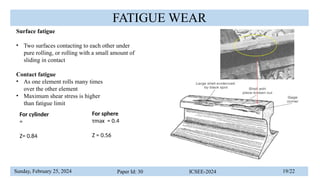
FATIGUE WEAR
Surface fatigue
• Two surfaces contacting to each other under
pure rolling, or rolling with a small amount of
sliding in contact
Contact fatigue
• As one element rolls many times
over the other element
• Maximum shear stress is higher
than fatigue limit
For cylinder
=
Z= 0.84
For sphere
τmax = 0.4
Z = 0.56
Sunday, February 25, 2024 Paper Id: 30 ICSEE-2024 20/22
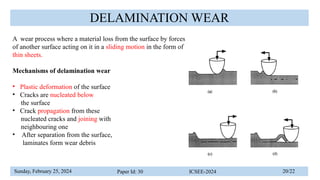
DELAMINATION WEAR
A wear process where a material loss from the surface by forces
of another surface acting on it in a sliding motion in the form of
thin sheets.
Mechanisms of delamination wear
• Plastic deformation of the surface
• Cracks are nucleated below
the surface
• Crack propagation from these
nucleated cracks and joining with
neighbouring one
• After separation from the surface,
laminates form wear debris
Sunday, February 25, 2024 Paper Id: 30 ICSEE-2024 21/22
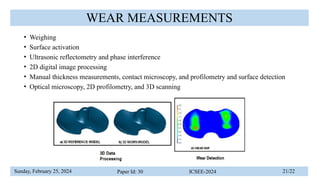
WEAR MEASUREMENTS
• Weighing
• Surface activation
• Ultrasonic reflectometry and phase interference
• 2D digital image processing
• Manual thickness measurements, contact microscopy, and profilometry and surface detection
• Optical microscopy, 2D profilometry, and 3D scanning
Sunday, February 25, 2024 Paper Id: 30 ICSEE-2024 22/22
SUMMARY
• Enough terms have been defined so that newcomers to tribology can
deal with the jargon used in describing test.
• Importance of Studying Tribology as a subject have been discussed.
• Highlights of recent Research & Development in tribology.
• Some economical aspects have been discussed.
• Various techniques of wear measurements have been discussed.
Thank You !!!

A simple, low-cost, eco-friendly water–solid TENG

  • 1.
    International Conference onSustainable Energy and Environment (23th – 25th February 2024) Dr. Mohammad Mohsin Khan Email: mohsinkhan@nitsri.ac.in Assistant Professor Department of Mechanical Engineering National Institute of Technology Srinagar, India Tapping into Potential: Kapton Tape-Enhanced Water-Solid TENGs for Hydropower Harvesting
  • 2.
    Sunday, February 25,2024 Paper Id: 30 ICSEE-2024 2/22 LAYOUT Introduction Objectives Affecting Factors Tribology & Industry Research & Development Economic Aspects Tribology as a Subject Introduction to Wear Wear Mechanism Types of Wear Wear Measurements
  • 3.
    Sunday, February 25,2024 Paper Id: 30 ICSEE-2024 3/22 INTRODUCTION TENG is a device which generates electricity from very low frequency energies like rain drops, human motion, water flow.  Get ready to witness a groundbreaking fusion of science and innovation, where every drop of water becomes a potential source of renewable energy.
  • 4.
    Sunday, February 25,2024 Paper Id: 30 ICSEE-2024 4/22 PRACTICAL OBJECTIVES OF TRIBOLOGY
  • 5.
    Sunday, February 25,2024 Paper Id: 30 ICSEE-2024 5/22 FACTORS AFFECTING FRICTION AND WEAR  We unveil the future of sustainable power generation with water-solid TENGs  Pinnacle of cutting-edge technology and limitless possibilities
  • 6.
    Sunday, February 25,2024 Paper Id: 30 ICSEE-2024 6/22 OBJECTIVES
  • 7.
    Sunday, February 25,2024 Paper Id: 30 ICSEE-2024 7/22 TRIBOLOGY RESEARCH DEVELOPMENTS TRIBOLOGY: RESEARCH & DEVELOPMENT
  • 8.
    Sunday, February 25,2024 Paper Id: 30 ICSEE-2024 8/22 ECONOMIC ASPECTS OF TRIBOLOGY • The Lubricant report estimated an amount exceeding 500 million pounds can be saved in the civilian sector of UK by research in tribology. • The estimated 11% total savings in annual US energy consumption is equivalent to some 16 billion US dollars by an expenditure in research & development of an estimated twenty four million dollars. • Analysis of the failure of boiler tube indicates that about one third of all occurrence were due to erosion. • In UK, the application of tribological principles can effect national energy savings these are estimated at 468 to 700 millions pounds per annum.
  • 9.
    Sunday, February 25,2024 Paper Id: 30 ICSEE-2024 9/22 TRIBOLOGY AS A SUBJECT Most tribological phenomenon are inherently complicated and interconnected. Integration of knowledge from multifaceted disciplines is essential and therefore, a separate subject is required. • Solid Mechanics: Focus is on expressions of contact stresses/deformations and surface temperatures due to rolling/sliding. • Fluid Mechanics: Study of lubricant film formed between various geometric shapes of rolling/sliding surfaces. • Material Science: Focus is on atomic and micro scales mechanisms whereby solid surface degradation or alteration occurs during relative motion. • Chemistry: Deals with reactivity between lubricants and solid surfaces. • Thermodynamics: Heat and mass transfer in fluids and bounding solids.
  • 10.
    Sunday, February 25,2024 Paper Id: 30 ICSEE-2024 10/22 INTRODUCTION OF WEAR Zero wear: Removal of material which causes polishing of material surfaces may be known as "Zero wear". It may increase performance. It is for betterment, so it is not undesirable. Measurable wear: Removal of material from surface that increases vibration; noise or surface roughness may be treated an "Measureable wear". Often we measure wear in volume/mass reduction. Undesirable removal of material occurs in measurable wear.
  • 11.
    Sunday, February 25,2024 Paper Id: 30 ICSEE-2024 11/22 WEAR MECHANISMS
  • 12.
    Sunday, February 25,2024 Paper Id: 30 ICSEE-2024 12/22 WEAR PARAMETERS Occurrence of Wear depends on: • Geometry of the surface • Applied load • The rolling and sliding velocities • Environmental conditions • Mechanical, Thermal, Chemical and Metallurgical properties • Physical, Thermal and Chemical properties of the lubricant
  • 13.
    Sunday, February 25,2024 Paper Id: 30 ICSEE-2024 13/22 TYPES OF WEAR PROCESS
  • 14.
    Sunday, February 25,2024 Paper Id: 30 ICSEE-2024 14/22 ABRASIVE WEAR Abrasive wear occurs when a harder material is rubbing against a softer material V Where V = wear volume, L = sliding velocity N = applied load, σs = surface strength K = wear coefficient Two body wear Three body wear
  • 15.
    Sunday, February 25,2024 Paper Id: 30 ICSEE-2024 15/22 TYPES OF ABRASIVE WEAR • Gouging abrasion • • Large particles • • High compression loads • High stress or grinding abrasion • • Smaller particles • • High compression load • • Low stress or scratching abrasion • • No compression load • • Scratching abrasion while material is sliding • Polishing abrasion
  • 16.
    Sunday, February 25,2024 Paper Id: 30 ICSEE-2024 16/22 EROSIVE WEAR The impingement of solid particles, or small drops of liquid or gas on the solid surface cause wear what is known as erosion of materials and components. Pressure generated due to change in velocity P = V 𝞓 P = Impact pressure E = Modulus of elasticity of impacted material 𝞺 = Density of the fluid V = Velocity Advantages • Cutting, drilling and polishing of brittle material
  • 17.
    Sunday, February 25,2024 Paper Id: 30 ICSEE-2024 17/22 TYPES OF EROSION • Solid particle erosion Surface wear by impingement of solid particles carried by a gas or fluid. e.g. Wear of helicopter blade leading edges in dusty environments. • Liquid drop erosion Surface wear by impingement of liquid drops. e.g. Wear of centrifugal gas compressor blades by condensate droplets. • Cavitation erosion Surface wear in a flowing liquid by the generation and implosive collapse of gas bubbles. e.g. Fluid-handling machines as marine propellers, dam slipways, gates, and all other hydraulic turbines. Cavitation wear occurs when a solid and a fluid are in relative motion. i.e. Cavitation wear occurs from the collapse of cavitation bubbles.
  • 18.
    Sunday, February 25,2024 Paper Id: 30 ICSEE-2024 18/22 FRICTIONAL WEAR / ADHESIVE WEAR • Two bodies sliding over or pressed into each other which promote the material • transfer from one to another. Where V = wear volume L = sliding velocity P = applied load σy = yield stress of softer material K = wear coefficient
  • 19.
    Sunday, February 25,2024 Paper Id: 30 ICSEE-2024 19/22 FATIGUE WEAR Surface fatigue • Two surfaces contacting to each other under pure rolling, or rolling with a small amount of sliding in contact Contact fatigue • As one element rolls many times over the other element • Maximum shear stress is higher than fatigue limit For cylinder = Z= 0.84 For sphere τmax = 0.4 Z = 0.56
  • 20.
    Sunday, February 25,2024 Paper Id: 30 ICSEE-2024 20/22 DELAMINATION WEAR A wear process where a material loss from the surface by forces of another surface acting on it in a sliding motion in the form of thin sheets. Mechanisms of delamination wear • Plastic deformation of the surface • Cracks are nucleated below the surface • Crack propagation from these nucleated cracks and joining with neighbouring one • After separation from the surface, laminates form wear debris
  • 21.
    Sunday, February 25,2024 Paper Id: 30 ICSEE-2024 21/22 WEAR MEASUREMENTS • Weighing • Surface activation • Ultrasonic reflectometry and phase interference • 2D digital image processing • Manual thickness measurements, contact microscopy, and profilometry and surface detection • Optical microscopy, 2D profilometry, and 3D scanning
  • 22.
    Sunday, February 25,2024 Paper Id: 30 ICSEE-2024 22/22 SUMMARY • Enough terms have been defined so that newcomers to tribology can deal with the jargon used in describing test. • Importance of Studying Tribology as a subject have been discussed. • Highlights of recent Research & Development in tribology. • Some economical aspects have been discussed. • Various techniques of wear measurements have been discussed. Thank You !!!