Auto bottle filler machine 2014-2015
V.P.M.P POLYTECHNIC Page 1
CHAPTER.NO:-
1
INTRODUCTION
Auto bottle filler machine 2014-2015
V.P.M.P POLYTECHNIC Page 2
 1.1Introduction
A batch operation where a set amount of inputs to be process is received as a group and an
operation produce the finish product. This project is the Combination of stepper gear which is
used for gap between two bottles, cam and follower, conveyor belt, water tank, pressure
pump. This project is divided into 4 Sections,
 The loading section,
 stepper section
 filling section
 The conveyor section (transfer section), this project is to design and develop the –
“Automatic bottle filling Machine”.
First of us we discus about the automation, what is automation?
Automation is the use of various control system for operating equipment such as machinery,
process in factories and other application with minimum or reduced human intervention.
The purpose of this project is to apply filling system where this system can Automatically
filling water into their bottle randomly by using various mechanisms the filling system will
be using the filling concept Time Gravity Filler with the help of pressure pump Selection
Guide.
The mechanical part of the project consists of,
Mechanical drawing, design, measuring, welding and fabricating process,
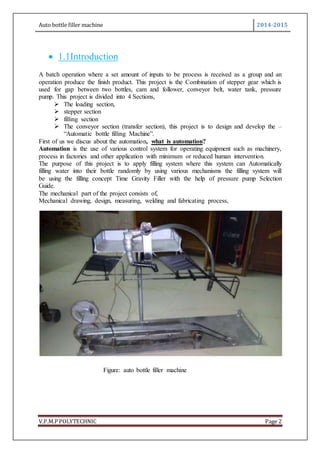
Figure: auto bottle filler machine
Auto bottle filler machine 2014-2015
V.P.M.P POLYTECHNIC Page 3
 1.2Objectives of the Project
The project is aimed to meet the following objectives:
 To design and implement automated bottle filling machine
 To learn the concept of stepper gear and cam follower
 To implement gear and cam design, measurement and then manufacturing
 To apply selector conveyor and water tank
 To check and analysis of all components in this project.
 Working of the model.
 1.3 Problem Statements
This machine is designed to filling water in the bottle automatically in a
Single machine. This project will reduce the usage of man power because all of the work will
be done by machine. Human held filling process will cause inexact volume of liquid into the
bottle. So using automated system will set the volume of the liquid exactly the same for each
bottle. If all the process is done manually, it will cost lot of time to complete the task. This
machine will also reduce the human error while doing this process manually.
Auto bottle filler machine 2014-2015
V.P.M.P POLYTECHNIC Page 4
CHAPTER. NO:-
2
PROBLEM DEFINITION
Auto bottle filler machine 2014-2015
V.P.M.P POLYTECHNIC Page 5
2.1 Definition
“To develop the auto bottle filler machine “
Competition is increase in industries day by day due to globalization and new company
introduced in market.
To stay in market every industry does something new to attract the customer and their
reputation in market.
To satisfy the need of customer industries should make machine such a way that the machine
will function it function satisfactorily and affordable to customer.
This project is used in small scale industries and other area which have law budget.
For that purpose the auto bottle filler machine are suitable for customer. Because it filling the
water automatically so in this machine minimum worker is need.
Auto bottle filler machine 2014-2015
V.P.M.P POLYTECHNIC Page 6
CHAPTER.NO:-
3
Model detail
Auto bottle filler machine 2014-2015
V.P.M.P POLYTECHNIC Page 7
 3.1 Part used in auto bottle filler machine:
1. Metal base
2. Roller
3. Rubber belt
4. Spur gear
5. Stepper spur gear
6. Water tank
7. Pressure pump
8. Ac/dc motor
Auto bottle filler machine 2014-2015
V.P.M.P POLYTECHNIC Page 8
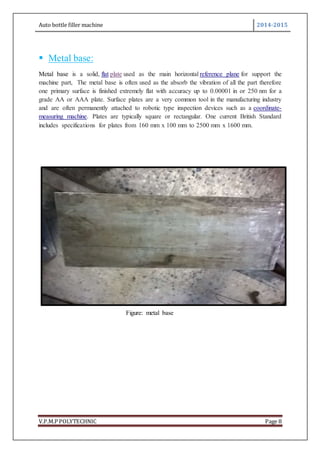
 Metal base:
Metal base is a solid, flat plate used as the main horizontal reference plane for support the
machine part, The metal base is often used as the absorb the vibration of all the part therefore
one primary surface is finished extremely flat with accuracy up to 0.00001 in or 250 nm for a
grade AA or AAA plate. Surface plates are a very common tool in the manufacturing industry
and are often permanently attached to robotic type inspection devices such as a coordinate-
measuring machine. Plates are typically square or rectangular. One current British Standard
includes specifications for plates from 160 mm x 100 mm to 2500 mm x 1600 mm.
Figure: metal base
Auto bottle filler machine 2014-2015
V.P.M.P POLYTECHNIC Page 9
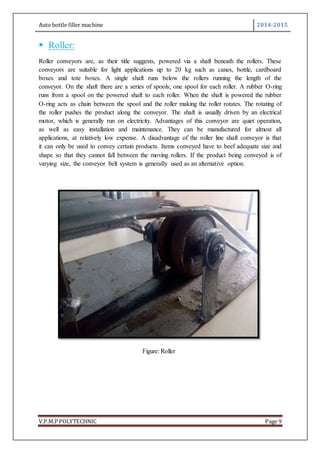
 Roller:
Roller conveyors are, as their title suggests, powered via a shaft beneath the rollers. These
conveyors are suitable for light applications up to 20 kg such as canes, bottle, cardboard
boxes and tote boxes. A single shaft runs below the rollers running the length of the
conveyor. On the shaft there are a series of spools; one spool for each roller. A rubber O-ring
runs from a spool on the powered shaft to each roller. When the shaft is powered the rubber
O-ring acts as chain between the spool and the roller making the roller rotates. The rotating of
the roller pushes the product along the conveyor. The shaft is usually driven by an electrical
motor, which is generally run on electricity. Advantages of this conveyor are quiet operation,
as well as easy installation and maintenance. They can be manufactured for almost all
applications, at relatively low expense. A disadvantage of the roller line shaft conveyor is that
it can only be used to convey certain products. Items conveyed have to beef adequate size and
shape so that they cannot fall between the moving rollers. If the product being conveyed is of
varying size, the conveyor belt system is generally used as an alternative option.
Figure: Roller
Auto bottle filler machine 2014-2015
V.P.M.P POLYTECHNIC Page 10
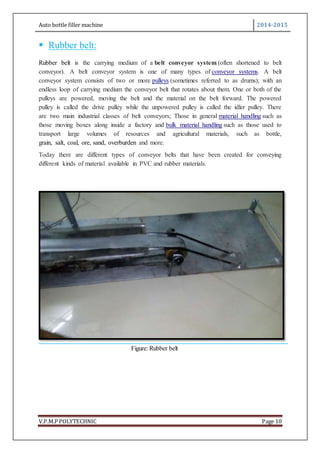
 Rubber belt:
Rubber belt is the carrying medium of a belt conveyor system (often shortened to belt
conveyor). A belt conveyor system is one of many types of conveyor systems. A belt
conveyor system consists of two or more pulleys (sometimes referred to as drums); with an
endless loop of carrying medium the conveyor belt that rotates about them. One or both of the
pulleys are powered, moving the belt and the material on the belt forward. The powered
pulley is called the drive pulley while the unpowered pulley is called the idler pulley. There
are two main industrial classes of belt conveyors; Those in general material handling such as
those moving boxes along inside a factory and bulk material handling such as those used to
transport large volumes of resources and agricultural materials, such as bottle,
grain, salt, coal, ore, sand, overburden and more.
Today there are different types of conveyor belts that have been created for conveying
different kinds of material available in PVC and rubber materials.
Figure: Rubber belt
Auto bottle filler machine 2014-2015
V.P.M.P POLYTECHNIC Page 11
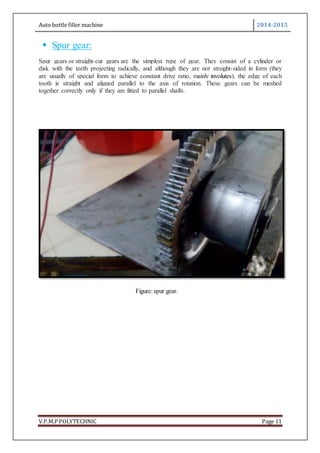
 Spur gear:
Spur gears or straight-cut gears are the simplest type of gear. They consist of a cylinder or
disk with the teeth projecting radically, and although they are not straight-sided in form (they
are usually of special form to achieve constant drive ratio, mainly involutes), the edge of each
tooth is straight and aligned parallel to the axis of rotation. These gears can be meshed
together correctly only if they are fitted to parallel shafts.
Figure: spur gear.
Auto bottle filler machine 2014-2015
V.P.M.P POLYTECHNIC Page 12
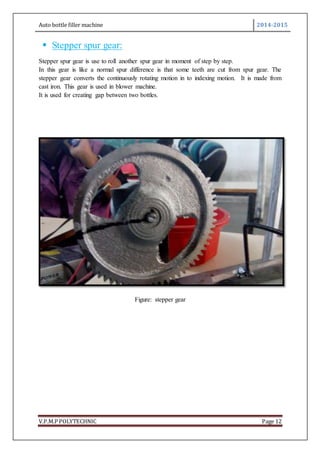
 Stepper spur gear:
Stepper spur gear is use to roll another spur gear in moment of step by step.
In this gear is like a normal spur difference is that some teeth are cut from spur gear. The
stepper gear converts the continuously rotating motion in to indexing motion. It is made from
cast iron. This gear is used in blower machine.
It is used for creating gap between two bottles.
Figure: stepper gear
Auto bottle filler machine 2014-2015
V.P.M.P POLYTECHNIC Page 13
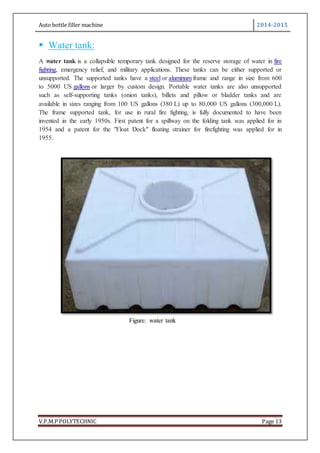
 Water tank:
A water tank is a collapsible temporary tank designed for the reserve storage of water in fire
fighting, emergency relief, and military applications. These tanks can be either supported or
unsupported. The supported tanks have a steel or aluminum frame and range in size from 600
to 5000 US gallons or larger by custom design. Portable water tanks are also unsupported
such as self-supporting tanks (onion tanks), billets and pillow or bladder tanks and are
available in sizes ranging from 100 US gallons (380 L) up to 80,000 US gallons (300,000 L).
The frame supported tank, for use in rural fire fighting, is fully documented to have been
invented in the early 1950s. First patent for a spillway on the folding tank was applied for in
1954 and a patent for the "Float Dock" floating strainer for firefighting was applied for in
1955.
Figure: water tank
Auto bottle filler machine 2014-2015
V.P.M.P POLYTECHNIC Page 14
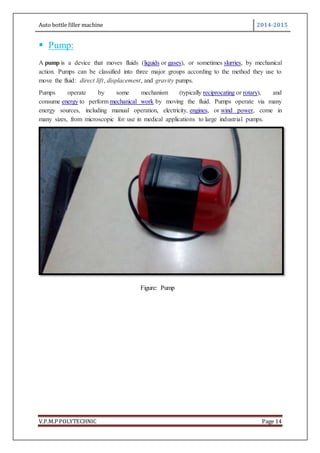
 Pump:
A pump is a device that moves fluids (liquids or gases), or sometimes slurries, by mechanical
action. Pumps can be classified into three major groups according to the method they use to
move the fluid: direct lift, displacement, and gravity pumps.
Pumps operate by some mechanism (typically reciprocating or rotary), and
consume energy to perform mechanical work by moving the fluid. Pumps operate via many
energy sources, including manual operation, electricity, engines, or wind power, come in
many sizes, from microscopic for use in medical applications to large industrial pumps.
Figure: Pump
Auto bottle filler machine 2014-2015
V.P.M.P POLYTECHNIC Page 15
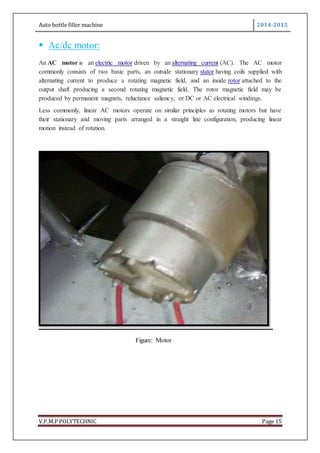
 Ac/dc motor:
An AC motor is an electric motor driven by an alternating current (AC). The AC motor
commonly consists of two basic parts, an outside stationary stator having coils supplied with
alternating current to produce a rotating magnetic field, and an inside rotor attached to the
output shaft producing a second rotating magnetic field. The rotor magnetic field may be
produced by permanent magnets, reluctance saliency, or DC or AC electrical windings.
Less commonly, linear AC motors operate on similar principles as rotating motors but have
their stationary and moving parts arranged in a straight line configuration, producing linear
motion instead of rotation.
Figure: Motor
Auto bottle filler machine 2014-2015
V.P.M.P POLYTECHNIC Page 16
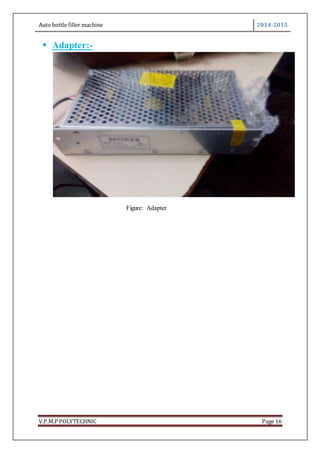
 Adapter:-
Figure: Adapter
Auto bottle filler machine 2014-2015
V.P.M.P POLYTECHNIC Page 17
CHAPTER.NO:-
4
Specification of part
Auto bottle filler machine 2014-2015
V.P.M.P POLYTECHNIC Page 18
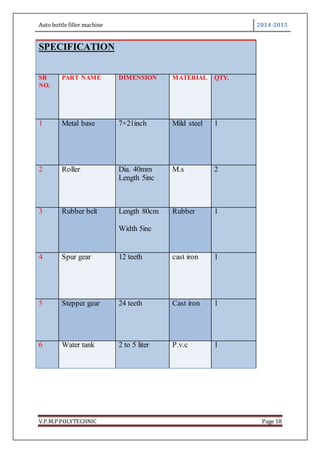
SPECIFICATION
SR
NO.
PART NAME DIMENSION MATERIAL QTY.
1 Metal base 7×21inch Mild steel 1
2 Roller Dia. 40mm
Length 5inc
M.s 2
3 Rubber belt Length 80cm
Width 5inc
Rubber 1
4 Spur gear 12 teeth cast iron 1
5 Stepper gear 24 teeth Cast iron 1
6 Water tank 2 to 5 liter P.v.c 1
Auto bottle filler machine 2014-2015
V.P.M.P POLYTECHNIC Page 19
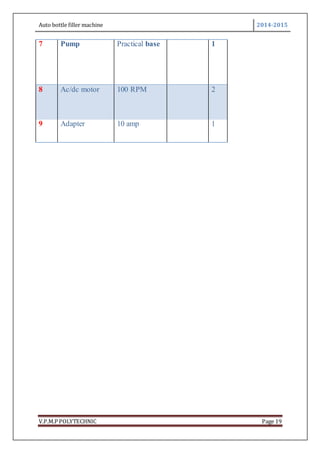
7 Pump Practical base 1
8 Ac/dc motor 100 RPM 2
9 Adapter 10 amp 1
Auto bottle filler machine 2014-2015
V.P.M.P POLYTECHNIC Page 20
CHAPTER.NO:-
5
Working of auto bottle Filler machine
Auto bottle filler machine 2014-2015
V.P.M.P POLYTECHNIC Page 21
In this auto bottle filler machine we can fill water in bottle automatically .there is machine
labour work is less .first the bottle is kept on rubber belt. This rubber belt moves on rollers.
Roller rotates with the help of stepper gear. Stepper gear is made by cutting of some teeth of
simple spur gear for provide time gap between two bottle.
Put bottle on rubber belt. Bottle will move forward in motion of step by step. At last bottle
stops exact at down of the tape. Water comes out from tap with force with the help of
submersible pump. And when cam stops bottle will be filled under 3.5sec. After complete fall
portion of cam tape will be close and water stop .at that moment stepper gear and spur gear is
in contect.then help of gear rubber belt move forward and also bottle will move forward
Then bottle stop at end of roller. With help of roller force bottle will fit in guide way. It is just
like storage system. After bottle store in storage we can pick up from there.
Auto bottle filler machine 2014-2015
V.P.M.P POLYTECHNIC Page 22
CHAPTER.NO:-
6
Detailed description about the auto bottle filler
machine
Auto bottle filler machine 2014-2015
V.P.M.P POLYTECHNIC Page 23
 Classification of auto bottle filling system:-
 Overflow automatic filling machines
This type of filler is perhaps the most widely used machine in small bottle filling
operations because it handles a wide range of thin, free flowing liquids as well as
liquids with medium viscosity. This machine is also commonly referred to as a "fill to
level" filling machine or cosmetic height filler. This means that machine fills to a
target fill height in the container rather than volumetrically. But it can also be shown
that as long as the container specification do not vary greatly, the volumetric accuracy
of this machine is excellent. Because this filler operates in a closed loop basis, it is
also ideal for handling foamy products. The Examples of products that work well in
this filler are bottled water, liquid soap, motor oil, cleansers and even some dairy
products. It can be constructed in both chemical duty versions as well as sanitary
versions capable of filling pasteurized products at high temperatures. This machine is
relatively low cost and easy to use. However it is generally not useable for products
with viscosities greater than 25000 centipoises or products that have any particulates
exceeding approximately 1/16" diameter.
 Servo Pump automatic filling machines
This is a very versatile bottle filling machine capable of filling nearly any type of
product that can be pumped. Each nozzle has a dedicated servo controlled pump that
can deliver thin liquids, medium and thick viscosity liquids, and liquids with large
particulates. Because it is so versatile, it is often purchased by contract packagers who
never know what their next filling challenge is going to be. Examples of the range of
products that can be run on this machine include soaps, pharmaceutical products, oils
and greases, cosmetics, salsa and sauces, etc. etc. The challenges of this machine are
its high capital cost and the ability of the owner to conduct normal maintenance on a
more sophisticated machine. Positive displacement pumps are expensive and so are
servo controlled drive systems. Troubleshooting and maintenance requires reasonably
competent technical level. However, if affordable, this type of filler is an outstanding
choice for nearly any type of filling operation.
 Peristaltic automatic filling machines
This filler is the machine of choice for high value; small volume fills at very high
accuracy. It is primarily suitable for aqueous and other light viscosity products.
Examples of products filled on this machine are sterile and pharmaceutical
preparations, fragrances, essential oils, reagents, inks, dyes, and specialty chemicals.
The unique advantage of this machine is that the only fluid path is surgical tubing.
The fluid path is disposable; easy to cleanup and eliminates cross contamination
problems. Accuracies of 0.5% are achievable for fill volumes less than 1 ml. The
peristaltic pumps on this filling machine make intermittent contact on only the outside
of the surgical (product) tubing so that the product only touches the inside of the
tubing. Like the servo pump filling machine above, this system operates with servo
Auto bottle filler machine 2014-2015
V.P.M.P POLYTECHNIC Page 24
drives. Each servo drive is dedicated to one or two peristaltic pump heads. The filler's
master computer independently tracks the # of rotations of the peristaltic pump head
so that it knows precisely how much product has been delivered. When the target fill
volume is reached, the pump stops and the remaining product fluid do not drip out due
to pipette action of the surgical tubing.
 Time Gravity automatic filling machines
This is the most economical type of filling machine for a limited range of
applications. This filler is best suited for liquids with very thin viscosities that do not
change with ambient temperature or with batch variation. This machine is also suited
for applications where recirculation of the liquid in the fluid path is not desirable. This
is especially true for corrosive chemical filling like acids and bleach. Other examples
of products this machine is well suited to include water, solvents, alcohol, specialty
chemicals, paint and inks. Although this type of filler is used predominantly on
products that do not foam, foam may be limited and controlled by subsurface/bottom-
up-fill capability. The machine works by a simple principle; the amount of liquid
flowing through a fluid path will always be the same for a fixed amount of time. It
functions as follows: the product bulk supply is pumped into a holding tank above a
set of pneumatically operated valves. Each valve is independently timed by the filler's
master computer so that precise amounts of liquid will flow by gravity into the
container. Independent timing of each filling valve/nozzle corrects for minor
variations in flow rates so that each container is filled accurately. The disadvantage
of this type of technology is that the dynamics of the fluid path and nozzle actuation
characteristics continuously change over time. This requires the operator to make
adjustments to the machine's stored parameters more frequently than other
technologies. Notwithstanding this drawback and the limitation of the range of
products that can run on this filler, it offers excellent value for its performance.
 Piston automatic filling machines:-
The piston filler is one of the oldest and most reliable types of fillers used in the
packaging industry. This filling machine is best suited for viscous products that are
paste, semi paste, or chunky with large particulates. Piston fillers are primarily built to
meet food grade standards and commonly fill heavy sauces, salsas, salad dressings,
cosmetic creams, heavy shampoo, gels, and conditioners. Thy are also used for
viscous chemical preparations like paste cleaners and waxes, adhesives and epoxy’s,
heavy lubricant oils and greases. The machine works by a simple principle; the piston
is drawn back in its cylinder so that the product is sucked into the cylinder. A rotary
valve then changes position so that the product is then pushed out of the nozzle
instead of back into the hopper. The volume of the product that is sucked
 Net Weigh automatic filling machines:-
This type of filler is best suited for liquids filled in bulk quantities e.g. 5 gallon pails,
etc. or smaller quantity products that have a very high manufactured value.
Oftentimes there are products that must be sold by weight for commercial reasons and
therefore this filling machine is the only choice. Examples of this type of filler for
bulk products include cleaning chemicals, enzyme solutions, oils and other medium
Auto bottle filler machine 2014-2015
V.P.M.P POLYTECHNIC Page 25
value products. High value products filled by these machines include specialty
adhesives and paints, precious metals dissolved in acids, and other expensive
specialty chemicals.
 Hazardous Location automatic filling machines:-
Any of the machines outlined above can be built for Hazardous Location operation.
Hazardous location means that there is risk of explosion or auto-ignition of the
products being filled. Examples of products like this are alcohol, solvents, petroleum
products, paints, etc. Many of the manual and semi-automatic versions of the types of
automatic filling machines discussed above are inherently safe since they require no
electrical operating systems. However, more sophisticated and higher output
automatic machines using electrical systems must be built with intrinsically safe
enclosures that are UL listed and conform to the National Electric Code as well as
requirements of major insurance carriers. There are automatic filling machines
offered in the market with completely pneumatically controlled operating systems.
However, the major disadvantage of these systems includes susceptibility to
inconsistencies of plant air volume and pressure. In other words, there is risk that
pneumatic logic controlled machines will not function repeatable. For this reason,
hazardous location automatic filling machines using electrically safe systems are
preferable because they can offer all the consistency, convenience, and efficiency of
conventional fillers including full visual displays and user friendly controls.
 Corrosive Environment automatic filling machines:-
As suggested above, time gravity fillers are often used for filling of corrosive
products. But sometimes the products being filled are so aggressive that special
construction methods are required. Harsh factory environments or where the product
being filled can also be particularly aggressive on machinery. This includes not only
chemical plants plants producing strong acids or bleach but also food plants using
brine or sugar solutions in their products. In both cases, even the factory air alone
contributes to the accelerated degradation of the machinery.
Auto bottle filler machine 2014-2015
V.P.M.P POLYTECHNIC Page 26
CHAPTER.NO:-
7
Assembly of the machine
Auto bottle filler machine 2014-2015
V.P.M.P POLYTECHNIC Page 27
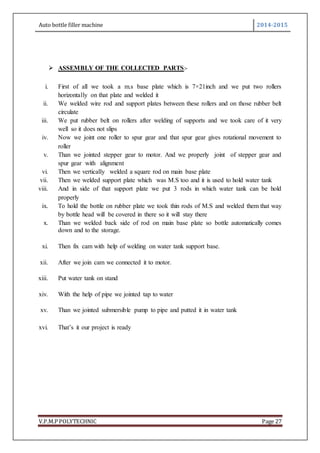
 ASSEMBLY OF THE COLLECTED PARTS:-
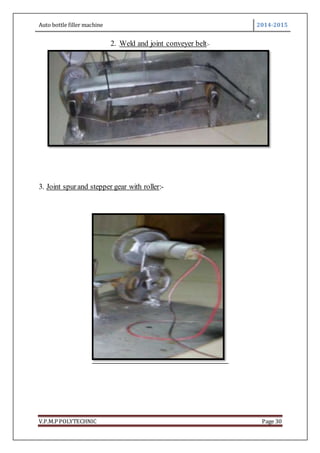
i. First of all we took a m.s base plate which is 7×21inch and we put two rollers
horizontally on that plate and welded it
ii. We welded wire rod and support plates between these rollers and on those rubber belt
circulate
iii. We put rubber belt on rollers after welding of supports and we took care of it very
well so it does not slips
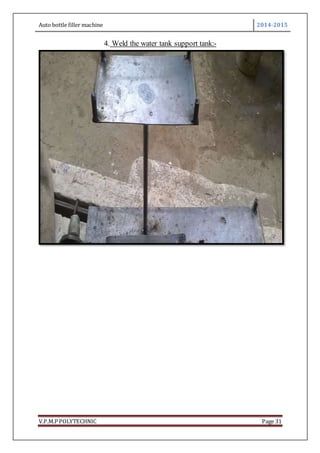
iv. Now we joint one roller to spur gear and that spur gear gives rotational movement to
roller
v. Than we jointed stepper gear to motor. And we properly joint of stepper gear and
spur gear with alignment
vi. Then we vertically welded a square rod on main base plate
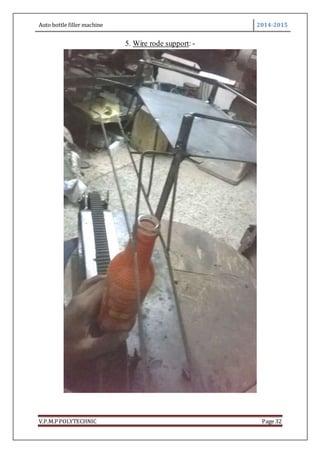
vii. Then we welded support plate which was M.S too and it is used to hold water tank
viii. And in side of that support plate we put 3 rods in which water tank can be hold
properly
ix. To hold the bottle on rubber plate we took thin rods of M.S and welded them that way
by bottle head will be covered in there so it will stay there
x. Than we welded back side of rod on main base plate so bottle automatically comes
down and to the storage.
xi. Then fix cam with help of welding on water tank support base.
xii. After we join cam we connected it to motor.
xiii. Put water tank on stand
xiv. With the help of pipe we jointed tap to water
xv. Than we jointed submersible pump to pipe and putted it in water tank
xvi. That’s it our project is ready
Auto bottle filler machine 2014-2015
V.P.M.P POLYTECHNIC Page 28
CHAPTER.NO:-
8
Pictures of the assembled machine
Auto bottle filler machine 2014-2015
V.P.M.P POLYTECHNIC Page 29
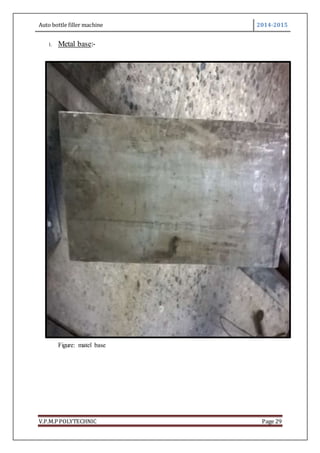
1. Metal base:-
Figure: matel base
Auto bottle filler machine 2014-2015
V.P.M.P POLYTECHNIC Page 30
2. .Weld and joint conveyer belt:-
3. Joint spurand stepper gear with roller:-
Auto bottle filler machine 2014-2015
V.P.M.P POLYTECHNIC Page 31
4. Weld the water tank support tank:-
Auto bottle filler machine 2014-2015
V.P.M.P POLYTECHNIC Page 32
5. Wire rode support: -
Auto bottle filler machine 2014-2015
V.P.M.P POLYTECHNIC Page 33
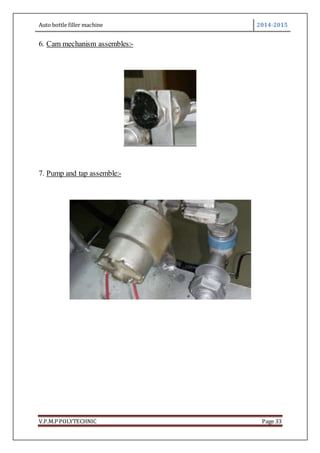
6. Cam mechanism assembles:-
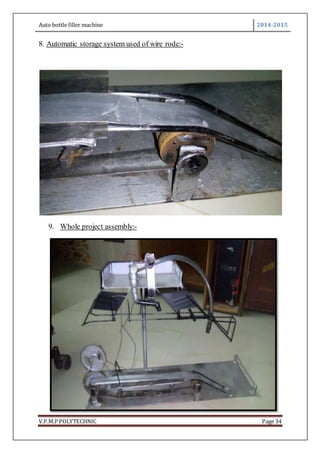
7. Pump and tap assemble:-
Auto bottle filler machine 2014-2015
V.P.M.P POLYTECHNIC Page 34
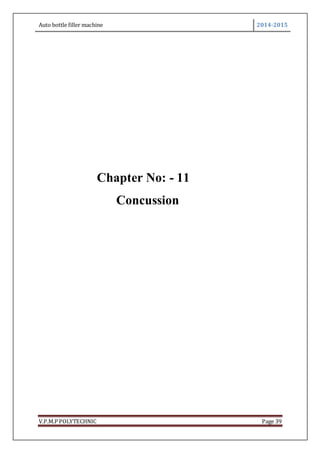
8. Automatic storage system used of wire rode:-
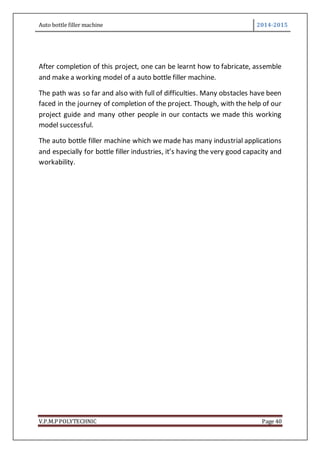
9. Whole project assembly:-
Auto bottle filler machine 2014-2015
V.P.M.P POLYTECHNIC Page 35
CHAPTER.NO:-
9
Experimental sheet of the project
Auto bottle filler machine 2014-2015
V.P.M.P POLYTECHNIC Page 36
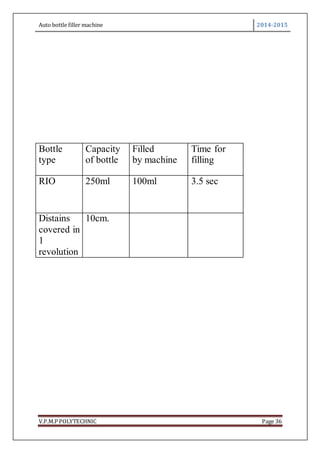
Bottle
type
Capacity
of bottle
Filled
by machine
Time for
filling
RIO 250ml 100ml 3.5 sec
Distains
covered in
1
revolution
10cm.
Auto bottle filler machine 2014-2015
V.P.M.P POLYTECHNIC Page 37
CHAPTER.NO:-
10
Future scope
Auto bottle filler machine 2014-2015
V.P.M.P POLYTECHNIC Page 38
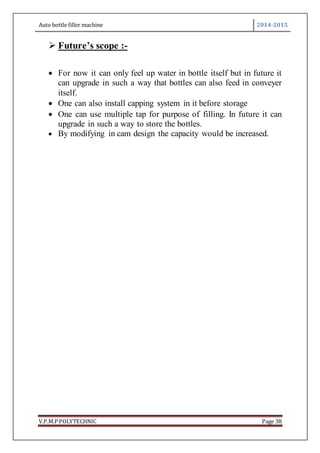
 Future’s scope :-
 For now it can only feel up water in bottle itself but in future it
can upgrade in such a way that bottles can also feed in conveyer
itself.
 One can also install capping system in it before storage
 One can use multiple tap for purpose of filling. In future it can
upgrade in such a way to store the bottles.
 By modifying in cam design the capacity would be increased.
Auto bottle filler machine 2014-2015
V.P.M.P POLYTECHNIC Page 39
Chapter No: - 11
Concussion
Auto bottle filler machine 2014-2015
V.P.M.P POLYTECHNIC Page 40
After completion of this project, one can be learnt how to fabricate, assemble
and make a working model of a auto bottle filler machine.
The path was so far and also with full of difficulties. Many obstacles have been
faced in the journey of completion of the project. Though, with the help of our
project guide and many other people in our contacts we made this working
model successful.
The auto bottle filler machine which we made has many industrial applications
and especially for bottle filler industries, it’s having the very good capacity and
workability.

Auto bottle filler machine

  • 1.
    Auto bottle fillermachine 2014-2015 V.P.M.P POLYTECHNIC Page 1 CHAPTER.NO:- 1 INTRODUCTION
  • 2.
    Auto bottle fillermachine 2014-2015 V.P.M.P POLYTECHNIC Page 2  1.1Introduction A batch operation where a set amount of inputs to be process is received as a group and an operation produce the finish product. This project is the Combination of stepper gear which is used for gap between two bottles, cam and follower, conveyor belt, water tank, pressure pump. This project is divided into 4 Sections,  The loading section,  stepper section  filling section  The conveyor section (transfer section), this project is to design and develop the – “Automatic bottle filling Machine”. First of us we discus about the automation, what is automation? Automation is the use of various control system for operating equipment such as machinery, process in factories and other application with minimum or reduced human intervention. The purpose of this project is to apply filling system where this system can Automatically filling water into their bottle randomly by using various mechanisms the filling system will be using the filling concept Time Gravity Filler with the help of pressure pump Selection Guide. The mechanical part of the project consists of, Mechanical drawing, design, measuring, welding and fabricating process, Figure: auto bottle filler machine
  • 3.
    Auto bottle fillermachine 2014-2015 V.P.M.P POLYTECHNIC Page 3  1.2Objectives of the Project The project is aimed to meet the following objectives:  To design and implement automated bottle filling machine  To learn the concept of stepper gear and cam follower  To implement gear and cam design, measurement and then manufacturing  To apply selector conveyor and water tank  To check and analysis of all components in this project.  Working of the model.  1.3 Problem Statements This machine is designed to filling water in the bottle automatically in a Single machine. This project will reduce the usage of man power because all of the work will be done by machine. Human held filling process will cause inexact volume of liquid into the bottle. So using automated system will set the volume of the liquid exactly the same for each bottle. If all the process is done manually, it will cost lot of time to complete the task. This machine will also reduce the human error while doing this process manually.
  • 4.
    Auto bottle fillermachine 2014-2015 V.P.M.P POLYTECHNIC Page 4 CHAPTER. NO:- 2 PROBLEM DEFINITION
  • 5.
    Auto bottle fillermachine 2014-2015 V.P.M.P POLYTECHNIC Page 5 2.1 Definition “To develop the auto bottle filler machine “ Competition is increase in industries day by day due to globalization and new company introduced in market. To stay in market every industry does something new to attract the customer and their reputation in market. To satisfy the need of customer industries should make machine such a way that the machine will function it function satisfactorily and affordable to customer. This project is used in small scale industries and other area which have law budget. For that purpose the auto bottle filler machine are suitable for customer. Because it filling the water automatically so in this machine minimum worker is need.
  • 6.
    Auto bottle fillermachine 2014-2015 V.P.M.P POLYTECHNIC Page 6 CHAPTER.NO:- 3 Model detail
  • 7.
    Auto bottle fillermachine 2014-2015 V.P.M.P POLYTECHNIC Page 7  3.1 Part used in auto bottle filler machine: 1. Metal base 2. Roller 3. Rubber belt 4. Spur gear 5. Stepper spur gear 6. Water tank 7. Pressure pump 8. Ac/dc motor
  • 8.
    Auto bottle fillermachine 2014-2015 V.P.M.P POLYTECHNIC Page 8  Metal base: Metal base is a solid, flat plate used as the main horizontal reference plane for support the machine part, The metal base is often used as the absorb the vibration of all the part therefore one primary surface is finished extremely flat with accuracy up to 0.00001 in or 250 nm for a grade AA or AAA plate. Surface plates are a very common tool in the manufacturing industry and are often permanently attached to robotic type inspection devices such as a coordinate- measuring machine. Plates are typically square or rectangular. One current British Standard includes specifications for plates from 160 mm x 100 mm to 2500 mm x 1600 mm. Figure: metal base
  • 9.
    Auto bottle fillermachine 2014-2015 V.P.M.P POLYTECHNIC Page 9  Roller: Roller conveyors are, as their title suggests, powered via a shaft beneath the rollers. These conveyors are suitable for light applications up to 20 kg such as canes, bottle, cardboard boxes and tote boxes. A single shaft runs below the rollers running the length of the conveyor. On the shaft there are a series of spools; one spool for each roller. A rubber O-ring runs from a spool on the powered shaft to each roller. When the shaft is powered the rubber O-ring acts as chain between the spool and the roller making the roller rotates. The rotating of the roller pushes the product along the conveyor. The shaft is usually driven by an electrical motor, which is generally run on electricity. Advantages of this conveyor are quiet operation, as well as easy installation and maintenance. They can be manufactured for almost all applications, at relatively low expense. A disadvantage of the roller line shaft conveyor is that it can only be used to convey certain products. Items conveyed have to beef adequate size and shape so that they cannot fall between the moving rollers. If the product being conveyed is of varying size, the conveyor belt system is generally used as an alternative option. Figure: Roller
  • 10.
    Auto bottle fillermachine 2014-2015 V.P.M.P POLYTECHNIC Page 10  Rubber belt: Rubber belt is the carrying medium of a belt conveyor system (often shortened to belt conveyor). A belt conveyor system is one of many types of conveyor systems. A belt conveyor system consists of two or more pulleys (sometimes referred to as drums); with an endless loop of carrying medium the conveyor belt that rotates about them. One or both of the pulleys are powered, moving the belt and the material on the belt forward. The powered pulley is called the drive pulley while the unpowered pulley is called the idler pulley. There are two main industrial classes of belt conveyors; Those in general material handling such as those moving boxes along inside a factory and bulk material handling such as those used to transport large volumes of resources and agricultural materials, such as bottle, grain, salt, coal, ore, sand, overburden and more. Today there are different types of conveyor belts that have been created for conveying different kinds of material available in PVC and rubber materials. Figure: Rubber belt
  • 11.
    Auto bottle fillermachine 2014-2015 V.P.M.P POLYTECHNIC Page 11  Spur gear: Spur gears or straight-cut gears are the simplest type of gear. They consist of a cylinder or disk with the teeth projecting radically, and although they are not straight-sided in form (they are usually of special form to achieve constant drive ratio, mainly involutes), the edge of each tooth is straight and aligned parallel to the axis of rotation. These gears can be meshed together correctly only if they are fitted to parallel shafts. Figure: spur gear.
  • 12.
    Auto bottle fillermachine 2014-2015 V.P.M.P POLYTECHNIC Page 12  Stepper spur gear: Stepper spur gear is use to roll another spur gear in moment of step by step. In this gear is like a normal spur difference is that some teeth are cut from spur gear. The stepper gear converts the continuously rotating motion in to indexing motion. It is made from cast iron. This gear is used in blower machine. It is used for creating gap between two bottles. Figure: stepper gear
  • 13.
    Auto bottle fillermachine 2014-2015 V.P.M.P POLYTECHNIC Page 13  Water tank: A water tank is a collapsible temporary tank designed for the reserve storage of water in fire fighting, emergency relief, and military applications. These tanks can be either supported or unsupported. The supported tanks have a steel or aluminum frame and range in size from 600 to 5000 US gallons or larger by custom design. Portable water tanks are also unsupported such as self-supporting tanks (onion tanks), billets and pillow or bladder tanks and are available in sizes ranging from 100 US gallons (380 L) up to 80,000 US gallons (300,000 L). The frame supported tank, for use in rural fire fighting, is fully documented to have been invented in the early 1950s. First patent for a spillway on the folding tank was applied for in 1954 and a patent for the "Float Dock" floating strainer for firefighting was applied for in 1955. Figure: water tank
  • 14.
    Auto bottle fillermachine 2014-2015 V.P.M.P POLYTECHNIC Page 14  Pump: A pump is a device that moves fluids (liquids or gases), or sometimes slurries, by mechanical action. Pumps can be classified into three major groups according to the method they use to move the fluid: direct lift, displacement, and gravity pumps. Pumps operate by some mechanism (typically reciprocating or rotary), and consume energy to perform mechanical work by moving the fluid. Pumps operate via many energy sources, including manual operation, electricity, engines, or wind power, come in many sizes, from microscopic for use in medical applications to large industrial pumps. Figure: Pump
  • 15.
    Auto bottle fillermachine 2014-2015 V.P.M.P POLYTECHNIC Page 15  Ac/dc motor: An AC motor is an electric motor driven by an alternating current (AC). The AC motor commonly consists of two basic parts, an outside stationary stator having coils supplied with alternating current to produce a rotating magnetic field, and an inside rotor attached to the output shaft producing a second rotating magnetic field. The rotor magnetic field may be produced by permanent magnets, reluctance saliency, or DC or AC electrical windings. Less commonly, linear AC motors operate on similar principles as rotating motors but have their stationary and moving parts arranged in a straight line configuration, producing linear motion instead of rotation. Figure: Motor
  • 16.
    Auto bottle fillermachine 2014-2015 V.P.M.P POLYTECHNIC Page 16  Adapter:- Figure: Adapter
  • 17.
    Auto bottle fillermachine 2014-2015 V.P.M.P POLYTECHNIC Page 17 CHAPTER.NO:- 4 Specification of part
  • 18.
    Auto bottle fillermachine 2014-2015 V.P.M.P POLYTECHNIC Page 18 SPECIFICATION SR NO. PART NAME DIMENSION MATERIAL QTY. 1 Metal base 7×21inch Mild steel 1 2 Roller Dia. 40mm Length 5inc M.s 2 3 Rubber belt Length 80cm Width 5inc Rubber 1 4 Spur gear 12 teeth cast iron 1 5 Stepper gear 24 teeth Cast iron 1 6 Water tank 2 to 5 liter P.v.c 1
  • 19.
    Auto bottle fillermachine 2014-2015 V.P.M.P POLYTECHNIC Page 19 7 Pump Practical base 1 8 Ac/dc motor 100 RPM 2 9 Adapter 10 amp 1
  • 20.
    Auto bottle fillermachine 2014-2015 V.P.M.P POLYTECHNIC Page 20 CHAPTER.NO:- 5 Working of auto bottle Filler machine
  • 21.
    Auto bottle fillermachine 2014-2015 V.P.M.P POLYTECHNIC Page 21 In this auto bottle filler machine we can fill water in bottle automatically .there is machine labour work is less .first the bottle is kept on rubber belt. This rubber belt moves on rollers. Roller rotates with the help of stepper gear. Stepper gear is made by cutting of some teeth of simple spur gear for provide time gap between two bottle. Put bottle on rubber belt. Bottle will move forward in motion of step by step. At last bottle stops exact at down of the tape. Water comes out from tap with force with the help of submersible pump. And when cam stops bottle will be filled under 3.5sec. After complete fall portion of cam tape will be close and water stop .at that moment stepper gear and spur gear is in contect.then help of gear rubber belt move forward and also bottle will move forward Then bottle stop at end of roller. With help of roller force bottle will fit in guide way. It is just like storage system. After bottle store in storage we can pick up from there.
  • 22.
    Auto bottle fillermachine 2014-2015 V.P.M.P POLYTECHNIC Page 22 CHAPTER.NO:- 6 Detailed description about the auto bottle filler machine
  • 23.
    Auto bottle fillermachine 2014-2015 V.P.M.P POLYTECHNIC Page 23  Classification of auto bottle filling system:-  Overflow automatic filling machines This type of filler is perhaps the most widely used machine in small bottle filling operations because it handles a wide range of thin, free flowing liquids as well as liquids with medium viscosity. This machine is also commonly referred to as a "fill to level" filling machine or cosmetic height filler. This means that machine fills to a target fill height in the container rather than volumetrically. But it can also be shown that as long as the container specification do not vary greatly, the volumetric accuracy of this machine is excellent. Because this filler operates in a closed loop basis, it is also ideal for handling foamy products. The Examples of products that work well in this filler are bottled water, liquid soap, motor oil, cleansers and even some dairy products. It can be constructed in both chemical duty versions as well as sanitary versions capable of filling pasteurized products at high temperatures. This machine is relatively low cost and easy to use. However it is generally not useable for products with viscosities greater than 25000 centipoises or products that have any particulates exceeding approximately 1/16" diameter.  Servo Pump automatic filling machines This is a very versatile bottle filling machine capable of filling nearly any type of product that can be pumped. Each nozzle has a dedicated servo controlled pump that can deliver thin liquids, medium and thick viscosity liquids, and liquids with large particulates. Because it is so versatile, it is often purchased by contract packagers who never know what their next filling challenge is going to be. Examples of the range of products that can be run on this machine include soaps, pharmaceutical products, oils and greases, cosmetics, salsa and sauces, etc. etc. The challenges of this machine are its high capital cost and the ability of the owner to conduct normal maintenance on a more sophisticated machine. Positive displacement pumps are expensive and so are servo controlled drive systems. Troubleshooting and maintenance requires reasonably competent technical level. However, if affordable, this type of filler is an outstanding choice for nearly any type of filling operation.  Peristaltic automatic filling machines This filler is the machine of choice for high value; small volume fills at very high accuracy. It is primarily suitable for aqueous and other light viscosity products. Examples of products filled on this machine are sterile and pharmaceutical preparations, fragrances, essential oils, reagents, inks, dyes, and specialty chemicals. The unique advantage of this machine is that the only fluid path is surgical tubing. The fluid path is disposable; easy to cleanup and eliminates cross contamination problems. Accuracies of 0.5% are achievable for fill volumes less than 1 ml. The peristaltic pumps on this filling machine make intermittent contact on only the outside of the surgical (product) tubing so that the product only touches the inside of the tubing. Like the servo pump filling machine above, this system operates with servo
  • 24.
    Auto bottle fillermachine 2014-2015 V.P.M.P POLYTECHNIC Page 24 drives. Each servo drive is dedicated to one or two peristaltic pump heads. The filler's master computer independently tracks the # of rotations of the peristaltic pump head so that it knows precisely how much product has been delivered. When the target fill volume is reached, the pump stops and the remaining product fluid do not drip out due to pipette action of the surgical tubing.  Time Gravity automatic filling machines This is the most economical type of filling machine for a limited range of applications. This filler is best suited for liquids with very thin viscosities that do not change with ambient temperature or with batch variation. This machine is also suited for applications where recirculation of the liquid in the fluid path is not desirable. This is especially true for corrosive chemical filling like acids and bleach. Other examples of products this machine is well suited to include water, solvents, alcohol, specialty chemicals, paint and inks. Although this type of filler is used predominantly on products that do not foam, foam may be limited and controlled by subsurface/bottom- up-fill capability. The machine works by a simple principle; the amount of liquid flowing through a fluid path will always be the same for a fixed amount of time. It functions as follows: the product bulk supply is pumped into a holding tank above a set of pneumatically operated valves. Each valve is independently timed by the filler's master computer so that precise amounts of liquid will flow by gravity into the container. Independent timing of each filling valve/nozzle corrects for minor variations in flow rates so that each container is filled accurately. The disadvantage of this type of technology is that the dynamics of the fluid path and nozzle actuation characteristics continuously change over time. This requires the operator to make adjustments to the machine's stored parameters more frequently than other technologies. Notwithstanding this drawback and the limitation of the range of products that can run on this filler, it offers excellent value for its performance.  Piston automatic filling machines:- The piston filler is one of the oldest and most reliable types of fillers used in the packaging industry. This filling machine is best suited for viscous products that are paste, semi paste, or chunky with large particulates. Piston fillers are primarily built to meet food grade standards and commonly fill heavy sauces, salsas, salad dressings, cosmetic creams, heavy shampoo, gels, and conditioners. Thy are also used for viscous chemical preparations like paste cleaners and waxes, adhesives and epoxy’s, heavy lubricant oils and greases. The machine works by a simple principle; the piston is drawn back in its cylinder so that the product is sucked into the cylinder. A rotary valve then changes position so that the product is then pushed out of the nozzle instead of back into the hopper. The volume of the product that is sucked  Net Weigh automatic filling machines:- This type of filler is best suited for liquids filled in bulk quantities e.g. 5 gallon pails, etc. or smaller quantity products that have a very high manufactured value. Oftentimes there are products that must be sold by weight for commercial reasons and therefore this filling machine is the only choice. Examples of this type of filler for bulk products include cleaning chemicals, enzyme solutions, oils and other medium
  • 25.
    Auto bottle fillermachine 2014-2015 V.P.M.P POLYTECHNIC Page 25 value products. High value products filled by these machines include specialty adhesives and paints, precious metals dissolved in acids, and other expensive specialty chemicals.  Hazardous Location automatic filling machines:- Any of the machines outlined above can be built for Hazardous Location operation. Hazardous location means that there is risk of explosion or auto-ignition of the products being filled. Examples of products like this are alcohol, solvents, petroleum products, paints, etc. Many of the manual and semi-automatic versions of the types of automatic filling machines discussed above are inherently safe since they require no electrical operating systems. However, more sophisticated and higher output automatic machines using electrical systems must be built with intrinsically safe enclosures that are UL listed and conform to the National Electric Code as well as requirements of major insurance carriers. There are automatic filling machines offered in the market with completely pneumatically controlled operating systems. However, the major disadvantage of these systems includes susceptibility to inconsistencies of plant air volume and pressure. In other words, there is risk that pneumatic logic controlled machines will not function repeatable. For this reason, hazardous location automatic filling machines using electrically safe systems are preferable because they can offer all the consistency, convenience, and efficiency of conventional fillers including full visual displays and user friendly controls.  Corrosive Environment automatic filling machines:- As suggested above, time gravity fillers are often used for filling of corrosive products. But sometimes the products being filled are so aggressive that special construction methods are required. Harsh factory environments or where the product being filled can also be particularly aggressive on machinery. This includes not only chemical plants plants producing strong acids or bleach but also food plants using brine or sugar solutions in their products. In both cases, even the factory air alone contributes to the accelerated degradation of the machinery.
  • 26.
    Auto bottle fillermachine 2014-2015 V.P.M.P POLYTECHNIC Page 26 CHAPTER.NO:- 7 Assembly of the machine
  • 27.
    Auto bottle fillermachine 2014-2015 V.P.M.P POLYTECHNIC Page 27  ASSEMBLY OF THE COLLECTED PARTS:- i. First of all we took a m.s base plate which is 7×21inch and we put two rollers horizontally on that plate and welded it ii. We welded wire rod and support plates between these rollers and on those rubber belt circulate iii. We put rubber belt on rollers after welding of supports and we took care of it very well so it does not slips iv. Now we joint one roller to spur gear and that spur gear gives rotational movement to roller v. Than we jointed stepper gear to motor. And we properly joint of stepper gear and spur gear with alignment vi. Then we vertically welded a square rod on main base plate vii. Then we welded support plate which was M.S too and it is used to hold water tank viii. And in side of that support plate we put 3 rods in which water tank can be hold properly ix. To hold the bottle on rubber plate we took thin rods of M.S and welded them that way by bottle head will be covered in there so it will stay there x. Than we welded back side of rod on main base plate so bottle automatically comes down and to the storage. xi. Then fix cam with help of welding on water tank support base. xii. After we join cam we connected it to motor. xiii. Put water tank on stand xiv. With the help of pipe we jointed tap to water xv. Than we jointed submersible pump to pipe and putted it in water tank xvi. That’s it our project is ready
  • 28.
    Auto bottle fillermachine 2014-2015 V.P.M.P POLYTECHNIC Page 28 CHAPTER.NO:- 8 Pictures of the assembled machine
  • 29.
    Auto bottle fillermachine 2014-2015 V.P.M.P POLYTECHNIC Page 29 1. Metal base:- Figure: matel base
  • 30.
    Auto bottle fillermachine 2014-2015 V.P.M.P POLYTECHNIC Page 30 2. .Weld and joint conveyer belt:- 3. Joint spurand stepper gear with roller:-
  • 31.
    Auto bottle fillermachine 2014-2015 V.P.M.P POLYTECHNIC Page 31 4. Weld the water tank support tank:-
  • 32.
    Auto bottle fillermachine 2014-2015 V.P.M.P POLYTECHNIC Page 32 5. Wire rode support: -
  • 33.
    Auto bottle fillermachine 2014-2015 V.P.M.P POLYTECHNIC Page 33 6. Cam mechanism assembles:- 7. Pump and tap assemble:-
  • 34.
    Auto bottle fillermachine 2014-2015 V.P.M.P POLYTECHNIC Page 34 8. Automatic storage system used of wire rode:- 9. Whole project assembly:-
  • 35.
    Auto bottle fillermachine 2014-2015 V.P.M.P POLYTECHNIC Page 35 CHAPTER.NO:- 9 Experimental sheet of the project
  • 36.
    Auto bottle fillermachine 2014-2015 V.P.M.P POLYTECHNIC Page 36 Bottle type Capacity of bottle Filled by machine Time for filling RIO 250ml 100ml 3.5 sec Distains covered in 1 revolution 10cm.
  • 37.
    Auto bottle fillermachine 2014-2015 V.P.M.P POLYTECHNIC Page 37 CHAPTER.NO:- 10 Future scope
  • 38.
    Auto bottle fillermachine 2014-2015 V.P.M.P POLYTECHNIC Page 38  Future’s scope :-  For now it can only feel up water in bottle itself but in future it can upgrade in such a way that bottles can also feed in conveyer itself.  One can also install capping system in it before storage  One can use multiple tap for purpose of filling. In future it can upgrade in such a way to store the bottles.  By modifying in cam design the capacity would be increased.
  • 39.
    Auto bottle fillermachine 2014-2015 V.P.M.P POLYTECHNIC Page 39 Chapter No: - 11 Concussion
  • 40.
    Auto bottle fillermachine 2014-2015 V.P.M.P POLYTECHNIC Page 40 After completion of this project, one can be learnt how to fabricate, assemble and make a working model of a auto bottle filler machine. The path was so far and also with full of difficulties. Many obstacles have been faced in the journey of completion of the project. Though, with the help of our project guide and many other people in our contacts we made this working model successful. The auto bottle filler machine which we made has many industrial applications and especially for bottle filler industries, it’s having the very good capacity and workability.