A REPORT ON
“CONTROL SYSTEMS”
PREPARED BY
Chirag Rathod
(126540319541)
GUIDED BY
MR. H.R. RATHOD
LECTURER MECHANICAL ENGINEERING DEPARTMENT
A REPORT SUBMITTED TO
VPMP POLYTECHNIC FOR PARTIALLY COMPLETION OF
MANUFACTURING SYSTEM SUBJECT
AT 6TH SEM MECHANICAL ENGINEERING
VPMP POLYTECHNIC
GANDHINAGAR
2014-2015
A REPORT ON
“CONTROL SYSTEMS”
PREPARED BY
Parag Darji
(126540319561)
GUIDED BY
MR. H.R. RATHOD
LECTURER MECHANICAL ENGINEERING DEPARTMENT
A REPORT SUBMITTED TO
VPMP POLYTECHNIC FOR PARTIALLY COMPLETION OF
MANUFACTURING SYSTEM SUBJECT
AT 6TH SEM MECHANICAL ENGINEERING
VPMP POLYTECHNIC
GANDHINAGAR
2014-2015
A REPORT ON
“CONTROL SYSTEMS”
PREPARED BY
Achal Patel
(126540319548)
GUIDED BY
MR. H.R. RATHOD
LECTURER MECHANICAL ENGINEERING DEPARTMENT
A REPORT SUBMITTED TO
VPMP POLYTECHNIC FOR PARTIALLY COMPLETION OF
MANUFACTURING SYSTEM SUBJECT
AT 6TH SEM MECHANICAL ENGINEERING
VPMP POLYTECHNIC
GANDHINAGAR
2014-2015
Controlled Systems
In control engineering, a controlled system is primarily characterized by its dynamic behavior
which also determines the scope and quality required to solve a control task. Frequently, the so-
called step response of the controlled system is used to reflect this dynamic behavior.
The step response reveals how the controlled variable reacts to a change in the manipulated
variable. This is determined by measuring the controlled variable after a step change in the
manipulated variable . Depending on there sulting dynamic behavior, the controlled systemscan
be classified as follows:
P controlled systems (proportional control action)
I controlled systems (integral control action)
Controlled systems with dead time
Controlled systems with energy storing components
P controlled system
In controlled systems with proportional action, the controlled variable x changes proportional
to the manipulated variabley. The controlled variable follows the manipulated variable without
any lag.
Since any energy transfer requires a finite amount of time, P control action without any lag does
no toccurin practice. When the time lagbetween manipulated and controlled variable is sosmall,
however, that it does not have any effecton thesystem,this behavioris calledproportional control
action of a system or a P controlled system.
4Example: Flow control
If the valve travel changes in the pressure control system illustrated in Fig. 1, an ewflow rate qis
reached(almost)in stant an eously. Depending ont hevalve flow coefficient, the controlled
variable changes proportional to the manupulated variable; the systemhas proportional control
action.
I controlled system
I controlled system
Integral controlled systems are systems without self-regulation if the manipu lated variable does
not equal zero, the integral controlled system responds with a continuous change–continuou
sincrease or decrease–of the control- led variable. A new equilibrium is not reached.
4Example: Liquid level in a tank (Fig. 3)
In a tank with an outlet and equally high supply and discharge flow rates, a
constantliquidlevelisreached.Ifthesupplyordischargeflowratechanges, the liquid level will rise or
fall. The level changes the quicker, the larger the difference between supply and discharge flow.
This example shows that the use of integralcontrol action is mostly limited in practice. The
controlled variable increases or decreases only until it reaches a system-related limit value: the
tank will overflow or be discharged, maxi- mum or minimum system pressure is reached, etc.
Proportional controller (P controller)
The manipulated variabley of a P controller is proportional to the measured error e. From this
can be deducted that a P controller
4reacts to any deviation without lag and
4only generates a manipulated variable in case of system deviation.
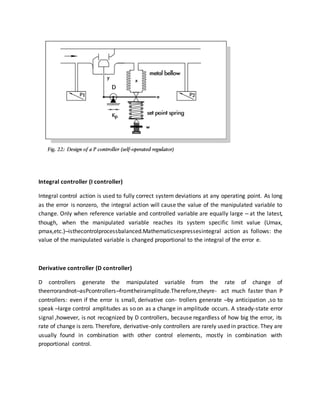
The proportional pressure control erillustrated in Fig.22compare the force FS of the set point
spring with the force FM created in the elasticmetalbellows by the pressure p2. When the forces
are off balance, the lever pivots about point D. This changes the position of the valve plug – and,
hence, the pressure p2 to be controlled – until a new equilibrium of forces is restored.
Integral controller (I controller)
Integral control action is used to fully correct system deviations at any operating point. As long
as the error is nonzero, the integral action will cause the value of the manipulated variable to
change. Only when reference variable and controlled variable are equally large – at the latest,
though, when the manipulated variable reaches its system specific limit value (Umax,
pmax,etc.)–isthecontrolprocessbalanced.Mathematicsexpressesintegral action as follows: the
value of the manipulated variable is changed proportional to the integral of the error e.
Derivative controller (D controller)
D controllers generate the manipulated variable from the rate of change of
theerrorandnot–asPcontrollers–fromtheiramplitude.Therefore,theyre- act much faster than P
controllers: even if the error is small, derivative con- trollers generate –by anticipation ,so to
speak –large control amplitudes as so on as a change in amplitude occurs. A steady-state error
signal ,however, is not recognized by D controllers, because regardless of how big the error, its
rate of change is zero. Therefore, derivative-only controllers are rarely used in practice. They are
usually found in combination with other control elements, mostly in combination with
proportional control.
combined P and D controllers
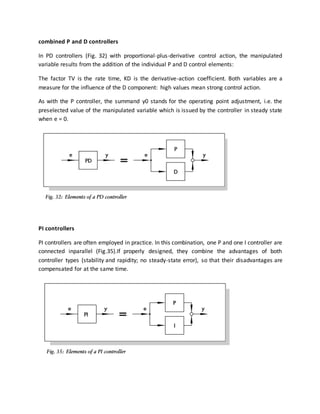
In PD controllers (Fig. 32) with proportional-plus-derivative control action, the manipulated
variable results from the addition of the individual P and D control elements:
The factor TV is the rate time, KD is the derivative-action coefficient. Both variables are a
measure for the influence of the D component: high values mean strong control action.
As with the P controller, the summand y0 stands for the operating point adjustment, i.e. the
preselected value of the manipulated variable which is issued by the controller in steady state
when e = 0.
PI controllers
PI controllers are often employed in practice. In this combination, one P and one I controller are
connected inparallel (Fig.35).If properly designed, they combine the advantages of both
controller types (stability and rapidity; no steady-state error), so that their disadvantages are
compensated for at the same time.
PID controller
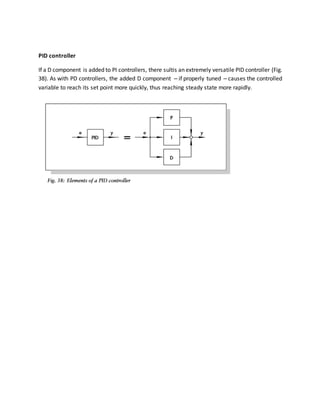
If a D component is added to PI controllers, there sultis an extremely versatile PID controller (Fig.
38). As with PD controllers, the added D component – if properly tuned – causes the controlled
variable to reach its set point more quickly, thus reaching steady state more rapidly.

Control systems

  • 1.
    A REPORT ON “CONTROLSYSTEMS” PREPARED BY Chirag Rathod (126540319541) GUIDED BY MR. H.R. RATHOD LECTURER MECHANICAL ENGINEERING DEPARTMENT A REPORT SUBMITTED TO VPMP POLYTECHNIC FOR PARTIALLY COMPLETION OF MANUFACTURING SYSTEM SUBJECT AT 6TH SEM MECHANICAL ENGINEERING VPMP POLYTECHNIC GANDHINAGAR 2014-2015
  • 2.
    A REPORT ON “CONTROLSYSTEMS” PREPARED BY Parag Darji (126540319561) GUIDED BY MR. H.R. RATHOD LECTURER MECHANICAL ENGINEERING DEPARTMENT A REPORT SUBMITTED TO VPMP POLYTECHNIC FOR PARTIALLY COMPLETION OF MANUFACTURING SYSTEM SUBJECT AT 6TH SEM MECHANICAL ENGINEERING VPMP POLYTECHNIC GANDHINAGAR 2014-2015
  • 3.
    A REPORT ON “CONTROLSYSTEMS” PREPARED BY Achal Patel (126540319548) GUIDED BY MR. H.R. RATHOD LECTURER MECHANICAL ENGINEERING DEPARTMENT A REPORT SUBMITTED TO VPMP POLYTECHNIC FOR PARTIALLY COMPLETION OF MANUFACTURING SYSTEM SUBJECT AT 6TH SEM MECHANICAL ENGINEERING VPMP POLYTECHNIC GANDHINAGAR 2014-2015
  • 4.
    Controlled Systems In controlengineering, a controlled system is primarily characterized by its dynamic behavior which also determines the scope and quality required to solve a control task. Frequently, the so- called step response of the controlled system is used to reflect this dynamic behavior. The step response reveals how the controlled variable reacts to a change in the manipulated variable. This is determined by measuring the controlled variable after a step change in the manipulated variable . Depending on there sulting dynamic behavior, the controlled systemscan be classified as follows: P controlled systems (proportional control action) I controlled systems (integral control action) Controlled systems with dead time Controlled systems with energy storing components P controlled system In controlled systems with proportional action, the controlled variable x changes proportional to the manipulated variabley. The controlled variable follows the manipulated variable without any lag. Since any energy transfer requires a finite amount of time, P control action without any lag does no toccurin practice. When the time lagbetween manipulated and controlled variable is sosmall, however, that it does not have any effecton thesystem,this behavioris calledproportional control action of a system or a P controlled system. 4Example: Flow control
  • 5.
    If the valvetravel changes in the pressure control system illustrated in Fig. 1, an ewflow rate qis reached(almost)in stant an eously. Depending ont hevalve flow coefficient, the controlled variable changes proportional to the manupulated variable; the systemhas proportional control action. I controlled system I controlled system Integral controlled systems are systems without self-regulation if the manipu lated variable does not equal zero, the integral controlled system responds with a continuous change–continuou sincrease or decrease–of the control- led variable. A new equilibrium is not reached. 4Example: Liquid level in a tank (Fig. 3) In a tank with an outlet and equally high supply and discharge flow rates, a constantliquidlevelisreached.Ifthesupplyordischargeflowratechanges, the liquid level will rise or fall. The level changes the quicker, the larger the difference between supply and discharge flow. This example shows that the use of integralcontrol action is mostly limited in practice. The controlled variable increases or decreases only until it reaches a system-related limit value: the tank will overflow or be discharged, maxi- mum or minimum system pressure is reached, etc.
  • 6.
    Proportional controller (Pcontroller) The manipulated variabley of a P controller is proportional to the measured error e. From this can be deducted that a P controller 4reacts to any deviation without lag and 4only generates a manipulated variable in case of system deviation. The proportional pressure control erillustrated in Fig.22compare the force FS of the set point spring with the force FM created in the elasticmetalbellows by the pressure p2. When the forces are off balance, the lever pivots about point D. This changes the position of the valve plug – and, hence, the pressure p2 to be controlled – until a new equilibrium of forces is restored.
  • 7.
    Integral controller (Icontroller) Integral control action is used to fully correct system deviations at any operating point. As long as the error is nonzero, the integral action will cause the value of the manipulated variable to change. Only when reference variable and controlled variable are equally large – at the latest, though, when the manipulated variable reaches its system specific limit value (Umax, pmax,etc.)–isthecontrolprocessbalanced.Mathematicsexpressesintegral action as follows: the value of the manipulated variable is changed proportional to the integral of the error e. Derivative controller (D controller) D controllers generate the manipulated variable from the rate of change of theerrorandnot–asPcontrollers–fromtheiramplitude.Therefore,theyre- act much faster than P controllers: even if the error is small, derivative con- trollers generate –by anticipation ,so to speak –large control amplitudes as so on as a change in amplitude occurs. A steady-state error signal ,however, is not recognized by D controllers, because regardless of how big the error, its rate of change is zero. Therefore, derivative-only controllers are rarely used in practice. They are usually found in combination with other control elements, mostly in combination with proportional control.
  • 8.
    combined P andD controllers In PD controllers (Fig. 32) with proportional-plus-derivative control action, the manipulated variable results from the addition of the individual P and D control elements: The factor TV is the rate time, KD is the derivative-action coefficient. Both variables are a measure for the influence of the D component: high values mean strong control action. As with the P controller, the summand y0 stands for the operating point adjustment, i.e. the preselected value of the manipulated variable which is issued by the controller in steady state when e = 0. PI controllers PI controllers are often employed in practice. In this combination, one P and one I controller are connected inparallel (Fig.35).If properly designed, they combine the advantages of both controller types (stability and rapidity; no steady-state error), so that their disadvantages are compensated for at the same time.
  • 9.
    PID controller If aD component is added to PI controllers, there sultis an extremely versatile PID controller (Fig. 38). As with PD controllers, the added D component – if properly tuned – causes the controlled variable to reach its set point more quickly, thus reaching steady state more rapidly.