CREEP & CREEP FAILURE
G.Gopinath
Assistant Prof - Mechanical
Creep
• Creep is a time-dependent process where a
material under an applied stress exhibits a
dimensional change at high temprature.
• High temperature progressive deformation of a
material at constant stress is called creep.
• The process is also temperature-dependent
• Creep always increases with temperature.
How Does Creep Occur
• Normally, Creep occurs when vacancies in the
material migrate toward grain boundaries that
are oriented normal to the direction of the
applied stress.
• Creep can be occur due to different
Mechanisms
Threshold for Creep
The Critical Temperature for Creep is 40% of
the Melting Temperature.
If T > 0.40 TM  Creep Is Likely
TM = Melting temprature
Mechanisms of Creep
• Different mechanisms are responsible for creep in
different materials and under different loading
and temperature conditions. The mechanisms
include
• Stress-assisted vacancy diffusion
• Grain boundary diffusion (diffusion creep)
• Grain boundary sliding
• Dislocation Glide
• Dislocation creep
High Temperature - Creep
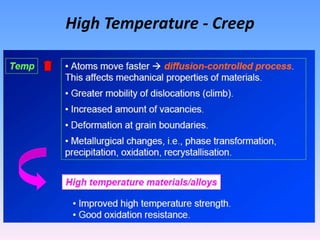
Effect of High Temperature on Metals:
• Lower strength.
• Greater atomic and dislocation mobility, assisting
dislocation climb and diffusion.
• Higher equilibrium concentration of vacancies.
• New deformation mechanisms, such as new slip
systems or grain boundary sliding.
• Recrystallisation and grain growth.
• Oxidation and intergranular penetration.
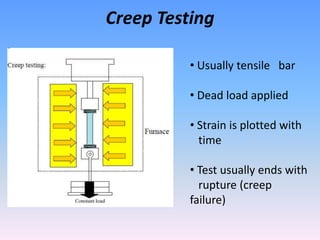
Creep Testing
• Usually tensile bar
• Dead load applied
• Strain is plotted with
time
• Test usually ends with
rupture (creep
failure)
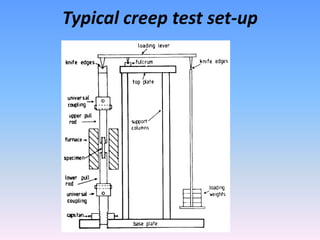
Typical creep test set-up
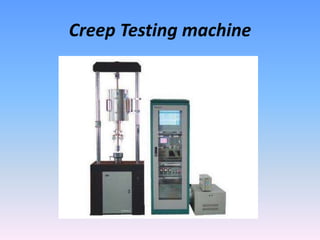
Creep Testing machine
11
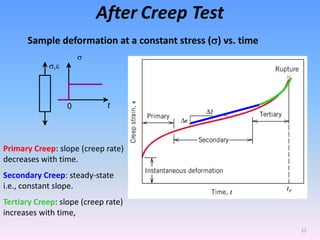
After Creep Test
Sample deformation at a constant stress (s) vs. time
Primary Creep: slope (creep rate)
decreases with time.
Secondary Creep: steady-state
i.e., constant slope.
Tertiary Creep: slope (creep rate)
increases with time,
s
s,e
0 t
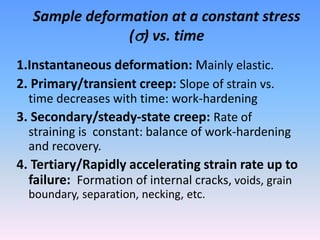
Sample deformation at a constant stress
(s) vs. time
1.Instantaneous deformation: Mainly elastic.
2. Primary/transient creep: Slope of strain vs.
time decreases with time: work-hardening
3. Secondary/steady-state creep: Rate of
straining is constant: balance of work-hardening
and recovery.
4. Tertiary/Rapidly accelerating strain rate up to
failure: Formation of internal cracks, voids, grain
boundary, separation, necking, etc.
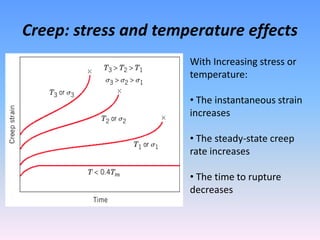
Creep: stress and temperature effects
With Increasing stress or
temperature:
• The instantaneous strain
increases
• The steady-state creep
rate increases
• The time to rupture
decreases
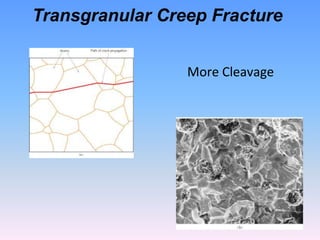
Creep fracture or Stress Rupture
• Stress rupture testing is similar to creep testing
except that the stresses used are higher than in a
creep test.
• Stress rupture testing is always done until failure of
the material or fracture
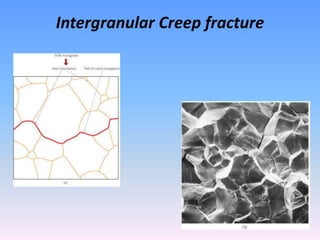
• Cracking that precedes the rupture of the material
can be either transgranular or intergranular
Transgranular Creep Fracture
More Cleavage
Intergranular Creep fracture
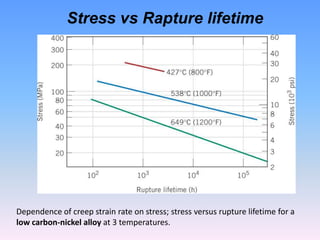
Stress vs Rapture lifetime
Dependence of creep strain rate on stress; stress versus rupture lifetime for a
low carbon-nickel alloy at 3 temperatures.
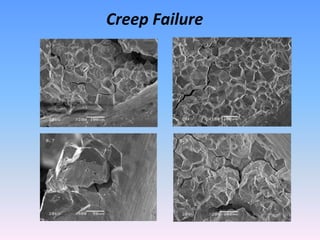
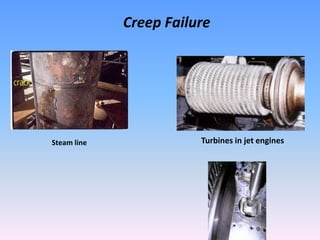
Creep Failure
Creep Failure
Steam line Turbines in jet engines
• Bulging or blisters in the tube
• Thick-edged fractures often with very little obvious
ductility
• Intergranular voids and cracks in the microstructure
• Longitudinal "stress cracks" in either or both ID and OD
oxide scales
• External or internal oxide-scale thicknesses that suggest
higher than expected temperatures
Creep failures are characterized by:
To Avoid creep failure
Creep is generally minimized in materials with:
• High melting temperature
• High elastic modulus
• Large grain sizes
Materials which especially resilient to creep:
• Stainless steels
• Refractory metals (containing elements like Nb, Mo, W, Ta)
• “Super alloys” (Co, Ni based: solid solution hardening and
secondary phases)
Allison AE 2100 Turboprop engine
Single Crystal Turbine Blade
• Nuclear power plant
• Heat exchangers
• Turbines in jet engines
• Hypersonic airplanes
THANK YOU

Creep

  • 1.
    CREEP & CREEPFAILURE G.Gopinath Assistant Prof - Mechanical
  • 2.
    Creep • Creep isa time-dependent process where a material under an applied stress exhibits a dimensional change at high temprature. • High temperature progressive deformation of a material at constant stress is called creep. • The process is also temperature-dependent • Creep always increases with temperature.
  • 3.
    How Does CreepOccur • Normally, Creep occurs when vacancies in the material migrate toward grain boundaries that are oriented normal to the direction of the applied stress. • Creep can be occur due to different Mechanisms
  • 4.
    Threshold for Creep TheCritical Temperature for Creep is 40% of the Melting Temperature. If T > 0.40 TM  Creep Is Likely TM = Melting temprature
  • 5.
    Mechanisms of Creep •Different mechanisms are responsible for creep in different materials and under different loading and temperature conditions. The mechanisms include • Stress-assisted vacancy diffusion • Grain boundary diffusion (diffusion creep) • Grain boundary sliding • Dislocation Glide • Dislocation creep
  • 6.
  • 7.
    Effect of HighTemperature on Metals: • Lower strength. • Greater atomic and dislocation mobility, assisting dislocation climb and diffusion. • Higher equilibrium concentration of vacancies. • New deformation mechanisms, such as new slip systems or grain boundary sliding. • Recrystallisation and grain growth. • Oxidation and intergranular penetration.
  • 8.
    Creep Testing • Usuallytensile bar • Dead load applied • Strain is plotted with time • Test usually ends with rupture (creep failure)
  • 9.
  • 10.
  • 11.
    11 After Creep Test Sampledeformation at a constant stress (s) vs. time Primary Creep: slope (creep rate) decreases with time. Secondary Creep: steady-state i.e., constant slope. Tertiary Creep: slope (creep rate) increases with time, s s,e 0 t
  • 12.
    Sample deformation ata constant stress (s) vs. time 1.Instantaneous deformation: Mainly elastic. 2. Primary/transient creep: Slope of strain vs. time decreases with time: work-hardening 3. Secondary/steady-state creep: Rate of straining is constant: balance of work-hardening and recovery. 4. Tertiary/Rapidly accelerating strain rate up to failure: Formation of internal cracks, voids, grain boundary, separation, necking, etc.
  • 13.
    Creep: stress andtemperature effects With Increasing stress or temperature: • The instantaneous strain increases • The steady-state creep rate increases • The time to rupture decreases
  • 14.
    Creep fracture orStress Rupture • Stress rupture testing is similar to creep testing except that the stresses used are higher than in a creep test. • Stress rupture testing is always done until failure of the material or fracture • Cracking that precedes the rupture of the material can be either transgranular or intergranular
  • 15.
  • 16.
  • 17.
    Stress vs Rapturelifetime Dependence of creep strain rate on stress; stress versus rupture lifetime for a low carbon-nickel alloy at 3 temperatures.
  • 18.
  • 19.
    Creep Failure Steam lineTurbines in jet engines
  • 20.
    • Bulging orblisters in the tube • Thick-edged fractures often with very little obvious ductility • Intergranular voids and cracks in the microstructure • Longitudinal "stress cracks" in either or both ID and OD oxide scales • External or internal oxide-scale thicknesses that suggest higher than expected temperatures Creep failures are characterized by:
  • 21.
    To Avoid creepfailure Creep is generally minimized in materials with: • High melting temperature • High elastic modulus • Large grain sizes Materials which especially resilient to creep: • Stainless steels • Refractory metals (containing elements like Nb, Mo, W, Ta) • “Super alloys” (Co, Ni based: solid solution hardening and secondary phases)
  • 22.
    Allison AE 2100Turboprop engine Single Crystal Turbine Blade
  • 23.
    • Nuclear powerplant • Heat exchangers • Turbines in jet engines • Hypersonic airplanes
  • 24.