+


Air Pressure and Winds
Chapter 6

                         © 2011 Pearson Education, Inc.
+


6.1 Wind and Air Pressure


                            © 2011 Pearson Education, Inc.
+
 Wind and Air Pressure


 Wind  is the result of horizontal differences
  in atmospheric pressure.
 Atmospheric   (air) pressure is the force
  exerted against a surface by continuous
  collision of gas molecules.
   Atmosphere  is without walls but the force of
   gravity prevents its escape.
+
 Wind and Air Pressure


   The    air pressure at sea level is about 1
       kg/cm2.
   Specifically,    a column of air is 1 sq inch in
       cross section, measured from sea level to
       the top of the atmosphere would weigh
       14.7 lbs.


© 2011 Pearson Education, Inc.
+


6.2 Measuring Air Pressure


                             © 2011 Pearson Education, Inc.
+
 Measuring Air Pressure

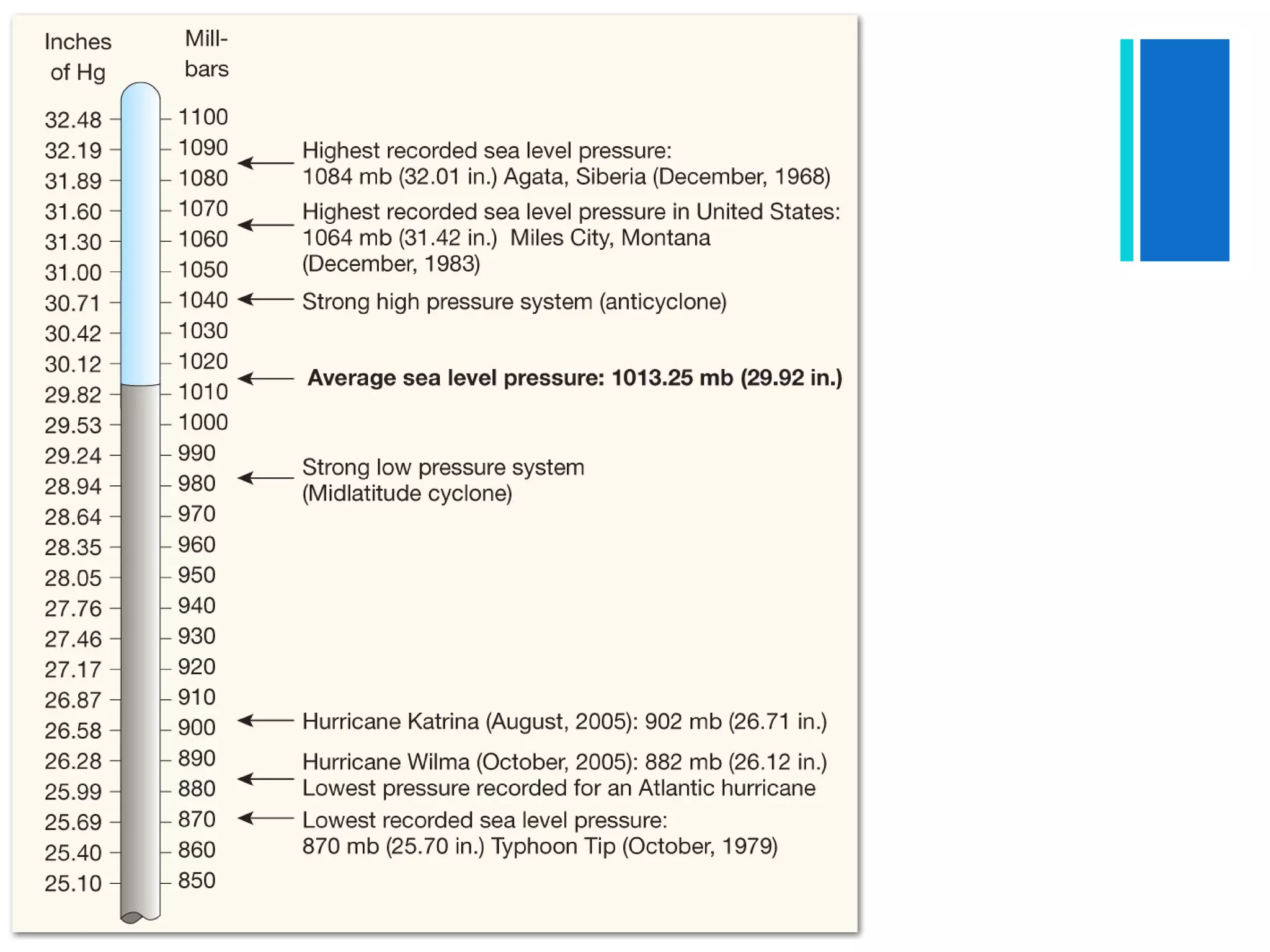
  Air   pressure is measured in millibars.
  1 millibar (mb) = 100 newtons/m2
   1013.25 mb = sea level pressure

  The
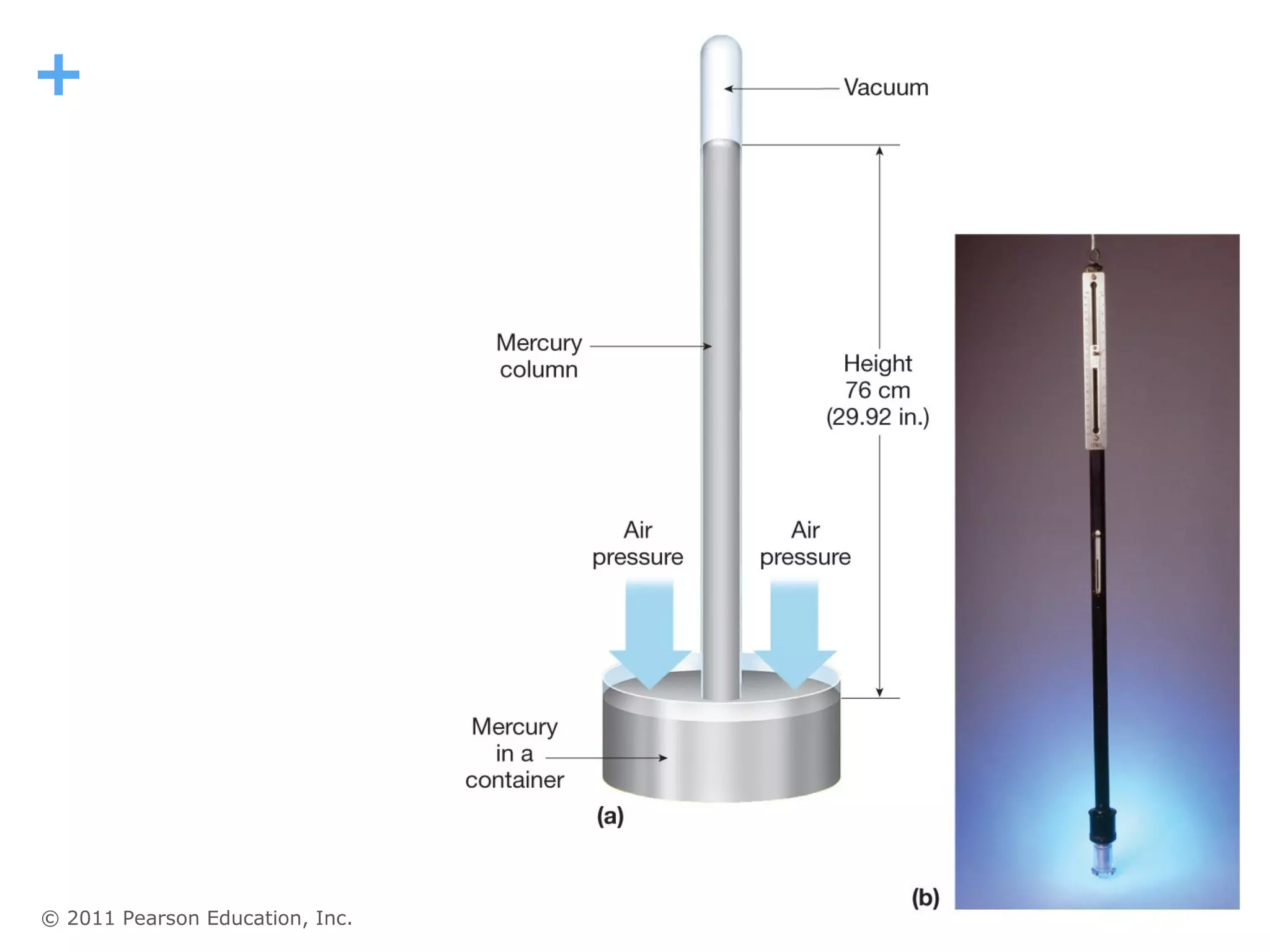
     mercury barometer is the standard pressure-
  measuring instrument.
   Air pressure pushes on a pool of mercury, which forces
    the mercury up a tube.
         High pressure: The mercury goes further up the
          tube.
         Low pressure: The mercury stays lower.
+
 Measuring Air Pressure


   Fair         weather = high pressure
   Rain          = low pressure


© 2011 Pearson Education, Inc.
+
 Measuring Air Pressure
+


© 2011 Pearson Education, Inc.
+


6.3 Pressure Changes with Altitude


                             © 2011 Pearson Education, Inc.
+
 Pressure Changes with Altitude


 Air pressure is defined as the force exerted
  against a surface by continuous collision of
  gas molecules.
   Air pressure decreases with altitude.
     Because of the decrease of pressure above you
   Air pressure increases with depth.
     Because of the increase of pressure above you
+
 Pressure Changes with Altitude


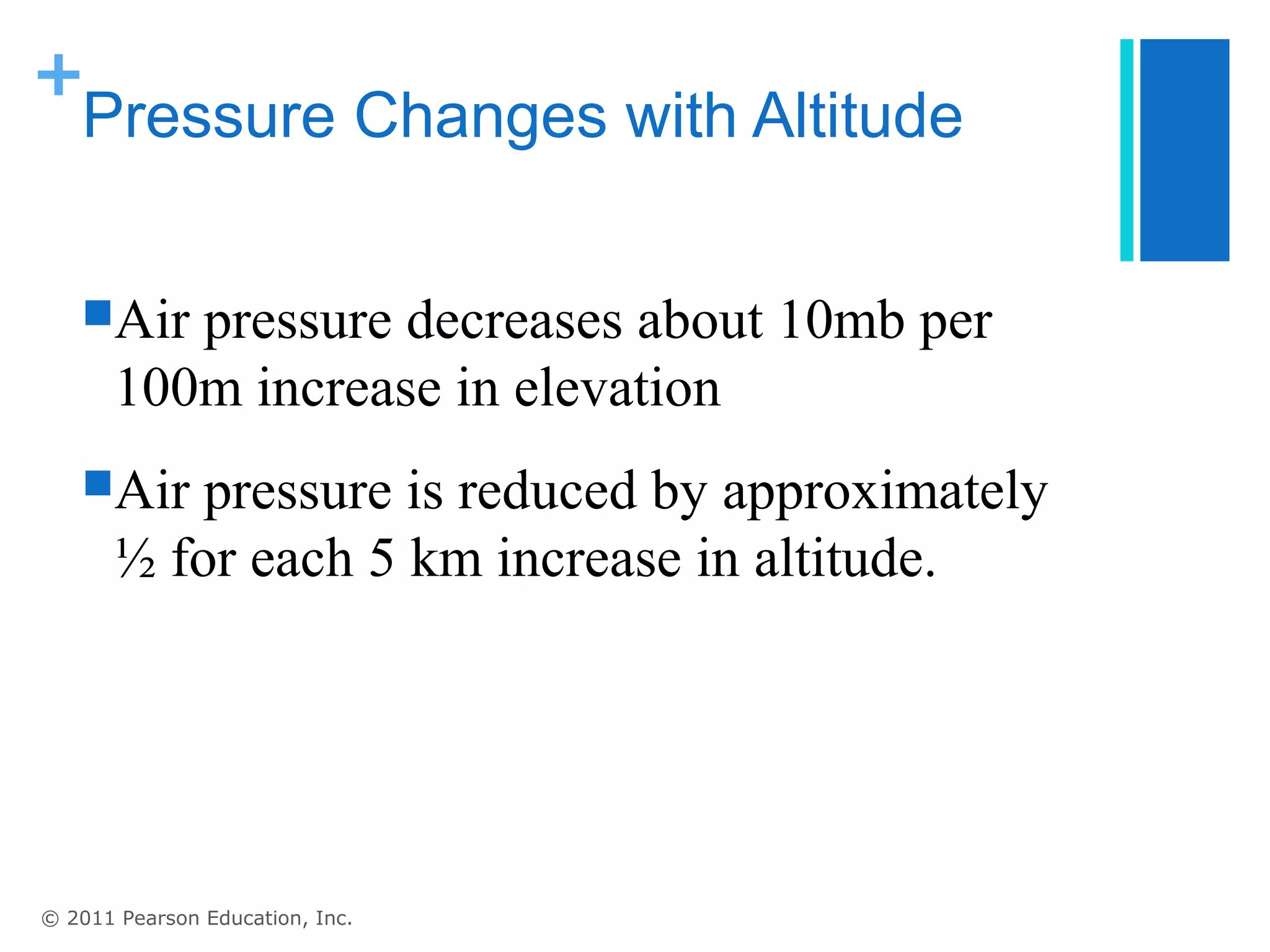
   Air   pressure decreases about 10mb per
       100m increase in elevation
   Air    pressure is reduced by approximately
       ½ for each 5 km increase in altitude.


© 2011 Pearson Education, Inc.
+


6.4 Why does Air Pressure Vary?


                            © 2011 Pearson Education, Inc.
+
 Why Does Air Pressure Vary?

 Recall that variations in air pressure causes the
  wind to blow, which in turn causes changes in
  temperature and humidity
 Water    vapor affects air pressure.
   The   amount of water vapor reduces the density of
    air.
   Cold dry air has higher pressure.
   Warm, dry air has higher pressure than equally
    warm, moist air.
+
 Why Does Air Pressure Vary?


 The  movement of air can also cause
  variations in air pressure.
   Convergence    occurs when a net airflow into a
    region causing pressure to rise.
   Divergence results when there is a net outflow
    of air from a region and surface pressure drops.
+
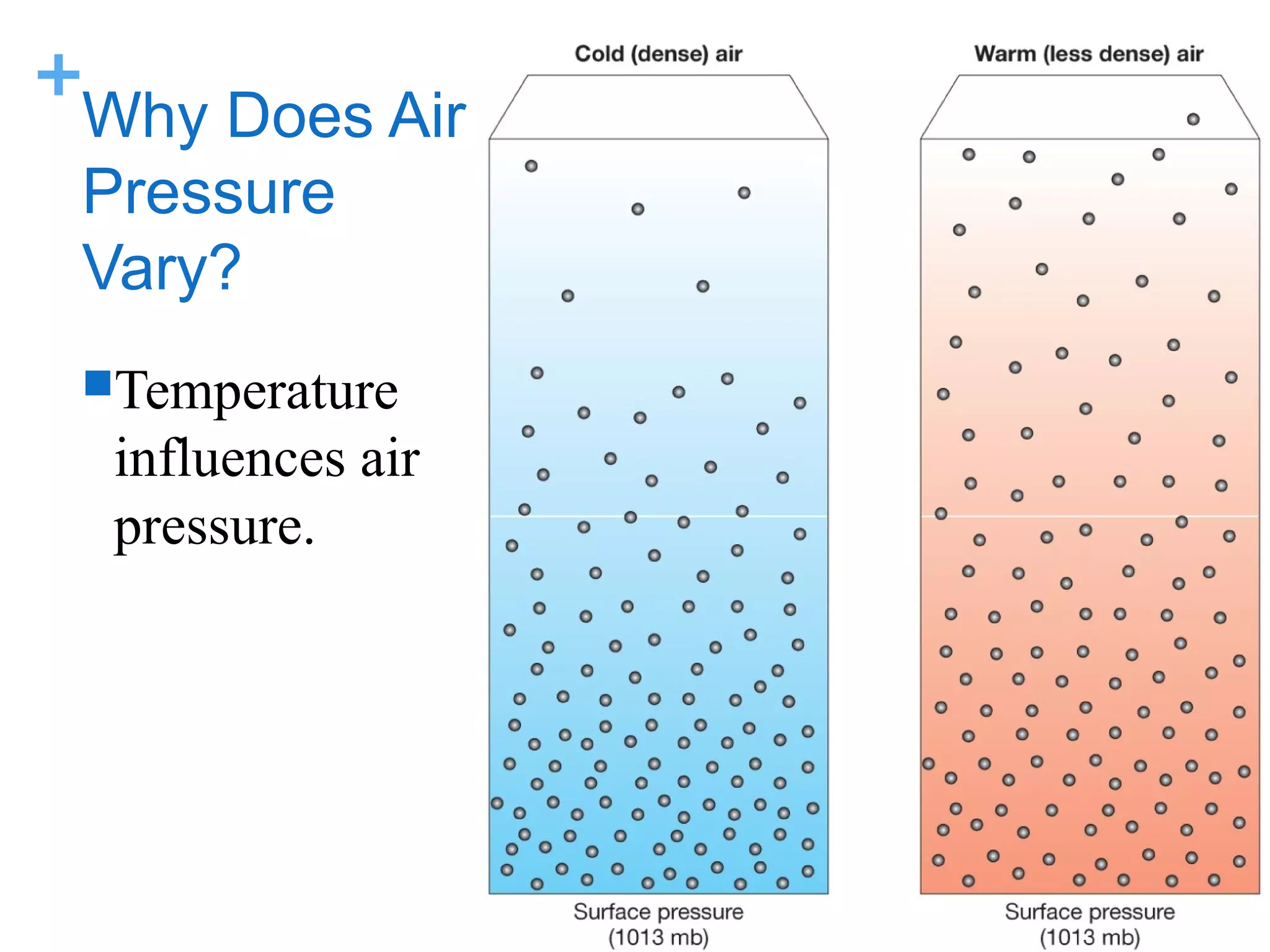
 Why Does Air
 Pressure
 Vary?
 Temperature
  influences air
  pressure.
+


6.5 Factors Affecting Wind


                             © 2011 Pearson Education, Inc.
+
 Factors Affecting Wind


 Pressure   gradient force
 Coriolis   force
 Friction
+
 Factors Affecting Wind- Pressure
 Gradient Force
 The  force that generates winds results from
  horizontal pressure differences. Greater
  differences the greater the wind blows
 Pressure    gradient force
   Spacing of the isobars indicate the amount of
   pressure change occurring over a given
   distance.
+
 Factors Affecting Wind- Pressure
 Gradient Force
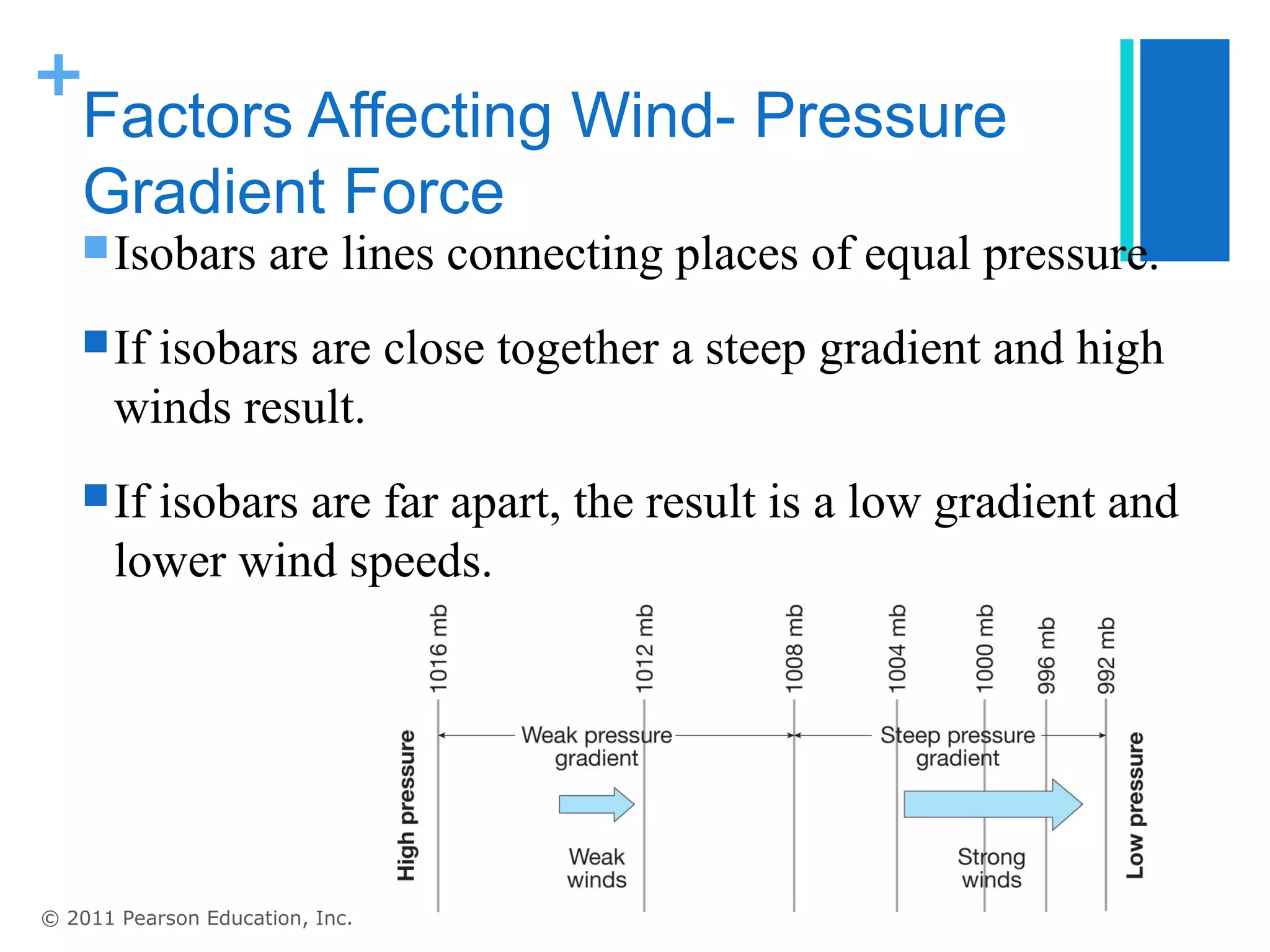
    Isobars         are lines connecting places of equal pressure.
    If  isobars are close together a steep gradient and high
       winds result.
    If  isobars are far apart, the result is a low gradient and
       lower wind speeds.


© 2011 Pearson Education, Inc.
+
 Factors Affecting Wind- Pressure
 Gradient Force
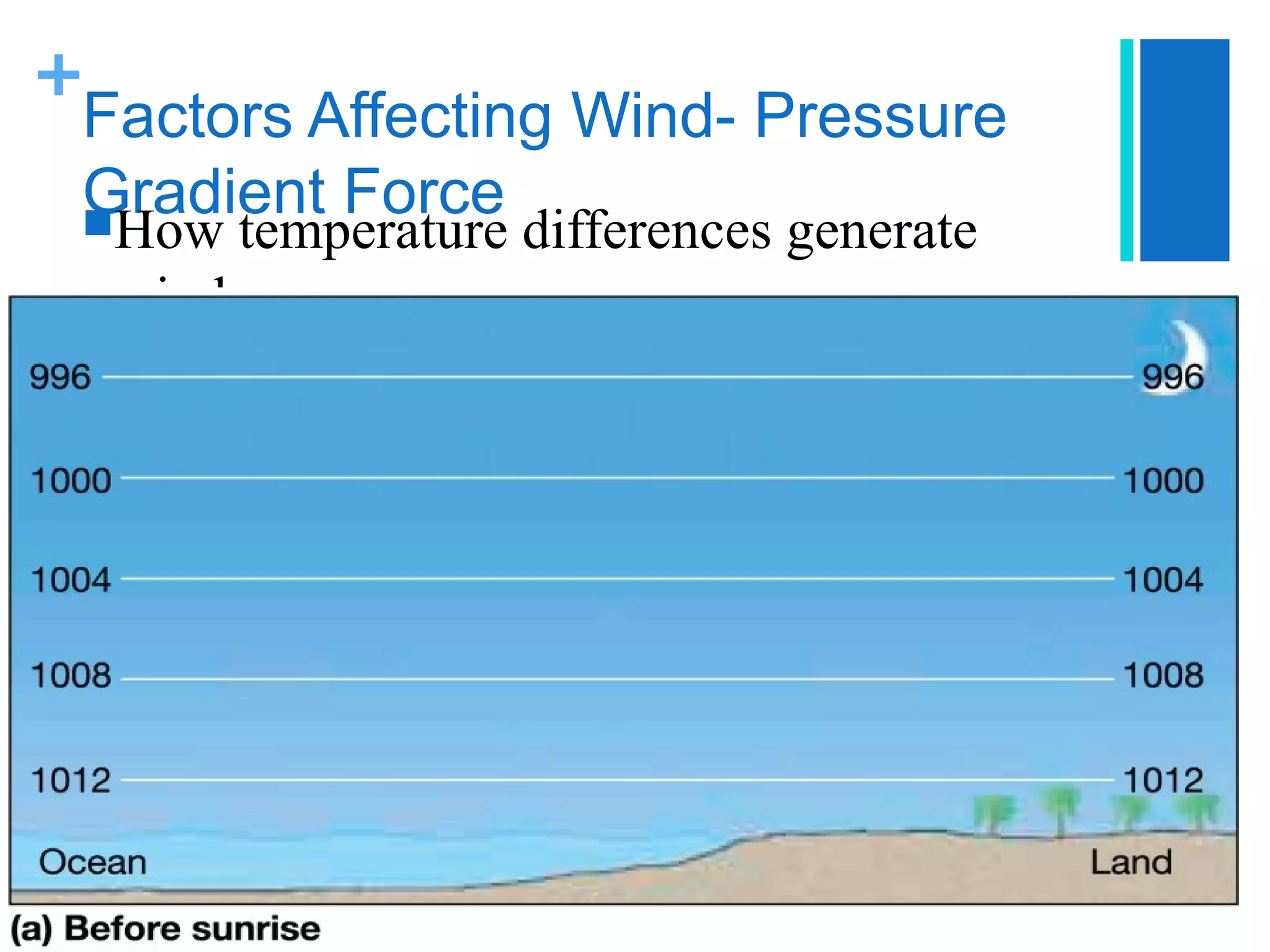
 How temperature differences generate
  wind
 Sea   Breeze figure 6-11 page 169
 A- Temp and pressure don’t vary
  horizontally
+
 Factors Affecting Wind- Pressure
 Gradient Force
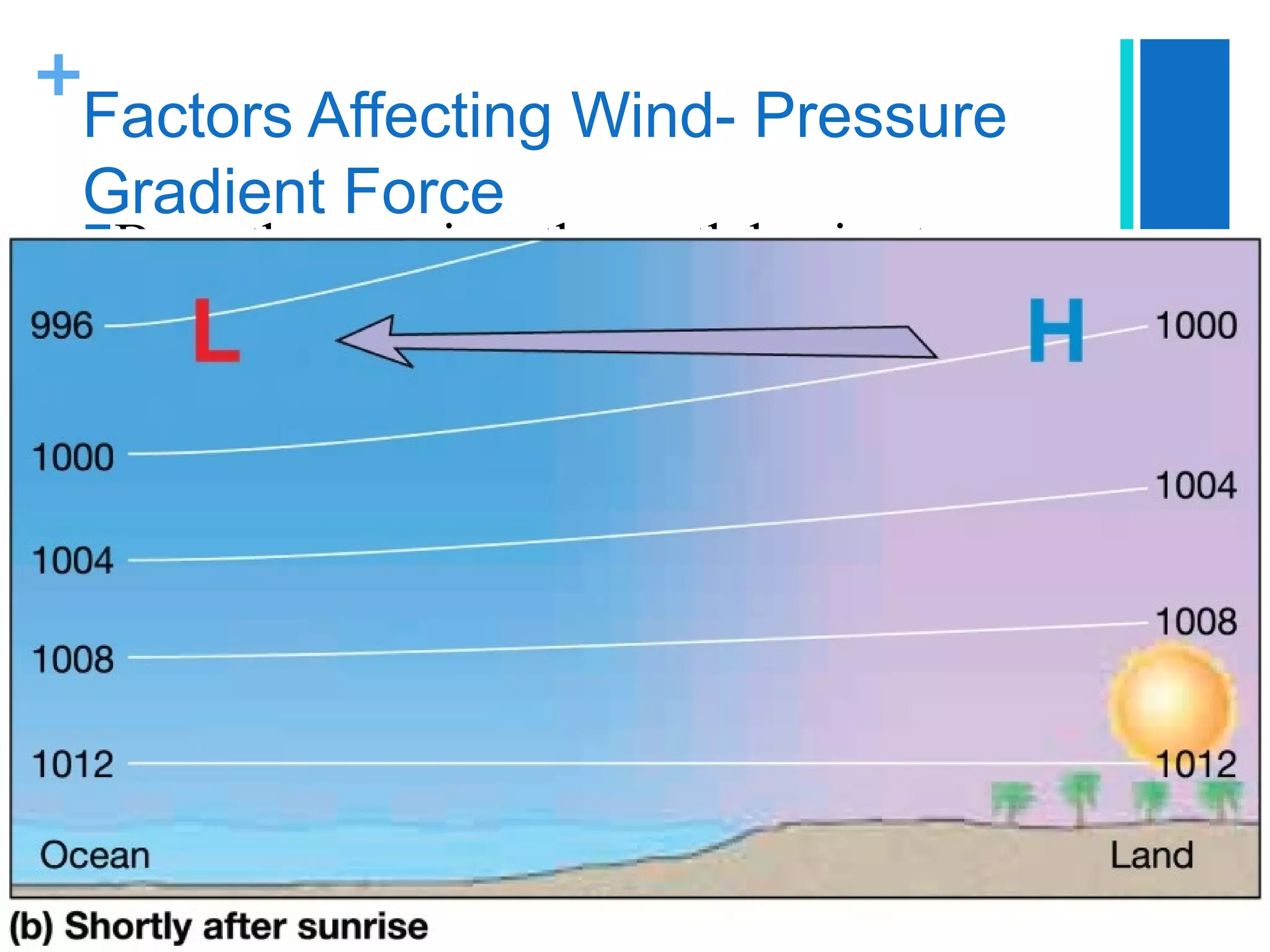
   B-     as the sun rises the earth begins to
       warm. Air above the land warms and
       expands creating a high pressure area (less
       dense air column) and the air aloft begins
       to flow away from the land


© 2011 Pearson Education, Inc.
+
 Factors Affecting Wind- Pressure
 Gradient Force
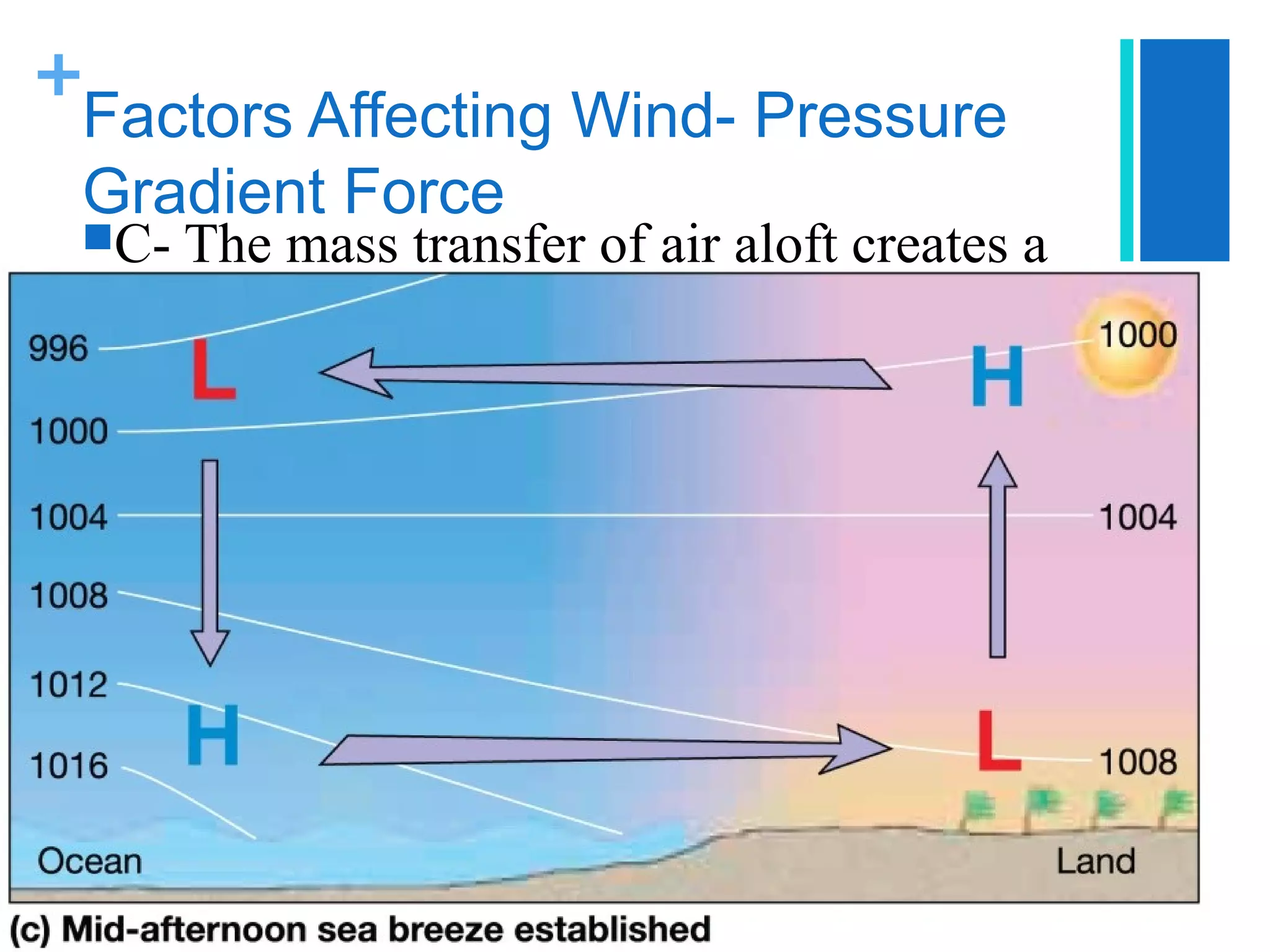
   C-    The mass transfer of air aloft creates a
       surface high pressure area over the land.
       The surface circulation that develops from
       this redistribution of mass is from the sea
       towards the land = sea breeze.


© 2011 Pearson Education, Inc.
+
 Factors Affecting Wind- Pressure
 Gradient Force
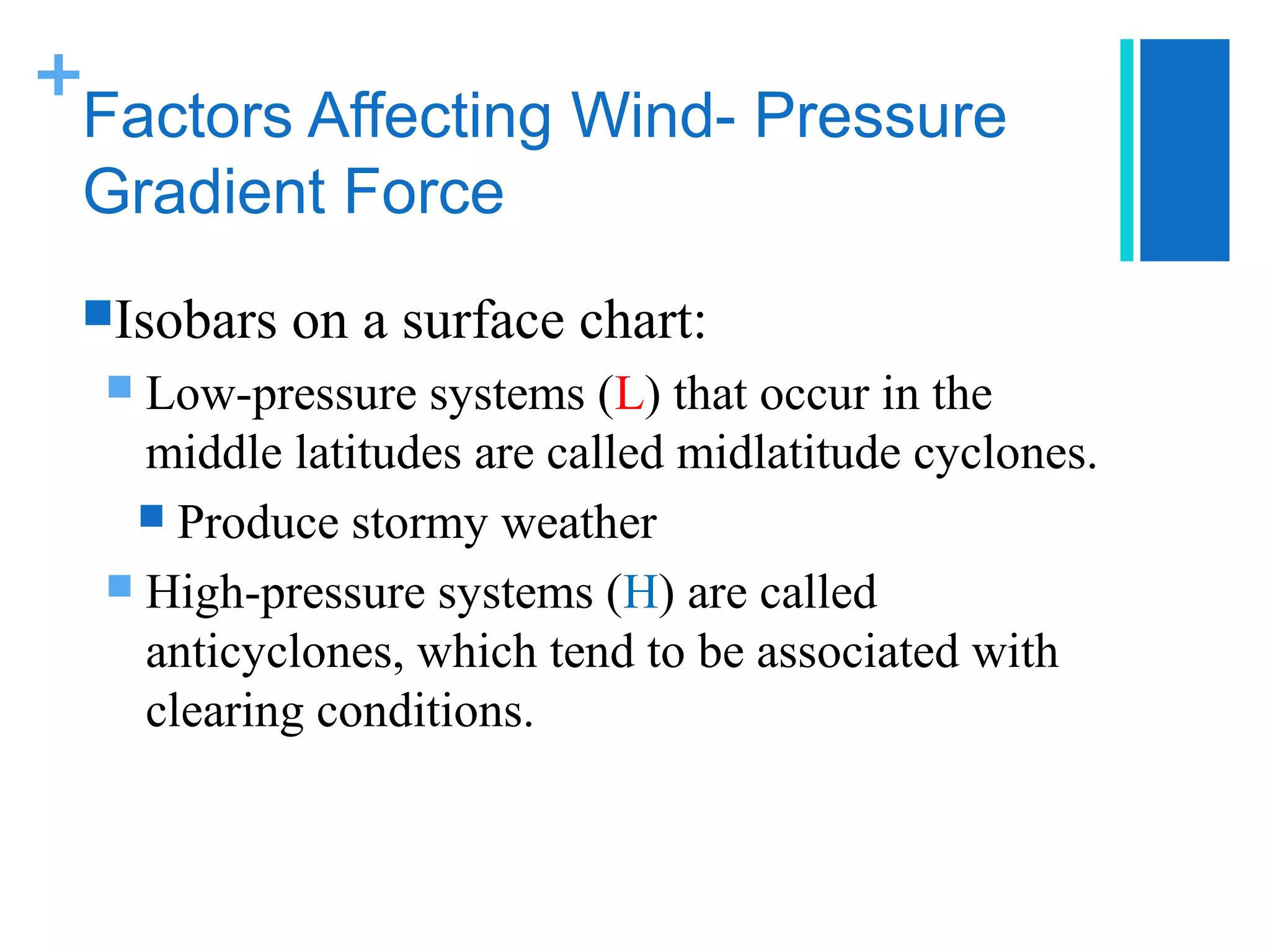
 Isobars   on a surface chart:
   Low-pressure systems (L) that occur in the
    middle latitudes are called midlatitude cyclones.
    Produce stormy weather
   High-pressure systems (H) are called
    anticyclones, which tend to be associated with
    clearing conditions.
+
 Factors Affecting Wind- Coriolis
 Force
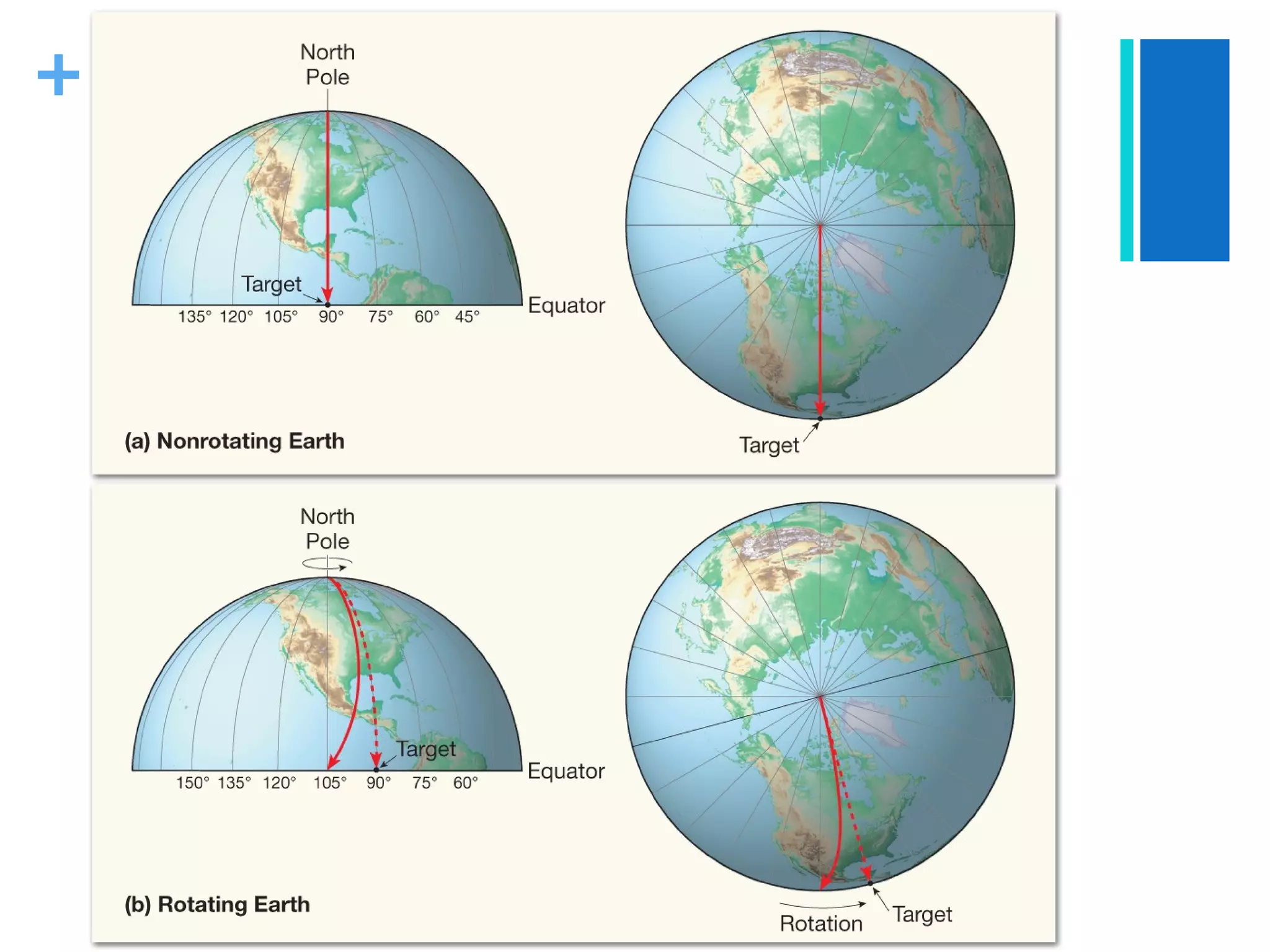
 TheCoriolis force cannot generate wind; it
  modifies airflow.
 The Coriolis force causes all free flowing
  objects including wind:
   In the Northern Hemisphere, a deviation to the
    right is due to the Earth’s rotation.
   In the Southern Hemisphere, the deviation is to
    the left.
+
 Factors Affecting Wind- Coriolis
 Force
 The    Coriolis force is a deflecting force.
   It is always directed at right angles to the
    direction of airflow.
   It controls only wind direction, not speed.
   It is affected by wind speed (the stronger the
    wind, the greater the force).
   The Coriolis force is strongest at the poles and
    is nonexistent at the equator.
+
 Factors Affecting Wind- Coriolis
 Force
 Coriolis   force
+
 Factors Affecting Wind- Friction
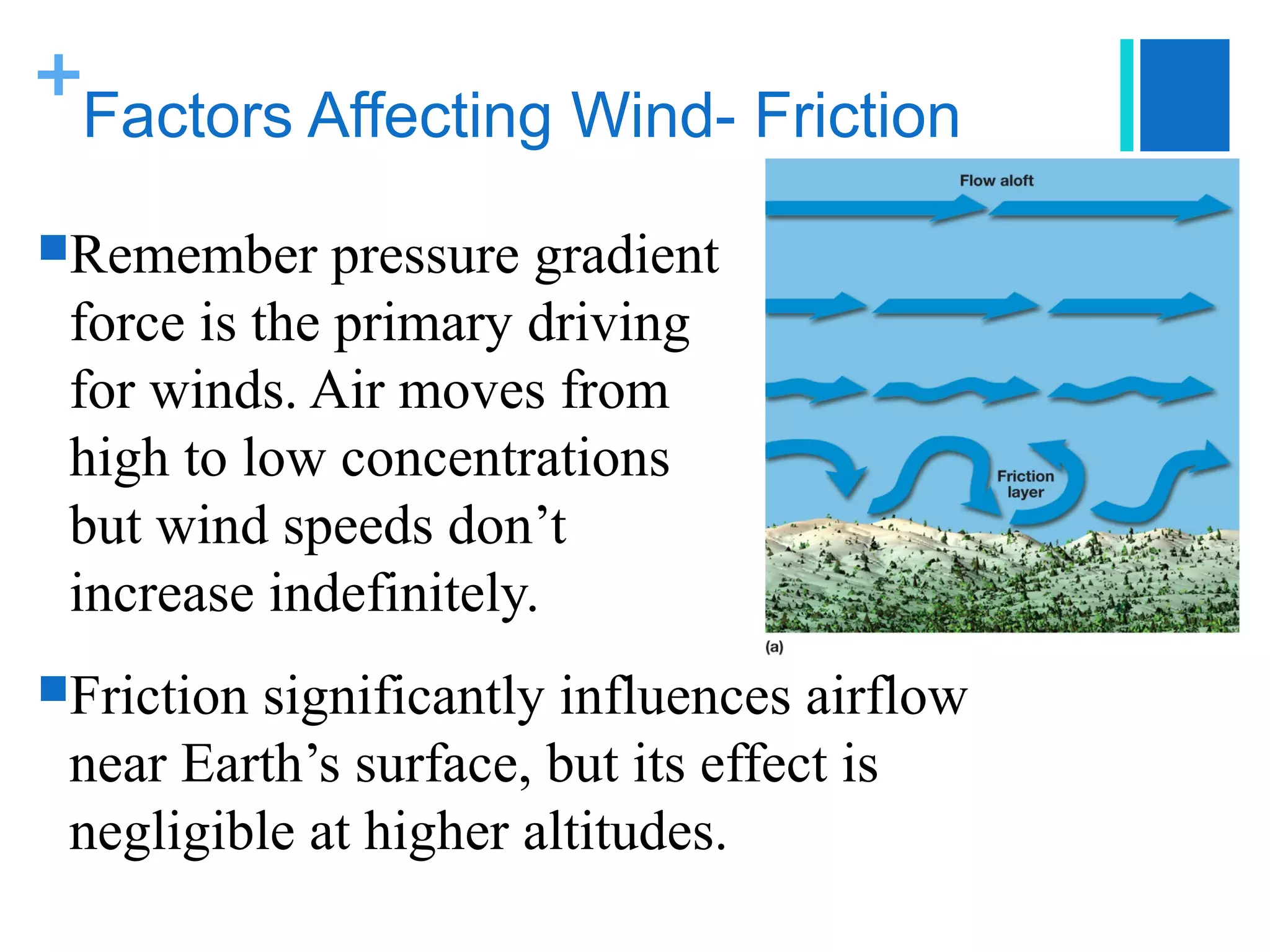
Remember     pressure gradient
 force is the primary driving      force
 for winds. Air moves from
 high to low concentrations
 but wind speeds don’t
 increase indefinitely.
Friction significantly influences airflow
 near Earth’s surface, but its effect is
 negligible at higher altitudes.
+


6.6 Winds Aloft


                  © 2011 Pearson Education, Inc.
+
 Winds Aloft

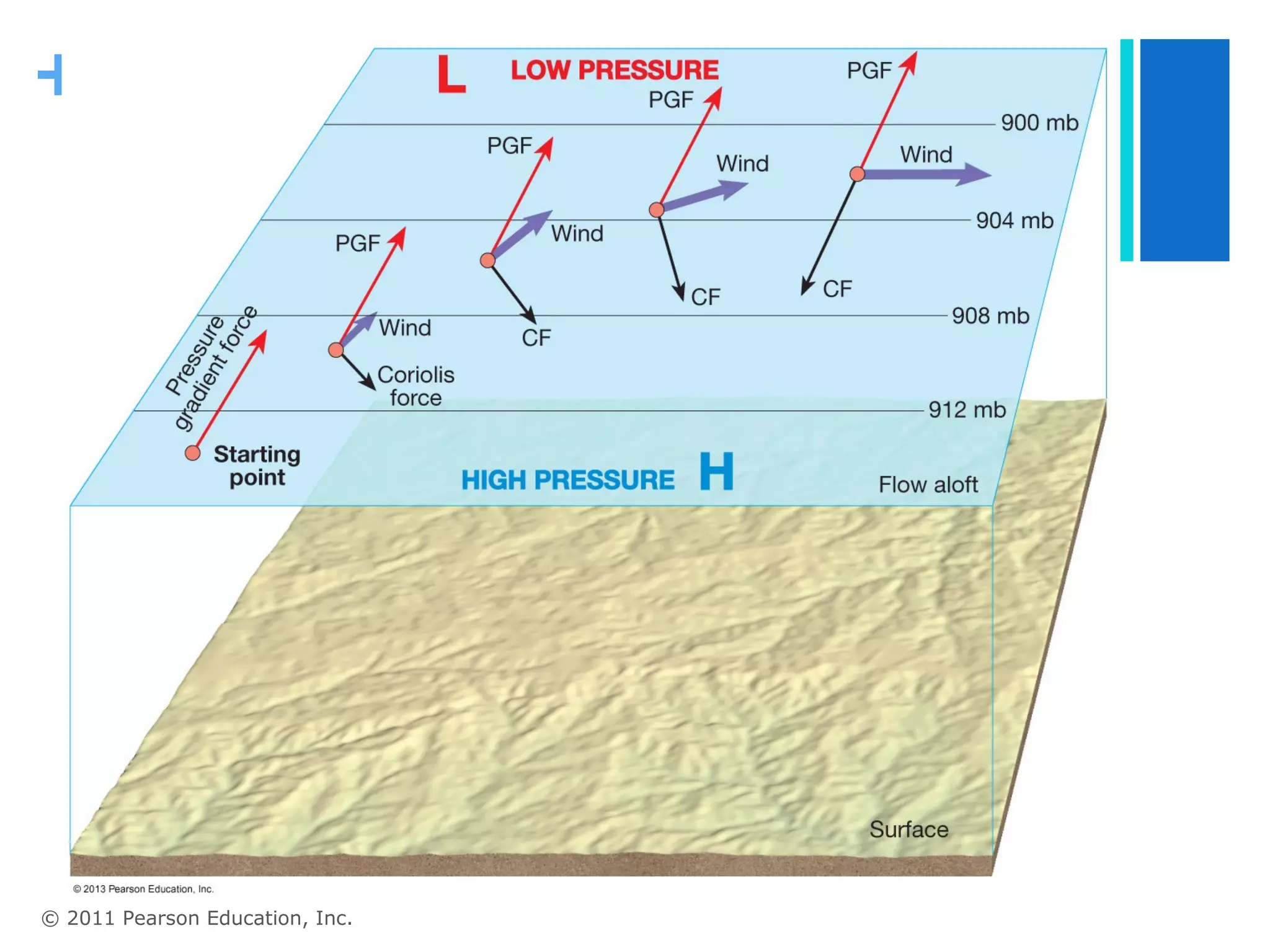
  Geostrophic flow occurs when the pressure
  gradient force and the Coriolis force are balanced.
   Thewind flows parallel to the isobars.
   They flow in relatively straight paths.

  Wind  Direction is directly related to prevailing
  pressure patterns. So if we know direction we can
  establish a rough approximation of the pressure
  distribution.
+


© 2011 Pearson Education, Inc.
+
 Winds Aloft


   Buys     Ballot’s Law states that if you stand
       with the wind at your back, low pressure
       will be found on your left, high pressure on
       the right.
   The   situation is reversed in the southern
       hemisphere.


© 2011 Pearson Education, Inc.
+
 Winds Aloft
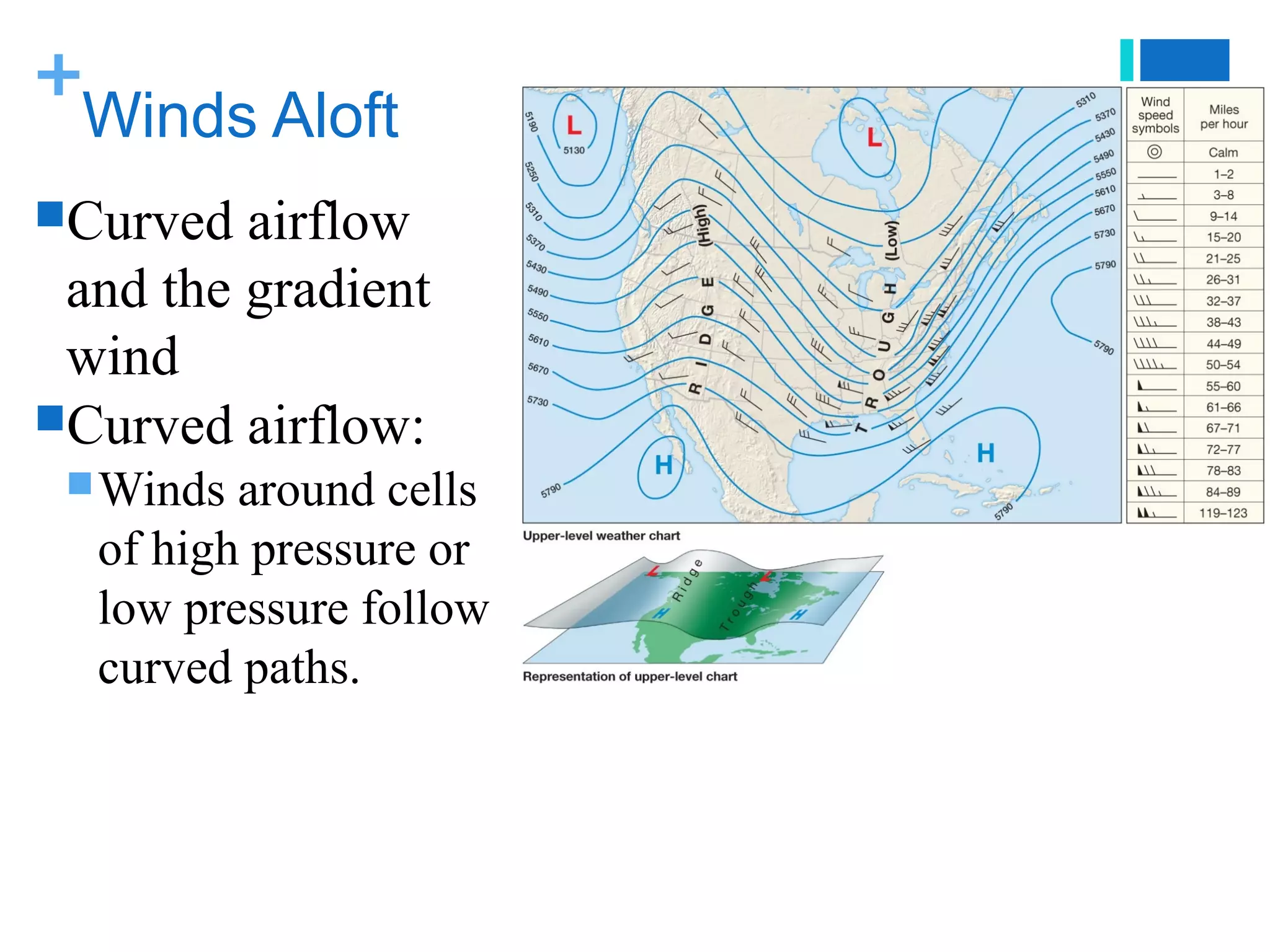
Curved  airflow
 and the gradient
 wind
Curved airflow:
  Winds around cells
  of high pressure or
  low pressure follow
  curved paths.
+
 Winds Aloft
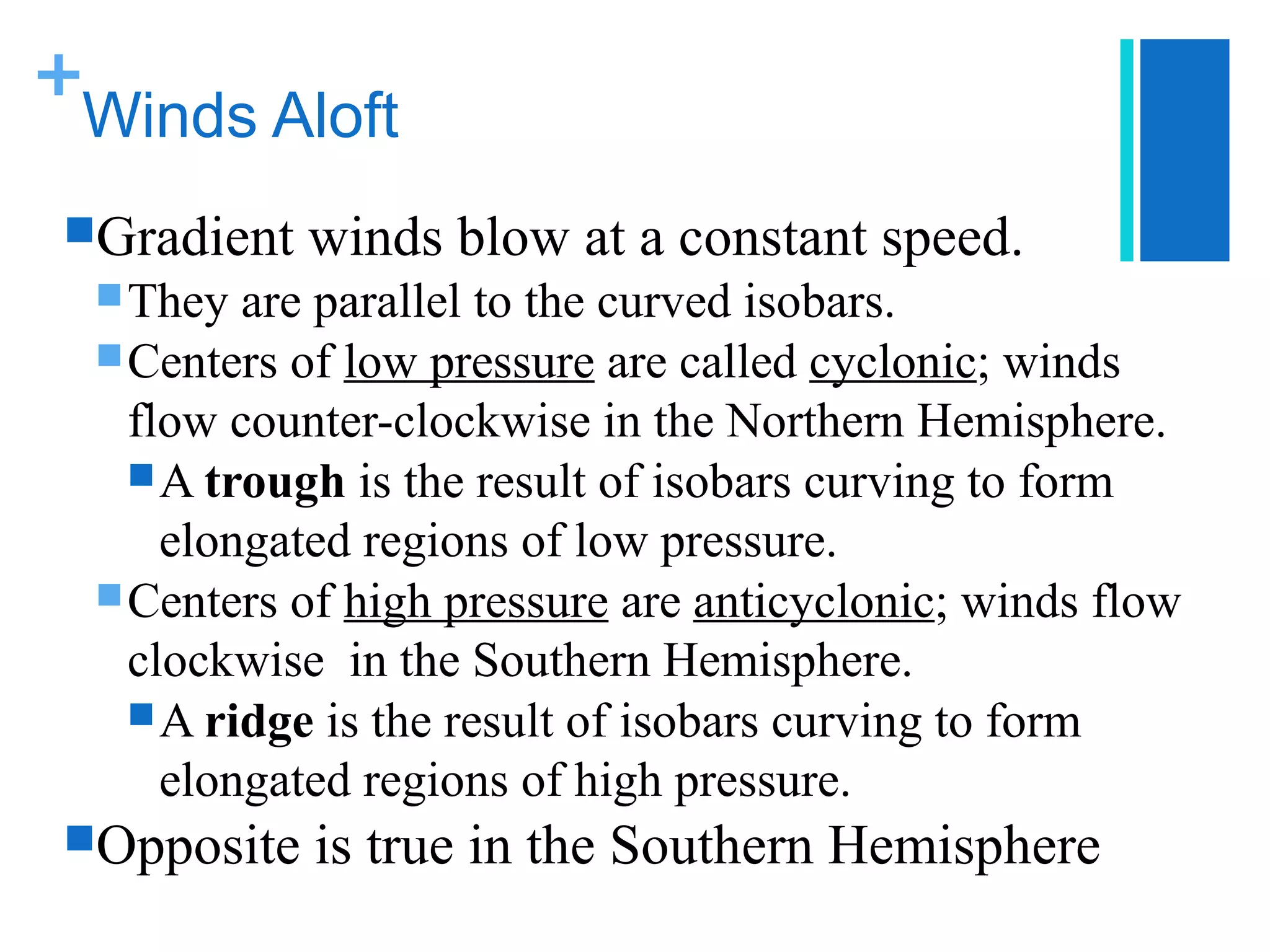
 Gradient   winds blow at a constant speed.
   They  are parallel to the curved isobars.
   Centers of low pressure are called cyclonic; winds
    flow counter-clockwise in the Northern Hemisphere.
     A trough is the result of isobars curving to form
      elongated regions of low pressure.
   Centers of high pressure are anticyclonic; winds flow
    clockwise in the Southern Hemisphere.
     A ridge is the result of isobars curving to form
      elongated regions of high pressure.
 Opposite   is true in the Southern Hemisphere
+
 Winds Aloft

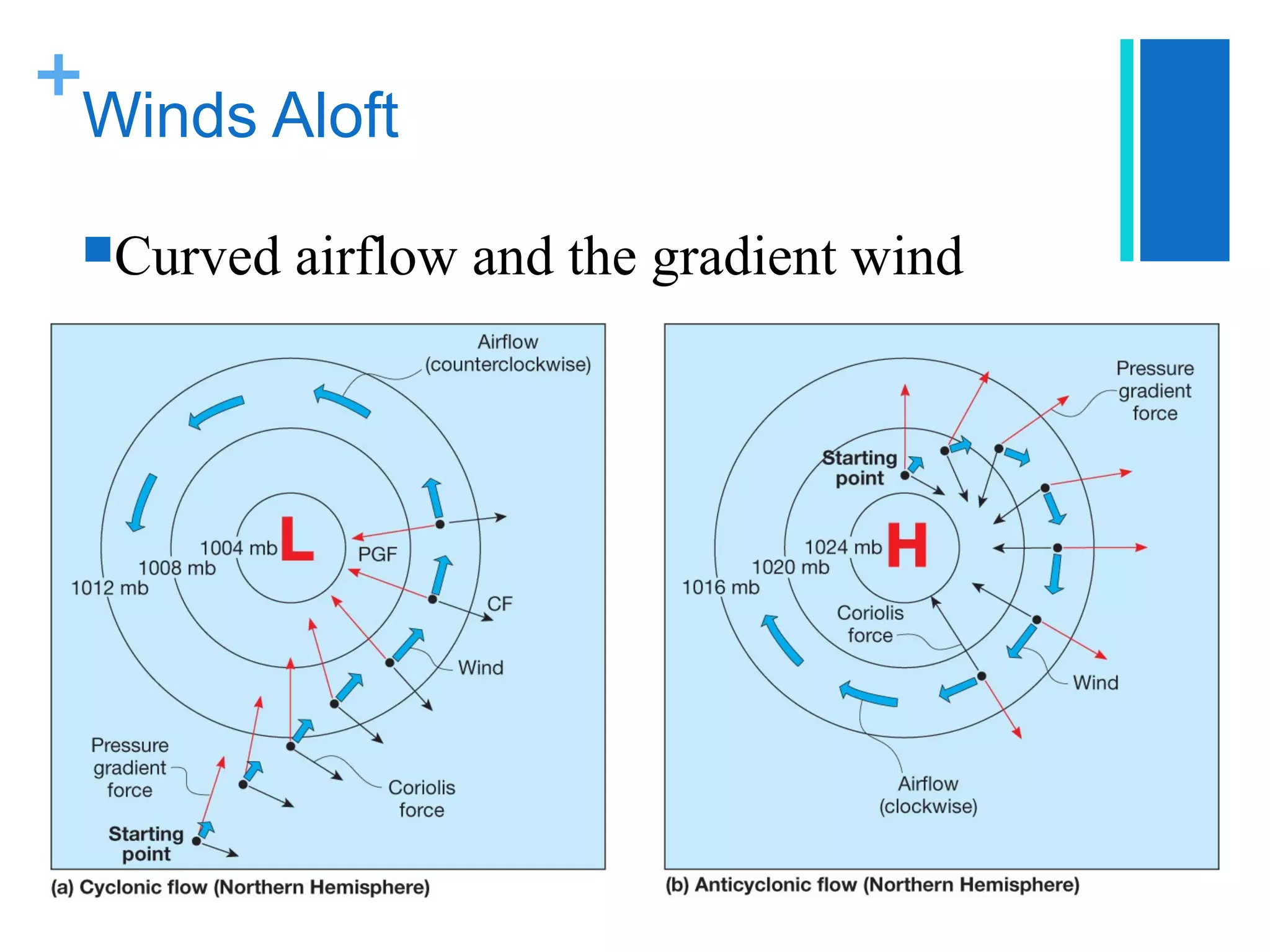
 Curved   airflow and the gradient wind
+
 Winds Aloft
   In      Low Pressure Centers- Figure A
        The  inward directed pressure gradient force is
          opposed by the outward directed Coriolis force. The
          pressure gradient force must exceed the coriolis
          force to overcome the air’s tendency to continue
          moving in a straight line.
   In      High Pressure Centers- Figure B
        Pressure  gradient force and Coriolis force are not
          balanced. The imbalance provides a change in
          direction and generates the curved flow
© 2011 Pearson Education, Inc.
+


6.7 Surface Winds


                    © 2011 Pearson Education, Inc.
+
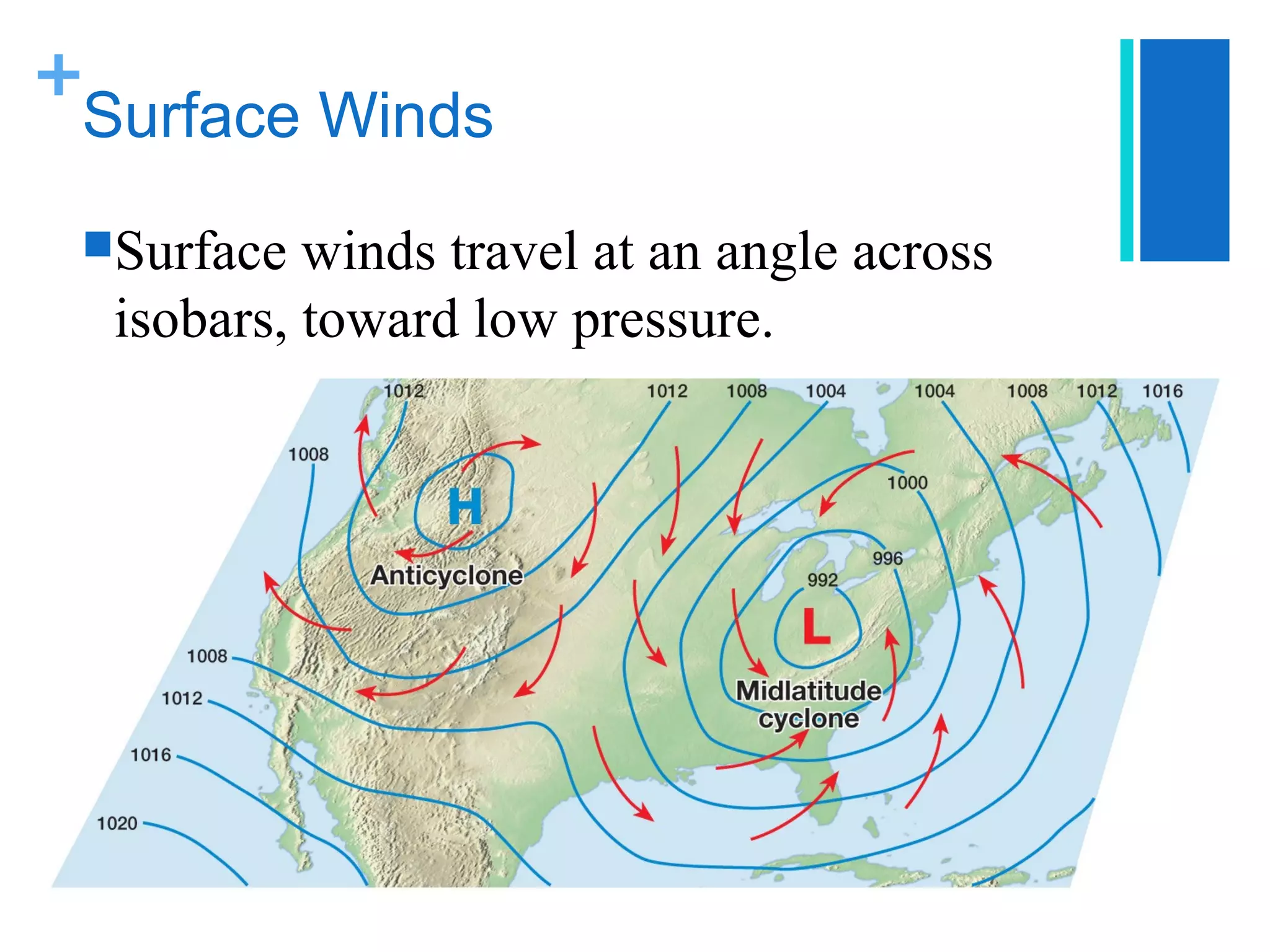
 Surface Winds
 Surface  winds travel at an angle across
  isobars, toward low pressure.
+
 Surface Winds


 Air  flow crosses the isobars at varying angles
    depending on friction for terrain, but winds
    always move from high to low pressure.
 In   a cyclone pressure decreases inward and
    friction causes a new flow towards its center
 In  an anticyclone pressure decreases outward
    and friction causes a net flow away from its
    center
© 2011 Pearson Education, Inc.
+


6.8 How Winds Generate Vertical Air Motion


                                © 2011 Pearson Education, Inc.
+
How Winds Generate Vertical Air Motion


 Factors    that promote vertical airflow:
 Friction
     Increased  friction causes a drop in wind speed
      resulting in a pileup of air upstream from the
      ocean to land.
     Convergence can result in cloudy weather.
     Decreased friction causes and increase in wind
      speed from the land to the ocean.
     Subsidence and divergence results in clearing
      weather.
+
How Winds Generate Vertical Air Motion

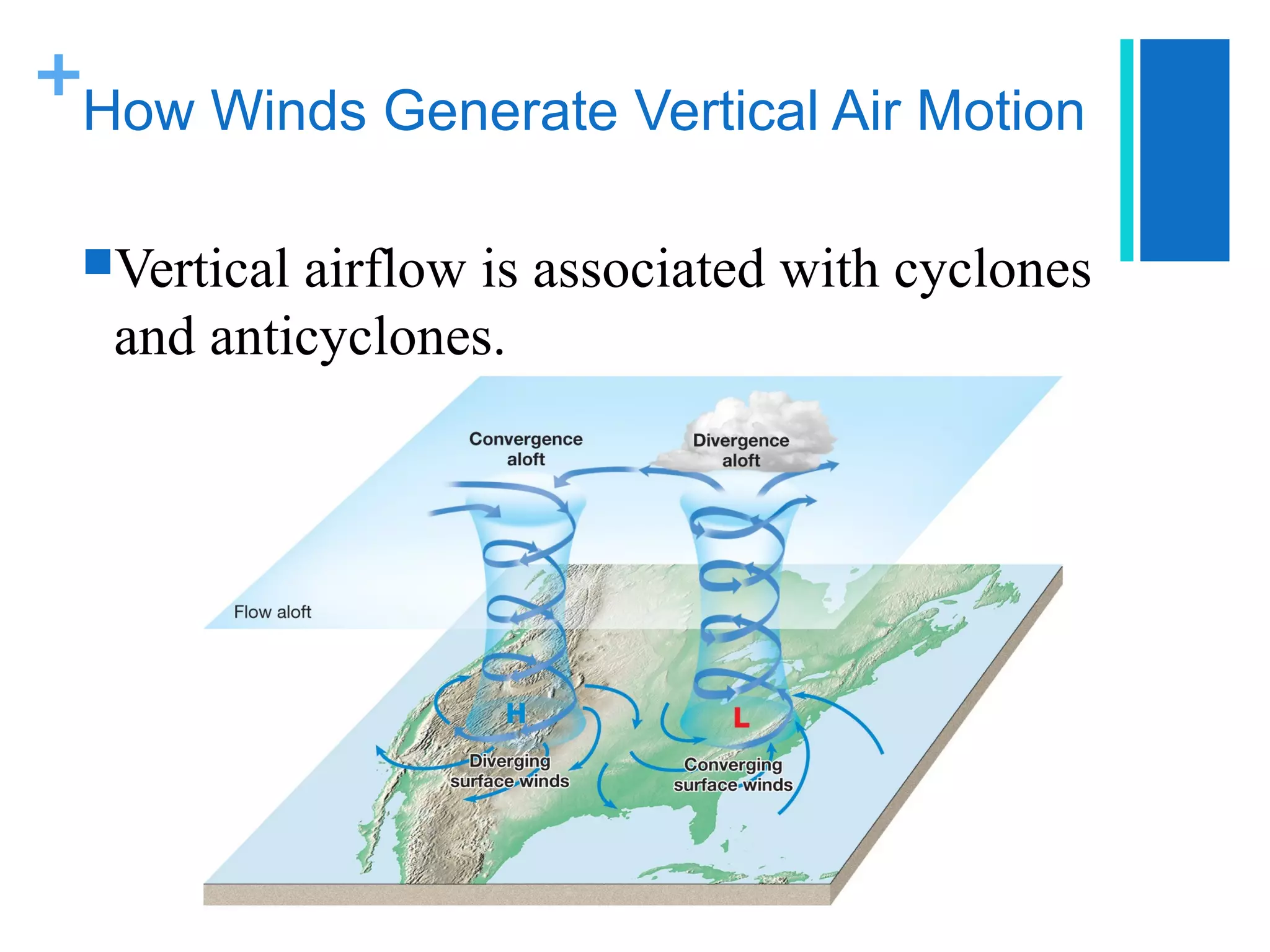
Vertical   airflow is associated with cyclones
    and anticyclones.
+
   How Winds Generate Vertical Air Motion


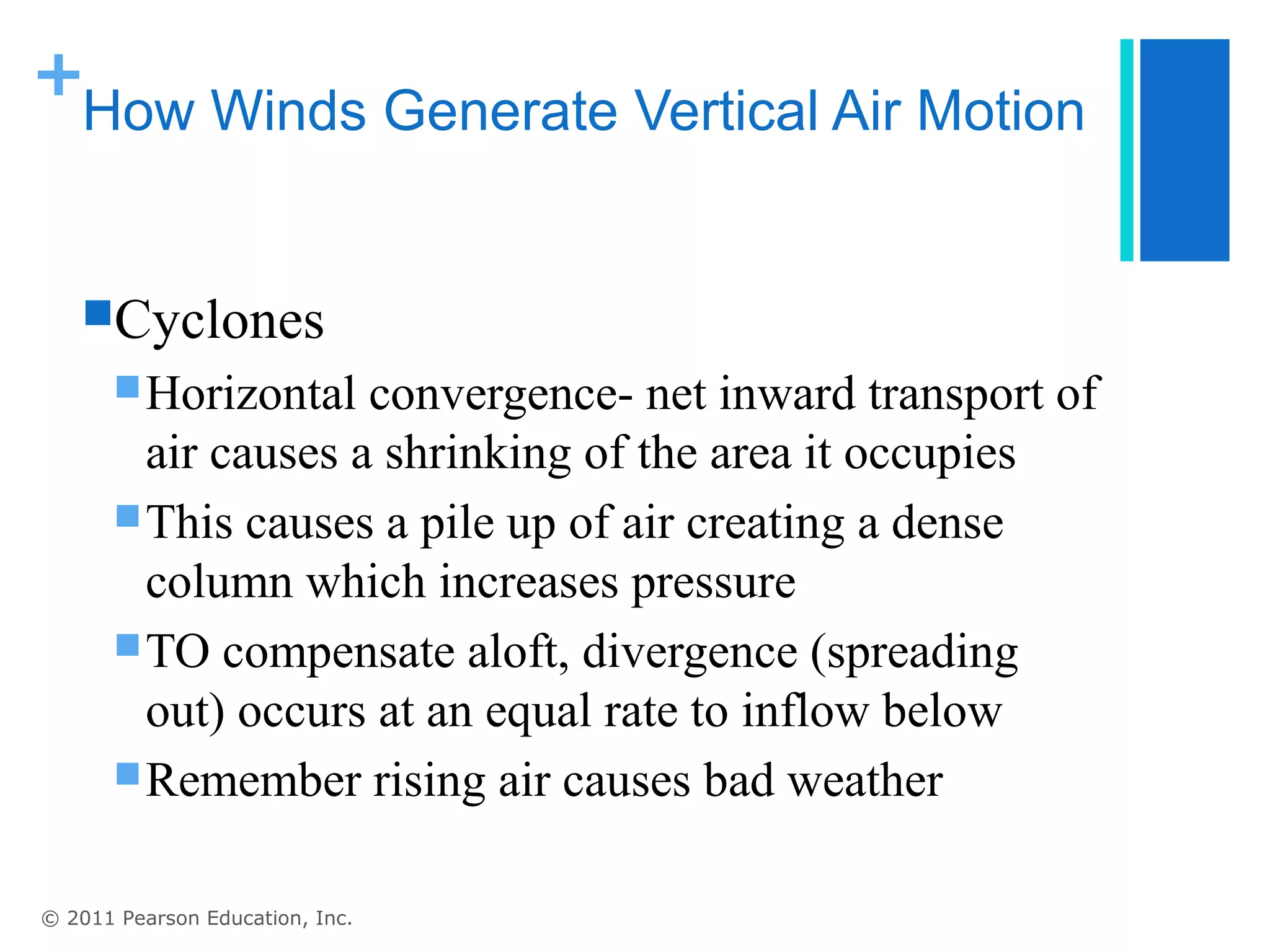
   Cyclones
        Horizontal  convergence- net inward transport of
         air causes a shrinking of the area it occupies
        This causes a pile up of air creating a dense
         column which increases pressure
        TO compensate aloft, divergence (spreading
         out) occurs at an equal rate to inflow below
        Remember rising air causes bad weather


© 2011 Pearson Education, Inc.
+
   How Winds Generate Vertical Air Motion


   Anticyclones
        Convergence   (pulling in) happens aloft and
         general subsidence of the air column happens
        This creates good, nice weather


© 2011 Pearson Education, Inc.
+


6.9 Wind Measurements


                        © 2011 Pearson Education, Inc.
+
 Wind Measurement


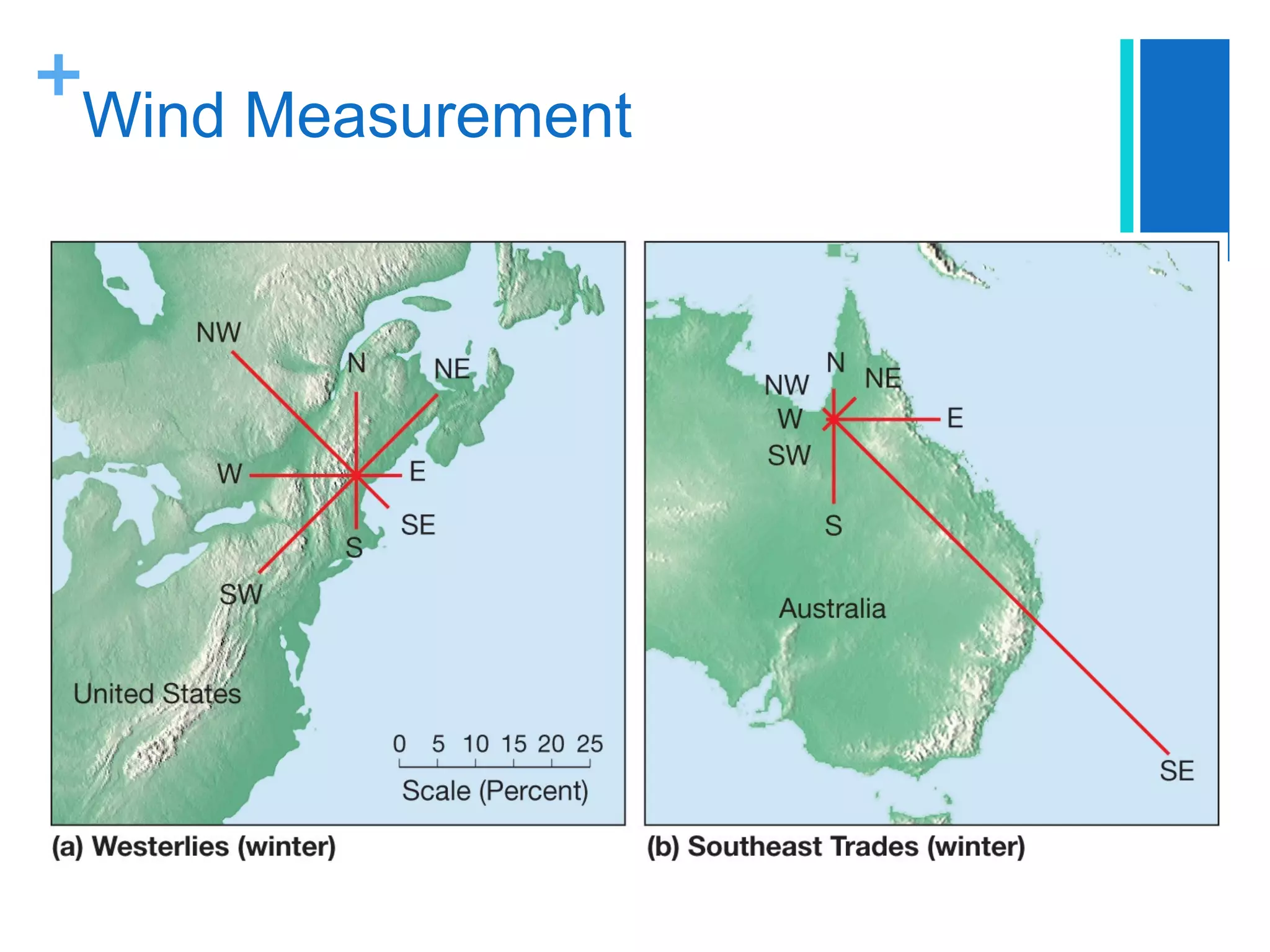
 Wind   direction is always measured from
  the direction it is coming.
   A North wind blows north to south.
   A East wind blows east to west.

 A prevailing wind consistently blows
  more often than not from one direction.
+
 Wind Measurement
+
 Wind Measurement


 A wind   vane shows wind direction.
 Wind speed is often measured with a cup
  anemometer, which has a dial that shows
  wind speed.
 An aerovane is a combination of wind
  vane and anemometer.

Chapter 6

  • 1.
    + Air Pressure andWinds Chapter 6 © 2011 Pearson Education, Inc.
  • 2.
    + 6.1 Wind andAir Pressure © 2011 Pearson Education, Inc.
  • 3.
    + Wind andAir Pressure Wind is the result of horizontal differences in atmospheric pressure. Atmospheric (air) pressure is the force exerted against a surface by continuous collision of gas molecules.  Atmosphere is without walls but the force of gravity prevents its escape.
  • 4.
    + Wind andAir Pressure The air pressure at sea level is about 1 kg/cm2. Specifically, a column of air is 1 sq inch in cross section, measured from sea level to the top of the atmosphere would weigh 14.7 lbs. © 2011 Pearson Education, Inc.
  • 5.
    + 6.2 Measuring AirPressure © 2011 Pearson Education, Inc.
  • 6.
    + Measuring AirPressure  Air pressure is measured in millibars. 1 millibar (mb) = 100 newtons/m2  1013.25 mb = sea level pressure  The mercury barometer is the standard pressure- measuring instrument.  Air pressure pushes on a pool of mercury, which forces the mercury up a tube.  High pressure: The mercury goes further up the tube.  Low pressure: The mercury stays lower.
  • 7.
    + Measuring AirPressure Fair weather = high pressure Rain = low pressure © 2011 Pearson Education, Inc.
  • 8.
  • 9.
    + © 2011 PearsonEducation, Inc.
  • 10.
    + 6.3 Pressure Changeswith Altitude © 2011 Pearson Education, Inc.
  • 11.
    + Pressure Changeswith Altitude Air pressure is defined as the force exerted against a surface by continuous collision of gas molecules.  Air pressure decreases with altitude.  Because of the decrease of pressure above you  Air pressure increases with depth.  Because of the increase of pressure above you
  • 12.
    + Pressure Changeswith Altitude Air pressure decreases about 10mb per 100m increase in elevation Air pressure is reduced by approximately ½ for each 5 km increase in altitude. © 2011 Pearson Education, Inc.
  • 13.
    + 6.4 Why doesAir Pressure Vary? © 2011 Pearson Education, Inc.
  • 14.
    + Why DoesAir Pressure Vary? Recall that variations in air pressure causes the wind to blow, which in turn causes changes in temperature and humidity Water vapor affects air pressure.  The amount of water vapor reduces the density of air.  Cold dry air has higher pressure.  Warm, dry air has higher pressure than equally warm, moist air.
  • 15.
    + Why DoesAir Pressure Vary? The movement of air can also cause variations in air pressure.  Convergence occurs when a net airflow into a region causing pressure to rise.  Divergence results when there is a net outflow of air from a region and surface pressure drops.
  • 16.
    + Why DoesAir Pressure Vary? Temperature influences air pressure.
  • 17.
    + 6.5 Factors AffectingWind © 2011 Pearson Education, Inc.
  • 18.
    + Factors AffectingWind Pressure gradient force Coriolis force Friction
  • 19.
    + Factors AffectingWind- Pressure Gradient Force The force that generates winds results from horizontal pressure differences. Greater differences the greater the wind blows Pressure gradient force  Spacing of the isobars indicate the amount of pressure change occurring over a given distance.
  • 20.
    + Factors AffectingWind- Pressure Gradient Force  Isobars are lines connecting places of equal pressure.  If isobars are close together a steep gradient and high winds result.  If isobars are far apart, the result is a low gradient and lower wind speeds. © 2011 Pearson Education, Inc.
  • 21.
    + Factors AffectingWind- Pressure Gradient Force How temperature differences generate wind Sea Breeze figure 6-11 page 169 A- Temp and pressure don’t vary horizontally
  • 22.
    + Factors AffectingWind- Pressure Gradient Force B- as the sun rises the earth begins to warm. Air above the land warms and expands creating a high pressure area (less dense air column) and the air aloft begins to flow away from the land © 2011 Pearson Education, Inc.
  • 23.
    + Factors AffectingWind- Pressure Gradient Force C- The mass transfer of air aloft creates a surface high pressure area over the land. The surface circulation that develops from this redistribution of mass is from the sea towards the land = sea breeze. © 2011 Pearson Education, Inc.
  • 24.
    + Factors AffectingWind- Pressure Gradient Force Isobars on a surface chart:  Low-pressure systems (L) that occur in the middle latitudes are called midlatitude cyclones.  Produce stormy weather  High-pressure systems (H) are called anticyclones, which tend to be associated with clearing conditions.
  • 25.
    + Factors AffectingWind- Coriolis Force TheCoriolis force cannot generate wind; it modifies airflow. The Coriolis force causes all free flowing objects including wind:  In the Northern Hemisphere, a deviation to the right is due to the Earth’s rotation.  In the Southern Hemisphere, the deviation is to the left.
  • 26.
    + Factors AffectingWind- Coriolis Force The Coriolis force is a deflecting force.  It is always directed at right angles to the direction of airflow.  It controls only wind direction, not speed.  It is affected by wind speed (the stronger the wind, the greater the force).  The Coriolis force is strongest at the poles and is nonexistent at the equator.
  • 27.
    + Factors AffectingWind- Coriolis Force Coriolis force
  • 28.
    + Factors AffectingWind- Friction Remember pressure gradient force is the primary driving force for winds. Air moves from high to low concentrations but wind speeds don’t increase indefinitely. Friction significantly influences airflow near Earth’s surface, but its effect is negligible at higher altitudes.
  • 29.
    + 6.6 Winds Aloft © 2011 Pearson Education, Inc.
  • 30.
    + Winds Aloft  Geostrophic flow occurs when the pressure gradient force and the Coriolis force are balanced.  Thewind flows parallel to the isobars.  They flow in relatively straight paths.  Wind Direction is directly related to prevailing pressure patterns. So if we know direction we can establish a rough approximation of the pressure distribution.
  • 31.
    + © 2011 PearsonEducation, Inc.
  • 32.
    + Winds Aloft Buys Ballot’s Law states that if you stand with the wind at your back, low pressure will be found on your left, high pressure on the right. The situation is reversed in the southern hemisphere. © 2011 Pearson Education, Inc.
  • 33.
    + Winds Aloft Curved airflow and the gradient wind Curved airflow:  Winds around cells of high pressure or low pressure follow curved paths.
  • 34.
    + Winds Aloft Gradient winds blow at a constant speed.  They are parallel to the curved isobars.  Centers of low pressure are called cyclonic; winds flow counter-clockwise in the Northern Hemisphere.  A trough is the result of isobars curving to form elongated regions of low pressure.  Centers of high pressure are anticyclonic; winds flow clockwise in the Southern Hemisphere.  A ridge is the result of isobars curving to form elongated regions of high pressure. Opposite is true in the Southern Hemisphere
  • 35.
    + Winds Aloft Curved airflow and the gradient wind
  • 36.
    + Winds Aloft In Low Pressure Centers- Figure A  The inward directed pressure gradient force is opposed by the outward directed Coriolis force. The pressure gradient force must exceed the coriolis force to overcome the air’s tendency to continue moving in a straight line. In High Pressure Centers- Figure B  Pressure gradient force and Coriolis force are not balanced. The imbalance provides a change in direction and generates the curved flow © 2011 Pearson Education, Inc.
  • 37.
    + 6.7 Surface Winds © 2011 Pearson Education, Inc.
  • 38.
    + Surface Winds Surface winds travel at an angle across isobars, toward low pressure.
  • 39.
    + Surface Winds Air flow crosses the isobars at varying angles depending on friction for terrain, but winds always move from high to low pressure. In a cyclone pressure decreases inward and friction causes a new flow towards its center In an anticyclone pressure decreases outward and friction causes a net flow away from its center © 2011 Pearson Education, Inc.
  • 40.
    + 6.8 How WindsGenerate Vertical Air Motion © 2011 Pearson Education, Inc.
  • 41.
    + How Winds GenerateVertical Air Motion  Factors that promote vertical airflow:  Friction  Increased friction causes a drop in wind speed resulting in a pileup of air upstream from the ocean to land.  Convergence can result in cloudy weather.  Decreased friction causes and increase in wind speed from the land to the ocean.  Subsidence and divergence results in clearing weather.
  • 42.
    + How Winds GenerateVertical Air Motion Vertical airflow is associated with cyclones and anticyclones.
  • 43.
    + How Winds Generate Vertical Air Motion Cyclones  Horizontal convergence- net inward transport of air causes a shrinking of the area it occupies  This causes a pile up of air creating a dense column which increases pressure  TO compensate aloft, divergence (spreading out) occurs at an equal rate to inflow below  Remember rising air causes bad weather © 2011 Pearson Education, Inc.
  • 44.
    + How Winds Generate Vertical Air Motion Anticyclones  Convergence (pulling in) happens aloft and general subsidence of the air column happens  This creates good, nice weather © 2011 Pearson Education, Inc.
  • 45.
    + 6.9 Wind Measurements © 2011 Pearson Education, Inc.
  • 46.
    + Wind Measurement Wind direction is always measured from the direction it is coming.  A North wind blows north to south.  A East wind blows east to west. A prevailing wind consistently blows more often than not from one direction.
  • 47.
  • 48.
    + Wind Measurement A wind vane shows wind direction. Wind speed is often measured with a cup anemometer, which has a dial that shows wind speed. An aerovane is a combination of wind vane and anemometer.