+


     Temperature
     Chapter 3

Copyright © 2013 Pearson Education, Inc.
+


     3.1 For the Record: Air Temperature
     Data
Copyright © 2013 Pearson Education, Inc.
+
         For the Record: Air-Temperature Data


          Basic             calculations:
              Daily mean                     Monthly  mean
                Average of 24 hourly           Average of daily means
                 readings                     Annual mean
              Daily temperature range          Average of monthly means
                Difference of daily          Annual temperature range
                 high and low                   Difference of highest and
                                                 lowest monthly mean


Copyright © 2013 Pearson Education, Inc.
+
         For the Record: Air-Temperature Data

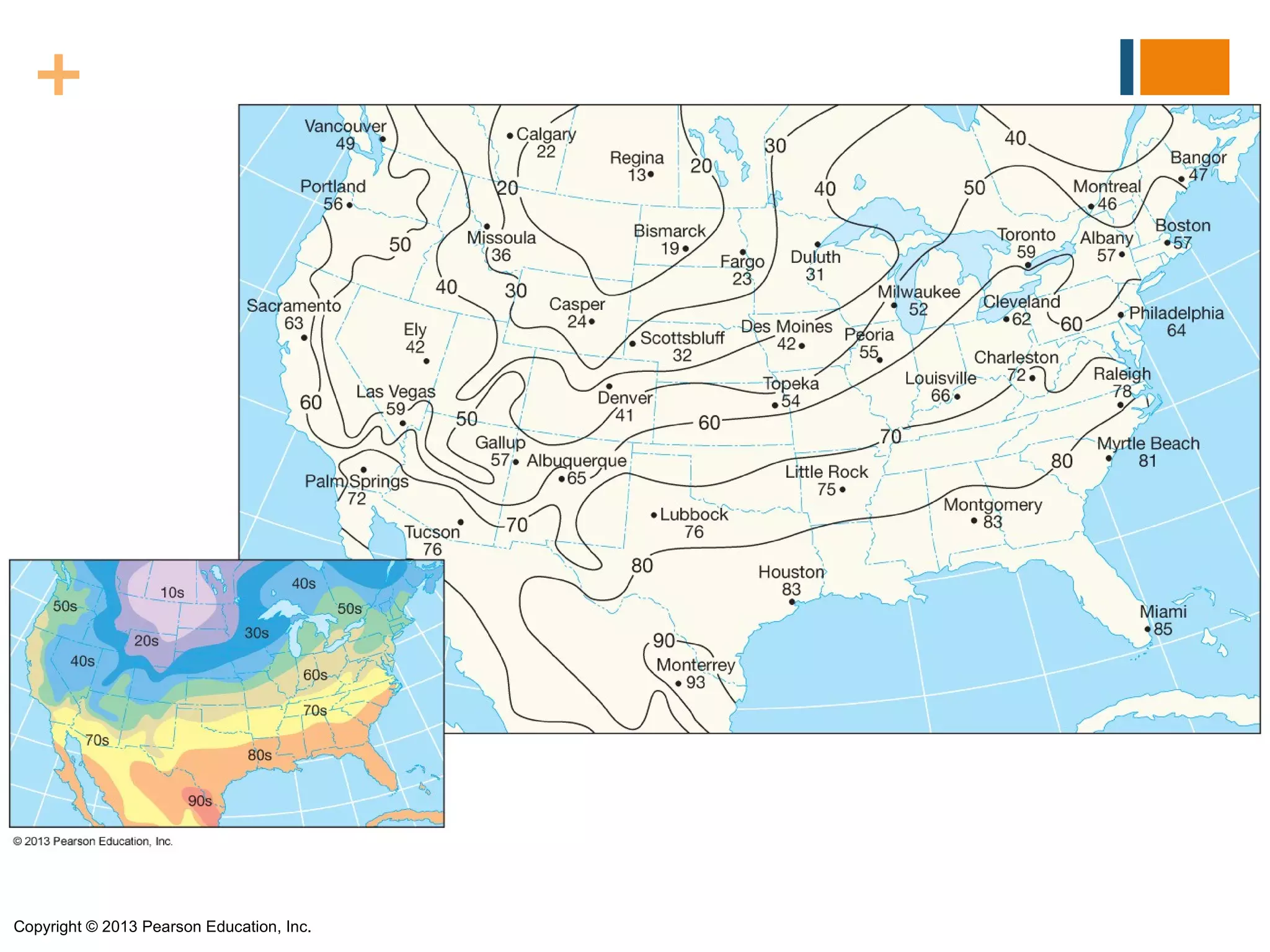
         Isotherms:
              Lineconnecting equal temperature
              Generally there is a 5° to 10° temperature
               change per unit of difference
         Closely   spaced isotherms indicate rapid
             temperature changes
         Wider    spaced isotherms indicate a more
             gradual rate of change

Copyright © 2013 Pearson Education, Inc.
+


Copyright © 2013 Pearson Education, Inc.
+


     3.2 Why Temperatures Vary: The
     Controls of Temperature
Copyright © 2013 Pearson Education, Inc.
+
         Why Temperatures Vary: The Controls
         of Temperature

         Controls                     of temperature:
              Differential
                          heating of land and water
              Ocean currents
              Altitude
              Geographic positioning
              Cloud cover and albedo


Copyright © 2013 Pearson Education, Inc.
+


     3.3 Land and Water

Copyright © 2013 Pearson Education, Inc.
+
   Land and Water
       Why do they cool differently?
         Water                is mobile.
              Temperatures                 rise and fall slower on water than
                 on land.
         Land               is opaque.
              Heat            is absorbed only on the surface.
         Specific    heat is three times greater for water
             than land.
         Evaporation                      is greater over water.
Copyright © 2013 Pearson Education, Inc.
+


     3.4 Ocean Currents

Copyright © 2013 Pearson Education, Inc.
+
   Ocean Currents
      At    the water surface energy is passed from moving
         air to the water through friction. The drag exerted
         by winds blowing steadily across the ocean causes
         he surface layer of water to move.
      Minor    horizontal movements of surface water are
         closely related to the circulation of the atoms,
         which in turn is driven by the unequal heating of
         earth by the sun.


Copyright © 2013 Pearson Education, Inc.
+Ocean Currents
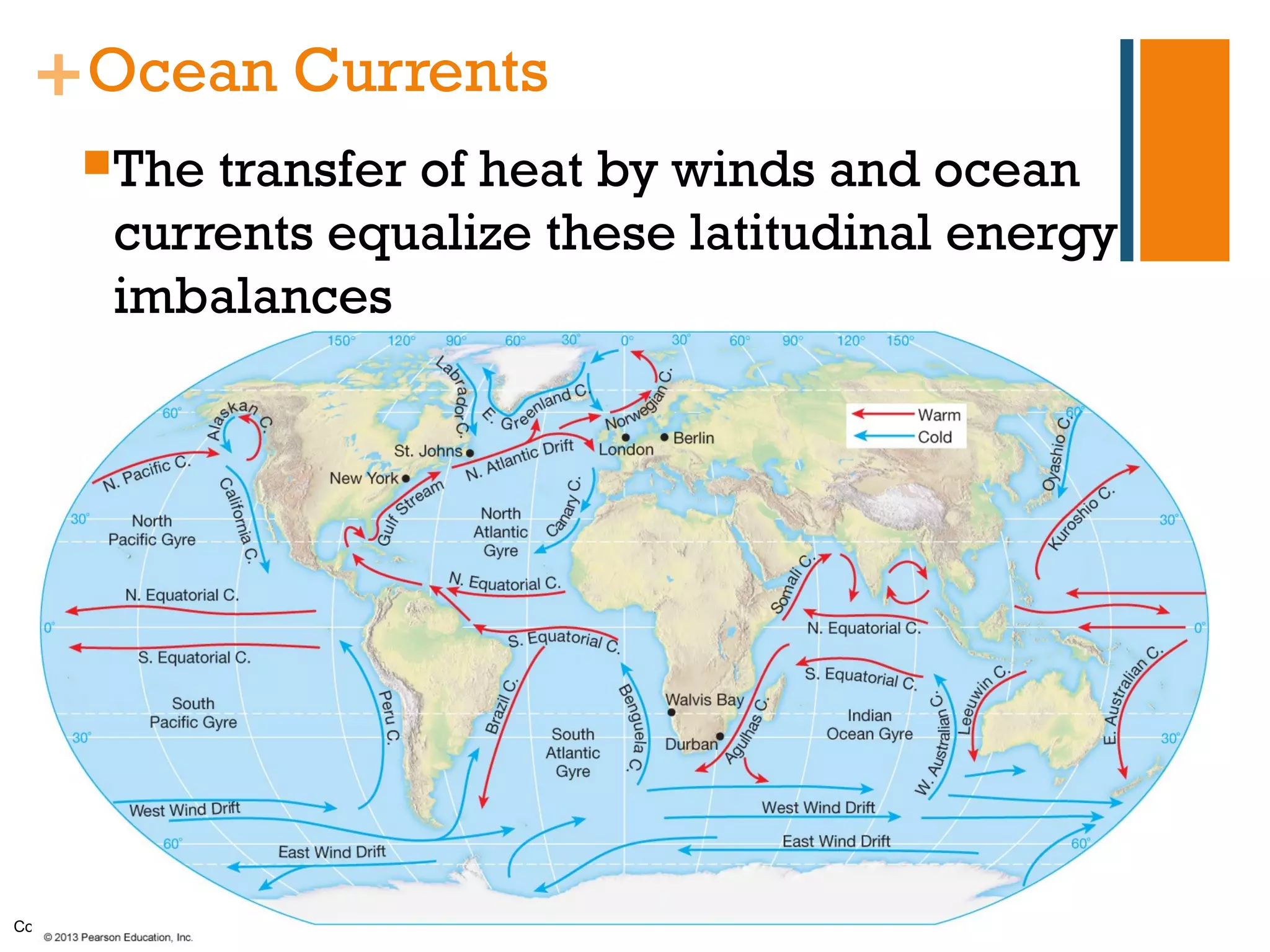
         The    transfer of heat by winds and ocean
             currents equalize these latitudinal energy
             imbalances


Copyright © 2013 Pearson Education, Inc.
+


     3.5 Altitude

Copyright © 2013 Pearson Education, Inc.
+
   Altitude

         Temperatures                     decrease with altitude.
         The             atmosphere is thinner at higher altitudes.
         Higher    altitudes produce a greater daily
             temperature range.


Copyright © 2013 Pearson Education, Inc.
+


     3.6 Geographic Position

Copyright © 2013 Pearson Education, Inc.
+
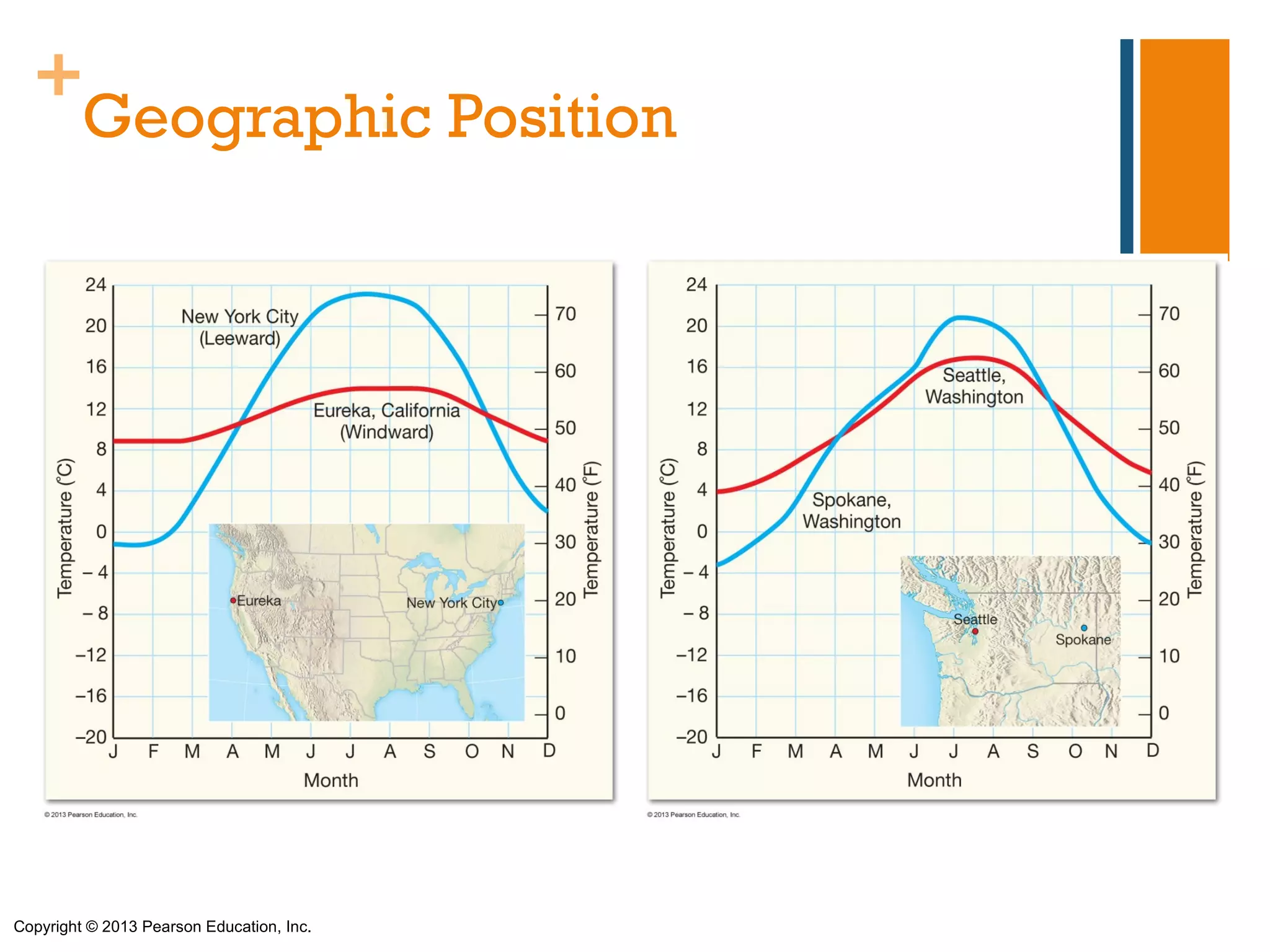
   Geographic Position

         Windward                          coast
              Costal  location where prevailing winds blow from the
                 ocean onto the shore
         Leeward                          coast
              Costal   location where prevailing winds blow from
                 land toward the ocean
         Mountains     can cut off the ocean winds and give
             cities more continental temperatures

Copyright © 2013 Pearson Education, Inc.
+
   Geographic Position


Copyright © 2013 Pearson Education, Inc.
+


     3.7 Cloud Cover and Albedo

Copyright © 2013 Pearson Education, Inc.
+
   Cloud Cover and Albedo

         More      clouds cause lower surface temperatures
             during the day, but warmer temperatures at
             night.
         A high                  albedo reduces surface temperature.
              Clouds    have high albedos, so incoming solar
                 radiation gets bounced back to space. So by
                 reducing incoming solar radiation, day temps
                 will be lower than if clouds were absent.

Copyright © 2013 Pearson Education, Inc.
+
   Cloud Cover and Albedo

         Snow                 acts like clouds
              Sunny      days are cooler because energy the land
                 would have absorbed and used for heating the
                 air is reflected and lost.


Copyright © 2013 Pearson Education, Inc.
+


     3.8 World Distribution of
     Temperatures
Copyright © 2013 Pearson Education, Inc.
+
   World Distribution of Temperature

         There  is a smaller temperature range at the
          equator.
         There is a larger temperature range at higher
          latitudes.
         Interiors of continents have a higher
          temperature range.
         Coastal regions have a smaller temperature
          range.

Copyright © 2013 Pearson Education, Inc.
+
   World Distribution of Temperature

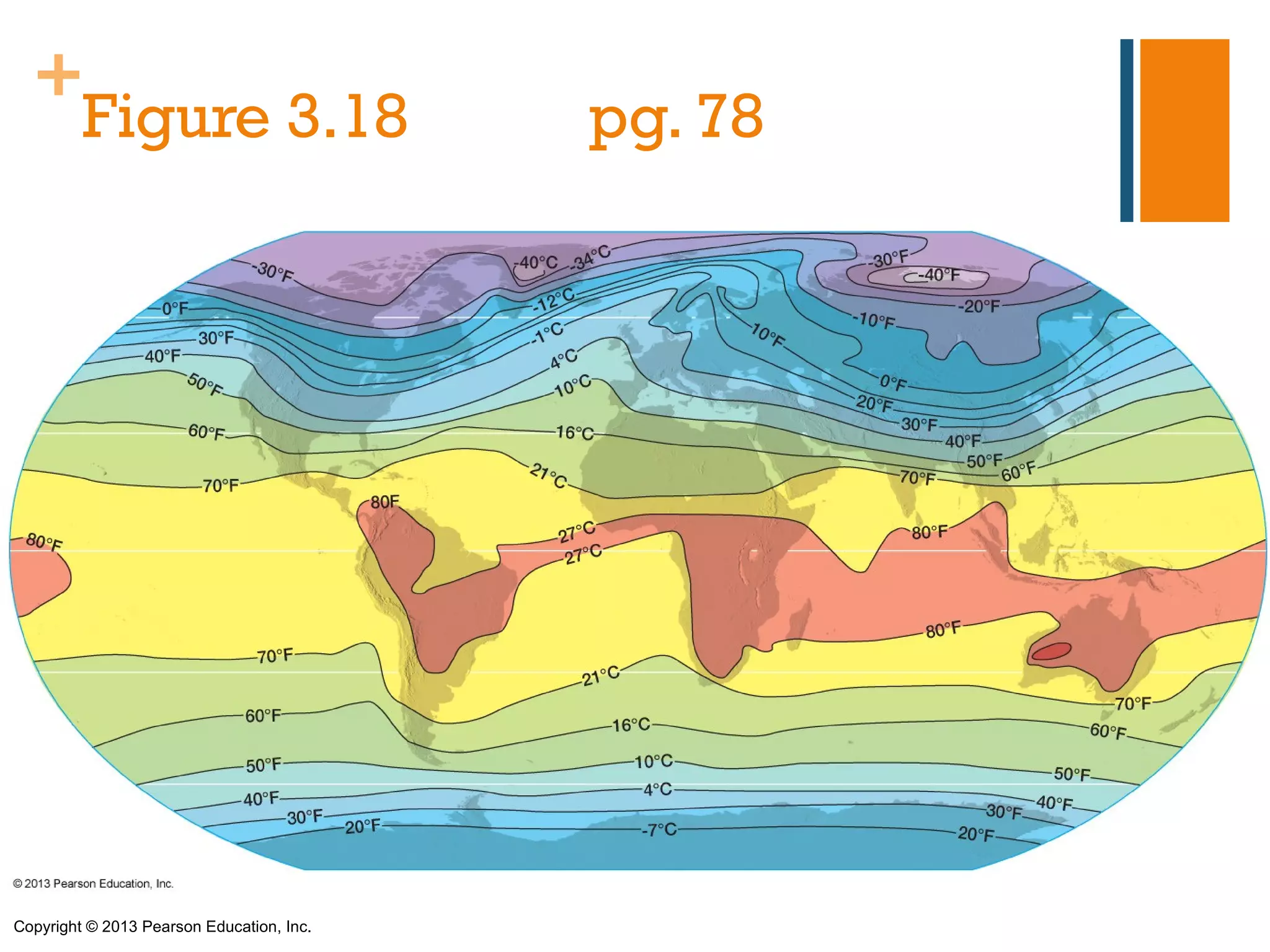
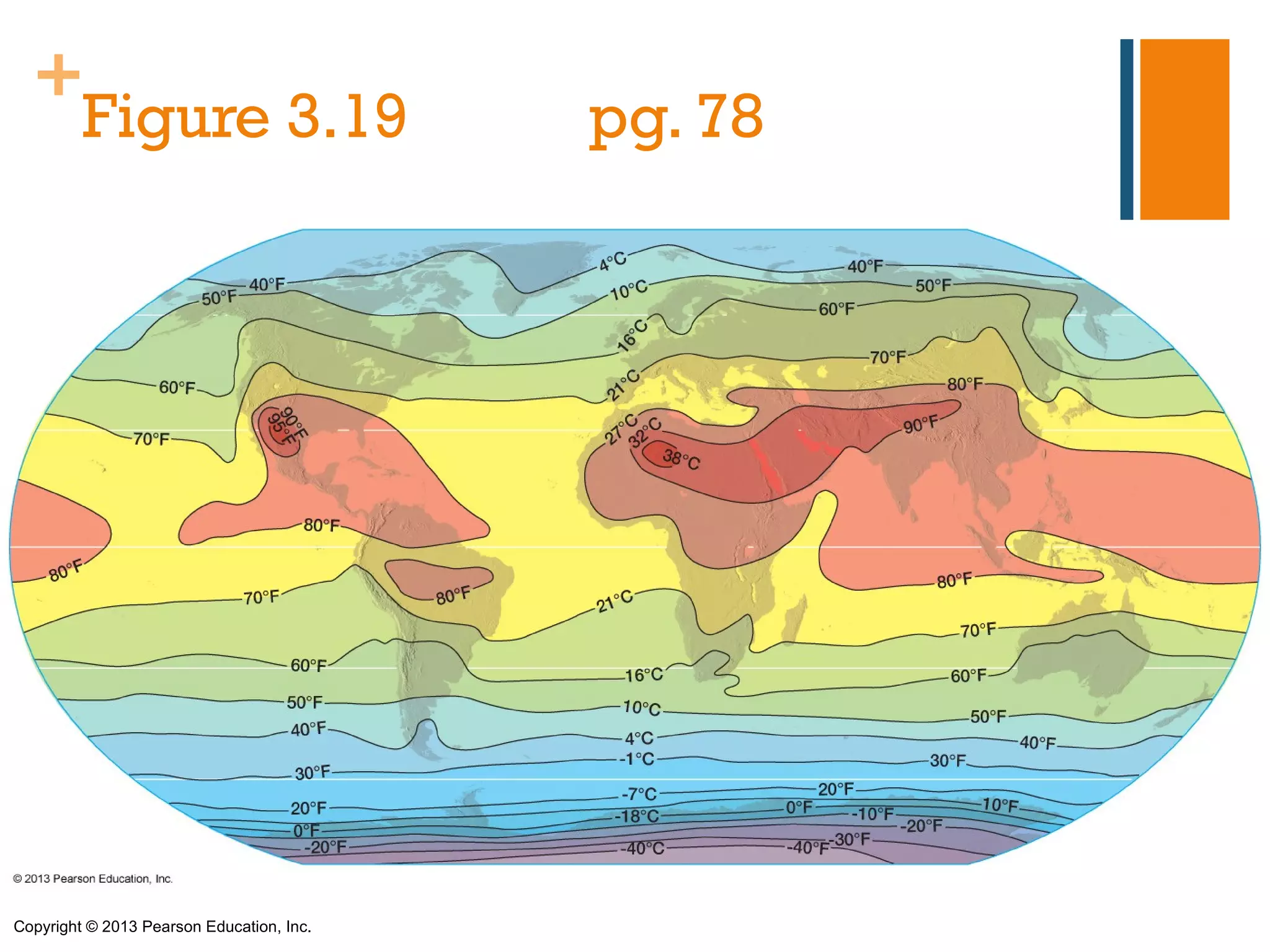
         There    are also latitudinal shifting of
             temperatures caused by seasonal migration of
             the sun
              Look              at colors on figures 3.18 and 3.19
         Isotherms   in Southern Hemisphere are much
             more regular than in Northern Hemisphere.


Copyright © 2013 Pearson Education, Inc.
+
   Figure 3.18                             pg. 78


Copyright © 2013 Pearson Education, Inc.
+
   Figure 3.19                             pg. 78


Copyright © 2013 Pearson Education, Inc.
+


     3.9 Cycles of Air Temperature

Copyright © 2013 Pearson Education, Inc.
+
   Cycles of Air Temperatures
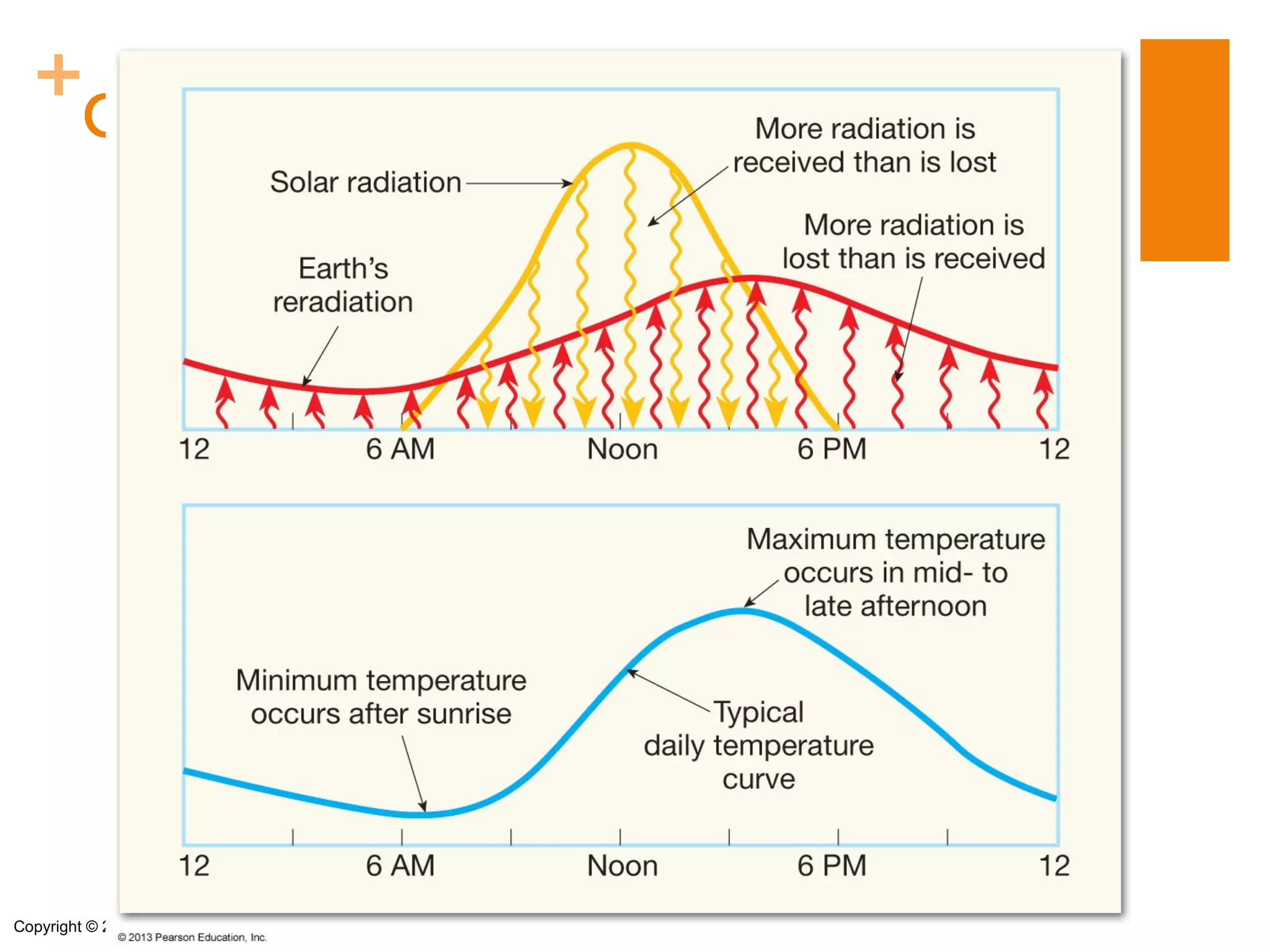
         Daily               temperature variations:
              Primary  control of the daily cycle of air temp is
               earth’s daily rotation causing periods of light and
               dark.
              At noon time incoming rays exceed outgoing equal a
               surplus for a few hours. When the input is no longer
               exceeds the rate of energy lost by Earth the
               temperature falls.
              Vary by seasons.
              Vary with cloud cover.

Copyright © 2013 Pearson Education, Inc.
+
   Cycles of Air Temperatures


Copyright © 2013 Pearson Education, Inc.
+
   Cycles of Air Temperatures

         Magnitude                        of daily temperature change:
              At mid and low latitudes, a high sun angle
               results in a large variation throughout the day.
              At higher latitudes, a low sun angle results in
               lower temperature variations.
              Windward coasts have small variations.
              Inland areas have larger variations.
              Temperature change depends on the amount of
               cloud cover and water vapor.
Copyright © 2013 Pearson Education, Inc.
+
   Cycles of Air Temperatures

         Annual                    temperature variations:
              Highest  and lowest mean temperatures do not
               coincide with maximum or minimum incoming
               solar radiation.
              In the northern hemisphere, August has the
               highest mean temperature, while June has the
               highest incoming solar radiation.


Copyright © 2013 Pearson Education, Inc.
+


     3.10 Temperature
     Measurements
Copyright © 2013 Pearson Education, Inc.
+
   Temperature Measurement

         Mechanical                        thermometers:
              Liquidin glass
              Maximum thermometer—mercury
              Minimum thermometer—alcohol
              Thermograph—bimetal strip

         Electrical                       thermometers:
              Thermistor—electrically                     resistant at different
                 temperatures
                  Very fast

Copyright © 2013 Pearson Education, Inc.
+
   Temperature Measurement

         Instrument                       shelters:
              White box
              Louvered sides
              Over grass
              1.5 m above ground


Copyright © 2013 Pearson Education, Inc.
+


     3.11 Temperature Scales

Copyright © 2013 Pearson Education, Inc.
+
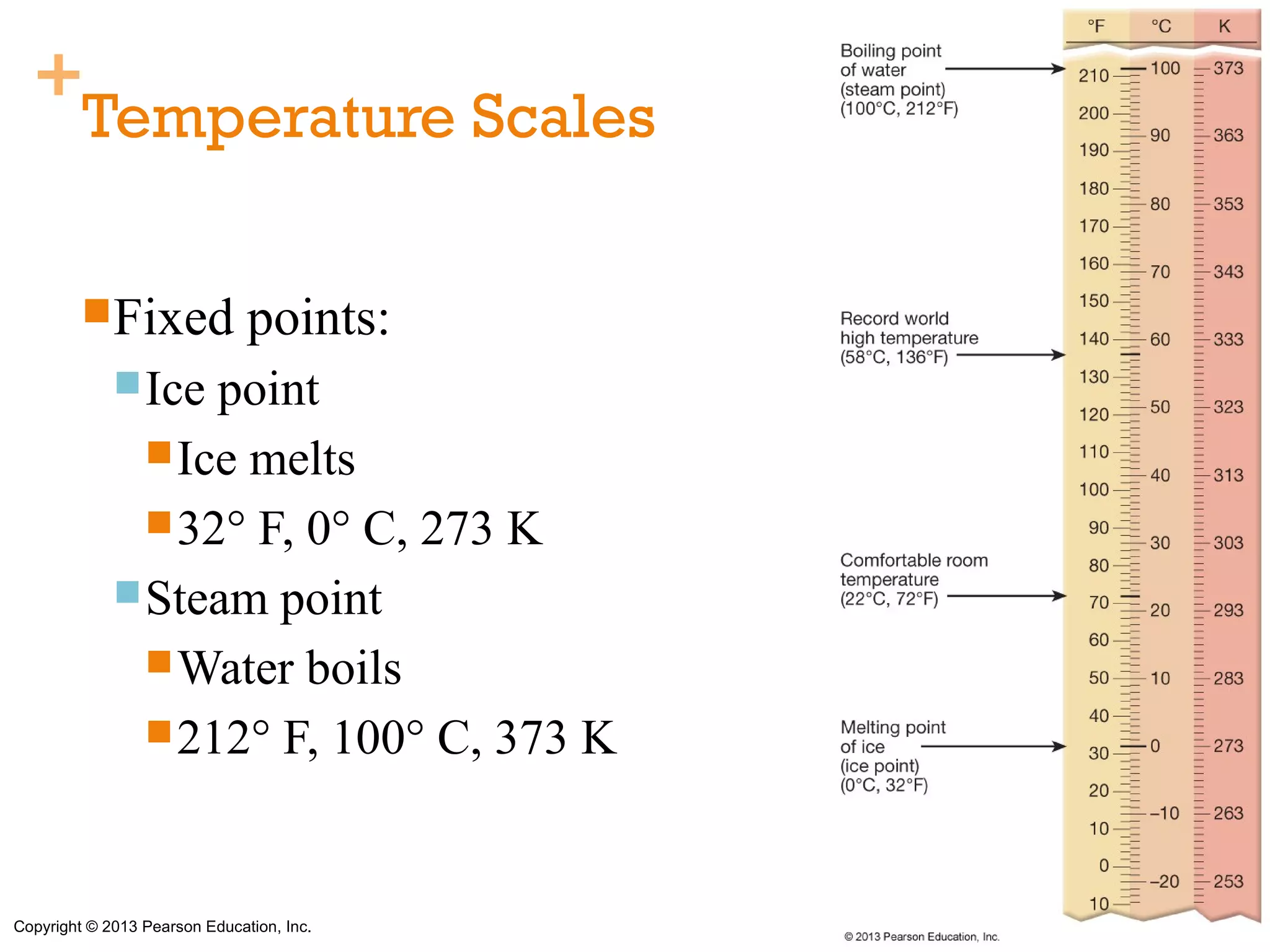
   Temperature Scales

         Fixed                points:
              Ice point
                Ice melts
                32° F, 0° C, 273 K
              Steam point
                Water boils
                212° F, 100° C, 373 K


Copyright © 2013 Pearson Education, Inc.
+
   Temperature Scales

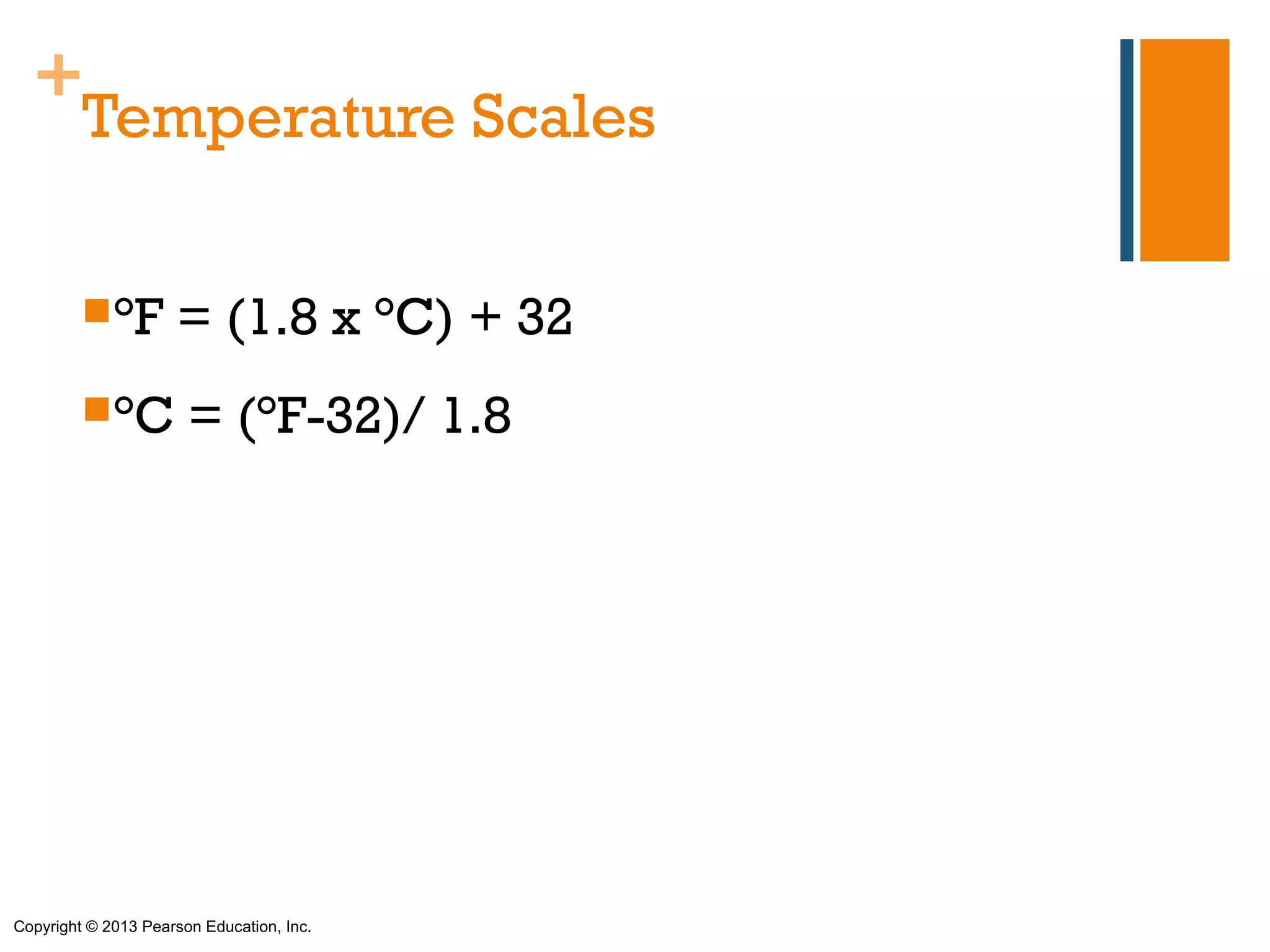
         °F         = (1.8 x °C) + 32
         °C           = (°F-32)/ 1.8


Copyright © 2013 Pearson Education, Inc.
+


     3.12 Heat Stress and Wind Chill

Copyright © 2013 Pearson Education, Inc.
+
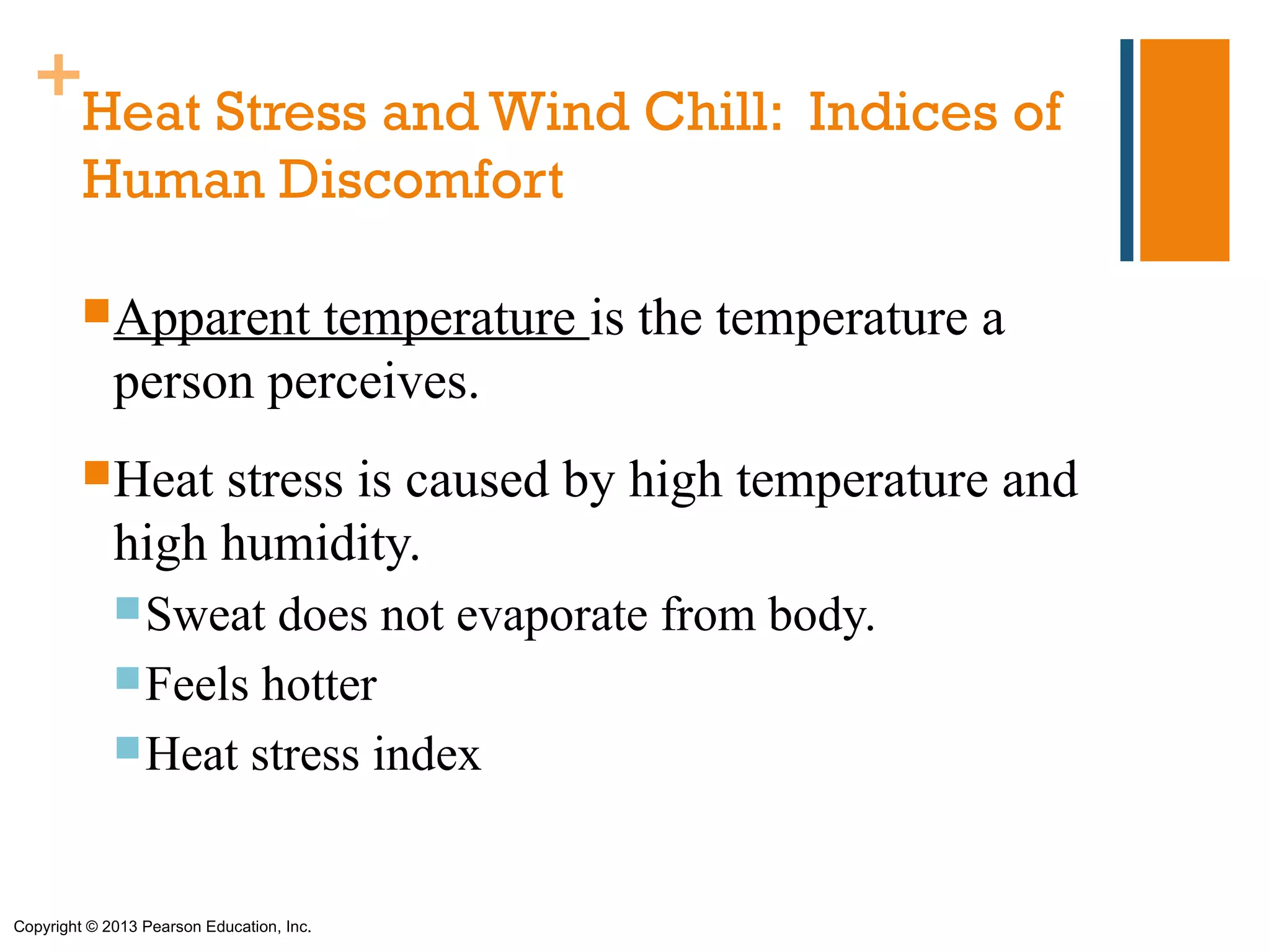
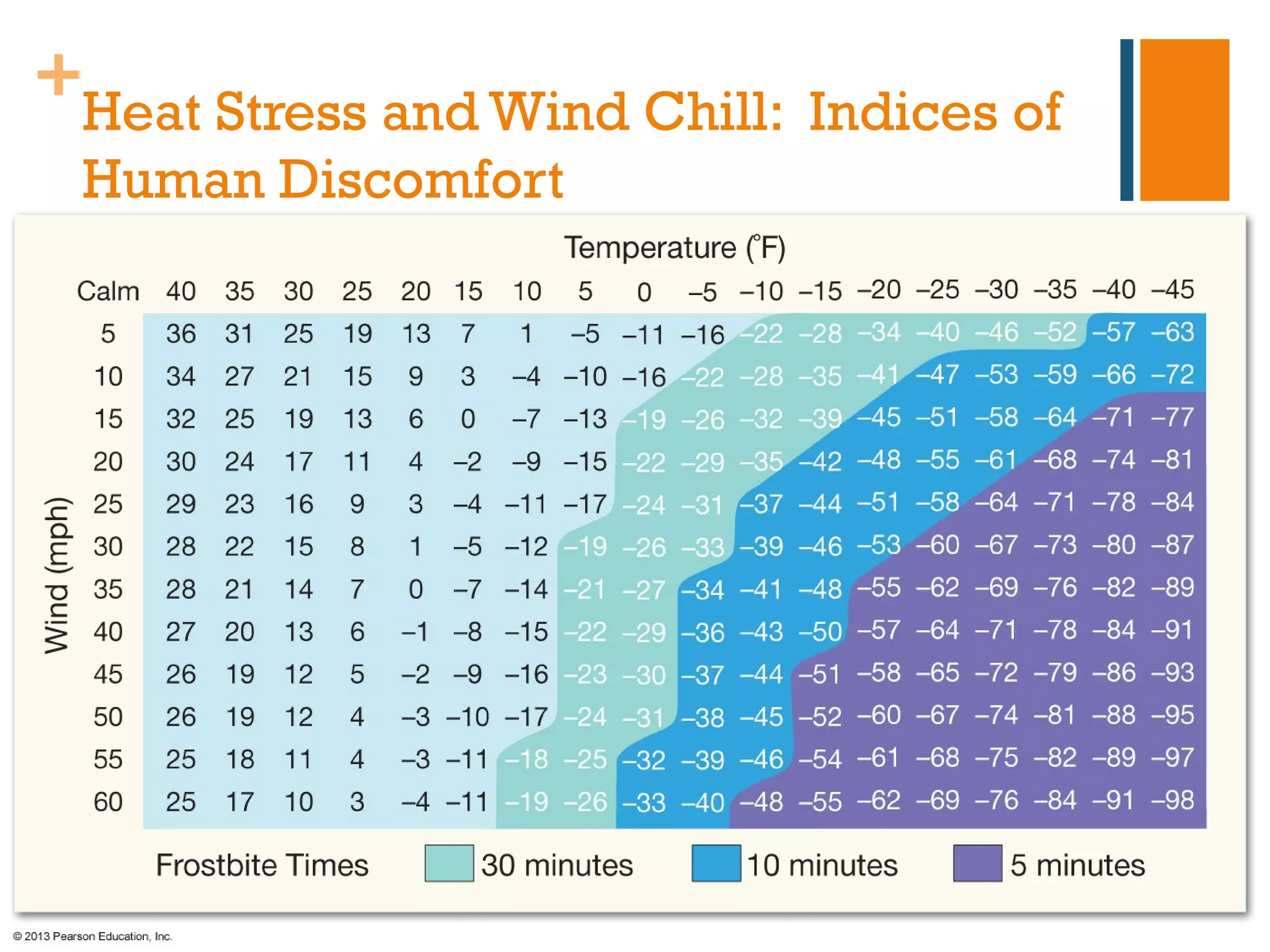
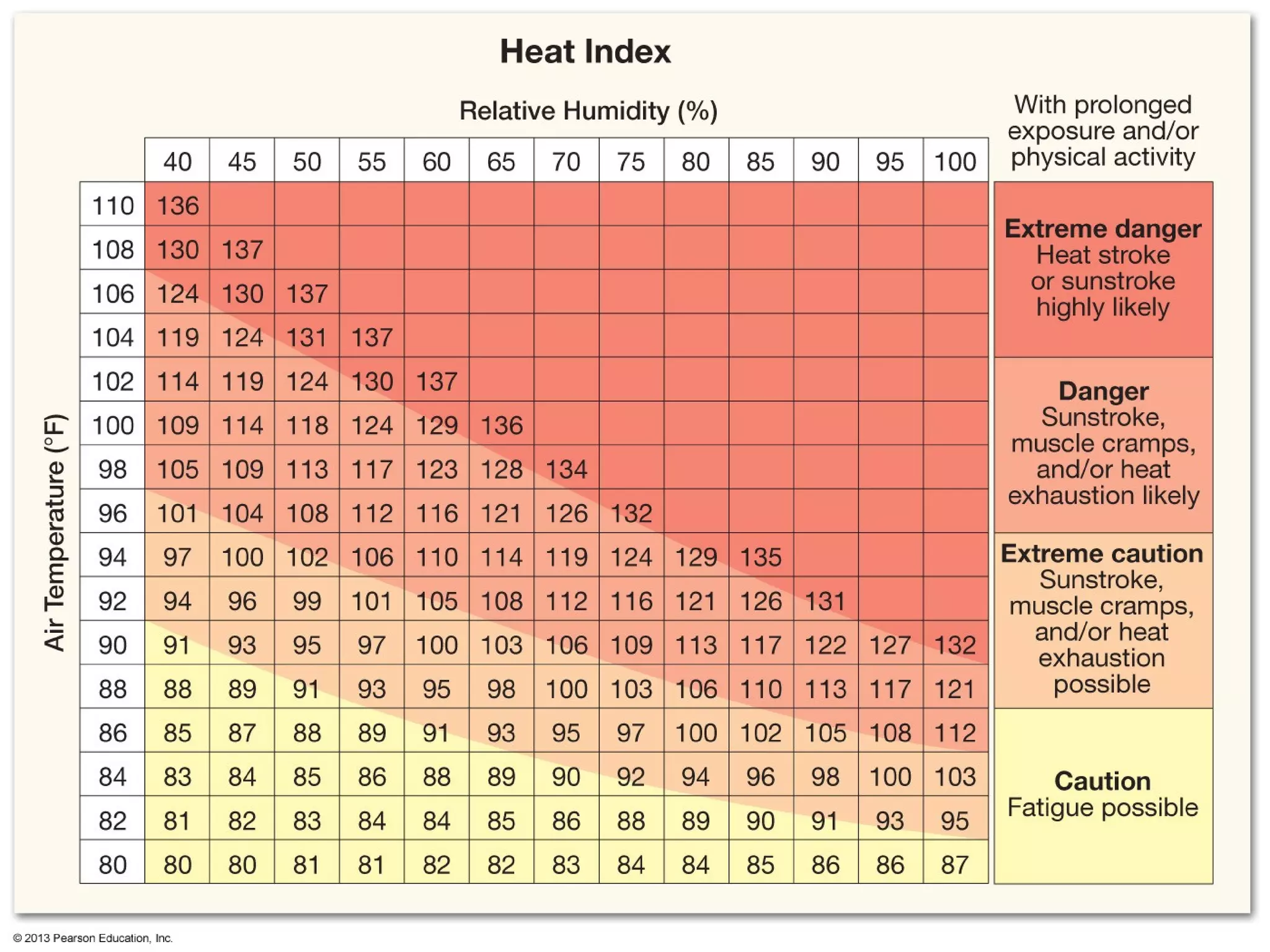
         Heat Stress and Wind Chill: Indices of
         Human Discomfort

         Apparent    temperature is the temperature a
             person perceives.
         Heat    stress is caused by high temperature and
             high humidity.
              Sweat  does not evaporate from body.
              Feels hotter
              Heat stress index


Copyright © 2013 Pearson Education, Inc.
+
         Heat Stress and Wind Chill: Indices of
         Human Discomfort


Copyright © 2013 Pearson Education, Inc.
+
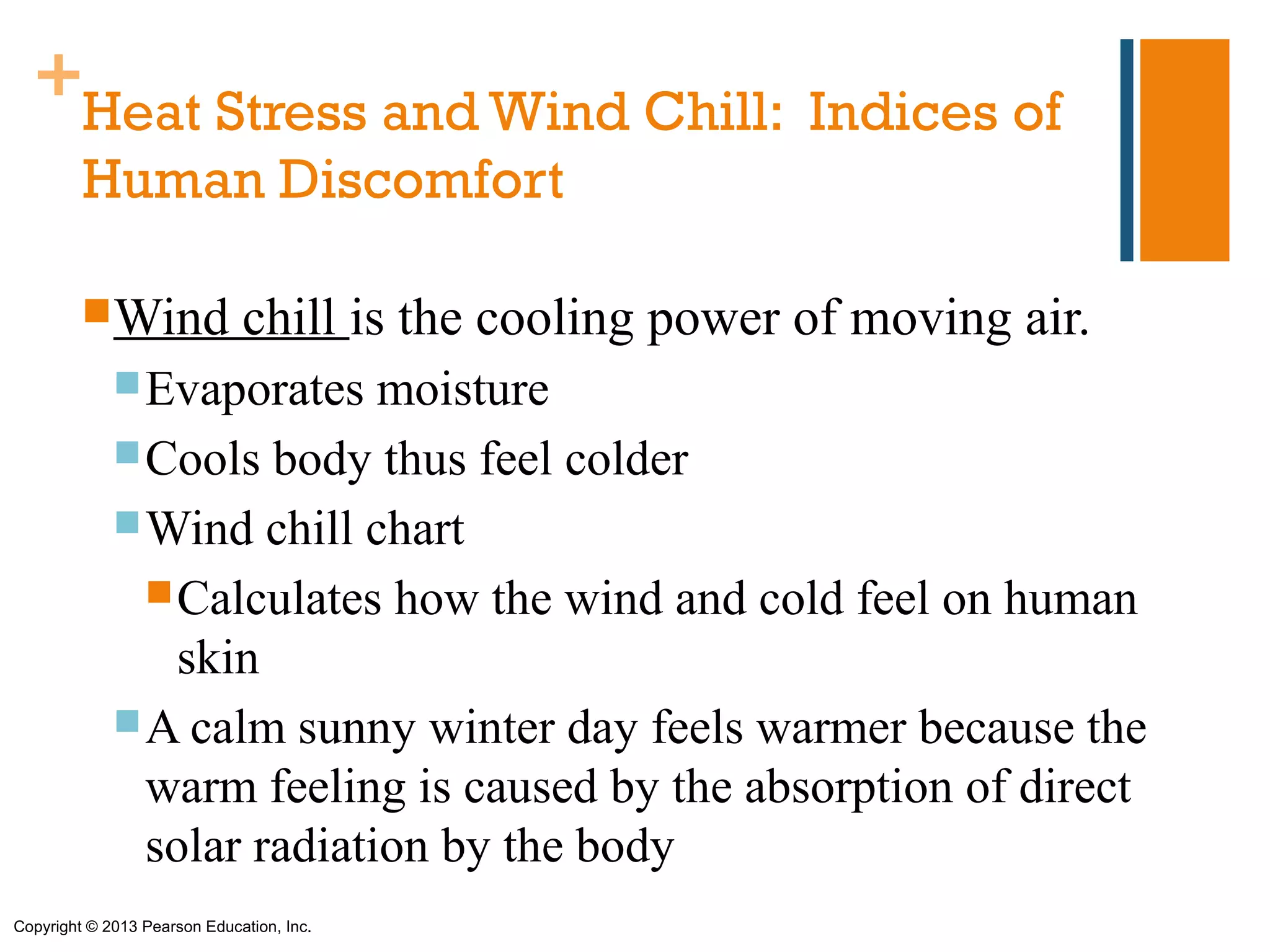
         Heat Stress and Wind Chill: Indices of
         Human Discomfort

          Wind               chill is the cooling power of moving air.
              Evaporates   moisture
              Cools body thus feel colder
              Wind chill chart
                Calculates how the wind and cold feel on human
                 skin
              A calm sunny winter day feels warmer because the
               warm feeling is caused by the absorption of direct
               solar radiation by the body
Copyright © 2013 Pearson Education, Inc.
+
         Heat Stress and Wind Chill: Indices of
         Human Discomfort


Copyright © 2013 Pearson Education, Inc.

Temperature

  • 1.
    + Temperature Chapter 3 Copyright © 2013 Pearson Education, Inc.
  • 2.
    + 3.1 For the Record: Air Temperature Data Copyright © 2013 Pearson Education, Inc.
  • 3.
    + For the Record: Air-Temperature Data  Basic calculations:  Daily mean  Monthly mean  Average of 24 hourly  Average of daily means readings  Annual mean  Daily temperature range  Average of monthly means  Difference of daily  Annual temperature range high and low  Difference of highest and lowest monthly mean Copyright © 2013 Pearson Education, Inc.
  • 4.
    + For the Record: Air-Temperature Data Isotherms:  Lineconnecting equal temperature  Generally there is a 5° to 10° temperature change per unit of difference Closely spaced isotherms indicate rapid temperature changes Wider spaced isotherms indicate a more gradual rate of change Copyright © 2013 Pearson Education, Inc.
  • 5.
    + Copyright © 2013Pearson Education, Inc.
  • 6.
    + 3.2 Why Temperatures Vary: The Controls of Temperature Copyright © 2013 Pearson Education, Inc.
  • 7.
    + Why Temperatures Vary: The Controls of Temperature Controls of temperature:  Differential heating of land and water  Ocean currents  Altitude  Geographic positioning  Cloud cover and albedo Copyright © 2013 Pearson Education, Inc.
  • 8.
    + 3.3 Land and Water Copyright © 2013 Pearson Education, Inc.
  • 9.
    + Land and Water Why do they cool differently? Water is mobile.  Temperatures rise and fall slower on water than on land. Land is opaque.  Heat is absorbed only on the surface. Specific heat is three times greater for water than land. Evaporation is greater over water. Copyright © 2013 Pearson Education, Inc.
  • 10.
    + 3.4 Ocean Currents Copyright © 2013 Pearson Education, Inc.
  • 11.
    + Ocean Currents  At the water surface energy is passed from moving air to the water through friction. The drag exerted by winds blowing steadily across the ocean causes he surface layer of water to move.  Minor horizontal movements of surface water are closely related to the circulation of the atoms, which in turn is driven by the unequal heating of earth by the sun. Copyright © 2013 Pearson Education, Inc.
  • 12.
    +Ocean Currents The transfer of heat by winds and ocean currents equalize these latitudinal energy imbalances Copyright © 2013 Pearson Education, Inc.
  • 13.
    + 3.5 Altitude Copyright © 2013 Pearson Education, Inc.
  • 14.
    + Altitude Temperatures decrease with altitude. The atmosphere is thinner at higher altitudes. Higher altitudes produce a greater daily temperature range. Copyright © 2013 Pearson Education, Inc.
  • 15.
    + 3.6 Geographic Position Copyright © 2013 Pearson Education, Inc.
  • 16.
    + Geographic Position Windward coast  Costal location where prevailing winds blow from the ocean onto the shore Leeward coast  Costal location where prevailing winds blow from land toward the ocean Mountains can cut off the ocean winds and give cities more continental temperatures Copyright © 2013 Pearson Education, Inc.
  • 17.
    + Geographic Position Copyright © 2013 Pearson Education, Inc.
  • 18.
    + 3.7 Cloud Cover and Albedo Copyright © 2013 Pearson Education, Inc.
  • 19.
    + Cloud Cover and Albedo More clouds cause lower surface temperatures during the day, but warmer temperatures at night. A high albedo reduces surface temperature.  Clouds have high albedos, so incoming solar radiation gets bounced back to space. So by reducing incoming solar radiation, day temps will be lower than if clouds were absent. Copyright © 2013 Pearson Education, Inc.
  • 20.
    + Cloud Cover and Albedo Snow acts like clouds  Sunny days are cooler because energy the land would have absorbed and used for heating the air is reflected and lost. Copyright © 2013 Pearson Education, Inc.
  • 21.
    + 3.8 World Distribution of Temperatures Copyright © 2013 Pearson Education, Inc.
  • 22.
    + World Distribution of Temperature There is a smaller temperature range at the equator. There is a larger temperature range at higher latitudes. Interiors of continents have a higher temperature range. Coastal regions have a smaller temperature range. Copyright © 2013 Pearson Education, Inc.
  • 23.
    + World Distribution of Temperature There are also latitudinal shifting of temperatures caused by seasonal migration of the sun  Look at colors on figures 3.18 and 3.19 Isotherms in Southern Hemisphere are much more regular than in Northern Hemisphere. Copyright © 2013 Pearson Education, Inc.
  • 24.
    + Figure 3.18 pg. 78 Copyright © 2013 Pearson Education, Inc.
  • 25.
    + Figure 3.19 pg. 78 Copyright © 2013 Pearson Education, Inc.
  • 26.
    + 3.9 Cycles of Air Temperature Copyright © 2013 Pearson Education, Inc.
  • 27.
    + Cycles of Air Temperatures Daily temperature variations:  Primary control of the daily cycle of air temp is earth’s daily rotation causing periods of light and dark.  At noon time incoming rays exceed outgoing equal a surplus for a few hours. When the input is no longer exceeds the rate of energy lost by Earth the temperature falls.  Vary by seasons.  Vary with cloud cover. Copyright © 2013 Pearson Education, Inc.
  • 28.
    + Cycles of Air Temperatures Copyright © 2013 Pearson Education, Inc.
  • 29.
    + Cycles of Air Temperatures Magnitude of daily temperature change:  At mid and low latitudes, a high sun angle results in a large variation throughout the day.  At higher latitudes, a low sun angle results in lower temperature variations.  Windward coasts have small variations.  Inland areas have larger variations.  Temperature change depends on the amount of cloud cover and water vapor. Copyright © 2013 Pearson Education, Inc.
  • 30.
    + Cycles of Air Temperatures Annual temperature variations:  Highest and lowest mean temperatures do not coincide with maximum or minimum incoming solar radiation.  In the northern hemisphere, August has the highest mean temperature, while June has the highest incoming solar radiation. Copyright © 2013 Pearson Education, Inc.
  • 31.
    + 3.10 Temperature Measurements Copyright © 2013 Pearson Education, Inc.
  • 32.
    + Temperature Measurement Mechanical thermometers:  Liquidin glass  Maximum thermometer—mercury  Minimum thermometer—alcohol  Thermograph—bimetal strip Electrical thermometers:  Thermistor—electrically resistant at different temperatures  Very fast Copyright © 2013 Pearson Education, Inc.
  • 33.
    + Temperature Measurement Instrument shelters:  White box  Louvered sides  Over grass  1.5 m above ground Copyright © 2013 Pearson Education, Inc.
  • 34.
    + 3.11 Temperature Scales Copyright © 2013 Pearson Education, Inc.
  • 35.
    + Temperature Scales Fixed points:  Ice point  Ice melts  32° F, 0° C, 273 K  Steam point  Water boils  212° F, 100° C, 373 K Copyright © 2013 Pearson Education, Inc.
  • 36.
    + Temperature Scales °F = (1.8 x °C) + 32 °C = (°F-32)/ 1.8 Copyright © 2013 Pearson Education, Inc.
  • 37.
    + 3.12 Heat Stress and Wind Chill Copyright © 2013 Pearson Education, Inc.
  • 38.
    + Heat Stress and Wind Chill: Indices of Human Discomfort Apparent temperature is the temperature a person perceives. Heat stress is caused by high temperature and high humidity.  Sweat does not evaporate from body.  Feels hotter  Heat stress index Copyright © 2013 Pearson Education, Inc.
  • 39.
    + Heat Stress and Wind Chill: Indices of Human Discomfort Copyright © 2013 Pearson Education, Inc.
  • 40.
    + Heat Stress and Wind Chill: Indices of Human Discomfort  Wind chill is the cooling power of moving air.  Evaporates moisture  Cools body thus feel colder  Wind chill chart  Calculates how the wind and cold feel on human skin  A calm sunny winter day feels warmer because the warm feeling is caused by the absorption of direct solar radiation by the body Copyright © 2013 Pearson Education, Inc.
  • 41.
    + Heat Stress and Wind Chill: Indices of Human Discomfort Copyright © 2013 Pearson Education, Inc.