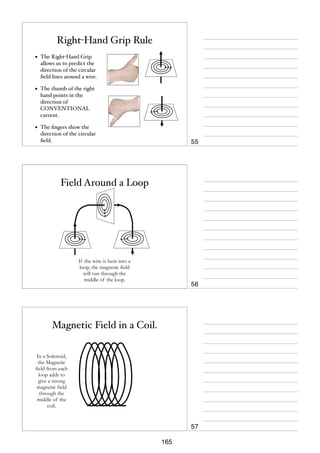
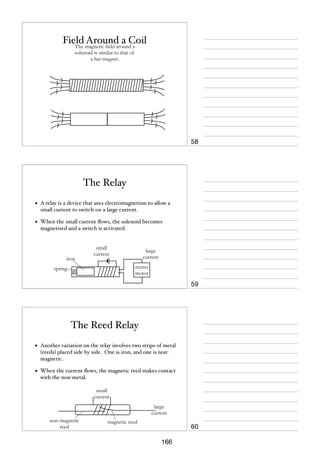
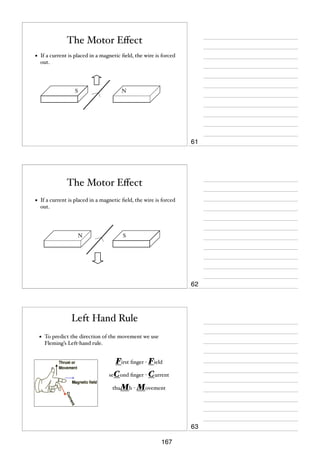
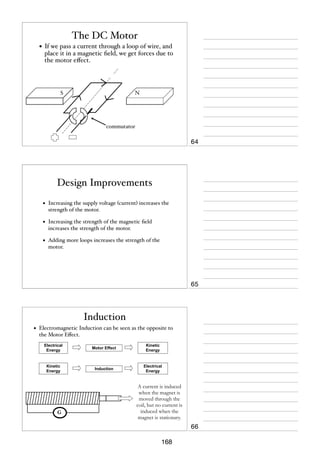
Physics
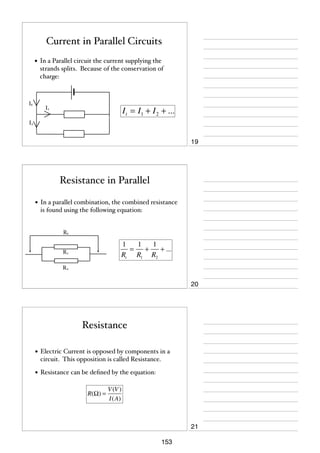
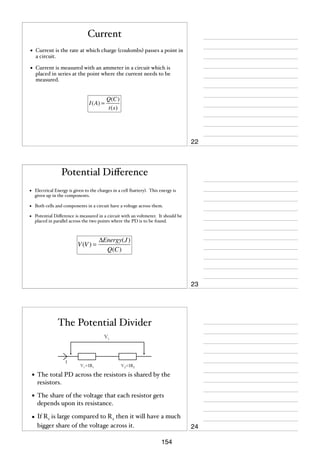
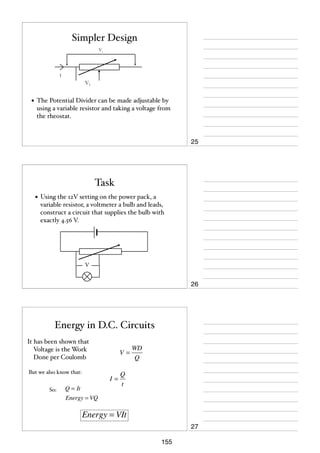
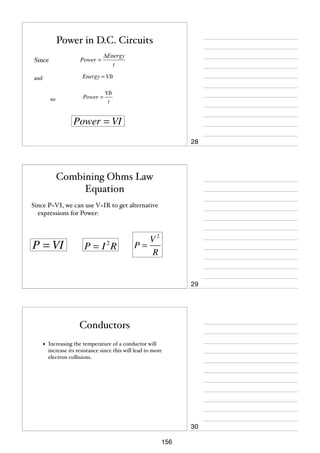
for the
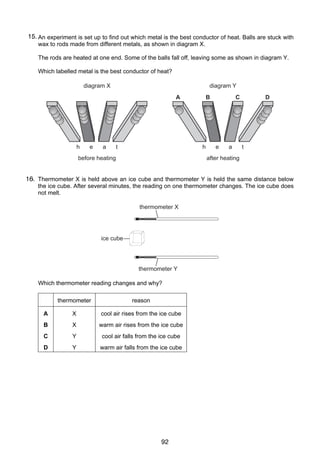
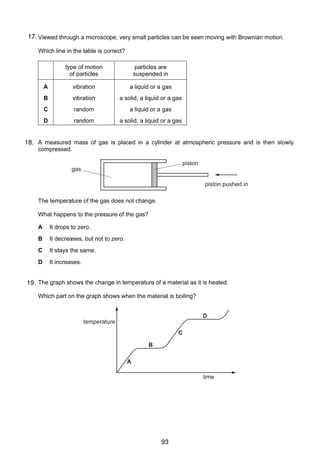
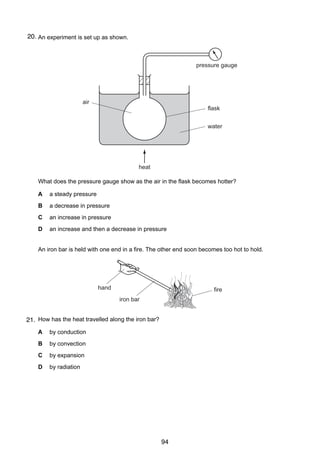
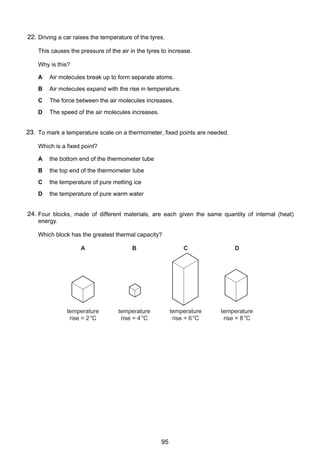
Cambridge iGCSE Syllabus

B. Murphy
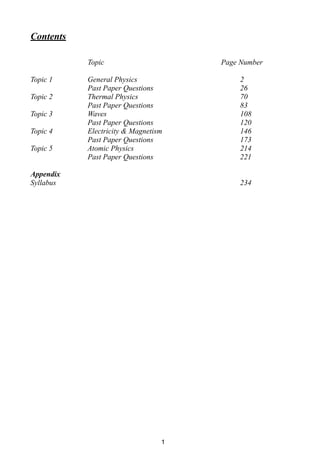
Contents
Topic
Topic 1
Topic 2
Topic 3
Topic 4
Topic 5

Page Number

General Physics
Past Paper Questions
Thermal Physics
Past Paper Questions
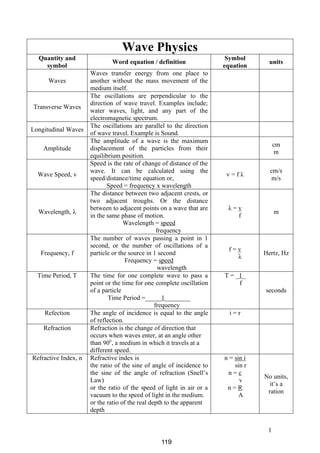
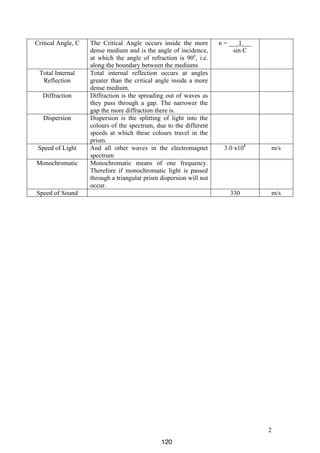
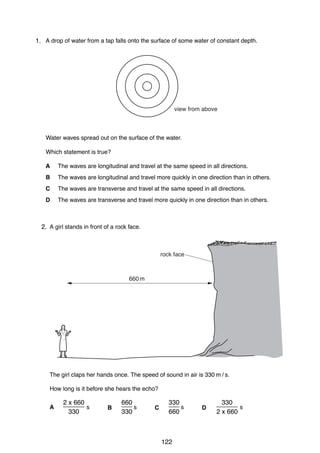
Waves
Past Paper Questions
Electricity & Magnetism
Past Paper Questions
Atomic Physics
Past Paper Questions

Appendix
Syllabus

2
26
70
83
108
120
146
173
214
221
234

1
Topic 1:
General Physics

1

Length
•

Length is a distance measurement and its SI unit is
the metre (m).

•

Length is usually measured with a rule, a tape or a
trundle wheel.

•

Small lengths are measured with a micrometer or
callipers where a greater precision is available.

•

In certain circumstances, average lengths can be
found be measuring a number of distances together
then dividing by the number of objects eg a ream of
paper.

2

Time
•

Time is usually measured with a stopclock. Human
timing is not precise because of reaction times.

•

The SI unit for time is seconds (s).

•

For repeated events, an average time can be found
by measuring a number of repeats then dividing by
the number of cycles eg. a pendulum.

3
2
Speed
•

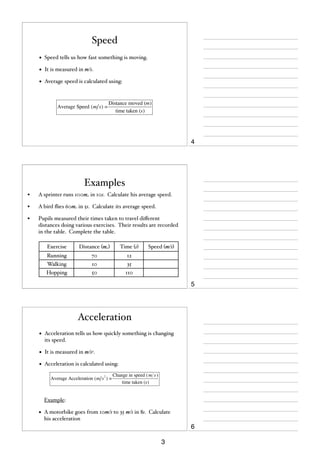
Speed tells us how fast something is moving.

•

It is measured in m/s.

•

Average speed is calculated using:

Average Speed (m s) =

Distance moved (m)
time taken (s)

4

Examples
•

A sprinter runs 100m in 10s. Calculate his average speed.

•

A bird flies 60m in 5s. Calculate its average speed.

•

Pupils measured their times taken to travel different
distances doing various exercises. Their results are recorded
in the table. Complete the table.
Exercise

Distance (m)

Time (s)

Running

70

12

Walking

10

35

Hopping

50

Speed (m/s)

110

5

Acceleration
•

Acceleration tells us how quickly something is changing
its speed.

•

It is measured in m/s2.

•

Acceleration is calculated using:
Average Acceleration (m s 2 ) =

Change in speed ( m s )
time taken (s)

Example:

•

A motorbike goes from 10m/s to 35 m/s in 8s. Calculate
his acceleration

6
3
Distance/time graphs
•

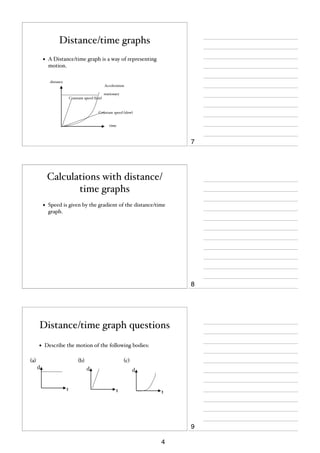
A Distance/time graph is a way of representing
motion.
distance
Acceleration
stationary
Constant speed (fast)

Constant speed (slow)

time

7

Calculations with distance/
time graphs
•

Speed is given by the gradient of the distance/time
graph.

8

Distance/time graph questions
•

Describe the motion of the following bodies:

(a)

(b)
d

(c)
d

t

d

t

t

9
4
Distance/Time Graph
questions
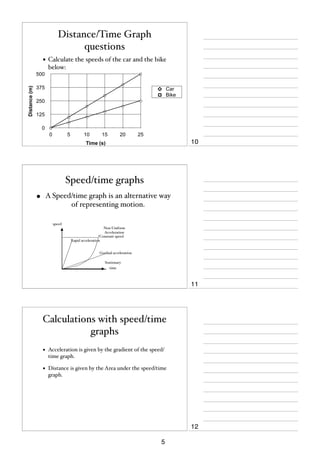
• Calculate the speeds of the car and the bike
below:
Distance (m)

500
375

Car
Bike

250
125
0
0

5

10

15

20

25

10

Time (s)

Speed/time graphs
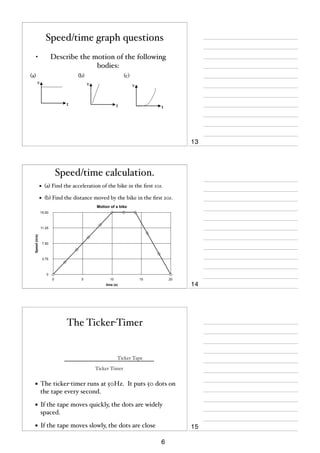
• A Speed/time graph is an alternative way
of representing motion.
speed
Non-Uniform
Acceleration
Constant speed
Rapid acceleration
Gradual acceleration
Stationary
time

11

Calculations with speed/time
graphs
•

Acceleration is given by the gradient of the speed/
time graph.

•

Distance is given by the Area under the speed/time
graph.

12
5
Speed/time graph questions
Describe the motion of the following
bodies:

•
(a)

(b)
v

(c)
v

v

t

t

t

13

Speed/time calculation.
•

(a) Find the acceleration of the bike in the first 10s.

•

(b) Find the distance moved by the bike in the first 20s.
Motion of a bike

15.00

Speed (m/s)

11.25

7.50

3.75

0
0

5

10

15

20

14

time (s)

The Ticker-Timer

Ticker Tape
Ticker Timer

• The ticker-timer runs at 50Hz. It puts 50 dots on
the tape every second.

• If the tape moves quickly, the dots are widely
spaced.

• If the tape moves slowly, the dots are close

15
6
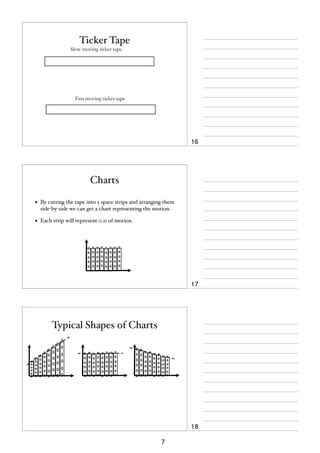
Ticker Tape

Slow moving ticker-tape

Fast moving ticker-tape

16

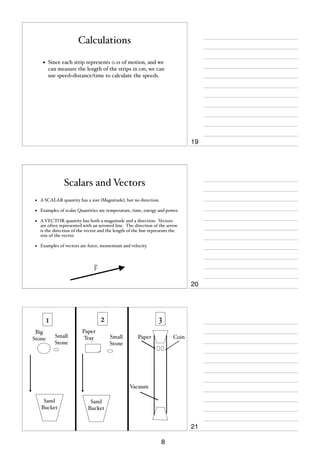
Charts
•

By cutting the tape into 5 space strips and arranging them
side-by-side we can get a chart representing the motion.

•

Each strip will represent 0.1s of motion.

17

Typical Shapes of Charts

18
7
Calculations
•

Since each strip represents 0.1s of motion, and we
can measure the length of the strips in cm, we can
use speed=distance/time to calculate the speeds.

19

Scalars and Vectors
•

A SCALAR quantity has a size (Magnitude), but no direction.

•

Examples of scalar Quantities are temperature, time, energy and power.

•

A VECTOR quantity has both a magnitude and a direction. Vectors
are often represented with an arrowed line. The direction of the arrow
is the direction of the vector and the length of the line represents the
size of the vector.

•

Examples of vectors are force, momentum and velocity.

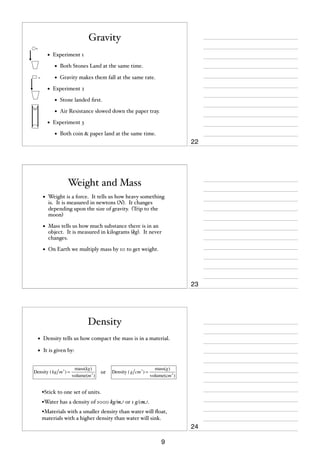
F

20

2

1
Big
Stone

Small
Stone

Paper
Tray

3
Small
Stone

Paper

Coin

Vacuum
Sand
Bucket

Sand
Bucket

21
8
Gravity
•

Experiment 1

•
•
•

Both Stones Land at the same time.
Gravity makes them fall at the same rate.

Experiment 2

•
•
•

Stone landed first.
Air Resistance slowed down the paper tray.

Experiment 3

•

Both coin & paper land at the same time.

22

Weight and Mass
•

Weight is a force. It tells us how heavy something
is. It is measured in newtons (N). It changes
depending upon the size of gravity. (Trip to the
moon)

•

Mass tells us how much substance there is in an
object. It is measured in kilograms (kg). It never
changes.

•

On Earth we multiply mass by 10 to get weight.

23

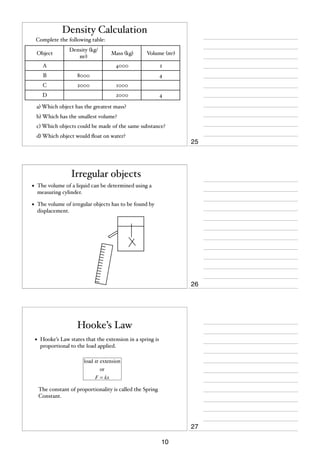
Density
•

Density tells us how compact the mass is in a material.

•

It is given by:

Density ( kg m 3 ) =

mass(kg)
volume(m 3 )

or

Density ( g cm 3 ) =

mass(g)
volume(cm 3 )

•Stick to one set of units.
•Water has a density of 1000 kg/m3 or 1 g/cm3.
•Materials with a smaller density than water will float,
materials with a higher density than water will sink.

24
9
Density Calculation
Complete the following table:
Object

Density (kg/
m3)

B

2000

2

8000

C

Volume (m3)

4000

A

Mass (kg)

D

4
1000
2000

4

a) Which object has the greatest mass?
b) Which has the smallest volume?
c) Which objects could be made of the same substance?
d) Which object would float on water?

25

Irregular objects
•

The volume of a liquid can be determined using a
measuring cylinder.

•

The volume of irregular objects has to be found by
displacement.

26

Hooke’s Law
•

Hooke’s Law states that the extension in a spring is
proportional to the load applied.
load α extension
or
F = kx

The constant of proportionality is called the Spring
Constant.

27
10
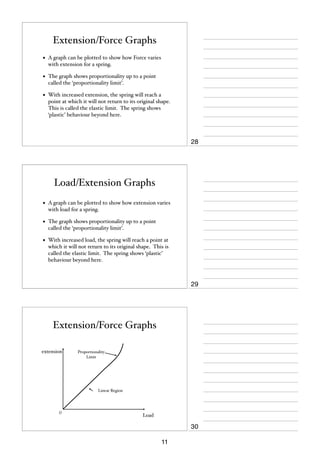
Extension/Force Graphs
•

A graph can be plotted to show how Force varies
with extension for a spring.

•

The graph shows proportionality up to a point
called the ‘proportionality limit’.

•

With increased extension, the spring will reach a
point at which it will not return to its original shape.
This is called the elastic limit. The spring shows
‘plastic’ behaviour beyond here.

28

Load/Extension Graphs
•

A graph can be plotted to show how extension varies
with load for a spring.

•

The graph shows proportionality up to a point
called the ‘proportionality limit’.

•

With increased load, the spring will reach a point at
which it will not return to its original shape. This is
called the elastic limit. The spring shows ‘plastic’
behaviour beyond here.

29

Extension/Force Graphs
extension

Proportionality
Limit

Linear Region

0

Load

30
11
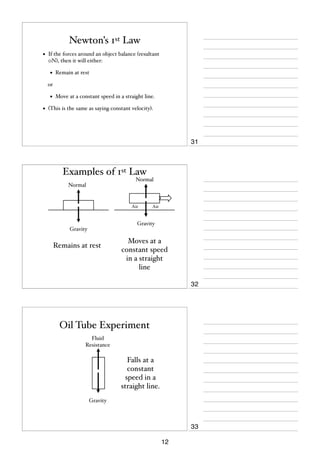
Newton’s 1st Law
•

If the forces around an object balance (resultant
0N), then it will either:

•

Remain at rest

or

•
•

Move at a constant speed in a straight line.

(This is the same as saying constant velocity).

31

Examples of 1st Law

Normal

Normal

Air

Air

Gravity

Gravity

Remains at rest

Moves at a
constant speed
in a straight
line
32

Oil Tube Experiment
Fluid
Resistance

Falls at a
constant
speed in a
straight line.
Gravity

33
12
Unbalanced Forces
• If the forces around an object do not balance, then
they will cause the object to accelerate (or
decelerate).

• The rate of the acceleration depends upon the
mass of the object.

• The quantities are linked by the following
equation:

F(N ) = m(kg) × a(m s 2 )
34

Questions
•

1. What will be the Force needed to produce an
acceleration of 2m/s2 on a mass of 4kg?

•

2. What will be the Force needed to produce an
acceleration of 5m/s2 on a mass of 42kg?

•

3. What will be the acceleration produced when a
Force of 50N acts upon a mass of 10kg?

35

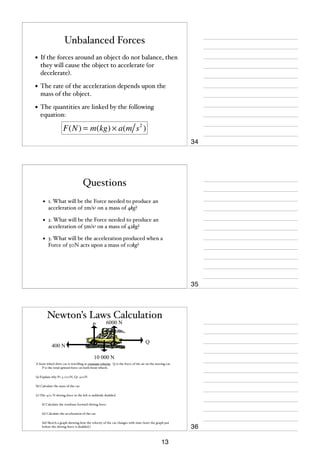
Newton’s Laws Calculation
P

6000 N

Q

400 N
10 000 N

A front wheel drive car is travelling at constant velocity. Q is the force of the air on the moving car.
P is the total upward force on both front wheels.
(a) Explain why P= 4 000N, Q= 400N
(b) Calculate the mass of the car.
(c) The 400 N driving force to the left is suddenly doubled.


(i) Calculate the resultant forward driving force.


(ii) Calculate the acceleration of the car.


(iii) Sketch a graph showing how the velocity of the car changes with time (start the graph just
before the driving force is doubled.)

13

36
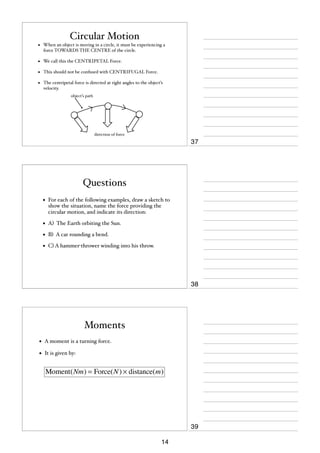
Circular Motion
•

When an object is moving in a circle, it must be experiencing a
force TOWARDS THE CENTRE of the circle.

•

We call this the CENTRIPETAL Force.

•

This should not be confused with CENTRIFUGAL Force.

•

The centripetal force is directed at right angles to the object’s
velocity.
object’s path

direction of force

37

Questions
•

For each of the following examples, draw a sketch to
show the situation, name the force providing the
circular motion, and indicate its direction:

•

A) The Earth orbiting the Sun.

•

B) A car rounding a bend.

•

C) A hammer-thrower winding into his throw.

38

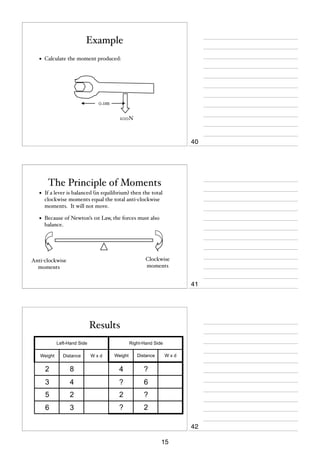
Moments
•

A moment is a turning force.

•

It is given by:

Moment(Nm) = Force(N ) × distance(m)

39
14
Example
•

Calculate the moment produced:

0.1m
100N

40

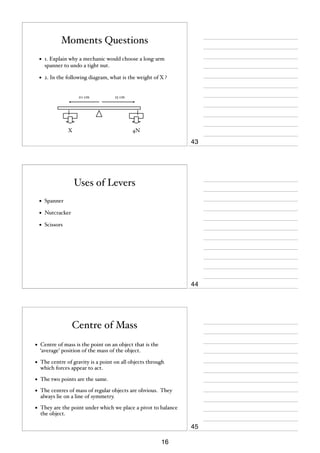
The Principle of Moments
•

If a lever is balanced (in equilibrium) then the total
clockwise moments equal the total anti-clockwise
moments. It will not move.

•

Because of Newton’s 1st Law, the forces must also
balance.

Clockwise
moments

Anti-clockwise
moments

41

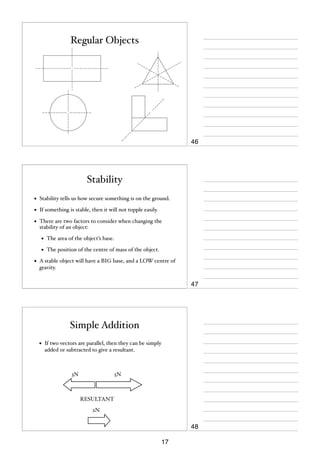
Results
Left-Hand Side

Right-Hand Side
Weight

Distance

8

4

?

3

4

?

6

5

2

2

?

6

3

?

2

Weight

Distance

2

Wxd

Wxd

42
15
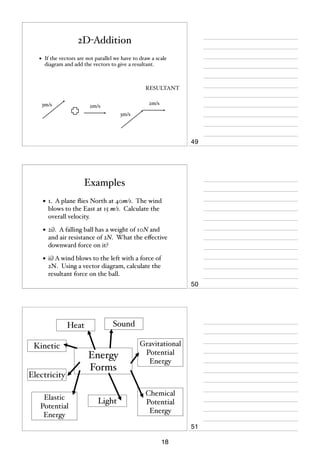
Moments Questions
•

1. Explain why a mechanic would choose a long-arm
spanner to undo a tight nut.

•

2. In the following diagram, what is the weight of X ?

20 cm

X

25 cm

4N

43

Uses of Levers
•

Spanner

•

Nutcracker

•

Scissors

44

Centre of Mass
•

Centre of mass is the point on an object that is the
‘average’ position of the mass of the object.

•

The centre of gravity is a point on all objects through
which forces appear to act.

•

The two points are the same.

•

The centres of mass of regular objects are obvious. They
always lie on a line of symmetry.

•

They are the point under which we place a pivot to balance
the object.

45
16
Regular Objects

46

Stability
•

Stability tells us how secure something is on the ground.

•

If something is stable, then it will not topple easily.

•

There are two factors to consider when changing the
stability of an object:

•
•
•

The area of the object’s base.
The position of the centre of mass of the object.

A stable object will have a BIG base, and a LOW centre of
gravity.

47

Simple Addition
•

If two vectors are parallel, then they can be simply
added or subtracted to give a resultant.

3N

5N

RESULTANT
2N

48
17
2D-Addition
•

If the vectors are not parallel we have to draw a scale
diagram and add the vectors to give a resultant.

RESULTANT
3m/s

2m/s

2m/s
3m/s

49

Examples
• 1. A plane flies North at 40m/s. The wind
blows to the East at 15 m/s. Calculate the
overall velocity.

• 2i). A falling ball has a weight of 10N and
and air resistance of 2N. What the effective
downward force on it?

• ii) A wind blows to the left with a force of
2N. Using a vector diagram, calculate the
resultant force on the ball.

50

Heat

Sound

Kinetic

Electricity
Elastic
Potential
Energy

Energy
Forms
Light

Gravitational
Potential
Energy

Chemical
Potential
Energy
51
18
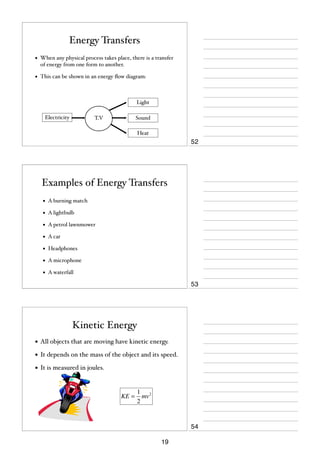
Energy Transfers
•

When any physical process takes place, there is a transfer
of energy from one form to another.

•

This can be shown in an energy flow diagram:

Light
Electricity

T.V

Sound
Heat

52

Examples of Energy Transfers
•

A burning match

•

A lightbulb

•

A petrol lawnmower

•

A car

•

Headphones

•

A microphone

•

A waterfall

53

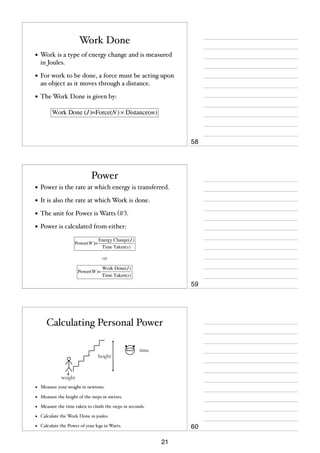
Kinetic Energy
• All objects that are moving have kinetic energy.
• It depends on the mass of the object and its speed.
• It is measured in joules.
KE =

1 2
mv
2

54
19
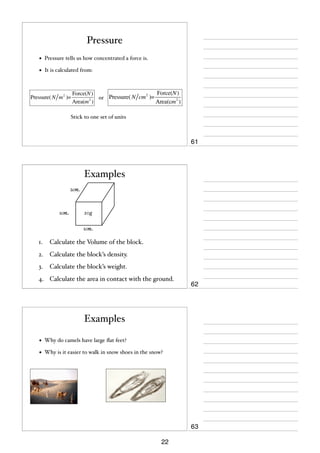
Gravitational Energy
• Gravitational energy is stored in objects that
are at a height.

• It depends upon the mass of the object, and
how high the object is.

• It measured in joules.

GPE = mgh
55

The Principle of the
Conservation of Energy
•

Energy cannot be created or destroyed, it simply
moves from one form to another.

•

When energy moves from one form to another, the
total AMOUNT of energy remains the same.

•

A certain amount of heat energy is always lost to the
surroundings in any process.

56

Efficiency
•

Efficiency tells us how effective a process or energy transfer is.

•

The more useful energy that is produced, for the least input energy, the
more efficient the process is.

•

Efficiency has no unit, and can be expressed as a decimal or percentage.

•

It can be the ratio of power output to input, or energy output to input
for a process

Efficiency =

output
(×100)
input

57
20
Work Done
• Work is a type of energy change and is measured
in Joules.

• For work to be done, a force must be acting upon
an object as it moves through a distance.

• The Work Done is given by:
Work Done (J )=Force(N ) × Distance(m)

58

Power
• Power is the rate at which energy is transferred.
• It is also the rate at which Work is done.
• The unit for Power is Watts (W).
• Power is calculated from either:
Power(W )=

Energy Change(J )
Time Taken(s)

or
Power(W )=

Work Done(J )
Time Taken(s)

59

Calculating Personal Power
height

time

weight

•

Measure your weight in newtons.

•

Measure the height of the steps in metres.

•

Measure the time taken to climb the steps in seconds.

•

Calculate the Work Done in joules.

•

Calculate the Power of your legs in Watts.

60
21
Pressure
•

Pressure tells us how concentrated a force is.

•

It is calculated from:

Pressure( N m 2 )=

Force(N )
Force(N )
2
or Pressure( N cm )=
2
Area(m )
Area(cm 2 )

Stick to one set of units

61

Examples
2cm

1cm

20g
1cm

1.

Calculate the Volume of the block.

2.

Calculate the block’s density.

3.

Calculate the block’s weight.

4. Calculate the area in contact with the ground.

62

Examples
•

Why do camels have large flat feet?

•

Why is it easier to walk in snow shoes in the snow?

63
22
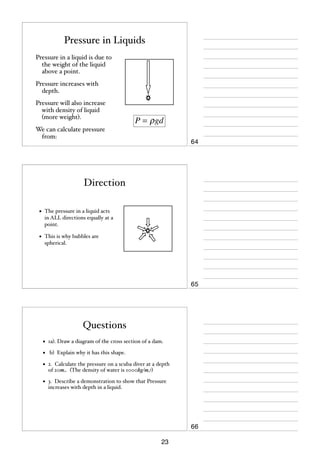
Pressure in Liquids
Pressure in a liquid is due to
the weight of the liquid
above a point.
Pressure increases with
depth.
Pressure will also increase
with density of liquid
(more weight).

P = ρ gd

We can calculate pressure
from:

64

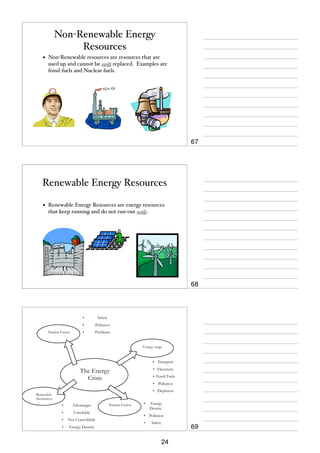
Direction
•

The pressure in a liquid acts
in ALL directions equally at a
point.

•

This is why bubbles are
spherical.

65

Questions
•

1a). Draw a diagram of the cross section of a dam.

•

b) Explain why it has this shape.

•

2. Calculate the pressure on a scuba diver at a depth
of 20m. (The density of water is 1000kg/m3)

•

3. Describe a demonstration to show that Pressure
increases with depth in a liquid.

66
23
Non-Renewable Energy
Resources
•

Non-Renewable resources are resources that are
used up and cannot be easily replaced. Examples are
fossil fuels and Nuclear fuels.

67

Renewable Energy Resources
•

Renewable Energy Resources are energy resources
that keep running and do not run-out easily.

68

•
Nuclear Fusion

Safety

•

Pollution

•

Problems

Energy usage

• Transport
• Electricity

The Energy
Crisis

• Fossil Fuels
• Pollution
• Depletion

Renewable
Alternatives

•

Advantages

•

Unreliable

•

Not Controllable

•

Energy Density

Nuclear Fission

•

Energy
Density

• Pollution
•

Safety

69
24
General Physics
Quantity and
symbol
Scalar Quantities
Vector Quantities

Average Speed, s

Velocity
Acceleration, a
Mass, m

Weight, W, F

Density, ρ
Force, F
Load, (Hookes
law)
Moment
Equilibrium
Work done, W, E
Kinetic energy,
KE

Definition/Word equation
Scalar quantities only have a magnitude.
Vector quantities have a magnitude, a direction
and a point of application.
Speed is the rate of change of distance. It is a
scalar quantity.
Speed = Total distance
Total time
For constant acceleration situations, the
average speed is also equal to the average of
the initial and final speeds.
s = initial speed + final speed
2
Velocity is the rate of change of displacement.
It is speed in a given direction. A vector
quantity.
Acceleration is the rate of change of velocity.
Acceleration = Final velocity – initial velocity
Time
Mass is a property of a body that resists change
in motion.
Weight is the force on a mass due to the
gravitational field of the Planet. It changes
from planet to planet. Weights can be
compared using a balance.
Weight = mass x acceleration due to gravity
Weight = mass x gravitational field strength
Density is the mass per unit volume.
Density = mass
volume
A force is a push or a pull; it can change the
shape, direction, and/or speed of an object.
Force = mass x acceleration
Load = spring constant x extension
Load α extension
A moment is the turning affect of a force.
Moment = force x perpendicular distance from
the pivot
When there is no resultant force AND no
resulting turning affect, a system is in
equilibrium.
Work done = Force x distance in the direction
of the force = change in energy
Kinetic energy is the energy of a body due to
its motion.
Kinetic energy = ½ x mass x velocity2

25

Symbol
equation

Units

s=d
t
s=u+v
2

m/s
cm/s
km/h

m/s
cm/s
km/h
a= v–u
t

m/s2

W=mxg

Newtons,
N

ρ=m
V

Kg/m3
g/cm3

F=ma

Newtons,
N

F=kl
F α l

Newtons,
N

Moment = F d

Nm

W = F d = ΔE

Joules, J

KE = ½ m v2

Joules, J
Gravitational
energy, GPE
Efficiency

Power, P

Gravitational potential energy is the energy of
a body due to its position in the gravitational
field.
Gravitational energy =mass x acceleration due
to gravity x height gained/lost
Efficiency = useful output x 100%
total input
Power is the rate at which energy is converted.
Power = work done
time taken
Power = energy change
time taken

GPE = m g h

%
P=E
t

Pressure, p, P

Pressure = force
area

P=F
A

Fluid Pressure, p,
P

Pressure = density of fluid x acceleration due
to gravity x height of fluid above

P=ρgh

26

Joules, J

Watts, W
N/m2
Pascals,
Pa
millibar
N/m2
Pascals,
Pa
Millibar
iGCSE Physics
Past Paper Questions
Paper 1 Compilation
General Physics

27
2
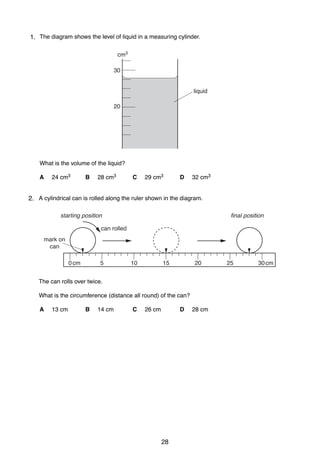
11. The diagram shows the level of liquid in a measuring cylinder.
cm3
30

liquid
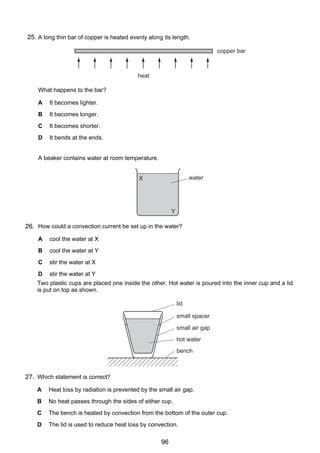
20

What is the volume of the liquid?
A

24 cm3

B

28 cm3

C

29 cm3

D

32 cm3

2 A cylindrical can is rolled along the ruler shown in the diagram.
2.
final position

starting position
can rolled
mark on
can
0 cm

5

10

15

20

The can rolls over twice.
What is the circumference (distance all round) of the can?
A

13 cm

B

14 cm

C

26 cm

D

0625/1/M/J/02

28

28 cm

25

30 cm
3
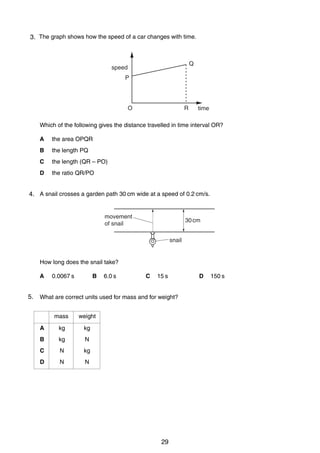
33. The graph shows how the speed of a car changes with time.

Q

speed
P

O

R

time

Which of the following gives the distance travelled in time interval OR?
A

the area OPQR

B

the length PQ

C

the length (QR – PO)

D

the ratio QR/PO

4
4. A snail crosses a garden path 30 cm wide at a speed of 0.2 cm/s.

movement
of snail

30 cm
snail

How long does the snail take?
A

5.
5

B

0.0067 s

6.0 s

C

15 s

D

150 s

What are correct units used for mass and for weight?
mass

weight

A

kg

kg

B

kg

N

C

N

kg

D

N

N

0625/1/M/J/02

29

[Turn over
4
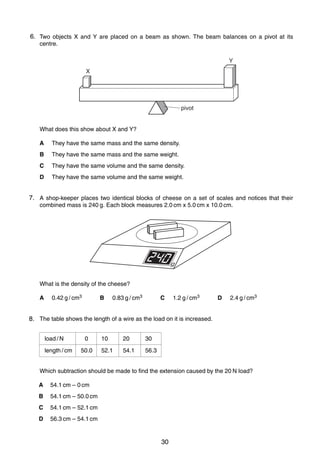
66. Two objects X and Y are placed on a beam as shown. The beam balances on a pivot at its
centre.
Y
X

pivot
What does this show about X and Y?
A

They have the same mass and the same density.

B

They have the same mass and the same weight.

C

They have the same volume and the same density.

D

They have the same volume and the same weight.

7. A shop-keeper places two identical blocks of cheese on a set of scales and notices that their
7
combined mass is 240 g. Each block measures 2.0 cm x 5.0 cm x 10.0 cm.

g

What is the density of the cheese?
A

0.42 g / cm3

B

0.83 g / cm3

C

1.2 g / cm3

D

2.4 g / cm3

8
8. The table shows the length of a wire as the load on it is increased.
load / N
length / cm

0
50.0

10

20

30

52.1

54.1

56.3

Which subtraction should be made to find the extension caused by the 20 N load?
A

54.1 cm – 0 cm

B

54.1 cm – 50.0 cm

C

54.1 cm – 52.1 cm

D

56.3 cm – 54.1 cm
0625/1/M/J/02

30
5
99. A child tries to push over a large empty oil drum.
Where should the drum be pushed to topple it over with least force?
A

B

C

D

10. Which device is designed to convert chemical energy into kinetic energy (energy of motion)?
10
A

an a.c. generator

B

a battery-powered torch

C

a car engine

D

a wind-up mechanical clock

11. A ball is released from rest and rolls down a track from the position shown.
11
What is the furthest position the ball could reach?
C
ball
starts
here

B
D

A

0625/1/M/J/02

31

[Turn over
6
12 Two sharp nails and two blunt nails are held on a piece of wood. Each nail is hit with the same
12.
hammer with the same amount of force.
When it is hit, which nail causes the greatest pressure on the wood?
A

B
hammer

sharp nails

C

D
hammer

blunt nails

13.
13 The diagram shows a manometer connected to a container of carbon dioxide.
container

carbon dioxide
5 cm

mercury
manometer
Which statement correctly describes the pressure exerted by the carbon dioxide?
A

It is equal to the atmospheric pressure.

B

It is equal to 5 cm of mercury.

C

It is equal to 5 cm of mercury above atmospheric pressure.

D

It is equal to 5 cm of mercury below atmospheric pressure.

0625/1/M/J/02

32
2

14. A glass tank contains some water.
1

V
water

T

Q
U

S

R
The length QR and the width RS of the tank are known.
What other distance needs to be measured in order to be able to calculate the volume of the
water?
A

B

ST

C

SV

D

TU

TV

2
15. A stopwatch is used to time a race. The diagrams show the watch at the start and at the end of the
race.

start
55

end

60

5

55
10

50

40
35

30

45.7 s

B

46.0 s

15

40

25

C

46.5 s

D

0625/01/M/J/03

33

47.0 s

20

seconds
35

How long did the race take?
A

10

45

20

seconds

5

50

15

45

60

30

25
3

16. The diagram shows a speed-time graph for a body moving with constant acceleration.
3

speed

0

time

0

What is represented by the shaded area under the graph?
A

acceleration

B

distance

C

speed

D

time

17. A tunnel has a length of 50 km. A car takes 20 min to travel between the two ends of the tunnel.
4
What is the average speed of the car?
A

2.5 km / h

B

16.6 km / h

C

150 km / h

D

1000 km / h

18. Which statement is correct?
5
A

Mass is a force, measured in kilograms.

B

Mass is a force, measured in newtons.

C

Weight is a force, measured in kilograms.

D

Weight is a force, measured in newtons.

0625/01/M/J/03

34

[Turn over
4
6
19. Three children, X, Y and Z, are using a see-saw to compare their weights.
X

Y

Y

Z

X

Z

Which line in the table shows the correct order of the children’s weights?
heaviest

←→

lightest

A

X

Y

Z

B

X

Z

Y

C

Y

X

Z

D

Y

Z

X

20. What apparatus is needed to determine the density of a regularly-shaped block?
7
A

a balance and a ruler

B

a balance and a forcemeter (spring balance)

C

a measuring cylinder and a ruler

D

a measuring cylinder and a beaker

21. A spring is suspended from a stand. Loads are added and the extensions are measured.
8

spring

stand
loads

rule

Which graph shows the result of plotting extension against load?

0

0

load

0

0

0

load

0625/01/M/J/03

35

extension

D

extension

C

extension

B

extension

A

0

load

0

0

load
5

22. A student uses a stand and clamp to hold a flask of liquid.
9
Which diagram shows the most stable arrangement?
A

B

C

D

10 What is the source of the energy converted by a hydro-electric power station?
23.
A

hot rocks

B

falling water

C

oil

D

waves

24.
11 A labourer on a building site lifts heavy concrete blocks onto a lorry. Lighter blocks are now lifted
the same distance in the same time.
What happens to the work done in lifting each block and the power exerted by the labourer?
work done in
lifting each block

power exerted by
labourer

A

decreases

decreases

B

decreases

remains the same

C

increases

increases

D

remains the same

increases

0625/01/M/J/03

36

[Turn over
6

25.
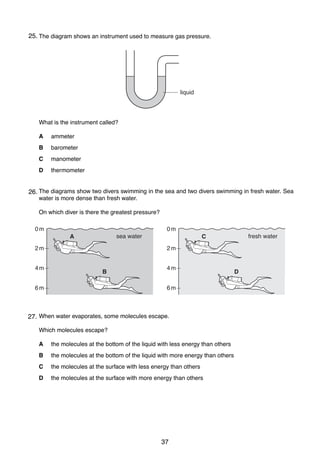
12 The diagram shows an instrument used to measure gas pressure.

liquid

What is the instrument called?
A

ammeter

B

barometer

C

manometer

D

thermometer

13 The diagrams show two divers swimming in the sea and two divers swimming in fresh water. Sea
26.
water is more dense than fresh water.
On which diver is there the greatest pressure?
0m

0m
sea water

A
2m
4m

fresh water

C
2m

B

6m

4m
6m

14 When water evaporates, some molecules escape.
27.
Which molecules escape?
A

the molecules at the bottom of the liquid with less energy than others

B

the molecules at the bottom of the liquid with more energy than others

C

the molecules at the surface with less energy than others

D

the molecules at the surface with more energy than others

0625/01/M/J/03

37

D
2
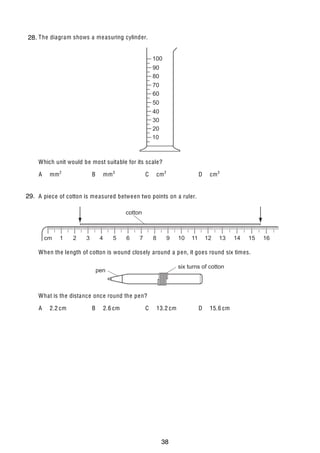
1 The diagram shows a me asuring cylinder.
28.
100
90
80
70
60
50
40
30
20
10

Which unit would be most suitable for its scale?
A

mm 2

mm 3

B

cm 2

C

D

cm 3

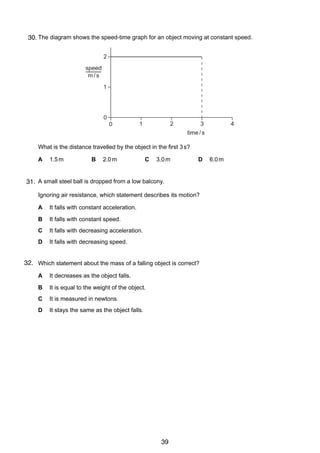
29. A piece of cotton is me asured betwe en two points on a ruler.
2
cotton

cm

1

2

3

4

5

6

7

8

9

10

11

12

13

14

15

When the length of cotton is wound closely around a pen, it goes round six times.
six turns of cotton

pen

What is the distance once round the pen?
A

2.2 cm

U C L E S 2004

B

2.6 cm

C

13.2 cm

0625/01/M/J/04

38

D

15.6 cm

16
3
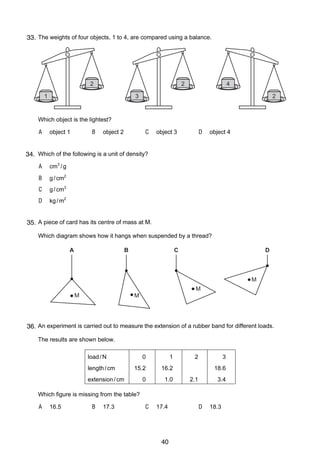
3 The diagram shows the speed-time graph for an object moving at constant speed.
30.
2
speed
m/s
1

0
0

1

2

4

3
time / s

What is the distance travelled by the object in the first 3 s?
A

1.5 m

B

2.0 m

C

3.0 m

D

6.0 m

4
31. A small steel ball is dropped from a low balcony.
Ignoring air resistance, which statement describes its motion?
A

It falls with constant acceleration.

B

It falls with constant speed.

C

It falls with decreasing acceleration.

D

It falls with decreasing speed.

32. Which statement about the mass of a falling object is correct?
5
A

It decreases as the object falls.

B

It is equal to the weight of the object.

C

It is measured in newtons.

D

It stays the same as the object falls.

© UCLES 2004

0625/01/M/J/04

39

[Turn over
4
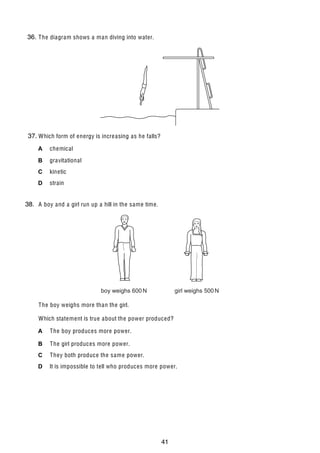
6 The weights of four objects, 1 to 4, are compared using a balance.
33.

2

2

1

4
2

3

Which object is the lightest?
A

B

object 1

C

object 2

D

object 3

object 4

7
34. Which of the following is a unit of density?
A

cm3 / g

B

g / cm2

C

g / cm3

D

kg / m2

8 A piece of card has its centre of mass at M.
35.
Which diagram shows how it hangs when suspended by a thread?
A

B

C

D

M
M
M

M

9 An experiment is carried out to measure the extension of a rubber band for different loads.
36.
The results are shown below.
load / N
length / cm

0

1

15.2

16.2

0

1.0

extension / cm

2

3
18.6

2.1

3.4

Which figure is missing from the table?
A

16.5

© UCLES 2004

B

17.3

C

17.4

0625/01/M/J/04

40

D

18.3
5

36.
10 The diagram shows a man diving into water.

37. Which form of energy is incre asing as he falls?
A

chemical

B

gravitational

C

kinetic

D

strain

38. A boy and a girl run up a hill in the same time.
11

boy weighs 600 N

girl weighs 500 N

The boy weighs more than the girl.
Which statement is true about the power produced?
A

The boy produces more power.

B

The girl produces more power.

C

They both produce the same power.

D

It is impossible to tell who produces more power.

© UCLES 2004

0625/01/M/J/04

41

[Turn over
6

39.
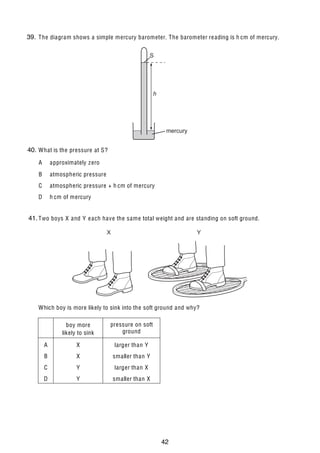
12 The diagram shows a simple mercury barometer. The barometer re ading is h cm of mercury.
S

h

mercury

40. What is the pressure at S?
A

approximately z ero

B

atmospheric pressure

C

atmospheric pressure + h cm of mercury

D

h cm of mercury

41.
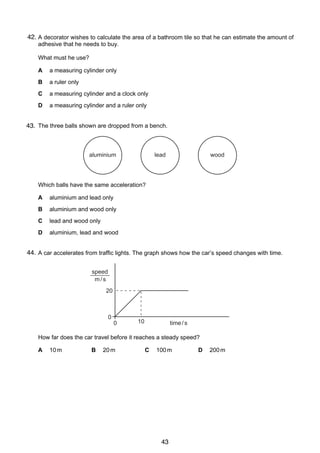
13 Two boys X and Y e ach have the same total weight and are standing on soft ground.
X

Y

Which boy is more likely to sink into the soft ground and why?
boy more
likely to sink

pressure on soft
ground

A

X

larger than Y

B

X

smaller than Y

C

Y

larger than X

D

Y

smaller than X

U C L E S 2004

0625/01/M/J/04

42
2

42.
1 A decorator wishes to calculate the area of a bathroom tile so that he can estimate the amount of
adhesive that he needs to buy.
What must he use?
A

a measuring cylinder only

B

a ruler only

C

a measuring cylinder and a clock only

D

a measuring cylinder and a ruler only

2
43. The three balls shown are dropped from a bench.

aluminium

lead

wood

Which balls have the same acceleration?
A

aluminium and lead only

B

aluminium and wood only

C

lead and wood only

D

aluminium, lead and wood

44.
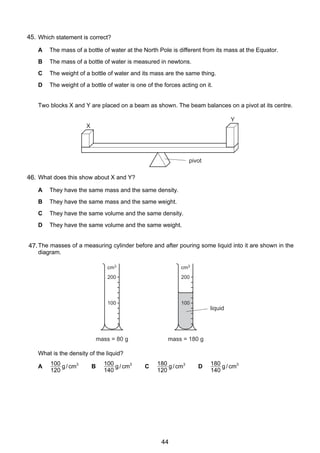
3 A car accelerates from traffic lights. The graph shows how the car’s speed changes with time.
speed
m/s
20

0
0

10

time / s

How far does the car travel before it reaches a steady speed?
A

10 m

© UCLES 2005

B

20 m

C

100 m

0625/01/M/J/05

43

D

200 m
3

45.
4 Which statement is correct?
A
B

The mass of a bottle of water is measured in newtons.

C

The weight of a bottle of water and its mass are the same thing.

D

5

The mass of a bottle of water at the North Pole is different from its mass at the Equator.

The weight of a bottle of water is one of the forces acting on it.

Two blocks X and Y are placed on a beam as shown. The beam balances on a pivot at its centre.
Y
X

pivot

46. What does this show about X and Y?
A

They have the same mass and the same density.

B

They have the same mass and the same weight.

C

They have the same volume and the same density.

D

They have the same volume and the same weight.

6 The masses of a measuring cylinder before and after pouring some liquid into it are shown in the
47.
diagram.
cm3

cm3

200

200

100

100

liquid

mass = 80 g

mass = 180 g

What is the density of the liquid?
A

100 g / cm3
120

© UCLES 2005

B

100 g / cm3
140

C

180 g / cm3
120

0625/01/M/J/05

44

D

180 g / cm3
140

[Turn over
4
7
48. A girl and a boy are pulling in opposite directions on a rope. The forces acting on the rope are
shown in the diagram.
girl

boy
200 N

150 N
rope

49. Which single force has the same effect as the two forces shown?
A

50 N acting towards the girl

B

350 N acting towards the girl

C

50 N acting towards the boy

D

350 N acting towards the boy

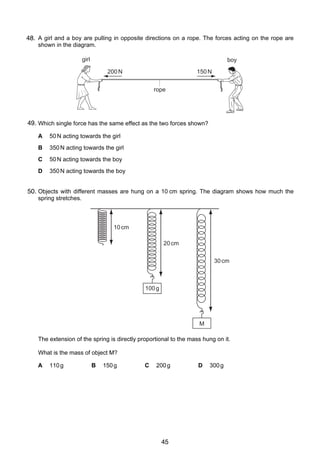
8 Objects with different masses are hung on a 10 cm spring. The diagram shows how much the
50.
spring stretches.

10 cm
20 cm
30 cm

100 g

M

The extension of the spring is directly proportional to the mass hung on it.
What is the mass of object M?
A

110 g

© UCLES 2005

B

150 g

C

200 g

0625/01/M/J/05

45

D

300 g
5

51.
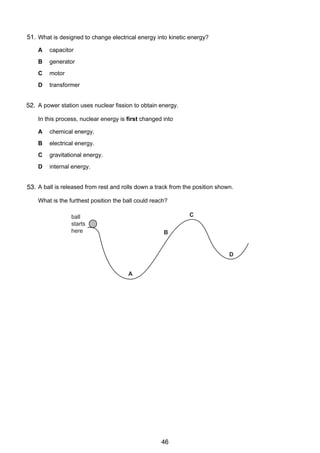
9 What is designed to change electrical energy into kinetic energy?
A

capacitor

B

generator

C

motor

D

transformer

10
52. A power station uses nuclear fission to obtain energy.
In this process, nuclear energy is first changed into
A

chemical energy.

B

electrical energy.

C

gravitational energy.

D

internal energy.

11 A ball is released from rest and rolls down a track from the position shown.
53.
What is the furthest position the ball could reach?

C

ball
starts
here

B

D

A

© UCLES 2005

0625/01/M/J/05

46

[Turn over
6

54.
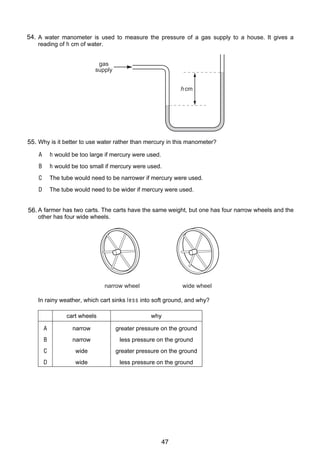
12 A water manometer is used to measure the pressure of a gas supply to a house. It gives a
reading of h cm of water.
gas
supply
h cm

55. Why is it better to use water rather than mercury in this manometer?
A

h would be too large if mercury were used.

B

h would be too small if mercury were used.

C

The tube would need to be narrower if mercury were used.

D

The tube would need to be wider if mercury were used.

13 A farmer has two carts. The carts have the same weight, but one has four narrow wheels and the
56.
other has four wide wheels.

narrow wheel

wide wheel

In rainy weather, which cart sinks le s s into soft ground, and why?
cart wheels

why

A

narrow

greater pressure on the ground

B

narrow

less pressure on the ground

C

wide

greater pressure on the ground

D

wide

less pressure on the ground

© U C L E S 2005

0625/01/M/J/05

47
2

57.
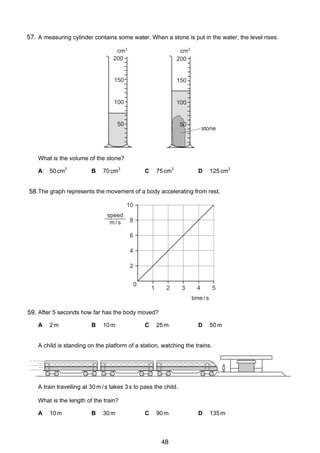
1 A measuring cylinder contains some water. When a stone is put in the water, the level rises.
cm3
200

cm3
200

150

150

100

100

50

50

stone

What is the volume of the stone?
A

50 cm3

B

70 cm3

75 cm3

C

D

125 cm3

258.The graph represents the movement of a body accelerating from rest.
10
speed
m/s

8
6
4
2
0

1

2

3

4

5

time / s

59. After 5 seconds how far has the body moved?
A

3

2m

B

10 m

C

25 m

D

50 m

A child is standing on the platform of a station, watching the trains.

A train travelling at 30 m / s takes 3 s to pass the child.
What is the length of the train?
A

10 m

© UCLES 2006

B

30 m

C

90 m

0625/01/M/J/06

48

D

135 m
3

60.
4 Below are four statements about the effects of forces on objects.
Three of the statements are correct.
Which statement is incorrect?
A

A force can change the length of an object.

B

A force can change the mass of an object.

C

A force can change the shape of an object.

D

A force can change the speed of an object.

61.
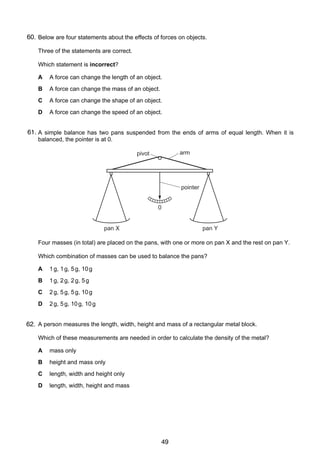
5 A simple balance has two pans suspended from the ends of arms of equal length. When it is
balanced, the pointer is at 0.
arm

pivot

pointer
0
pan X

pan Y

Four masses (in total) are placed on the pans, with one or more on pan X and the rest on pan Y.
Which combination of masses can be used to balance the pans?
A

1 g, 1 g, 5 g, 10 g

B

1 g, 2 g, 2 g, 5 g

C

2 g, 5 g, 5 g, 10 g

D

2 g, 5 g, 10 g, 10 g

6
62. A person measures the length, width, height and mass of a rectangular metal block.
Which of these measurements are needed in order to calculate the density of the metal?
A

mass only

B

height and mass only

C

length, width and height only

D

length, width, height and mass

© UCLES 2006

0625/01/M/J/06

49

[Turn over
4

63.
7 Two forces act on an object.
In which situation is it impossible for the object to be in equilibrium?
A

The two forces act in the same direction.

B

The two forces act through the same point.

C

The two forces are of the same type.

D

The two forces are the same size.

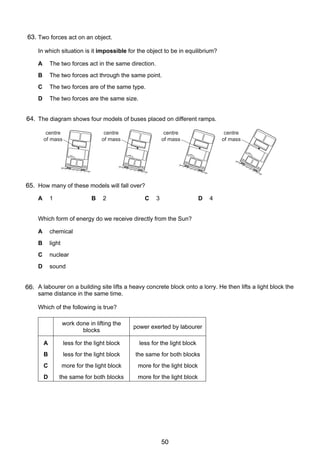
64. The diagram shows four models of buses placed on different ramps.
8
centre
of mass

centre
of mass

centre
of mass

centre
of mass

65. How many of these models will fall over?
A

9

1

B

2

C

3

D

4

Which form of energy do we receive directly from the Sun?
A

chemical

B

light

C

nuclear

D

sound

10
66. A labourer on a building site lifts a heavy concrete block onto a lorry. He then lifts a light block the
same distance in the same time.
Which of the following is true?
work done in lifting the
blocks

power exerted by labourer

A

less for the light block

less for the light block

B

less for the light block

the same for both blocks

C

more for the light block

more for the light block

D

the same for both blocks

more for the light block

© UCLES 2006

0625/01/M/J/06

50
5

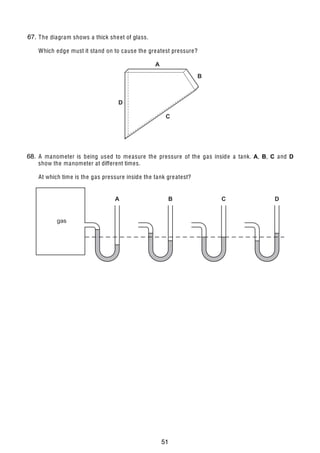
67.
11 The diagram shows a thick she et of glass.
Which edge must it stand on to cause the gre atest pressure?

A
B

D
C

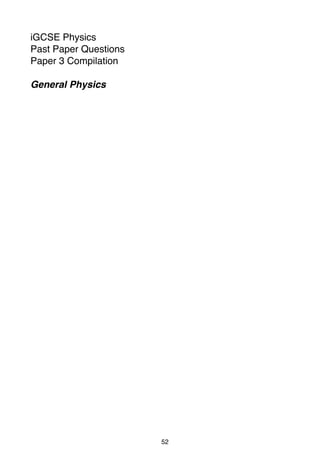
68.
12 A manometer is being used to me asure the pressure of the gas inside a tank. A, B, C and D
show the manometer at different times.
At which time is the gas pressure inside the tank gre atest?

A

B

C

D

gas

13 Brownian motion is se en by looking at smoke particles through a microscope.
How do the smoke particles move in Brownian motion?
A

all in the same direction

B

at random

C

in circles

D

vibrating about fixed points

© U C L E S 2006

0625/01/M/J/06

51

[Turn over
iGCSE Physics
Past Paper Questions
Paper 3 Compilation
General Physics

52
2
1
1. A group of students attempts to find out how much power each student can generate. The
students work in pairs in order to find the time taken for each student to run up a flight of
stairs.
The stairs used are shown in Fig. 1.1.
finishing point

starting point

Fig. 1.1
(a) Make a list of all the readings that would be needed. Where possible, indicate how the
accuracy of the readings could be improved.
..........................................................................................................................................
..........................................................................................................................................
..........................................................................................................................................
..........................................................................................................................................
..........................................................................................................................................
..................................................................................................................................... [4]
(b) Using words, not symbols, write down all equations that would be needed to work out
the power of a student.
..........................................................................................................................................
..........................................................................................................................................
..................................................................................................................................... [2]
(c) (i)

When the student has reached the finishing point and is standing at the top of the
stairs, what form of energy has increased to its maximum?
...................................................................................................................................

(ii)

Suggest why the total power of the student is greater than the power calculated by
this method.
...................................................................................................................................
...................................................................................................................................
[3]

0625/3/M/J/02

53

For
Examiner’s
Use
3

For
Examiner’s
Use

2
2. A small rubber ball falls vertically, hits the ground and rebounds vertically upwards.
Fig. 2.1 is the speed-time graph for the ball.

10

B

speed
8
m/s
6

D

4
2
0

A
0

E

C
0.5

1.0

1.5

time / s

2.0

Fig. 2.1
(a) Using information from the graph, describe the following parts of the motion of the ball.
(i)

part AB
...................................................................................................................................
...................................................................................................................................
...................................................................................................................................

(ii)

part DE
...................................................................................................................................
...................................................................................................................................
...................................................................................................................................
[3]

(b) Explain what is happening to the ball along the part of the graph from B through C to D.
..........................................................................................................................................
..........................................................................................................................................
..................................................................................................................................... [2]
(c) Whilst the ball is in contact with the ground, what is the
(i)

overall change in speed,
change in speed = ........................................

(ii)

overall change in velocity?
change in velocity = ......................................
[2]
0625/3/M/J/02

54

[Turn over
4
(d) Use your answer to (c) to explain the difference between speed and velocity.
..........................................................................................................................................
..........................................................................................................................................
..................................................................................................................................... [2]
(e) Use the graph to calculate the distance travelled by the ball between D and E.

distance travelled = ..................................[2]
(f)

Use the graph to calculate the deceleration of the ball between D and E.

deceleration = ..................................[2]

0625/3/M/J/02

55

For
Examiner’s
Use
2
1
3. Fig. 1.1 shows apparatus that may be used to compare the strengths of two springs of the
same size, but made from different materials.

spring

scale
masses

Fig. 1.1
(a) (i)

Explain how the masses produce a force to stretch the spring.
...................................................................................................................................

(ii) Explain why this force, like all forces, is a vector quantity.
...................................................................................................................................
...................................................................................................................................
[2]
(b) Fig. 1.2 shows the graphs obtained when the two springs are stretched.

force/N

20
spring 1

15

spring 2

10
5
0

0

10

20

30

extension/mm
Fig. 1.2

0625/3/M/J/03

56

40

For
Examiner’s
Use
3
(i)

State which spring is more difficult to extend. Quote values from the graphs to
support your answer.

For
Examiner’s
Use

...................................................................................................................................
...................................................................................................................................
...................................................................................................................................
...................................................................................................................................
(ii)

On the graph of spring 2, mark a point P at the limit of proportionality. Explain your
choice of point P.
...................................................................................................................................
...................................................................................................................................
...................................................................................................................................

(iii)

Use the graphs to find the difference in the extensions of the two springs when a
force of 15 N is applied to each one.

difference in extensions = ..................................
[6]
24. The speed of a cyclist reduces uniformly from 2.5 m/s to 1.0 m/s in 12 s.
(a) Calculate the deceleration of the cyclist.

deceleration = ..................................[3]

(b) Calculate the distance travelled by the cyclist in this time.

distance = ..................................[2]

0625/3/M/J/03

57

[Turn over
4
3
5. Fig. 3.1 shows the arm of a crane when it is lifting a heavy box.

1220 N
950 N
40° 30°
P
box

Fig. 3.1
(a) By the use of a scale diagram (not calculation) of the forces acting at P, find the weight
of the box.
[5]

0625/3/M/J/03

58

For
Examiner’s
Use
For
Examiner’s
Use

5
(b) Another box of weight 1500 N is raised vertically by 3.0 m.
(i)

Calculate the work done on the box.

work done = ..................................
(ii)

The crane takes 2.5 s to raise this box 3.0 m. Calculate the power output of the
crane.

power = ..................................
[4]

4

Fig. 4.1 shows a sealed glass syringe that contains air and many very tiny suspended dust
particles.
syringe
seal

piston
dust particles
Fig. 4.1
(a) Explain why the dust particles are suspended in the air and do not settle to the bottom.
..........................................................................................................................................
..........................................................................................................................................
..........................................................................................................................................
......................................................................................................................................[3]
(b) The air in the syringe is at a pressure of 2.0 × 10⁵ Pa. The piston is slowly moved into the
syringe, keeping the temperature constant, until the volume of the air is reduced from
80 cm3 to 25 cm3. Calculate the final pressure of the air.

pressure = ..................................[3]
0625/3/M/J/03

59

[Turn over
2

For
Examiner’s
Use

6. Fig. 1.1 shows a cycle track.
1
A

B

E

C

v = 6 m/s

D
Fig. 1.1
A cyclist starts at A and follows the path ABCDEB.
The speed-time graph is shown in Fig. 1.2.
B

C

D

E

B

6
speed
m/s 5
4
3
2
1
0A
0

10

20

30

40

50

60

70

80

90

100

time / s
Fig. 1.2
(a) Use information from Fig. 1.1 and Fig. 1.2 to describe the motion of the cyclist
(i)

along AB,
...................................................................................................................................

(ii)

along BCDEB.
...................................................................................................................................
...................................................................................................................................
[4]

© UCLES 2004

0625/03 M/J/04

60
3

For
Examiner’s
Use

(b) The velocity v of the cyclist at C is shown in Fig. 1.1.
State one similarity and one difference between the velocity at C and the velocity at E.
similarity ...........................................................................................................................
difference ......................................................................................................................[2]
(c) Calculate
(i)

the distance along the cycle track from A to B,

distance = …………………
(ii)

the circumference of the circular part of the track.

circumference = …………………
[4]

© UCLES 2004

0625/03 M/J/04

61

[Turn over
4

7. Fig. 2.1 shows a rock that is falling from the top of a cliff into the river below.
2

cliff

falling
rock

river

Fig. 2.1
(a) The mass of the rock is 75 kg. The acceleration of free fall is 10 m/s2.
Calculate the weight of the rock.

weight = …………………[1]
(b) The rock falls from rest through a distance of 15 m before it hits the water.
Calculate its kinetic energy just before hitting the water. Show your working.

kinetic energy = …………………[3]
(c) The rock hits the water. Suggest what happens to the kinetic energy of the rock during
the impact.
..........................................................................................................................................
..........................................................................................................................................
......................................................................................................................................[3]

© UCLES 2004

0625/03 M/J/04

62

For
Examiner’s
Use
5

For
Examiner’s
Use

8. A large spring is repeatedly stretched by an athlete to increase the strength of his arms.
3
Fig. 3.1 is a table showing the force required to stretch the spring.
extension of spring / m
force exerted to produce extension / N

0.096

0.192

0.288

0.384

250

500

750

1000

Fig. 3.1
(a) (i)

State Hooke’s law.
...................................................................................................................................
...............................................................................................................................[1]

(ii)

Use the results in Fig. 3.1 to show that the spring obeys Hooke’s law.

[1]
(b) Another athlete using a different spring exerts an average force of 400 N to enable her
to extend the spring by 0.210 m.
(i)

Calculate the work done by this athlete in extending the spring once.

work done = …………………
(ii)

She is able to extend the spring by this amount and to release it 24 times in 60 s.
Calculate the power used by this athlete while doing this exercise.

power = …………………
[4]

© UCLES 2004

0625/03 M/J/04

63

[Turn over
2

9. A solid plastic sphere falls towards the Earth.
1
Fig. 1.1 is the speed-time graph of the fall up to the point where the sphere hits the Earth’s
surface.
140
speed
m/s

R

120

S

T

100
80
60
Q

40
20
0

P
0

10

20

30

40

50

60

70 80
time / s

90

100 110

Fig. 1.1
(a) Describe in detail the motion of the sphere shown by the graph.
..........................................................................................................................................
..........................................................................................................................................
..........................................................................................................................................
..........................................................................................................................................
..................................................................................................................................... [3]

© UCLES 2005

0625/03/M/J/05

64

For
Examiner’s
Use
3
(b) On Fig. 1.2, draw arrows to show the directions of the forces acting on the sphere when
it is at the position shown by point S on the graph. Label your arrows with the names of
the forces.
[2]

Fig. 1.2
(c) Explain why the sphere is moving with constant speed at S.
..........................................................................................................................................
..........................................................................................................................................
..................................................................................................................................... [2]
(d) Use the graph to calculate the approximate distance that the sphere falls
(i)

between R and T,

(ii)

between P and Q.

distance = ………………. [2]

distance = ………………. [2]

© UCLES 2005

0625/03/M/J/05

65

[Turn over

For
Examiner’s
Use
4

10. Fig. 2.1 shows a simple pendulum that swings backwards and forwards between P and Q.
2

support
string

P

R

Q

pendulum bob

Fig. 2.1
(a) The time taken for the pendulum to swing from P to Q is approximately 0.5 s.
Describe how you would determine this time as accurately as possible.
..........................................................................................................................................
..........................................................................................................................................
..................................................................................................................................... [2]
(b) (i)

State the two vertical forces acting on the pendulum bob when it is at position R.
1. ...............................................................................................................................
2. .......................................................................................................................... [1]

(ii)

The pendulum bob moves along the arc of a circle. State the direction of the
resultant of the two forces in (i).
.............................................................................................................................. [1]

(c) The mass of the bob is 0.2 kg. During the swing it moves so that P is 0.05 m higher
than R.
Calculate the increase in potential energy of the pendulum bob between R and P.

potential energy = ………………. [2]

© UCLES 2005

0625/03/M/J/05

66

For
Examiner’s
Use
5

11. A mass of 3.0 kg accelerates at 2.0 m/s2 in a straight line.
3
(a) State why the velocity and the acceleration are both described as vector quantities.
..........................................................................................................................................
..................................................................................................................................... [1]
(b) Calculate the force required to accelerate the mass.

force = ………………. [2]
(c) The mass hits a wall.
The average force exerted on the wall during the impact is 120 N.
The area of the mass in contact with the wall at impact is 0.050 m2.
Calculate the average pressure that the mass exerts on the wall during the impact.

pressure = ………………. [2]

© UCLES 2005

0625/03/M/J/05

67

[Turn over

For
Examiner’s
Use
2
1
12. A bus travels from one bus stop to the next. The journey has three distinct parts. Stated in
order they are
uniform acceleration from rest for 8.0 s,
uniform speed for 12 s,
non-uniform deceleration for 5.0 s.
Fig. 1.1 shows only the deceleration of the bus.
15
speed
m/s
10

5

0

0

5

10

15

time/s

20

25

Fig. 1.1
(a) On Fig. 1.1, complete the graph to show the first two parts of the journey.

[3]

(b) Calculate the acceleration of the bus 4.0 s after leaving the first bus stop.

acceleration = ........................[2]
(c) Use the graph to estimate the distance the bus travels between 20 s and 25 s.

estimated distance = ........................[2]
(d) On leaving the second bus stop, the uniform acceleration of the bus is 1.2 m / s2. The
mass of the bus and passengers is 4000 kg.
Calculate the accelerating force that acts on the bus.

force = ........................[2]
(e) The acceleration of the bus from the second bus stop is less than that from the first bus
stop.
Suggest two reasons for this.
1. ......................................................................................................................................
..........................................................................................................................................
2. ......................................................................................................................................
......................................................................................................................................[2]
© UCLES 2006

0625/03/M/J/06

68

For
Examiner’s
Use
3
2
13. A student sets up the apparatus shown in Fig. 2.1 in order to find the resultant of the two
tensions T1 and T2 acting at P. When the tensions T1, T2 and T3 are balanced, the angles
between T1 and the vertical and T2 and the vertical are as marked on Fig. 2.1.
pulley

pulley

T1 = 6.0 N
69°

T2 = 8.0 N

44°

vertical
board

P
T3

Fig. 2.1
In the space below, draw a scale diagram of the forces T1 and T2. Use the diagram to find the
resultant of the two forces.

State
(a) the scale used,

scale = ........................................

(b) the value of the resultant,

value = ........................................

(c) the direction of the resultant.

© UCLES 2006

direction = ........................................
[6]

0625/03/M/J/06

69

[Turn over

For
Examiner’s
Use
4
3
14. An electric pump is used to raise water from a well, as shown in Fig. 3.1.
pump
ground

well

Fig. 3.1
(a) The pump does work in raising the water. State an equation that could be used to
calculate the work done in raising the water.
......................................................................................................................................[2]
(b) The water is raised through a vertical distance of 8.0 m. The weight of water raised in
5.0 s is 100 N.
(i)

Calculate the work done in raising the water in this time.

work done = .......................[1]
(ii)

Calculate the power the pump uses to raise the water.

power = ........................[1]
(iii)

The energy transferred by the pump to the water is greater than your answer to (i).
Suggest what the additional energy is used for.
..............................................................................................................................[1]

© UCLES 2006

0625/03/M/J/06

70

For
Examiner’s
Use
Topic 2:
Thermal Physics

1

Solids
• The particles in solids are tightly held together by strong
forces.
• They vibrate around mean positions.
• The higher the temperature, the more vibrational kinetic
energy the particles have.
• Solids have a rigid shape.

2

Liquids
• In liquids the forces are strong, but the vibrating
particles are not fixed in position.
• The particles can move but they are held close to their
neighbours.
• Liquids do not keep their shape.

3
71
Gases
• In gases the forces are very weak and they are virtually
free to move around their container.
• The particles occasionally collide.
• Gases expand to fill their container.
• The collisions between the particles and the container
walls provides pressure.

4

Changing State
• When a material changes from one state to another,
bonds are either broken or created.
• When bonds are broken, heat must be supplied. When
bonds are created, heat is released.
• When materials change state there is no change in the
temperature.

5

Phase Changes
• The phase change from solid to liquid is called ‘fusion’.
• The phase change from liquid to gas is called
‘vaporisation’.
• The energy required to effect the phase change is called
the ‘Latent Heat’.
• The Latent Heat required per kg is called the ‘Specific
Latent Heat’.

6
72
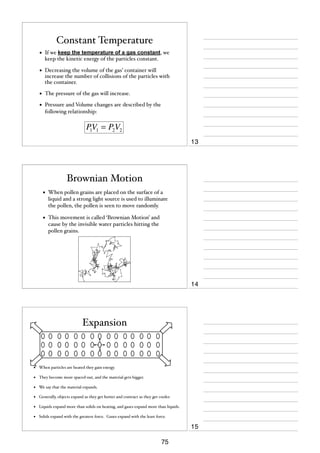
Phases Changes (Graphical)
vaporisation

Temperature
liquid
water

fusion

Time

7

Latent Heat Calculations
• The Specific Latent Heat of a material is given the symbol l.
• From the definition, we have the following relationship:

H = ml
H-J
m - kg
l - J/kg

8

Heat Capacity
• Whilst a material is being heated within a certain state
of matter, its temperature will rise.
• The temperature rise depends upon the mass of the
material, the type of material and the amount of heat
supplied.
• The property of a material that represents how much
heat is needed to raise its temperature is called its
‘Specific Heat Capacity’ and is given the symbol c.

9
73
Calculations
• To calculate heat required we use:

H = mcΔT
H-J
m - kg
C - J/kg/
ºC
∆T - ºC

10

Constant Volume
• If we increase the temperature of a gas in a

container at a constant volume, the particles
will move with more energy, and so there will
be more collisions, and so greater pressure:

Pressure increases with Temperature

11

Constant Pressure
•

If we increase the temperature of a gas in a container at
a constant pressure, the particles will move with more
energy, but they need more space to keep the collisions
constant and so there will be a greater volume:

Volume increases with Temperature

12
74
Constant Temperature
•

If we keep the temperature of a gas constant, we
keep the kinetic energy of the particles constant.

•

Decreasing the volume of the gas’ container will
increase the number of collisions of the particles with
the container.

•

The pressure of the gas will increase.

•

Pressure and Volume changes are described by the
following relationship:

P1V1 = P2V2
13

Brownian Motion
•

When pollen grains are placed on the surface of a
liquid and a strong light source is used to illuminate
the pollen, the pollen is seen to move randomly.

•

This movement is called ‘Brownian Motion’ and
cause by the invisible water particles hitting the
pollen grains.

14

Expansion

•

When particles are heated they gain energy.

•

They become more spaced-out, and the material gets bigger.

•

We say that the material expands.

•

Generally, objects expand as they get hotter and contract as they get cooler.

•

Liquids expand more than solids on heating, and gases expand more than liquids.

•

Solids expand with the greatest force. Gases expand with the least force.

15
75
Questions on Expansion
•

Why do walls have expansion joints?

•

Why are pylon electrical cables tighter in winter?

•

Why do railway lines leave regular gaps between
them?

16

Temperature Scales
•

The most common temperature scale that is used is the
Celsius scale. This has its zero at the freezing point of water,
and the boiling point of water is 100°C.

•

In Physics, the Kelvin scale (or Absolute Temperature scale) is
often used.

•

This is often more sensible as the zero is defined as the point
at which the particles have no kinetic energy (Absolute Zero).

•

To convert between Celsius and Kelvin, we add 273°C.

•

A rise of 1K is the same as a rise of 1°C.

17

Internal Energy
• The Kelvin Temperature is proportional to
the average kinetic energy of the particles.

18
76
Evaporation
• Evaporation is a process by which a liquid
cools due to the fact that particles are lost
from its surface.

• The higher energy particles will be more

likely to leave the liquid, so lowering the
average KE of the particles remaining in the
liquid. The temperature will thus be
lowered.

• Increasing the exposed surface area of the
liquid, or increasing the movement of air will
increase the rate of evaporation.

19

Changing State
When a material changes from one state to another,
bonds are either broken or created. This involves an
associated Internal Energy change.
When bonds are broken, heat must be supplied.
When bonds are created, Heat is released.
Since the energy changes are entirely Internal, there
is no change in kinetic energy of the particles, and
hence no change in the temperature of the material.

20

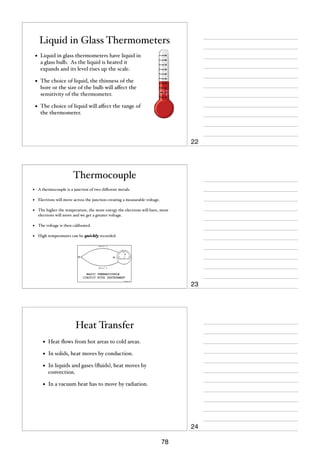
Thermometry
To make a thermometer, we need a property that
changes with temperature in a linear fashion.
We then need to calibrate the thermometer by
choosing two fixed points.
The fixed points for calibration are the boiling point
of water (100°C) and the freezing point of water
(0°C).
The scale is then divided into 100 equal parts for
interpolation.

21
77
Liquid in Glass Thermometers
•

Liquid in glass thermometers have liquid in
a glass bulb. As the liquid is heated it
expands and its level rises up the scale.

•

The choice of liquid, the thinness of the
bore or the size of the bulb will affect the
sensitivity of the thermometer.

•

The choice of liquid will affect the range of
the thermometer.

22

Thermocouple
•

A thermocouple is a junction of two different metals.

•

Electrons will move across the junction creating a measurable voltage.

•

The higher the temperature, the more energy the electrons will have, more
electrons will move and we get a greater voltage.

•

The voltage is then calibrated.

•

High temperatures can be quickly recorded.

23

Heat Transfer
•

Heat flows from hot areas to cold areas.

•

In solids, heat moves by conduction.

•

In liquids and gases (fluids), heat moves by
convection.

•

In a vacuum heat has to move by radiation.

24
78
Conduction

Heat

Heat

•

Heat moves from particle to particle as they collide.

•

Poor conductors are called insulators.

•

Solids are the best conductors (especially metals).

•

Gases are the best insulators.

25

Questions on Conduction.
1. Why does a robin fluff up its feathers in Winter?
2. Why is a string vest warmer than a cotton vest?
3. Design an experiment to compare conductors.

26

Convection
Cool fluid in
a beaker.

Convection
currents
circulate the
heat.

Heat source
is applied.

Warm fluid
expands and
rises. (low
density)

Denser Cool
fluid sinks
Heat

27
79
Questions on Convection
•

Why should you stay close to the ground in a smokefilled room?

•

Why is the heating element at the bottom of a kettle?

28

Radiation
Hot object
(warmer than
surroundings).

Infra-red
light energy
emitted..

Cooler
object

29

Radiation
•

Black objects are better radiators and absorbers than
white or shiny objects.

•

Rough objects are better radiators and absorbers than
shiny or smooth objects.

30
80
Questions on Radiation
•

Why are houses often painted white in hot
countries?

•

Why do marathon runners wear an aluminium
blanket at the end of a race?

31

The Vacuum Flask
stopper

silver
surface

vacuum

32

81
1

Thermal Physics
Quantity and
symbol

Symbol
equation

Definition

The temperature of a gas is related to the
motion of its particles. The faster, and
Temperature, T, θ
therefore the more energetic the particles
the hotter the gas.
The random, jerky motion of particles
(pollen in water, smoke in air) in a
Brownian Motion suspension is evidence for the kinetic model
of matter. The massive particles are moved
by light, fast moving molecules.
The more energetic molecules escape from
the surface of a liquid. This leaves the
Evaporation
liquid left behind with a lower average KE,
and hence a cooler liquid.
For a fixed mass of gas, the pressure is
Pα1
inversely proportional to the volume, (at
V
Boyles’ Law
constant temperature)
PV = k
For a fixed mass of gas, the volume is
VαT
Charles’ Law
directly proportional to the temperature, (at
V=kT
constant pressure)
For a fixed mass of gas, the pressure is
PαT
directly proportional to the temperature, (at
P=kT
Pressure Law
constant volume)
For a fixed mass of gas, the
PV = k
Pressure x Volume = a constant
T
Gas Law
Temperature
P1V1 = P2V2
T1
T2
The amount of heat energy required to
c=E
Thermal Capacity, c
change the temperature of a body by 1 oC
ΔT
The amount of heat energy required to
c=Q
Specific Heat
change the temperature of a unit mass of a
mΔT
Capacity, c
o
substance by 1 C
The amount of energy required to change
Latent Heat, L
the state of a body without a change in
temperature
The amount of energy required to change
L=Q
Specific Latent Heat the state of unit mass of substance, from
m
of Fusion, L
solid to liquid without a change in
temperature
The amount of energy required to change
L=Q
Specific Latent Heat the state of unit mass of a substance from
m
of Vaporisation, L liquid to gas without a change in
temperature
The movement of heat energy by the
passing on of vibrations from particle to
Conduction
particle.

82

units
o

C, K

Temperature
must be the
absolute
temperature
in Kelvin,
K.
The other
quantities
must be
consistent.
J/ oC
J/kg oC
Jkg oC
J
J/kg
J/g
J/kg
J/g
2

Convection
Radiation

The movement of heat energy by the mass
movement of fluids, due to expansion and
density changes due to heating.
The movement of heat energy by the form
of an electromagnetic wave. (Infrared)

83
iGCSE Physics
Past Paper Questions
Paper 1 Compilation
Thermal Physics

84
7

1.
14 The diagram represents molecules in a liquid.
A and C are molecules with a high amount of energy.
B and D are molecules with a low amount of energy.
Which molecule is most likely to be leaving the liquid by evaporation?

A

B

D

C

15 The size of a balloon increases when the pressure inside it increases.
2.
The balloon gets bigger when it is left in the heat from the Sun.
cool balloon

hot balloon

Why does this happen?
A

The air molecules inside the balloon all move outwards when it is heated.

B

The air molecules inside the balloon are bigger when it is heated.

C

The air molecules inside the balloon move more quickly when it is heated.

D

The number of air molecules inside the balloon increases when it is heated.

3.
16 What must expand in order to show the temperature rise in a mercury-in-glass thermometer?
A

the glass bulb

B

the glass stem

C

the mercury

D

the vacuum

0625/1/M/J/02

85

[Turn over
8

4.
17 The table shows the melting points and boiling points of four substances.
Which substance is a liquid at a room temperature of 20 oC?
substance

melting point / oC

boiling point / oC

A

–101

–35

B

–39

357

C

30

2100

D

327

1750

18 A bar made of half wood and half copper has a piece of paper wrapped tightly round it.
5.
The bar is heated strongly at the centre for a short time, and the paper goes brown on one side
only.
wood paper copper

heat
Which side goes brown, and what does this show about wood and copper?
brown side

wood

copper

A

copper

conductor

insulator

B

copper

insulator

conductor

C

wood

conductor

insulator

D

wood

insulator

conductor

0625/1/M/J/02

86
9

6.
19 The diagrams show part of a water-heating system which is working by convection.
Which diagram shows the most likely flow of water in the system?
A

B

hot
water
tank

hot
water
tank
boiler

boiler

heat

heat

C

D

hot
water
tank

hot
water
tank
boiler

boiler

heat

9

heat

19 The diagram shows a heater used to heat a tank of cold water.
7.
20 A drop of water from a tap falls onto the surface of some water of constant depth.

water
lagging
view from above
tank
heater
Water waves spread out on the surface of the water.
Which statement is true?
A

What is the main process and travel at the same speed in all directions.
The waves are longitudinal by which heat moves through the water?

B

The waves are longitudinal and travel more quickly in one direction than in others.
A conduction

C

The waves are transverse and travel at the same speed in all directions.
B convection

D

The waves are transverse and travel more quickly in one direction than in others.
C evaporation
D

radiation
0625/1/M/J/02

20 What causes refraction when light travels from air into glass?
A

87

The amplitude of the light waves changes.

[Turn over
7
15 Two metal boxes containing air are standing in a room. Box X is on top of a heater. Box Y is on a
8.
bench. The boxes are left for a long time.
Y

X

heater

bench

Which line in the table best describes the average speed of the molecules in the containers?
box X

box Y

A

fast

zero

B

fast

slow

C

slow

fast

D

zero

fast

9.
16 The top of the mercury thread in a mercury-in-glass thermometer reaches point X at 0 °C and
point Z at 100 °C.
Z
Y

X
W

Where might it be at a temperature below the ice-point?
A

point W

B

point X

C

point Y

D

point Z

0625/01/M/J/03

88

[Turn over
8
17 The same quantity of heat energy is applied to four different blocks. The temperature rise
10.
produced is shown on each block.
Which block has the highest thermal capacity?
A

B

temperature
rise is
3 °C

temperature
rise is
6 °C

C

D

temperature
rise is
18 °C

temperature
rise is
9 °C

11.
18 A person holds a glass beaker in one hand and fills it quickly with hot water. It takes several
seconds before his hand starts to feel the heat.
Why is there this delay?
A

Glass is a poor conductor of heat.

B

Glass is a good conductor of heat.

C

Water is a poor conductor of heat.

D

Water is a good conductor of heat.

0625/01/M/J/03

89
7
14 A student places his thumb firmly on the outlet of a bicycle pump, to stop the air coming out.

trapped air
direction of
motion
handle
What happens to the pressure and to the volume of the trapped air as the pump handle is pushed
in?
pressure

volume

A

decreases

decreases

B

decreases

remains the same

C

increases

decreases

D

increases

remains the same

15 A balloon is inflated in a cold room. When the room becomes much warmer, the balloon becomes
larger.
How does the behaviour of the air molecules in the balloon explain this?
A

The molecules become larger.

B

The molecules evaporate.

C

The molecules move more quickly.

D

The molecules repel each other.
9

19 The diagram shows a block of ice placed in a warm room.
At which point is the temperature the lowest?
$

D
!
&$"'(

)&%

!"#$%

C
"

B

# A

20 The drawing shows a wave.
Which labelled distance is the wavelength?
© UCLES 2004

0625/01/M/J/04

90
A

[Turn over
8

12.
16 A substance is heated at a steady rate. It changes from a solid to a liquid, and then to a gas.
The graph shows how its temperature changes with time.

S
temperature
5 R

Q
11 The diagram shows a thick sheet of glass.
Which edge must it stand on to cause the greatest pressure?
P

A

time

B
Which parts of the graph show a change of state taking place?
A

P and R

B

P and S

C

Q and R

D

Q and S

D
C

13. An engineer wants to fix a steel washer on to a steel rod. The rod is just too big to fit into the hole
17
12 A manometer is being used to measure the pressure of the gas inside a tank. A, B, C and D
of the washer.
show the manometer at different times.
steel
steel rod
At which time is washer pressure inside the tank greatest?
the gas

A

B

C

How can the engineer fit the washer onto the rod?
gas
A cool the washer and put it over the rod
B

cool the washer and rod to the same temperature and push them together

C

heat the rod and then place it in the hole

D

heat the washer and place it over the rod

13 Brownian motion is seen by looking at smoke particles through a microscope.
14.
How do the smoke particles move in Brownian motion?
A

all in the same direction

B

at random

C

in circles

D

vibrating about fixed points

© U C L E S 2004

0625/01/M/J/04

91

D
9

15.
18 An experiment is set up to find out which metal is the best conductor of heat. Balls are stuck with
wax to rods made from different metals, as shown in diagram X.
The rods are heated at one end. Some of the balls fall off, leaving some as shown in diagram Y.
Which labelled metal is the best conductor of heat?
diagram X

diagram Y
A

h

e

a

t

B

h

before heating

C

e

a

D

t

after heating

16. Thermometer X is held above an ice cube and thermometer Y is held the same distance below
19
the ice cube. After several minutes, the reading on one thermometer changes. The ice cube does
not melt.
thermometer X

ice cube

thermometer Y

Which thermometer reading changes and why?
thermometer

reason

A

X

cool air rises from the ice cube

B

X

warm air rises from the ice cube

C

Y

cool air falls from the ice cube

D

Y

warm air falls from the ice cube

UCLES 2004

0625/01/M/J/04

92

[Turn over
7

17.
14 Viewed through a microscope, very small particles can be seen moving with Brownian motion.
Which line in the table is correct?
type of motion
of particles

particles are
suspended in

A

vibration

a liquid or a gas

B

vibration

a solid, a liquid or a gas

C

random

a liquid or a gas

D

random

a solid, a liquid or a gas

15
18. A measured mass of gas is placed in a cylinder at atmospheric pressure and is then slowly
compressed.
piston
gas
piston pushed in

The temperature of the gas does not change.
What happens to the pressure of the gas?
A

It drops to zero.

B

It decreases, but not to zero.

C

It stays the same.

D

It increases.

16 The graph shows the change in temperature of a material as it is heated.
19.
Which part on the graph shows when the material is boiling?

D
temperature
C
B
A
time

© UCLES 2005

0625/01/M/J/05

93

[Turn over
8

20.
17 An experiment is set up as shown.

pressure gauge

air
flask
water

heat
What does the pressure gauge show as the air in the flask becomes hotter?
A

a steady pressure

B

a decrease in pressure

C

an increase in pressure

D

an increase and then a decrease in pressure

18 An iron bar is held with one end in a fire. The other end soon becomes too hot to hold.

hand

fire
iron bar

21. How has the heat travelled along the iron bar?
A

by conduction

B

by convection

C

by expansion

D

by radiation

© UCLES 2005

0625/01/M/J/05

94
6

22.
14 Driving a car raises the temperature of the tyres.
This causes the pressure of the air in the tyres to increase.
Why is this?
A

Air molecules break up to form separate atoms.

B

Air molecules expand with the rise in temperature.

C

The force between the air molecules increases.

D

The speed of the air molecules increases.

23. To mark a temperature scale on a thermometer, fixed points are needed.
15
Which is a fixed point?
A

the bottom end of the thermometer tube

B

the top end of the thermometer tube

C

the temperature of pure melting ice

D

the temperature of pure warm water

24.
16 Four blocks, made of different materials, are each given the same quantity of internal (heat)
energy.
Which block has the greatest thermal capacity?
A

C

D

temperature
rise = 2 oC

© UCLES 2006

B

temperature
rise = 4 oC

temperature
rise = 6 oC

temperature
rise = 8 oC

0625/01/M/J/06

95
7

25.
17 A long thin bar of copper is heated evenly along its length.
copper bar

heat
What happens to the bar?
A

It becomes lighter.

B

It becomes longer.

C

It becomes shorter.

D

It bends at the ends.

18 A beaker contains water at room temperature.
water

X

Y

26. How could a convection current be set up in the water?
A

cool the water at X

B

cool the water at Y

C

stir the water at X

D

stir the water at Y

8
19 Two plastic cups are placed one inside the other. Hot water is poured into the inner cup and a lid
is put on top as shown.
lid
small spacer
small air gap
hot water
bench

27. Which statement is correct?
A

Heat loss by radiation is prevented by the small air gap.

B

No heat passes through the sides of either cup.

C

The bench is heated by convection from the bottom of the outer cup.

D

The lid is used to reduce heat loss by convection.

© UCLES 2006

0625/01/M/J/06

96
20 Which is the best description of the speed of a water wave?

[Turn over
iGCSE Physics
Past Paper Questions
Paper 3 Compilation
Thermal Physics

97
5
3
1.

Fig. 3.1 is an attempt to show the molecules in water and the water vapour molecules over
the water surface.

For
Examiner’s
Use

water vapour
molecules

water molecules
Fig. 3.1
(a) Explain, in terms of the energies of the molecules, why only a few water molecules have
escaped from the water surface.
..........................................................................................................................................
..........................................................................................................................................
..................................................................................................................................... [2]
(b) State two ways of increasing the number of water molecules escaping from the surface.
1 .......................................................................................................................................
2 .................................................................................................................................. [2]
(c) Energy is required to evaporate water.
Explain, in molecular terms, why this energy is needed.
..........................................................................................................................................
..........................................................................................................................................
..................................................................................................................................... [2]

0625/3/M/J/02

98

[Turn over
6
42. (a) Fig. 4.1 shows a cylinder containing air at a pressure of 1.0 × 10⁵ Pa. The length of the
air column in the cylinder is 80 mm.
80 mm

air
piston

cylinder
Fig. 4.1

The piston is pushed in until the pressure in the cylinder rises to 3.8 × 10⁵ Pa.
Calculate the new length of the air column in the cylinder, assuming that the
temperature of the air has not changed.

new length = .................................. [3]
(b) Fig. 4.2 shows the same cylinder containing air.

air
Fig. 4.2
The volume of the air in the cylinder changes as the temperature of the air changes.
(i)

The apparatus is to be used as a thermometer. Describe how two fixed points, 0 °C
and 100 °C, and a temperature scale could be marked on the apparatus.
...................................................................................................................................
...................................................................................................................................
...................................................................................................................................
...................................................................................................................................

(ii)

Describe how this apparatus could be used to indicate the temperature of a large
beaker of water.
...................................................................................................................................
...................................................................................................................................
...................................................................................................................................
...................................................................................................................................
[5]
0625/3/M/J/02

99

For
Examiner’s
Use
[4]
4

Fig. 4.1 shows a sealed glass syringe that contains air and many very tiny suspended dust
5
particles.
3. (b) Another box of weight 1500 N is raised vertically by 3.0 m.
(i)

syringe
Calculate the work done on the box.
seal

piston
work done = ..................................

dust particles
(ii)

For
Examiner’s
Use

The crane takes 2.5 s to raise this box 3.0 m. Calculate the power output of the
Fig. 4.1
crane.

(a) Explain why the dust particles are suspended in the air and do not settle to the bottom.
..........................................................................................................................................
..........................................................................................................................................
power = ..................................
[4]
..........................................................................................................................................
4

......................................................................................................................................[3]
Fig. 4.1 shows a sealed glass syringe that contains air and many very tiny suspended dust
particles.
(b) The air in the syringe is at a pressure of 2.0 × 10⁵ Pa. The piston is slowly moved into the
syringe, keeping the temperature constant, until the volume of the air is reduced from
syringe
80 cm3 to 25 cm3. Calculate the final pressure of the air.
seal

piston
pressure = ..................................[3]

dust particles
0625/3/M/J/03

Fig. 4.1

[Turn over

(a) Explain why the dust particles are suspended in the air and do not settle to the bottom.
..........................................................................................................................................
..........................................................................................................................................
..........................................................................................................................................
......................................................................................................................................[3]
(b) The air in the syringe is at a pressure of 2.0 × 10⁵ Pa. The piston is slowly moved into the
syringe, keeping the temperature constant, until the volume of the air is reduced from
80 cm3 to 25 cm3. Calculate the final pressure of the air.

pressure = ..................................[3]
0625/3/M/J/03

100

[Turn over
6
54. Fig. 5.1 shows a thermocouple set up to measure the temperature at a point on a solar
panel.
Sun's rays
surface
of solar
panel

Z
X

cold junction
Y

hot junction

Fig. 5.1
(a) X is a copper wire.
(i)

Suggest a material for Y.
...................................................................................................................................

(ii)

Name the component Z.
...................................................................................................................................
[2]

(b) Explain how a thermocouple is used to measure temperature.
..........................................................................................................................................
..........................................................................................................................................
......................................................................................................................................[3]
(c) Experiment shows that the temperature of the surface depends upon the type of
surface used.
Describe the nature of the surface that will cause the temperature to rise most.
..........................................................................................................................................
......................................................................................................................................[1]

0625/3/M/J/03

101

For
Examiner’s
Use
6

5. (a) Two identical open boxes originally contain the same volume of water.
4
One is kept at 15 °C and the other at 85 °C for the same length of time.
Fig. 4.1 shows the final water levels.

15 °C

85 °C
Fig. 4.1

With reference to the energies of the water molecules, explain why the levels are
different.
..........................................................................................................................................
..........................................................................................................................................
..........................................................................................................................................
......................................................................................................................................[3]
(b) In an experiment to find the specific latent heat of vaporisation of water, it took 34 500 J
of energy to evaporate 15 g of water that was originally at 100 °C.
A second experiment showed that 600 J of energy was lost to the atmosphere from the
apparatus during the time it took to evaporate 15 g of water.
Calculate the specific latent heat of vaporisation of water that would be obtained from
this experiment.

specific latent heat = …………………[3]

© UCLES 2004

0625/03 M/J/04

102

For
Examiner’s
Use
7
56. (a) Fig. 5.1 shows two identical metal plates. The front surface of one is dull black and the
front surface of the other is shiny silver.
The plates are fitted with heaters that keep the surfaces of the plates at the same
temperature.
dull black

For
Examiner’s
Use

shiny silver

Fig. 5.1
(i)

State the additional apparatus needed to test which surface is the best emitter of
heat radiation.
...................................................................................................................................

(ii)

State one precaution that is needed to ensure a fair comparison.
...................................................................................................................................
...................................................................................................................................

(iii)

State the result that you expect.
...................................................................................................................................

(iv)

Write down another name for heat radiation.
...................................................................................................................................
[4]

(b) In the space below, draw a labelled diagram of an everyday situation in which a
convection current occurs.
Mark the path of the current with a line and show its direction with arrows.

© UCLES 2004

0625/03 M/J/04

103

[3]

[Turn over
6

7.
4

Fig. 4.1 shows apparatus that a student uses to make an estimate of the specific heat
capacity of iron.

electrical heater

thermometer

iron block

Fig. 4.1
(a) The power of the heater is known. State the four readings the student must take to find
the specific heat capacity of iron.
1. ......................................................................................................................................
2. ......................................................................................................................................
3. ......................................................................................................................................
4. ................................................................................................................................. [3]
(b) Write down an equation, in words or in symbols, that could be used to work out the
specific heat capacity of iron from the readings in (a).

[2]

© UCLES 2005

0625/03/M/J/05

104

For
Examiner’s
Use
7
(c) (i)

Explain why the value obtained with this apparatus is higher than the actual value.
...................................................................................................................................
.............................................................................................................................. [1]

(ii)

State one addition to the apparatus that would help to improve the accuracy of the
value obtained.
...................................................................................................................................
.............................................................................................................................. [1]

© UCLES 2005

0625/03/M/J/05

105

[Turn over

For
Examiner’s
Use
8
5 8. (a) Fig. 5.1 shows the paths of a few air molecules and a single dust particle. The actual air
molecules are too small to show on the diagram.
paths of
air molecules
dust particle

Fig. 5.1
Explain why the dust particle undergoes small random movements.
..........................................................................................................................................
..........................................................................................................................................
..........................................................................................................................................
..................................................................................................................................... [4]
(b) Fig. 5.2 shows the paths of a few molecules leaving the surface of a liquid. The liquid is
below its boiling point.

air and vapour
liquid
Fig. 5.2
(i)

State which liquid molecules are most likely to leave the surface.
...................................................................................................................................
.............................................................................................................................. [1]

(ii) Explain your answer to (i).
...................................................................................................................................
...................................................................................................................................
.............................................................................................................................. [2]

© UCLES 2005

0625/03/M/J/05

106

For
Examiner’s
Use
5
4 9. (a) State two differences between evaporation of water and boiling of water.
1. ......................................................................................................................................
2. ..................................................................................................................................[2]
(b) The specific latent heat of vaporisation of water is 2260 kJ / kg.
Explain why this energy is needed to boil water and why the temperature of the water
does not change during the boiling.
..........................................................................................................................................
..........................................................................................................................................
..........................................................................................................................................
......................................................................................................................................[3]
(c) A laboratory determination of the specific latent heat of vaporisation of water uses a
120 W heater to keep water boiling at its boiling point. Water is turned into steam at the
rate of 0.050 g / s.
Calculate the value of the specific latent heat of vaporisation obtained from this
experiment. Show your working.

specific latent heat of vaporisation = ........................[3]

© UCLES 2006

0625/03/M/J/06

107

[Turn over

For
Examiner’s
Use
6
510. (a) Fig. 5.1 shows a tank used for evaporating salt solution to produce crystals.
evaporating tank
steam in
salt solution
steam out
Fig. 5.1
Suggest two ways of increasing the rate of evaporation of the water from the solution.
Changes may be made to the apparatus, but the rate of steam supply must stay constant.
You may assume the temperature of the salt solution remains constant.
1. ......................................................................................................................................
..........................................................................................................................................
2. ......................................................................................................................................
......................................................................................................................................[2]
(b) A manufacturer of liquid-in-glass thermometers changes the design in order to meet
new requirements.
Describe the changes that could be made to
(i)

give the thermometer a greater range,
..............................................................................................................................[1]

(ii)

make the thermometer more sensitive.
..............................................................................................................................[1]

(c) A toilet flush is operated by the compression of air. The air inside the flush has a
pressure of 1.0 × 10⁵ Pa and a volume of 150 cm3. When the flush is operated the
volume is reduced to 50 cm3. The temperature of the air remains constant during this
process.
Calculate the new pressure of the air inside the flush.

pressure = .......................[2]

© UCLES 2006

0625/03/M/J/06

108

For
Examiner’s
Use
Topic 3:
Waves

1

Transverse Waves
Wavelength
amplitude
amplitude
Wavelength
Frequency=Number of Waves per second (Hz)

2

Types of Waves
•

Waves carry energy without matter being
transferred.

•

There are two types of wave motion:

•

Transverse.

•

Longitudinal.

3
109
Transverse Waves

•

In a transverse wave, the wave
motion is at right angles to the
direction of the wave.

•

The Energy flows in a direction at
right angles to the wave motion.

•

Examples of transverse waves are
Light, Pond-ripples, Seismic Swaves.

4

Longitudinal Waves



In a longitudinal wave, the wave motion
is along the direction of the wave. It
consists of a series of compressions and
rarefractions.



The Energy flows in the same direction
as the wave motion.



Examples of longitudinal waves are
Sound and Seismic P-waves.

5

Reflection
•

If waves hit a boundary, they will reflect.

•

The angle of incidence will be equal to the angle of
reflection.

Incident
wavefronts

Reflected
wavefronts

Reflecting
Surface
Normal

6
110
Refraction
•

If a wave changes speed, its direction will change.

•

If it slows-down it will bend towards the normal.

•

If the wave speeds-up it will bend away from the normal.
Incident
wavefronts

Boundary
Refracted
Wavefronts
Normal

7

Diffraction
•

If a wave encounters a gap that is of a similar size as the
wavelength of the wave, we will get diffraction.

•

The wave appears to spread-out from the gap.

8

Period of a Wave
• The period of a wave is the time taken for the
wave to complete one cycle.

• There is a simple relationship between Period
(T) and Frequency (f):

Period =

1
frequency

9
111
The Wave Equation
• The wave-speed (v), the frequency (f) and the
wavelength (λ) are linked with the wave equation:

v(m s) = f (Hz)λ (m)

10

Wave Equation Questions
1. The speed of sound in air is 340m/s. A musical note has
a wavelength of 0.6m. Calculate the frequency of the note.
2. In a concert hall, an echo is heard 0.5s after the note was
played. How long is the hall?
3 The speed of light in air is 300 000 000 m/s. The
frequency of the “Radio Uno” radio station is 567
kHz. Calculate the wavelength of the radio waves.
4 What would be the Period of one these waves?

11

Reflection in a Plane Mirror
•

In a plane mirror, angle of incidence=angle of reflection.

•

The mirror produces a virtual upright image behind the mirror, the same size as
the object and at the same distance as the object.

•

The image is laterality inverted.

Eye

Object

Image

112

12
Refraction in a Rectangular
Block
Air

Glass

Air

r
i
r
i

13

Refractive Index
• When light moves through a medium, it is
slowed down.

• A high refractive index (n) means that the

light’s speed (vm) is slow in the medium. We
define refractive index in terms of the speed of
light (c)

n=

c
vm
14

Refraction
•

When light moves from air to a medium it bends
towards the normal. The angles depend upon the
refractive index of the material concerned.
air

medium
r

i

n=

sin i
sin r

15
113
Spectrum of Visible Light
• The colours of visible light can be arranged
according to their wavelength.

• We normally say that there are seven distinct

colours, although the spectrum is continuous.

• In order of increasing wavelength, the colours
are:

• Red, Orange, Yellow, Green, Blue, Indigo &
Violet.

• Each colour of light refracts by a different

amount; violet light the most, red light the least.

16

Dispersion

White light

screen
prism

17

Refraction in a Semi-Circular
Block
r
i

Refraction

C

Critical
Angle

i

r

Total
Internal
Reflection

18
114
Total Internal Reflection
•

If the angle of Incidence is greater than the Critical
angle then the light undergoes TOTAL
INTERNAL REFLECTION.

•

All of the energy stays inside the block.

19

Optical Fibres
Optical Fibre

20

Refracting Periscope

21
115
Keyhole Surgery

A camera and remote-controlled
surgical instruments are inserted
into a small incision in the
patient.
There is less risk of infection and
a quicker recovery time than
invasive surgery.

22

Fibre Optic Transmission

Signals are sent as pulses of light.
Cheaper signal production, less signal boosting, more
secure transmission, higher bandwidth (more information
possible).

23

Converging Lens
focus

focus

focal
length

focal
length

•

A convex (converging) lens is wider in the middle than at the
edges.

•

Convex lenses have a principal focus on either side.

•

The distance between the lens and the focus is called the “focal
length”

116

24
• Parallel light is converged to the focus.
• Light entering through the focus emerges
parallel.

• Light passing through the centre of the lens is
unaffected.

25

Ray Diagrams
• When drawing a ray diagram, we construct
at least two rays from point on an object,
and try to use the rules of converging lenses.

• The image is formed where the rays cross.
• The Image can be magnified or reduced,
further or closer, real or virtual, inverted or
upright.

26

Problems
•

Construct ray diagrams for the following:

•

A) An object of height 2cm placed 10cm from a
convex lens of focal length 3cm.

•

B) An object of height 2cm placed 5cm from a
convex lens of focal length 3cm.

•

C) An object of height 2cm placed 2.5cm from a
convex lens of focal length 3cm.

27
117
The Electromagnetic Spectrum
Long Wavelength

Short Wavelength

Low Frequency

High Frequency

Radio
Waves

Micro
Waves

Infra-red
Waves

Visible

Ultraviolet
Rays

X-Rays

Gamma
Rays

28

Sound
•

Sounds are produced when objects VIBRATE.

•

Sound is a LONGITUDINAL wave.

•

Reflected sound waves produce echoes.

•

Sound travels at about 340 m/s in air. It travels faster in liquids and faster still in
solids.

•

Unlike light, sound needs a medium.

•

Sound waves can be displayed electronically using an Oscilloscope.

•

The greater the amplitude, the louder the sound.

•

The greater the frequency, the higher the pitch.

•

Our ears are sensitive to sound in the range 20 Hz - 20 kHz.

•

Ultrasound is of a higher frequency than our ears can detect. (pre-natal scans, sonar)

29

Sound Waves

Low Frequency (Low pitch) and Large
Amplitude (Loud)

High Frequency (High pitch) and Large
Amplitude (Loud)

Low Frequency (Low pitch) and Small
Amplitude (Quiet)

High Frequency (High pitch) and Small
Amplitude (Quiet)

30
118
Wave Physics
Quantity and
symbol
Waves

Transverse Waves
Longitudinal Waves
Amplitude

Wave Speed, v

Wavelength, λ

Frequency, f
Time Period, T

Refection
Refraction

Refractive Index, n

Word equation / definition
Waves transfer energy from one place to
another without the mass movement of the
medium itself.
The oscillations are perpendicular to the
direction of wave travel. Examples include;
water waves, light, and any part of the
electromagnetic spectrum.
The oscillations are parallel to the direction
of wave travel. Example is Sound.
The amplitude of a wave is the maximum
displacement of the particles from their
equilibrium position.
Speed is the rate of change of distance of the
wave. It can be calculated using the
speed/distance/time equation or,
Speed = frequency x wavelength
The distance between two adjacent crests, or
two adjacent troughs. Or the distance
between to adjacent points on a wave that are
in the same phase of motion.
Wavelength = speed
frequency
The number of waves passing a point in 1
second, or the number of oscillations of a
particle or the source in 1 second
Frequency = speed
wavelength
The time for one complete wave to pass a
point or the time for one complete oscillation
of a particle
Time Period =_____1________
frequency
The angle of incidence is equal to the angle
of reflection.
Refraction is the change of direction that
occurs when waves enter, at an angle other
than 90o, a medium in which it travels at a
different speed.
Refractive index is
the ratio of the sine of angle of incidence to
the sine of the angle of refraction (Snell’s
Law)
or the ratio of the speed of light in air or a
vacuum to the speed of light in the medium.
or the ratio of the real depth to the apparent
depth

Symbol
equation

units

cm
m
v=fλ

cm/s
m/s

λ=v
f

m

f=v
λ

Hertz, Hz

T = _1_
f
seconds
i=r

n = sin i
sin r
n=c
v
n=R
A

No units,
it’s a
ration

1
119
Critical Angle, C

Total Internal
Reflection
Diffraction
Dispersion

Speed of Light
Monochromatic

The Critical Angle occurs inside the more
dense medium and is the angle of incidence,
at which the angle of refraction is 90o, i.e.
along the boundary between the mediums
Total internal reflection occurs at angles
greater than the critical angle inside a more
dense medium.
Diffraction is the spreading out of waves as
they pass through a gap. The narrower the
gap the more diffraction there is.
Dispersion is the splitting of light into the
colours of the spectrum, due to the different
speeds at which these colours travel in the
prism.
And all other waves in the electromagnet
spectrum
Monochromatic means of one frequency.
Therefore if monochromatic light is passed
through a triangular prism dispersion will not
occur.

n = ___1___
sin C

m/s

330

Speed of Sound

3.0 x10⁸

m/s

2
120
iGCSE Physics
Past Paper Questions
Paper 1 Compilation
Waves

121
heat

heat

9

19 The diagrams show part of a water-heating system which is working by convection.
20 A drop of water from a tap falls onto the surface of some water of constant depth.
1.
Which diagram shows the most likely flow of water in the system?
A

B

hot
water
tank

hot
water
tank
view from above

boiler

heat
Water waves spread out on the surface of the water.
Which statement is true?
C
A
B
C
D

boiler

heat

D

The waves are longitudinal and travel at the same speed in all directions.
hot
hot
water are longitudinal and travel more quickly in one direction than in others.
water
The waves
tank
tank
The waves are transverse and travel at the same speed in all directions.
The waves are transverseboilertravel more quickly in one direction thanboiler
and
in others.

heat
25 A girl stands in front of a rock face.
2.

12

heat
[Turn over

0625/1/M/J/02

20 A drop of water from a tap falls onto the surface of some water of constant depth.
rock face

660 m

view from above

Water waves spread out on the surface of the water.
Which statement is true?
A

The waves are longitudinal and travel at the same speed in all directions.

B The girl claps her hands once. The speed of quickly in air is directions.
The waves are longitudinal and travel more sound in one 330 m / than in others.
C How long is it before she hears the echo? same speed in all directions.
The waves are transverse and travel at the
D

The waves are transverse and travel more quickly in one direction than in others.
2 x 660
660
330
330
______ s
___ s
___ s
______ s
A
B
C
D

330

330

660

0625/1/M/J/02

2 x 660

26 Which diagram best shows the pattern of field lines around a bar magnet?

122

[Turn over
10

3.
21 A student measures how far a cork moves up and down on a wave in a tank of water.
ruler

cork
direction
of wave

Which quantity can he obtain from his measurement?
A

amplitude

B

frequency

C

speed

D

wavelength

4.
22 Alpha-particles, beta-particles, gamma-rays and infra-red radiation may all be emitted from a
solid.
Which of these are included in the electromagnetic spectrum?
A

alpha-particles and beta-particles

B

alpha-particles and gamma-rays

C

beta-particles and infra-red radiation

D

gamma-rays and infra-red radiation

0625/1/M/J/02

123
11
23 The image of a clock face as seen in a plane mirror is shown.
5.

21

3

9

6
What is the actual time on the clock?
A

1.25

B

C

1.35

10.25

D

10.35

6.
24 Four sound waves W, X, Y and Z are displayed by an oscilloscope screen. The oscilloscope
settings are the same in each case.

W

X

Y

Z

Which two sounds have the same pitch?
A

W and X

B

W and Y

C

X and Y

D

X and Z

0625/1/M/J/02

124

[Turn over
10

7.
22 Which statement is correct about the speed of electromagnetic waves in a vacuum?
A

Ultra-violet waves have the greatest speed.

B

Visible light waves have the greatest speed.

C

Infra-red waves have the greatest speed.

D

All electromagnetic waves have the same speed.

23 Which diagram correctly shows rays passing through a camera lens?
camera

A

camera

B
film

film

object

object
lens

lens

image

camera

C

image

camera

D
film

film

object

object
lens

lens

image

0625/01/M/J/03

125

image
11
248. A sound wave passes through the air, in the direction shown.
→
direction of travel of sound wave

How does a particle of air move as the sound wave passes?
A
B

moves left and right

C

moves up and stays there

D

•→

moves to the right and stays there

moves up and down

←•→
↑
•
↑
•
↓

9.
25 A boy is stranded on an island 500 m from the shore.

500 m

cliffs

island

He shouts for help, but all he can hear in reply is the echo of his shout from some cliffs.
Sound travels at 340 m / s through the air.
What is the time interval between the boy shouting and hearing the echo?
A

500
s
340

B

2 × 500
s
340

C

340
s
500

0625/01/M/J/03

126

D

2 × 340
s
500

[Turn over
10

10.
20 Water waves change direction when they move from shallow water to deep water.
new wave
direction
original
wave
direction
deep
water
shallow
water

What is the name of this effect?
A

diffraction

B

dispersion

C

reflection

D

refraction

11.
21 A vertical stick is dipped up and down in water at P. In two seconds, three wave crests are
produced on the surface of the water.

Y
wave
crests

P

X

Which statement is true?
A

Distance X is the amplitude of the waves.

B

Distance Y is the wavelength of the waves.

C

Each circle represents a wavefront.

D

The frequency of the waves is 3 Hz.

© UCLES 2004

0625/01/M/J/04

127
11

12.
22 A plane mirror is on a wall.
Which is a correct description of the image formed by the mirror?
A

the right way up and smaller than the object

B

the right way up and the same size as the object

C

upside down and smaller than the object

D

upside down and the same size as the object

23 The diagram shows a ray of light entering a block of glass.
13.
normal
ray of
light
2
air
glass

1
3
4

Which numbered angles are the angles of incidence and of refraction?
angle
of incidence

angle
of refraction

A

1

3

B

1

4

C

2

3

D

2

4

© UCLES 2004

0625/01/M/J/04

128

[T urn o v er
12

14.
24 Thre e rays of light fall on a converging lens as shown.

lens
Which diagram shows the path of the rays after passing through the lens?

A

B

C

D

15.
25 Which type of wave c a n n ot travel through a vacuum?
A

infra-red radiation

B

microwaves

C

sound waves

D

X-rays

U C L E S 2004

0625/01/M/J/04

129
9
19 The diagram shows a block of ice placed in a warm room.
13
At which point is the temperature the lo w e st?
16.
26 An engineer standing at P hears the sound of an explosion at X.
$
!

P
clamp

ice

table

#

Z
"

Y

X

DANGER BLASTING

V

W

20 The drawing shows a wave.
After the explosion, she is the wavelength? One bang is heard a fraction of a second after the
Which labelled distance hears two bangs.
other.
The second bang is an echo from
A
A XY.
B

ZY.

D

D

PV.

C

B

WX.

C

17. R adio waves are received at a house at the bottom of a hill.
21
27 How can a permanent magnet be demagnetised?
A

cool the magnet for a long time

B

hit the magnet repeatedly with a hammer

C

leave the magnet in a coil which carries direct current

D

hill
pass a small current through the magnet

28 An electromagnet is used to separate magnetic metals from non-magnetic metals.
The waves re ach the house because the hill has caused them to be
Why is steel unsuitable as the core of the electromagnet?
A diffracted.
AB Itradiated. conductor of electricity.
is a good
BC Itreflected.permanent magnet.
forms a
CD Itrefracted. density.
has a high
D It has a high thermal capacity.

© U C L E S 2005

© UCLES 2004

0625/01/M/J/05

0625/01/M/J/04

130

[T urn o v er

[T urn o v er
10

18.
22 Which diagram correctly shows a ray of light passing through a rectangular glass block?
A

B

C

D

23
19. The ray diagram shows how an image is formed by a converging lens.
9

24 cm

10 cm

8 cm

19 The diagram shows a block of ice placed in a warm room.
At which point is the temperature the lo w e st?
$
!
clamp

ice

table

"

#

What is the focal length of this lens?
A

8 cm

B

10 cm

C

18 cm

D

20
20. The drawing shows a wave.
Which labelled distance is the wavelength?

A
B

D
C

21 Radio waves are received at a house at the bottom of a hill.

© UCLES 2005

0625/01/M/J/05

131

24 cm
11

21. A fire alarm is not loud enough. An engine er adjusts it so that it produces a note of the same pitch
24
which is louder.

What effect does this have on the amplitude and on the frequency of the sound?
amplitude

frequency

A

larger

larger

B

larger

same

C

same

larger

8

19 Two plastic cups are placed one inside the other. Hot water is poured into the inner cup and a lid
D
same
same
is put on top as shown.
lid
22.
25 To estimate the width of a valley, a climber starts a stopwatch as he shouts. H e he ars an echo
from the opposite side of the valley after 1.0 s.
small spacer
small air gap

sound

hot water

climber

Which statement is correct?

bench

valley

A H e at travels at 340 m s.
The soundloss by radiation /is prevented by the small air gap.
B No he at passes through the sides of either cup.
What is the width of the valley?
C The bench is he ated by convection from the bottom of the outer cup.
B 170 m
C 340 m
D 680 m
A 85 m
D The lid is used to reduce he at loss by convection.
26 Which material is used for the core of an electromagnet?
23.
20 Which is the best description of the spe ed of a water wave?
A aluminium
A the distance betwe en one wave crest and the next
B copper
B the distance betwe en the crest of a wave and a trough
C iron
C the distance that a particle of water moves up and down in one second
D ste el
D the distance that a wavefront moves along the surface in one second

© UCLES 2005

0625/01/M/J/05

132

[Turn over
9

24.
21 Water waves travel more slowly in shallow water than in deep water.
Which diagram shows what will happen to plane waves in deep water when they enter shallow
water?

A
deep

B
shallow

deep

D

C
deep

shallow

deep

shallow

shallow

22 A ray of light passes through a window.
25.
Which path does it take?
air

glass

air

A
B
C
D

© UCLES 2006

0625/01/M/J/06

133

[Turn over
10

26.
23 The diagram shows the image of a clock in a plane mirror.

What time is shown?
A

02:25

B

02:35

C

09:25

D

09:35

24 The diagram shows a man standing at X who shouts to a man standing at Y.
27.

X
N

W

E
S

Y
The man’s voice will be heard sooner and more clearly if the wind is blowing towards the
A

north.

B

south.

C

east.

D

west.

25 Sounds are made by vibrating objects. A certain object vibrates but a person nearby cannot hear
any sound.

28. Which statement might explain why nothing is heard?
A

The amplitude of the sound waves is too large.

B

The frequency of the vibration is too high.

C

The sound waves are transverse.

D

The speed of the sound waves is too high.

© UCLES 2006

0625/01/M/J/06

134
B

convection

C

evaporation

D

radiation

9

19 The diagram shows a heater used to heat a tank of cold water.
20
29. What causes refraction when light travels from air into glass?
A

The amplitude of the light waves changes.

B

The colour of the light changes.

C

The frequency of the light waves changes.

D

The speed ofwater
the light changes.

lagging
30.
21 A woman tunes her radio to a station broadcasting on 200 m.
tank
What does the 200 m tell her about the radio wave?
heater
A its amplitude
B

its frequency

C its speed
What is the main process by which heat moves through the water?
D its wavelength
A

conduction

B

convection

C

evaporation

D

radiation
0625/01/M/J/03

20 What causes refraction when light travels from air into glass?
A

The amplitude of the light waves changes.

B

The colour of the light changes.

C

The frequency of the light waves changes.

D

[Turn over

The speed of the light changes.

21 A woman tunes her radio to a station broadcasting on 200 m.
What does the 200 m tell her about the radio wave?
A

its amplitude

B

its frequency

C

its speed

D

its wavelength

0625/01/M/J/03

135

[Turn over
iGCSE Physics
Past Paper Questions
Paper 3 Compilation
Waves

136
7
5 1. Fig. 5.1 shows an arrangement where a plane mirror is used in a shop to watch a display
counter. The arrangement is drawn to a scale of 1 cm : 1 m.

For
Examiner’s
Use

plane mirror

P

wall
display counter

Fig. 5.1
(a) (i)

State the law of reflection.
...................................................................................................................................

(ii)

On Fig. 5.1, draw rays to show how much of the display cannot be seen from P.
Indicate this by shading in the part that cannot be seen.
[3]

(b) By construction on Fig. 5.1 and by using the scale, calculate how far the mirror must be
moved so that all of the display counter can be seen from P.

distance moved = .................................... [2]
(c) State the characteristics of an image seen in a plane mirror.
..........................................................................................................................................
..........................................................................................................................................
..................................................................................................................................... [2]

0625/3/M/J/02

137

[Turn over
For
Examiner’s
Use

8
62. Observations of a distant thunderstorm are made.
(a) During a lightning flash, the average wavelength of the light emitted is 5 × 10⁻⁷ m. This
light travels at 3 × 10⁸ m/s.
Calculate the average frequency of this light.

frequency = ...................................... [2]
(b) The interval between the lightning flash being seen and the thunder being heard is
3.6 s. The speed of sound in air is 340 m/s.
(i)

Calculate the distance between the thunderstorm and the observer.

distance = ............................................
(ii)

Explain why the speed of light is not taken into account in this calculation.
...................................................................................................................................
...................................................................................................................................
[3]

(c) A single ray of white light from the lightning is incident on a prism as shown in Fig. 6.1.
prism

screen
ray of
light

Fig. 6.1
Complete the path of the ray to show how a spectrum is formed on the screen. Label the
colours.
[2]

0625/3/M/J/02

138
7

For
Examiner’s
Use

63. Fig. 6.1 shows wavefronts of light crossing the edge of a glass block from air into glass.

air
direction in which
wavefronts
are moving
glass

edge of glass
Fig. 6.1
(a) On Fig. 6.1
(i)

draw in an incident ray, a normal and a refracted ray that meet at the same point on
the edge of the glass block,

(ii)

label the angle of incidence and the angle of refraction,

(iii)

measure the two angles and record their values.
angle of incidence = ..................................
angle of refraction = ..................................
[4]

(b) Calculate the refractive index of the glass.

refractive index = ..................................[3]

0625/3/M/J/03

139

[Turn over
8

For
Examiner’s
Use

74. In a thunderstorm, both light and sound waves are generated at the same time.
(a) How fast does the light travel towards an observer?
speed = ..................................

[1]

(b) Explain why the sound waves always reach the observer after the light waves.
......................................................................................................................................[1]
(c) The speed of sound waves in air may be determined by experiment using a source that
generates light waves and sound waves at the same time.
(i)

Draw a labelled diagram of the arrangement of suitable apparatus for the
experiment.

(ii)

State the readings you would take.
...................................................................................................................................
...................................................................................................................................
...................................................................................................................................

(iii)

Explain how you would calculate the speed of sound in air from your readings.
...................................................................................................................................
...................................................................................................................................
[4]

0625/3/M/J/03

140
8
65. Fig. 6.1 shows a ray PQ of blue light incident on the side of a rectangular glass block.

A

B

glass

C
Q

D

air

Fig. 6.1

P

Fig. 6.1
(a) (i)
(ii)

By drawing on Fig. 6.1, continue the ray PQ through and beyond the block.
Mark the angle of incidence at CD with the letter i and the angle of refraction at CD
with the letter r.
[3]

(b) The speed of light in air is 3.0 x 10⁸ m/s and the speed of light in glass is 2.0 x 10⁸ m/s.
(i)

Write down a formula that gives the refractive index of glass in terms of the
speeds of light in air and glass.
refractive index =

(ii)

Use this formula to calculate the refractive index of glass.
refractive index = …………………
[2]

(c) The frequency of the blue light in ray PQ is 6.0 x 10¹⁴ Hz.
Calculate the wavelength of this light in air.

wavelength = ……………..……[2]
© UCLES 2004

0625/03 M/J/04

141

For
Examiner’s
Use
9
76. Fig. 7.1 shows the cone of a loudspeaker that is producing sound waves in air.
At any given moment, a series of compressions and rarefactions exist along the line XY.

For
Examiner’s
Use

cone

X

Y

wires
air

Fig. 7.1
(a) On Fig. 7.1, use the letter C to mark three compressions and the letter R to mark three
rarefactions along XY.
[1]
(b) Explain what is meant by
(i)

a compression,
...................................................................................................................................
...................................................................................................................................

(ii)

a rarefaction.
...................................................................................................................................
...................................................................................................................................
[2]

(c) A sound wave is a longitudinal wave. With reference to the sound wave travelling along
XY in Fig. 7.1, explain what is meant by a longitudinal wave.
..........................................................................................................................................
......................................................................................................................................[2]
(d) There is a large vertical wall 50 m in front of the loudspeaker. The wall reflects the
sound waves.
The speed of sound in air is 340 m/s.
Calculate the time taken for the sound waves to travel from X to the wall and to return
to X.

time = …………………[2]

© UCLES 2004

0625/03 M/J/04

142

[Turn over
9
67. Fig. 6.1 shows a ray of light OPQ passing through a semi-circular glass block.

For
Examiner’s
Use

O

P

30°

Q

Fig. 6.1
(a) Explain why there is no change in the direction of the ray at P.
..........................................................................................................................................
..................................................................................................................................... [1]
(b) State the changes, if any, that occur to the speed, wavelength and frequency of the light
as it enters the glass block.
..........................................................................................................................................
..........................................................................................................................................
..................................................................................................................................... [2]
(c) At Q some of the light in ray OPQ is reflected and some is refracted.
On Fig. 6.1, draw in the approximate positions of the reflected ray and the refracted ray.
Label these rays.
[2]
(d) The refractive index for light passing from glass to air is 0.67.
Calculate the angle of refraction of the ray that is refracted at Q into air.

angle = ………………. [3]

© UCLES 2005

0625/03/M/J/05

143

[Turn over
10
78. Fig. 7.1 shows the parts of the electromagnetic spectrum.

ultraviolet

γ - rays and X - rays

v
i
s
i
b
l
e

infrared

For
Examiner’s
Use

radio
waves

Fig. 7.1
(a) Name one type of radiation that has
(i)

a higher frequency than ultra-violet,
.............................................................................................................................. [1]

(ii)

a longer wavelength than visible light.
.............................................................................................................................. [1]

(b) Some γ-rays emitted from a radioactive source have a speed in air of 3.0 x 10⁸ m/s and
a wavelength of 1.0 x 10⁻¹² m.
Calculate the frequency of the γ-rays.

frequency = ………………. [2]
(c) State the approximate speed of infra-red waves in air.
..................................................................................................................................... [1]

© UCLES 2005

0625/03/M/J/05

144
7
69. Fig. 6.1 shows white light incident at P on a glass prism. Only the refracted red ray PQ is
shown in the prism.

P red ray
Q

t

white ligh

screen

Fig. 6.1
(a) On Fig. 6.1, draw rays to complete the path of the red ray and the whole path of the
violet ray up to the point where they hit the screen. Label the violet ray.
[3]
(b) The angle of incidence of the white light is increased to 40°. The refractive index of the
glass for the red light is 1.52.
Calculate the angle of refraction at P for the red light.

angle of refraction = ........................[3]
(c) State the approximate speed of
(i)

the white light incident at P,

speed = ........................ [1]

(ii)

the red light after it leaves the prism at Q.

speed = ........................ [1]

© UCLES 2006

0625/03/M/J/06

145

[Turn over

For
Examiner’s
Use
8
7
10. Fig. 7.1 shows how the air pressure at one instant varies with distance along the path of a
continuous sound wave.
air pressure

normal
P
air pressure

X

Y
distance in direction
of travel of the wave

Fig. 7.1
(a) What type of waves are sound waves?
......................................................................................................................................[1]
(b) On Fig. 7.1, mark on the axis PY
(i)

one point C where there is a compression in the wave,

[1]

(ii)

one point R where there is a rarefaction in the wave.

[1]

(c) Describe the motion of a group of air particles situated on the path of the wave shown in
Fig. 7.1.
..........................................................................................................................................
..........................................................................................................................................
......................................................................................................................................[2]
(d) The sound wave shown has speed of 340 m / s and a frequency of 200 Hz.
Calculate the distance represented by PX on Fig. 7.1.

distance = ........................[2]

© UCLES 2006

0625/03/M/J/06

146

For
Examiner’s
Use
Topic 4:
Electricity & Magnetism

1

Charge
•

Charge is a property that objects can have.

•

Charge can be positive (+) or negative (-).

•

Charge is measured in coulombs (C).

•

Conductors allow charge to move (metals & graphite).

•

Insulators prevent charge from moving (Most non-metals).

•

Electrons are usually responsible for movement of charge
(current).

2

Charging by Friction
•

When two insulators are rubbed together,
ELECTRONS are transferred from one to the other
and the objects become charged.

•

This is called charging by friction because friction is
the force that moves the electrons.

•

Only electrons move. Positive charge does not
move.

3
147
Polythene Rods
•

Polythene rods gain a negative charge when rubbed
with a cloth.

•

Electrons are moved from the cloth to the rod.

•

The cloth becomes positively charged.

4

Perspex Rods
•

Perspex rods gain a positive charge when rubbed
with a cloth.

•

Electrons are moved from the rod to the cloth.

•

The cloth becomes negatively charged.

5

The Gold-Leaf Electroscope
Metal Cap
Metal Rod

Metal Case

Insulator
Gold Leaf

•

The Gold-Leaf electroscope is an instrument that detects and
measures electrostatic charge.

•

It consists of a metal (conductor) cap and rod with a thin piece of gold
foil (conductor) connected.

•

The rod is held in place by plastic (insulator).

•

The earthed outer case is made from metal (conductor).

6
148
The Law of Electrostatics
•

If charged objects are placed beside each other, they
experience a force.

•

The force depends upon the charges on the objects.

•

An electric field surrounds the charges. This is a region of
influence on other charges.
repel

repel

attract

attract

7

The Law of Electrostatics
•

This can be summarised as:

Opposite Charges Attract.
Like Charges Repel.

8

Summary of Quantities
Quantity

Symbol

Unit

Unit’s
Symbol

Current

I

Ampere

A

Potential
Difference
(Voltage)

V

Volt

V

Resistance

R

Ohm

Ω
9
149
Current/Voltage Graphs
•

The characteristics of a component can be shown by
graphing the current through it for varying voltages.

•

This graph is called the characteristic of the
component.

•

Negative p.d.s are plotted as well as positive ones.

10

Ohmic Resistors
•

Ohmic resistors have a proportional relationship between
current and pd. This is because the resistance remains
constant for all voltages.
current

p.d.

11

Filament Lamp
•

A filament lamp or standard resistor does not ‘behave
itself ’ as well as an ohmic resistor. The resistance increases
with voltage as the wire gets hotter.
current

p.d.

12
150
The Diode
•

The diode’s behaviour depends upon its direction in the
circuit. It allows current to flow in the positive direction
but blocks it in the negative direction. It can be thought
of as an electric valve.
current

p.d.
0.7 V

13

Ohm’s Law
•

Ohm’s Law states that the current in, and voltage
across a conductor are proportional provided that
the temperature and other physical quantities
remain the same.

•

This is easily seen in an ohmic resistor.

14

Potential Difference in Series
Circuits
• In a series circuit the PD from the cell (Vt) is
divided among the individual components:
Vt

V1

V2

Vt = V1 + V2 + ...

15
151
Current in Series Circuits
• In a series circuit the Current is the same at all
points in the circuit. This is because of the
conservation of charge.
It

It

I2

I1

I t = I1 = I 2 = ...

I3

16

Resistance in Series Circuits
• The Combined Resistance (Rt) is equal to the sum
of the individual resistances:

Rt = R1 + R2 + ...

Rt

R1

R2

17

Potential Difference in Parallel
• In a Parallel circuit the PD across each strand is
the same as the PD supplied to the strand since
the voltage is between the same two points in each
case.
Vt

V1

Vt = V1 = V2 = ...

V2

18
152
Current in Parallel Circuits
• In a Parallel circuit the current supplying the
strands splits. Because of the conservation of
charge:

It

I t = I1 + I 2 + ...

I1

I2

19

Resistance in Parallel
• In a parallel combination, the combined resistance
is found using the following equation:

Rt

1
1
1
=
+
+ ...
Rt R1 R2

R1
R2

20

Resistance
• Electric Current is opposed by components in a
circuit. This opposition is called Resistance.

• Resistance can be defined by the equation:
R(Ω) =

V (V )
I(A)

21
153
Current
•

Current is the rate at which charge (coulombs) passes a point in
a circuit.

•

Current is measured with an ammeter in a circuit which is
placed in series at the point where the current needs to be
measured.

I(A) =

Q(C)
t(s)

22

Potential Difference
•

Electrical Energy is given to the charges in a cell (battery). This energy is
given up in the components.

•

Both cells and components in a circuit have a voltage across them.

•

Potential Difference is measured in a circuit with an voltmeter. It should be
placed in parallel across the two points where the PD is to be found.

V (V ) =

ΔEnergy(J )
Q(C)

23

The Potential Divider
Vt

I

V1=IR1

V2=IR2

• The total PD across the resistors is shared by the
resistors.

• The share of the voltage that each resistor gets
depends upon its resistance.

• If R1 is large compared to R2 then it will have a much
bigger share of the voltage across it.

24
154
Simpler Design
Vt

I

V1

• The Potential Divider can be made adjustable by
using a variable resistor and taking a voltage from
the rheostat.

25

Task
• Using the 12V setting on the power pack, a
variable resistor, a voltmeter a bulb and leads,
construct a circuit that supplies the bulb with
exactly 4.56 V.

V

26

Energy in D.C. Circuits
It has been shown that
Voltage is the Work
Done per Coulomb
But we also know that:
So:

V=

I=

Q = It
Energy = VQ

WD
Q

Q
t

Energy = VIt
27
155
Power in D.C. Circuits
Power =

Since

ΔEnergy
t

Energy = VIt

and

Power =

so

VIt
t

Power = VI
28

Combining Ohms Law
Equation
Since P=VI, we can use V=IR to get alternative
expressions for Power:

P = VI

P=I R
2

V2
P=
R

29

Conductors
•

Increasing the temperature of a conductor will
increase its resistance since this will lead to more
electron collisions.

30
156
Semiconductors

• Silicon is a semiconductor. Its electrons are held

tightly so it is a poor conductor of electricity.
Increasing the energy to the electrons can free
them, and the silicon becomes a better conductor.

• This energy can be provided from light (an LDR)
or heat (a Thermistor).

31

The Transistor
collector
base
emitter

• A transistor is an electronic component.
• It is often used as a switch.
• The base-emitter current (small) controls the
collector-emitter current (large).

• It can be compared to “opening a gate”.

Transistor

32

+6V

0V
As the temperature drops, the resistance of the
thermistor ................... The voltage across b-e will....................
and the transistor is switched-on and the bulb lights.
Possible Use:

33
157
Transistor

+6V

0V
As the temperature rises, the resistance of the
thermistor ................... The voltage across b-e will....................
and the transistor is switched-on and the bulb lights.
Possible Use:

34

Transistor
+6V

0V
As the light level drops, the resistance of the LDR ...................
The voltage across b-e will.................... and the transistor is
switched-on and the bulb lights.
Possible Use:

35

Transistor

+6V

0V
As the light level rises, the resistance of the LDR ...................
The voltage across b-e will.................... and the transistor is
switched-on and the bulb lights.
Possible Use:

36
158
The Diode
•

The Diode is an electronic ‘valve’.

•

It allows current to flow one way but not the other.

37

The Capacitor
•

A capacitor charges-up when a current flows, and
discharges when the current is removed.

•

Because this takes time to happen, they are often
used in electronics to control timed events.

38

Rectification Circuit
A.C.
Input

D.C.
Output

•

The Diode removes any current flowing in the reverse
direction.

•

The Capacitor charges up and discharges to smooth the
output.

39
159
A.C Voltage

Half-Wave
Rectified
Half-Wave
Rectified and
Smoothed
40

Digital vs Analogue Signals
•

Analogue signals are continuously varying.

•

Digital signals are pulses (on, off). They contain
data as binary digits.

•

Computers process ONLY digital signals.

41

Electronic Systems
•

There are three stages to an electronic system:

•

INPUT Transducers - Create digital information.

•

PROCESS - Manipulate or compare information.

•

OUTPUT Transducers - Use the result of the
process.

42
160
NOT Gate

A

A
0
1

B

B
1
0

43

OR Gate
A

0

0

1

1

0

1

1

B

0

1

C

C

0

A

B

1

1

44

AND Gate
A
A
C
B

B

C

0

0

0

0

1

0

1

0

0

1

1

1

45
161
Tasks
•

Build an alarm clock for a deaf person that will light up at dawn.

•

Build a eco-friendly device that would tell you if your pool was too
cold for swimming. The device should light up when you press a
button.

•

Build a device that will sound an alarm at Isha. It must activate a
buzzer when it is dark and the device is switched on.

•

Build a fire alarm that activates a buzzer and a warning light when it
gets too hot. The alarm should have a test button for the battery.

46

Production of a Cathode Ray
Anode

H
Heating
Element

Cathode

Vacuum

•

The heating element ‘boils’ the excess electrons off the
cathode.

•

Most of the electrons hit the Anode, but some pass
through the gap in a high speed Cathode Ray.

47

The Electron Gun
•

A television produces a picture by focusing a
cathode ray onto a screen that glows when the beam
hits it.

•

Computer monitors and Cathode Ray Oscilloscopes
(CROs) also use this idea.

•

X-Ray generators also use cathode rays.

48
162
Uses of Cathode Rays

49

Magnets
• There are two types of magnetic pole, North and
South.

• Fields run from North to South and can be shown
with iron filings.

• Magnets attract magnetic materials.
• Ferrous materials (containing iron) are often
magnetic, especially steel.

• Magnetic materials can have magnetism induced.
This is called ‘magnetising’.

• Pure iron loses its magnetism easily.

50

Magnetising and
Demagnetising
•

Methods of magnetising include:

•
•
•

Stroking
Field induction (DC Coil)

Methods of demagnetising include

•

Heating

•

Hammering

•

AC coil

51
163
Permanent Magnets vs
Electromagnets
•

Permanent magnets keep their magnetism and need
no power source. Their strength not easy to control.

•

Electromagnets need current to keep their
magnetism. Their strength is easy to control.

52

Field Around a Current Carrying
Wire
If a current is
passed through
a wire, a circular
magnetic field is
generated
around the wire.

53

Field Around a Current Carrying
Wire
If the current is
reversed, the
direction of the
magnetic field is
reversed.

54
164
Right-Hand Grip Rule
•

The Right-Hand Grip
allows us to predict the
direction of the circular
field lines around a wire.

•

The thumb of the right
hand points in the
direction of
CONVENTIONAL
current.

•

The fingers show the
direction of the circular
field.

55

Field Around a Loop

If the wire is bent into a
loop, the magnetic field
will run through the
middle of the loop.

56

Magnetic Field in a Coil.
In a Solenoid,
the Magnetic
field from each
loop adds to
give a strong
magnetic field
through the
middle of the
coil.

57
165
Field magnetic field around a
Around a Coil
The
solenoid is similar to that of
a bar magnet.

58

The Relay
•

A relay is a device that uses electromagnetism to allow a
small current to switch-on a large current.

•

When the small current flows, the solenoid becomes
magnetised and a switch is activated.

iron

small
current

large
current
starter
motor

spring

59

The Reed Relay
•

Another variation on the relay involves two strips of metal
(reeds) placed side by side. One is iron, and one is nonmagnetic.

•

When the current flows, the magnetic reed makes contact
with the non-metal.
small
current
large
current
non-magnetic
reed

magnetic reed

60
166
The Motor Effect
•

If a current is placed in a magnetic field, the wire is forced
out.

S

N

61

The Motor Effect
•

If a current is placed in a magnetic field, the wire is forced
out.

N

S

62

Left Hand Rule
•

To predict the direction of the movement we use
Fleming’s Left-hand rule.

First finger - Field
seCond finger - Current
thuMb - Movement

63
167
The DC Motor
• If we pass a current through a loop of wire, and

place it in a magnetic field, we get forces due to
the motor effect.

S

N

commutator

64

Design Improvements
•

Increasing the supply voltage (current) increases the
strength of the motor.

•

Increasing the strength of the magnetic field
increases the strength of the motor.

•

Adding more loops increases the strength of the
motor.

65

Induction
•

Electromagnetic Induction can be seen as the opposite to
the Motor Effect.
Electrical
Energy

Motor Effect

Kinetic
Energy

Kinetic
Energy

Induction

Electrical
Energy

G

A current is induced
when the magnet is
moved through the
coil, but no current is
induced when the
magnet is stationary.

66
168
Induced Current
•

If the wire is pushed downwards, it will cut field lines
and a current will be induced into the page as shown.

S

•
•

N

The faster the relative movement, the stronger the
current.
If the movement is reversed, the current is reversed.

67

Generating AC
•

If a coil spins in a magnetic field, an AC Voltage is
induced.

S

N

68

Uses of Induction
•

Microphone

•

Bicycle Dynamo

•

Power Station Generator

69
169
Transformer Overview
•

The transformer consists of a ring of laminated
magnetic material (Iron) with two circuits attached.

•

An AC current in the Primary Circuit induces a
changing magnetic field in the iron.

•

This field in turn induces an AC current in the
Secondary Circuit.

70

Primary
Circuit (AC)

NP

NS

Secondary
Circuit (AC)
VS

VP

71

Transformer Equation
• If the number of coils increase, we have a step-up
transformer and the voltage increases in the same
ratio.

• If the number of coils decrease, we have a stepdown transformer and the voltage decreases in the
same ratio.

• This gives the following relationship:
VS N S
=
VP N P

72
170
Energy Considerations
• Since Power in a circuit is given by P=VI, we can
calculate the electrical power in the primary and
secondary circuits:

PP = VP I P

PS = VS I S

• If we assume the transformer to be 100%
efficient, we have:

VP I P = VS I S
73

171
Electricity and Magnetism
Quantity and
symbol

Word equation / definition

Symbol
equation

Charge = current x time
Q=It
The charge on one electron is 1.6 x 10⁻¹⁹
An electric field is a region in which an
electric charge experiences a force. The
Electric Field
direction of the field is the direction in which
a positive test charge would move.
The electro-motive force, or E.M.F., is
Electro-motive
defined as the amount of energy supplied by
force, E, E.M.F.,
a source in driving charge around a complete
e.m.f.
circuit.
The potential difference is the energy
Potential Difference, difference per coulomb of charge that the
1 V = 1 J/C
p.d.,V
current is carrying before and after a
component.
Current is the rate of flow of charge.
I=Q
Conventional current is from positive to
Current, I
negative. This is the opposite direction to the
t
flow of electrons.
Resistance is a property of a material that
R=V
opposes the flow of current.
Resistance, R
Resistance = potential difference
I
current
Resistance is directly proportional to the
length of a piece of wire, for constant
Resistance, R
RαL
temperature and cross-section area.
Resistance is indirectly proportional to the
Rα1
cross-section area of a piece of wire, for
Resistance, R
constant temperature and length. Material
A
and temperature also affect the resistance.
The current in a series circuit is the same at
every point. The sum of the p.d.’s across the
Series Circuits
components in a series circuit is equal to the
total p.d. across the supply.
The current from the source is the sum of the
currents in the separate branches of a parallel
Parallel Circuits
circuit. The p.d.’s across each parallel branch
in a parallel circuit is the same.
Total resistance = the sum of the resistors in
Resistors, in series
RT = R1 + R2
series
The combined resistance of 2 resistors in
1
1
1
Resistors, in parallel parallel is less than that of either resistor by
RT = R1 + R2
itself.
Electrical Energy, E Electrical energy = potential difference x
E=VIt
current x time
Electrical Power, P
Electrical power = potential difference x
P=IV
Charge, q, Q

units
Coulombs,
C, As

V

V
mV
A
mA
Ohms
Ω
Ohms
Ω
Ohms
Ω

Ohms
Ω
Ohms
Ω
Joules, J
Watts, W

1
172
Electromagnetic
Induction
Transformer, (for
100% efficiency)

The Motor Effect

Thermionic
Emission

current
Or Electrical power = potential difference2
resistance
Or Electrical power = current2 x resistance
A changing magnetic field can induce a
e.m.f. in a closed circuit. The direction of the
induced e.m.f. opposes the change causing it.
Ratio of the potential difference in the
primary coil to the secondary coil is equal to
the ratio of the number of turns on the
primary to the secondary, and equal to the
ratio of the current in the secondary to the
current in the primary
A current carrying wire in a magnetic field
experiences a force. The direction of that
force can be worked out using Fleming’s
Left Hand Rule.
A heated piece of metal will release
electrons.

P = V2
R
P = I2R

np/ns = Vp/Vs
=Is/Ip

No units,
it’s a ratio

2
173
iGCSE Physics
Past Paper Questions
Paper 1 Compilation
Electricity & Magnetism

174
15
12

1.
34 When electricity is transmitted over long distances, energy is wasted. How can the wasted
25 energy stands in front of asrock face.
A girl be kept as small a possible?
A

Keep the current in the transmission lines as large as possible.

B

rock lines
Keep the power supplied to the transmissionface as large as possible.

C

Keep the resistance of the transmission lines as large as possible.

D

Keep the voltage supplied to the transmission lines as large as possible.
660 m

35 The diagram shows a transformer.
2.
300 turns

30 turns
12 V
a.c.

V

a.c. voltmeter

The girl claps her hands once. The speed of sound in air is 330 m / s.
What is the voltmeter reading?
How long is it before she hears the echo?
A 1.2 V
B 12 V
C 120 V
D 1200 V
A

2 x 660
______ s
330

B

660
___ s
330

C

330
___ s
660

D

330
______ s
2 x 660

26 Which diagram best shows the pattern of field lines around a bar magnet?
3.
A

N

B

S

N

C

N

S

D

S

N

0625/1/M/J/02
0625/1/M/J/02

175

S

[Turn over
13

4.
27 Which materials are suitable to make a permanent magnet and the core of an electromagnet?
permanent magnet

core of an electromagnet

A

iron

iron

B

iron

steel

C

steel

iron

D

steel

steel

5.
28 Which two electrical quantities are measured in volts?
A

current and e.m.f.

B

current and resistance

C

e.m.f. and potential difference

D

potential difference and resistance

6.
29 Which of the following pieces of copper wire has the greatest electrical resistance?
length / m

diameter / mm

A

5.0

0.05

B

5.0

0.10

C

50

0.05

D

50

0.10

7.
30 A 20 Ω resistor and a 10 Ω resistor are connected in parallel.

20 Ω
10 Ω
What is their combined resistance?
A

less than 10 Ω

B

10 Ω

C

20 Ω

D

more than 20 Ω

0625/1/M/J/02

176

[Turn over
14

8.
31 The diagram shows an incomplete circuit.
space
A

Which component should be connected in the space to make the lamp light?
A

B

C

D

9.
32 Why are the electric lamps in a house lighting circuit normally connected in parallel?
A

The current in every circuit must be the same.

B

The lamps are always switched on and off at the same time.

C

The voltage across each lamp must be the mains voltage.

D

When one of the lamps blows, all the others go out.

10.
33 In the circuit shown, one of the fuses blows and all the lamps go out.
Which fuse blows?
+

–

A

B

C
D

0625/1/M/J/02

177
16

11.
36 The diagram shows part of a circuit used to switch street lamps on and off automatically.
+

LDR
–
What is the effect on the light-dependent resistor (LDR) when it gets dark?
resistance of LDR

p.d. across LDR

A

decreases

decreases

B

decreases

increases

C

increases

decreases

D

increases

increases

12.
37 An alternating potential difference (p.d.) is applied to the Y-plates of a cathode-ray oscilloscope.
The time-base is turned off.
Which of the following patterns would appear on the screen?
A

B

C

38 What is a beta-particle?
A

a helium nucleus

B

a high-energy electron

C

four protons

D

two neutrons

0625/1/M/J/02

178

D
12

13.
26 A student wishes to use a magnetising coil to make a permanent magnet from a piece of metal.
metal

Which metal should she use?
A

aluminium

B

copper

C

iron

D

steel

14.
27 A metal rod XY is placed near a magnet. End X is attracted when it is placed near to the north pole
of the magnet, and also when it is placed near to the south pole.
X

Y
N

N
attraction

X

Y

S

S

attraction
How does end Y behave when it is placed, in turn, near to the two poles of the magnet?
Y near north pole Y near south pole
A

attraction

attraction

B

attraction

repulsion

C

repulsion

attraction

D

repulsion

repulsion

0625/01/M/J/03

179
13

15.
28 When the potential difference (p.d.) across a piece of resistance wire is changed, the current
through the wire also changes.
The temperature of the wire is kept the same.
Which graph shows how the p.d. and current are related?
A

B

current

0
0

C

current

current

0

p.d.

D

0

p.d.

0

current

p.d.

0

0

p.d.

0

16.
29 Two faulty ammeters and two perfect ammeters are connected in series in the circuit shown.

A1

A2

A3

A4

The readings on the ammeters are
A1 2.9 A
A2 3.1 A
A3 3.1 A
A4 3.3 A
Which two ammeters are faulty?
A

A1 and A2

B

A1 and A4

C

A2 and A3

D

A3 and A4

17.
30 Which electrical component would not normally be found in a battery-operated torch (flashlight)?
A

B

C

0625/01/M/J/03

180

D

[Turn over
14

18.
31 A student connects two lamps in the circuit shown.

1

2
3

Which switches must he close to light both lamps?
A

1 and 2

B

1, 2 and 3

C

1 and 3

D

2 and 3

32 A student makes four circuits.
19.
In which circuit are both lamps protected by the fuse?
A

B

C

D

0625/01/M/J/03

181
15

20.
33 Four lamps are labelled ‘60 W 240 V’.
In which circuit are the lamps connected so that they all work at normal brightness?
A

B

C

240 V

240 V

D

240 V

240 V

21.
34 The diagram shows a solenoid connected to a sensitive voltmeter.
S

magnet

N

solenoid
V

Which of the following would give a zero reading on the voltmeter?
A

holding the magnet stationary inside the solenoid

B

moving the magnet away from the solenoid

C

moving the magnet towards the solenoid

D

moving the solenoid towards the magnet

0625/01/M/J/03

182

[Turn over
16

21.
35 The diagram shows a transformer with an alternating voltage of 100 V applied to the primary coil.

secondary coil

primary coil
100 V

(40 turns)

(80 turns)

What is the voltage produced across the secondary coil?
A

B

50 V

100 V

C

D

200 V

8000 V

36 The diagram below shows the screen of a cathode-ray oscilloscope tube.
22.
spot of light

The tube is placed between a pair of charged plates.
Which diagram shows the new position of the spot?
A

B

+

–

+

–

+

–

+

–

+

–

+

–

+

–

+

–

+

–

+

–

C

D

+

–

+

–

+

–

+

–

+

–

+

–

+

–

+

–

+

–

+

–

0625/01/M/J/03

183
17

23.
37 An electrical component X is placed in water, as shown.
13

A
26 An engineer standing at P hears the sound of an explosion at X.
Z

P

thermometer

X

Y
X

DANGER BLASTING

water

V

W

After the explosion, she hears two is increased, the reading on thefraction of increases. after the
When the temperature of the water bangs. One bang is heard a ammeter a second
other.

What is component X?
The second bang is an echo from
A
A

a capacitor
XY.

B
B
C
C

a light-dependent resistor
PV.
a reed relay
ZY.

D
D

a thermistor
WX.

38 Which type of radiation can be stopped by a sheet of paper?
27 How can a permanent magnet be demagnetised?
24.
A
A

α-particles
cool the magnet for a long time

B
B

β-particles
hit the magnet repeatedly with a hammer

C
C

γ-rays
leave the magnet in a coil which carries direct current

D
D

X-rays
pass a small current through the magnet

39 The half-life of a is used to substance is 5 hours. A sample is tested and found to
28 An electromagnetradioactive separate magnetic metals from non-magnetic metals. contain 0.48 g
25.
of the substance.
Why is steel unsuitable as the core of the electromagnet?
How much of the substance was present in the sample 20 hours before the sample was tested?
A It is a good conductor of electricity.
A 0.03 g
B It forms a permanent magnet.
B 0.12 g
C It has a high density.
C 1.92 g
D It has a high thermal capacity.
D 7.68 g

0625/01/M/J/03

184

[Turn over
14

26.
29 Which circuit shows how a voltmeter is connected to measure the potential difference across the
cell?
A

V

B

C

11

V

D

V

24 A fire alarm is not loud enough. An engineer adjusts it so that it produces a note of the same pitc
V
which is louder.
What effect does this have on the amplitude and on the frequency of the sound?

30
27. A polythene rod repels an inflated balloon hanging from a nylon thread.
amplitude
What charges must the rod frequency
and the balloon carry?

A
B
C
D

A
larger
larger
The rod and the balloon carry opposite charges.
B
larger
same
The rod and the balloon carry like charges.
C
same
larger
The rod is charged but the balloon is not.
D
same
same
The balloon is charged but the rod is not.

25 To estimate the width of a valley, a climber starts a stopwatch as he shouts. He hears an ech

31
electrical component is to the valley after circuit
28. Anfrom the opposite side of be placed in the 1.0 s. at Z, to allow the brightness of the lamp to
be varied from bright to dim.
sound

climber

Z

valley

What should be connected at Z?
The sound travels at 340 m / s.
A
B
What is the width of the valley?
V
B 170 m
A 85 m

C

C

340 m

26 Which material is used for the core of an electromagnet?
29.
A

aluminium

B

copper

C

iron

D

steel

© UCLES 2004

0625/01/M/J/04

185

D

D

680 m
15

30.
32 The circuit shown contains four lamps and thre e switches.

switch 1

lamp 1

switch 2

lamp 2
lamp 3

switch 3

lamp 4

Which switches must be closed to light only lamps 1 and 3?
A

switch 1 only

B

switch 1 and switch 2 only

C

switch 1 and switch 3 only

D

switch 2 and switch 3 only

31.
33 The diagram shows a torch containing two 2 V cells, a switch and a lamp.

plastic
case
brass
connecting
strip

switch
lamp

What is the circuit diagram for the torch?
A

U C L E S 2004

B

C

0625/01/M/J/04

186

D

[Turn over
16

32.
34 Which statement is correct?
A

A fuse is included in a circuit to prevent the current becoming too high.

B

A fuse should be connected to the neutral wire in a plug.

C

An electric circuit will only work if it includes a fuse.

D

An earth wire is needed to prevent the fuse blowing.

33.
35 A straight wire carrying a current produces a magnetic field.
Which diagram shows the correct shape of the field?

A

B

current

current

C

D
current

© UCLES 2004

current

0625/01/M/J/04

187
17

34.
36 A student carries out an experiment to se e the effect of a magnetic field on a wire carrying a
current.
The wire moves upwards as shown.
wire moves
upwards

N

S
direction
of current

What should the student do to make the wire move downwards?
A

change the direction of the current

B

move the poles of the magnet closer together

C

send a smaller current through the wire

D

use a stronger magnet

35.
37 A be am of cathode rays passes through an electric field betwe en two parallel plates.
+ + + + + +
cathode rays
_ _ _ _ _ _

In which direction is the be am deflected?
A

into the page

B

out of the page

C

towards the bottom of the page

D

towards the top of the page

U C L E S 2004

0625/01/M/J/04

188

[Turn over
12

36.
27 A brass rod is positioned in an east-west direction and a plotting compass is placed at each end.
brass rod
N

plotting
compass

Which diagram shows the positions of the needles of the plotting compasses?
A

B

C

D

28 How many of the following materials conduct electricity?
37.
aluminium
silver
iron
plastic
A

1

© UCLES 2005

B

2

C

3

D

0625/01/M/J/05

189

4
13

38.
29 In which circuit does the voltmeter read the potential difference across the lamp?
A

B

V

V

C

D

V

V

30 In the circuit below, X and Y are identical 6 V lamps.
39.
6V
switch

X

Y

What happens when the switch is closed?
A

X lights more brightly than Y.

B

Y lights more brightly than X.

C

X and Y light with equal brightness.

D

Neither X nor Y light.

© UCLES 2005

0625/01/M/J/05

190

[Turn over
14

40.
31 The diagram shows a circuit with three ammeters, X, Y and Z.

A X
A
A

Y
Z

Which set of readings is possible?
X

Y

Z

A

2A

3A

5A

B

3A

2A

5A

C

3A

3A

3A

D

5A

2A

3A

41.
32 A lamp is to be connected in a circuit so that the p.d. across it can be varied from 0 to 6 V.
Which circuit would be most suitable?

A

B

6V

6V

C

D

6V

© UCLES 2005

6V

0625/01/M/J/05

191
15
33 A student makes the circuit shown.
42.
5 A fuse

The fuse has blown and stopped the current.
What could have caused this?
A

The current rating of the fuse was too high.

B

The current was too large.

C

The lamp was loose.

D

The voltage was too small.

34 Which graph shows the output voltage from a simple a.c. generator?
43.

voltage
A

0

time

voltage
B

0

time

voltage
C

0

time

voltage
D

© UCLES 2005

0

time

0625/01/M/J/05

192

[Turn over
16

44.
35 A transformer has 50 turns on its primary coil and 100 turns on its secondary coil. An a.c. voltage
of 25.0 V is connected across the primary coil.

25.0 V
primary coil
50 turns

secondary coil
100 turns

What is the voltage across the secondary coil?
A

12.5 V

B

50.0 V

C

175 V

D

200 V

45.
36 Two circuits are set up as shown. The iron rods are placed close together, and are fre e to move.

S
iron rod

X

iron rod

What happens to the siz e of the gap at X when switch S is closed?
A

It decre ases.

B

It decre ases then incre ases.

C

It incre ases.

D

It does not change.

37 The diagram shows a simple cathode-ray tube.
46.
Which part emits the electrons?
–

+

D
A

© U C L E S 2005

B

C

0625/01/M/J/05

193
11

47.
26 A student investigates which end of a magnetic compass needle is attracted to a bar magnet.
What does the investigation show?
A

Both ends of the compass needle are attracted by the north pole of the magnet.

B

Both ends of the compass needle are attracted by the south pole of the magnet.

C

One end of the compass needle is attracted by the north pole and the other end by the south
pole.

D

The compass needle is not attracted by either end of the magnet.

27
48. From which materials are the coil and the core of an electromagnet made?
coil

core

A

copper

copper

B

copper

iron

C

iron

copper

D

iron

iron

28 What are the symbols used for the units of current and resistance?
49.
unit of current

unit of resistance

A

A

W

B

A

Ω

C

V

W

D

V

Ω

29
50. When a plastic comb is placed next to a small piece of aluminium foil hanging from a nylon
thread, the foil is repelled by the comb.
Why is this?
A

The comb is charged and the foil is uncharged.

B

The comb is uncharged and the foil is charged.

C

The comb and the foil have charge of opposite signs.

D

The comb and the foil have charge of the same sign.

© UCLES 2006

0625/01/M/J/06

194

[Turn over
12

51.
30 Which symbol represents an electrical component used to store energy?
A

B

C

D

31 F our lamps and four switches are connected to a power supply as shown in the circuit diagram.
52.
When all the switches are closed, all the lamps are lit.
When one of the switches is then opened, only one lamp goes out.
Which switch is opened?

A

B

C

D

53.
32 F our resistors and an ammeter are connected to a battery as shown.
The ammeter re ads 2 A.
Which of the four labelled points in the circuit is the only one where the current is less than 2 A?

A

A

C

B

© UCLES 2006

0625/01/M/J/06

195

D
13

54.
33 Why is a fuse used in an electrical circuit in a house?
A

to increase the circuit resistance

B

to keep the power used to a minimum value

C

to prevent a short-circuit from occurring

D

to stop the cables from carrying too much current

34 An electric power tool is being used outdoors in a shower of rain.
55.
What is the greatest hazard to the user?
A

The cable gets hot and causes burns.

B

The circuit-breaker cuts off the current.

C

The current passes through water and causes a shock.

D

The tool rusts.

35 A current-carrying coil in a magnetic field experiences a turning effect.
56.

variable power supply

N

S

How can the turning effect be increased?
A

increase the number of turns on the coil

B

reduce the size of the current

C

reverse the direction of the magnetic field

D

use thinner wire for the coil

© U C L E S 2006

0625/01/M/J/06

196

[Turn over
14

57.
36 A transformer is to be used to produce a 6 V output from a 24 V input.
coil X

coil Y

24 V

6V

What are suitable numbers of turns for coil X and for coil Y?
number of turns
on coil X

number of turns
on coil Y

A

240

60

B

240

240

C

240

960

D

960

60

58.
37 A cathode-ray tube has an anode and an earthed cathode.
Which line in the table shows the charge and the temperature of the anode?
anode charge

anode temperature

A

negative

cool

B

negative

hot

C

positive

cool

D

positive

hot

© UCLES 2006

0625/01/M/J/06

197
iGCSE Physics
Past Paper Questions
Paper 3 Compilation
Electricity & Magnetism

198
9
71. (a) Two non-conducting spheres, made of different materials, are initially uncharged. They
are rubbed together. This causes one of the spheres to become positively charged and
one negatively charged.

For
Examiner’s
Use

Describe, in terms of electron movement, why the spheres become charged.
..........................................................................................................................................
..........................................................................................................................................
..................................................................................................................................... [2]
(b) Once charged, the two spheres are separated, as shown in Fig. 7.1.

+ +
+ + +
+ +

– –
– – –
– –
Fig. 7.1

On Fig. 7.1, draw the electric field between the two spheres. Indicate by arrows the
direction of the electric field lines.
[2]
(c) A conducting wire attached to a negatively charged metal object is connected to earth.
This allows 2.0 × 10¹⁰ electrons, each carrying a charge of 1.6 × 10⁻¹⁹ C, to flow to
earth in 1.0 × 10⁻³ s.
Calculate
(i)

the total charge that flows,

charge .....................................
(ii)

the average current in the wire.

current .....................................
[3]

0625/3/M/J/02

199

[Turn over
10
82. Fig. 8.1 shows a transformer and a rectifier used in a battery charging circuit for a 12 V
battery.
T1
240 V a.c.

T2

primary

secondary
Fig. 8.1

(a) The transformer produces an output of 15 V across the secondary coil.
Calculate a suitable turns ratio for the transformer.

turns ratio = ................................ [2]
(b) Fig. 8.2 shows the 15 V output across the secondary coil.
potential
difference

time

Fig. 8.2
On the same axes, sketch the graph of the potential difference across the terminals T1
and T2 before the battery is connected.
[2]
(c) Explain how the circuit converts an a.c. supply into a d.c. output.
..........................................................................................................................................
..........................................................................................................................................
..................................................................................................................................... [2]
(d) On Fig. 8.1, draw in a battery connected so that it may be charged.

0625/3/M/J/02

200

[1]

For
Examiner’s
Use
11
(e) When fully charged, the 12V battery can supply a current of 2.0 A for 30 hours (1.08 ×
105 s).

For
Examiner’s
Use

Calculate
(i)

the battery power when supplying a current of 2.0 A,

power = ......................................
(ii)

the total energy that the battery will supply during the 30 hours.

energy = ......................................
[4]

9

Fig. 9.1 shows three resistors connected across a low voltage d.c. supply, and a c.r.o.
A

B

C

d.c.
supply

F

D

E

Y input
Fig. 9.1

3. (a) Explain how you would use a 1 V d.c. supply to calibrate the c.r.o.
..........................................................................................................................................
..........................................................................................................................................
..................................................................................................................................... [2]
(b) On Fig. 9.1, draw in the connections between the c.r.o. and the circuit so that the
potential difference between points C and D may be measured.
[2]
(c) The potential differences between A and F, B and C, C and D, and D and E are
measured.
State the relationship between them.
..........................................................................................................................................
......................................................................................................................................[2]

0625/3/M/J/02

201

[Turn over
9
84. Fig. 8.1 shows a battery with a resistor connected across its terminals. The e.m.f. of the
battery is 6.0 V.

For
Examiner’s
Use

6.0 V

Fig. 8.1
The battery causes 90 C of charge to flow through the circuit in 45 s.
(a) Calculate
(i)

the current in the circuit,

current = ..................................
(ii)

the resistance of the circuit,

resistance = ..................................

(iii)

the electrical energy transformed in the circuit in 45 s.

energy = ..................................
[6]
(b) Explain what is meant by the term e.m.f. of the battery.
..........................................................................................................................................
..........................................................................................................................................
......................................................................................................................................[2]

0625/3/M/J/03

202

[Turn over
10
95. A transformer has an output of 24 V when supplying a current of 2.0 A. The current in the
primary coil is 0.40 A and the transformer is 100% efficient.
(a) Calculate
(i)

the power output of the transformer,

power = ..................................
(ii) the voltage applied across the primary coil.

voltage = ..................................
[4]
(b) Explain
(i)

what is meant by the statement that the transformer is 100% efficient,
...................................................................................................................................
...................................................................................................................................
...................................................................................................................................

(ii)

how the transformer changes an input voltage into a different output voltage.
...................................................................................................................................
...................................................................................................................................
...................................................................................................................................
...................................................................................................................................
[4]

0625/3/M/J/03

203

For
Examiner’s
Use
11

6.
10 Fig. 10.1 and Fig. 10.2 show two views of a vertical wire carrying a current up through a
horizontal card. Points P and Q are marked on the card.

P

Q

For
Examiner’s
Use

vertical
wire

view from above the card
Fig. 10.1

Fig. 10.2

(a) On Fig. 10.2,
(i)

draw a complete magnetic field line (line of force) through P and indicate its
direction with an arrow,

(ii)

draw an arrow through Q to indicate the direction in which a compass placed at Q
would point.
[3]

(b) State the effect on the direction in which compass Q points of
(i)

increasing the current in the wire,
...................................................................................................................................

(ii)

reversing the direction of the current in the wire.
...................................................................................................................................
[2]

(c) Fig. 10.3 shows the view from above of another vertical wire carrying a current up
through a horizontal card. A cm grid is marked on the card. Point W is 1 cm vertically
above the top surface of the card.

T
R

vertical
wire carrying
current

S
W

Fig. 10.3
State the magnetic field strength at S, T and W in terms of the magnetic field strength
at R. Use one of the alternatives, weaker, same strength or stronger for each answer.
at S ........................................................................
at T ........................................................................
at W........................................................................
0625/3/M/J/03

204

[3]
[Turn over
10
87. Fig. 8.1 shows a 240 V a.c. mains circuit to which a number of appliances are connected and
switched on.

240 V a.c.

refrigerator

fan
1.2 kW

200 W

60 W

60 W

Fig. 8.1
(a) Calculate the power supplied to the circuit.
power = …………..[1]
(b) The appliances are connected in parallel.
(i)

Explain what connected in parallel means.
...................................................................................................................................
...................................................................................................................................

(ii) State two advantages of connecting the appliances in parallel rather than in series.
advantage 1 ...............................................................................................................
advantage 2 ...............................................................................................................
[3]
(c) Calculate
(i)

the current in the refrigerator,
current = …………..

(ii) the energy used by the fan in 3 hours,
energy = …………..
(iii) the resistance of the filament of one lamp.
resistance = …………..
[7]
© UCLES 2004

0625/03 M/J/04

205

For
Examiner’s
Use
11
9 8. Electromagnetic induction can be demonstrated using a solenoid, a magnet, a sensitive
ammeter and connecting wire.

For
Examiner’s
Use

(a) In the space below, draw a labelled diagram of the apparatus set up to demonstrate
electromagnetic induction.
[2]

(b) State one way of using the apparatus to produce an induced current.
..........................................................................................................................................
......................................................................................................................................[1]
(c) Explain why your method produces an induced current.
..........................................................................................................................................
..........................................................................................................................................
......................................................................................................................................[2]
(d) Without changing the apparatus, state what must be done to produce
(i)

an induced current in the opposite direction to the original current,
...................................................................................................................................
...................................................................................................................................

(ii)

a larger induced current.
...................................................................................................................................
...................................................................................................................................
[2]

© UCLES 2004

0625/03 M/J/04

206

[Turn over
12

9.
10 (a) Fig. 10.1 shows the faces of two ammeters. One has an analogue display and the other
a digital display.
3

2

A

4

A
5

0

1

Fig. 10.1
State what is meant by the terms analogue and digital.
..........................................................................................................................................
..........................................................................................................................................
......................................................................................................................................[2]
(b) (i)

Name the components from which logic gates are made.
...............................................................................................................................[1]

(ii)

(iii)

© UCLES 2004

In the space below, draw the symbol for an AND gate.
Label the inputs and the output.

[1]

Describe the action of an AND gate with two inputs.

[2]

0625/03 M/J/04

207

For
Examiner’s
Use
11

10. A student has a power supply, a resistor, a voltmeter, an ammeter and a variable resistor.
8
(a) The student obtains five sets of readings from which he determines an average value
for the resistance of the resistor.
In the space below, draw a labelled diagram of a circuit that he could use.

[3]
(b) Describe how the circuit should be used to obtain the five sets of readings.
..........................................................................................................................................
..........................................................................................................................................
..................................................................................................................................... [2]
(c) Fig. 8.1 shows another circuit.
6.0 V

A

resistor
3.0 Ω

resistor of
unknown value

Fig. 8.1
When the circuit is switched on, the ammeter reads 0.50 A.
(i)

Calculate the value of the unknown resistor.
resistance = ………………. [2]

(ii)

Calculate the charge passing through the 3.0 Ω resistor in 120 s.

charge = ………………. [1]
(iii)

Calculate the power dissipated in the 3.0 Ω resistor.
power = ………………. [2]

© UCLES 2005

0625/03/M/J/05

208

[Turn over

For
Examiner’s
Use
12
911. (a) Fig. 9.1 shows an a.c. supply connected to a resistor and a diode.

a.c. supply

resistor

For
Examiner’s
Use

output

Fig. 9.1
(i)

State the effect of fitting the diode in the circuit.
...................................................................................................................................
.............................................................................................................................. [1]

(ii) On Fig. 9.2, sketch graphs to show the variation of the a.c. supply voltage and the
output voltage with time.
a.c. supply
voltage
0

output
voltage

time

0

time

Fig. 9.2
[2]
(b) (i)

In the space below, draw the symbol for a NOT gate.

[1]
(ii)

State the action of a NOT gate.
...................................................................................................................................
...................................................................................................................................
.............................................................................................................................. [2]

© UCLES 2005

0625/03/M/J/05

209
14

12.
11 Fig. 11.1 shows a flexible wire hanging between two magnetic poles. The flexible wire is
connected to a 12 V d.c. supply that is switched off.
wire fixed here

N

S

+
12 V d.c.
–

flexible wire hanging
between magnetic poles
wire fixed here
Fig. 11.1
(a) Explain why the wire moves when the supply is switched on.
..........................................................................................................................................
..........................................................................................................................................
..................................................................................................................................... [2]
(b) State the direction of the deflection of the wire.
..........................................................................................................................................
..................................................................................................................................... [2]
(c) When the wire first moves, energy is changed from one form to another. State these two
forms of energy.
from ........................................................... to ............................................................ [1]

© UCLES 2005

0625/03/M/J/05

210

For
Examiner’s
Use
15
(d) Fig. 11.2 shows the flexible wire made into a rigid rectangular coil and mounted on an
axle.
magnetic pole
axle

N

N
coil

magnetic pole

S

S

axle

Fig. 11.2
(i)

Add to the diagram an arrangement that will allow current to be fed into the coil
whilst allowing the coil to turn continuously. Label the parts you have added.
[1]

(ii)

Briefly explain how your arrangement works.
...................................................................................................................................
.............................................................................................................................. [2]

© UCLES 2005

0625/03/M/J/05

211

For
Examiner’s
Use
9
8
13. Fig. 8.1 shows an electrical circuit.

For
Examiner’s
Use

12.0 V d.c.

A
one metre resistance wire

C

R

B

4.0
sliding
contact
Fig. 8.1

The resistance of the lamp is 4.0 Λ when it is at its normal brightness.
(a) The lamp is rated at 6.0 V, 9.0 W.
Calculate the current in the lamp when it is at its normal brightness.
current = ........................[2]
(b) The sliding contact C is moved to A. The lamp lights at its normal brightness.
Calculate
(i)

the total circuit resistance,
resistance = ........................[1]

(ii)

the potential difference across the 4.0 Λ resistor R.
potential difference = ........................[1]

(c) The sliding contact C is moved from A to B.
(i)

Describe any change that occurs in the brightness of the lamp.
..............................................................................................................................[1]

(ii)

Explain your answer to (i).
..................................................................................................................................
..............................................................................................................................[2]

(d) The 1 m wire between A and B, as shown in Fig. 8.1, has a resistance of 2.0 Λ.
Calculate the resistance between A and B when
(i)

the 1 m length is replaced by a 2 m length of the same wire,
resistance = ........................[1]

(ii)

the 1 m length is replaced by a 1 m length of a wire of the same material but of only
half the cross-sectional area.
resistance = ........................[1]

© UCLES 2006

0625/03/M/J/06

212

[Turn over
10
9
14. A transformer is needed to step down a 240 V a.c. supply to a 12 V a.c. output.
(a) In the space below, draw a labelled diagram of a suitable transformer.

[3]

(b) Explain
(i)

why the transformer only works on a.c.,
..................................................................................................................................
..............................................................................................................................[1]

(ii)

how the input voltage is changed to an output voltage.
..................................................................................................................................
..................................................................................................................................
..............................................................................................................................[2]

(c) The output current is 1.5 A.
Calculate
(i)

the power output,
power = ........................[1]

(ii)

the energy output in 30 s.
energy = ........................[1]

© UCLES 2006

0625/03/M/J/06

213

For
Examiner’s
Use
11
10 (a) Fig. 10.1 shows a positively charged plastic rod, a metal plate resting on an insulator,
15.
and a lead connected to earth.

positively charged
plastic rod

metal plate
insulator

lead connected
to earth
Fig. 10.1

Describe how the metal plate may be charged by induction.
..........................................................................................................................................
..........................................................................................................................................
......................................................................................................................................[3]
(b) An electrostatic generator sets up a current of 20 mA in a circuit.
Calculate
(i)

the charge flowing through the circuit in 15 s,

charge = ............................
(ii)

the potential difference across a 10 kΛ resistor in the circuit.

potential difference = ............................
[3]

© UCLES 2006

0625/03/M/J/06

214

[Turn over

For
Examiner’s
Use
Topic 5:
Atomic Physics

1

Background Radiation
• Whenever radioactivity from a sample is measured,
background radioactivity interferes with the
readings.

• Background radioactivity is from rocks, soil and
outer space.

• In one particular region, it remains reasonably
constant.

• Background radioactivity is measured before an

experiment and then subtracted from all readings
with the sample in place.

2

α-Particle Emission
•

The nucleus is unstable and needs to eject mass.

•

An α-particle is emitted containing 4 AMU.

•

Overall p/n ratio not seriously affected.

α-particle

3
215
β -Particle Emission
•

Nucleus unstable. A neutron needs to change into a
proton.

•

An electron is produced in the process.

•

Electron emitted and becomes β-particle.

β-particle

4

γ-Radiation
•

Nucleus excited and too much energy.

•

γ -ray emitted.

γ-ray

5

Properties of Radioactivity
•

Nature

•

Effect of of magnetic and electric fields.

•

Penetration

•

Ionisation

•

Dangerous

•

Speed

6
216
Detecting Radioactivity
•

Radioactivity is detected using a GM tube. This
detects the ionisation in a low pressure tube. It is
often connected to a counter.

•

Photographic film also detects radioactivity.

7

Summary of Radioactivity
structure

charge

mass

penetration

range

detection

α
β
ᵧ
8

Sub-Atomic Particles
• There are three subatomic particles.
Particle

Charge

Mass

Proton

+1

1 AMU

Neutron

Neutral

1 AMU

Electron

-1

Negligible

9
217
Rutherford Scattering
•

Large + α-particles are fired at gold atoms.

•

Most of the particles pass straight through the gold.

•

Some particles are deflected.

•

Some particles actually ‘bounce’ back towards the
source.

10

Rutherford’s Nuclear Model
Paths of α-particles

Gold
Nucleus

•

Rutherford explained these results using
the nuclear model of the atom. This says:

•

Most of the atom is empty space.

•

There is a positively charged nucleus.

•

Electrons orbit the nucleus in circular
paths.

11

Nuclear Notation
A

Z

X

•

Proton number (or Atomic Number) (Z) is the number of
protons in the Nucleus.

•

Nucleon Number (or Mass Number) (A) is the total
number of particles in the nucleus (protons + neutrons)

12
218
Isotopes
•

Isotopes are two nuclei with the same number of
electrons, the same numbers of protons, but
different numbers of neutrons.

•

They are chemically identical, but physically
different (density, radioactivity).

13

Half-Life
•

Over time, the number of particles in a radioactive
sample decreases, and so does the activity of the
sample.

•

This produces an exponential decay curve.

•

The time taken for the number of radioactive
nuclei to half is called the ‘half-life’.

•

It is also the time taken for the activity of THE
SAMPLE to half.

14

Number of Particles

Decay Curve
1000000
750000
500000
250000
0
0

25

50

75

100

Time
A similar shaped curve is produced for the activity of the sample
against time with the same half-life.

15
219
Nuclear Reactions
•

A nuclear reaction is a ‘random’ process.

•

It is impossible to predict exactly WHEN one will
happen, but since there are so many nuclei in a
sample, we can make good statistical estimates.

•

We can accurately predict the PROBABILITY of a
reaction taking place in a certain time.

16

Nuclear Equations
•

Nuclear reactions are shown with an equation.

•

The two key rules are:

•

The conservation of Proton Numbers (Charge).

•

The conservation of Nucleon Numbers (Mass).

•

A β-particle has a Nucleon number of 0 and a
Proton number of -1.

17

Examples of Nuclear
Equations
14
7

4
1
N + 2 α → 17O + 1 H
8

U→

238
92

1
0
131
53

4
Th + 2 α

234
90

1
0
n → 1 p + −1 β

0
I → 131 Xe + −1 β
54

18
220
Nuclear and Atomic Physics
Quantity and
symbol
Proton, p
Electron, e
Neutron, n
Nucleon
Nuclide notation
Proton Number, Z
Nucleon Number, A
Alpha Particle, α

Beta Particle, β
Gamma Ray, γ
Background
Radiation

Radioactive Decay
Alpha Decay
Beta Decay
Gamma Decay
Half Life

Isotopes

Word equation / definition
Positive particle found in the nucleus of an
atom.
Negative particle found in orbits around the
nucleus of an atom.
Neutral particle found in the nucleus
Any particle found in the nucleus of an atom.
A
ZX
Where X is the symbol for the nuclide
The number of protons in the nucleus
The number of nucleons in the nucleus
A helium nucleus, consisting of 2 protons
and 2 neutrons, given out when a nucleus
decays
A high speed electron, given off when a
neutron in the nucleus decays in to a proton
and beta particle. The proton remains in the
nucleus.
Electromagnetic radiation, sometimes given
off when a nucleus decays.
There is a small amount of radiation around
us all the time because of radioactive
materials in the environment. It is mainly
from sources such as soil, rock, air, building
materials, food and drink, and even space.
Radioactive decay is a random, spontaneous
event that cannot be change by chemical or
physical methods.
A
A-4
4
ZX →
Z-2Y + 2 α
A
A
0
ZX → Z+1Y + -1β
A
A
0
ZX → ZX + 0γ
The half life of a radioactive source is the
time taken for half the available particle to
decay. It is constant for a source.
The atoms of one element are not all exactly
alike. Some may have more neutrons than
others. These different versions of the
element are called isotopes. They have
identical chemical properties, although the
atoms have different masses. Isotopes have
the same proton number, but different
neutron numbers

221

Symbol
equation
1
0

charge

1p

+1

-1e

-1

1

0n

4

α

+2

-1β

-1

2

0

0

0γ

0

0
iGCSE Physics
Past Paper Questions
Paper 1 Compilation
Atomic & Nuclear Physics

222
17

1.
39 The diagram shows a radioactivity experiment.
counter
LDR

absorber
–

What is the effect on the light-dependent resistor (LDR) when it gets dark?
resistance of LDR sourceacross LDR
p.d.
radiation detector
A
decreases
decreases
When a piece of paper is used as the absorber, the count rate drops to the background count
B
decreases
increases
rate.
C
increases
decreases
2. What radiation is the source emitting?
D
increases
increases
A

alpha only

B beta only
37 An alternating potential difference (p.d.) is applied to the Y-plates of a cathode-ray oscilloscope.
C gamma only turned off.
The time-base is
D alpha, beta and gamma
Which of the following patterns would appear on the screen?
40
3.

22
10 Ne

represents an atom of neon.
A

B

C

How many neutrons does it have?
A

10

B

12

C

22

D

32

4.
38 What is a beta-particle?
A

a helium nucleus

B

a high-energy electron

C

four protons

D

two neutrons

0625/1/M/J/02

0625/1/M/J/02

223

D
17

5.
39 The diagram shows a radioactivity experiment.
counter

absorber

source

radiation detector

When a piece of paper is used as the absorber, the count rate drops to the background count
rate.

6. What radiation is the source emitting?
A
B

beta only

C

gamma only

D

7.
40

alpha only

alpha, beta and gamma

22
10 Ne

represents an atom of neon.

How many neutrons does it have?
A

10

B

12

C

22

D

32

0625/1/M/J/02

224
When the temperature of the water is increased, the reading on the ammeter increases.
18
What is component X?
8.
40 An atom of lithium contains three protons and three electrons.
A a capacitor
The nucleon number (mass number) of the atom is 7.
B a light-dependent resistor
How many neutrons are there in the atom?
C a reed relay
D
A

a
3 thermistor 4
B

C

7

D

10

9.
38 Which type of radiation can be stopped by a sheet of paper?
A

α-particles

B

β-particles

C

γ-rays

D

X-rays

10.
39 The half-life of a radioactive substance is 5 hours. A sample is tested and found to contain 0.48 g
of the substance.
How much of the substance was present in the sample 20 hours before the sample was tested?
A

0.03 g

B

0.12 g

C

1.92 g

D

7.68 g

0625/01/M/J/03

0625/01/M/J/03

225

[Turn over
18

11.
38 Which line correctly describes -particles?
electric charge

penetrates 1 cm
of aluminium?

A

negative

yes

B

negative

no

C

positive

yes

D

positive

no

39 A small amount of a radioactive isotope contains 72 billion unstable nuclei. The half-life of the
12.
isotope is 4 hours.
How many unstable nuclei would remain after 12 hours?
A

6 billion

B

9 billion

C

18 billion

D

24 billion

13.
40 How many nucleons are in a nucleus of
A

19

© U C L E S 2004

B

20

39
19 K

C

?
39

0625/01/M/J/04

226

D

58
17

14.
38 Which type of radiation has the gre atest ionising effect?
A

-particles

B

-particles

C

-rays
all have the same ionising effect

D

15.
39 A powder contains 400 mg of a radioactive material that emits -particles.
The half-life of the material is 5 days.
What mass of that material remains after 10 days?
0 mg

A

B

40 mg

C

100 mg

D

200 mg

16.
40 In the symbol below, A is the nucleon number and Z is the proton number.
A
Z

X

What is represented by the symbol?
A

an electron

B

a neutron

C

a nuclide

D

an X-ray
16

17.
40 The nucleus of a neutral atom of lithium is represented by 7 Li.
3
How many protons, electrons and neutrons does the atom contain?
protons

electrons

neutrons

A

7

7

3

B

3

7

3

C

3

4

4

D

3

3

4

© UCLES 2005

0625/01/M/J/05

227
15

18.
38 The diagram shows five atoms in a radioactive substance. The atoms each give out an α-particle.
1st particle
atom
1
atom
2

atom
5

atom
4

atom
3

2nd particle

19. Atom 1 is the first to give out a particle. Atom 3 is the second to give out a particle.
Which atom will give out the next particle?
A

atom 2

B

atom 4

C

atom 5

D

impossible to tell

39 A Geiger counter detects radiation from radioactive sources.
20.
A radioactive source is inside a thick aluminium container as shown.

radioactive source

2m
Geiger counter

thick aluminium container
Which type of radiation from this source is being detected?
A

α-particles

B

β-particles

C

γ-rays

D

radio waves

© UCLES 2006

0625/01/M/J/06

228

[Turn over
iGCSE Physics
Past Paper Questions
Paper 3 Compilation
Atomic & Nuclear Physics

229
12
10 Some liquid from an atomic power station is known to be radioactive. A sample of this liquid
is tested in a laboratory.
(a) In the space below, draw a labelled diagram of the test apparatus used to verify that
α-particles are emitted from the liquid.
[2]

(b) Explain how the apparatus may be used to estimate the quantity of α-radiation being
emitted from the sample.
..........................................................................................................................................
..........................................................................................................................................
..........................................................................................................................................
..........................................................................................................................................
..................................................................................................................................... [2]
(c) State any two safety precautions that the technician might take whilst making the test.
precaution 1 .....................................................................................................................
..........................................................................................................................................
precaution 2 .....................................................................................................................
..................................................................................................................................... [2]

0625/3/M/J/02

230

For
Examiner’s
Use
12

For
Examiner’s
Use

11 (a) A radioactive isotope emits only α-particles.
(i)

In the space below, draw a labelled diagram of the apparatus you would use to
prove that no β-particles or γ-radiation are emitted from the isotope.

(ii)

Describe the test you would carry out.
...................................................................................................................................
...................................................................................................................................
...................................................................................................................................
...................................................................................................................................

(iii)

Explain how your results would show that only α-particles are emitted.
...................................................................................................................................
...................................................................................................................................
...................................................................................................................................
[6]

(b) Fig. 11.1 shows a stream of α-particles about to enter the space between the poles of a
very strong magnet.

N
α-particles

S

Fig. 11.1
Describe the path of the α-particles in the space between the magnetic poles.
..........................................................................................................................................
..........................................................................................................................................
......................................................................................................................................[3]
0625/3/M/J/03

231
For
Examiner’s
Use

13
11 (a) α-particles can be scattered by thin gold foils.
Fig. 11.1 shows part of the paths of three α-particles.
Complete the paths of the three α-particles.

[3]

α-particle 1
α-particle 2

α-particle 3

gold nuclei

Fig. 11.1
(b) What does the scattering of α-particles show about atomic structure?
..........................................................................................................................................
..........................................................................................................................................
......................................................................................................................................[2]
(c) State the nucleon number (mass number) of an α-particle.
nucleon number = …………………[1]

© UCLES 2004

0625/03 M/J/04

232
13
10 (a) Fig. 10.1 is the decay curve for a radioactive isotope that emits only β-particles.

For
Examiner’s
Use

400
count rate
counts / min

300
200
100
0

0

10

20

30
time / min

40

Fig. 10.1
Use the graph to find the value of the half-life of the isotope.
Indicate, on the graph, how you arrived at your value.

half-life …………………………. [2]
(b) A student determines the percentage of β-particles absorbed by a thick aluminium
sheet. He uses a source that is emitting only β-particles and that has a long half-life.
(i)

In the space below, draw a labelled diagram of the apparatus required, set up to
make the determination.

[2]
(ii)

List the readings that the student needs to take.
...................................................................................................................................
...................................................................................................................................
...................................................................................................................................
.............................................................................................................................. [3]

© UCLES 2005

0625/03/M/J/05

233

[Turn over
12
11 Fig. 11.1 shows a beam of radiation that contains !-particles, "-particles and #-rays. The
beam enters a very strong magnetic field shown in symbol form by N and S poles.

For
Examiner’s
Use

N
beam of
radiation
S

Fig. 11.1
Complete the table below.
radiation

direction of deflection,
if any

charge carried by
radiation, if any

!-particles
"-particles
#-rays
[6]

Permission to reproduce items where third-party owned material protected by copyright is included has been sought and cleared where possible. Every reasonable
effort has been made by the publisher (UCLES) to trace copyright holders, but if any items requiring clearance have unwittingly been included, the publisher will
be pleased to make amends at the earliest possible opportunity.
University of Cambridge International Examinations is part of the University of Cambridge Local Examinations Syndicate (UCLES), which is itself a department
of the University of Cambridge.

© UCLES 2006

0625/03/M/J/06

234
PHYSICS 0625 IGCSE 2007

CURRICULUM CONTENT
Students can follow either the Core curriculum only or they may follow the Extended curriculum, which
includes both the Core and the Supplement. Students aiming for grades A* to C must follow the
Extended curriculum. Students are expected to have adequate mathematical skills to cope with the
curriculum.
Reference should also be made to the summary list of symbols, units and definitions of quantities.
Throughout the course, attention should be paid to showing the relevance of concepts to the students'
everyday life and to the natural and man-made world. In order to encourage such an approach and to
allow flexibility in teaching programmes to meet the more generalised Aims, the specified content of the
syllabus has been limited. In this wider sense, as well as in the literal sense, the following material
should be regarded as an examination syllabus rather than a teaching syllabus.

TOPIC

CORE

SUPPLEMENT

All students should be able to:

In addition to what is required for the
Core, students following the Extended
curriculum should be able to:

-use and describe the use of rules and
measuring cylinders to determine a length
or a volume
-use and describe the use of clocks and
devices for measuring an interval of time

-use and describe the use of a mechanical
method for the measurement of a small
distance
-measure and describe how to measure a
short interval of time (including the period
of a pendulum)

-define speed and calculate speed from
total distance
total time

-distinguish between speed and velocity
-recognise linear motion for which the
acceleration is constant and calculate the
acceleration
-recognise
motion
for
which
the
acceleration is not constant

1. General Physics
1.1 Length and time

1.2 Speed, velocity
acceleration

and

-plot and interpret a speed/time graph or a
distance/time graph
-recognise from the shape of a speed/time
graph when a body is (a) at rest, (b)
moving with constant speed, (c) moving
with changing speed
-calculate the area under a speed/time
graph to determine the distance travelled
for motion with constant acceleration
-demonstrate some understanding that
acceleration is related to changing speed
-state that the acceleration of free fall for
a body near to the Earth is constant

-describe qualitatively the motion of bodies
falling in a uniform gravitational field with
and without air resistance (including
reference to terminal velocity)

1.3 Mass and weight

-show familiarity with the idea of the mass
of a body
-state that weight is a force
-demonstrate understanding that weights
(and hence masses) may be compared
using a balance

-demonstrate an understanding that mass
is a property which 'resists' change in
motion
-describe, and use the concept of, weight
as the effect of a gravitational field on a
mass

1.4 Density

-describe an experiment to determine the
density of a liquid and of a regularly
shaped solid and make the necessary
calculation

-describe the determination of the density
of an irregularly shaped solid by the
method of displacement and make the
necessary calculation

235
5
PHYSICS 0625 IGCSE 2007

TOPIC

CORE

SUPPLEMENT

1.5 Forces
(a) Effects of forces

-state that a force may produce a change
in size and shape of a body
-plot extension/load graphs and describe
the associated experimental procedure

-describe the ways in which a force may
change the motion of a body
-find the resultant of two or more forces
acting along the same line

(b) Turning effect

-describe the moment of a force as a
measure of its turning effect and give
everyday examples
-describe, qualitatively, the balancing of a
beam about a pivot

(c) Conditions for
equilibrium

-perform and describe an
determine the position of
mass of a plane lamina
-describe qualitatively the
position of the centre of
stability of simple objects

-recall and use the relation between force,
mass and acceleration (including the
direction)
-describe, qualitatively, motion in a curved
path due to a perpendicular force
(F = mv2 / r is not required)

-perform and describe an experiment
(involving vertical forces) to verify that
there is no net moment on a body in
equilibrium
-apply the idea of opposing moments to
simple systems in equilibrium

-state that, when there is no resultant force
and no resultant turning effect, a system is
in equilibrium

(d) Centre of mass

-interpret extension/load graphs
-state Hooke’s Law and recall and use the
expression F = k x
-recognise the significance of the term 'limit
of proportionality' for an extension/load
graph

experiment to
the centre of
effect of the
mass on the

(e) Scalars and vectors

1.6 Energy, work and power
(a) Energy

-demonstrate an understanding of the
difference between scalars and vectors
and give common examples
-add vectors by graphical representation to
determine a resultant
-determine graphically a resultant of two
vectors
-demonstrate an understanding that an
object may have energy due to its motion
or its position, and that energy may be
transferred and stored
-give examples of energy in different
forms, including kinetic, gravitational,
chemical,
strain,
nuclear,
internal,
electrical, light and sound
-give examples of the conversion of energy
from one form to another and of its transfer
from on place to another
-apply the principle of energy conservation
to simple examples

236
6

-recall and use the expressions
2
k.e.= ½ mv and p.e. = mgh
PHYSICS 0625 IGCSE 2007

TOPIC

CORE

SUPPLEMENT

(b) Energy resources

-describe how electricity or other useful
forms of energy may be obtained from
(i) chemical energy stored in fuel
(ii) water, including the energy stored in
waves, in tides, and in water behind
hydroelectric dams
(iii) geothermal resources
(iv) nuclear fission
(v) heat and light from the Sun

-show an understanding that energy is
released by nuclear fusion in the Sun
-show a qualitative understanding of
efficiency

(c) Work

-relate, without calculation, work done to
the magnitude of a force and the distance
moved

-describe energy changes in terms of work
done
-recall and use ∆W = Fd = ∆E

(d) Power

-relate, without calculation, power to work
done and time taken, using appropriate
examples

-recall and use the equation P = E/t in
simple systems

-relate, without calculation, pressure to
force and area, using appropriate
examples

-recall and use the equation p = F/A

1.7 Pressure

-describe the simple mercury barometer
and its use in measuring atmospheric
pressure
-relate, without calculation, the pressure
beneath a liquid surface to depth and to
density, using appropriate examples

-recall and use the equation p = hρg

-use and describe the use of a manometer
2. Thermal Physics
2.1 Simple kinetic molecular
model of matter
(a) States of matter

-state the distinguishing
solids, liquids and gases

properties

(b) Molecular model

-describe qualitatively the molecular
structure of solids, liquids and gases
-interpret the temperature of a gas in terms
of the motion of its molecules
-describe qualitatively the pressure of a
gas in terms of the motion of its molecules
-describe qualitatively the effect of a
change of temperature on the pressure of a
gas at constant volume
-show an understanding of the random
motion of particles in a suspension as
evidence for the kinetic molecular model of
matter
-describe this motion (sometimes known as
Brownian motion) in terms of random
molecular bombardment

-relate the properties of solids, liquids and
gases to the forces and distances between
molecules and to the motion of the
molecules

(c) Evaporation

-describe evaporation in terms of the
escape of more-energetic molecules from
the surface of a liquid
-relate evaporation and the consequent
cooling

-demonstrate an understanding of how
temperature, surface area and draught
over a surface influence evaporation

(d) Pressure changes

-relate the change in volume of a gas to
change in pressure applied to the gas at
constant temperature

-recall and use the equation pV = constant
at constant temperature

237
7

of

-show an appreciation that massive
particles may be moved by light, fastmoving molecules
PHYSICS 0625 IGCSE 2007

TOPIC

SUPPLEMENT

(a) Thermal expansion
of solids, liquids and
gases

-describe
qualitatively
the
thermal
expansion of solids, liquids and gases
-identify and explain some of the everyday
applications and consequences of thermal
expansion
-describe qualitatively the effect of a
change of temperature on the volume of a
gas at constant pressure

-show an appreciation of the relative order
of magnitude of the expansion of solids,
liquids and gases

(b) Measurement of
temperature

2.2

CORE

-appreciate how a physical property which
varies with temperature may be used for
the measurement of temperature and state
examples of such properties
-recognise the need for and identify fixed
points
-describe the structure and action of liquidin-glass thermometers

-demonstrate understanding of sensitivity,
range and linearity

Thermal properties

(c) Thermal capacity

(d) Melting and boiling

-relate a rise in temperature of a body to an
increase in internal energy
-show an understanding of the term
thermal capacity
-describe melting and boiling in terms of
energy input without a change in
temperature
-state the meaning of melting point and
boiling point
-describe condensation and solidification

-describe the structure of a thermocouple
and show understanding of its use for
measuring high temperatures and those
which vary rapidly

-describe an experiment to measure the
specific heat capacity of a substance
-distinguish
between
boiling
and
evaporation

-use the terms latent heat of vaporisation
and latent heat of fusion and give a
molecular interpretation of latent heat
-describe an experiment to measure
specific latent heats for steam and for ice
2.3

Transfer of thermal
energy
(a) Conduction

-describe experiments to demonstrate the
properties of good and bad conductors of
heat

(b) Convection

-relate convection in fluids to density
changes and describe experiments to
illustrate convection

(c) Radiation

-identify infra-red radiation as part of the
electromagnetic spectrum

(d) Consequences of
energy transfer

-give a simple molecular account of heat
transfer in solids

-identify and explain some of the everyday
applications
and
consequences
of
conduction, convection and radiation

-describe experiments to show the
properties of good and bad emitters and
good and bad absorbers of infra-red
radiation

3. Properties of waves,
including light and
sound
3.1

General wave properties

-describe what is meant by wave motion as
illustrated by vibration in ropes, springs and
by experiments using water waves
-use the term wavefront
-give the meaning of speed, frequency,
wavelength and amplitude

238
8

-recall and use the equation v = f λ
PHYSICS 0625 IGCSE 2007

TOPIC

SUPPLEMENT

-distinguish between transverse and
longitudinal waves and give suitable
examples
-describe the use of water waves to show
(i) reflection at a plane surface
(ii) refraction due to a change of speed
(iii) diffraction produced by wide and
narrow gaps
3.2

CORE

-interpret
reflection,
refraction
diffraction using wave theory

Light
(a) Reflection of light

(b) Refraction of light

(c) Thin converging
lens

-describe the formation, and give the
characteristics, of an optical image by a
plane mirror
-use the law angle of incidence = angle of
reflection
-describe an experimental demonstration of
the refraction of light
-use the terminology for the angle of
incidence i and angle of refraction r and
describe the passage of light through
parallel-sided transparent material
-give the meaning of critical angle
-describe internal and total internal
reflection
-describe the action of a thin converging
lens on a beam of light
-use the term principal focus and focal
length
-draw ray diagrams to illustrate the
formation of a real image by a single lens

(d) Dispersion of light

-describe the main features of the
electromagnetic spectrum and state that all
e.m. waves travel with the same high
speed in vacuo

Sound

-describe the production of sound by
vibrating sources
-describe the longitudinal nature of sound
waves
-state the approximate range of audible
frequencies
-show an understanding that a medium is
required in order to transmit sound waves
-describe an experiment to determine the
speed of sound in air
-relate the loudness and pitch of sound
waves to amplitude and frequency
-describe how the reflection of sound may
produce an echo

-perform
simple
constructions,
measurements and calculations

-recall and use the definition of refractive
index n in terms of speed
-recall and use the equation sin i /sin r = n
-describe the action of optical fibres

-draw ray diagrams to illustrate the
formation of a virtual image by a single lens
-use and describe the use of a single lens
as a magnifying glass

-give a qualitative account of the dispersion
of light as illustrated by the action on light
of a glass prism

(e) Electromagnetic
spectrum

3.3

and

4. Electricity and magnetism
4.1 Simple phenomena of -state the properties of magnets
magnetism
-give an account of induced magnetism
-distinguish between ferrous and nonferrous materials
-describe methods of magnetisation and of
demagnetisation

239
9

-state the approximate value of the speed
of electro-magnetic waves
-use the term monochromatic

-describe compression and rarefaction

-state the order of magnitude of the speed
of sound in air, liquids and solids
PHYSICS 0625 IGCSE 2007

TOPIC

CORE

SUPPLEMENT

-describe an experiment to identify the
pattern of field lines round a bar magnet
-distinguish
between
the
magnetic
properties of iron and steel
-distinguish between the design and use of
permanent magnets and electromagnets
4.2

Electrical quantities
(a) Electric charge

-describe simple experiments to show the
production and detection of electrostatic
charges
-state that there are positive and negative
charges
-state that unlike charges attract and that
like charges repel
-describe an electric field as a region in
which an electric charge experiences a
force
-distinguish between electrical conductors
and insulators and give typical examples

(b) Current

-state that current is related to the flow of
charge
-use and describe the use of an ammeter

(c) Electro-motive force

-state that the e.m.f. of a source of
electrical energy is measured in volts

(d) Potential difference

-state that resistance = p.d./ current and
understand qualitatively how changes in
p.d. or resistance affect current
-recall and use the equation R = V/I
-describe an experiment to determine
resistance using a voltmeter and an
ammeter
-relate (without calculation) the resistance
of a wire to its length and to its diameter

(f) Electrical energy
4.3

-state the direction of lines of force and
describe simple field patterns
-give an account of charging by induction
-recall and use the simple electron model
to distinguish between conductors and
insulators
-show understanding that a current is a
rate of flow of charge and recall and use
the equation l = Q/t
-distinguish between the direction of flow of
electrons and conventional current
-show understanding that e.m.f. is defined
in terms of energy supplied by a source in
driving charge round a complete circuit

-state that the potential difference across a
circuit component is measured in volts
-use and describe the use of a voltmeter

(e) Resistance

-state that charge is measured in coulombs

-recall
and
use
quantitatively
the
proportionality between resistance and the
length and the inverse proportionality
between resistance and cross-sectional
area of a wire
-recall and use the equations P = I V and
E=IVt

Electric circuits
(a)

Circuit diagrams

(b)

Series and parallel
circuits

-draw and interpret circuit diagrams
containing sources, switches, resistors
(fixed and variable), lamps, ammeters
voltmeters,
magnetising
coils,
transformers, bells, fuses and relays
-understand that the current at every point
in a series circuit is the same
-give the combined resistance of two or
more resistors in series
-state that, for a parallel circuit, the current
from the source is larger than the current in
each branch
-state that the combined resistance of two
resistors in parallel is less than that of
either resistor by itself

240
10

-draw and interpret circuit diagrams
containing diodes and transistors

-recall and use the fact that the sum of the
p.d.’s across the components in a series
circuit is equal to the total p.d. across the
supply
-recall and use the fact that the current
from the source is the sum of the currents
in the separate branches of a parallel
circuit
-calculate the effective resistance of two
resistors in parallel
PHYSICS 0625 IGCSE 2007

TOPIC

CORE

SUPPLEMENT

-state the advantages of connecting lamps
in parallel in a lighting circuit
(c) Action and use of
circuit components

-describe the action of a variable potential
divider (potentiometer)
-describe the action of thermistors and light
dependent
resistors
and
show
understanding of their use as input
transducers
-describe the action of a capacitor as an
energy store and show understanding of its
use in time delay circuits
-describe the action of a relay and show
understanding of its use in switching
circuits
-describe the action of a diode and show
understanding of its use as a rectifier
-describe the action of a transistor as an
electrically operated switch and show
understanding of its use in switching
circuits
-recognise and show understanding of
circuits operating as light sensitive
switches and temperature operated
alarms (using a relay or a transistor)

(d) Digital electronics

4.4

Dangers of electricity

4.5

-explain and use the terms digital and
analogue
- state that logic gates are circuits
containing
transistors
and
other
components
-describe the action of NOT, AND, OR,
NAND and NOR gates
-design and understand simple digital
circuits combining several logic gates
-state and use the symbols for logic gates
(the American ANSI#Y 32.14 symbols will
be used)
-state the hazards of
(i) damaged insulation
(ii) overheating of cables
(iii) damp conditions
-show an understanding of the use of fuses
and/or circuit-breakers

Electromagnetic effects
(a) Electromagnetic
induction

-describe an experiment which shows that
a changing magnetic field can induce an
e.m.f. in a circuit

(b) a.c. generator

-describe a rotating-coil generator and the
use of slip rings
-sketch a graph of voltage output against
time for a simple a.c. generator
-describe the construction of a basic ironcored transformer as used for voltage
transformations
-recall and use the equation
(Vp / Vs) = (Np / Ns)
-describe the use of the transformer in
high-voltage transmission of electricity
-give the advantages of high voltage
transmission

(c) Transformer

241
11

-state the factors affecting the magnitude of
an induced e.m.f.
-show understanding that the direction of
an induced e.m.f. opposes the change
causing it

-describe the principle of operation of a
transformer
-recall and use the equation Vp lp = Vs Is
(for 100% efficiency)

-discuss energy losses in cables
PHYSICS 0625 IGCSE 2007

TOPIC

CORE

SUPPLEMENT

(d) The magnetic effect - describe the pattern of the magnetic field
of a current
due to currents in straight wires and in
solenoids

-state the qualitative variation of the
strength of the magnetic field over salient
parts of the pattern
-describe the effect on the magnetic field of
changing the magnitude and direction of
the current

-describe applications of the magnetic
effect of current, including the action of a
relay
(e) Force on a current- -describe an experiment to show that a
carrying conductor
force acts on a current-carrying conductor
in a magnetic field, including the effect of
reversing:
(i) the current
(ii) the direction of the field
(f) d.c. motor
-state that a current-carrying coil in a
magnetic field experiences a turning effect
and that the effect is increased by
increasing the number of turns on the coil
-relate this turning effect to the action of
an electric motor

-describe an experiment to show the
corresponding force on beams of charged
particles
-state and use the relative directions of
force, field and current
-describe the effect of increasing the
current

4.6 Cathode ray oscilloscopes
-describe the production and detection of
(a) Cathode rays
cathode rays
-describe their deflection in electric fields
-state that the particles emitted in
thermionic emission are electrons
(b) Simple treatment of
cathode-ray
oscilloscope

-describe in outline the basic structure and
action of a cathode-ray oscilloscope
(detailed circuits are not required)
-use and describe the use of a cathode-ray
oscilloscope to display waveforms

5. Atomic Physics
5.1

Radioactivity
(a) Detection of
radioactivity

-show awareness of the existence of
background radiation
-describe the detection of α-particles, βparticles and γ -rays

(b) Characteristics of the -state that radioactive emissions occur
three kinds of
randomly over space and time
emission
-state, for radioactive emissions:
(i) their nature
(ii) their relative ionising effects
(iii) their relative penetrating abilities
(c) Radioactive decay

-state the meaning of radioactive decay,
using equations (involving words or
symbols) to represent changes in the
composition of the nucleus when particles
are emitted

(d) Half-life

-use the term half-life in simple calculations
which might involve information in tables or
decay curves

(e) Safety precautions

-describe how radioactive materials are
handled, used and stored in a safe way

242
12

-describe their deflection in electric fields
and magnetic fields
-interpret their relative ionising effects
PHYSICS 0625 IGCSE 2007

TOPIC
5.2

CORE

SUPPLEMENT

(a) Atomic model

-describe the structure of an atom in terms
of a nucleus and electrons

-describe how the scattering of α-particles
by thin metal foils provides evidence for the
nuclear atom

(b) Nucleus

-describe the composition of the nucleus
in terms of protons and neutrons
-use the term proton number Z
-use the term nucleon number A
-use the term nuclide and use the nuclide

The nuclear atom

A

notation Z X
(c) Isotopes

-use the term isotope
-give and explain examples of practical
applications of isotopes

243
13

IGCSE Physics notes

  • 1.
  • 3.
    Contents Topic Topic 1 Topic 2 Topic3 Topic 4 Topic 5 Page Number General Physics Past Paper Questions Thermal Physics Past Paper Questions Waves Past Paper Questions Electricity & Magnetism Past Paper Questions Atomic Physics Past Paper Questions Appendix Syllabus 2 26 70 83 108 120 146 173 214 221 234 1
  • 4.
    Topic 1: General Physics 1 Length • Lengthis a distance measurement and its SI unit is the metre (m). • Length is usually measured with a rule, a tape or a trundle wheel. • Small lengths are measured with a micrometer or callipers where a greater precision is available. • In certain circumstances, average lengths can be found be measuring a number of distances together then dividing by the number of objects eg a ream of paper. 2 Time • Time is usually measured with a stopclock. Human timing is not precise because of reaction times. • The SI unit for time is seconds (s). • For repeated events, an average time can be found by measuring a number of repeats then dividing by the number of cycles eg. a pendulum. 3 2
  • 5.
    Speed • Speed tells ushow fast something is moving. • It is measured in m/s. • Average speed is calculated using: Average Speed (m s) = Distance moved (m) time taken (s) 4 Examples • A sprinter runs 100m in 10s. Calculate his average speed. • A bird flies 60m in 5s. Calculate its average speed. • Pupils measured their times taken to travel different distances doing various exercises. Their results are recorded in the table. Complete the table. Exercise Distance (m) Time (s) Running 70 12 Walking 10 35 Hopping 50 Speed (m/s) 110 5 Acceleration • Acceleration tells us how quickly something is changing its speed. • It is measured in m/s2. • Acceleration is calculated using: Average Acceleration (m s 2 ) = Change in speed ( m s ) time taken (s) Example: • A motorbike goes from 10m/s to 35 m/s in 8s. Calculate his acceleration 6 3
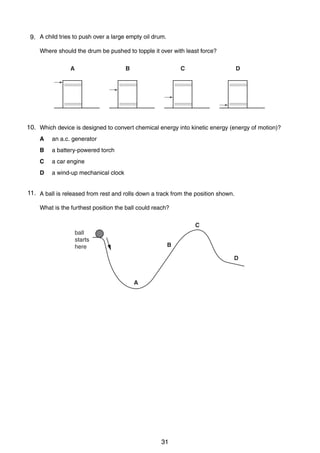
  • 6.
    Distance/time graphs • A Distance/timegraph is a way of representing motion. distance Acceleration stationary Constant speed (fast) Constant speed (slow) time 7 Calculations with distance/ time graphs • Speed is given by the gradient of the distance/time graph. 8 Distance/time graph questions • Describe the motion of the following bodies: (a) (b) d (c) d t d t t 9 4
  • 7.
    Distance/Time Graph questions • Calculatethe speeds of the car and the bike below: Distance (m) 500 375 Car Bike 250 125 0 0 5 10 15 20 25 10 Time (s) Speed/time graphs • A Speed/time graph is an alternative way of representing motion. speed Non-Uniform Acceleration Constant speed Rapid acceleration Gradual acceleration Stationary time 11 Calculations with speed/time graphs • Acceleration is given by the gradient of the speed/ time graph. • Distance is given by the Area under the speed/time graph. 12 5
  • 8.
    Speed/time graph questions Describethe motion of the following bodies: • (a) (b) v (c) v v t t t 13 Speed/time calculation. • (a) Find the acceleration of the bike in the first 10s. • (b) Find the distance moved by the bike in the first 20s. Motion of a bike 15.00 Speed (m/s) 11.25 7.50 3.75 0 0 5 10 15 20 14 time (s) The Ticker-Timer Ticker Tape Ticker Timer • The ticker-timer runs at 50Hz. It puts 50 dots on the tape every second. • If the tape moves quickly, the dots are widely spaced. • If the tape moves slowly, the dots are close 15 6
  • 9.
    Ticker Tape Slow movingticker-tape Fast moving ticker-tape 16 Charts • By cutting the tape into 5 space strips and arranging them side-by-side we can get a chart representing the motion. • Each strip will represent 0.1s of motion. 17 Typical Shapes of Charts 18 7
  • 10.
    Calculations • Since each striprepresents 0.1s of motion, and we can measure the length of the strips in cm, we can use speed=distance/time to calculate the speeds. 19 Scalars and Vectors • A SCALAR quantity has a size (Magnitude), but no direction. • Examples of scalar Quantities are temperature, time, energy and power. • A VECTOR quantity has both a magnitude and a direction. Vectors are often represented with an arrowed line. The direction of the arrow is the direction of the vector and the length of the line represents the size of the vector. • Examples of vectors are force, momentum and velocity. F 20 2 1 Big Stone Small Stone Paper Tray 3 Small Stone Paper Coin Vacuum Sand Bucket Sand Bucket 21 8
  • 11.
    Gravity • Experiment 1 • • • Both StonesLand at the same time. Gravity makes them fall at the same rate. Experiment 2 • • • Stone landed first. Air Resistance slowed down the paper tray. Experiment 3 • Both coin & paper land at the same time. 22 Weight and Mass • Weight is a force. It tells us how heavy something is. It is measured in newtons (N). It changes depending upon the size of gravity. (Trip to the moon) • Mass tells us how much substance there is in an object. It is measured in kilograms (kg). It never changes. • On Earth we multiply mass by 10 to get weight. 23 Density • Density tells us how compact the mass is in a material. • It is given by: Density ( kg m 3 ) = mass(kg) volume(m 3 ) or Density ( g cm 3 ) = mass(g) volume(cm 3 ) •Stick to one set of units. •Water has a density of 1000 kg/m3 or 1 g/cm3. •Materials with a smaller density than water will float, materials with a higher density than water will sink. 24 9
  • 12.
    Density Calculation Complete thefollowing table: Object Density (kg/ m3) B 2000 2 8000 C Volume (m3) 4000 A Mass (kg) D 4 1000 2000 4 a) Which object has the greatest mass? b) Which has the smallest volume? c) Which objects could be made of the same substance? d) Which object would float on water? 25 Irregular objects • The volume of a liquid can be determined using a measuring cylinder. • The volume of irregular objects has to be found by displacement. 26 Hooke’s Law • Hooke’s Law states that the extension in a spring is proportional to the load applied. load α extension or F = kx The constant of proportionality is called the Spring Constant. 27 10
  • 13.
    Extension/Force Graphs • A graphcan be plotted to show how Force varies with extension for a spring. • The graph shows proportionality up to a point called the ‘proportionality limit’. • With increased extension, the spring will reach a point at which it will not return to its original shape. This is called the elastic limit. The spring shows ‘plastic’ behaviour beyond here. 28 Load/Extension Graphs • A graph can be plotted to show how extension varies with load for a spring. • The graph shows proportionality up to a point called the ‘proportionality limit’. • With increased load, the spring will reach a point at which it will not return to its original shape. This is called the elastic limit. The spring shows ‘plastic’ behaviour beyond here. 29 Extension/Force Graphs extension Proportionality Limit Linear Region 0 Load 30 11
  • 14.
    Newton’s 1st Law • Ifthe forces around an object balance (resultant 0N), then it will either: • Remain at rest or • • Move at a constant speed in a straight line. (This is the same as saying constant velocity). 31 Examples of 1st Law Normal Normal Air Air Gravity Gravity Remains at rest Moves at a constant speed in a straight line 32 Oil Tube Experiment Fluid Resistance Falls at a constant speed in a straight line. Gravity 33 12
  • 15.
    Unbalanced Forces • Ifthe forces around an object do not balance, then they will cause the object to accelerate (or decelerate). • The rate of the acceleration depends upon the mass of the object. • The quantities are linked by the following equation: F(N ) = m(kg) × a(m s 2 ) 34 Questions • 1. What will be the Force needed to produce an acceleration of 2m/s2 on a mass of 4kg? • 2. What will be the Force needed to produce an acceleration of 5m/s2 on a mass of 42kg? • 3. What will be the acceleration produced when a Force of 50N acts upon a mass of 10kg? 35 Newton’s Laws Calculation P 6000 N Q 400 N 10 000 N A front wheel drive car is travelling at constant velocity. Q is the force of the air on the moving car. P is the total upward force on both front wheels. (a) Explain why P= 4 000N, Q= 400N (b) Calculate the mass of the car. (c) The 400 N driving force to the left is suddenly doubled. (i) Calculate the resultant forward driving force. (ii) Calculate the acceleration of the car. (iii) Sketch a graph showing how the velocity of the car changes with time (start the graph just before the driving force is doubled.) 13 36
  • 16.
    Circular Motion • When anobject is moving in a circle, it must be experiencing a force TOWARDS THE CENTRE of the circle. • We call this the CENTRIPETAL Force. • This should not be confused with CENTRIFUGAL Force. • The centripetal force is directed at right angles to the object’s velocity. object’s path direction of force 37 Questions • For each of the following examples, draw a sketch to show the situation, name the force providing the circular motion, and indicate its direction: • A) The Earth orbiting the Sun. • B) A car rounding a bend. • C) A hammer-thrower winding into his throw. 38 Moments • A moment is a turning force. • It is given by: Moment(Nm) = Force(N ) × distance(m) 39 14
  • 17.
    Example • Calculate the momentproduced: 0.1m 100N 40 The Principle of Moments • If a lever is balanced (in equilibrium) then the total clockwise moments equal the total anti-clockwise moments. It will not move. • Because of Newton’s 1st Law, the forces must also balance. Clockwise moments Anti-clockwise moments 41 Results Left-Hand Side Right-Hand Side Weight Distance 8 4 ? 3 4 ? 6 5 2 2 ? 6 3 ? 2 Weight Distance 2 Wxd Wxd 42 15
  • 18.
    Moments Questions • 1. Explainwhy a mechanic would choose a long-arm spanner to undo a tight nut. • 2. In the following diagram, what is the weight of X ? 20 cm X 25 cm 4N 43 Uses of Levers • Spanner • Nutcracker • Scissors 44 Centre of Mass • Centre of mass is the point on an object that is the ‘average’ position of the mass of the object. • The centre of gravity is a point on all objects through which forces appear to act. • The two points are the same. • The centres of mass of regular objects are obvious. They always lie on a line of symmetry. • They are the point under which we place a pivot to balance the object. 45 16
  • 19.
    Regular Objects 46 Stability • Stability tellsus how secure something is on the ground. • If something is stable, then it will not topple easily. • There are two factors to consider when changing the stability of an object: • • • The area of the object’s base. The position of the centre of mass of the object. A stable object will have a BIG base, and a LOW centre of gravity. 47 Simple Addition • If two vectors are parallel, then they can be simply added or subtracted to give a resultant. 3N 5N RESULTANT 2N 48 17
  • 20.
    2D-Addition • If the vectorsare not parallel we have to draw a scale diagram and add the vectors to give a resultant. RESULTANT 3m/s 2m/s 2m/s 3m/s 49 Examples • 1. A plane flies North at 40m/s. The wind blows to the East at 15 m/s. Calculate the overall velocity. • 2i). A falling ball has a weight of 10N and and air resistance of 2N. What the effective downward force on it? • ii) A wind blows to the left with a force of 2N. Using a vector diagram, calculate the resultant force on the ball. 50 Heat Sound Kinetic Electricity Elastic Potential Energy Energy Forms Light Gravitational Potential Energy Chemical Potential Energy 51 18
  • 21.
    Energy Transfers • When anyphysical process takes place, there is a transfer of energy from one form to another. • This can be shown in an energy flow diagram: Light Electricity T.V Sound Heat 52 Examples of Energy Transfers • A burning match • A lightbulb • A petrol lawnmower • A car • Headphones • A microphone • A waterfall 53 Kinetic Energy • All objects that are moving have kinetic energy. • It depends on the mass of the object and its speed. • It is measured in joules. KE = 1 2 mv 2 54 19
  • 22.
    Gravitational Energy • Gravitationalenergy is stored in objects that are at a height. • It depends upon the mass of the object, and how high the object is. • It measured in joules. GPE = mgh 55 The Principle of the Conservation of Energy • Energy cannot be created or destroyed, it simply moves from one form to another. • When energy moves from one form to another, the total AMOUNT of energy remains the same. • A certain amount of heat energy is always lost to the surroundings in any process. 56 Efficiency • Efficiency tells us how effective a process or energy transfer is. • The more useful energy that is produced, for the least input energy, the more efficient the process is. • Efficiency has no unit, and can be expressed as a decimal or percentage. • It can be the ratio of power output to input, or energy output to input for a process Efficiency = output (×100) input 57 20
  • 23.
    Work Done • Workis a type of energy change and is measured in Joules. • For work to be done, a force must be acting upon an object as it moves through a distance. • The Work Done is given by: Work Done (J )=Force(N ) × Distance(m) 58 Power • Power is the rate at which energy is transferred. • It is also the rate at which Work is done. • The unit for Power is Watts (W). • Power is calculated from either: Power(W )= Energy Change(J ) Time Taken(s) or Power(W )= Work Done(J ) Time Taken(s) 59 Calculating Personal Power height time weight • Measure your weight in newtons. • Measure the height of the steps in metres. • Measure the time taken to climb the steps in seconds. • Calculate the Work Done in joules. • Calculate the Power of your legs in Watts. 60 21
  • 24.
    Pressure • Pressure tells ushow concentrated a force is. • It is calculated from: Pressure( N m 2 )= Force(N ) Force(N ) 2 or Pressure( N cm )= 2 Area(m ) Area(cm 2 ) Stick to one set of units 61 Examples 2cm 1cm 20g 1cm 1. Calculate the Volume of the block. 2. Calculate the block’s density. 3. Calculate the block’s weight. 4. Calculate the area in contact with the ground. 62 Examples • Why do camels have large flat feet? • Why is it easier to walk in snow shoes in the snow? 63 22
  • 25.
    Pressure in Liquids Pressurein a liquid is due to the weight of the liquid above a point. Pressure increases with depth. Pressure will also increase with density of liquid (more weight). P = ρ gd We can calculate pressure from: 64 Direction • The pressure in a liquid acts in ALL directions equally at a point. • This is why bubbles are spherical. 65 Questions • 1a). Draw a diagram of the cross section of a dam. • b) Explain why it has this shape. • 2. Calculate the pressure on a scuba diver at a depth of 20m. (The density of water is 1000kg/m3) • 3. Describe a demonstration to show that Pressure increases with depth in a liquid. 66 23
  • 26.
    Non-Renewable Energy Resources • Non-Renewable resourcesare resources that are used up and cannot be easily replaced. Examples are fossil fuels and Nuclear fuels. 67 Renewable Energy Resources • Renewable Energy Resources are energy resources that keep running and do not run-out easily. 68 • Nuclear Fusion Safety • Pollution • Problems Energy usage • Transport • Electricity The Energy Crisis • Fossil Fuels • Pollution • Depletion Renewable Alternatives • Advantages • Unreliable • Not Controllable • Energy Density Nuclear Fission • Energy Density • Pollution • Safety 69 24
  • 27.
    General Physics Quantity and symbol ScalarQuantities Vector Quantities Average Speed, s Velocity Acceleration, a Mass, m Weight, W, F Density, ρ Force, F Load, (Hookes law) Moment Equilibrium Work done, W, E Kinetic energy, KE Definition/Word equation Scalar quantities only have a magnitude. Vector quantities have a magnitude, a direction and a point of application. Speed is the rate of change of distance. It is a scalar quantity. Speed = Total distance Total time For constant acceleration situations, the average speed is also equal to the average of the initial and final speeds. s = initial speed + final speed 2 Velocity is the rate of change of displacement. It is speed in a given direction. A vector quantity. Acceleration is the rate of change of velocity. Acceleration = Final velocity – initial velocity Time Mass is a property of a body that resists change in motion. Weight is the force on a mass due to the gravitational field of the Planet. It changes from planet to planet. Weights can be compared using a balance. Weight = mass x acceleration due to gravity Weight = mass x gravitational field strength Density is the mass per unit volume. Density = mass volume A force is a push or a pull; it can change the shape, direction, and/or speed of an object. Force = mass x acceleration Load = spring constant x extension Load α extension A moment is the turning affect of a force. Moment = force x perpendicular distance from the pivot When there is no resultant force AND no resulting turning affect, a system is in equilibrium. Work done = Force x distance in the direction of the force = change in energy Kinetic energy is the energy of a body due to its motion. Kinetic energy = ½ x mass x velocity2 25 Symbol equation Units s=d t s=u+v 2 m/s cm/s km/h m/s cm/s km/h a= v–u t m/s2 W=mxg Newtons, N ρ=m V Kg/m3 g/cm3 F=ma Newtons, N F=kl F α l Newtons, N Moment = F d Nm W = F d = ΔE Joules, J KE = ½ m v2 Joules, J
  • 28.
    Gravitational energy, GPE Efficiency Power, P Gravitationalpotential energy is the energy of a body due to its position in the gravitational field. Gravitational energy =mass x acceleration due to gravity x height gained/lost Efficiency = useful output x 100% total input Power is the rate at which energy is converted. Power = work done time taken Power = energy change time taken GPE = m g h % P=E t Pressure, p, P Pressure = force area P=F A Fluid Pressure, p, P Pressure = density of fluid x acceleration due to gravity x height of fluid above P=ρgh 26 Joules, J Watts, W N/m2 Pascals, Pa millibar N/m2 Pascals, Pa Millibar
  • 29.
    iGCSE Physics Past PaperQuestions Paper 1 Compilation General Physics 27
  • 30.
    2 11. The diagramshows the level of liquid in a measuring cylinder. cm3 30 liquid 20 What is the volume of the liquid? A 24 cm3 B 28 cm3 C 29 cm3 D 32 cm3 2 A cylindrical can is rolled along the ruler shown in the diagram. 2. final position starting position can rolled mark on can 0 cm 5 10 15 20 The can rolls over twice. What is the circumference (distance all round) of the can? A 13 cm B 14 cm C 26 cm D 0625/1/M/J/02 28 28 cm 25 30 cm
  • 31.
    3 33. The graphshows how the speed of a car changes with time. Q speed P O R time Which of the following gives the distance travelled in time interval OR? A the area OPQR B the length PQ C the length (QR – PO) D the ratio QR/PO 4 4. A snail crosses a garden path 30 cm wide at a speed of 0.2 cm/s. movement of snail 30 cm snail How long does the snail take? A 5. 5 B 0.0067 s 6.0 s C 15 s D 150 s What are correct units used for mass and for weight? mass weight A kg kg B kg N C N kg D N N 0625/1/M/J/02 29 [Turn over
  • 32.
    4 66. Two objectsX and Y are placed on a beam as shown. The beam balances on a pivot at its centre. Y X pivot What does this show about X and Y? A They have the same mass and the same density. B They have the same mass and the same weight. C They have the same volume and the same density. D They have the same volume and the same weight. 7. A shop-keeper places two identical blocks of cheese on a set of scales and notices that their 7 combined mass is 240 g. Each block measures 2.0 cm x 5.0 cm x 10.0 cm. g What is the density of the cheese? A 0.42 g / cm3 B 0.83 g / cm3 C 1.2 g / cm3 D 2.4 g / cm3 8 8. The table shows the length of a wire as the load on it is increased. load / N length / cm 0 50.0 10 20 30 52.1 54.1 56.3 Which subtraction should be made to find the extension caused by the 20 N load? A 54.1 cm – 0 cm B 54.1 cm – 50.0 cm C 54.1 cm – 52.1 cm D 56.3 cm – 54.1 cm 0625/1/M/J/02 30
  • 33.
    5 99. A childtries to push over a large empty oil drum. Where should the drum be pushed to topple it over with least force? A B C D 10. Which device is designed to convert chemical energy into kinetic energy (energy of motion)? 10 A an a.c. generator B a battery-powered torch C a car engine D a wind-up mechanical clock 11. A ball is released from rest and rolls down a track from the position shown. 11 What is the furthest position the ball could reach? C ball starts here B D A 0625/1/M/J/02 31 [Turn over
  • 34.
    6 12 Two sharpnails and two blunt nails are held on a piece of wood. Each nail is hit with the same 12. hammer with the same amount of force. When it is hit, which nail causes the greatest pressure on the wood? A B hammer sharp nails C D hammer blunt nails 13. 13 The diagram shows a manometer connected to a container of carbon dioxide. container carbon dioxide 5 cm mercury manometer Which statement correctly describes the pressure exerted by the carbon dioxide? A It is equal to the atmospheric pressure. B It is equal to 5 cm of mercury. C It is equal to 5 cm of mercury above atmospheric pressure. D It is equal to 5 cm of mercury below atmospheric pressure. 0625/1/M/J/02 32
  • 35.
    2 14. A glasstank contains some water. 1 V water T Q U S R The length QR and the width RS of the tank are known. What other distance needs to be measured in order to be able to calculate the volume of the water? A B ST C SV D TU TV 2 15. A stopwatch is used to time a race. The diagrams show the watch at the start and at the end of the race. start 55 end 60 5 55 10 50 40 35 30 45.7 s B 46.0 s 15 40 25 C 46.5 s D 0625/01/M/J/03 33 47.0 s 20 seconds 35 How long did the race take? A 10 45 20 seconds 5 50 15 45 60 30 25
  • 36.
    3 16. The diagramshows a speed-time graph for a body moving with constant acceleration. 3 speed 0 time 0 What is represented by the shaded area under the graph? A acceleration B distance C speed D time 17. A tunnel has a length of 50 km. A car takes 20 min to travel between the two ends of the tunnel. 4 What is the average speed of the car? A 2.5 km / h B 16.6 km / h C 150 km / h D 1000 km / h 18. Which statement is correct? 5 A Mass is a force, measured in kilograms. B Mass is a force, measured in newtons. C Weight is a force, measured in kilograms. D Weight is a force, measured in newtons. 0625/01/M/J/03 34 [Turn over
  • 37.
    4 6 19. Three children,X, Y and Z, are using a see-saw to compare their weights. X Y Y Z X Z Which line in the table shows the correct order of the children’s weights? heaviest ←→ lightest A X Y Z B X Z Y C Y X Z D Y Z X 20. What apparatus is needed to determine the density of a regularly-shaped block? 7 A a balance and a ruler B a balance and a forcemeter (spring balance) C a measuring cylinder and a ruler D a measuring cylinder and a beaker 21. A spring is suspended from a stand. Loads are added and the extensions are measured. 8 spring stand loads rule Which graph shows the result of plotting extension against load? 0 0 load 0 0 0 load 0625/01/M/J/03 35 extension D extension C extension B extension A 0 load 0 0 load
  • 38.
    5 22. A studentuses a stand and clamp to hold a flask of liquid. 9 Which diagram shows the most stable arrangement? A B C D 10 What is the source of the energy converted by a hydro-electric power station? 23. A hot rocks B falling water C oil D waves 24. 11 A labourer on a building site lifts heavy concrete blocks onto a lorry. Lighter blocks are now lifted the same distance in the same time. What happens to the work done in lifting each block and the power exerted by the labourer? work done in lifting each block power exerted by labourer A decreases decreases B decreases remains the same C increases increases D remains the same increases 0625/01/M/J/03 36 [Turn over
  • 39.
    6 25. 12 The diagramshows an instrument used to measure gas pressure. liquid What is the instrument called? A ammeter B barometer C manometer D thermometer 13 The diagrams show two divers swimming in the sea and two divers swimming in fresh water. Sea 26. water is more dense than fresh water. On which diver is there the greatest pressure? 0m 0m sea water A 2m 4m fresh water C 2m B 6m 4m 6m 14 When water evaporates, some molecules escape. 27. Which molecules escape? A the molecules at the bottom of the liquid with less energy than others B the molecules at the bottom of the liquid with more energy than others C the molecules at the surface with less energy than others D the molecules at the surface with more energy than others 0625/01/M/J/03 37 D
  • 40.
    2 1 The diagramshows a me asuring cylinder. 28. 100 90 80 70 60 50 40 30 20 10 Which unit would be most suitable for its scale? A mm 2 mm 3 B cm 2 C D cm 3 29. A piece of cotton is me asured betwe en two points on a ruler. 2 cotton cm 1 2 3 4 5 6 7 8 9 10 11 12 13 14 15 When the length of cotton is wound closely around a pen, it goes round six times. six turns of cotton pen What is the distance once round the pen? A 2.2 cm U C L E S 2004 B 2.6 cm C 13.2 cm 0625/01/M/J/04 38 D 15.6 cm 16
  • 41.
    3 3 The diagramshows the speed-time graph for an object moving at constant speed. 30. 2 speed m/s 1 0 0 1 2 4 3 time / s What is the distance travelled by the object in the first 3 s? A 1.5 m B 2.0 m C 3.0 m D 6.0 m 4 31. A small steel ball is dropped from a low balcony. Ignoring air resistance, which statement describes its motion? A It falls with constant acceleration. B It falls with constant speed. C It falls with decreasing acceleration. D It falls with decreasing speed. 32. Which statement about the mass of a falling object is correct? 5 A It decreases as the object falls. B It is equal to the weight of the object. C It is measured in newtons. D It stays the same as the object falls. © UCLES 2004 0625/01/M/J/04 39 [Turn over
  • 42.
    4 6 The weightsof four objects, 1 to 4, are compared using a balance. 33. 2 2 1 4 2 3 Which object is the lightest? A B object 1 C object 2 D object 3 object 4 7 34. Which of the following is a unit of density? A cm3 / g B g / cm2 C g / cm3 D kg / m2 8 A piece of card has its centre of mass at M. 35. Which diagram shows how it hangs when suspended by a thread? A B C D M M M M 9 An experiment is carried out to measure the extension of a rubber band for different loads. 36. The results are shown below. load / N length / cm 0 1 15.2 16.2 0 1.0 extension / cm 2 3 18.6 2.1 3.4 Which figure is missing from the table? A 16.5 © UCLES 2004 B 17.3 C 17.4 0625/01/M/J/04 40 D 18.3
  • 43.
    5 36. 10 The diagramshows a man diving into water. 37. Which form of energy is incre asing as he falls? A chemical B gravitational C kinetic D strain 38. A boy and a girl run up a hill in the same time. 11 boy weighs 600 N girl weighs 500 N The boy weighs more than the girl. Which statement is true about the power produced? A The boy produces more power. B The girl produces more power. C They both produce the same power. D It is impossible to tell who produces more power. © UCLES 2004 0625/01/M/J/04 41 [Turn over
  • 44.
    6 39. 12 The diagramshows a simple mercury barometer. The barometer re ading is h cm of mercury. S h mercury 40. What is the pressure at S? A approximately z ero B atmospheric pressure C atmospheric pressure + h cm of mercury D h cm of mercury 41. 13 Two boys X and Y e ach have the same total weight and are standing on soft ground. X Y Which boy is more likely to sink into the soft ground and why? boy more likely to sink pressure on soft ground A X larger than Y B X smaller than Y C Y larger than X D Y smaller than X U C L E S 2004 0625/01/M/J/04 42
  • 45.
    2 42. 1 A decoratorwishes to calculate the area of a bathroom tile so that he can estimate the amount of adhesive that he needs to buy. What must he use? A a measuring cylinder only B a ruler only C a measuring cylinder and a clock only D a measuring cylinder and a ruler only 2 43. The three balls shown are dropped from a bench. aluminium lead wood Which balls have the same acceleration? A aluminium and lead only B aluminium and wood only C lead and wood only D aluminium, lead and wood 44. 3 A car accelerates from traffic lights. The graph shows how the car’s speed changes with time. speed m/s 20 0 0 10 time / s How far does the car travel before it reaches a steady speed? A 10 m © UCLES 2005 B 20 m C 100 m 0625/01/M/J/05 43 D 200 m
  • 46.
    3 45. 4 Which statementis correct? A B The mass of a bottle of water is measured in newtons. C The weight of a bottle of water and its mass are the same thing. D 5 The mass of a bottle of water at the North Pole is different from its mass at the Equator. The weight of a bottle of water is one of the forces acting on it. Two blocks X and Y are placed on a beam as shown. The beam balances on a pivot at its centre. Y X pivot 46. What does this show about X and Y? A They have the same mass and the same density. B They have the same mass and the same weight. C They have the same volume and the same density. D They have the same volume and the same weight. 6 The masses of a measuring cylinder before and after pouring some liquid into it are shown in the 47. diagram. cm3 cm3 200 200 100 100 liquid mass = 80 g mass = 180 g What is the density of the liquid? A 100 g / cm3 120 © UCLES 2005 B 100 g / cm3 140 C 180 g / cm3 120 0625/01/M/J/05 44 D 180 g / cm3 140 [Turn over
  • 47.
    4 7 48. A girland a boy are pulling in opposite directions on a rope. The forces acting on the rope are shown in the diagram. girl boy 200 N 150 N rope 49. Which single force has the same effect as the two forces shown? A 50 N acting towards the girl B 350 N acting towards the girl C 50 N acting towards the boy D 350 N acting towards the boy 8 Objects with different masses are hung on a 10 cm spring. The diagram shows how much the 50. spring stretches. 10 cm 20 cm 30 cm 100 g M The extension of the spring is directly proportional to the mass hung on it. What is the mass of object M? A 110 g © UCLES 2005 B 150 g C 200 g 0625/01/M/J/05 45 D 300 g
  • 48.
    5 51. 9 What isdesigned to change electrical energy into kinetic energy? A capacitor B generator C motor D transformer 10 52. A power station uses nuclear fission to obtain energy. In this process, nuclear energy is first changed into A chemical energy. B electrical energy. C gravitational energy. D internal energy. 11 A ball is released from rest and rolls down a track from the position shown. 53. What is the furthest position the ball could reach? C ball starts here B D A © UCLES 2005 0625/01/M/J/05 46 [Turn over
  • 49.
    6 54. 12 A watermanometer is used to measure the pressure of a gas supply to a house. It gives a reading of h cm of water. gas supply h cm 55. Why is it better to use water rather than mercury in this manometer? A h would be too large if mercury were used. B h would be too small if mercury were used. C The tube would need to be narrower if mercury were used. D The tube would need to be wider if mercury were used. 13 A farmer has two carts. The carts have the same weight, but one has four narrow wheels and the 56. other has four wide wheels. narrow wheel wide wheel In rainy weather, which cart sinks le s s into soft ground, and why? cart wheels why A narrow greater pressure on the ground B narrow less pressure on the ground C wide greater pressure on the ground D wide less pressure on the ground © U C L E S 2005 0625/01/M/J/05 47
  • 50.
    2 57. 1 A measuringcylinder contains some water. When a stone is put in the water, the level rises. cm3 200 cm3 200 150 150 100 100 50 50 stone What is the volume of the stone? A 50 cm3 B 70 cm3 75 cm3 C D 125 cm3 258.The graph represents the movement of a body accelerating from rest. 10 speed m/s 8 6 4 2 0 1 2 3 4 5 time / s 59. After 5 seconds how far has the body moved? A 3 2m B 10 m C 25 m D 50 m A child is standing on the platform of a station, watching the trains. A train travelling at 30 m / s takes 3 s to pass the child. What is the length of the train? A 10 m © UCLES 2006 B 30 m C 90 m 0625/01/M/J/06 48 D 135 m
  • 51.
    3 60. 4 Below arefour statements about the effects of forces on objects. Three of the statements are correct. Which statement is incorrect? A A force can change the length of an object. B A force can change the mass of an object. C A force can change the shape of an object. D A force can change the speed of an object. 61. 5 A simple balance has two pans suspended from the ends of arms of equal length. When it is balanced, the pointer is at 0. arm pivot pointer 0 pan X pan Y Four masses (in total) are placed on the pans, with one or more on pan X and the rest on pan Y. Which combination of masses can be used to balance the pans? A 1 g, 1 g, 5 g, 10 g B 1 g, 2 g, 2 g, 5 g C 2 g, 5 g, 5 g, 10 g D 2 g, 5 g, 10 g, 10 g 6 62. A person measures the length, width, height and mass of a rectangular metal block. Which of these measurements are needed in order to calculate the density of the metal? A mass only B height and mass only C length, width and height only D length, width, height and mass © UCLES 2006 0625/01/M/J/06 49 [Turn over
  • 52.
    4 63. 7 Two forcesact on an object. In which situation is it impossible for the object to be in equilibrium? A The two forces act in the same direction. B The two forces act through the same point. C The two forces are of the same type. D The two forces are the same size. 64. The diagram shows four models of buses placed on different ramps. 8 centre of mass centre of mass centre of mass centre of mass 65. How many of these models will fall over? A 9 1 B 2 C 3 D 4 Which form of energy do we receive directly from the Sun? A chemical B light C nuclear D sound 10 66. A labourer on a building site lifts a heavy concrete block onto a lorry. He then lifts a light block the same distance in the same time. Which of the following is true? work done in lifting the blocks power exerted by labourer A less for the light block less for the light block B less for the light block the same for both blocks C more for the light block more for the light block D the same for both blocks more for the light block © UCLES 2006 0625/01/M/J/06 50
  • 53.
    5 67. 11 The diagramshows a thick she et of glass. Which edge must it stand on to cause the gre atest pressure? A B D C 68. 12 A manometer is being used to me asure the pressure of the gas inside a tank. A, B, C and D show the manometer at different times. At which time is the gas pressure inside the tank gre atest? A B C D gas 13 Brownian motion is se en by looking at smoke particles through a microscope. How do the smoke particles move in Brownian motion? A all in the same direction B at random C in circles D vibrating about fixed points © U C L E S 2006 0625/01/M/J/06 51 [Turn over
  • 54.
    iGCSE Physics Past PaperQuestions Paper 3 Compilation General Physics 52
  • 55.
    2 1 1. A groupof students attempts to find out how much power each student can generate. The students work in pairs in order to find the time taken for each student to run up a flight of stairs. The stairs used are shown in Fig. 1.1. finishing point starting point Fig. 1.1 (a) Make a list of all the readings that would be needed. Where possible, indicate how the accuracy of the readings could be improved. .......................................................................................................................................... .......................................................................................................................................... .......................................................................................................................................... .......................................................................................................................................... .......................................................................................................................................... ..................................................................................................................................... [4] (b) Using words, not symbols, write down all equations that would be needed to work out the power of a student. .......................................................................................................................................... .......................................................................................................................................... ..................................................................................................................................... [2] (c) (i) When the student has reached the finishing point and is standing at the top of the stairs, what form of energy has increased to its maximum? ................................................................................................................................... (ii) Suggest why the total power of the student is greater than the power calculated by this method. ................................................................................................................................... ................................................................................................................................... [3] 0625/3/M/J/02 53 For Examiner’s Use
  • 56.
    3 For Examiner’s Use 2 2. A smallrubber ball falls vertically, hits the ground and rebounds vertically upwards. Fig. 2.1 is the speed-time graph for the ball. 10 B speed 8 m/s 6 D 4 2 0 A 0 E C 0.5 1.0 1.5 time / s 2.0 Fig. 2.1 (a) Using information from the graph, describe the following parts of the motion of the ball. (i) part AB ................................................................................................................................... ................................................................................................................................... ................................................................................................................................... (ii) part DE ................................................................................................................................... ................................................................................................................................... ................................................................................................................................... [3] (b) Explain what is happening to the ball along the part of the graph from B through C to D. .......................................................................................................................................... .......................................................................................................................................... ..................................................................................................................................... [2] (c) Whilst the ball is in contact with the ground, what is the (i) overall change in speed, change in speed = ........................................ (ii) overall change in velocity? change in velocity = ...................................... [2] 0625/3/M/J/02 54 [Turn over
  • 57.
    4 (d) Use youranswer to (c) to explain the difference between speed and velocity. .......................................................................................................................................... .......................................................................................................................................... ..................................................................................................................................... [2] (e) Use the graph to calculate the distance travelled by the ball between D and E. distance travelled = ..................................[2] (f) Use the graph to calculate the deceleration of the ball between D and E. deceleration = ..................................[2] 0625/3/M/J/02 55 For Examiner’s Use
  • 58.
    2 1 3. Fig. 1.1shows apparatus that may be used to compare the strengths of two springs of the same size, but made from different materials. spring scale masses Fig. 1.1 (a) (i) Explain how the masses produce a force to stretch the spring. ................................................................................................................................... (ii) Explain why this force, like all forces, is a vector quantity. ................................................................................................................................... ................................................................................................................................... [2] (b) Fig. 1.2 shows the graphs obtained when the two springs are stretched. force/N 20 spring 1 15 spring 2 10 5 0 0 10 20 30 extension/mm Fig. 1.2 0625/3/M/J/03 56 40 For Examiner’s Use
  • 59.
    3 (i) State which springis more difficult to extend. Quote values from the graphs to support your answer. For Examiner’s Use ................................................................................................................................... ................................................................................................................................... ................................................................................................................................... ................................................................................................................................... (ii) On the graph of spring 2, mark a point P at the limit of proportionality. Explain your choice of point P. ................................................................................................................................... ................................................................................................................................... ................................................................................................................................... (iii) Use the graphs to find the difference in the extensions of the two springs when a force of 15 N is applied to each one. difference in extensions = .................................. [6] 24. The speed of a cyclist reduces uniformly from 2.5 m/s to 1.0 m/s in 12 s. (a) Calculate the deceleration of the cyclist. deceleration = ..................................[3] (b) Calculate the distance travelled by the cyclist in this time. distance = ..................................[2] 0625/3/M/J/03 57 [Turn over
  • 60.
    4 3 5. Fig. 3.1shows the arm of a crane when it is lifting a heavy box. 1220 N 950 N 40° 30° P box Fig. 3.1 (a) By the use of a scale diagram (not calculation) of the forces acting at P, find the weight of the box. [5] 0625/3/M/J/03 58 For Examiner’s Use
  • 61.
    For Examiner’s Use 5 (b) Another boxof weight 1500 N is raised vertically by 3.0 m. (i) Calculate the work done on the box. work done = .................................. (ii) The crane takes 2.5 s to raise this box 3.0 m. Calculate the power output of the crane. power = .................................. [4] 4 Fig. 4.1 shows a sealed glass syringe that contains air and many very tiny suspended dust particles. syringe seal piston dust particles Fig. 4.1 (a) Explain why the dust particles are suspended in the air and do not settle to the bottom. .......................................................................................................................................... .......................................................................................................................................... .......................................................................................................................................... ......................................................................................................................................[3] (b) The air in the syringe is at a pressure of 2.0 × 10⁵ Pa. The piston is slowly moved into the syringe, keeping the temperature constant, until the volume of the air is reduced from 80 cm3 to 25 cm3. Calculate the final pressure of the air. pressure = ..................................[3] 0625/3/M/J/03 59 [Turn over
  • 62.
    2 For Examiner’s Use 6. Fig. 1.1shows a cycle track. 1 A B E C v = 6 m/s D Fig. 1.1 A cyclist starts at A and follows the path ABCDEB. The speed-time graph is shown in Fig. 1.2. B C D E B 6 speed m/s 5 4 3 2 1 0A 0 10 20 30 40 50 60 70 80 90 100 time / s Fig. 1.2 (a) Use information from Fig. 1.1 and Fig. 1.2 to describe the motion of the cyclist (i) along AB, ................................................................................................................................... (ii) along BCDEB. ................................................................................................................................... ................................................................................................................................... [4] © UCLES 2004 0625/03 M/J/04 60
  • 63.
    3 For Examiner’s Use (b) The velocityv of the cyclist at C is shown in Fig. 1.1. State one similarity and one difference between the velocity at C and the velocity at E. similarity ........................................................................................................................... difference ......................................................................................................................[2] (c) Calculate (i) the distance along the cycle track from A to B, distance = ………………… (ii) the circumference of the circular part of the track. circumference = ………………… [4] © UCLES 2004 0625/03 M/J/04 61 [Turn over
  • 64.
    4 7. Fig. 2.1shows a rock that is falling from the top of a cliff into the river below. 2 cliff falling rock river Fig. 2.1 (a) The mass of the rock is 75 kg. The acceleration of free fall is 10 m/s2. Calculate the weight of the rock. weight = …………………[1] (b) The rock falls from rest through a distance of 15 m before it hits the water. Calculate its kinetic energy just before hitting the water. Show your working. kinetic energy = …………………[3] (c) The rock hits the water. Suggest what happens to the kinetic energy of the rock during the impact. .......................................................................................................................................... .......................................................................................................................................... ......................................................................................................................................[3] © UCLES 2004 0625/03 M/J/04 62 For Examiner’s Use
  • 65.
    5 For Examiner’s Use 8. A largespring is repeatedly stretched by an athlete to increase the strength of his arms. 3 Fig. 3.1 is a table showing the force required to stretch the spring. extension of spring / m force exerted to produce extension / N 0.096 0.192 0.288 0.384 250 500 750 1000 Fig. 3.1 (a) (i) State Hooke’s law. ................................................................................................................................... ...............................................................................................................................[1] (ii) Use the results in Fig. 3.1 to show that the spring obeys Hooke’s law. [1] (b) Another athlete using a different spring exerts an average force of 400 N to enable her to extend the spring by 0.210 m. (i) Calculate the work done by this athlete in extending the spring once. work done = ………………… (ii) She is able to extend the spring by this amount and to release it 24 times in 60 s. Calculate the power used by this athlete while doing this exercise. power = ………………… [4] © UCLES 2004 0625/03 M/J/04 63 [Turn over
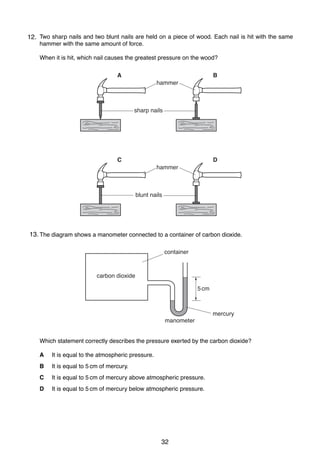
  • 66.
    2 9. A solidplastic sphere falls towards the Earth. 1 Fig. 1.1 is the speed-time graph of the fall up to the point where the sphere hits the Earth’s surface. 140 speed m/s R 120 S T 100 80 60 Q 40 20 0 P 0 10 20 30 40 50 60 70 80 time / s 90 100 110 Fig. 1.1 (a) Describe in detail the motion of the sphere shown by the graph. .......................................................................................................................................... .......................................................................................................................................... .......................................................................................................................................... .......................................................................................................................................... ..................................................................................................................................... [3] © UCLES 2005 0625/03/M/J/05 64 For Examiner’s Use
  • 67.
    3 (b) On Fig.1.2, draw arrows to show the directions of the forces acting on the sphere when it is at the position shown by point S on the graph. Label your arrows with the names of the forces. [2] Fig. 1.2 (c) Explain why the sphere is moving with constant speed at S. .......................................................................................................................................... .......................................................................................................................................... ..................................................................................................................................... [2] (d) Use the graph to calculate the approximate distance that the sphere falls (i) between R and T, (ii) between P and Q. distance = ………………. [2] distance = ………………. [2] © UCLES 2005 0625/03/M/J/05 65 [Turn over For Examiner’s Use
  • 68.
    4 10. Fig. 2.1shows a simple pendulum that swings backwards and forwards between P and Q. 2 support string P R Q pendulum bob Fig. 2.1 (a) The time taken for the pendulum to swing from P to Q is approximately 0.5 s. Describe how you would determine this time as accurately as possible. .......................................................................................................................................... .......................................................................................................................................... ..................................................................................................................................... [2] (b) (i) State the two vertical forces acting on the pendulum bob when it is at position R. 1. ............................................................................................................................... 2. .......................................................................................................................... [1] (ii) The pendulum bob moves along the arc of a circle. State the direction of the resultant of the two forces in (i). .............................................................................................................................. [1] (c) The mass of the bob is 0.2 kg. During the swing it moves so that P is 0.05 m higher than R. Calculate the increase in potential energy of the pendulum bob between R and P. potential energy = ………………. [2] © UCLES 2005 0625/03/M/J/05 66 For Examiner’s Use
  • 69.
    5 11. A massof 3.0 kg accelerates at 2.0 m/s2 in a straight line. 3 (a) State why the velocity and the acceleration are both described as vector quantities. .......................................................................................................................................... ..................................................................................................................................... [1] (b) Calculate the force required to accelerate the mass. force = ………………. [2] (c) The mass hits a wall. The average force exerted on the wall during the impact is 120 N. The area of the mass in contact with the wall at impact is 0.050 m2. Calculate the average pressure that the mass exerts on the wall during the impact. pressure = ………………. [2] © UCLES 2005 0625/03/M/J/05 67 [Turn over For Examiner’s Use
  • 70.
    2 1 12. A bustravels from one bus stop to the next. The journey has three distinct parts. Stated in order they are uniform acceleration from rest for 8.0 s, uniform speed for 12 s, non-uniform deceleration for 5.0 s. Fig. 1.1 shows only the deceleration of the bus. 15 speed m/s 10 5 0 0 5 10 15 time/s 20 25 Fig. 1.1 (a) On Fig. 1.1, complete the graph to show the first two parts of the journey. [3] (b) Calculate the acceleration of the bus 4.0 s after leaving the first bus stop. acceleration = ........................[2] (c) Use the graph to estimate the distance the bus travels between 20 s and 25 s. estimated distance = ........................[2] (d) On leaving the second bus stop, the uniform acceleration of the bus is 1.2 m / s2. The mass of the bus and passengers is 4000 kg. Calculate the accelerating force that acts on the bus. force = ........................[2] (e) The acceleration of the bus from the second bus stop is less than that from the first bus stop. Suggest two reasons for this. 1. ...................................................................................................................................... .......................................................................................................................................... 2. ...................................................................................................................................... ......................................................................................................................................[2] © UCLES 2006 0625/03/M/J/06 68 For Examiner’s Use
  • 71.
    3 2 13. A studentsets up the apparatus shown in Fig. 2.1 in order to find the resultant of the two tensions T1 and T2 acting at P. When the tensions T1, T2 and T3 are balanced, the angles between T1 and the vertical and T2 and the vertical are as marked on Fig. 2.1. pulley pulley T1 = 6.0 N 69° T2 = 8.0 N 44° vertical board P T3 Fig. 2.1 In the space below, draw a scale diagram of the forces T1 and T2. Use the diagram to find the resultant of the two forces. State (a) the scale used, scale = ........................................ (b) the value of the resultant, value = ........................................ (c) the direction of the resultant. © UCLES 2006 direction = ........................................ [6] 0625/03/M/J/06 69 [Turn over For Examiner’s Use
  • 72.
    4 3 14. An electricpump is used to raise water from a well, as shown in Fig. 3.1. pump ground well Fig. 3.1 (a) The pump does work in raising the water. State an equation that could be used to calculate the work done in raising the water. ......................................................................................................................................[2] (b) The water is raised through a vertical distance of 8.0 m. The weight of water raised in 5.0 s is 100 N. (i) Calculate the work done in raising the water in this time. work done = .......................[1] (ii) Calculate the power the pump uses to raise the water. power = ........................[1] (iii) The energy transferred by the pump to the water is greater than your answer to (i). Suggest what the additional energy is used for. ..............................................................................................................................[1] © UCLES 2006 0625/03/M/J/06 70 For Examiner’s Use
  • 73.
    Topic 2: Thermal Physics 1 Solids •The particles in solids are tightly held together by strong forces. • They vibrate around mean positions. • The higher the temperature, the more vibrational kinetic energy the particles have. • Solids have a rigid shape. 2 Liquids • In liquids the forces are strong, but the vibrating particles are not fixed in position. • The particles can move but they are held close to their neighbours. • Liquids do not keep their shape. 3 71
  • 74.
    Gases • In gasesthe forces are very weak and they are virtually free to move around their container. • The particles occasionally collide. • Gases expand to fill their container. • The collisions between the particles and the container walls provides pressure. 4 Changing State • When a material changes from one state to another, bonds are either broken or created. • When bonds are broken, heat must be supplied. When bonds are created, heat is released. • When materials change state there is no change in the temperature. 5 Phase Changes • The phase change from solid to liquid is called ‘fusion’. • The phase change from liquid to gas is called ‘vaporisation’. • The energy required to effect the phase change is called the ‘Latent Heat’. • The Latent Heat required per kg is called the ‘Specific Latent Heat’. 6 72
  • 75.
    Phases Changes (Graphical) vaporisation Temperature liquid water fusion Time 7 LatentHeat Calculations • The Specific Latent Heat of a material is given the symbol l. • From the definition, we have the following relationship: H = ml H-J m - kg l - J/kg 8 Heat Capacity • Whilst a material is being heated within a certain state of matter, its temperature will rise. • The temperature rise depends upon the mass of the material, the type of material and the amount of heat supplied. • The property of a material that represents how much heat is needed to raise its temperature is called its ‘Specific Heat Capacity’ and is given the symbol c. 9 73
  • 76.
    Calculations • To calculateheat required we use: H = mcΔT H-J m - kg C - J/kg/ ºC ∆T - ºC 10 Constant Volume • If we increase the temperature of a gas in a container at a constant volume, the particles will move with more energy, and so there will be more collisions, and so greater pressure: Pressure increases with Temperature 11 Constant Pressure • If we increase the temperature of a gas in a container at a constant pressure, the particles will move with more energy, but they need more space to keep the collisions constant and so there will be a greater volume: Volume increases with Temperature 12 74
  • 77.
    Constant Temperature • If wekeep the temperature of a gas constant, we keep the kinetic energy of the particles constant. • Decreasing the volume of the gas’ container will increase the number of collisions of the particles with the container. • The pressure of the gas will increase. • Pressure and Volume changes are described by the following relationship: P1V1 = P2V2 13 Brownian Motion • When pollen grains are placed on the surface of a liquid and a strong light source is used to illuminate the pollen, the pollen is seen to move randomly. • This movement is called ‘Brownian Motion’ and cause by the invisible water particles hitting the pollen grains. 14 Expansion • When particles are heated they gain energy. • They become more spaced-out, and the material gets bigger. • We say that the material expands. • Generally, objects expand as they get hotter and contract as they get cooler. • Liquids expand more than solids on heating, and gases expand more than liquids. • Solids expand with the greatest force. Gases expand with the least force. 15 75
  • 78.
    Questions on Expansion • Whydo walls have expansion joints? • Why are pylon electrical cables tighter in winter? • Why do railway lines leave regular gaps between them? 16 Temperature Scales • The most common temperature scale that is used is the Celsius scale. This has its zero at the freezing point of water, and the boiling point of water is 100°C. • In Physics, the Kelvin scale (or Absolute Temperature scale) is often used. • This is often more sensible as the zero is defined as the point at which the particles have no kinetic energy (Absolute Zero). • To convert between Celsius and Kelvin, we add 273°C. • A rise of 1K is the same as a rise of 1°C. 17 Internal Energy • The Kelvin Temperature is proportional to the average kinetic energy of the particles. 18 76
  • 79.
    Evaporation • Evaporation isa process by which a liquid cools due to the fact that particles are lost from its surface. • The higher energy particles will be more likely to leave the liquid, so lowering the average KE of the particles remaining in the liquid. The temperature will thus be lowered. • Increasing the exposed surface area of the liquid, or increasing the movement of air will increase the rate of evaporation. 19 Changing State When a material changes from one state to another, bonds are either broken or created. This involves an associated Internal Energy change. When bonds are broken, heat must be supplied. When bonds are created, Heat is released. Since the energy changes are entirely Internal, there is no change in kinetic energy of the particles, and hence no change in the temperature of the material. 20 Thermometry To make a thermometer, we need a property that changes with temperature in a linear fashion. We then need to calibrate the thermometer by choosing two fixed points. The fixed points for calibration are the boiling point of water (100°C) and the freezing point of water (0°C). The scale is then divided into 100 equal parts for interpolation. 21 77
  • 80.
    Liquid in GlassThermometers • Liquid in glass thermometers have liquid in a glass bulb. As the liquid is heated it expands and its level rises up the scale. • The choice of liquid, the thinness of the bore or the size of the bulb will affect the sensitivity of the thermometer. • The choice of liquid will affect the range of the thermometer. 22 Thermocouple • A thermocouple is a junction of two different metals. • Electrons will move across the junction creating a measurable voltage. • The higher the temperature, the more energy the electrons will have, more electrons will move and we get a greater voltage. • The voltage is then calibrated. • High temperatures can be quickly recorded. 23 Heat Transfer • Heat flows from hot areas to cold areas. • In solids, heat moves by conduction. • In liquids and gases (fluids), heat moves by convection. • In a vacuum heat has to move by radiation. 24 78
  • 81.
    Conduction Heat Heat • Heat moves fromparticle to particle as they collide. • Poor conductors are called insulators. • Solids are the best conductors (especially metals). • Gases are the best insulators. 25 Questions on Conduction. 1. Why does a robin fluff up its feathers in Winter? 2. Why is a string vest warmer than a cotton vest? 3. Design an experiment to compare conductors. 26 Convection Cool fluid in a beaker. Convection currents circulate the heat. Heat source is applied. Warm fluid expands and rises. (low density) Denser Cool fluid sinks Heat 27 79
  • 82.
    Questions on Convection • Whyshould you stay close to the ground in a smokefilled room? • Why is the heating element at the bottom of a kettle? 28 Radiation Hot object (warmer than surroundings). Infra-red light energy emitted.. Cooler object 29 Radiation • Black objects are better radiators and absorbers than white or shiny objects. • Rough objects are better radiators and absorbers than shiny or smooth objects. 30 80
  • 83.
    Questions on Radiation • Whyare houses often painted white in hot countries? • Why do marathon runners wear an aluminium blanket at the end of a race? 31 The Vacuum Flask stopper silver surface vacuum 32 81
  • 84.
    1 Thermal Physics Quantity and symbol Symbol equation Definition Thetemperature of a gas is related to the motion of its particles. The faster, and Temperature, T, θ therefore the more energetic the particles the hotter the gas. The random, jerky motion of particles (pollen in water, smoke in air) in a Brownian Motion suspension is evidence for the kinetic model of matter. The massive particles are moved by light, fast moving molecules. The more energetic molecules escape from the surface of a liquid. This leaves the Evaporation liquid left behind with a lower average KE, and hence a cooler liquid. For a fixed mass of gas, the pressure is Pα1 inversely proportional to the volume, (at V Boyles’ Law constant temperature) PV = k For a fixed mass of gas, the volume is VαT Charles’ Law directly proportional to the temperature, (at V=kT constant pressure) For a fixed mass of gas, the pressure is PαT directly proportional to the temperature, (at P=kT Pressure Law constant volume) For a fixed mass of gas, the PV = k Pressure x Volume = a constant T Gas Law Temperature P1V1 = P2V2 T1 T2 The amount of heat energy required to c=E Thermal Capacity, c change the temperature of a body by 1 oC ΔT The amount of heat energy required to c=Q Specific Heat change the temperature of a unit mass of a mΔT Capacity, c o substance by 1 C The amount of energy required to change Latent Heat, L the state of a body without a change in temperature The amount of energy required to change L=Q Specific Latent Heat the state of unit mass of substance, from m of Fusion, L solid to liquid without a change in temperature The amount of energy required to change L=Q Specific Latent Heat the state of unit mass of a substance from m of Vaporisation, L liquid to gas without a change in temperature The movement of heat energy by the passing on of vibrations from particle to Conduction particle. 82 units o C, K Temperature must be the absolute temperature in Kelvin, K. The other quantities must be consistent. J/ oC J/kg oC Jkg oC J J/kg J/g J/kg J/g
  • 85.
    2 Convection Radiation The movement ofheat energy by the mass movement of fluids, due to expansion and density changes due to heating. The movement of heat energy by the form of an electromagnetic wave. (Infrared) 83
  • 86.
    iGCSE Physics Past PaperQuestions Paper 1 Compilation Thermal Physics 84
  • 87.
    7 1. 14 The diagramrepresents molecules in a liquid. A and C are molecules with a high amount of energy. B and D are molecules with a low amount of energy. Which molecule is most likely to be leaving the liquid by evaporation? A B D C 15 The size of a balloon increases when the pressure inside it increases. 2. The balloon gets bigger when it is left in the heat from the Sun. cool balloon hot balloon Why does this happen? A The air molecules inside the balloon all move outwards when it is heated. B The air molecules inside the balloon are bigger when it is heated. C The air molecules inside the balloon move more quickly when it is heated. D The number of air molecules inside the balloon increases when it is heated. 3. 16 What must expand in order to show the temperature rise in a mercury-in-glass thermometer? A the glass bulb B the glass stem C the mercury D the vacuum 0625/1/M/J/02 85 [Turn over
  • 88.
    8 4. 17 The tableshows the melting points and boiling points of four substances. Which substance is a liquid at a room temperature of 20 oC? substance melting point / oC boiling point / oC A –101 –35 B –39 357 C 30 2100 D 327 1750 18 A bar made of half wood and half copper has a piece of paper wrapped tightly round it. 5. The bar is heated strongly at the centre for a short time, and the paper goes brown on one side only. wood paper copper heat Which side goes brown, and what does this show about wood and copper? brown side wood copper A copper conductor insulator B copper insulator conductor C wood conductor insulator D wood insulator conductor 0625/1/M/J/02 86
  • 89.
    9 6. 19 The diagramsshow part of a water-heating system which is working by convection. Which diagram shows the most likely flow of water in the system? A B hot water tank hot water tank boiler boiler heat heat C D hot water tank hot water tank boiler boiler heat 9 heat 19 The diagram shows a heater used to heat a tank of cold water. 7. 20 A drop of water from a tap falls onto the surface of some water of constant depth. water lagging view from above tank heater Water waves spread out on the surface of the water. Which statement is true? A What is the main process and travel at the same speed in all directions. The waves are longitudinal by which heat moves through the water? B The waves are longitudinal and travel more quickly in one direction than in others. A conduction C The waves are transverse and travel at the same speed in all directions. B convection D The waves are transverse and travel more quickly in one direction than in others. C evaporation D radiation 0625/1/M/J/02 20 What causes refraction when light travels from air into glass? A 87 The amplitude of the light waves changes. [Turn over
  • 90.
    7 15 Two metalboxes containing air are standing in a room. Box X is on top of a heater. Box Y is on a 8. bench. The boxes are left for a long time. Y X heater bench Which line in the table best describes the average speed of the molecules in the containers? box X box Y A fast zero B fast slow C slow fast D zero fast 9. 16 The top of the mercury thread in a mercury-in-glass thermometer reaches point X at 0 °C and point Z at 100 °C. Z Y X W Where might it be at a temperature below the ice-point? A point W B point X C point Y D point Z 0625/01/M/J/03 88 [Turn over
  • 91.
    8 17 The samequantity of heat energy is applied to four different blocks. The temperature rise 10. produced is shown on each block. Which block has the highest thermal capacity? A B temperature rise is 3 °C temperature rise is 6 °C C D temperature rise is 18 °C temperature rise is 9 °C 11. 18 A person holds a glass beaker in one hand and fills it quickly with hot water. It takes several seconds before his hand starts to feel the heat. Why is there this delay? A Glass is a poor conductor of heat. B Glass is a good conductor of heat. C Water is a poor conductor of heat. D Water is a good conductor of heat. 0625/01/M/J/03 89
  • 92.
    7 14 A studentplaces his thumb firmly on the outlet of a bicycle pump, to stop the air coming out. trapped air direction of motion handle What happens to the pressure and to the volume of the trapped air as the pump handle is pushed in? pressure volume A decreases decreases B decreases remains the same C increases decreases D increases remains the same 15 A balloon is inflated in a cold room. When the room becomes much warmer, the balloon becomes larger. How does the behaviour of the air molecules in the balloon explain this? A The molecules become larger. B The molecules evaporate. C The molecules move more quickly. D The molecules repel each other. 9 19 The diagram shows a block of ice placed in a warm room. At which point is the temperature the lowest? $ D ! &$"'( )&% !"#$% C " B # A 20 The drawing shows a wave. Which labelled distance is the wavelength? © UCLES 2004 0625/01/M/J/04 90 A [Turn over
  • 93.
    8 12. 16 A substanceis heated at a steady rate. It changes from a solid to a liquid, and then to a gas. The graph shows how its temperature changes with time. S temperature 5 R Q 11 The diagram shows a thick sheet of glass. Which edge must it stand on to cause the greatest pressure? P A time B Which parts of the graph show a change of state taking place? A P and R B P and S C Q and R D Q and S D C 13. An engineer wants to fix a steel washer on to a steel rod. The rod is just too big to fit into the hole 17 12 A manometer is being used to measure the pressure of the gas inside a tank. A, B, C and D of the washer. show the manometer at different times. steel steel rod At which time is washer pressure inside the tank greatest? the gas A B C How can the engineer fit the washer onto the rod? gas A cool the washer and put it over the rod B cool the washer and rod to the same temperature and push them together C heat the rod and then place it in the hole D heat the washer and place it over the rod 13 Brownian motion is seen by looking at smoke particles through a microscope. 14. How do the smoke particles move in Brownian motion? A all in the same direction B at random C in circles D vibrating about fixed points © U C L E S 2004 0625/01/M/J/04 91 D
  • 94.
    9 15. 18 An experimentis set up to find out which metal is the best conductor of heat. Balls are stuck with wax to rods made from different metals, as shown in diagram X. The rods are heated at one end. Some of the balls fall off, leaving some as shown in diagram Y. Which labelled metal is the best conductor of heat? diagram X diagram Y A h e a t B h before heating C e a D t after heating 16. Thermometer X is held above an ice cube and thermometer Y is held the same distance below 19 the ice cube. After several minutes, the reading on one thermometer changes. The ice cube does not melt. thermometer X ice cube thermometer Y Which thermometer reading changes and why? thermometer reason A X cool air rises from the ice cube B X warm air rises from the ice cube C Y cool air falls from the ice cube D Y warm air falls from the ice cube UCLES 2004 0625/01/M/J/04 92 [Turn over
  • 95.
    7 17. 14 Viewed througha microscope, very small particles can be seen moving with Brownian motion. Which line in the table is correct? type of motion of particles particles are suspended in A vibration a liquid or a gas B vibration a solid, a liquid or a gas C random a liquid or a gas D random a solid, a liquid or a gas 15 18. A measured mass of gas is placed in a cylinder at atmospheric pressure and is then slowly compressed. piston gas piston pushed in The temperature of the gas does not change. What happens to the pressure of the gas? A It drops to zero. B It decreases, but not to zero. C It stays the same. D It increases. 16 The graph shows the change in temperature of a material as it is heated. 19. Which part on the graph shows when the material is boiling? D temperature C B A time © UCLES 2005 0625/01/M/J/05 93 [Turn over
  • 96.
    8 20. 17 An experimentis set up as shown. pressure gauge air flask water heat What does the pressure gauge show as the air in the flask becomes hotter? A a steady pressure B a decrease in pressure C an increase in pressure D an increase and then a decrease in pressure 18 An iron bar is held with one end in a fire. The other end soon becomes too hot to hold. hand fire iron bar 21. How has the heat travelled along the iron bar? A by conduction B by convection C by expansion D by radiation © UCLES 2005 0625/01/M/J/05 94
  • 97.
    6 22. 14 Driving acar raises the temperature of the tyres. This causes the pressure of the air in the tyres to increase. Why is this? A Air molecules break up to form separate atoms. B Air molecules expand with the rise in temperature. C The force between the air molecules increases. D The speed of the air molecules increases. 23. To mark a temperature scale on a thermometer, fixed points are needed. 15 Which is a fixed point? A the bottom end of the thermometer tube B the top end of the thermometer tube C the temperature of pure melting ice D the temperature of pure warm water 24. 16 Four blocks, made of different materials, are each given the same quantity of internal (heat) energy. Which block has the greatest thermal capacity? A C D temperature rise = 2 oC © UCLES 2006 B temperature rise = 4 oC temperature rise = 6 oC temperature rise = 8 oC 0625/01/M/J/06 95
  • 98.
    7 25. 17 A longthin bar of copper is heated evenly along its length. copper bar heat What happens to the bar? A It becomes lighter. B It becomes longer. C It becomes shorter. D It bends at the ends. 18 A beaker contains water at room temperature. water X Y 26. How could a convection current be set up in the water? A cool the water at X B cool the water at Y C stir the water at X D stir the water at Y 8 19 Two plastic cups are placed one inside the other. Hot water is poured into the inner cup and a lid is put on top as shown. lid small spacer small air gap hot water bench 27. Which statement is correct? A Heat loss by radiation is prevented by the small air gap. B No heat passes through the sides of either cup. C The bench is heated by convection from the bottom of the outer cup. D The lid is used to reduce heat loss by convection. © UCLES 2006 0625/01/M/J/06 96 20 Which is the best description of the speed of a water wave? [Turn over
  • 99.
    iGCSE Physics Past PaperQuestions Paper 3 Compilation Thermal Physics 97
  • 100.
    5 3 1. Fig. 3.1 isan attempt to show the molecules in water and the water vapour molecules over the water surface. For Examiner’s Use water vapour molecules water molecules Fig. 3.1 (a) Explain, in terms of the energies of the molecules, why only a few water molecules have escaped from the water surface. .......................................................................................................................................... .......................................................................................................................................... ..................................................................................................................................... [2] (b) State two ways of increasing the number of water molecules escaping from the surface. 1 ....................................................................................................................................... 2 .................................................................................................................................. [2] (c) Energy is required to evaporate water. Explain, in molecular terms, why this energy is needed. .......................................................................................................................................... .......................................................................................................................................... ..................................................................................................................................... [2] 0625/3/M/J/02 98 [Turn over
  • 101.
    6 42. (a) Fig.4.1 shows a cylinder containing air at a pressure of 1.0 × 10⁵ Pa. The length of the air column in the cylinder is 80 mm. 80 mm air piston cylinder Fig. 4.1 The piston is pushed in until the pressure in the cylinder rises to 3.8 × 10⁵ Pa. Calculate the new length of the air column in the cylinder, assuming that the temperature of the air has not changed. new length = .................................. [3] (b) Fig. 4.2 shows the same cylinder containing air. air Fig. 4.2 The volume of the air in the cylinder changes as the temperature of the air changes. (i) The apparatus is to be used as a thermometer. Describe how two fixed points, 0 °C and 100 °C, and a temperature scale could be marked on the apparatus. ................................................................................................................................... ................................................................................................................................... ................................................................................................................................... ................................................................................................................................... (ii) Describe how this apparatus could be used to indicate the temperature of a large beaker of water. ................................................................................................................................... ................................................................................................................................... ................................................................................................................................... ................................................................................................................................... [5] 0625/3/M/J/02 99 For Examiner’s Use
  • 102.
    [4] 4 Fig. 4.1 showsa sealed glass syringe that contains air and many very tiny suspended dust 5 particles. 3. (b) Another box of weight 1500 N is raised vertically by 3.0 m. (i) syringe Calculate the work done on the box. seal piston work done = .................................. dust particles (ii) For Examiner’s Use The crane takes 2.5 s to raise this box 3.0 m. Calculate the power output of the Fig. 4.1 crane. (a) Explain why the dust particles are suspended in the air and do not settle to the bottom. .......................................................................................................................................... .......................................................................................................................................... power = .................................. [4] .......................................................................................................................................... 4 ......................................................................................................................................[3] Fig. 4.1 shows a sealed glass syringe that contains air and many very tiny suspended dust particles. (b) The air in the syringe is at a pressure of 2.0 × 10⁵ Pa. The piston is slowly moved into the syringe, keeping the temperature constant, until the volume of the air is reduced from syringe 80 cm3 to 25 cm3. Calculate the final pressure of the air. seal piston pressure = ..................................[3] dust particles 0625/3/M/J/03 Fig. 4.1 [Turn over (a) Explain why the dust particles are suspended in the air and do not settle to the bottom. .......................................................................................................................................... .......................................................................................................................................... .......................................................................................................................................... ......................................................................................................................................[3] (b) The air in the syringe is at a pressure of 2.0 × 10⁵ Pa. The piston is slowly moved into the syringe, keeping the temperature constant, until the volume of the air is reduced from 80 cm3 to 25 cm3. Calculate the final pressure of the air. pressure = ..................................[3] 0625/3/M/J/03 100 [Turn over
  • 103.
    6 54. Fig. 5.1shows a thermocouple set up to measure the temperature at a point on a solar panel. Sun's rays surface of solar panel Z X cold junction Y hot junction Fig. 5.1 (a) X is a copper wire. (i) Suggest a material for Y. ................................................................................................................................... (ii) Name the component Z. ................................................................................................................................... [2] (b) Explain how a thermocouple is used to measure temperature. .......................................................................................................................................... .......................................................................................................................................... ......................................................................................................................................[3] (c) Experiment shows that the temperature of the surface depends upon the type of surface used. Describe the nature of the surface that will cause the temperature to rise most. .......................................................................................................................................... ......................................................................................................................................[1] 0625/3/M/J/03 101 For Examiner’s Use
  • 104.
    6 5. (a) Twoidentical open boxes originally contain the same volume of water. 4 One is kept at 15 °C and the other at 85 °C for the same length of time. Fig. 4.1 shows the final water levels. 15 °C 85 °C Fig. 4.1 With reference to the energies of the water molecules, explain why the levels are different. .......................................................................................................................................... .......................................................................................................................................... .......................................................................................................................................... ......................................................................................................................................[3] (b) In an experiment to find the specific latent heat of vaporisation of water, it took 34 500 J of energy to evaporate 15 g of water that was originally at 100 °C. A second experiment showed that 600 J of energy was lost to the atmosphere from the apparatus during the time it took to evaporate 15 g of water. Calculate the specific latent heat of vaporisation of water that would be obtained from this experiment. specific latent heat = …………………[3] © UCLES 2004 0625/03 M/J/04 102 For Examiner’s Use
  • 105.
    7 56. (a) Fig.5.1 shows two identical metal plates. The front surface of one is dull black and the front surface of the other is shiny silver. The plates are fitted with heaters that keep the surfaces of the plates at the same temperature. dull black For Examiner’s Use shiny silver Fig. 5.1 (i) State the additional apparatus needed to test which surface is the best emitter of heat radiation. ................................................................................................................................... (ii) State one precaution that is needed to ensure a fair comparison. ................................................................................................................................... ................................................................................................................................... (iii) State the result that you expect. ................................................................................................................................... (iv) Write down another name for heat radiation. ................................................................................................................................... [4] (b) In the space below, draw a labelled diagram of an everyday situation in which a convection current occurs. Mark the path of the current with a line and show its direction with arrows. © UCLES 2004 0625/03 M/J/04 103 [3] [Turn over
  • 106.
    6 7. 4 Fig. 4.1 showsapparatus that a student uses to make an estimate of the specific heat capacity of iron. electrical heater thermometer iron block Fig. 4.1 (a) The power of the heater is known. State the four readings the student must take to find the specific heat capacity of iron. 1. ...................................................................................................................................... 2. ...................................................................................................................................... 3. ...................................................................................................................................... 4. ................................................................................................................................. [3] (b) Write down an equation, in words or in symbols, that could be used to work out the specific heat capacity of iron from the readings in (a). [2] © UCLES 2005 0625/03/M/J/05 104 For Examiner’s Use
  • 107.
    7 (c) (i) Explain whythe value obtained with this apparatus is higher than the actual value. ................................................................................................................................... .............................................................................................................................. [1] (ii) State one addition to the apparatus that would help to improve the accuracy of the value obtained. ................................................................................................................................... .............................................................................................................................. [1] © UCLES 2005 0625/03/M/J/05 105 [Turn over For Examiner’s Use
  • 108.
    8 5 8. (a)Fig. 5.1 shows the paths of a few air molecules and a single dust particle. The actual air molecules are too small to show on the diagram. paths of air molecules dust particle Fig. 5.1 Explain why the dust particle undergoes small random movements. .......................................................................................................................................... .......................................................................................................................................... .......................................................................................................................................... ..................................................................................................................................... [4] (b) Fig. 5.2 shows the paths of a few molecules leaving the surface of a liquid. The liquid is below its boiling point. air and vapour liquid Fig. 5.2 (i) State which liquid molecules are most likely to leave the surface. ................................................................................................................................... .............................................................................................................................. [1] (ii) Explain your answer to (i). ................................................................................................................................... ................................................................................................................................... .............................................................................................................................. [2] © UCLES 2005 0625/03/M/J/05 106 For Examiner’s Use
  • 109.
    5 4 9. (a)State two differences between evaporation of water and boiling of water. 1. ...................................................................................................................................... 2. ..................................................................................................................................[2] (b) The specific latent heat of vaporisation of water is 2260 kJ / kg. Explain why this energy is needed to boil water and why the temperature of the water does not change during the boiling. .......................................................................................................................................... .......................................................................................................................................... .......................................................................................................................................... ......................................................................................................................................[3] (c) A laboratory determination of the specific latent heat of vaporisation of water uses a 120 W heater to keep water boiling at its boiling point. Water is turned into steam at the rate of 0.050 g / s. Calculate the value of the specific latent heat of vaporisation obtained from this experiment. Show your working. specific latent heat of vaporisation = ........................[3] © UCLES 2006 0625/03/M/J/06 107 [Turn over For Examiner’s Use
  • 110.
    6 510. (a) Fig.5.1 shows a tank used for evaporating salt solution to produce crystals. evaporating tank steam in salt solution steam out Fig. 5.1 Suggest two ways of increasing the rate of evaporation of the water from the solution. Changes may be made to the apparatus, but the rate of steam supply must stay constant. You may assume the temperature of the salt solution remains constant. 1. ...................................................................................................................................... .......................................................................................................................................... 2. ...................................................................................................................................... ......................................................................................................................................[2] (b) A manufacturer of liquid-in-glass thermometers changes the design in order to meet new requirements. Describe the changes that could be made to (i) give the thermometer a greater range, ..............................................................................................................................[1] (ii) make the thermometer more sensitive. ..............................................................................................................................[1] (c) A toilet flush is operated by the compression of air. The air inside the flush has a pressure of 1.0 × 10⁵ Pa and a volume of 150 cm3. When the flush is operated the volume is reduced to 50 cm3. The temperature of the air remains constant during this process. Calculate the new pressure of the air inside the flush. pressure = .......................[2] © UCLES 2006 0625/03/M/J/06 108 For Examiner’s Use
  • 111.
    Topic 3: Waves 1 Transverse Waves Wavelength amplitude amplitude Wavelength Frequency=Numberof Waves per second (Hz) 2 Types of Waves • Waves carry energy without matter being transferred. • There are two types of wave motion: • Transverse. • Longitudinal. 3 109
  • 112.
    Transverse Waves • In atransverse wave, the wave motion is at right angles to the direction of the wave. • The Energy flows in a direction at right angles to the wave motion. • Examples of transverse waves are Light, Pond-ripples, Seismic Swaves. 4 Longitudinal Waves  In a longitudinal wave, the wave motion is along the direction of the wave. It consists of a series of compressions and rarefractions.  The Energy flows in the same direction as the wave motion.  Examples of longitudinal waves are Sound and Seismic P-waves. 5 Reflection • If waves hit a boundary, they will reflect. • The angle of incidence will be equal to the angle of reflection. Incident wavefronts Reflected wavefronts Reflecting Surface Normal 6 110
  • 113.
    Refraction • If a wavechanges speed, its direction will change. • If it slows-down it will bend towards the normal. • If the wave speeds-up it will bend away from the normal. Incident wavefronts Boundary Refracted Wavefronts Normal 7 Diffraction • If a wave encounters a gap that is of a similar size as the wavelength of the wave, we will get diffraction. • The wave appears to spread-out from the gap. 8 Period of a Wave • The period of a wave is the time taken for the wave to complete one cycle. • There is a simple relationship between Period (T) and Frequency (f): Period = 1 frequency 9 111
  • 114.
    The Wave Equation •The wave-speed (v), the frequency (f) and the wavelength (λ) are linked with the wave equation: v(m s) = f (Hz)λ (m) 10 Wave Equation Questions 1. The speed of sound in air is 340m/s. A musical note has a wavelength of 0.6m. Calculate the frequency of the note. 2. In a concert hall, an echo is heard 0.5s after the note was played. How long is the hall? 3 The speed of light in air is 300 000 000 m/s. The frequency of the “Radio Uno” radio station is 567 kHz. Calculate the wavelength of the radio waves. 4 What would be the Period of one these waves? 11 Reflection in a Plane Mirror • In a plane mirror, angle of incidence=angle of reflection. • The mirror produces a virtual upright image behind the mirror, the same size as the object and at the same distance as the object. • The image is laterality inverted. Eye Object Image 112 12
  • 115.
    Refraction in aRectangular Block Air Glass Air r i r i 13 Refractive Index • When light moves through a medium, it is slowed down. • A high refractive index (n) means that the light’s speed (vm) is slow in the medium. We define refractive index in terms of the speed of light (c) n= c vm 14 Refraction • When light moves from air to a medium it bends towards the normal. The angles depend upon the refractive index of the material concerned. air medium r i n= sin i sin r 15 113
  • 116.
    Spectrum of VisibleLight • The colours of visible light can be arranged according to their wavelength. • We normally say that there are seven distinct colours, although the spectrum is continuous. • In order of increasing wavelength, the colours are: • Red, Orange, Yellow, Green, Blue, Indigo & Violet. • Each colour of light refracts by a different amount; violet light the most, red light the least. 16 Dispersion White light screen prism 17 Refraction in a Semi-Circular Block r i Refraction C Critical Angle i r Total Internal Reflection 18 114
  • 117.
    Total Internal Reflection • Ifthe angle of Incidence is greater than the Critical angle then the light undergoes TOTAL INTERNAL REFLECTION. • All of the energy stays inside the block. 19 Optical Fibres Optical Fibre 20 Refracting Periscope 21 115
  • 118.
    Keyhole Surgery A cameraand remote-controlled surgical instruments are inserted into a small incision in the patient. There is less risk of infection and a quicker recovery time than invasive surgery. 22 Fibre Optic Transmission Signals are sent as pulses of light. Cheaper signal production, less signal boosting, more secure transmission, higher bandwidth (more information possible). 23 Converging Lens focus focus focal length focal length • A convex (converging) lens is wider in the middle than at the edges. • Convex lenses have a principal focus on either side. • The distance between the lens and the focus is called the “focal length” 116 24
  • 119.
    • Parallel lightis converged to the focus. • Light entering through the focus emerges parallel. • Light passing through the centre of the lens is unaffected. 25 Ray Diagrams • When drawing a ray diagram, we construct at least two rays from point on an object, and try to use the rules of converging lenses. • The image is formed where the rays cross. • The Image can be magnified or reduced, further or closer, real or virtual, inverted or upright. 26 Problems • Construct ray diagrams for the following: • A) An object of height 2cm placed 10cm from a convex lens of focal length 3cm. • B) An object of height 2cm placed 5cm from a convex lens of focal length 3cm. • C) An object of height 2cm placed 2.5cm from a convex lens of focal length 3cm. 27 117
  • 120.
    The Electromagnetic Spectrum LongWavelength Short Wavelength Low Frequency High Frequency Radio Waves Micro Waves Infra-red Waves Visible Ultraviolet Rays X-Rays Gamma Rays 28 Sound • Sounds are produced when objects VIBRATE. • Sound is a LONGITUDINAL wave. • Reflected sound waves produce echoes. • Sound travels at about 340 m/s in air. It travels faster in liquids and faster still in solids. • Unlike light, sound needs a medium. • Sound waves can be displayed electronically using an Oscilloscope. • The greater the amplitude, the louder the sound. • The greater the frequency, the higher the pitch. • Our ears are sensitive to sound in the range 20 Hz - 20 kHz. • Ultrasound is of a higher frequency than our ears can detect. (pre-natal scans, sonar) 29 Sound Waves Low Frequency (Low pitch) and Large Amplitude (Loud) High Frequency (High pitch) and Large Amplitude (Loud) Low Frequency (Low pitch) and Small Amplitude (Quiet) High Frequency (High pitch) and Small Amplitude (Quiet) 30 118
  • 121.
    Wave Physics Quantity and symbol Waves TransverseWaves Longitudinal Waves Amplitude Wave Speed, v Wavelength, λ Frequency, f Time Period, T Refection Refraction Refractive Index, n Word equation / definition Waves transfer energy from one place to another without the mass movement of the medium itself. The oscillations are perpendicular to the direction of wave travel. Examples include; water waves, light, and any part of the electromagnetic spectrum. The oscillations are parallel to the direction of wave travel. Example is Sound. The amplitude of a wave is the maximum displacement of the particles from their equilibrium position. Speed is the rate of change of distance of the wave. It can be calculated using the speed/distance/time equation or, Speed = frequency x wavelength The distance between two adjacent crests, or two adjacent troughs. Or the distance between to adjacent points on a wave that are in the same phase of motion. Wavelength = speed frequency The number of waves passing a point in 1 second, or the number of oscillations of a particle or the source in 1 second Frequency = speed wavelength The time for one complete wave to pass a point or the time for one complete oscillation of a particle Time Period =_____1________ frequency The angle of incidence is equal to the angle of reflection. Refraction is the change of direction that occurs when waves enter, at an angle other than 90o, a medium in which it travels at a different speed. Refractive index is the ratio of the sine of angle of incidence to the sine of the angle of refraction (Snell’s Law) or the ratio of the speed of light in air or a vacuum to the speed of light in the medium. or the ratio of the real depth to the apparent depth Symbol equation units cm m v=fλ cm/s m/s λ=v f m f=v λ Hertz, Hz T = _1_ f seconds i=r n = sin i sin r n=c v n=R A No units, it’s a ration 1 119
  • 122.
    Critical Angle, C TotalInternal Reflection Diffraction Dispersion Speed of Light Monochromatic The Critical Angle occurs inside the more dense medium and is the angle of incidence, at which the angle of refraction is 90o, i.e. along the boundary between the mediums Total internal reflection occurs at angles greater than the critical angle inside a more dense medium. Diffraction is the spreading out of waves as they pass through a gap. The narrower the gap the more diffraction there is. Dispersion is the splitting of light into the colours of the spectrum, due to the different speeds at which these colours travel in the prism. And all other waves in the electromagnet spectrum Monochromatic means of one frequency. Therefore if monochromatic light is passed through a triangular prism dispersion will not occur. n = ___1___ sin C m/s 330 Speed of Sound 3.0 x10⁸ m/s 2 120
  • 123.
    iGCSE Physics Past PaperQuestions Paper 1 Compilation Waves 121
  • 124.
    heat heat 9 19 The diagramsshow part of a water-heating system which is working by convection. 20 A drop of water from a tap falls onto the surface of some water of constant depth. 1. Which diagram shows the most likely flow of water in the system? A B hot water tank hot water tank view from above boiler heat Water waves spread out on the surface of the water. Which statement is true? C A B C D boiler heat D The waves are longitudinal and travel at the same speed in all directions. hot hot water are longitudinal and travel more quickly in one direction than in others. water The waves tank tank The waves are transverse and travel at the same speed in all directions. The waves are transverseboilertravel more quickly in one direction thanboiler and in others. heat 25 A girl stands in front of a rock face. 2. 12 heat [Turn over 0625/1/M/J/02 20 A drop of water from a tap falls onto the surface of some water of constant depth. rock face 660 m view from above Water waves spread out on the surface of the water. Which statement is true? A The waves are longitudinal and travel at the same speed in all directions. B The girl claps her hands once. The speed of quickly in air is directions. The waves are longitudinal and travel more sound in one 330 m / than in others. C How long is it before she hears the echo? same speed in all directions. The waves are transverse and travel at the D The waves are transverse and travel more quickly in one direction than in others. 2 x 660 660 330 330 ______ s ___ s ___ s ______ s A B C D 330 330 660 0625/1/M/J/02 2 x 660 26 Which diagram best shows the pattern of field lines around a bar magnet? 122 [Turn over
  • 125.
    10 3. 21 A studentmeasures how far a cork moves up and down on a wave in a tank of water. ruler cork direction of wave Which quantity can he obtain from his measurement? A amplitude B frequency C speed D wavelength 4. 22 Alpha-particles, beta-particles, gamma-rays and infra-red radiation may all be emitted from a solid. Which of these are included in the electromagnetic spectrum? A alpha-particles and beta-particles B alpha-particles and gamma-rays C beta-particles and infra-red radiation D gamma-rays and infra-red radiation 0625/1/M/J/02 123
  • 126.
    11 23 The imageof a clock face as seen in a plane mirror is shown. 5. 21 3 9 6 What is the actual time on the clock? A 1.25 B C 1.35 10.25 D 10.35 6. 24 Four sound waves W, X, Y and Z are displayed by an oscilloscope screen. The oscilloscope settings are the same in each case. W X Y Z Which two sounds have the same pitch? A W and X B W and Y C X and Y D X and Z 0625/1/M/J/02 124 [Turn over
  • 127.
    10 7. 22 Which statementis correct about the speed of electromagnetic waves in a vacuum? A Ultra-violet waves have the greatest speed. B Visible light waves have the greatest speed. C Infra-red waves have the greatest speed. D All electromagnetic waves have the same speed. 23 Which diagram correctly shows rays passing through a camera lens? camera A camera B film film object object lens lens image camera C image camera D film film object object lens lens image 0625/01/M/J/03 125 image
  • 128.
    11 248. A soundwave passes through the air, in the direction shown. → direction of travel of sound wave How does a particle of air move as the sound wave passes? A B moves left and right C moves up and stays there D •→ moves to the right and stays there moves up and down ←•→ ↑ • ↑ • ↓ 9. 25 A boy is stranded on an island 500 m from the shore. 500 m cliffs island He shouts for help, but all he can hear in reply is the echo of his shout from some cliffs. Sound travels at 340 m / s through the air. What is the time interval between the boy shouting and hearing the echo? A 500 s 340 B 2 × 500 s 340 C 340 s 500 0625/01/M/J/03 126 D 2 × 340 s 500 [Turn over
  • 129.
    10 10. 20 Water waveschange direction when they move from shallow water to deep water. new wave direction original wave direction deep water shallow water What is the name of this effect? A diffraction B dispersion C reflection D refraction 11. 21 A vertical stick is dipped up and down in water at P. In two seconds, three wave crests are produced on the surface of the water. Y wave crests P X Which statement is true? A Distance X is the amplitude of the waves. B Distance Y is the wavelength of the waves. C Each circle represents a wavefront. D The frequency of the waves is 3 Hz. © UCLES 2004 0625/01/M/J/04 127
  • 130.
    11 12. 22 A planemirror is on a wall. Which is a correct description of the image formed by the mirror? A the right way up and smaller than the object B the right way up and the same size as the object C upside down and smaller than the object D upside down and the same size as the object 23 The diagram shows a ray of light entering a block of glass. 13. normal ray of light 2 air glass 1 3 4 Which numbered angles are the angles of incidence and of refraction? angle of incidence angle of refraction A 1 3 B 1 4 C 2 3 D 2 4 © UCLES 2004 0625/01/M/J/04 128 [T urn o v er
  • 131.
    12 14. 24 Thre erays of light fall on a converging lens as shown. lens Which diagram shows the path of the rays after passing through the lens? A B C D 15. 25 Which type of wave c a n n ot travel through a vacuum? A infra-red radiation B microwaves C sound waves D X-rays U C L E S 2004 0625/01/M/J/04 129
  • 132.
    9 19 The diagramshows a block of ice placed in a warm room. 13 At which point is the temperature the lo w e st? 16. 26 An engineer standing at P hears the sound of an explosion at X. $ ! P clamp ice table # Z " Y X DANGER BLASTING V W 20 The drawing shows a wave. After the explosion, she is the wavelength? One bang is heard a fraction of a second after the Which labelled distance hears two bangs. other. The second bang is an echo from A A XY. B ZY. D D PV. C B WX. C 17. R adio waves are received at a house at the bottom of a hill. 21 27 How can a permanent magnet be demagnetised? A cool the magnet for a long time B hit the magnet repeatedly with a hammer C leave the magnet in a coil which carries direct current D hill pass a small current through the magnet 28 An electromagnet is used to separate magnetic metals from non-magnetic metals. The waves re ach the house because the hill has caused them to be Why is steel unsuitable as the core of the electromagnet? A diffracted. AB Itradiated. conductor of electricity. is a good BC Itreflected.permanent magnet. forms a CD Itrefracted. density. has a high D It has a high thermal capacity. © U C L E S 2005 © UCLES 2004 0625/01/M/J/05 0625/01/M/J/04 130 [T urn o v er [T urn o v er
  • 133.
    10 18. 22 Which diagramcorrectly shows a ray of light passing through a rectangular glass block? A B C D 23 19. The ray diagram shows how an image is formed by a converging lens. 9 24 cm 10 cm 8 cm 19 The diagram shows a block of ice placed in a warm room. At which point is the temperature the lo w e st? $ ! clamp ice table " # What is the focal length of this lens? A 8 cm B 10 cm C 18 cm D 20 20. The drawing shows a wave. Which labelled distance is the wavelength? A B D C 21 Radio waves are received at a house at the bottom of a hill. © UCLES 2005 0625/01/M/J/05 131 24 cm
  • 134.
    11 21. A firealarm is not loud enough. An engine er adjusts it so that it produces a note of the same pitch 24 which is louder. What effect does this have on the amplitude and on the frequency of the sound? amplitude frequency A larger larger B larger same C same larger 8 19 Two plastic cups are placed one inside the other. Hot water is poured into the inner cup and a lid D same same is put on top as shown. lid 22. 25 To estimate the width of a valley, a climber starts a stopwatch as he shouts. H e he ars an echo from the opposite side of the valley after 1.0 s. small spacer small air gap sound hot water climber Which statement is correct? bench valley A H e at travels at 340 m s. The soundloss by radiation /is prevented by the small air gap. B No he at passes through the sides of either cup. What is the width of the valley? C The bench is he ated by convection from the bottom of the outer cup. B 170 m C 340 m D 680 m A 85 m D The lid is used to reduce he at loss by convection. 26 Which material is used for the core of an electromagnet? 23. 20 Which is the best description of the spe ed of a water wave? A aluminium A the distance betwe en one wave crest and the next B copper B the distance betwe en the crest of a wave and a trough C iron C the distance that a particle of water moves up and down in one second D ste el D the distance that a wavefront moves along the surface in one second © UCLES 2005 0625/01/M/J/05 132 [Turn over
  • 135.
    9 24. 21 Water wavestravel more slowly in shallow water than in deep water. Which diagram shows what will happen to plane waves in deep water when they enter shallow water? A deep B shallow deep D C deep shallow deep shallow shallow 22 A ray of light passes through a window. 25. Which path does it take? air glass air A B C D © UCLES 2006 0625/01/M/J/06 133 [Turn over
  • 136.
    10 26. 23 The diagramshows the image of a clock in a plane mirror. What time is shown? A 02:25 B 02:35 C 09:25 D 09:35 24 The diagram shows a man standing at X who shouts to a man standing at Y. 27. X N W E S Y The man’s voice will be heard sooner and more clearly if the wind is blowing towards the A north. B south. C east. D west. 25 Sounds are made by vibrating objects. A certain object vibrates but a person nearby cannot hear any sound. 28. Which statement might explain why nothing is heard? A The amplitude of the sound waves is too large. B The frequency of the vibration is too high. C The sound waves are transverse. D The speed of the sound waves is too high. © UCLES 2006 0625/01/M/J/06 134
  • 137.
    B convection C evaporation D radiation 9 19 The diagramshows a heater used to heat a tank of cold water. 20 29. What causes refraction when light travels from air into glass? A The amplitude of the light waves changes. B The colour of the light changes. C The frequency of the light waves changes. D The speed ofwater the light changes. lagging 30. 21 A woman tunes her radio to a station broadcasting on 200 m. tank What does the 200 m tell her about the radio wave? heater A its amplitude B its frequency C its speed What is the main process by which heat moves through the water? D its wavelength A conduction B convection C evaporation D radiation 0625/01/M/J/03 20 What causes refraction when light travels from air into glass? A The amplitude of the light waves changes. B The colour of the light changes. C The frequency of the light waves changes. D [Turn over The speed of the light changes. 21 A woman tunes her radio to a station broadcasting on 200 m. What does the 200 m tell her about the radio wave? A its amplitude B its frequency C its speed D its wavelength 0625/01/M/J/03 135 [Turn over
  • 138.
    iGCSE Physics Past PaperQuestions Paper 3 Compilation Waves 136
  • 139.
    7 5 1. Fig.5.1 shows an arrangement where a plane mirror is used in a shop to watch a display counter. The arrangement is drawn to a scale of 1 cm : 1 m. For Examiner’s Use plane mirror P wall display counter Fig. 5.1 (a) (i) State the law of reflection. ................................................................................................................................... (ii) On Fig. 5.1, draw rays to show how much of the display cannot be seen from P. Indicate this by shading in the part that cannot be seen. [3] (b) By construction on Fig. 5.1 and by using the scale, calculate how far the mirror must be moved so that all of the display counter can be seen from P. distance moved = .................................... [2] (c) State the characteristics of an image seen in a plane mirror. .......................................................................................................................................... .......................................................................................................................................... ..................................................................................................................................... [2] 0625/3/M/J/02 137 [Turn over
  • 140.
    For Examiner’s Use 8 62. Observations ofa distant thunderstorm are made. (a) During a lightning flash, the average wavelength of the light emitted is 5 × 10⁻⁷ m. This light travels at 3 × 10⁸ m/s. Calculate the average frequency of this light. frequency = ...................................... [2] (b) The interval between the lightning flash being seen and the thunder being heard is 3.6 s. The speed of sound in air is 340 m/s. (i) Calculate the distance between the thunderstorm and the observer. distance = ............................................ (ii) Explain why the speed of light is not taken into account in this calculation. ................................................................................................................................... ................................................................................................................................... [3] (c) A single ray of white light from the lightning is incident on a prism as shown in Fig. 6.1. prism screen ray of light Fig. 6.1 Complete the path of the ray to show how a spectrum is formed on the screen. Label the colours. [2] 0625/3/M/J/02 138
  • 141.
    7 For Examiner’s Use 63. Fig. 6.1shows wavefronts of light crossing the edge of a glass block from air into glass. air direction in which wavefronts are moving glass edge of glass Fig. 6.1 (a) On Fig. 6.1 (i) draw in an incident ray, a normal and a refracted ray that meet at the same point on the edge of the glass block, (ii) label the angle of incidence and the angle of refraction, (iii) measure the two angles and record their values. angle of incidence = .................................. angle of refraction = .................................. [4] (b) Calculate the refractive index of the glass. refractive index = ..................................[3] 0625/3/M/J/03 139 [Turn over
  • 142.
    8 For Examiner’s Use 74. In athunderstorm, both light and sound waves are generated at the same time. (a) How fast does the light travel towards an observer? speed = .................................. [1] (b) Explain why the sound waves always reach the observer after the light waves. ......................................................................................................................................[1] (c) The speed of sound waves in air may be determined by experiment using a source that generates light waves and sound waves at the same time. (i) Draw a labelled diagram of the arrangement of suitable apparatus for the experiment. (ii) State the readings you would take. ................................................................................................................................... ................................................................................................................................... ................................................................................................................................... (iii) Explain how you would calculate the speed of sound in air from your readings. ................................................................................................................................... ................................................................................................................................... [4] 0625/3/M/J/03 140
  • 143.
    8 65. Fig. 6.1shows a ray PQ of blue light incident on the side of a rectangular glass block. A B glass C Q D air Fig. 6.1 P Fig. 6.1 (a) (i) (ii) By drawing on Fig. 6.1, continue the ray PQ through and beyond the block. Mark the angle of incidence at CD with the letter i and the angle of refraction at CD with the letter r. [3] (b) The speed of light in air is 3.0 x 10⁸ m/s and the speed of light in glass is 2.0 x 10⁸ m/s. (i) Write down a formula that gives the refractive index of glass in terms of the speeds of light in air and glass. refractive index = (ii) Use this formula to calculate the refractive index of glass. refractive index = ………………… [2] (c) The frequency of the blue light in ray PQ is 6.0 x 10¹⁴ Hz. Calculate the wavelength of this light in air. wavelength = ……………..……[2] © UCLES 2004 0625/03 M/J/04 141 For Examiner’s Use
  • 144.
    9 76. Fig. 7.1shows the cone of a loudspeaker that is producing sound waves in air. At any given moment, a series of compressions and rarefactions exist along the line XY. For Examiner’s Use cone X Y wires air Fig. 7.1 (a) On Fig. 7.1, use the letter C to mark three compressions and the letter R to mark three rarefactions along XY. [1] (b) Explain what is meant by (i) a compression, ................................................................................................................................... ................................................................................................................................... (ii) a rarefaction. ................................................................................................................................... ................................................................................................................................... [2] (c) A sound wave is a longitudinal wave. With reference to the sound wave travelling along XY in Fig. 7.1, explain what is meant by a longitudinal wave. .......................................................................................................................................... ......................................................................................................................................[2] (d) There is a large vertical wall 50 m in front of the loudspeaker. The wall reflects the sound waves. The speed of sound in air is 340 m/s. Calculate the time taken for the sound waves to travel from X to the wall and to return to X. time = …………………[2] © UCLES 2004 0625/03 M/J/04 142 [Turn over
  • 145.
    9 67. Fig. 6.1shows a ray of light OPQ passing through a semi-circular glass block. For Examiner’s Use O P 30° Q Fig. 6.1 (a) Explain why there is no change in the direction of the ray at P. .......................................................................................................................................... ..................................................................................................................................... [1] (b) State the changes, if any, that occur to the speed, wavelength and frequency of the light as it enters the glass block. .......................................................................................................................................... .......................................................................................................................................... ..................................................................................................................................... [2] (c) At Q some of the light in ray OPQ is reflected and some is refracted. On Fig. 6.1, draw in the approximate positions of the reflected ray and the refracted ray. Label these rays. [2] (d) The refractive index for light passing from glass to air is 0.67. Calculate the angle of refraction of the ray that is refracted at Q into air. angle = ………………. [3] © UCLES 2005 0625/03/M/J/05 143 [Turn over
  • 146.
    10 78. Fig. 7.1shows the parts of the electromagnetic spectrum. ultraviolet γ - rays and X - rays v i s i b l e infrared For Examiner’s Use radio waves Fig. 7.1 (a) Name one type of radiation that has (i) a higher frequency than ultra-violet, .............................................................................................................................. [1] (ii) a longer wavelength than visible light. .............................................................................................................................. [1] (b) Some γ-rays emitted from a radioactive source have a speed in air of 3.0 x 10⁸ m/s and a wavelength of 1.0 x 10⁻¹² m. Calculate the frequency of the γ-rays. frequency = ………………. [2] (c) State the approximate speed of infra-red waves in air. ..................................................................................................................................... [1] © UCLES 2005 0625/03/M/J/05 144
  • 147.
    7 69. Fig. 6.1shows white light incident at P on a glass prism. Only the refracted red ray PQ is shown in the prism. P red ray Q t white ligh screen Fig. 6.1 (a) On Fig. 6.1, draw rays to complete the path of the red ray and the whole path of the violet ray up to the point where they hit the screen. Label the violet ray. [3] (b) The angle of incidence of the white light is increased to 40°. The refractive index of the glass for the red light is 1.52. Calculate the angle of refraction at P for the red light. angle of refraction = ........................[3] (c) State the approximate speed of (i) the white light incident at P, speed = ........................ [1] (ii) the red light after it leaves the prism at Q. speed = ........................ [1] © UCLES 2006 0625/03/M/J/06 145 [Turn over For Examiner’s Use
  • 148.
    8 7 10. Fig. 7.1shows how the air pressure at one instant varies with distance along the path of a continuous sound wave. air pressure normal P air pressure X Y distance in direction of travel of the wave Fig. 7.1 (a) What type of waves are sound waves? ......................................................................................................................................[1] (b) On Fig. 7.1, mark on the axis PY (i) one point C where there is a compression in the wave, [1] (ii) one point R where there is a rarefaction in the wave. [1] (c) Describe the motion of a group of air particles situated on the path of the wave shown in Fig. 7.1. .......................................................................................................................................... .......................................................................................................................................... ......................................................................................................................................[2] (d) The sound wave shown has speed of 340 m / s and a frequency of 200 Hz. Calculate the distance represented by PX on Fig. 7.1. distance = ........................[2] © UCLES 2006 0625/03/M/J/06 146 For Examiner’s Use
  • 149.
    Topic 4: Electricity &Magnetism 1 Charge • Charge is a property that objects can have. • Charge can be positive (+) or negative (-). • Charge is measured in coulombs (C). • Conductors allow charge to move (metals & graphite). • Insulators prevent charge from moving (Most non-metals). • Electrons are usually responsible for movement of charge (current). 2 Charging by Friction • When two insulators are rubbed together, ELECTRONS are transferred from one to the other and the objects become charged. • This is called charging by friction because friction is the force that moves the electrons. • Only electrons move. Positive charge does not move. 3 147
  • 150.
    Polythene Rods • Polythene rodsgain a negative charge when rubbed with a cloth. • Electrons are moved from the cloth to the rod. • The cloth becomes positively charged. 4 Perspex Rods • Perspex rods gain a positive charge when rubbed with a cloth. • Electrons are moved from the rod to the cloth. • The cloth becomes negatively charged. 5 The Gold-Leaf Electroscope Metal Cap Metal Rod Metal Case Insulator Gold Leaf • The Gold-Leaf electroscope is an instrument that detects and measures electrostatic charge. • It consists of a metal (conductor) cap and rod with a thin piece of gold foil (conductor) connected. • The rod is held in place by plastic (insulator). • The earthed outer case is made from metal (conductor). 6 148
  • 151.
    The Law ofElectrostatics • If charged objects are placed beside each other, they experience a force. • The force depends upon the charges on the objects. • An electric field surrounds the charges. This is a region of influence on other charges. repel repel attract attract 7 The Law of Electrostatics • This can be summarised as: Opposite Charges Attract. Like Charges Repel. 8 Summary of Quantities Quantity Symbol Unit Unit’s Symbol Current I Ampere A Potential Difference (Voltage) V Volt V Resistance R Ohm Ω 9 149
  • 152.
    Current/Voltage Graphs • The characteristicsof a component can be shown by graphing the current through it for varying voltages. • This graph is called the characteristic of the component. • Negative p.d.s are plotted as well as positive ones. 10 Ohmic Resistors • Ohmic resistors have a proportional relationship between current and pd. This is because the resistance remains constant for all voltages. current p.d. 11 Filament Lamp • A filament lamp or standard resistor does not ‘behave itself ’ as well as an ohmic resistor. The resistance increases with voltage as the wire gets hotter. current p.d. 12 150
  • 153.
    The Diode • The diode’sbehaviour depends upon its direction in the circuit. It allows current to flow in the positive direction but blocks it in the negative direction. It can be thought of as an electric valve. current p.d. 0.7 V 13 Ohm’s Law • Ohm’s Law states that the current in, and voltage across a conductor are proportional provided that the temperature and other physical quantities remain the same. • This is easily seen in an ohmic resistor. 14 Potential Difference in Series Circuits • In a series circuit the PD from the cell (Vt) is divided among the individual components: Vt V1 V2 Vt = V1 + V2 + ... 15 151
  • 154.
    Current in SeriesCircuits • In a series circuit the Current is the same at all points in the circuit. This is because of the conservation of charge. It It I2 I1 I t = I1 = I 2 = ... I3 16 Resistance in Series Circuits • The Combined Resistance (Rt) is equal to the sum of the individual resistances: Rt = R1 + R2 + ... Rt R1 R2 17 Potential Difference in Parallel • In a Parallel circuit the PD across each strand is the same as the PD supplied to the strand since the voltage is between the same two points in each case. Vt V1 Vt = V1 = V2 = ... V2 18 152
  • 155.
    Current in ParallelCircuits • In a Parallel circuit the current supplying the strands splits. Because of the conservation of charge: It I t = I1 + I 2 + ... I1 I2 19 Resistance in Parallel • In a parallel combination, the combined resistance is found using the following equation: Rt 1 1 1 = + + ... Rt R1 R2 R1 R2 20 Resistance • Electric Current is opposed by components in a circuit. This opposition is called Resistance. • Resistance can be defined by the equation: R(Ω) = V (V ) I(A) 21 153
  • 156.
    Current • Current is therate at which charge (coulombs) passes a point in a circuit. • Current is measured with an ammeter in a circuit which is placed in series at the point where the current needs to be measured. I(A) = Q(C) t(s) 22 Potential Difference • Electrical Energy is given to the charges in a cell (battery). This energy is given up in the components. • Both cells and components in a circuit have a voltage across them. • Potential Difference is measured in a circuit with an voltmeter. It should be placed in parallel across the two points where the PD is to be found. V (V ) = ΔEnergy(J ) Q(C) 23 The Potential Divider Vt I V1=IR1 V2=IR2 • The total PD across the resistors is shared by the resistors. • The share of the voltage that each resistor gets depends upon its resistance. • If R1 is large compared to R2 then it will have a much bigger share of the voltage across it. 24 154
  • 157.
    Simpler Design Vt I V1 • ThePotential Divider can be made adjustable by using a variable resistor and taking a voltage from the rheostat. 25 Task • Using the 12V setting on the power pack, a variable resistor, a voltmeter a bulb and leads, construct a circuit that supplies the bulb with exactly 4.56 V. V 26 Energy in D.C. Circuits It has been shown that Voltage is the Work Done per Coulomb But we also know that: So: V= I= Q = It Energy = VQ WD Q Q t Energy = VIt 27 155
  • 158.
    Power in D.C.Circuits Power = Since ΔEnergy t Energy = VIt and Power = so VIt t Power = VI 28 Combining Ohms Law Equation Since P=VI, we can use V=IR to get alternative expressions for Power: P = VI P=I R 2 V2 P= R 29 Conductors • Increasing the temperature of a conductor will increase its resistance since this will lead to more electron collisions. 30 156
  • 159.
    Semiconductors • Silicon isa semiconductor. Its electrons are held tightly so it is a poor conductor of electricity. Increasing the energy to the electrons can free them, and the silicon becomes a better conductor. • This energy can be provided from light (an LDR) or heat (a Thermistor). 31 The Transistor collector base emitter • A transistor is an electronic component. • It is often used as a switch. • The base-emitter current (small) controls the collector-emitter current (large). • It can be compared to “opening a gate”. Transistor 32 +6V 0V As the temperature drops, the resistance of the thermistor ................... The voltage across b-e will.................... and the transistor is switched-on and the bulb lights. Possible Use: 33 157
  • 160.
    Transistor +6V 0V As the temperaturerises, the resistance of the thermistor ................... The voltage across b-e will.................... and the transistor is switched-on and the bulb lights. Possible Use: 34 Transistor +6V 0V As the light level drops, the resistance of the LDR ................... The voltage across b-e will.................... and the transistor is switched-on and the bulb lights. Possible Use: 35 Transistor +6V 0V As the light level rises, the resistance of the LDR ................... The voltage across b-e will.................... and the transistor is switched-on and the bulb lights. Possible Use: 36 158
  • 161.
    The Diode • The Diodeis an electronic ‘valve’. • It allows current to flow one way but not the other. 37 The Capacitor • A capacitor charges-up when a current flows, and discharges when the current is removed. • Because this takes time to happen, they are often used in electronics to control timed events. 38 Rectification Circuit A.C. Input D.C. Output • The Diode removes any current flowing in the reverse direction. • The Capacitor charges up and discharges to smooth the output. 39 159
  • 162.
    A.C Voltage Half-Wave Rectified Half-Wave Rectified and Smoothed 40 Digitalvs Analogue Signals • Analogue signals are continuously varying. • Digital signals are pulses (on, off). They contain data as binary digits. • Computers process ONLY digital signals. 41 Electronic Systems • There are three stages to an electronic system: • INPUT Transducers - Create digital information. • PROCESS - Manipulate or compare information. • OUTPUT Transducers - Use the result of the process. 42 160
  • 163.
  • 164.
    Tasks • Build an alarmclock for a deaf person that will light up at dawn. • Build a eco-friendly device that would tell you if your pool was too cold for swimming. The device should light up when you press a button. • Build a device that will sound an alarm at Isha. It must activate a buzzer when it is dark and the device is switched on. • Build a fire alarm that activates a buzzer and a warning light when it gets too hot. The alarm should have a test button for the battery. 46 Production of a Cathode Ray Anode H Heating Element Cathode Vacuum • The heating element ‘boils’ the excess electrons off the cathode. • Most of the electrons hit the Anode, but some pass through the gap in a high speed Cathode Ray. 47 The Electron Gun • A television produces a picture by focusing a cathode ray onto a screen that glows when the beam hits it. • Computer monitors and Cathode Ray Oscilloscopes (CROs) also use this idea. • X-Ray generators also use cathode rays. 48 162
  • 165.
    Uses of CathodeRays 49 Magnets • There are two types of magnetic pole, North and South. • Fields run from North to South and can be shown with iron filings. • Magnets attract magnetic materials. • Ferrous materials (containing iron) are often magnetic, especially steel. • Magnetic materials can have magnetism induced. This is called ‘magnetising’. • Pure iron loses its magnetism easily. 50 Magnetising and Demagnetising • Methods of magnetising include: • • • Stroking Field induction (DC Coil) Methods of demagnetising include • Heating • Hammering • AC coil 51 163
  • 166.
    Permanent Magnets vs Electromagnets • Permanentmagnets keep their magnetism and need no power source. Their strength not easy to control. • Electromagnets need current to keep their magnetism. Their strength is easy to control. 52 Field Around a Current Carrying Wire If a current is passed through a wire, a circular magnetic field is generated around the wire. 53 Field Around a Current Carrying Wire If the current is reversed, the direction of the magnetic field is reversed. 54 164
  • 167.
    Right-Hand Grip Rule • TheRight-Hand Grip allows us to predict the direction of the circular field lines around a wire. • The thumb of the right hand points in the direction of CONVENTIONAL current. • The fingers show the direction of the circular field. 55 Field Around a Loop If the wire is bent into a loop, the magnetic field will run through the middle of the loop. 56 Magnetic Field in a Coil. In a Solenoid, the Magnetic field from each loop adds to give a strong magnetic field through the middle of the coil. 57 165
  • 168.
    Field magnetic fieldaround a Around a Coil The solenoid is similar to that of a bar magnet. 58 The Relay • A relay is a device that uses electromagnetism to allow a small current to switch-on a large current. • When the small current flows, the solenoid becomes magnetised and a switch is activated. iron small current large current starter motor spring 59 The Reed Relay • Another variation on the relay involves two strips of metal (reeds) placed side by side. One is iron, and one is nonmagnetic. • When the current flows, the magnetic reed makes contact with the non-metal. small current large current non-magnetic reed magnetic reed 60 166
  • 169.
    The Motor Effect • Ifa current is placed in a magnetic field, the wire is forced out. S N 61 The Motor Effect • If a current is placed in a magnetic field, the wire is forced out. N S 62 Left Hand Rule • To predict the direction of the movement we use Fleming’s Left-hand rule. First finger - Field seCond finger - Current thuMb - Movement 63 167
  • 170.
    The DC Motor •If we pass a current through a loop of wire, and place it in a magnetic field, we get forces due to the motor effect. S N commutator 64 Design Improvements • Increasing the supply voltage (current) increases the strength of the motor. • Increasing the strength of the magnetic field increases the strength of the motor. • Adding more loops increases the strength of the motor. 65 Induction • Electromagnetic Induction can be seen as the opposite to the Motor Effect. Electrical Energy Motor Effect Kinetic Energy Kinetic Energy Induction Electrical Energy G A current is induced when the magnet is moved through the coil, but no current is induced when the magnet is stationary. 66 168
  • 171.
    Induced Current • If thewire is pushed downwards, it will cut field lines and a current will be induced into the page as shown. S • • N The faster the relative movement, the stronger the current. If the movement is reversed, the current is reversed. 67 Generating AC • If a coil spins in a magnetic field, an AC Voltage is induced. S N 68 Uses of Induction • Microphone • Bicycle Dynamo • Power Station Generator 69 169
  • 172.
    Transformer Overview • The transformerconsists of a ring of laminated magnetic material (Iron) with two circuits attached. • An AC current in the Primary Circuit induces a changing magnetic field in the iron. • This field in turn induces an AC current in the Secondary Circuit. 70 Primary Circuit (AC) NP NS Secondary Circuit (AC) VS VP 71 Transformer Equation • If the number of coils increase, we have a step-up transformer and the voltage increases in the same ratio. • If the number of coils decrease, we have a stepdown transformer and the voltage decreases in the same ratio. • This gives the following relationship: VS N S = VP N P 72 170
  • 173.
    Energy Considerations • SincePower in a circuit is given by P=VI, we can calculate the electrical power in the primary and secondary circuits: PP = VP I P PS = VS I S • If we assume the transformer to be 100% efficient, we have: VP I P = VS I S 73 171
  • 174.
    Electricity and Magnetism Quantityand symbol Word equation / definition Symbol equation Charge = current x time Q=It The charge on one electron is 1.6 x 10⁻¹⁹ An electric field is a region in which an electric charge experiences a force. The Electric Field direction of the field is the direction in which a positive test charge would move. The electro-motive force, or E.M.F., is Electro-motive defined as the amount of energy supplied by force, E, E.M.F., a source in driving charge around a complete e.m.f. circuit. The potential difference is the energy Potential Difference, difference per coulomb of charge that the 1 V = 1 J/C p.d.,V current is carrying before and after a component. Current is the rate of flow of charge. I=Q Conventional current is from positive to Current, I negative. This is the opposite direction to the t flow of electrons. Resistance is a property of a material that R=V opposes the flow of current. Resistance, R Resistance = potential difference I current Resistance is directly proportional to the length of a piece of wire, for constant Resistance, R RαL temperature and cross-section area. Resistance is indirectly proportional to the Rα1 cross-section area of a piece of wire, for Resistance, R constant temperature and length. Material A and temperature also affect the resistance. The current in a series circuit is the same at every point. The sum of the p.d.’s across the Series Circuits components in a series circuit is equal to the total p.d. across the supply. The current from the source is the sum of the currents in the separate branches of a parallel Parallel Circuits circuit. The p.d.’s across each parallel branch in a parallel circuit is the same. Total resistance = the sum of the resistors in Resistors, in series RT = R1 + R2 series The combined resistance of 2 resistors in 1 1 1 Resistors, in parallel parallel is less than that of either resistor by RT = R1 + R2 itself. Electrical Energy, E Electrical energy = potential difference x E=VIt current x time Electrical Power, P Electrical power = potential difference x P=IV Charge, q, Q units Coulombs, C, As V V mV A mA Ohms Ω Ohms Ω Ohms Ω Ohms Ω Ohms Ω Joules, J Watts, W 1 172
  • 175.
    Electromagnetic Induction Transformer, (for 100% efficiency) TheMotor Effect Thermionic Emission current Or Electrical power = potential difference2 resistance Or Electrical power = current2 x resistance A changing magnetic field can induce a e.m.f. in a closed circuit. The direction of the induced e.m.f. opposes the change causing it. Ratio of the potential difference in the primary coil to the secondary coil is equal to the ratio of the number of turns on the primary to the secondary, and equal to the ratio of the current in the secondary to the current in the primary A current carrying wire in a magnetic field experiences a force. The direction of that force can be worked out using Fleming’s Left Hand Rule. A heated piece of metal will release electrons. P = V2 R P = I2R np/ns = Vp/Vs =Is/Ip No units, it’s a ratio 2 173
  • 176.
    iGCSE Physics Past PaperQuestions Paper 1 Compilation Electricity & Magnetism 174
  • 177.
    15 12 1. 34 When electricityis transmitted over long distances, energy is wasted. How can the wasted 25 energy stands in front of asrock face. A girl be kept as small a possible? A Keep the current in the transmission lines as large as possible. B rock lines Keep the power supplied to the transmissionface as large as possible. C Keep the resistance of the transmission lines as large as possible. D Keep the voltage supplied to the transmission lines as large as possible. 660 m 35 The diagram shows a transformer. 2. 300 turns 30 turns 12 V a.c. V a.c. voltmeter The girl claps her hands once. The speed of sound in air is 330 m / s. What is the voltmeter reading? How long is it before she hears the echo? A 1.2 V B 12 V C 120 V D 1200 V A 2 x 660 ______ s 330 B 660 ___ s 330 C 330 ___ s 660 D 330 ______ s 2 x 660 26 Which diagram best shows the pattern of field lines around a bar magnet? 3. A N B S N C N S D S N 0625/1/M/J/02 0625/1/M/J/02 175 S [Turn over
  • 178.
    13 4. 27 Which materialsare suitable to make a permanent magnet and the core of an electromagnet? permanent magnet core of an electromagnet A iron iron B iron steel C steel iron D steel steel 5. 28 Which two electrical quantities are measured in volts? A current and e.m.f. B current and resistance C e.m.f. and potential difference D potential difference and resistance 6. 29 Which of the following pieces of copper wire has the greatest electrical resistance? length / m diameter / mm A 5.0 0.05 B 5.0 0.10 C 50 0.05 D 50 0.10 7. 30 A 20 Ω resistor and a 10 Ω resistor are connected in parallel. 20 Ω 10 Ω What is their combined resistance? A less than 10 Ω B 10 Ω C 20 Ω D more than 20 Ω 0625/1/M/J/02 176 [Turn over
  • 179.
    14 8. 31 The diagramshows an incomplete circuit. space A Which component should be connected in the space to make the lamp light? A B C D 9. 32 Why are the electric lamps in a house lighting circuit normally connected in parallel? A The current in every circuit must be the same. B The lamps are always switched on and off at the same time. C The voltage across each lamp must be the mains voltage. D When one of the lamps blows, all the others go out. 10. 33 In the circuit shown, one of the fuses blows and all the lamps go out. Which fuse blows? + – A B C D 0625/1/M/J/02 177
  • 180.
    16 11. 36 The diagramshows part of a circuit used to switch street lamps on and off automatically. + LDR – What is the effect on the light-dependent resistor (LDR) when it gets dark? resistance of LDR p.d. across LDR A decreases decreases B decreases increases C increases decreases D increases increases 12. 37 An alternating potential difference (p.d.) is applied to the Y-plates of a cathode-ray oscilloscope. The time-base is turned off. Which of the following patterns would appear on the screen? A B C 38 What is a beta-particle? A a helium nucleus B a high-energy electron C four protons D two neutrons 0625/1/M/J/02 178 D
  • 181.
    12 13. 26 A studentwishes to use a magnetising coil to make a permanent magnet from a piece of metal. metal Which metal should she use? A aluminium B copper C iron D steel 14. 27 A metal rod XY is placed near a magnet. End X is attracted when it is placed near to the north pole of the magnet, and also when it is placed near to the south pole. X Y N N attraction X Y S S attraction How does end Y behave when it is placed, in turn, near to the two poles of the magnet? Y near north pole Y near south pole A attraction attraction B attraction repulsion C repulsion attraction D repulsion repulsion 0625/01/M/J/03 179
  • 182.
    13 15. 28 When thepotential difference (p.d.) across a piece of resistance wire is changed, the current through the wire also changes. The temperature of the wire is kept the same. Which graph shows how the p.d. and current are related? A B current 0 0 C current current 0 p.d. D 0 p.d. 0 current p.d. 0 0 p.d. 0 16. 29 Two faulty ammeters and two perfect ammeters are connected in series in the circuit shown. A1 A2 A3 A4 The readings on the ammeters are A1 2.9 A A2 3.1 A A3 3.1 A A4 3.3 A Which two ammeters are faulty? A A1 and A2 B A1 and A4 C A2 and A3 D A3 and A4 17. 30 Which electrical component would not normally be found in a battery-operated torch (flashlight)? A B C 0625/01/M/J/03 180 D [Turn over
  • 183.
    14 18. 31 A studentconnects two lamps in the circuit shown. 1 2 3 Which switches must he close to light both lamps? A 1 and 2 B 1, 2 and 3 C 1 and 3 D 2 and 3 32 A student makes four circuits. 19. In which circuit are both lamps protected by the fuse? A B C D 0625/01/M/J/03 181
  • 184.
    15 20. 33 Four lampsare labelled ‘60 W 240 V’. In which circuit are the lamps connected so that they all work at normal brightness? A B C 240 V 240 V D 240 V 240 V 21. 34 The diagram shows a solenoid connected to a sensitive voltmeter. S magnet N solenoid V Which of the following would give a zero reading on the voltmeter? A holding the magnet stationary inside the solenoid B moving the magnet away from the solenoid C moving the magnet towards the solenoid D moving the solenoid towards the magnet 0625/01/M/J/03 182 [Turn over
  • 185.
    16 21. 35 The diagramshows a transformer with an alternating voltage of 100 V applied to the primary coil. secondary coil primary coil 100 V (40 turns) (80 turns) What is the voltage produced across the secondary coil? A B 50 V 100 V C D 200 V 8000 V 36 The diagram below shows the screen of a cathode-ray oscilloscope tube. 22. spot of light The tube is placed between a pair of charged plates. Which diagram shows the new position of the spot? A B + – + – + – + – + – + – + – + – + – + – C D + – + – + – + – + – + – + – + – + – + – 0625/01/M/J/03 183
  • 186.
    17 23. 37 An electricalcomponent X is placed in water, as shown. 13 A 26 An engineer standing at P hears the sound of an explosion at X. Z P thermometer X Y X DANGER BLASTING water V W After the explosion, she hears two is increased, the reading on thefraction of increases. after the When the temperature of the water bangs. One bang is heard a ammeter a second other. What is component X? The second bang is an echo from A A a capacitor XY. B B C C a light-dependent resistor PV. a reed relay ZY. D D a thermistor WX. 38 Which type of radiation can be stopped by a sheet of paper? 27 How can a permanent magnet be demagnetised? 24. A A α-particles cool the magnet for a long time B B β-particles hit the magnet repeatedly with a hammer C C γ-rays leave the magnet in a coil which carries direct current D D X-rays pass a small current through the magnet 39 The half-life of a is used to substance is 5 hours. A sample is tested and found to 28 An electromagnetradioactive separate magnetic metals from non-magnetic metals. contain 0.48 g 25. of the substance. Why is steel unsuitable as the core of the electromagnet? How much of the substance was present in the sample 20 hours before the sample was tested? A It is a good conductor of electricity. A 0.03 g B It forms a permanent magnet. B 0.12 g C It has a high density. C 1.92 g D It has a high thermal capacity. D 7.68 g 0625/01/M/J/03 184 [Turn over
  • 187.
    14 26. 29 Which circuitshows how a voltmeter is connected to measure the potential difference across the cell? A V B C 11 V D V 24 A fire alarm is not loud enough. An engineer adjusts it so that it produces a note of the same pitc V which is louder. What effect does this have on the amplitude and on the frequency of the sound? 30 27. A polythene rod repels an inflated balloon hanging from a nylon thread. amplitude What charges must the rod frequency and the balloon carry? A B C D A larger larger The rod and the balloon carry opposite charges. B larger same The rod and the balloon carry like charges. C same larger The rod is charged but the balloon is not. D same same The balloon is charged but the rod is not. 25 To estimate the width of a valley, a climber starts a stopwatch as he shouts. He hears an ech 31 electrical component is to the valley after circuit 28. Anfrom the opposite side of be placed in the 1.0 s. at Z, to allow the brightness of the lamp to be varied from bright to dim. sound climber Z valley What should be connected at Z? The sound travels at 340 m / s. A B What is the width of the valley? V B 170 m A 85 m C C 340 m 26 Which material is used for the core of an electromagnet? 29. A aluminium B copper C iron D steel © UCLES 2004 0625/01/M/J/04 185 D D 680 m
  • 188.
    15 30. 32 The circuitshown contains four lamps and thre e switches. switch 1 lamp 1 switch 2 lamp 2 lamp 3 switch 3 lamp 4 Which switches must be closed to light only lamps 1 and 3? A switch 1 only B switch 1 and switch 2 only C switch 1 and switch 3 only D switch 2 and switch 3 only 31. 33 The diagram shows a torch containing two 2 V cells, a switch and a lamp. plastic case brass connecting strip switch lamp What is the circuit diagram for the torch? A U C L E S 2004 B C 0625/01/M/J/04 186 D [Turn over
  • 189.
    16 32. 34 Which statementis correct? A A fuse is included in a circuit to prevent the current becoming too high. B A fuse should be connected to the neutral wire in a plug. C An electric circuit will only work if it includes a fuse. D An earth wire is needed to prevent the fuse blowing. 33. 35 A straight wire carrying a current produces a magnetic field. Which diagram shows the correct shape of the field? A B current current C D current © UCLES 2004 current 0625/01/M/J/04 187
  • 190.
    17 34. 36 A studentcarries out an experiment to se e the effect of a magnetic field on a wire carrying a current. The wire moves upwards as shown. wire moves upwards N S direction of current What should the student do to make the wire move downwards? A change the direction of the current B move the poles of the magnet closer together C send a smaller current through the wire D use a stronger magnet 35. 37 A be am of cathode rays passes through an electric field betwe en two parallel plates. + + + + + + cathode rays _ _ _ _ _ _ In which direction is the be am deflected? A into the page B out of the page C towards the bottom of the page D towards the top of the page U C L E S 2004 0625/01/M/J/04 188 [Turn over
  • 191.
    12 36. 27 A brassrod is positioned in an east-west direction and a plotting compass is placed at each end. brass rod N plotting compass Which diagram shows the positions of the needles of the plotting compasses? A B C D 28 How many of the following materials conduct electricity? 37. aluminium silver iron plastic A 1 © UCLES 2005 B 2 C 3 D 0625/01/M/J/05 189 4
  • 192.
    13 38. 29 In whichcircuit does the voltmeter read the potential difference across the lamp? A B V V C D V V 30 In the circuit below, X and Y are identical 6 V lamps. 39. 6V switch X Y What happens when the switch is closed? A X lights more brightly than Y. B Y lights more brightly than X. C X and Y light with equal brightness. D Neither X nor Y light. © UCLES 2005 0625/01/M/J/05 190 [Turn over
  • 193.
    14 40. 31 The diagramshows a circuit with three ammeters, X, Y and Z. A X A A Y Z Which set of readings is possible? X Y Z A 2A 3A 5A B 3A 2A 5A C 3A 3A 3A D 5A 2A 3A 41. 32 A lamp is to be connected in a circuit so that the p.d. across it can be varied from 0 to 6 V. Which circuit would be most suitable? A B 6V 6V C D 6V © UCLES 2005 6V 0625/01/M/J/05 191
  • 194.
    15 33 A studentmakes the circuit shown. 42. 5 A fuse The fuse has blown and stopped the current. What could have caused this? A The current rating of the fuse was too high. B The current was too large. C The lamp was loose. D The voltage was too small. 34 Which graph shows the output voltage from a simple a.c. generator? 43. voltage A 0 time voltage B 0 time voltage C 0 time voltage D © UCLES 2005 0 time 0625/01/M/J/05 192 [Turn over
  • 195.
    16 44. 35 A transformerhas 50 turns on its primary coil and 100 turns on its secondary coil. An a.c. voltage of 25.0 V is connected across the primary coil. 25.0 V primary coil 50 turns secondary coil 100 turns What is the voltage across the secondary coil? A 12.5 V B 50.0 V C 175 V D 200 V 45. 36 Two circuits are set up as shown. The iron rods are placed close together, and are fre e to move. S iron rod X iron rod What happens to the siz e of the gap at X when switch S is closed? A It decre ases. B It decre ases then incre ases. C It incre ases. D It does not change. 37 The diagram shows a simple cathode-ray tube. 46. Which part emits the electrons? – + D A © U C L E S 2005 B C 0625/01/M/J/05 193
  • 196.
    11 47. 26 A studentinvestigates which end of a magnetic compass needle is attracted to a bar magnet. What does the investigation show? A Both ends of the compass needle are attracted by the north pole of the magnet. B Both ends of the compass needle are attracted by the south pole of the magnet. C One end of the compass needle is attracted by the north pole and the other end by the south pole. D The compass needle is not attracted by either end of the magnet. 27 48. From which materials are the coil and the core of an electromagnet made? coil core A copper copper B copper iron C iron copper D iron iron 28 What are the symbols used for the units of current and resistance? 49. unit of current unit of resistance A A W B A Ω C V W D V Ω 29 50. When a plastic comb is placed next to a small piece of aluminium foil hanging from a nylon thread, the foil is repelled by the comb. Why is this? A The comb is charged and the foil is uncharged. B The comb is uncharged and the foil is charged. C The comb and the foil have charge of opposite signs. D The comb and the foil have charge of the same sign. © UCLES 2006 0625/01/M/J/06 194 [Turn over
  • 197.
    12 51. 30 Which symbolrepresents an electrical component used to store energy? A B C D 31 F our lamps and four switches are connected to a power supply as shown in the circuit diagram. 52. When all the switches are closed, all the lamps are lit. When one of the switches is then opened, only one lamp goes out. Which switch is opened? A B C D 53. 32 F our resistors and an ammeter are connected to a battery as shown. The ammeter re ads 2 A. Which of the four labelled points in the circuit is the only one where the current is less than 2 A? A A C B © UCLES 2006 0625/01/M/J/06 195 D
  • 198.
    13 54. 33 Why isa fuse used in an electrical circuit in a house? A to increase the circuit resistance B to keep the power used to a minimum value C to prevent a short-circuit from occurring D to stop the cables from carrying too much current 34 An electric power tool is being used outdoors in a shower of rain. 55. What is the greatest hazard to the user? A The cable gets hot and causes burns. B The circuit-breaker cuts off the current. C The current passes through water and causes a shock. D The tool rusts. 35 A current-carrying coil in a magnetic field experiences a turning effect. 56. variable power supply N S How can the turning effect be increased? A increase the number of turns on the coil B reduce the size of the current C reverse the direction of the magnetic field D use thinner wire for the coil © U C L E S 2006 0625/01/M/J/06 196 [Turn over
  • 199.
    14 57. 36 A transformeris to be used to produce a 6 V output from a 24 V input. coil X coil Y 24 V 6V What are suitable numbers of turns for coil X and for coil Y? number of turns on coil X number of turns on coil Y A 240 60 B 240 240 C 240 960 D 960 60 58. 37 A cathode-ray tube has an anode and an earthed cathode. Which line in the table shows the charge and the temperature of the anode? anode charge anode temperature A negative cool B negative hot C positive cool D positive hot © UCLES 2006 0625/01/M/J/06 197
  • 200.
    iGCSE Physics Past PaperQuestions Paper 3 Compilation Electricity & Magnetism 198
  • 201.
    9 71. (a) Twonon-conducting spheres, made of different materials, are initially uncharged. They are rubbed together. This causes one of the spheres to become positively charged and one negatively charged. For Examiner’s Use Describe, in terms of electron movement, why the spheres become charged. .......................................................................................................................................... .......................................................................................................................................... ..................................................................................................................................... [2] (b) Once charged, the two spheres are separated, as shown in Fig. 7.1. + + + + + + + – – – – – – – Fig. 7.1 On Fig. 7.1, draw the electric field between the two spheres. Indicate by arrows the direction of the electric field lines. [2] (c) A conducting wire attached to a negatively charged metal object is connected to earth. This allows 2.0 × 10¹⁰ electrons, each carrying a charge of 1.6 × 10⁻¹⁹ C, to flow to earth in 1.0 × 10⁻³ s. Calculate (i) the total charge that flows, charge ..................................... (ii) the average current in the wire. current ..................................... [3] 0625/3/M/J/02 199 [Turn over
  • 202.
    10 82. Fig. 8.1shows a transformer and a rectifier used in a battery charging circuit for a 12 V battery. T1 240 V a.c. T2 primary secondary Fig. 8.1 (a) The transformer produces an output of 15 V across the secondary coil. Calculate a suitable turns ratio for the transformer. turns ratio = ................................ [2] (b) Fig. 8.2 shows the 15 V output across the secondary coil. potential difference time Fig. 8.2 On the same axes, sketch the graph of the potential difference across the terminals T1 and T2 before the battery is connected. [2] (c) Explain how the circuit converts an a.c. supply into a d.c. output. .......................................................................................................................................... .......................................................................................................................................... ..................................................................................................................................... [2] (d) On Fig. 8.1, draw in a battery connected so that it may be charged. 0625/3/M/J/02 200 [1] For Examiner’s Use
  • 203.
    11 (e) When fullycharged, the 12V battery can supply a current of 2.0 A for 30 hours (1.08 × 10⁵ s). For Examiner’s Use Calculate (i) the battery power when supplying a current of 2.0 A, power = ...................................... (ii) the total energy that the battery will supply during the 30 hours. energy = ...................................... [4] 9 Fig. 9.1 shows three resistors connected across a low voltage d.c. supply, and a c.r.o. A B C d.c. supply F D E Y input Fig. 9.1 3. (a) Explain how you would use a 1 V d.c. supply to calibrate the c.r.o. .......................................................................................................................................... .......................................................................................................................................... ..................................................................................................................................... [2] (b) On Fig. 9.1, draw in the connections between the c.r.o. and the circuit so that the potential difference between points C and D may be measured. [2] (c) The potential differences between A and F, B and C, C and D, and D and E are measured. State the relationship between them. .......................................................................................................................................... ......................................................................................................................................[2] 0625/3/M/J/02 201 [Turn over
  • 204.
    9 84. Fig. 8.1shows a battery with a resistor connected across its terminals. The e.m.f. of the battery is 6.0 V. For Examiner’s Use 6.0 V Fig. 8.1 The battery causes 90 C of charge to flow through the circuit in 45 s. (a) Calculate (i) the current in the circuit, current = .................................. (ii) the resistance of the circuit, resistance = .................................. (iii) the electrical energy transformed in the circuit in 45 s. energy = .................................. [6] (b) Explain what is meant by the term e.m.f. of the battery. .......................................................................................................................................... .......................................................................................................................................... ......................................................................................................................................[2] 0625/3/M/J/03 202 [Turn over
  • 205.
    10 95. A transformerhas an output of 24 V when supplying a current of 2.0 A. The current in the primary coil is 0.40 A and the transformer is 100% efficient. (a) Calculate (i) the power output of the transformer, power = .................................. (ii) the voltage applied across the primary coil. voltage = .................................. [4] (b) Explain (i) what is meant by the statement that the transformer is 100% efficient, ................................................................................................................................... ................................................................................................................................... ................................................................................................................................... (ii) how the transformer changes an input voltage into a different output voltage. ................................................................................................................................... ................................................................................................................................... ................................................................................................................................... ................................................................................................................................... [4] 0625/3/M/J/03 203 For Examiner’s Use
  • 206.
    11 6. 10 Fig. 10.1and Fig. 10.2 show two views of a vertical wire carrying a current up through a horizontal card. Points P and Q are marked on the card. P Q For Examiner’s Use vertical wire view from above the card Fig. 10.1 Fig. 10.2 (a) On Fig. 10.2, (i) draw a complete magnetic field line (line of force) through P and indicate its direction with an arrow, (ii) draw an arrow through Q to indicate the direction in which a compass placed at Q would point. [3] (b) State the effect on the direction in which compass Q points of (i) increasing the current in the wire, ................................................................................................................................... (ii) reversing the direction of the current in the wire. ................................................................................................................................... [2] (c) Fig. 10.3 shows the view from above of another vertical wire carrying a current up through a horizontal card. A cm grid is marked on the card. Point W is 1 cm vertically above the top surface of the card. T R vertical wire carrying current S W Fig. 10.3 State the magnetic field strength at S, T and W in terms of the magnetic field strength at R. Use one of the alternatives, weaker, same strength or stronger for each answer. at S ........................................................................ at T ........................................................................ at W........................................................................ 0625/3/M/J/03 204 [3] [Turn over
  • 207.
    10 87. Fig. 8.1shows a 240 V a.c. mains circuit to which a number of appliances are connected and switched on. 240 V a.c. refrigerator fan 1.2 kW 200 W 60 W 60 W Fig. 8.1 (a) Calculate the power supplied to the circuit. power = …………..[1] (b) The appliances are connected in parallel. (i) Explain what connected in parallel means. ................................................................................................................................... ................................................................................................................................... (ii) State two advantages of connecting the appliances in parallel rather than in series. advantage 1 ............................................................................................................... advantage 2 ............................................................................................................... [3] (c) Calculate (i) the current in the refrigerator, current = ………….. (ii) the energy used by the fan in 3 hours, energy = ………….. (iii) the resistance of the filament of one lamp. resistance = ………….. [7] © UCLES 2004 0625/03 M/J/04 205 For Examiner’s Use
  • 208.
    11 9 8. Electromagneticinduction can be demonstrated using a solenoid, a magnet, a sensitive ammeter and connecting wire. For Examiner’s Use (a) In the space below, draw a labelled diagram of the apparatus set up to demonstrate electromagnetic induction. [2] (b) State one way of using the apparatus to produce an induced current. .......................................................................................................................................... ......................................................................................................................................[1] (c) Explain why your method produces an induced current. .......................................................................................................................................... .......................................................................................................................................... ......................................................................................................................................[2] (d) Without changing the apparatus, state what must be done to produce (i) an induced current in the opposite direction to the original current, ................................................................................................................................... ................................................................................................................................... (ii) a larger induced current. ................................................................................................................................... ................................................................................................................................... [2] © UCLES 2004 0625/03 M/J/04 206 [Turn over
  • 209.
    12 9. 10 (a) Fig.10.1 shows the faces of two ammeters. One has an analogue display and the other a digital display. 3 2 A 4 A 5 0 1 Fig. 10.1 State what is meant by the terms analogue and digital. .......................................................................................................................................... .......................................................................................................................................... ......................................................................................................................................[2] (b) (i) Name the components from which logic gates are made. ...............................................................................................................................[1] (ii) (iii) © UCLES 2004 In the space below, draw the symbol for an AND gate. Label the inputs and the output. [1] Describe the action of an AND gate with two inputs. [2] 0625/03 M/J/04 207 For Examiner’s Use
  • 210.
    11 10. A studenthas a power supply, a resistor, a voltmeter, an ammeter and a variable resistor. 8 (a) The student obtains five sets of readings from which he determines an average value for the resistance of the resistor. In the space below, draw a labelled diagram of a circuit that he could use. [3] (b) Describe how the circuit should be used to obtain the five sets of readings. .......................................................................................................................................... .......................................................................................................................................... ..................................................................................................................................... [2] (c) Fig. 8.1 shows another circuit. 6.0 V A resistor 3.0 Ω resistor of unknown value Fig. 8.1 When the circuit is switched on, the ammeter reads 0.50 A. (i) Calculate the value of the unknown resistor. resistance = ………………. [2] (ii) Calculate the charge passing through the 3.0 Ω resistor in 120 s. charge = ………………. [1] (iii) Calculate the power dissipated in the 3.0 Ω resistor. power = ………………. [2] © UCLES 2005 0625/03/M/J/05 208 [Turn over For Examiner’s Use
  • 211.
    12 911. (a) Fig.9.1 shows an a.c. supply connected to a resistor and a diode. a.c. supply resistor For Examiner’s Use output Fig. 9.1 (i) State the effect of fitting the diode in the circuit. ................................................................................................................................... .............................................................................................................................. [1] (ii) On Fig. 9.2, sketch graphs to show the variation of the a.c. supply voltage and the output voltage with time. a.c. supply voltage 0 output voltage time 0 time Fig. 9.2 [2] (b) (i) In the space below, draw the symbol for a NOT gate. [1] (ii) State the action of a NOT gate. ................................................................................................................................... ................................................................................................................................... .............................................................................................................................. [2] © UCLES 2005 0625/03/M/J/05 209
  • 212.
    14 12. 11 Fig. 11.1shows a flexible wire hanging between two magnetic poles. The flexible wire is connected to a 12 V d.c. supply that is switched off. wire fixed here N S + 12 V d.c. – flexible wire hanging between magnetic poles wire fixed here Fig. 11.1 (a) Explain why the wire moves when the supply is switched on. .......................................................................................................................................... .......................................................................................................................................... ..................................................................................................................................... [2] (b) State the direction of the deflection of the wire. .......................................................................................................................................... ..................................................................................................................................... [2] (c) When the wire first moves, energy is changed from one form to another. State these two forms of energy. from ........................................................... to ............................................................ [1] © UCLES 2005 0625/03/M/J/05 210 For Examiner’s Use
  • 213.
    15 (d) Fig. 11.2shows the flexible wire made into a rigid rectangular coil and mounted on an axle. magnetic pole axle N N coil magnetic pole S S axle Fig. 11.2 (i) Add to the diagram an arrangement that will allow current to be fed into the coil whilst allowing the coil to turn continuously. Label the parts you have added. [1] (ii) Briefly explain how your arrangement works. ................................................................................................................................... .............................................................................................................................. [2] © UCLES 2005 0625/03/M/J/05 211 For Examiner’s Use
  • 214.
    9 8 13. Fig. 8.1shows an electrical circuit. For Examiner’s Use 12.0 V d.c. A one metre resistance wire C R B 4.0 sliding contact Fig. 8.1 The resistance of the lamp is 4.0 Λ when it is at its normal brightness. (a) The lamp is rated at 6.0 V, 9.0 W. Calculate the current in the lamp when it is at its normal brightness. current = ........................[2] (b) The sliding contact C is moved to A. The lamp lights at its normal brightness. Calculate (i) the total circuit resistance, resistance = ........................[1] (ii) the potential difference across the 4.0 Λ resistor R. potential difference = ........................[1] (c) The sliding contact C is moved from A to B. (i) Describe any change that occurs in the brightness of the lamp. ..............................................................................................................................[1] (ii) Explain your answer to (i). .................................................................................................................................. ..............................................................................................................................[2] (d) The 1 m wire between A and B, as shown in Fig. 8.1, has a resistance of 2.0 Λ. Calculate the resistance between A and B when (i) the 1 m length is replaced by a 2 m length of the same wire, resistance = ........................[1] (ii) the 1 m length is replaced by a 1 m length of a wire of the same material but of only half the cross-sectional area. resistance = ........................[1] © UCLES 2006 0625/03/M/J/06 212 [Turn over
  • 215.
    10 9 14. A transformeris needed to step down a 240 V a.c. supply to a 12 V a.c. output. (a) In the space below, draw a labelled diagram of a suitable transformer. [3] (b) Explain (i) why the transformer only works on a.c., .................................................................................................................................. ..............................................................................................................................[1] (ii) how the input voltage is changed to an output voltage. .................................................................................................................................. .................................................................................................................................. ..............................................................................................................................[2] (c) The output current is 1.5 A. Calculate (i) the power output, power = ........................[1] (ii) the energy output in 30 s. energy = ........................[1] © UCLES 2006 0625/03/M/J/06 213 For Examiner’s Use
  • 216.
    11 10 (a) Fig.10.1 shows a positively charged plastic rod, a metal plate resting on an insulator, 15. and a lead connected to earth. positively charged plastic rod metal plate insulator lead connected to earth Fig. 10.1 Describe how the metal plate may be charged by induction. .......................................................................................................................................... .......................................................................................................................................... ......................................................................................................................................[3] (b) An electrostatic generator sets up a current of 20 mA in a circuit. Calculate (i) the charge flowing through the circuit in 15 s, charge = ............................ (ii) the potential difference across a 10 kΛ resistor in the circuit. potential difference = ............................ [3] © UCLES 2006 0625/03/M/J/06 214 [Turn over For Examiner’s Use
  • 217.
    Topic 5: Atomic Physics 1 BackgroundRadiation • Whenever radioactivity from a sample is measured, background radioactivity interferes with the readings. • Background radioactivity is from rocks, soil and outer space. • In one particular region, it remains reasonably constant. • Background radioactivity is measured before an experiment and then subtracted from all readings with the sample in place. 2 α-Particle Emission • The nucleus is unstable and needs to eject mass. • An α-particle is emitted containing 4 AMU. • Overall p/n ratio not seriously affected. α-particle 3 215
  • 218.
    β -Particle Emission • Nucleusunstable. A neutron needs to change into a proton. • An electron is produced in the process. • Electron emitted and becomes β-particle. β-particle 4 γ-Radiation • Nucleus excited and too much energy. • γ -ray emitted. γ-ray 5 Properties of Radioactivity • Nature • Effect of of magnetic and electric fields. • Penetration • Ionisation • Dangerous • Speed 6 216
  • 219.
    Detecting Radioactivity • Radioactivity isdetected using a GM tube. This detects the ionisation in a low pressure tube. It is often connected to a counter. • Photographic film also detects radioactivity. 7 Summary of Radioactivity structure charge mass penetration range detection α β ᵧ 8 Sub-Atomic Particles • There are three subatomic particles. Particle Charge Mass Proton +1 1 AMU Neutron Neutral 1 AMU Electron -1 Negligible 9 217
  • 220.
    Rutherford Scattering • Large +α-particles are fired at gold atoms. • Most of the particles pass straight through the gold. • Some particles are deflected. • Some particles actually ‘bounce’ back towards the source. 10 Rutherford’s Nuclear Model Paths of α-particles Gold Nucleus • Rutherford explained these results using the nuclear model of the atom. This says: • Most of the atom is empty space. • There is a positively charged nucleus. • Electrons orbit the nucleus in circular paths. 11 Nuclear Notation A Z X • Proton number (or Atomic Number) (Z) is the number of protons in the Nucleus. • Nucleon Number (or Mass Number) (A) is the total number of particles in the nucleus (protons + neutrons) 12 218
  • 221.
    Isotopes • Isotopes are twonuclei with the same number of electrons, the same numbers of protons, but different numbers of neutrons. • They are chemically identical, but physically different (density, radioactivity). 13 Half-Life • Over time, the number of particles in a radioactive sample decreases, and so does the activity of the sample. • This produces an exponential decay curve. • The time taken for the number of radioactive nuclei to half is called the ‘half-life’. • It is also the time taken for the activity of THE SAMPLE to half. 14 Number of Particles Decay Curve 1000000 750000 500000 250000 0 0 25 50 75 100 Time A similar shaped curve is produced for the activity of the sample against time with the same half-life. 15 219
  • 222.
    Nuclear Reactions • A nuclearreaction is a ‘random’ process. • It is impossible to predict exactly WHEN one will happen, but since there are so many nuclei in a sample, we can make good statistical estimates. • We can accurately predict the PROBABILITY of a reaction taking place in a certain time. 16 Nuclear Equations • Nuclear reactions are shown with an equation. • The two key rules are: • The conservation of Proton Numbers (Charge). • The conservation of Nucleon Numbers (Mass). • A β-particle has a Nucleon number of 0 and a Proton number of -1. 17 Examples of Nuclear Equations 14 7 4 1 N + 2 α → 17O + 1 H 8 U→ 238 92 1 0 131 53 4 Th + 2 α 234 90 1 0 n → 1 p + −1 β 0 I → 131 Xe + −1 β 54 18 220
  • 223.
    Nuclear and AtomicPhysics Quantity and symbol Proton, p Electron, e Neutron, n Nucleon Nuclide notation Proton Number, Z Nucleon Number, A Alpha Particle, α Beta Particle, β Gamma Ray, γ Background Radiation Radioactive Decay Alpha Decay Beta Decay Gamma Decay Half Life Isotopes Word equation / definition Positive particle found in the nucleus of an atom. Negative particle found in orbits around the nucleus of an atom. Neutral particle found in the nucleus Any particle found in the nucleus of an atom. A ZX Where X is the symbol for the nuclide The number of protons in the nucleus The number of nucleons in the nucleus A helium nucleus, consisting of 2 protons and 2 neutrons, given out when a nucleus decays A high speed electron, given off when a neutron in the nucleus decays in to a proton and beta particle. The proton remains in the nucleus. Electromagnetic radiation, sometimes given off when a nucleus decays. There is a small amount of radiation around us all the time because of radioactive materials in the environment. It is mainly from sources such as soil, rock, air, building materials, food and drink, and even space. Radioactive decay is a random, spontaneous event that cannot be change by chemical or physical methods. A A-4 4 ZX → Z-2Y + 2 α A A 0 ZX → Z+1Y + -1β A A 0 ZX → ZX + 0γ The half life of a radioactive source is the time taken for half the available particle to decay. It is constant for a source. The atoms of one element are not all exactly alike. Some may have more neutrons than others. These different versions of the element are called isotopes. They have identical chemical properties, although the atoms have different masses. Isotopes have the same proton number, but different neutron numbers 221 Symbol equation 1 0 charge 1p +1 -1e -1 1 0n 4 α +2 -1β -1 2 0 0 0γ 0 0
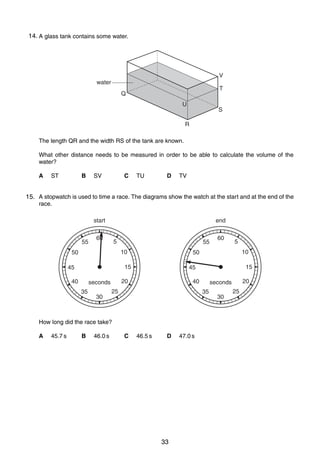
  • 224.
    iGCSE Physics Past PaperQuestions Paper 1 Compilation Atomic & Nuclear Physics 222
  • 225.
    17 1. 39 The diagramshows a radioactivity experiment. counter LDR absorber – What is the effect on the light-dependent resistor (LDR) when it gets dark? resistance of LDR sourceacross LDR p.d. radiation detector A decreases decreases When a piece of paper is used as the absorber, the count rate drops to the background count B decreases increases rate. C increases decreases 2. What radiation is the source emitting? D increases increases A alpha only B beta only 37 An alternating potential difference (p.d.) is applied to the Y-plates of a cathode-ray oscilloscope. C gamma only turned off. The time-base is D alpha, beta and gamma Which of the following patterns would appear on the screen? 40 3. 22 10 Ne represents an atom of neon. A B C How many neutrons does it have? A 10 B 12 C 22 D 32 4. 38 What is a beta-particle? A a helium nucleus B a high-energy electron C four protons D two neutrons 0625/1/M/J/02 0625/1/M/J/02 223 D
  • 226.
    17 5. 39 The diagramshows a radioactivity experiment. counter absorber source radiation detector When a piece of paper is used as the absorber, the count rate drops to the background count rate. 6. What radiation is the source emitting? A B beta only C gamma only D 7. 40 alpha only alpha, beta and gamma 22 10 Ne represents an atom of neon. How many neutrons does it have? A 10 B 12 C 22 D 32 0625/1/M/J/02 224
  • 227.
    When the temperatureof the water is increased, the reading on the ammeter increases. 18 What is component X? 8. 40 An atom of lithium contains three protons and three electrons. A a capacitor The nucleon number (mass number) of the atom is 7. B a light-dependent resistor How many neutrons are there in the atom? C a reed relay D A a 3 thermistor 4 B C 7 D 10 9. 38 Which type of radiation can be stopped by a sheet of paper? A α-particles B β-particles C γ-rays D X-rays 10. 39 The half-life of a radioactive substance is 5 hours. A sample is tested and found to contain 0.48 g of the substance. How much of the substance was present in the sample 20 hours before the sample was tested? A 0.03 g B 0.12 g C 1.92 g D 7.68 g 0625/01/M/J/03 0625/01/M/J/03 225 [Turn over
  • 228.
    18 11. 38 Which linecorrectly describes -particles? electric charge penetrates 1 cm of aluminium? A negative yes B negative no C positive yes D positive no 39 A small amount of a radioactive isotope contains 72 billion unstable nuclei. The half-life of the 12. isotope is 4 hours. How many unstable nuclei would remain after 12 hours? A 6 billion B 9 billion C 18 billion D 24 billion 13. 40 How many nucleons are in a nucleus of A 19 © U C L E S 2004 B 20 39 19 K C ? 39 0625/01/M/J/04 226 D 58
  • 229.
    17 14. 38 Which typeof radiation has the gre atest ionising effect? A -particles B -particles C -rays all have the same ionising effect D 15. 39 A powder contains 400 mg of a radioactive material that emits -particles. The half-life of the material is 5 days. What mass of that material remains after 10 days? 0 mg A B 40 mg C 100 mg D 200 mg 16. 40 In the symbol below, A is the nucleon number and Z is the proton number. A Z X What is represented by the symbol? A an electron B a neutron C a nuclide D an X-ray 16 17. 40 The nucleus of a neutral atom of lithium is represented by 7 Li. 3 How many protons, electrons and neutrons does the atom contain? protons electrons neutrons A 7 7 3 B 3 7 3 C 3 4 4 D 3 3 4 © UCLES 2005 0625/01/M/J/05 227
  • 230.
    15 18. 38 The diagramshows five atoms in a radioactive substance. The atoms each give out an α-particle. 1st particle atom 1 atom 2 atom 5 atom 4 atom 3 2nd particle 19. Atom 1 is the first to give out a particle. Atom 3 is the second to give out a particle. Which atom will give out the next particle? A atom 2 B atom 4 C atom 5 D impossible to tell 39 A Geiger counter detects radiation from radioactive sources. 20. A radioactive source is inside a thick aluminium container as shown. radioactive source 2m Geiger counter thick aluminium container Which type of radiation from this source is being detected? A α-particles B β-particles C γ-rays D radio waves © UCLES 2006 0625/01/M/J/06 228 [Turn over
  • 231.
    iGCSE Physics Past PaperQuestions Paper 3 Compilation Atomic & Nuclear Physics 229
  • 232.
    12 10 Some liquidfrom an atomic power station is known to be radioactive. A sample of this liquid is tested in a laboratory. (a) In the space below, draw a labelled diagram of the test apparatus used to verify that α-particles are emitted from the liquid. [2] (b) Explain how the apparatus may be used to estimate the quantity of α-radiation being emitted from the sample. .......................................................................................................................................... .......................................................................................................................................... .......................................................................................................................................... .......................................................................................................................................... ..................................................................................................................................... [2] (c) State any two safety precautions that the technician might take whilst making the test. precaution 1 ..................................................................................................................... .......................................................................................................................................... precaution 2 ..................................................................................................................... ..................................................................................................................................... [2] 0625/3/M/J/02 230 For Examiner’s Use
  • 233.
    12 For Examiner’s Use 11 (a) Aradioactive isotope emits only α-particles. (i) In the space below, draw a labelled diagram of the apparatus you would use to prove that no β-particles or γ-radiation are emitted from the isotope. (ii) Describe the test you would carry out. ................................................................................................................................... ................................................................................................................................... ................................................................................................................................... ................................................................................................................................... (iii) Explain how your results would show that only α-particles are emitted. ................................................................................................................................... ................................................................................................................................... ................................................................................................................................... [6] (b) Fig. 11.1 shows a stream of α-particles about to enter the space between the poles of a very strong magnet. N α-particles S Fig. 11.1 Describe the path of the α-particles in the space between the magnetic poles. .......................................................................................................................................... .......................................................................................................................................... ......................................................................................................................................[3] 0625/3/M/J/03 231
  • 234.
    For Examiner’s Use 13 11 (a) α-particlescan be scattered by thin gold foils. Fig. 11.1 shows part of the paths of three α-particles. Complete the paths of the three α-particles. [3] α-particle 1 α-particle 2 α-particle 3 gold nuclei Fig. 11.1 (b) What does the scattering of α-particles show about atomic structure? .......................................................................................................................................... .......................................................................................................................................... ......................................................................................................................................[2] (c) State the nucleon number (mass number) of an α-particle. nucleon number = …………………[1] © UCLES 2004 0625/03 M/J/04 232
  • 235.
    13 10 (a) Fig.10.1 is the decay curve for a radioactive isotope that emits only β-particles. For Examiner’s Use 400 count rate counts / min 300 200 100 0 0 10 20 30 time / min 40 Fig. 10.1 Use the graph to find the value of the half-life of the isotope. Indicate, on the graph, how you arrived at your value. half-life …………………………. [2] (b) A student determines the percentage of β-particles absorbed by a thick aluminium sheet. He uses a source that is emitting only β-particles and that has a long half-life. (i) In the space below, draw a labelled diagram of the apparatus required, set up to make the determination. [2] (ii) List the readings that the student needs to take. ................................................................................................................................... ................................................................................................................................... ................................................................................................................................... .............................................................................................................................. [3] © UCLES 2005 0625/03/M/J/05 233 [Turn over
  • 236.
    12 11 Fig. 11.1shows a beam of radiation that contains !-particles, "-particles and #-rays. The beam enters a very strong magnetic field shown in symbol form by N and S poles. For Examiner’s Use N beam of radiation S Fig. 11.1 Complete the table below. radiation direction of deflection, if any charge carried by radiation, if any !-particles "-particles #-rays [6] Permission to reproduce items where third-party owned material protected by copyright is included has been sought and cleared where possible. Every reasonable effort has been made by the publisher (UCLES) to trace copyright holders, but if any items requiring clearance have unwittingly been included, the publisher will be pleased to make amends at the earliest possible opportunity. University of Cambridge International Examinations is part of the University of Cambridge Local Examinations Syndicate (UCLES), which is itself a department of the University of Cambridge. © UCLES 2006 0625/03/M/J/06 234
  • 237.
    PHYSICS 0625 IGCSE2007 CURRICULUM CONTENT Students can follow either the Core curriculum only or they may follow the Extended curriculum, which includes both the Core and the Supplement. Students aiming for grades A* to C must follow the Extended curriculum. Students are expected to have adequate mathematical skills to cope with the curriculum. Reference should also be made to the summary list of symbols, units and definitions of quantities. Throughout the course, attention should be paid to showing the relevance of concepts to the students' everyday life and to the natural and man-made world. In order to encourage such an approach and to allow flexibility in teaching programmes to meet the more generalised Aims, the specified content of the syllabus has been limited. In this wider sense, as well as in the literal sense, the following material should be regarded as an examination syllabus rather than a teaching syllabus. TOPIC CORE SUPPLEMENT All students should be able to: In addition to what is required for the Core, students following the Extended curriculum should be able to: -use and describe the use of rules and measuring cylinders to determine a length or a volume -use and describe the use of clocks and devices for measuring an interval of time -use and describe the use of a mechanical method for the measurement of a small distance -measure and describe how to measure a short interval of time (including the period of a pendulum) -define speed and calculate speed from total distance total time -distinguish between speed and velocity -recognise linear motion for which the acceleration is constant and calculate the acceleration -recognise motion for which the acceleration is not constant 1. General Physics 1.1 Length and time 1.2 Speed, velocity acceleration and -plot and interpret a speed/time graph or a distance/time graph -recognise from the shape of a speed/time graph when a body is (a) at rest, (b) moving with constant speed, (c) moving with changing speed -calculate the area under a speed/time graph to determine the distance travelled for motion with constant acceleration -demonstrate some understanding that acceleration is related to changing speed -state that the acceleration of free fall for a body near to the Earth is constant -describe qualitatively the motion of bodies falling in a uniform gravitational field with and without air resistance (including reference to terminal velocity) 1.3 Mass and weight -show familiarity with the idea of the mass of a body -state that weight is a force -demonstrate understanding that weights (and hence masses) may be compared using a balance -demonstrate an understanding that mass is a property which 'resists' change in motion -describe, and use the concept of, weight as the effect of a gravitational field on a mass 1.4 Density -describe an experiment to determine the density of a liquid and of a regularly shaped solid and make the necessary calculation -describe the determination of the density of an irregularly shaped solid by the method of displacement and make the necessary calculation 235 5
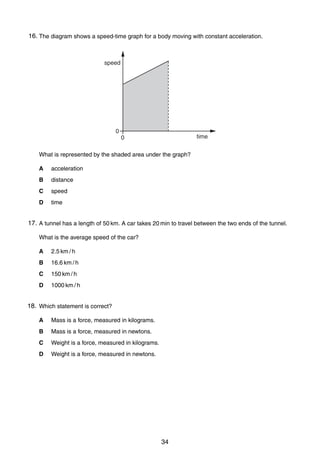
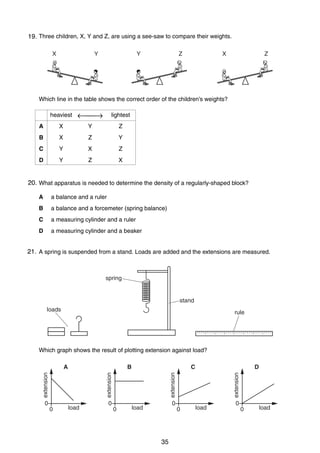
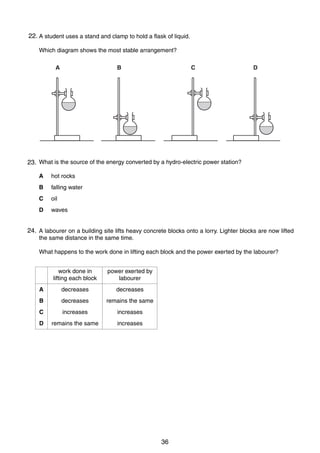
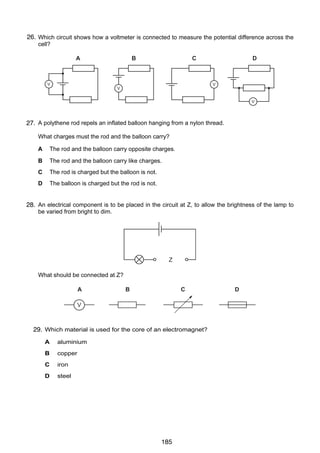
  • 238.
    PHYSICS 0625 IGCSE2007 TOPIC CORE SUPPLEMENT 1.5 Forces (a) Effects of forces -state that a force may produce a change in size and shape of a body -plot extension/load graphs and describe the associated experimental procedure -describe the ways in which a force may change the motion of a body -find the resultant of two or more forces acting along the same line (b) Turning effect -describe the moment of a force as a measure of its turning effect and give everyday examples -describe, qualitatively, the balancing of a beam about a pivot (c) Conditions for equilibrium -perform and describe an determine the position of mass of a plane lamina -describe qualitatively the position of the centre of stability of simple objects -recall and use the relation between force, mass and acceleration (including the direction) -describe, qualitatively, motion in a curved path due to a perpendicular force (F = mv2 / r is not required) -perform and describe an experiment (involving vertical forces) to verify that there is no net moment on a body in equilibrium -apply the idea of opposing moments to simple systems in equilibrium -state that, when there is no resultant force and no resultant turning effect, a system is in equilibrium (d) Centre of mass -interpret extension/load graphs -state Hooke’s Law and recall and use the expression F = k x -recognise the significance of the term 'limit of proportionality' for an extension/load graph experiment to the centre of effect of the mass on the (e) Scalars and vectors 1.6 Energy, work and power (a) Energy -demonstrate an understanding of the difference between scalars and vectors and give common examples -add vectors by graphical representation to determine a resultant -determine graphically a resultant of two vectors -demonstrate an understanding that an object may have energy due to its motion or its position, and that energy may be transferred and stored -give examples of energy in different forms, including kinetic, gravitational, chemical, strain, nuclear, internal, electrical, light and sound -give examples of the conversion of energy from one form to another and of its transfer from on place to another -apply the principle of energy conservation to simple examples 236 6 -recall and use the expressions 2 k.e.= ½ mv and p.e. = mgh
  • 239.
    PHYSICS 0625 IGCSE2007 TOPIC CORE SUPPLEMENT (b) Energy resources -describe how electricity or other useful forms of energy may be obtained from (i) chemical energy stored in fuel (ii) water, including the energy stored in waves, in tides, and in water behind hydroelectric dams (iii) geothermal resources (iv) nuclear fission (v) heat and light from the Sun -show an understanding that energy is released by nuclear fusion in the Sun -show a qualitative understanding of efficiency (c) Work -relate, without calculation, work done to the magnitude of a force and the distance moved -describe energy changes in terms of work done -recall and use ∆W = Fd = ∆E (d) Power -relate, without calculation, power to work done and time taken, using appropriate examples -recall and use the equation P = E/t in simple systems -relate, without calculation, pressure to force and area, using appropriate examples -recall and use the equation p = F/A 1.7 Pressure -describe the simple mercury barometer and its use in measuring atmospheric pressure -relate, without calculation, the pressure beneath a liquid surface to depth and to density, using appropriate examples -recall and use the equation p = hρg -use and describe the use of a manometer 2. Thermal Physics 2.1 Simple kinetic molecular model of matter (a) States of matter -state the distinguishing solids, liquids and gases properties (b) Molecular model -describe qualitatively the molecular structure of solids, liquids and gases -interpret the temperature of a gas in terms of the motion of its molecules -describe qualitatively the pressure of a gas in terms of the motion of its molecules -describe qualitatively the effect of a change of temperature on the pressure of a gas at constant volume -show an understanding of the random motion of particles in a suspension as evidence for the kinetic molecular model of matter -describe this motion (sometimes known as Brownian motion) in terms of random molecular bombardment -relate the properties of solids, liquids and gases to the forces and distances between molecules and to the motion of the molecules (c) Evaporation -describe evaporation in terms of the escape of more-energetic molecules from the surface of a liquid -relate evaporation and the consequent cooling -demonstrate an understanding of how temperature, surface area and draught over a surface influence evaporation (d) Pressure changes -relate the change in volume of a gas to change in pressure applied to the gas at constant temperature -recall and use the equation pV = constant at constant temperature 237 7 of -show an appreciation that massive particles may be moved by light, fastmoving molecules
  • 240.
    PHYSICS 0625 IGCSE2007 TOPIC SUPPLEMENT (a) Thermal expansion of solids, liquids and gases -describe qualitatively the thermal expansion of solids, liquids and gases -identify and explain some of the everyday applications and consequences of thermal expansion -describe qualitatively the effect of a change of temperature on the volume of a gas at constant pressure -show an appreciation of the relative order of magnitude of the expansion of solids, liquids and gases (b) Measurement of temperature 2.2 CORE -appreciate how a physical property which varies with temperature may be used for the measurement of temperature and state examples of such properties -recognise the need for and identify fixed points -describe the structure and action of liquidin-glass thermometers -demonstrate understanding of sensitivity, range and linearity Thermal properties (c) Thermal capacity (d) Melting and boiling -relate a rise in temperature of a body to an increase in internal energy -show an understanding of the term thermal capacity -describe melting and boiling in terms of energy input without a change in temperature -state the meaning of melting point and boiling point -describe condensation and solidification -describe the structure of a thermocouple and show understanding of its use for measuring high temperatures and those which vary rapidly -describe an experiment to measure the specific heat capacity of a substance -distinguish between boiling and evaporation -use the terms latent heat of vaporisation and latent heat of fusion and give a molecular interpretation of latent heat -describe an experiment to measure specific latent heats for steam and for ice 2.3 Transfer of thermal energy (a) Conduction -describe experiments to demonstrate the properties of good and bad conductors of heat (b) Convection -relate convection in fluids to density changes and describe experiments to illustrate convection (c) Radiation -identify infra-red radiation as part of the electromagnetic spectrum (d) Consequences of energy transfer -give a simple molecular account of heat transfer in solids -identify and explain some of the everyday applications and consequences of conduction, convection and radiation -describe experiments to show the properties of good and bad emitters and good and bad absorbers of infra-red radiation 3. Properties of waves, including light and sound 3.1 General wave properties -describe what is meant by wave motion as illustrated by vibration in ropes, springs and by experiments using water waves -use the term wavefront -give the meaning of speed, frequency, wavelength and amplitude 238 8 -recall and use the equation v = f λ
  • 241.
    PHYSICS 0625 IGCSE2007 TOPIC SUPPLEMENT -distinguish between transverse and longitudinal waves and give suitable examples -describe the use of water waves to show (i) reflection at a plane surface (ii) refraction due to a change of speed (iii) diffraction produced by wide and narrow gaps 3.2 CORE -interpret reflection, refraction diffraction using wave theory Light (a) Reflection of light (b) Refraction of light (c) Thin converging lens -describe the formation, and give the characteristics, of an optical image by a plane mirror -use the law angle of incidence = angle of reflection -describe an experimental demonstration of the refraction of light -use the terminology for the angle of incidence i and angle of refraction r and describe the passage of light through parallel-sided transparent material -give the meaning of critical angle -describe internal and total internal reflection -describe the action of a thin converging lens on a beam of light -use the term principal focus and focal length -draw ray diagrams to illustrate the formation of a real image by a single lens (d) Dispersion of light -describe the main features of the electromagnetic spectrum and state that all e.m. waves travel with the same high speed in vacuo Sound -describe the production of sound by vibrating sources -describe the longitudinal nature of sound waves -state the approximate range of audible frequencies -show an understanding that a medium is required in order to transmit sound waves -describe an experiment to determine the speed of sound in air -relate the loudness and pitch of sound waves to amplitude and frequency -describe how the reflection of sound may produce an echo -perform simple constructions, measurements and calculations -recall and use the definition of refractive index n in terms of speed -recall and use the equation sin i /sin r = n -describe the action of optical fibres -draw ray diagrams to illustrate the formation of a virtual image by a single lens -use and describe the use of a single lens as a magnifying glass -give a qualitative account of the dispersion of light as illustrated by the action on light of a glass prism (e) Electromagnetic spectrum 3.3 and 4. Electricity and magnetism 4.1 Simple phenomena of -state the properties of magnets magnetism -give an account of induced magnetism -distinguish between ferrous and nonferrous materials -describe methods of magnetisation and of demagnetisation 239 9 -state the approximate value of the speed of electro-magnetic waves -use the term monochromatic -describe compression and rarefaction -state the order of magnitude of the speed of sound in air, liquids and solids
  • 242.
    PHYSICS 0625 IGCSE2007 TOPIC CORE SUPPLEMENT -describe an experiment to identify the pattern of field lines round a bar magnet -distinguish between the magnetic properties of iron and steel -distinguish between the design and use of permanent magnets and electromagnets 4.2 Electrical quantities (a) Electric charge -describe simple experiments to show the production and detection of electrostatic charges -state that there are positive and negative charges -state that unlike charges attract and that like charges repel -describe an electric field as a region in which an electric charge experiences a force -distinguish between electrical conductors and insulators and give typical examples (b) Current -state that current is related to the flow of charge -use and describe the use of an ammeter (c) Electro-motive force -state that the e.m.f. of a source of electrical energy is measured in volts (d) Potential difference -state that resistance = p.d./ current and understand qualitatively how changes in p.d. or resistance affect current -recall and use the equation R = V/I -describe an experiment to determine resistance using a voltmeter and an ammeter -relate (without calculation) the resistance of a wire to its length and to its diameter (f) Electrical energy 4.3 -state the direction of lines of force and describe simple field patterns -give an account of charging by induction -recall and use the simple electron model to distinguish between conductors and insulators -show understanding that a current is a rate of flow of charge and recall and use the equation l = Q/t -distinguish between the direction of flow of electrons and conventional current -show understanding that e.m.f. is defined in terms of energy supplied by a source in driving charge round a complete circuit -state that the potential difference across a circuit component is measured in volts -use and describe the use of a voltmeter (e) Resistance -state that charge is measured in coulombs -recall and use quantitatively the proportionality between resistance and the length and the inverse proportionality between resistance and cross-sectional area of a wire -recall and use the equations P = I V and E=IVt Electric circuits (a) Circuit diagrams (b) Series and parallel circuits -draw and interpret circuit diagrams containing sources, switches, resistors (fixed and variable), lamps, ammeters voltmeters, magnetising coils, transformers, bells, fuses and relays -understand that the current at every point in a series circuit is the same -give the combined resistance of two or more resistors in series -state that, for a parallel circuit, the current from the source is larger than the current in each branch -state that the combined resistance of two resistors in parallel is less than that of either resistor by itself 240 10 -draw and interpret circuit diagrams containing diodes and transistors -recall and use the fact that the sum of the p.d.’s across the components in a series circuit is equal to the total p.d. across the supply -recall and use the fact that the current from the source is the sum of the currents in the separate branches of a parallel circuit -calculate the effective resistance of two resistors in parallel
  • 243.
    PHYSICS 0625 IGCSE2007 TOPIC CORE SUPPLEMENT -state the advantages of connecting lamps in parallel in a lighting circuit (c) Action and use of circuit components -describe the action of a variable potential divider (potentiometer) -describe the action of thermistors and light dependent resistors and show understanding of their use as input transducers -describe the action of a capacitor as an energy store and show understanding of its use in time delay circuits -describe the action of a relay and show understanding of its use in switching circuits -describe the action of a diode and show understanding of its use as a rectifier -describe the action of a transistor as an electrically operated switch and show understanding of its use in switching circuits -recognise and show understanding of circuits operating as light sensitive switches and temperature operated alarms (using a relay or a transistor) (d) Digital electronics 4.4 Dangers of electricity 4.5 -explain and use the terms digital and analogue - state that logic gates are circuits containing transistors and other components -describe the action of NOT, AND, OR, NAND and NOR gates -design and understand simple digital circuits combining several logic gates -state and use the symbols for logic gates (the American ANSI#Y 32.14 symbols will be used) -state the hazards of (i) damaged insulation (ii) overheating of cables (iii) damp conditions -show an understanding of the use of fuses and/or circuit-breakers Electromagnetic effects (a) Electromagnetic induction -describe an experiment which shows that a changing magnetic field can induce an e.m.f. in a circuit (b) a.c. generator -describe a rotating-coil generator and the use of slip rings -sketch a graph of voltage output against time for a simple a.c. generator -describe the construction of a basic ironcored transformer as used for voltage transformations -recall and use the equation (Vp / Vs) = (Np / Ns) -describe the use of the transformer in high-voltage transmission of electricity -give the advantages of high voltage transmission (c) Transformer 241 11 -state the factors affecting the magnitude of an induced e.m.f. -show understanding that the direction of an induced e.m.f. opposes the change causing it -describe the principle of operation of a transformer -recall and use the equation Vp lp = Vs Is (for 100% efficiency) -discuss energy losses in cables
  • 244.
    PHYSICS 0625 IGCSE2007 TOPIC CORE SUPPLEMENT (d) The magnetic effect - describe the pattern of the magnetic field of a current due to currents in straight wires and in solenoids -state the qualitative variation of the strength of the magnetic field over salient parts of the pattern -describe the effect on the magnetic field of changing the magnitude and direction of the current -describe applications of the magnetic effect of current, including the action of a relay (e) Force on a current- -describe an experiment to show that a carrying conductor force acts on a current-carrying conductor in a magnetic field, including the effect of reversing: (i) the current (ii) the direction of the field (f) d.c. motor -state that a current-carrying coil in a magnetic field experiences a turning effect and that the effect is increased by increasing the number of turns on the coil -relate this turning effect to the action of an electric motor -describe an experiment to show the corresponding force on beams of charged particles -state and use the relative directions of force, field and current -describe the effect of increasing the current 4.6 Cathode ray oscilloscopes -describe the production and detection of (a) Cathode rays cathode rays -describe their deflection in electric fields -state that the particles emitted in thermionic emission are electrons (b) Simple treatment of cathode-ray oscilloscope -describe in outline the basic structure and action of a cathode-ray oscilloscope (detailed circuits are not required) -use and describe the use of a cathode-ray oscilloscope to display waveforms 5. Atomic Physics 5.1 Radioactivity (a) Detection of radioactivity -show awareness of the existence of background radiation -describe the detection of α-particles, βparticles and γ -rays (b) Characteristics of the -state that radioactive emissions occur three kinds of randomly over space and time emission -state, for radioactive emissions: (i) their nature (ii) their relative ionising effects (iii) their relative penetrating abilities (c) Radioactive decay -state the meaning of radioactive decay, using equations (involving words or symbols) to represent changes in the composition of the nucleus when particles are emitted (d) Half-life -use the term half-life in simple calculations which might involve information in tables or decay curves (e) Safety precautions -describe how radioactive materials are handled, used and stored in a safe way 242 12 -describe their deflection in electric fields and magnetic fields -interpret their relative ionising effects
  • 245.
    PHYSICS 0625 IGCSE2007 TOPIC 5.2 CORE SUPPLEMENT (a) Atomic model -describe the structure of an atom in terms of a nucleus and electrons -describe how the scattering of α-particles by thin metal foils provides evidence for the nuclear atom (b) Nucleus -describe the composition of the nucleus in terms of protons and neutrons -use the term proton number Z -use the term nucleon number A -use the term nuclide and use the nuclide The nuclear atom A notation Z X (c) Isotopes -use the term isotope -give and explain examples of practical applications of isotopes 243 13