EQUILIBRIUM AND CENTRE OF MASS
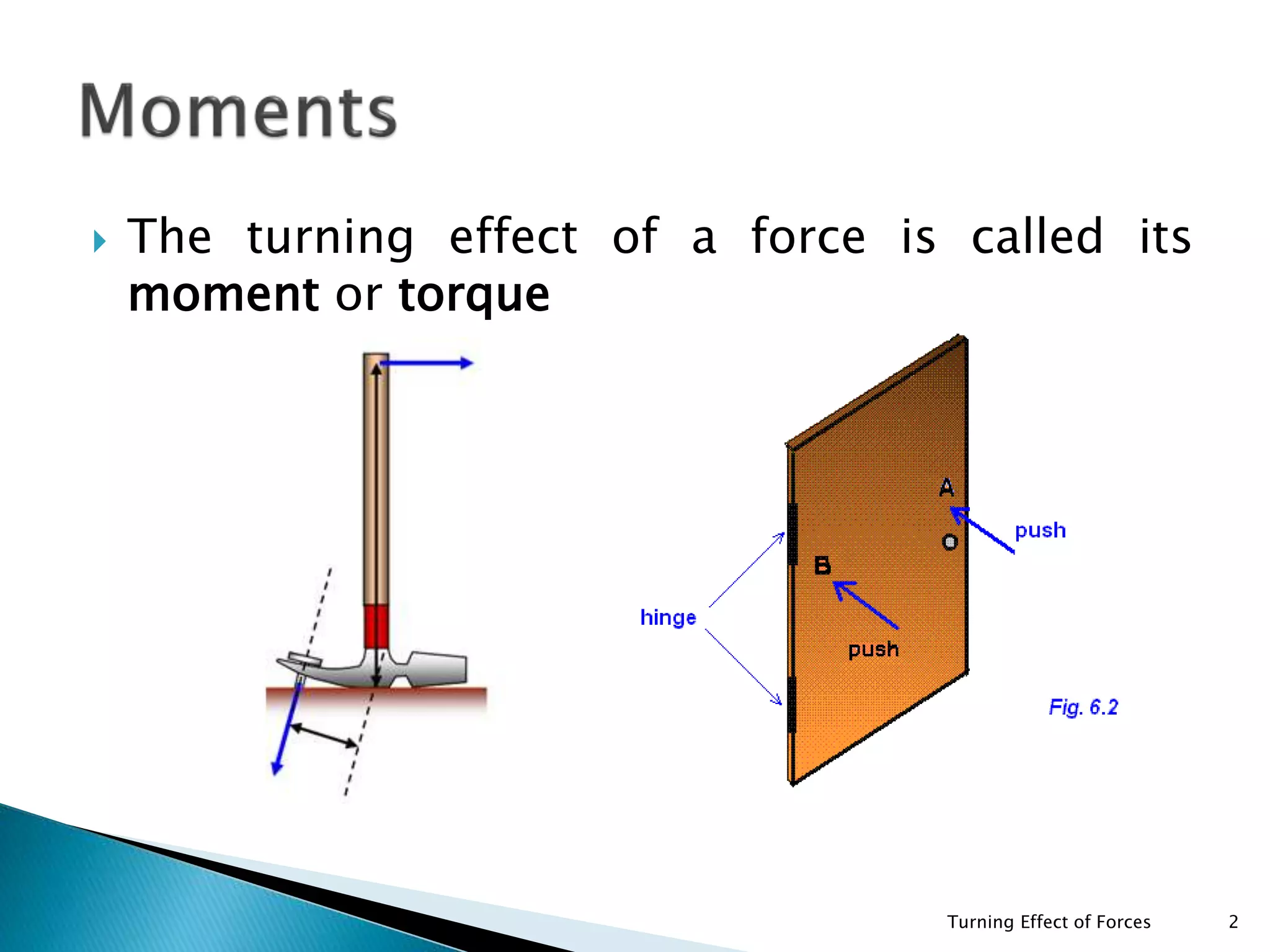
 The turning effect of a force is called its
moment or torque
Turning Effect of Forces 2
 The moment of a force is bigger if the force is
bigger.
 The moment of a force is bigger if it acts
further from the pivot.
 The moment of force is greatest if it acts at
90ᵒ to the object it acts on
Turning Effect of Forces 3
Turning Effect of Forces 4
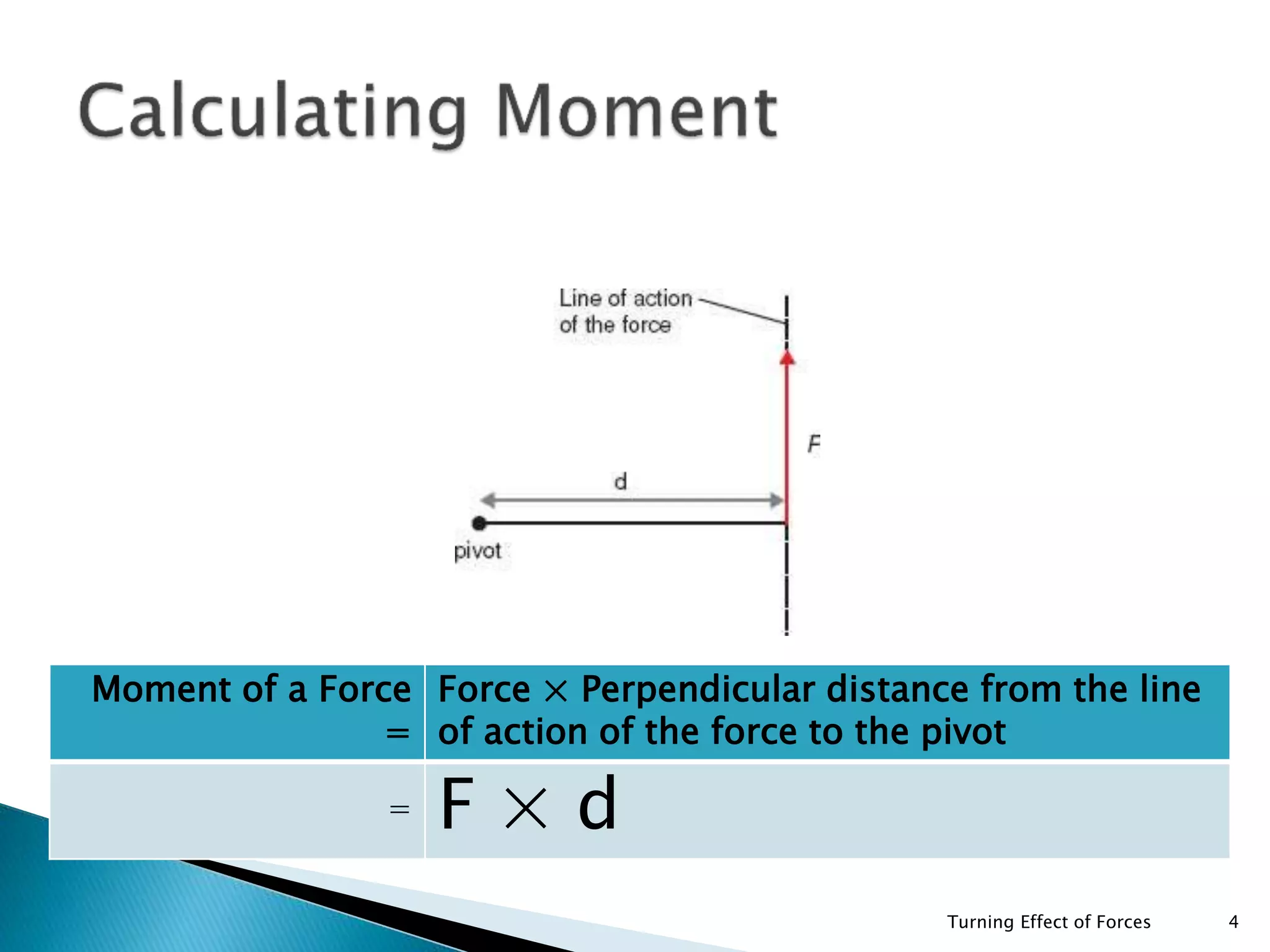
Moment of a Force
=
Force × Perpendicular distance from the line
of action of the force to the pivot
= F × d
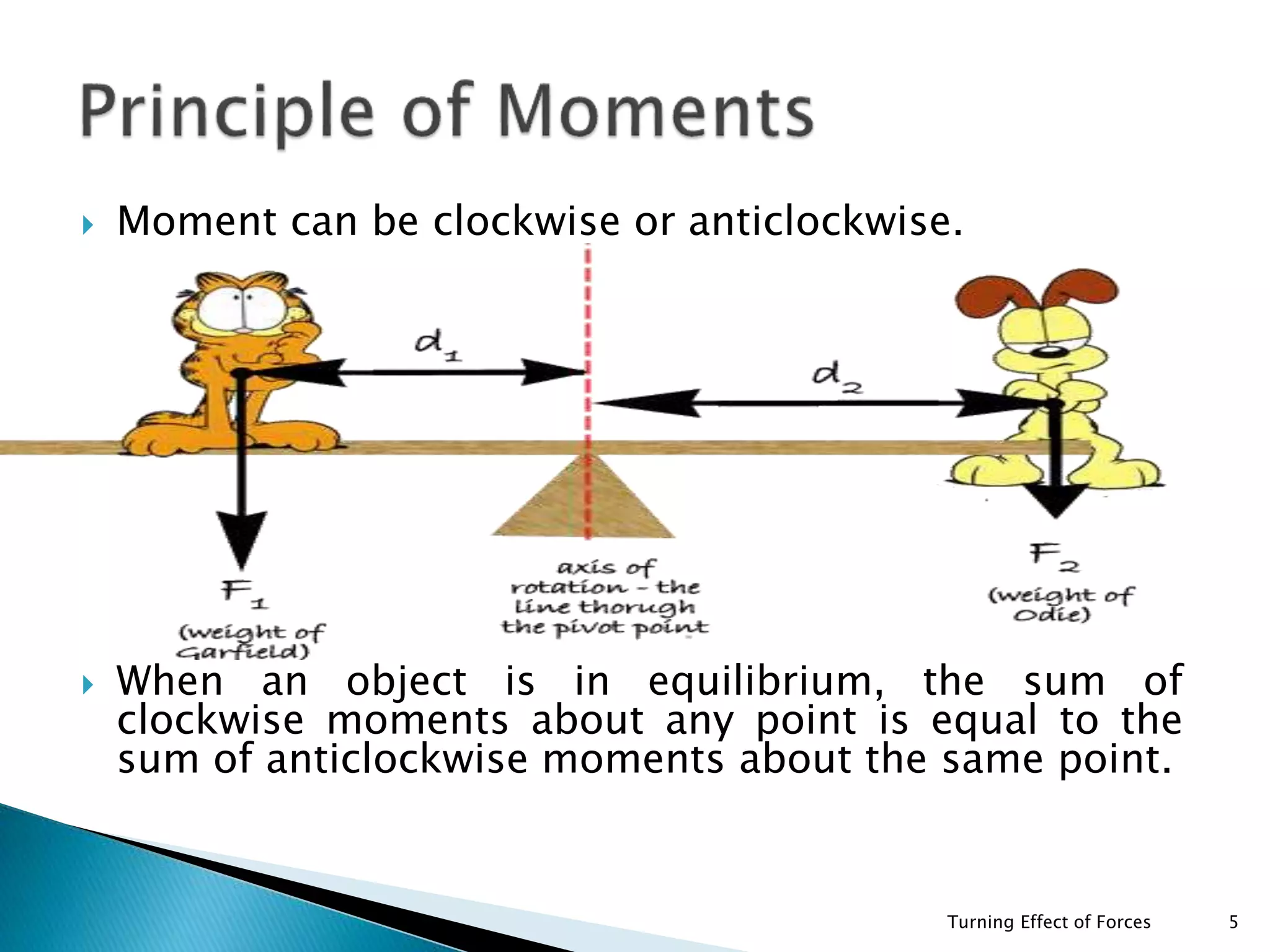
 Moment can be clockwise or anticlockwise.
 When an object is in equilibrium, the sum of
clockwise moments about any point is equal to the
sum of anticlockwise moments about the same point.
Turning Effect of Forces 5
 If an object is in equilibrium, the forces on it
must balance as well as their turning effect.
 So:
◦ The sum of the forces in one direction must equal
to the sum of the forces in the opposite direction.
◦ The principle of moments must apply.
Turning Effect of Forces 6
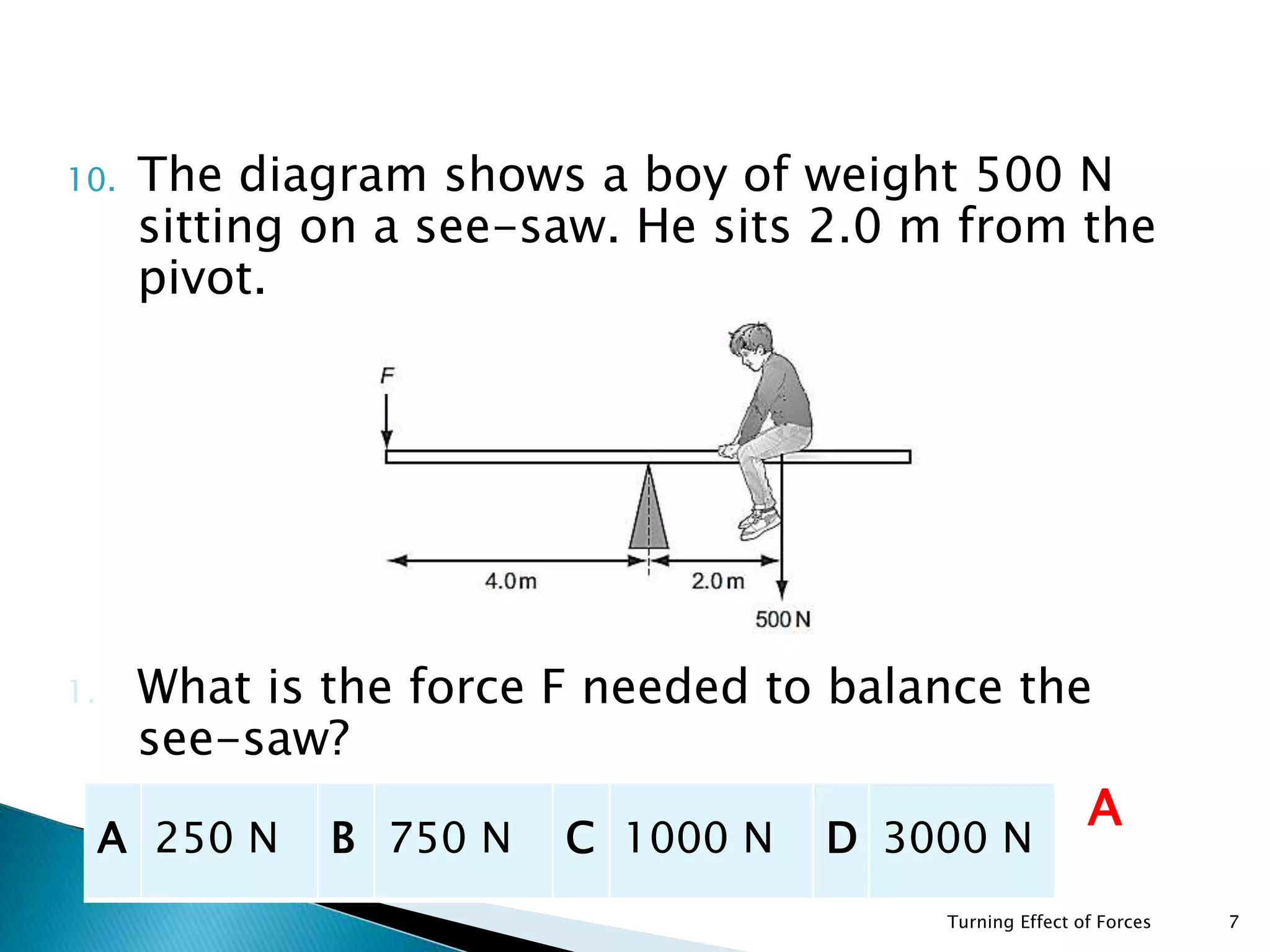
10. The diagram shows a boy of weight 500 N
sitting on a see-saw. He sits 2.0 m from the
pivot.
1. What is the force F needed to balance the
see-saw?
Turning Effect of Forces 7
A 250 N B 750 N C 1000 N D 3000 N
A
GCSE Physics
By the end of the lesson we will be able to…
 Understand the term Centre of Mass/Gravity
(CoG)
 Recognise the factors that affect an object’s
CoG
 Investigate how to find the CoG of an
irregular object.
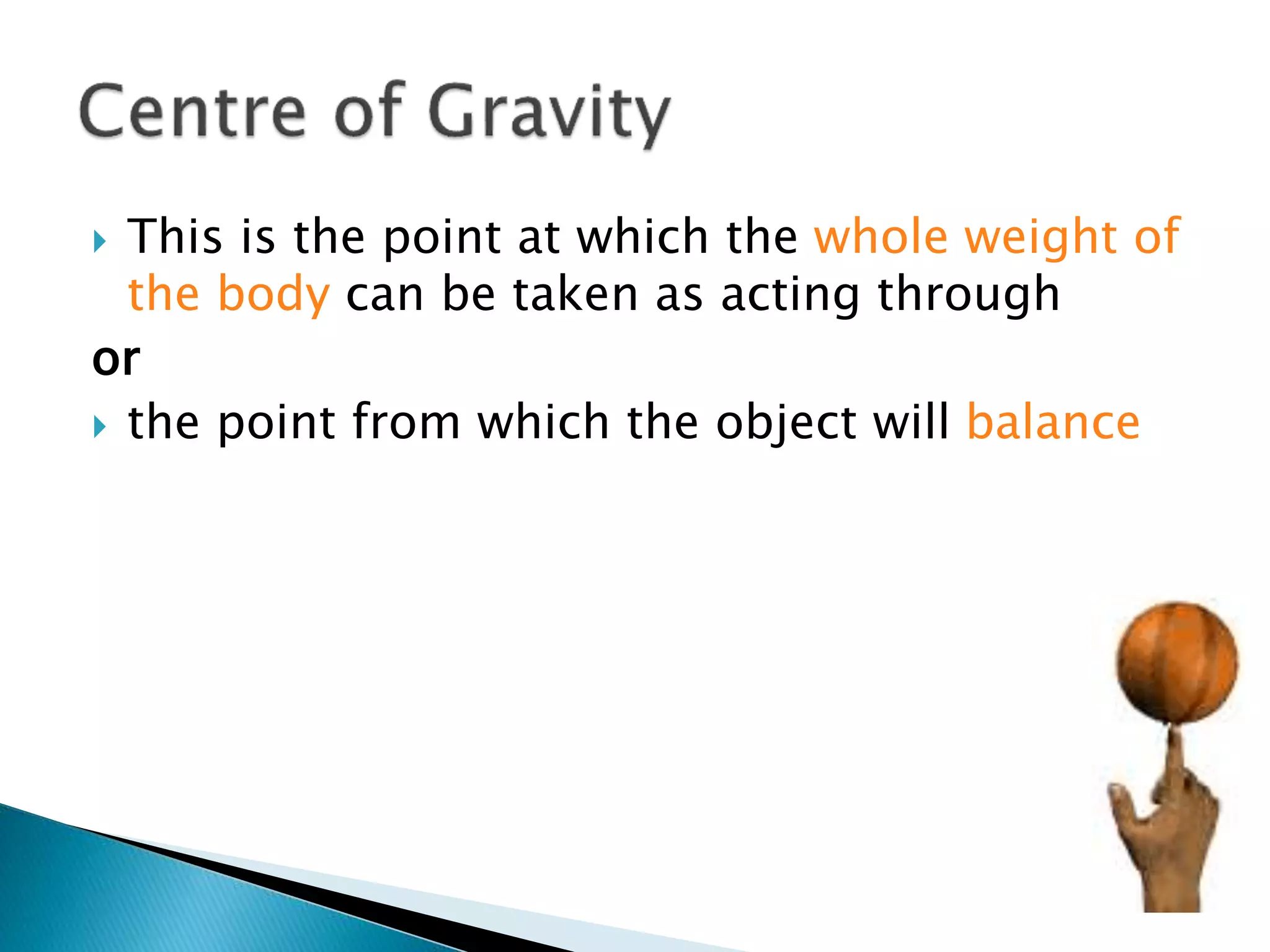
 This is the point at which the whole weight of
the body can be taken as acting through
or
 the point from which the object will balance
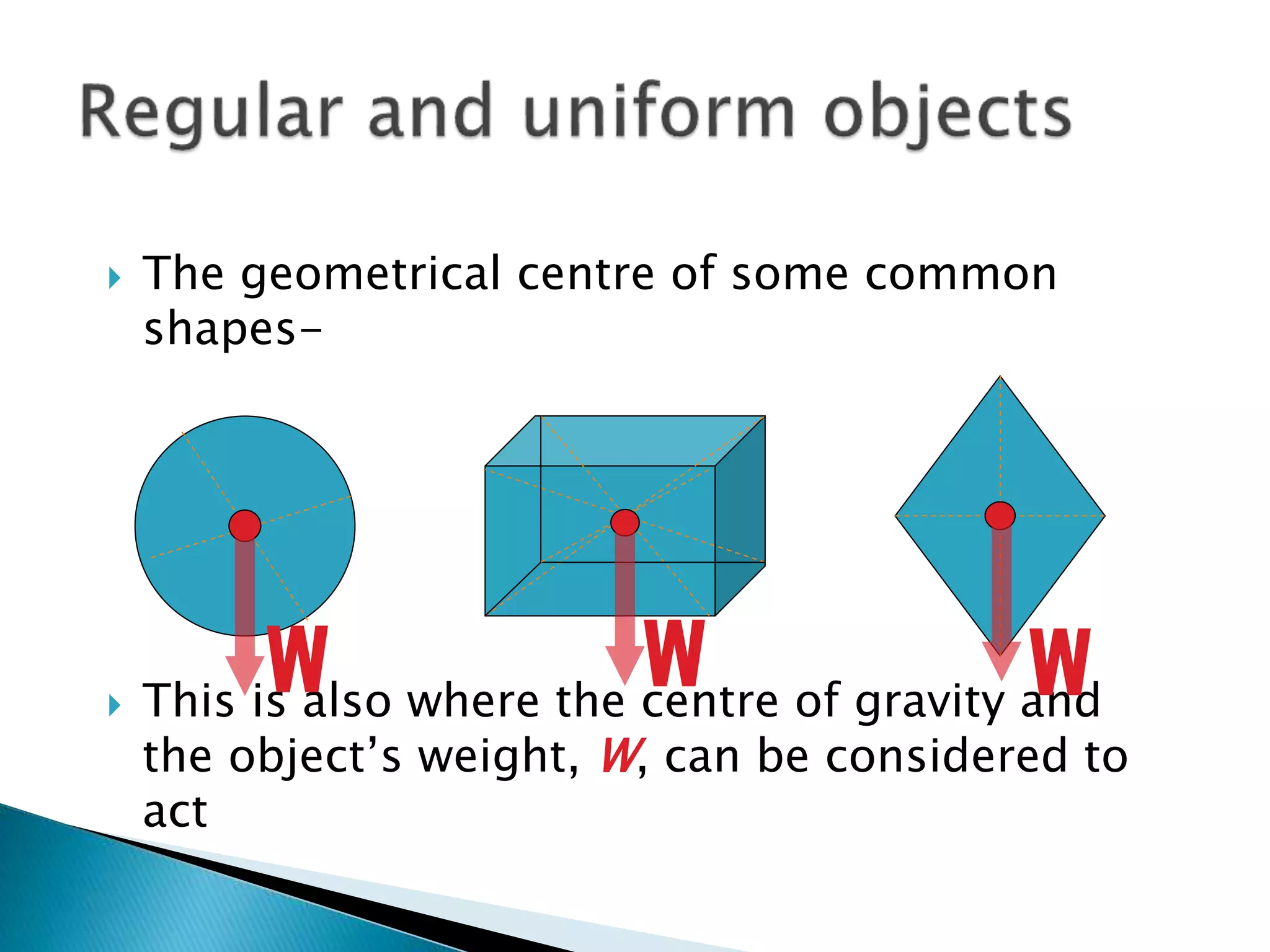
 The geometrical centre of some common
shapes-
 This is also where the centre of gravity and
the object’s weight, W, can be considered to
act
 The centre of gravity (and geometrical centre)
is found by drawing a line from the corner to
the opposite line’s midpoint
 For some objects the CoG is not located on
the actual object -
Ring
Stool
2 uniform
perpendicular
planks
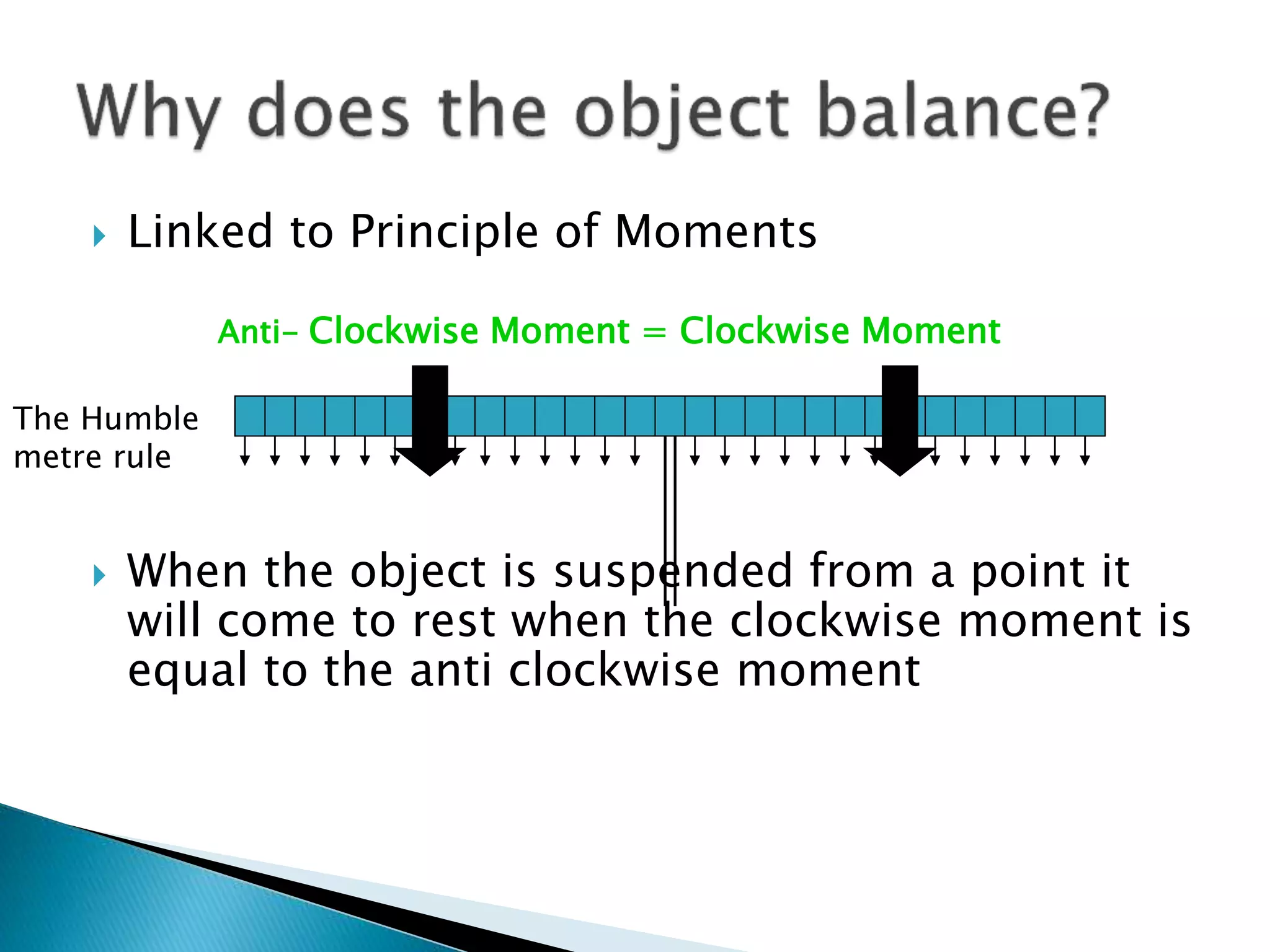
 Linked to Principle of Moments
 When the object is suspended from a point it
will come to rest when the clockwise moment is
equal to the anti clockwise moment
The Humble
metre rule
Anti- Clockwise Moment = Clockwise Moment
 When an object is suspended, so that it can
swing freely, it will come to rest with its CoG
vertically below the point of suspension
See Page 52 and 53 for extra notes in the book
 Find the CoG of an irregular shaped lamina
a
b
c
a b
c
b
a
c
plumb line
hole
Pin held by
clamp
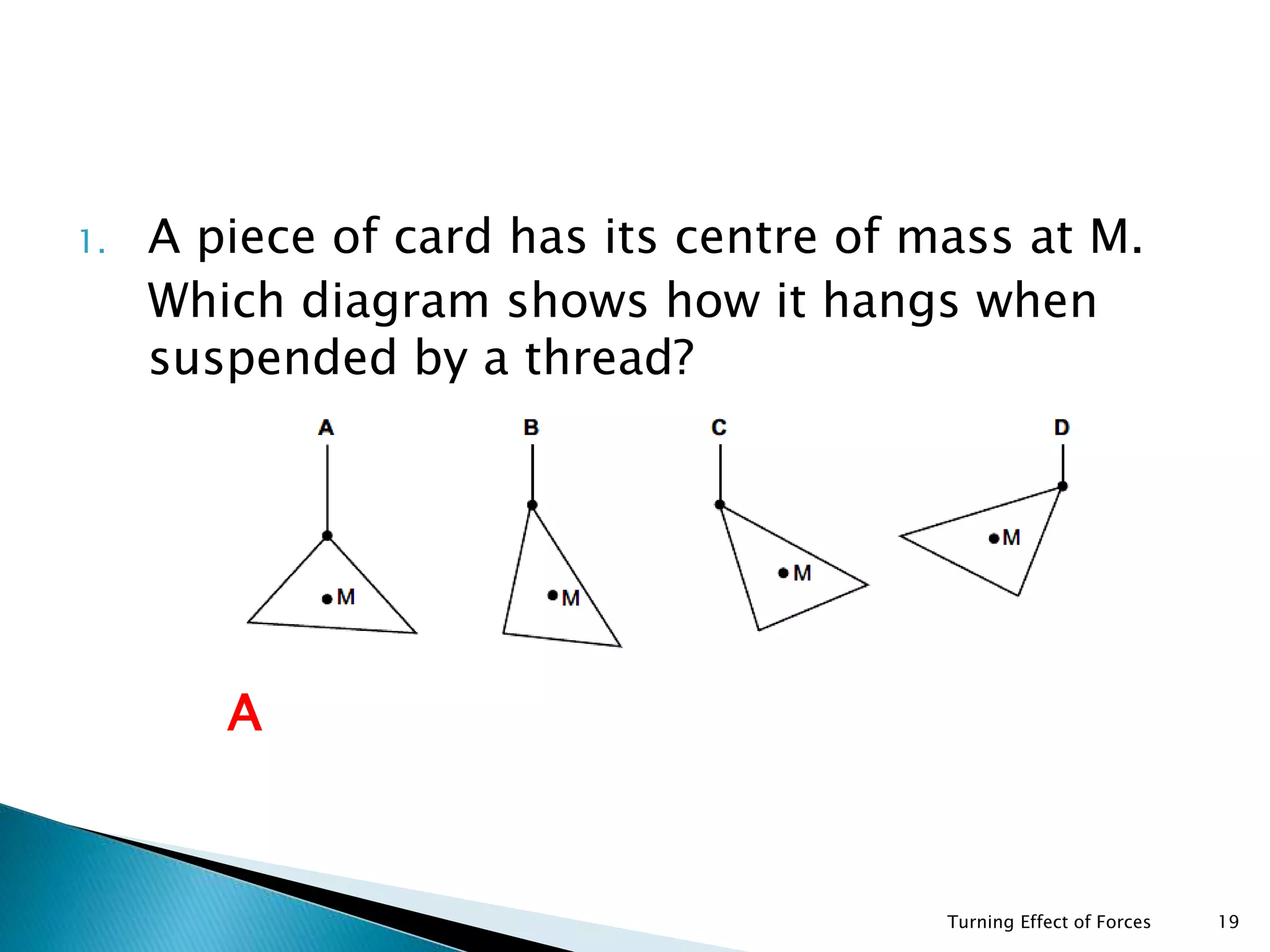
1. A piece of card has its centre of mass at M.
2. Which diagram shows how it hangs when
suspended by a thread?
Turning Effect of Forces 19
A
3. A piece of uniform card is suspended freely
from a horizontal pin.
4. At which of the points shown is its centre of
gravity?
Turning Effect of Forces 20
C
4. A tractor is being used on rough ground.
5. What is the safest position for its centre of
mass?
Turning Effect of Forces 21
D
5. An empty glass is placed on a join between
two tables as shown. The glass remains
stable.
6. Which point is the centre of mass of the
glass?
Turning Effect of Forces 22
C
6. A light aircraft stands at rest on the ground.
It stands on three wheels, one at the front
and two further back.
7. Which point could be its centre of mass?
Turning Effect of Forces 23
B
8. A student uses a stand and clamp to hold a
flask of liquid.
9. Which diagram shows the most stable
arrangement?
Turning Effect of Forces 24
B
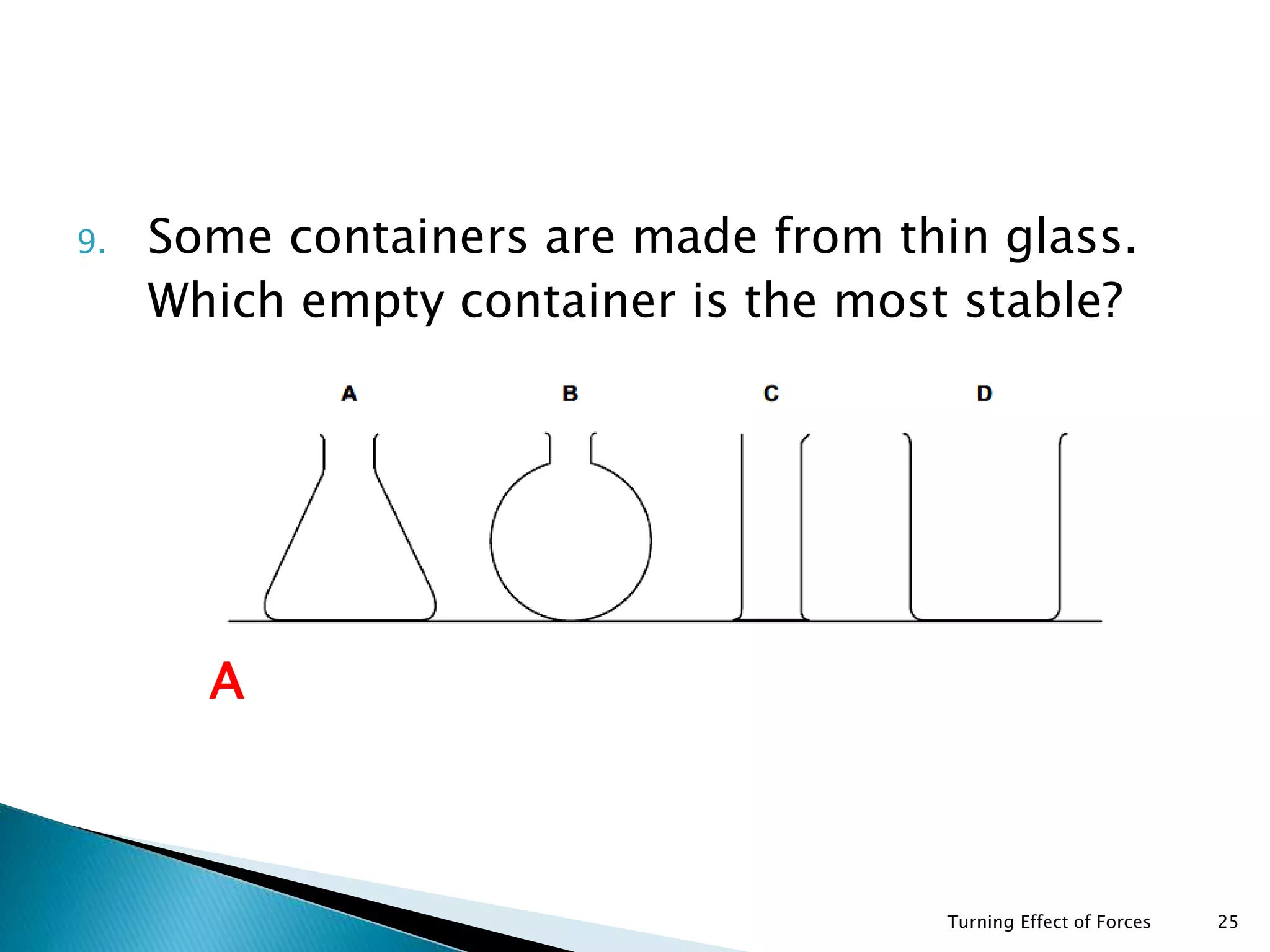
9. Some containers are made from thin glass.
10. Which empty container is the most stable?
Turning Effect of Forces 25
A
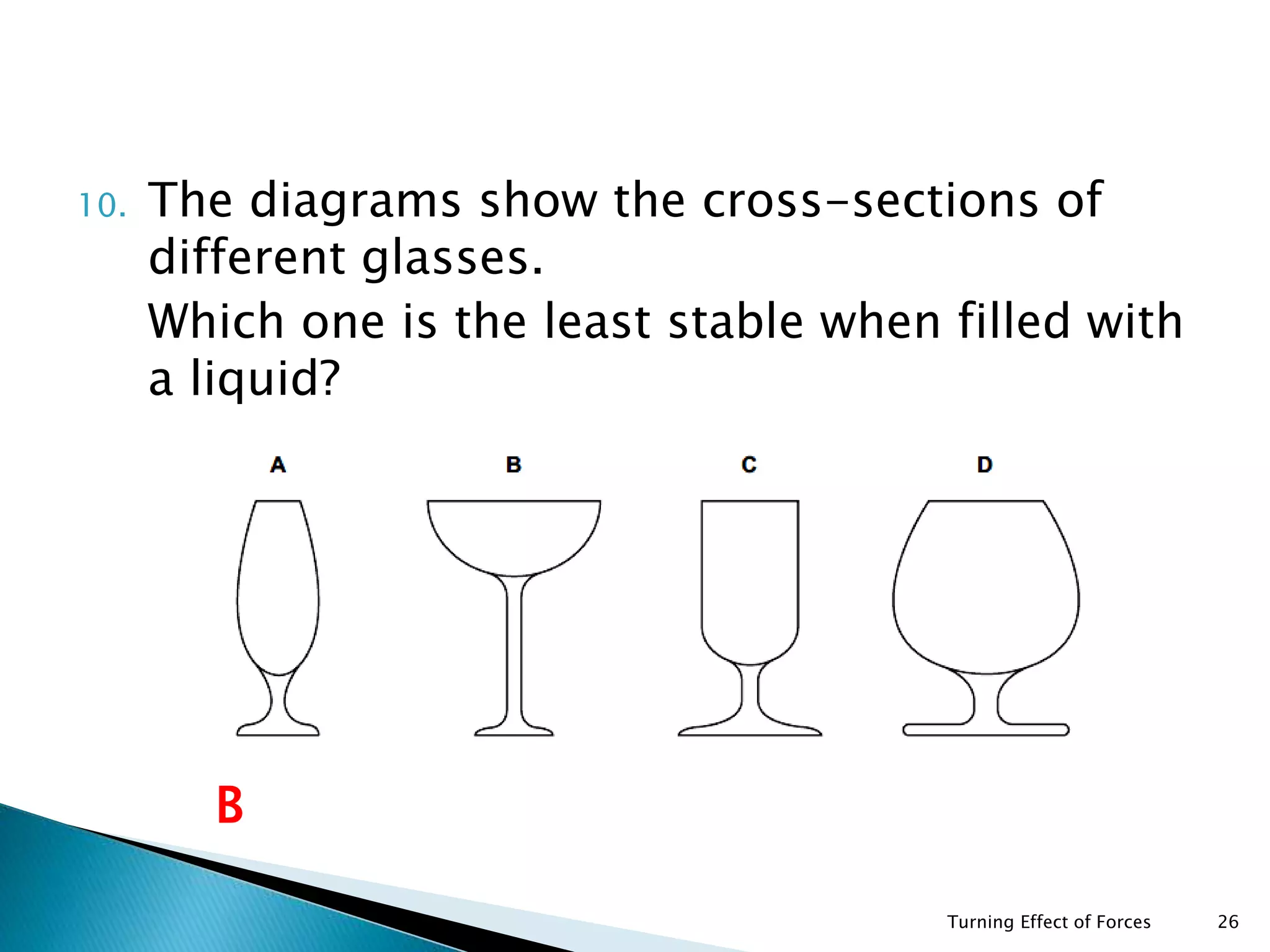
10. The diagrams show the cross-sections of
different glasses.
11. Which one is the least stable when filled with
a liquid?
Turning Effect of Forces 26
B
11. The diagram shows four models of buses placed
on different ramps.
How many of these models will fall over?
A. 1
B. 2
C. 3
D. 4
Turning Effect of Forces 27
12. The diagram shows four objects standing on
a flat surface.
13. The centre of mass of each object is marked
M.
14. Which object will fall over?
Turning Effect of Forces 28
C
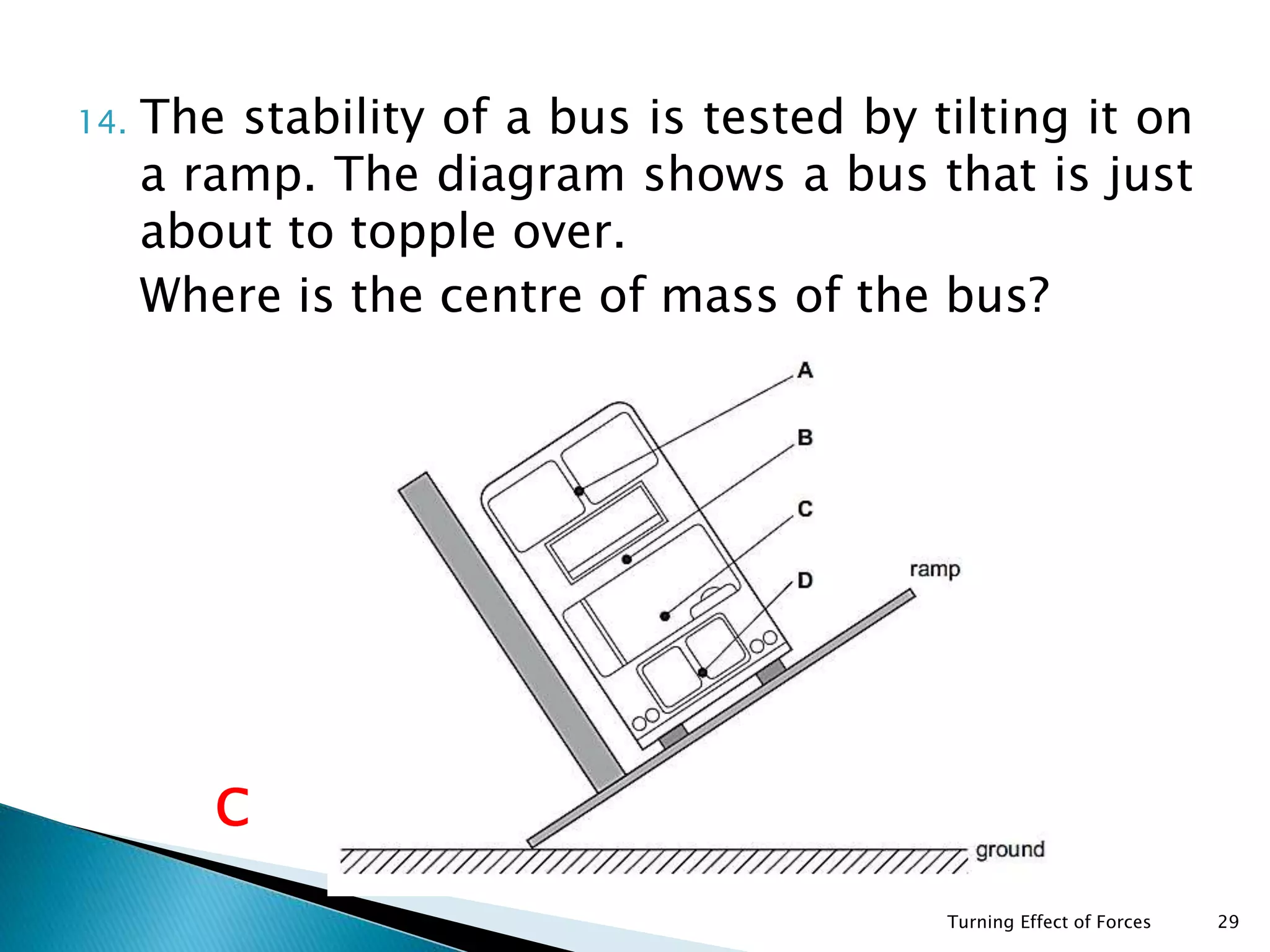
14. The stability of a bus is tested by tilting it on
a ramp. The diagram shows a bus that is just
about to topple over.
15. Where is the centre of mass of the bus?
Turning Effect of Forces 29
C
15. Passengers are not allowed to stand on the
upper deck of double-decker buses.
Turning Effect of Forces 30
1. Why is this?
A. They would cause the bus to become unstable.
B. They would cause the bus to slow down.
C. They would increase the kinetic energy of the bus.
D. They would lower the centre of mass of the bus.
Turning Effect of Forces 31
ENERGY,
WORK
AND
POWER

IGCSE PHYSICS: Equilibrium and Centre of Mass

  • 1.
  • 2.
     The turningeffect of a force is called its moment or torque Turning Effect of Forces 2
  • 3.
     The momentof a force is bigger if the force is bigger.  The moment of a force is bigger if it acts further from the pivot.  The moment of force is greatest if it acts at 90ᵒ to the object it acts on Turning Effect of Forces 3
  • 4.
    Turning Effect ofForces 4 Moment of a Force = Force × Perpendicular distance from the line of action of the force to the pivot = F × d
  • 5.
     Moment canbe clockwise or anticlockwise.  When an object is in equilibrium, the sum of clockwise moments about any point is equal to the sum of anticlockwise moments about the same point. Turning Effect of Forces 5
  • 6.
     If anobject is in equilibrium, the forces on it must balance as well as their turning effect.  So: ◦ The sum of the forces in one direction must equal to the sum of the forces in the opposite direction. ◦ The principle of moments must apply. Turning Effect of Forces 6
  • 7.
    10. The diagramshows a boy of weight 500 N sitting on a see-saw. He sits 2.0 m from the pivot. 1. What is the force F needed to balance the see-saw? Turning Effect of Forces 7 A 250 N B 750 N C 1000 N D 3000 N A
  • 10.
  • 11.
    By the endof the lesson we will be able to…  Understand the term Centre of Mass/Gravity (CoG)  Recognise the factors that affect an object’s CoG  Investigate how to find the CoG of an irregular object.
  • 12.
     This isthe point at which the whole weight of the body can be taken as acting through or  the point from which the object will balance
  • 13.
     The geometricalcentre of some common shapes-  This is also where the centre of gravity and the object’s weight, W, can be considered to act
  • 14.
     The centreof gravity (and geometrical centre) is found by drawing a line from the corner to the opposite line’s midpoint
  • 15.
     For someobjects the CoG is not located on the actual object - Ring Stool 2 uniform perpendicular planks
  • 16.
     Linked toPrinciple of Moments  When the object is suspended from a point it will come to rest when the clockwise moment is equal to the anti clockwise moment The Humble metre rule Anti- Clockwise Moment = Clockwise Moment
  • 17.
     When anobject is suspended, so that it can swing freely, it will come to rest with its CoG vertically below the point of suspension See Page 52 and 53 for extra notes in the book
  • 18.
     Find theCoG of an irregular shaped lamina a b c a b c b a c plumb line hole Pin held by clamp
  • 19.
    1. A pieceof card has its centre of mass at M. 2. Which diagram shows how it hangs when suspended by a thread? Turning Effect of Forces 19 A
  • 20.
    3. A pieceof uniform card is suspended freely from a horizontal pin. 4. At which of the points shown is its centre of gravity? Turning Effect of Forces 20 C
  • 21.
    4. A tractoris being used on rough ground. 5. What is the safest position for its centre of mass? Turning Effect of Forces 21 D
  • 22.
    5. An emptyglass is placed on a join between two tables as shown. The glass remains stable. 6. Which point is the centre of mass of the glass? Turning Effect of Forces 22 C
  • 23.
    6. A lightaircraft stands at rest on the ground. It stands on three wheels, one at the front and two further back. 7. Which point could be its centre of mass? Turning Effect of Forces 23 B
  • 24.
    8. A studentuses a stand and clamp to hold a flask of liquid. 9. Which diagram shows the most stable arrangement? Turning Effect of Forces 24 B
  • 25.
    9. Some containersare made from thin glass. 10. Which empty container is the most stable? Turning Effect of Forces 25 A
  • 26.
    10. The diagramsshow the cross-sections of different glasses. 11. Which one is the least stable when filled with a liquid? Turning Effect of Forces 26 B
  • 27.
    11. The diagramshows four models of buses placed on different ramps. How many of these models will fall over? A. 1 B. 2 C. 3 D. 4 Turning Effect of Forces 27
  • 28.
    12. The diagramshows four objects standing on a flat surface. 13. The centre of mass of each object is marked M. 14. Which object will fall over? Turning Effect of Forces 28 C
  • 29.
    14. The stabilityof a bus is tested by tilting it on a ramp. The diagram shows a bus that is just about to topple over. 15. Where is the centre of mass of the bus? Turning Effect of Forces 29 C
  • 30.
    15. Passengers arenot allowed to stand on the upper deck of double-decker buses. Turning Effect of Forces 30
  • 31.
    1. Why isthis? A. They would cause the bus to become unstable. B. They would cause the bus to slow down. C. They would increase the kinetic energy of the bus. D. They would lower the centre of mass of the bus. Turning Effect of Forces 31
  • 32.