+


Electrical Energy and Currents
Chapter 17
Pg. 592-625
+


17.1 Electric Potential
Pg. 594-601
+
            What do you think?
•   You may have purchased batteries for
    radios, watches, CD players, and other electronic
    devices. Batteries come in a variety of different
    sizes and voltages. You probably have 1.5 volt, 3
    volt, and 12 volt batteries in your home.
    •   What do volts measure?
    •   Is the number of volts related to the size of the
        battery?
    •   How is a 3 volt battery different from a 1.5 volt
        battery?
+
    Electric Potential Energy


     Potentialenergy associated with a charge
     due to its position in an electric field
     Electrical
             potential energy is a component of
     mechanical energy
      M. E. is conserved so long as friction and
       radiation are not present

     Electrical
               potential energy can be associated
     with a charge in a uniform field
+
    Electrical Potential Energy

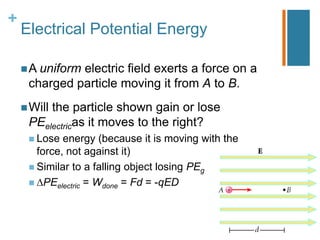
     A uniform
              electric field exerts a force on a
     charged particle moving it from A to B.
     Will
         the particle shown gain or lose
     PEelectricas it moves to the right?
      Lose  energy (because it is moving with the
       force, not against it)
      Similar to a falling object losing PEg
      PEelectric = Wdone = Fd = -qED
+
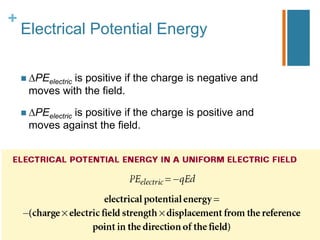
    Electrical Potential Energy

        PEelectric is positive if the charge is negative and
        moves with the field.

        PEelectric is positive if the charge is positive and
        moves against the field.
+
    Classroom Practice Problem


     A uniformelectric field strength of 1.0 x 10⁶
     N/C exists between a cloud at a height of 1.5
     km and the ground. A lightning bolt transfers
     25 C of charge to the ground. What is the
     change in PEelectric for this lightning bolt?
     d=   1,500m              q= 25C
     E=   1.0 X 10⁶ N/C       PEelectric= ??
+
    Classrom Practice Problem


     PEelectric   = -qEd
     PEe=   (-25)(1.0 X 10⁶)(1500)
     Answer:      -3.75 x 10¹⁰ J of energy
+
    Potential Difference

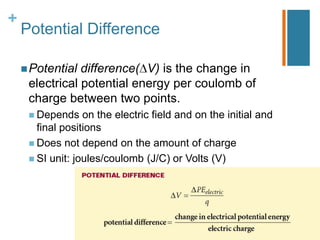
     Potential difference( V) is the change in
     electrical potential energy per coulomb of
     charge between two points.
      Depends    on the electric field and on the initial and
       final positions
      Does not depend on the amount of charge
      SI unit: joules/coulomb (J/C) or Volts (V)
+
    Potential Difference


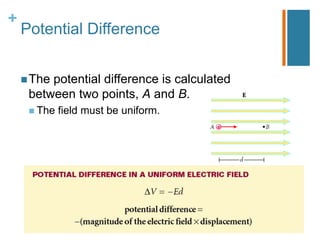
     Thepotential difference is calculated
     between two points, A and B.
      The   field must be uniform.
+
    Batteries

     A battery
              maintains a constant potential difference
     between the terminals.
      1.5   V (AAA, AA, C and D cell) or 9.0 V or 12 V (car)
     In1.5 V batteries, the electrons use chemical
     energy to move from the positive to the negative
     terminal.
      They    gain 1.5 joules of energy per coulomb of charge
     When connected to a flashlight, the electrons move
     through the bulb and lose 1.5 joules of energy per
     coulomb of charge.
     Sort   of like a concentration gradient.
+
            Now what do you think?
     You may have purchased batteries for
     radios, watches, CD players, and other electronic
     devices. Batteries come in a variety of different
     sizes and voltages. You probably have 1.5 volt, 3
     volt, and 12 volt batteries in your home.
      What   do volts measure?
      Is the number of volts related to the size of the
       battery?
      How is a 3 volt battery different from a 1.5 volt
       battery?
+


17.2 Capacitance
Pg 602- 607
+
                What do you think?
    •    If a light bulb replaced the two metal plates and the
         battery was connected, electrons would flow out of
         the negative and into the positive terminal. Will this
         also occur with the two metal plates?
         •   If not, why not?
         •   If so, is the flow similar or different from that with the light
             bulb? Explain.

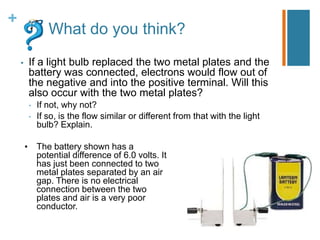
        • The battery shown has a
          potential difference of 6.0 volts. It
          has just been connected to two
          metal plates separated by an air
          gap. There is no electrical
          connection between the two
          plates and air is a very poor
          conductor.
+
    Capacitors
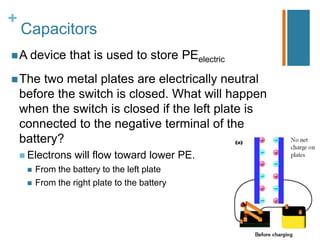
 A device        that is used to store PEelectric
 The    two metal plates are electrically neutral
    before the switch is closed. What will happen
    when the switch is closed if the left plate is
    connected to the negative terminal of the
    battery?
     Electrons    will flow toward lower PE.
        From the battery to the left plate
        From the right plate to the battery
+
    Parallel Plate Capacitors

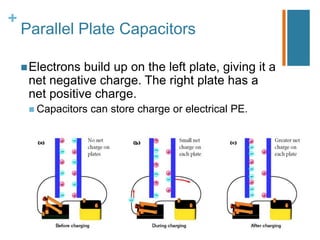
     Electrons build up on the left plate, giving it a
     net negative charge. The right plate has a
     net positive charge.
      Capacitors   can store charge or electrical PE.
+
    Capacitance

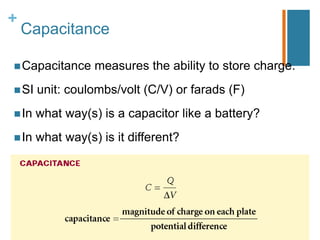
 Capacitance     measures the ability to store charge.
 SI   unit: coulombs/volt (C/V) or farads (F)
 In   what way(s) is a capacitor like a battery?
 In   what way(s) is it different?
+
    Capacitance


     How would capacitance change if the metal
     plates had more surface area?
      Capacitance   would increase.

     How would it change if they were closer
     together?
      Capacitance   would increase.
+
    Dielectrics
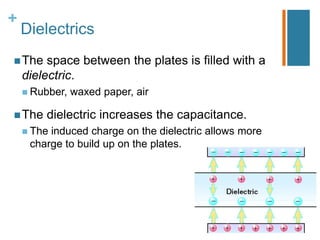
 The    space between the plates is filled with a
    dielectric.
     Rubber,   waxed paper, air

 The   dielectric increases the capacitance.
     Theinduced charge on the dielectric allows more
     charge to build up on the plates.
+ Capacitor Applications


  Connecting the two plates of a charged
  capacitor will discharge it.
   Flash
        attachments on cameras use a charged
   capacitor to produce a rapid flow of charge.
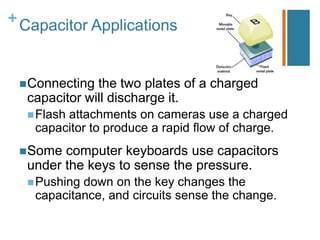
  Some computer keyboards use capacitors
  under the keys to sense the pressure.
   Pushingdown on the key changes the
   capacitance, and circuits sense the change.
+
    Energy and Capacitors
     Asthe charge builds, it requires more and more
     work to add electrons to the plate due to the
     electrical repulsion.
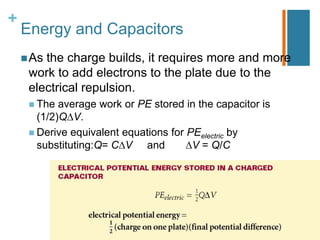
      The  average work or PE stored in the capacitor is
       (1/2)Q V.
      Derive equivalent equations for PEelectric by
       substituting:Q= C V and          V = Q/C
+
    ???? Classroom Practice Problem


     A 225  F is capacitor connected to a 6.00
     V battery and charged. How much charge
     is stored on the capacitor? How much
     electrical potential energy is stored on the
     capacitor?
      Answers:   1.35 x 10⁻³ C , 4.05 x 10⁻³ J
+
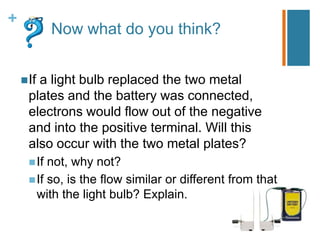
             Now what do you think?


     Ifa light bulb replaced the two metal
      plates and the battery was connected,
      electrons would flow out of the negative
      and into the positive terminal. Will this
      also occur with the two metal plates?
       If not, why not?
       If so, is the flow similar or different from that
        with the light bulb? Explain.
+


17.3 Current and Resistance
Pg 608-617
+
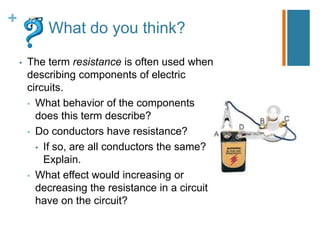
            What do you think?

    •   The term resistance is often used when
        describing components of electric
        circuits.
        • What behavior of the components
          does this term describe?
        • Do conductors have resistance?
          • If so, are all conductors the same?
            Explain.
        • What effect would increasing or
          decreasing the resistance in a circuit
          have on the circuit?
+
    Electric Current


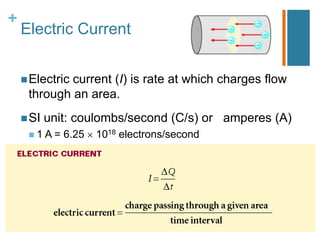
     Electric
             current (I) is rate at which charges flow
     through an area.
     SI   unit: coulombs/second (C/s) or amperes (A)
     1A=     6.25   1018 electrons/second
+
    Conventional Current

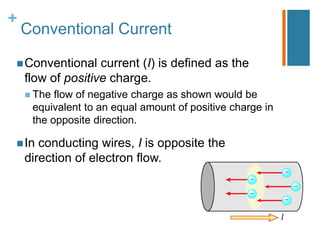
 Conventional     current (I) is defined as the
    flow of positive charge.
     The flow of negative charge as shown would be
     equivalent to an equal amount of positive charge in
     the opposite direction.

 In   conducting wires, I is opposite the
    direction of electron flow.
+
    Resistance to Current

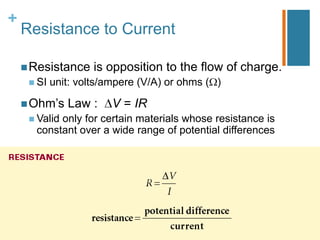
     Resistance     is opposition to the flow of charge.
      SI   unit: volts/ampere (V/A) or ohms ( )

     Ohm’s    Law :     V = IR
      Valid
           only for certain materials whose resistance is
      constant over a wide range of potential differences
+
    Classroom Practice Problems

     A typical100 W light bulb has a current of
     0.83 A. How much charge flows through the
     bulb filament in 1.0 h? How many electrons
     would flow through in the same time period?
     Given:

     I=   0.83A    t= 1 hour= 3600 seconds
     Q=   ?? C     electrons= ??
+
    Classroom Practice Problems


     I=   Q/t        or   Q= It
     Q=    (0.83)(3600)
      2988       C
     We    know that 1 A = 6.25      1018 electrons/second
     2988       C x (6.25 x 10¹⁸ electrons/C)
      1.87      x 1022electrons
+
    Classroom Practice Problems

     This same 100 watt bulb (from the previous
     question) is connected across a 120 V potential
     difference. Find the resistance of the bulb.
     Given:

     V=   120V           I= 0.83A    R= ?? Ω
    R   = V/I
     120    V / 0.83 A
      144.6
+
    Resistance of a Wire


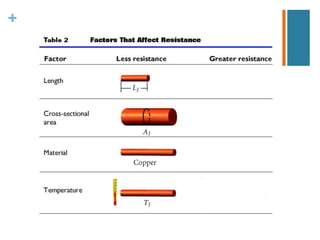
     On the next slide, predict the change
     necessary to increase the resistance of a
     piece of wire with respect to:
      Length of wire
      Cross sectional area or thickness of the
       wire
      Type of wire
      Temperature of the wire
+
+
    Applications

     Resistors   in a circuit can change the current.
      Variableresistors (potentiometers) are used in
       dimmer switches and volume controls.
      Resistors on circuit boards control the current
       to components.
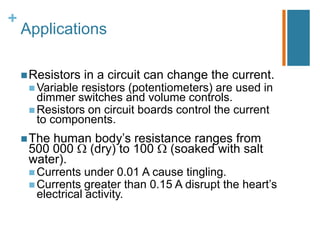
     Thehuman body’s resistance ranges from
     500 000 (dry) to 100 (soaked with salt
     water).
      Currents  under 0.01 A cause tingling.
      Currents  greater than 0.15 A disrupt the heart’s
      electrical activity.
+
               Now what do you think?
    •   The term resistance is often used when
        describing components of electric circuits.
        •   What behavior of the components
            does this term describe?
        •   Do conductors have resistance?
            • If so, are all conductors the
              same? Explain.
        •   What effect would increasing or
            decreasing the resistance in a
            circuit have on the circuit?
+


17.4 Electric Power
Pg. 618-623
+
                What do you think?
    •   Hair dryers, microwaves, stereos, and other
        appliances use electric power when plugged into
        your outlets.
        •   What is electric power?
            • Is electric power the same as the power discussed
              in the chapter “Work and Energy?”
        •   Do the utility companies bill your household for
            power, current, potential difference, energy, or
            something else?
        •   What do you think is meant by the terms alternating
            current (AC) and direct current (DC)?
            • Which do you have in your home?
+
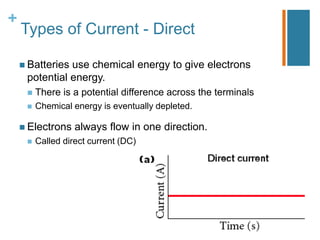
    Types of Current - Direct

     Batteriesuse chemical energy to give electrons
     potential energy.
        There is a potential difference across the terminals
        Chemical energy is eventually depleted.

     Electrons    always flow in one direction.
        Called direct current (DC)
+
    Types of Current - Alternating

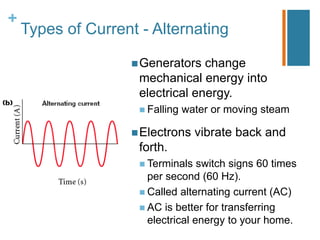
                    Generators   change
                     mechanical energy into
                     electrical energy.
                      Falling   water or moving steam

                    Electrons     vibrate back and
                     forth.
                      Terminals   switch signs 60 times
                       per second (60 Hz).
                      Called alternating current (AC)
                      AC is better for transferring
                       electrical energy to your home.
+
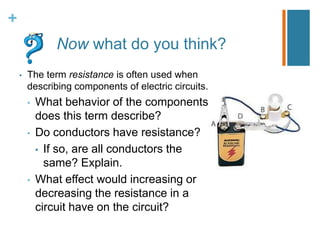
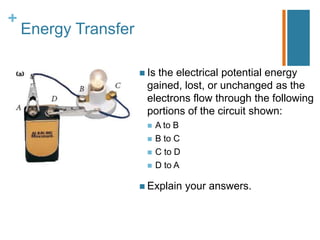
    Energy Transfer

                       Is
                         the electrical potential energy
                       gained, lost, or unchanged as the
                       electrons flow through the following
                       portions of the circuit shown:
                          A to B
                          B to C
                          C to D
                          D to A

                       Explain     your answers.
+
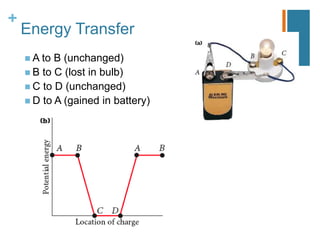
    Energy Transfer
     A to B (unchanged)
     B to C (lost in bulb)
     C to D (unchanged)
     D to A (gained in battery)
+
    Electric Power

      Click below to watch the Visual Concept.


                         Visual Concept
+
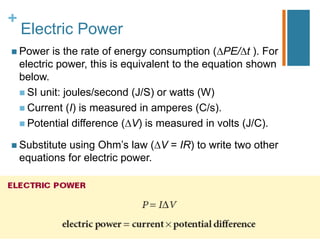
    Electric Power
 Power     is the rate of energy consumption ( PE/ t ). For
    electric power, this is equivalent to the equation shown
    below.
     SI unit: joules/second (J/S) or watts (W)
     Current (I) is measured in amperes (C/s).
     Potential difference ( V) is measured in volts (J/C).

 Substitute  using Ohm’s law ( V = IR) to write two other
    equations for electric power.
+
    Classroom Practice Problems

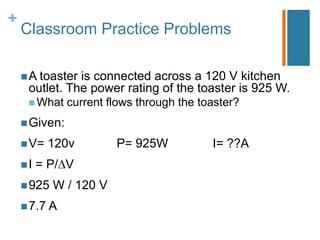
     A toasteris connected across a 120 V kitchen
     outlet. The power rating of the toaster is 925 W.
      What    current flows through the toaster?
     Given:

     V=   120v         P= 925W            I= ??A
    I   = P/ V
     925   W / 120 V
     7.7 A
+
    Classroom Practice Problems


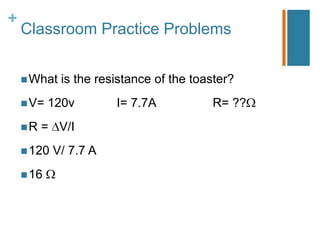
     What   is the resistance of the toaster?
     V=   120v        I= 7.7A           R= ??
    R   = V/I
     120   V/ 7.7 A
     16
+
    Classroom Practice Problems


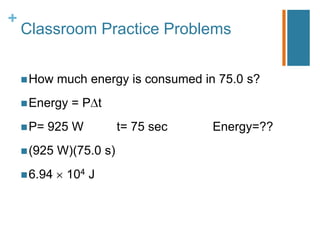
     How    much energy is consumed in 75.0 s?
     Energy   =P t
     P=   925 W          t= 75 sec    Energy=??
     (925   W)(75.0 s)
     6.94    104 J
+
    Household Energy Consumption

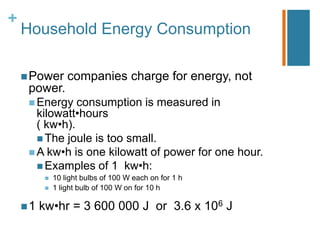
     Power      companies charge for energy, not
     power.
      Energy   consumption is measured in
       kilowatt•hours
       ( kw•h).
        The joule is too small.
      A kw•h is one kilowatt of power for one hour.
        Examples of 1 kw•h:
            10 light bulbs of 100 W each on for 1 h
            1 light bulb of 100 W on for 10 h

    1   kw•hr = 3 600 000 J or 3.6 x 10⁶ J
+
    Electrical Energy Transfer

     Transfer
             of energy from power plants to your
     neighborhood must be done at high voltage
     and low current.
      Power  lost in electrical lines is significant.
       P = I2R
       Power lines are good conductors but they are
        very long.
       Since power companies can’t control the
        resistance (R), they control the current (I) by
        transferring at high voltage.
+
          Now what do you think?
 Hair   dryers, microwaves, stereos, and other
    appliances use electric power when plugged
    into your outlets.
     What is electric power?
       Is electric power the same   as the power
        discussed in the chapter “Work and Energy?”
     Do the utility companies bill your household for
      power, current, potential difference, energy, or
      something else?
     What do you think is meant by the terms
      alternating current (AC) and direct current (DC)?
       Which do you have in your home?
+
    NOT NEEDED??? Gravitational
    Potential Difference
       Suppose a mass of 2.00 kg is moved from point A straight
        up to point B a distance of 3.00 m. Find the PEg for the
        mass if g = 9.81 m/s2. Repeat for a mass of 5.00 kg.
         Answer: 58.9 J and 147 J

       What is the PEg per kg for each?
         Answer: 29.4 J/kg for both

       The change per kg does not depend on the mass. It
        depends only on points A and B and the field strength.
       There is an analogous concept for electrical potential
        energy, as shown on the next slide.

Electrical Energy and Currents

  • 1.
    + Electrical Energy andCurrents Chapter 17 Pg. 592-625
  • 2.
  • 3.
    + What do you think? • You may have purchased batteries for radios, watches, CD players, and other electronic devices. Batteries come in a variety of different sizes and voltages. You probably have 1.5 volt, 3 volt, and 12 volt batteries in your home. • What do volts measure? • Is the number of volts related to the size of the battery? • How is a 3 volt battery different from a 1.5 volt battery?
  • 4.
    + Electric Potential Energy  Potentialenergy associated with a charge due to its position in an electric field  Electrical potential energy is a component of mechanical energy  M. E. is conserved so long as friction and radiation are not present  Electrical potential energy can be associated with a charge in a uniform field
  • 5.
    + Electrical Potential Energy  A uniform electric field exerts a force on a charged particle moving it from A to B.  Will the particle shown gain or lose PEelectricas it moves to the right?  Lose energy (because it is moving with the force, not against it)  Similar to a falling object losing PEg  PEelectric = Wdone = Fd = -qED
  • 6.
    + Electrical Potential Energy  PEelectric is positive if the charge is negative and moves with the field.  PEelectric is positive if the charge is positive and moves against the field.
  • 7.
    + Classroom Practice Problem  A uniformelectric field strength of 1.0 x 10⁶ N/C exists between a cloud at a height of 1.5 km and the ground. A lightning bolt transfers 25 C of charge to the ground. What is the change in PEelectric for this lightning bolt?  d= 1,500m q= 25C  E= 1.0 X 10⁶ N/C PEelectric= ??
  • 8.
    + Classrom Practice Problem  PEelectric = -qEd  PEe= (-25)(1.0 X 10⁶)(1500)  Answer: -3.75 x 10¹⁰ J of energy
  • 9.
    + Potential Difference  Potential difference( V) is the change in electrical potential energy per coulomb of charge between two points.  Depends on the electric field and on the initial and final positions  Does not depend on the amount of charge  SI unit: joules/coulomb (J/C) or Volts (V)
  • 10.
    + Potential Difference  Thepotential difference is calculated between two points, A and B.  The field must be uniform.
  • 11.
    + Batteries  A battery maintains a constant potential difference between the terminals.  1.5 V (AAA, AA, C and D cell) or 9.0 V or 12 V (car)  In1.5 V batteries, the electrons use chemical energy to move from the positive to the negative terminal.  They gain 1.5 joules of energy per coulomb of charge  When connected to a flashlight, the electrons move through the bulb and lose 1.5 joules of energy per coulomb of charge.  Sort of like a concentration gradient.
  • 12.
    + Now what do you think?  You may have purchased batteries for radios, watches, CD players, and other electronic devices. Batteries come in a variety of different sizes and voltages. You probably have 1.5 volt, 3 volt, and 12 volt batteries in your home.  What do volts measure?  Is the number of volts related to the size of the battery?  How is a 3 volt battery different from a 1.5 volt battery?
  • 13.
  • 14.
    + What do you think? • If a light bulb replaced the two metal plates and the battery was connected, electrons would flow out of the negative and into the positive terminal. Will this also occur with the two metal plates? • If not, why not? • If so, is the flow similar or different from that with the light bulb? Explain. • The battery shown has a potential difference of 6.0 volts. It has just been connected to two metal plates separated by an air gap. There is no electrical connection between the two plates and air is a very poor conductor.
  • 15.
    + Capacitors  A device that is used to store PEelectric  The two metal plates are electrically neutral before the switch is closed. What will happen when the switch is closed if the left plate is connected to the negative terminal of the battery?  Electrons will flow toward lower PE.  From the battery to the left plate  From the right plate to the battery
  • 16.
    + Parallel Plate Capacitors  Electrons build up on the left plate, giving it a net negative charge. The right plate has a net positive charge.  Capacitors can store charge or electrical PE.
  • 17.
    + Capacitance  Capacitance measures the ability to store charge.  SI unit: coulombs/volt (C/V) or farads (F)  In what way(s) is a capacitor like a battery?  In what way(s) is it different?
  • 18.
    + Capacitance  How would capacitance change if the metal plates had more surface area?  Capacitance would increase.  How would it change if they were closer together?  Capacitance would increase.
  • 19.
    + Dielectrics  The space between the plates is filled with a dielectric.  Rubber, waxed paper, air  The dielectric increases the capacitance.  Theinduced charge on the dielectric allows more charge to build up on the plates.
  • 20.
    + Capacitor Applications  Connecting the two plates of a charged capacitor will discharge it.  Flash attachments on cameras use a charged capacitor to produce a rapid flow of charge.  Some computer keyboards use capacitors under the keys to sense the pressure.  Pushingdown on the key changes the capacitance, and circuits sense the change.
  • 21.
    + Energy and Capacitors  Asthe charge builds, it requires more and more work to add electrons to the plate due to the electrical repulsion.  The average work or PE stored in the capacitor is (1/2)Q V.  Derive equivalent equations for PEelectric by substituting:Q= C V and V = Q/C
  • 22.
    + ???? Classroom Practice Problem  A 225 F is capacitor connected to a 6.00 V battery and charged. How much charge is stored on the capacitor? How much electrical potential energy is stored on the capacitor?  Answers: 1.35 x 10⁻³ C , 4.05 x 10⁻³ J
  • 23.
    + Now what do you think?  Ifa light bulb replaced the two metal plates and the battery was connected, electrons would flow out of the negative and into the positive terminal. Will this also occur with the two metal plates?  If not, why not?  If so, is the flow similar or different from that with the light bulb? Explain.
  • 24.
    + 17.3 Current andResistance Pg 608-617
  • 25.
    + What do you think? • The term resistance is often used when describing components of electric circuits. • What behavior of the components does this term describe? • Do conductors have resistance? • If so, are all conductors the same? Explain. • What effect would increasing or decreasing the resistance in a circuit have on the circuit?
  • 26.
    + Electric Current  Electric current (I) is rate at which charges flow through an area.  SI unit: coulombs/second (C/s) or amperes (A) 1A= 6.25 1018 electrons/second
  • 27.
    + Conventional Current  Conventional current (I) is defined as the flow of positive charge.  The flow of negative charge as shown would be equivalent to an equal amount of positive charge in the opposite direction.  In conducting wires, I is opposite the direction of electron flow.
  • 28.
    + Resistance to Current  Resistance is opposition to the flow of charge.  SI unit: volts/ampere (V/A) or ohms ( )  Ohm’s Law : V = IR  Valid only for certain materials whose resistance is constant over a wide range of potential differences
  • 29.
    + Classroom Practice Problems  A typical100 W light bulb has a current of 0.83 A. How much charge flows through the bulb filament in 1.0 h? How many electrons would flow through in the same time period?  Given:  I= 0.83A t= 1 hour= 3600 seconds  Q= ?? C electrons= ??
  • 30.
    + Classroom Practice Problems  I= Q/t or Q= It  Q= (0.83)(3600)  2988 C  We know that 1 A = 6.25 1018 electrons/second  2988 C x (6.25 x 1018 electrons/C)  1.87 x 10²²electrons
  • 31.
    + Classroom Practice Problems  This same 100 watt bulb (from the previous question) is connected across a 120 V potential difference. Find the resistance of the bulb.  Given:  V= 120V I= 0.83A R= ?? Ω R = V/I  120 V / 0.83 A  144.6
  • 32.
    + Resistance of a Wire  On the next slide, predict the change necessary to increase the resistance of a piece of wire with respect to:  Length of wire  Cross sectional area or thickness of the wire  Type of wire  Temperature of the wire
  • 33.
  • 34.
    + Applications  Resistors in a circuit can change the current.  Variableresistors (potentiometers) are used in dimmer switches and volume controls.  Resistors on circuit boards control the current to components.  Thehuman body’s resistance ranges from 500 000 (dry) to 100 (soaked with salt water).  Currents under 0.01 A cause tingling.  Currents greater than 0.15 A disrupt the heart’s electrical activity.
  • 35.
    + Now what do you think? • The term resistance is often used when describing components of electric circuits. • What behavior of the components does this term describe? • Do conductors have resistance? • If so, are all conductors the same? Explain. • What effect would increasing or decreasing the resistance in a circuit have on the circuit?
  • 36.
  • 37.
    + What do you think? • Hair dryers, microwaves, stereos, and other appliances use electric power when plugged into your outlets. • What is electric power? • Is electric power the same as the power discussed in the chapter “Work and Energy?” • Do the utility companies bill your household for power, current, potential difference, energy, or something else? • What do you think is meant by the terms alternating current (AC) and direct current (DC)? • Which do you have in your home?
  • 38.
    + Types of Current - Direct  Batteriesuse chemical energy to give electrons potential energy.  There is a potential difference across the terminals  Chemical energy is eventually depleted.  Electrons always flow in one direction.  Called direct current (DC)
  • 39.
    + Types of Current - Alternating  Generators change mechanical energy into electrical energy.  Falling water or moving steam  Electrons vibrate back and forth.  Terminals switch signs 60 times per second (60 Hz).  Called alternating current (AC)  AC is better for transferring electrical energy to your home.
  • 40.
    + Energy Transfer  Is the electrical potential energy gained, lost, or unchanged as the electrons flow through the following portions of the circuit shown:  A to B  B to C  C to D  D to A  Explain your answers.
  • 41.
    + Energy Transfer  A to B (unchanged)  B to C (lost in bulb)  C to D (unchanged)  D to A (gained in battery)
  • 42.
    + Electric Power Click below to watch the Visual Concept. Visual Concept
  • 43.
    + Electric Power  Power is the rate of energy consumption ( PE/ t ). For electric power, this is equivalent to the equation shown below.  SI unit: joules/second (J/S) or watts (W)  Current (I) is measured in amperes (C/s).  Potential difference ( V) is measured in volts (J/C).  Substitute using Ohm’s law ( V = IR) to write two other equations for electric power.
  • 44.
    + Classroom Practice Problems  A toasteris connected across a 120 V kitchen outlet. The power rating of the toaster is 925 W.  What current flows through the toaster?  Given:  V= 120v P= 925W I= ??A I = P/ V  925 W / 120 V  7.7 A
  • 45.
    + Classroom Practice Problems  What is the resistance of the toaster?  V= 120v I= 7.7A R= ?? R = V/I  120 V/ 7.7 A  16
  • 46.
    + Classroom Practice Problems  How much energy is consumed in 75.0 s?  Energy =P t  P= 925 W t= 75 sec Energy=??  (925 W)(75.0 s)  6.94 104 J
  • 47.
    + Household Energy Consumption  Power companies charge for energy, not power.  Energy consumption is measured in kilowatt•hours ( kw•h).  The joule is too small.  A kw•h is one kilowatt of power for one hour.  Examples of 1 kw•h:  10 light bulbs of 100 W each on for 1 h  1 light bulb of 100 W on for 10 h 1 kw•hr = 3 600 000 J or 3.6 x 10⁶ J
  • 48.
    + Electrical Energy Transfer  Transfer of energy from power plants to your neighborhood must be done at high voltage and low current.  Power lost in electrical lines is significant.  P = I2R  Power lines are good conductors but they are very long.  Since power companies can’t control the resistance (R), they control the current (I) by transferring at high voltage.
  • 49.
    + Now what do you think?  Hair dryers, microwaves, stereos, and other appliances use electric power when plugged into your outlets.  What is electric power?  Is electric power the same as the power discussed in the chapter “Work and Energy?”  Do the utility companies bill your household for power, current, potential difference, energy, or something else?  What do you think is meant by the terms alternating current (AC) and direct current (DC)?  Which do you have in your home?
  • 50.
    + NOT NEEDED??? Gravitational Potential Difference  Suppose a mass of 2.00 kg is moved from point A straight up to point B a distance of 3.00 m. Find the PEg for the mass if g = 9.81 m/s2. Repeat for a mass of 5.00 kg.  Answer: 58.9 J and 147 J  What is the PEg per kg for each?  Answer: 29.4 J/kg for both  The change per kg does not depend on the mass. It depends only on points A and B and the field strength.  There is an analogous concept for electrical potential energy, as shown on the next slide.